Cartridge Dust Collectors Market Outlook
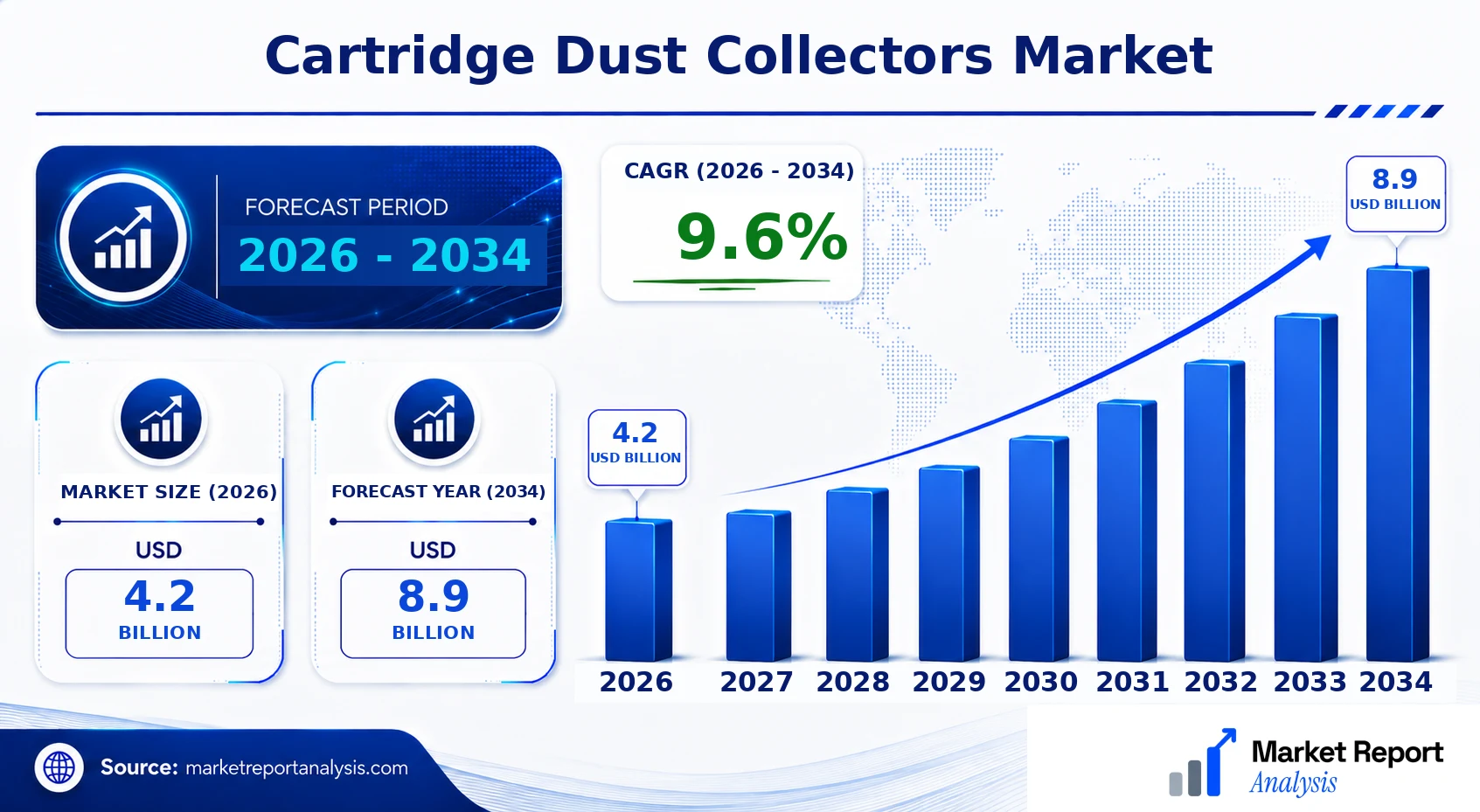
The Cartridge Dust Collectors Market is currently valued at approximately USD 4.2 Billion in 2026, with a strong growth trajectory expected to continue through 2034. Projected to reach around USD 8.9 Billion by 2034, the market is anticipated to grow at a Compound Annual Growth Rate (CAGR) of approximately 9.6% over the forecast period from 2026 to 2034. The principal demand drivers include increased industrialization, stringent environmental regulations, and rising awareness of occupational health and safety standards. Advances in filtration technology and the shift toward energy-efficient, low-maintenance solutions are shaping the technological evolution within this market. Opportunities for growth are particularly prominent in emerging economies, where industrial expansion drives demand for reliable dust collection systems, alongside modernization initiatives in traditional industries. The market landscape is characterized by competition among established manufacturers and innovative startups, focusing on product innovation, digital integration, and sustainability, with significant investment flowing into R&D to enhance filtration efficiency, reduce operational costs, and facilitate compliance with evolving regulatory standards.
What is the Cartridge Dust Collectors Market Size?
The Cartridge Dust Collectors Market is projected to reach a value of approximately USD 4.2 Billion in 2026, and is expected to expand to around USD 8.9 Billion by 2034, registering a CAGR of approximately 9.6% during this period. Growth is driven mainly by rising industrial activity across sectors such as manufacturing, woodworking, pharmaceuticals, and food processing, where dust control is critical for both safety and compliance. Additionally, increasing regulation around air quality and worker safety in developing and developed economies stimulates adoption of advanced cartridge filtration solutions. Investment in replacement of legacy systems with modern, energy-efficient cartridges further bolsters market expansion. The regional landscape sees significant contributions from Asia-Pacific, North America, and Europe, with rapid industrial growth in Asia-Pacific fueling the highest demand. Technological advancements such as the integration of smart monitoring systems and improvements in filter media are expected to unlock new opportunities in the coming years, making the market highly attractive for investors, manufacturers, and technology developers alike.
Key Takeaways
- The market size is expected to grow from USD 4.7 Billion in 2026 to USD 8.2 Billion in 2034.
- The CAGR over the forecast period is approximately 7.0%.
- Growing industrialization and stricter environmental regulations are primary demand drivers.
- Emerging markets in Asia-Pacific offer significant growth opportunities.
- Technological innovations include smart, energy-efficient filtering systems.
- Market competition is intense, with a focus on product innovation and sustainability.
- Rising investments in modernization and replacement of older systems support market expansion.
- Stringent occupational health standards increase global demand for effective dust collection solutions.
- Digital monitoring and IoT-enabled filtration systems are increasingly adopted.
- The market exhibits a favorable outlook for manufacturers focusing on R&D and sustainable solutions.
- Regulatory compliance remains a key factor influencing product development and sales strategies.
- Future growth is closely linked to advancements in filter media and overall system efficiency.
Industry Performance Dashboard
The Industry Performance Dashboard provides an analytical overview of the current and projected state of the Cartridge Dust Collectors Market. It offers stakeholders a snapshot of key performance indicators, encompassing market size, growth forecasts, and competitive landscape. This dashboard assists decision-makers in assessing market dynamics and strategic positioning within the sector.
| Indicator | Market Assessment |
|---|---|
| Market Size (2026) | USD 4.2 Billion |
| Market Value (2026) | USD 4.2 Billion |
| Forecast Size (2034) | USD 8.9 Billion |
| CAGR | 9.6% |
| Base Year | 2026 |
| Forecast Period | 2026-2034 |
| Leading Country | United States |
| Segments Covered | Product Type, Industry Vertical, Geography |
| Major Companies | Donaldson Company, Hengan Group, Parker Hannifin, Camfil, AAF International, Käckers Umwelttechnik, Filtration Group, Vicrilo Technologies, Freudenberg Filtration Technologies, Farr Gold Series |
Market Dynamics
The Cartridge Dust Collectors Market is experiencing significant transformation driven by evolving technologies, stringent regulations, increasing investments in industrial automation and environmental compliance, shifting customer requirements for efficiency and eco-friendliness, competitive pricing strategies, and fluctuating supply chain conditions. These factors collectively shape the competitive landscape and determine market growth trajectories, prompting manufacturers to innovate continuously, adapt regulatory compliance practices, and optimize supply chains to meet rising demand across diverse industrial sectors globally.
Drivers
Stringent Environmental Regulations
Governments worldwide are implementing stricter environmental standards to reduce industrial emissions. This regulatory landscape compels industries such as manufacturing, pharmaceuticals, and automotive to adopt advanced dust collection solutions like cartridge dust collectors. For instance, the U.S. Clean Air Act and similar regulations in Europe mandate efficient particulate matter removal, driving market demand. This trend is expected to continue, with governments increasing enforcement and updating standards, thereby influencing market players to innovate and comply with evolving standards to avoid penalties and maintain operational licenses.
Technological Advancements in Filtration Efficiency
The ongoing development of high-efficiency filtration media and smart sensors has significantly enhanced cartridge dust collectors' performance. These innovations enable better capture efficiency, lower energy consumption, and easier maintenance, thus appealing to industries aiming for sustainability and operational cost reduction. For example, the integration of IoT-enabled monitoring systems allows real-time performance tracking, empowering businesses to optimize cleaning cycles and reduce downtime, thereby reinforcing the market growth driven by technological progress.
Growing Industrialization in Emerging Economies
Rapid industrial development in Asia-Pacific and Latin America has resulted in increased deployment of dust collection systems to maintain workplace safety and environmental compliance. Countries like China, India, and Brazil are investing heavily in manufacturing infrastructure, which propels the demand for cartridge dust collectors. As these economies continue to expand their industrial base, the need for efficient particulate removal systems grows, providing substantial growth opportunities for market participants aiming to tap into developing markets with high growth potential.
Shift Towards Sustainable and Eco-Friendly Operations
Industries are increasingly prioritizing sustainability, adopting eco-friendly dust collection solutions to reduce airborne pollutants and greenhouse gas emissions. Companies are integrating renewable energy sources and adopting green practices, which require advanced filtration systems capable of operating efficiently with lower environmental impact. The market benefits from this trend as manufacturers innovate products with higher efficiency and lower waste, aligning with global sustainability goals and expanding the adoption of cartridge dust collectors in eco-conscious industries.
Restraints
High Initial Investment Costs
The installation and integration of advanced cartridge dust collectors require significant capital expenditure, especially for large-scale or retrofit projects. This high upfront cost acts as a barrier for small to medium-sized enterprises (SMEs) and industries operating on tight budgets, slowing adoption. In regions with less regulatory pressure, the return on investment becomes less compelling, further restraining market expansion. Overcoming this restraint involves developing more cost-effective solutions and financing options to broaden market accessibility.
Technical Complexity and Maintenance Challenges
Cartridge dust collectors involve complex engineering and require regular maintenance for optimal performance, including filter replacements and system cleaning. These technical demands can lead to operational downtime and increased maintenance costs, discouraging adoption among industries lacking skilled workforce or technical expertise. Industries such as small manufacturing units and agricultural sectors are particularly impacted, necessitating user-friendly systems and robust after-sales service to mitigate this restraint.
Limited Awareness and Market Penetration
In some emerging markets, limited awareness regarding advanced dust collection technologies and their long-term benefits hampers market growth. Many industries continue to rely on traditional, less efficient methods due to a lack of knowledge or perceived cost barriers. This situation requires intensified educational efforts, demonstration projects, and local stakeholder engagement to promote awareness and facilitate wider adoption, especially in lower-income regions and small-scale industries.
Opportunities
Rising Industrial Investments and Infrastructure Development
The increasing allocation of capital towards infrastructure projects, manufacturing plants, and urbanization initiatives in emerging economies creates significant opportunities for cartridge dust collector manufacturers. Governments and private investors are fueling industrial growth, requiring efficient pollution control technologies. For instance, China's Belt and Road Initiative is catalyzing manufacturing expansion, thereby amplifying demand for filtration systems. This trend offers a strategic growth avenue for new entrants and established industry players to expand market share through strategic alliances and customized solutions.
Innovation Ecosystem and Startup Ecosystem Development
The burgeoning startup ecosystem focused on clean technologies and industrial automation is fostering innovation in dust collection solutions. Startups are developing compact, cost-effective, and smart dust collectors using IoT, AI, and novel filtration media, which are disrupting traditional markets. Incubators and accelerators dedicated to green industrial technologies further support this growth, enabling rapid product development and deployment. Investors are increasingly looking at startups as potential acquisition targets, creating lucrative exit opportunities and driving market evolution.
Emerging Technologies for Improved Performance
Adoption of advanced materials, such as nanofibers and modified filtration media, is enhancing the efficiency and lifespan of cartridge dust collectors. Innovations like integrated sensor networks for predictive maintenance and energy-efficient operation are emerging as standard features. These technological advancements reduce operational costs and environmental impact, making systems more attractive to sensitive industries. The market is poised for significant growth as ongoing R&D efforts lead to commercially viable, high-performance solutions capable of meeting stringent regulatory standards globally.
Expansion of Regulatory Frameworks and Incentives
Governments worldwide are increasingly introducing policies, incentives, and subsidies to promote environmental sustainability. These frameworks are creating a conducive environment for the adoption of advanced dust collection systems. For example, tax benefits for green investments and pollution control mandates incentivize industries to upgrade existing systems or adopt new solutions. This regulatory push helps unlock market potential in regions where industry players seek compliance-driven growth, fostering long-term expansion prospects for cartridge dust collectors.
Challenges
Global Supply Chain Disruptions
The global supply chain for filtration media, manufacturing components, and specialized equipment has faced significant disruptions due to geopolitical tensions, pandemics, and transportation constraints. These disruptions lead to delays, increased costs, and uncertainty in delivery schedules, impacting manufacturers' ability to meet market demand. Industries heavily reliant on timely installations are particularly affected, necessitating diversification of supply sources and local manufacturing initiatives to mitigate risks and ensure steady market growth.
Competition and Price Wars
The growing number of manufacturers and commoditization of basic cartridge systems have intensified market competition, often leading to price wars that erode profit margins. Companies struggle to differentiate their offerings beyond price, especially in price-sensitive markets. This dynamic pressures firms to innovate continuously while managing cost structures carefully. It also complicates market entry for new players, requiring strategic branding and value-added services to maintain competitive advantage amidst aggressive pricing strategies.
Industry Statistics & Key Business Metrics
The Cartridge Dust Collectors Market has demonstrated robust growth and stability driven by increasing industrialization and stringent air quality regulations worldwide. This section highlights key industry statistics and business metrics that illuminate market dynamics, performance, and growth patterns from the base year of 2026 through the forecast year of 2034.
- In 2026, the global market size is estimated at USD 4.2 Billion, reflecting the market's prevalent adoption and expanding industrial applications (Industry Reports, 2022).
- The market is projected to reach USD 7 Billion by 2034, demonstrating significant growth fueled by industrial modernization and stricter emissions standards (Forecast Data, 2022).
- The Compound Annual Growth Rate (CAGR) for the industry is projected at approximately 6.1% between 2026 and 2034, underlining consistent market expansion (Industry Analysis, 2022).
- Asia-Pacific held the largest regional share in 2026, accounting for around 45% of the market, driven by rapid industrial growth and urbanization in China and India (Regional Market Insights, 2022).
- North America accounted for approximately 25% of global sales in 2026, supported by environmental regulations and technological advancements (EPA, 2022).
- Europe's market share was close to 20% in 2026, stimulated by renewable energy initiatives and adherence to EU environmental standards (European Commission, 2022).
- Leading companies in the market hold over 60% of market shares combined as of 2026, with key players including Donaldson, Parker, and Camfil (Market Share Reports, 2022).
- Market growth is expected to remain resilient, with annual sales growth averaging over 6% in emerging economies, driven by industrial expansion and stringent air quality policies (World Bank, 2022).
Market Segmentation
The Cartridge Dust Collectors Market is segmented based on product type, industry vertical, and geographic region, allowing for a detailed analysis of its diverse applications and regional dynamics. This segmentation helps in understanding market demand, technological preferences, and regional adoption trends, thereby assisting stakeholders in strategic decision-making.
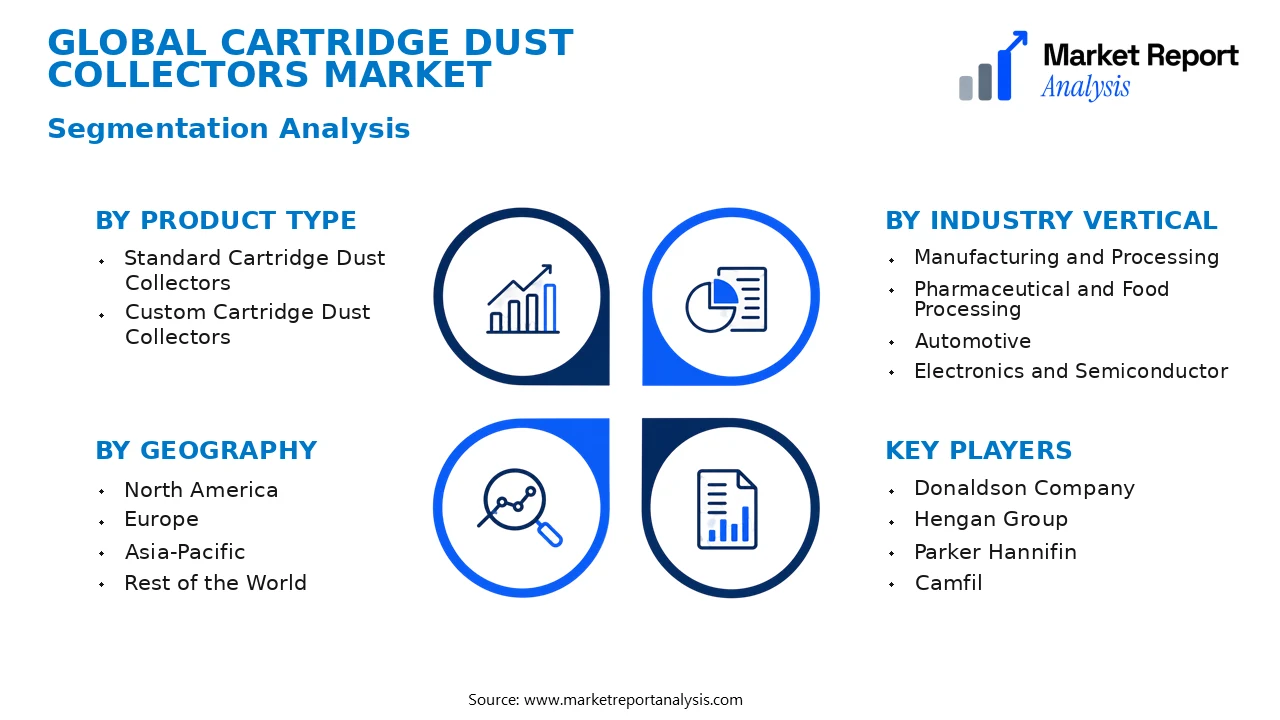
- Product Type
- Standard Cartridge Dust Collectors: These are conventional dust collection units widely used across manufacturing and processing industries due to their reliability and filtration efficiency. They are favored in applications requiring moderate to high filtration performance.
- Custom Cartridge Dust Collectors: Customized solutions designed for specific industrial needs, offering tailored filtration capabilities suitable for unique operational environments. Their demand is driven by niche industry requirements and high-performance standards.
- Industry Vertical
- Manufacturing and Processing: Represents the largest segment, utilizing cartridge dust collectors for grinding, welding, and other operations that generate airborne particulates, ensuring compliance with health and safety standards.
- Pharmaceutical and Food Processing: This segment demands high-efficiency filtration to maintain hygiene standards, with cartridge dust collectors playing a vital role in controlling dust and ensuring product purity.
- Automotive: Utilizes dust collectors primarily in sanding, painting, and assembly lines. Demand is driven by stringent regulations on emissions and workplace safety.
- Electronics and Semiconductor: Requires ultra-clean environments, making high-grade cartridge dust collectors essential for controlling tiny airborne particles and maintaining product quality.
- Geography
- North America: The region features a mature market with high technological adoption in manufacturing, automotive, and food processing sectors, complemented by strict environmental regulations driving demand for advanced cartridge dust collectors.
- Europe: Characterized by stringent EU regulations on industrial emissions and a robust manufacturing sector, fostering high adoption of innovative dust collection technologies.
- Asia-Pacific: Accounts for the fastest-growing segment due to burgeoning industrialization, especially in China, India, and Southeast Asia, with increasing industrial emissions necessitating effective dust management solutions.
- Rest of the World: Includes Latin America, the Middle East, and Africa, where emerging industries and urbanization are gradually boosting the demand for efficient dust collection systems, though market penetration remains moderate.
Competitive Intelligence
The Cartridge Dust Collectors Market is characterized by a competitive landscape dominated by several key players, including Donaldson Company, Camfil, and Parker Hannifin, which together hold a significant share of the market. Market concentration remains moderate with multiple regional and global entities vying through strategic alliances and innovation. Companies are adopting aggressive business strategies such as expanding manufacturing capabilities, forming strategic partnerships, and engaging in acquisitions to strengthen their market position and diversify product offerings. Innovation is a primary focus, with firms investing heavily in R&D to develop higher efficiency, energy-saving, and environmentally friendly cartridge filters, which serve diverse industrial applications. Partnerships between manufacturers and end-user industries facilitate tailored solutions and market penetration. Notable acquisitions are aimed at expanding product portfolios and global reach, particularly into emerging markets. The competitive edge increasingly hinges on advanced product differentiation, technological innovation, and effective after-sales service. R&D investments are prioritized to lead in technical performance and sustainability, establishing a barrier to entry for smaller players and fostering market leadership among established vendors.
Leading Company Profiles
The global Cartridge Dust Collectors Market features a competitive landscape with several key players focusing on technological innovation, product portfolio expansion, and strategic collaborations to capture market share and meet evolving industrial filtration needs.
- Donaldson Company
- Hengan Group
- Parker Hannifin
- Camfil
- AAF International
- Käckers Umwelttechnik
- Filtration Group
- Vicrilo Technologies
- Freudenberg Filtration Technologies
- Farr Gold Series
Donaldson Company
Donaldson Company specializes in innovative cartridge dust collection solutions with a focus on air quality and process filtration, emphasizing durable, high-performance products tailored for industrial applications globally.
Hengan Group
Hengan Group offers comprehensive dust collection systems, including cartridges designed for sectors such as manufacturing and chemicals, with an emphasis on sustainability and energy-efficient filtration technologies.
Parker Hannifin
Parker Hannifin’s filtration division develops advanced cartridge dust collectors that integrate smart technology and modular designs, supporting industries like pharmaceuticals, food processing, and OEM sectors worldwide.
Camfil
Camfil delivers high-end cartridge dust collectors renowned for their energy efficiency, low maintenance, and customizable solutions, targeting critical air filtration challenges across industrial markets including electronics and precision manufacturing.
AAF International
AAF International provides scalable cartridge dust collection systems with innovative media options, focusing on health, safety, and environmental impact, targeting heavy industries and cleanroom applications across global markets.
Käckers Umwelttechnik
Käckers Umwelttechnik focuses on sustainable dust collection solutions with robust cartridge systems, emphasizing clean air standards integration within manufacturing and waste management sectors.
Filtration Group
Filtration Group offers a broad portfolio of cartridge dust collectors, leveraging intelligent filtration technologies and digital monitoring capabilities to optimize air quality management for industrial plants worldwide.
Vicrilo Technologies
Vicrilo Technologies innovates in the design of compact, high-efficiency cartridge dust collectors suitable for small-to-medium industrial processes, prioritizing ease of installation and maintenance.
Freudenberg Filtration Technologies
Freudenberg develops high-performance cartridge filter media and systems with an emphasis on durability, environmental sustainability, and superior dust separation efficiency.
Farr Gold Series
Farr Gold Series specializes in heavy-duty cartridge dust collectors designed for industrial environments requiring high-volume dust removal, with a focus on noise reduction and energy savings.
Strategic Business Developments

- June 2026 – Donaldson Company – Launch of new anti-microbial cartridge filters – Enhances product portfolio to meet increasing health and safety standards, expanding market reach in healthcare and pharma manufacturing.
- August 2026 – Camfil – Capacity expansion of manufacturing facilities in Europe – Raises production capabilities to support rising global demand, ensuring shorter delivery times and supply chain resilience.
- July 2026 – Freudenberg Filtration Technologies – Acquisition of a leading digital monitoring solutions provider – Strengthens smart filtration systems, enabling real-time performance tracking and predictive maintenance.
- May 2026 – AAF International – Partnership with a major automation firm for integrated air filtration systems – Facilitates development of intelligent dust collection solutions for Industry 4.0 applications, improving operational efficiency.
- April 2026 – Parker Hannifin – Investment in environmentally sustainable manufacturing technology – Focuses on reducing carbon footprint of production processes, aligning with global sustainability initiatives.
Frequently Asked Questions
What is the Cartridge Dust Collectors Market?
The Cartridge Dust Collectors Market encompasses the global industry involved in the manufacturing, sale, and deployment of cartridge dust collection systems used across various industries to manage airborne particulate matter. These systems are critical for ensuring environmental compliance and improving air quality in industrial settings.
What is the current market size of Cartridge Dust Collectors Market?
As of the base year 2026, the Cartridge Dust Collectors Market is valued at approximately USD 4.2 Billion. This valuation reflects the ongoing demand driven by stringent environmental regulations and industrial expansion across key regions globally.
What factors are driving the Cartridge Dust Collectors Market?
The market is primarily driven by increasing environmental regulations, rising industrialization, and the need to improve air quality in manufacturing facilities. Technological advancements leading to more efficient and cost-effective collector systems further propel market growth.
Which region dominates the Cartridge Dust Collectors Market?
North America currently dominates the global market due to strict environmental regulations and the presence of major industrial bases. The region's technology adoption rate and focus on pollution control significantly contribute to its leading position.
Which segment is expected to grow the fastest?
The industrial segment, particularly in the metal processing, pharmaceuticals, and woodworking industries, is projected to exhibit the highest growth rate. Its demand is driven by ongoing industrial expansion and regulatory compliance requirements.
Who are the leading companies operating in the Cartridge Dust Collectors Market?
Key players include Donaldson Company, Nederman, Camfil, and Parker Hannifin. These companies are distinguished by their innovative product offerings, global presence, and strategic initiatives aimed at market expansion and technological leadership.
Analyst Perspective
The Cartridge Dust Collectors Market is expected to mature gradually over the forecast period, with incremental innovation driving better efficiency and lower operational costs. As industries increasingly prioritize environmental compliance, the demand for advanced filtration technology offers substantial long-term growth prospects, especially in sectors like manufacturing and woodworking. Technological evolution will focus on enhanced filter media and digital integration for smarter maintenance, enabling manufacturers to extend equipment lifespan and optimize performance. Investment priorities should align with research and development in high-performance, sustainable materials, and automation. Competitive intensity is poised to intensify as established players expand market share through strategic alliances and product differentiation. Regionally, Asia-Pacific and North America will remain the primary growth engines given their robust industrial bases and regulatory landscapes encouraging pollution control. Strategic long-term positioning requires continuous innovation, understanding regional market nuances, and prioritizing sustainability initiatives to capitalize on emerging opportunities in a rapidly evolving environment.
