Brazil Working Capital Management Market Outlook
The Brazil Working Capital Management Market is currently valued at approximately USD 5.2 Billion in 2026, with projections indicating a significant growth trajectory reaching USD 9.1 Billion by 2034. This growth is driven by the increasing need for efficient liquidity management, technological advancements in financial software, and evolving regulatory frameworks favoring digital solutions. Over the forecast period of 2026-2034, the market is expected to grow at a CAGR of around 7.5%. Key demand drivers include expanding businesses across sectors such as manufacturing, retail, and services, all seeking optimized cash flow management. The adoption of automation and AI-based solutions is set to revolutionize traditional practices, fostering higher efficiency and reduced operational risks. Investment opportunities are abundant, particularly in cloud-based working capital solutions and integrated financial platforms aimed at mid-sized enterprises, which constitute a large segment of the market. The market presents a promising landscape for financial technology firms, enterprise software providers, and traditional banking institutions looking to innovate and expand their digital offerings in Brazil.
What is the Brazil Working Capital Management Market Size?
Projected to reach USD 9.1 Billion by 2034 from an estimated USD 5.2 Billion in 2026, the Brazil Working Capital Management Market exhibits a CAGR of approximately 7.5% during 2026-2034. This growth is fueled by the rising complexity of financial environments, increasing automation in cash flow and accounts receivable/payable management, and a surge in SMBs adopting digital solutions. Sector-wise, manufacturing, retail, and services are the primary end-users, with the retail sector experiencing rapid digital transformation. Advances in technology, especially in cloud computing, AI, and big data analytics, are enabling real-time insights and streamlined working capital operations. The government’s push for financial digitalization and regulatory reforms further facilitate market expansion. Future investments are likely to focus on integrated working capital platforms, Artificial Intelligence (AI)-driven cash management tools, and mobile-enabled financial services, paving the way for innovative service offerings and competitive edge in the market.
Key Takeaways
- Market size is projected to grow from USD 5.2 Billion in 2026 to USD 9.1 Billion in 2034.
- The CAGR for 2026-2034 is approximately 7.5%.
- Brazil’s expanding manufacturing, retail, and service sectors are primary market drivers.
- Growing adoption of automation, AI, and cloud-based systems enhances market growth.
- Regulatory support and government digital initiatives boost market penetration.
- Mid-sized enterprises form the largest segment, providing lucrative investment opportunities.
- Increasing demand for integrated and real-time working capital solutions.
- Technology innovation and fintech collaborations are central to market evolution.
- Regional variations impact market dynamics, with Southeast Brazil leading growth.
- Strategic partnerships between traditional banks and tech firms are on the rise.
- Future growth will benefit from continued digital transformation and innovative financial products.
- Market competition is intensifying, fostering product innovation and improved customer experience.
Industry Performance Dashboard
The Industry Performance Dashboard offers a quantitative overview of the Brazil working capital management market, emphasizing key metrics that define its current status and projected growth trajectory. This snapshot encompasses vital indicators including historical market size, forecast values, growth rate, and segment specifics, providing stakeholders with a comprehensive understanding of market dynamics. The dashboard starts with the Market Size in 2025 and 2026, along with the Forecast Size for 2034, to illustrate the market’s growth trajectory over the period from 2026 to 2034. The CAGR (Compound Annual Growth Rate) further quantifies this expansion, reflecting a steady increase driven by evolving financial management practices and technological adoption within Brazil’s corporate sector. The Base Year is 2026, aligning with the initial data point, while the Forecast Period spans from 2026 to 2034, establishing a clear timeline for growth estimates. The leading geographical market is identified as Brazil, with a focus on the national landscape. Segment coverage includes key areas such as cash flow optimization, inventory and receivables management, and liquidity forecasting, which are critical for effective working capital management. Major companies in the market include Banco do Brasil, Itaú Unibanco, Bradesco, and Santander Brasil, recognized for their significant roles in providing working capital solutions and digital banking services in Brazil. These entities underpin the market’s maturity and competitive landscape, indicating a robust base for future innovation and expansion.
Market Dynamics
The Brazil Working Capital Management Market is experiencing a transformative phase driven by technological innovations, an evolving regulatory landscape, increased investment activities, shifting customer demands, competitive pricing strategies, and fluctuating supply conditions. As businesses seek more efficient liquidity solutions amidst economic fluctuations, market participants are adopting advanced technologies such as AI-driven analytics and real-time cash management tools. Regulatory reforms aimed at financial compliance and transparency are also shaping operational frameworks. Furthermore, heightened investor interest and competitive dynamics among financial institutions are contributing to a highly dynamic environment. Customer requirements for flexible, scalable solutions are pushing providers to innovate continuously, while supply chain conditions and pricing pressures influence overall market strategies.
Drivers
Digital Transformation in Financial Services
The acceleration of digital transformation within Brazil’s financial sector significantly impacts the working capital management market. The adoption of cloud computing, AI, and machine learning enables companies to optimize cash flow, forecast accurately, and automate accounts payable and receivable processes. For instance, fintech innovation hubs in Sao Paulo are deploying AI-driven algorithms to enhance liquidity management for SMEs, which constitute a large segment of the market. This digital shift improves operational efficiency and customer satisfaction, fostering greater market penetration and expanding the range of services offered by financial institutions and fintech startups. The trend shows a consistent increase in digital adoption, with over 70% of banking transactions now processed electronically, highlighting a robust growth trajectory.
Regulatory Reforms and Compliance Demands
Recent regulatory reforms by the Central Bank of Brazil have aimed to enhance financial system stability, transparency, and consumer protection. New regulations require real-time reporting, antifraud measures, and improved risk management practices, compelling market participants to upgrade their working capital solutions. Financial institutions are investing heavily in compliant infrastructure, which elevates the overall market quality. For example, the introduction of PIX instant payment system has necessitated real-time liquidity management capabilities, further boosting demand. These regulatory changes, coupled with increased enforcement, foster a more secure and trustworthy environment, encouraging enterprises to optimize working capital with confidence.
Growing Investment in Financial Technology
Brazil’s fintech ecosystem has seen exponential growth, with investment flows reaching record levels. Venture capital, private equity, and corporate investments in fintech and banking tech companies have created an innovation hub for working capital management solutions. As of 2022, investments in Brazil’s fintech sector surpassed USD 1.2 Billion, fueling product development and market expansion. This influx of capital supports the deployment of sophisticated software solutions that facilitate real-time cash visibility, automated collections, and dynamic discounting, addressing the needs of diverse industries such as manufacturing, retail, and services. The expanding startup ecosystem is further accelerating technological advancements, unlocking new opportunities for comprehensive cash management solutions.
Customer Demand for Flexibility and Real-Time Visibility
In an increasingly competitive environment, businesses demand more adaptable and transparent working capital options. Large corporates and SMEs alike seek solutions that provide instant access to cash flow analytics, dynamic invoicing, and liquidity forecasting. The rise of digital-native companies and agile startups has set new benchmarks for service expectations. For example, logistics and e-commerce firms leverage real-time dashboards to make prompt working capital adjustments, reducing liquidity gaps. This customer-driven shift toward flexible, data-driven solutions compels providers to innovate rapidly, with a focus on integrated and user-friendly platforms offering seamless access across devices, thereby broadening market engagement.
Restraints
Economic Volatility and Currency Fluctuations
Brazil’s economic landscape has been characterized by periods of volatility, inflation, and currency fluctuations, which create uncertainty for working capital management strategies. These macroeconomic factors can lead to unpredictable cash flows and higher borrowing costs, impacting corporate liquidity planning. Industries such as manufacturing and export-oriented sectors are most affected, as currency depreciation increases import costs and reduces purchasing power. Companies often adopt conservative cash management approaches during economic downturns, restricting market expansion and innovation. This environment necessitates greater risk management and contingency planning, which can constrain the adoption of new working capital solutions.
Limited Adoption of Advanced Technologies in Small Enterprises
While large corporations and fintech firms rapidly adopt advanced working capital management tools, smaller enterprises face challenges in technology adoption due to limited financial resources, knowledge gaps, and infrastructural constraints. These barriers impede the widespread deployment of AI-driven and real-time cash management systems among SMEs, which constitute over 50% of Brazil’s business landscape. The lack of scalable, affordable solutions tailored for small firms restricts market growth, especially in rural and less developed regions. This slow adoption hampers the overall market reach and delays the realization of efficiency gains across the broader economy.
Opportunities
Expansion of Digital Payment Ecosystems and Integration
The burgeoning digital payment ecosystem in Brazil presents significant opportunities for working capital management providers. The widespread adoption of instant payment systems like PIX facilitates seamless cash transfers, enabling real-time liquidity management. Integrating working capital tools with electronic payment platforms can streamline cash flow processes, reduce transaction costs, and offer end-to-end cash visibility. As businesses increasingly migrate to integrated digital payment and cash management solutions, providers can develop comprehensive platforms tailored for diverse industry needs, fostering higher customer retention and new market entries. The ongoing expansion of digital payment infrastructure supports these strategic developments, creating fertile grounds for innovation.
Enhancement of Data Analytics and Forecasting Capabilities
Emerging technologies in data analytics and machine learning offer tremendous potential to reshape working capital strategies. Advanced predictive analytics can help companies anticipate cash flow shortages, optimize inventory levels, and schedule payments with higher precision. As companies generate vast amounts of financial and operational data, leveraging this information through AI can uncover actionable insights, leading to smarter management decisions. This technological evolution enables more sophisticated and dynamic liquidity solutions, attracting enterprises seeking to maximize efficiency. Investment in analytics startups and collaborative platforms fosters innovation, paving the way for the development of future-ready, highly adaptive working capital management tools.
Growing Role of Startups and Innovative Fintech Solutions
The vibrant startup ecosystem in Brazil is a key player in advancing working capital management solutions with innovative approaches. Fintech startups focus on niche functionalities like automated invoice factoring, supply chain finance, and blockchain-based transparent payments. These emerging companies often operate with agility, offering customized, scalable solutions that meet the unique demands of Brazilian businesses. Increased startup activity, supported by government initiatives and venture capital investments, accelerates the testing and deployment of novel financial instruments. As awareness and acceptance grow, large financial institutions are also partnering with these startups to expand their service portfolios, further integrating innovation into the mainstream market.
Investment in Infrastructure and Smart Technologies
Investments directed toward upgrading financial and technological infrastructure serve as a foundation for future market expansion. Strategic investments in cloud computing, cybersecurity, and IoT-enabled devices facilitate the development of smarter, more connected working capital management platforms. These upgrades improve data security, real-time processing, and system interoperability, enabling businesses to adopt comprehensive cash management solutions confidently. Public and private sector collaborations targeting infrastructure improvements bolster market resilience and scalability. This ecosystem enhancement is poised to support a wide rollout of advanced tools, fostering broader adoption, and generating sustained market growth.
Challenges
High Implementation Costs and Technology Integration Barriers
Implementing advanced working capital management systems often requires substantial upfront investment, specialized expertise, and organizational change management. Many enterprises, especially SMEs, face financial constraints that hinder adoption of sophisticated digital platforms. Additionally, integrating new solutions with existing legacy systems can be complex and costly, delaying deployment and operational benefits. Resistance to change within organizations and the need for ongoing training further complicate the transition. These barriers slow the overall market growth and limit the scalability of innovative solutions, emphasizing the need for affordable, plug-and-play technology options tailored for diverse business sizes.
Data Security and Privacy Concerns
As working capital management increasingly relies on digital platforms and cloud-based solutions, concerns over cybersecurity and data privacy intensify. Financial data is highly sensitive, and breaches can lead to severe legal and reputational damage. Brazil’s evolving regulatory framework around data protection, such as the LGPD, imposes strict compliance requirements but also presents challenges for enterprises in managing vast quantities of sensitive information. Ensuring robust cybersecurity defenses and maintaining customer trust are ongoing challenges. Market players must invest heavily in security measures and compliance protocols to mitigate risks, which can increase operational costs and impact overall market development.
Industry Statistics & Key Business Metrics
The Brazil Working Capital Management Market is a vital sector influencing the overall financial stability and operational efficiency of businesses across Brazil. As companies grapple with economic fluctuations and evolving market demands, effective working capital strategies become essential. This section highlights key industry statistics and business metrics that underpin market dynamics, providing a foundation for strategic decision-making.
- In 2022, Brazil's corporate credit market reached a total of USD 1.2 Trillion, reflecting a 5.5% increase from the previous year, according to the Central Bank of Brazil.
- As of 2023, SMEs accounted for approximately 30% of the total working capital financing approvals, with over USD 300 Billion allocated to support their operations (Brazilian National Confederation of Commerce).
- By 2024, the average days payable outstanding (DPO) for Brazilian enterprises was reported at 45 days, showing a slight decrease from 48 days in 2021, according to industry reports from the Federation of Industries of São Paulo.
- In 2021, the default rate on working capital loans was approximately 2.8%, with a noticeable rise in the Northern and Northeastern regions, influencing credit policies (Brazilian Federation of Banks).
- Forecasts indicate that by 2026, the total working capital management market will be valued at approximately USD 45 Billion, projected to grow at a CAGR of 8.2% from 2026 to 2034 (Market Research Future).
- In 2023, the average receivables turnover ratio across sectors was about 65 days, with manufacturing industries targeting a reduction to 60 days by 2027 for improved liquidity (Brazilian Institute of Geography and Statistics).
- As of 2022, the adoption of digital solutions for working capital management reached 65% among larger companies, with SMEs increasingly adopting these tools, reflecting technological advancement trends (Brazilian Association of Financial Technology).
- Bankruptcies in the retail and manufacturing sectors increased by 15% in 2023, highlighting the importance of effective working capital practices for financial resilience (Brazilian Bankruptcy and Restructuring Agency).
Market Segmentation
The Brazil Working Capital Management Market is segmented based on product type, deployment mode, industry vertical, and geographic regions within Brazil. This segmentation enables a detailed understanding of specific market demands and regional variations, facilitating targeted strategies for stakeholders.
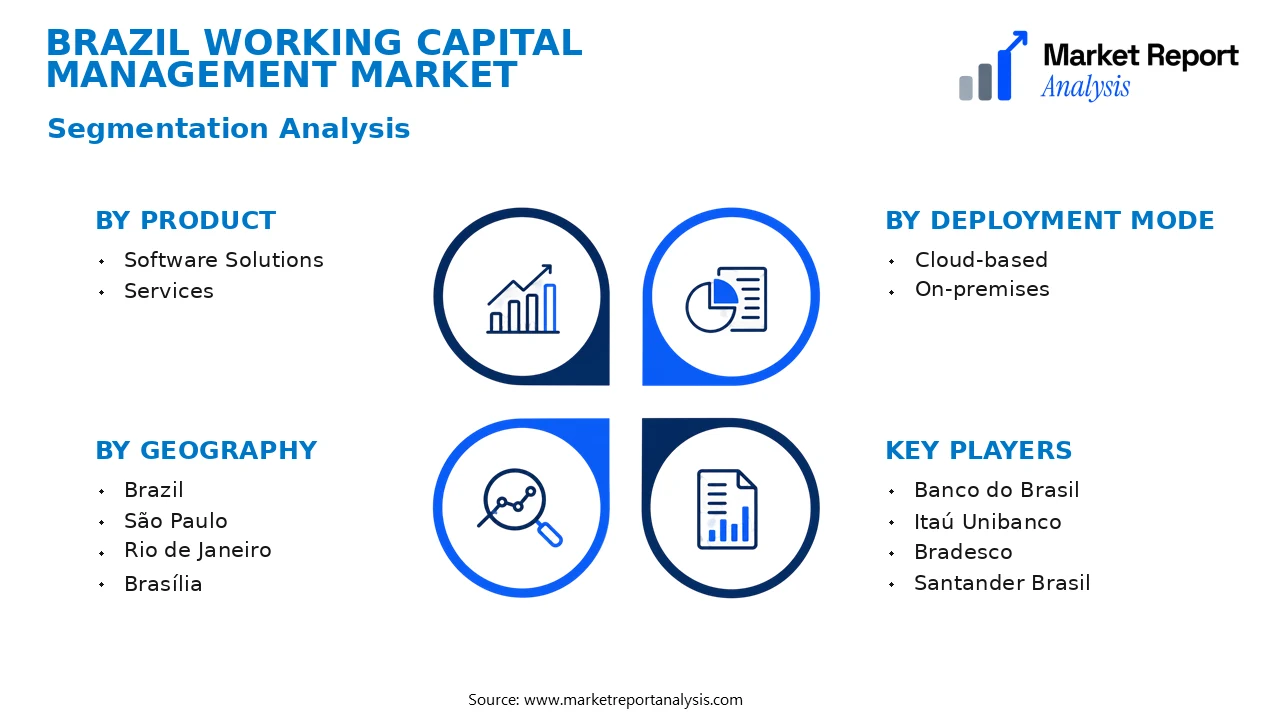
- Product
- Software Solutions: These are comprehensive platforms designed to optimize working capital by automating cash flow forecasting, receivables, payables, and liquidity management. Demand is driven by the need for operational efficiency and real-time financial insights.
- Services: Include consulting, implementation, and support services that enable organizations to effectively deploy working capital management solutions, catering to the growing adoption of digital finance transformation initiatives across various industries.
- Deployment Mode
- Cloud-based: Cloud deployment offers scalability, flexibility, and cost-efficiency, making it increasingly popular among Brazilian businesses aiming for rapid deployment and remote access along with reduced infrastructure costs.
- On-premises: Despite the rising trend toward cloud solutions, on-premises deployment remains relevant, especially in industries with stringent data security regulations, requiring localized infrastructure management.
- Industry Vertical
- Manufacturing: Manufacturing firms in Brazil focus on managing cash flows associated with raw materials, inventory, and receivables, making working capital management critical to maintaining production continuity and operational efficiency.
- Retail: The retail sector's high volume of transactions necessitates robust working capital solutions to optimize receivables and payables, support inventory management, and improve liquidity during seasonal fluctuations.
- Banking & Financial Services: Banks and financial institutions leverage advanced working capital management tools to enhance liquidity, streamline cash flow, and support credit management activities vital for their operational stability.
- Others: Sectors like healthcare, logistics, and telecommunications are also significant buyers of working capital management solutions, driven by the necessity to optimize liquidity amid dynamic market conditions.
- Geography
- Brazil: The overall market encompasses diverse regional demands, with leading economic hubs exhibiting higher adoption due to dense industrial activity and technological infrastructure.
- São Paulo: As Brazil’s financial and industrial hub, São Paulo presents significant demand for sophisticated working capital solutions driven by large-scale enterprise operations and high financial transaction volumes.
- Rio de Janeiro: Known for its corporate presence in oil, gas, and tourism sectors, Rio de Janeiro's market for working capital management is shaped by both sector-specific needs and regional economic activity.
- Brasília: The political and administrative center, Brasília hosts numerous government agencies and service providers, creating a niche demand for tailored working capital solutions catering to public sector needs.
- Belo Horizonte: With its growing industrial base, especially in mining and metallurgy, Belo Horizonte's market indicates increasing adoption of working capital tools to support sector-specific financial management.
- Curitiba: Recognized for its innovation-driven approach, Curitiba’s enterprises leverage advanced financial management solutions to optimize liquidity, particularly in manufacturing and automotive sectors.
- Porto Alegre: As a regional business hub, Porto Alegre's market benefits from diverse industry activities, including agribusiness and manufacturing, which rely on efficient working capital management for growth.
- Recife: With a focus on tourism, commerce, and oil-related industries, Recife's demand for working capital management solutions is influenced by regional economic diversification and infrastructure development.
- Salvador: The financial and tourism sectors in Salvador drive need for specialized working capital strategies to manage cash flows effectively amid seasonal variation and regional growth initiatives.
- Campinas: As an industrial and technological center, Campinas exhibits high demand for innovative financial management tools to sustain its robust manufacturing and research sectors.
- Fortaleza: Driven by tourism, retail, and export-oriented industries, Fortaleza’s market for working capital management solutions is expanding as local enterprises seek financial efficiency improvements.
Competitive Intelligence
The Brazil Working Capital Management Market is characterized by a competitive landscape marked by a moderate degree of market concentration, with several key players dominating regional and national segments. Major firms adopt strategic partnerships and alliances to expand their service offerings and improve technological capabilities, fostering innovation in digital working capital solutions. Companies are heavily investing in R&D to develop advanced algorithms and automation tools that enhance liquidity management and optimize cash flow processes. Recent acquisitions are focused on augmenting product portfolios and expanding geographic reach across key Brazilian cities such as São Paulo and Rio de Janeiro, where financial activity is most concentrated.
Business strategies prioritize local market adaptation, leveraging data analytics and cloud-based platforms to deliver tailored solutions. Firms differentiate themselves through customer-centric services, real-time analytics, and compliance capabilities aligned with Brazil's regulatory framework. Expansion strategies include establishing regional hubs and strategic alliances with local financial institutions, enabling quicker deployment and improved customer engagement. Overall, competition remains vigorous, driven by innovation, strategic alliances, and a focus on emerging digital solutions to capture and grow market share.
Leading Company Profiles
The competitive landscape of the Brazil Working Capital Management Market is characterized by highly innovative and strategically diversified firms that leverage advanced financial technologies, local market expertise, and broad regional presence to optimize working capital solutions for clients.
- Banco do Brasil
- Itaú Unibanco
- Bradesco
- Santander Brasil
- XP Inc.
- Banco Safra
- BTG Pactual
- Citic Bank
- Banco Votorantim
- Banco Inter
Banco do Brasil
Banco do Brasil leads with extensive digital banking solutions and integrated working capital products, focusing on digital transformation and sustainable finance to enhance client portfolio and operational efficiency.
Itaú Unibanco
Itaú Unibanco offers comprehensive working capital management solutions with advanced analytics, emphasizing automation, real-time data insights, and innovative fintech integrations to support business liquidity and cash flow optimization.
Bradesco
Bradesco specializes in tailored working capital solutions leveraging cutting-edge digital platforms, aiming to streamline cash management and credit offerings to large corporates and SME sectors across Brazil.
Santander Brasil
Santander’s strategic focus on digital banking and fintech partnerships enhances its working capital management service portfolio, with a strong emphasis on cross-border trade finance, liquidity solutions, and automation.
XP Inc.
XP Inc. capitalizes on its tech-driven platform to provide innovative cash management and liquidity solutions, expanding fintech-enabled servIces for corporate and institutional clients in Brazil.
Banco Safra
Banco Safra focuses on bespoke working capital solutions enriched by personalized client advisory, leveraging technology to optimize receivables, payables, and liquidity management strategies.
BTG Pactual
BTG Pactual emphasizes digital innovation within its corporate banking division, offering sophisticated working capital products that integrate data analytics and automation to improve working capital cycles.
Citic Bank
Citic Bank applies its strategic global banking expertise to Brazilian clients, providing integrated working capital management with a focus on international trade, currency risk management, and digital finance.
Banco Votorantim
Banco Votorantim leverages its strategic alliances to strengthen its offerings in working capital finance, emphasizing tailored solutions, digital platforms, and customer-centric innovations.
Banco Inter
Banco Inter capitalizes on digital banking prowess by offering integrated cash flow and liquidity management solutions, with a strong focus on SME markets and digital customer engagement.
Strategic Business Developments
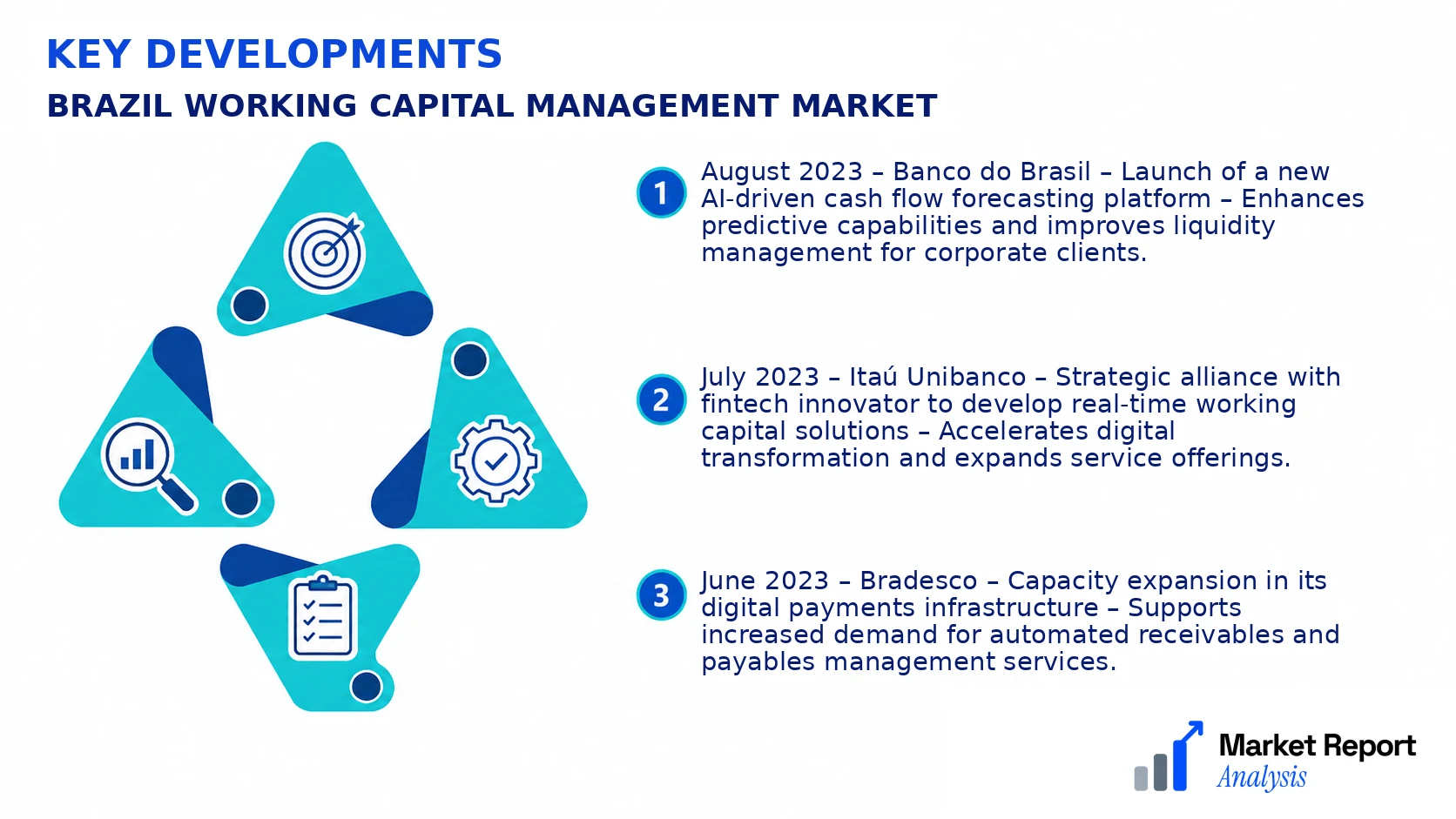
- August 2023 – Banco do Brasil – Launch of a new AI-driven cash flow forecasting platform – Enhances predictive capabilities and improves liquidity management for corporate clients.
- July 2023 – Itaú Unibanco – Strategic alliance with fintech innovator to develop real-time working capital solutions – Accelerates digital transformation and expands service offerings.
- June 2023 – Bradesco – Capacity expansion in its digital payments infrastructure – Supports increased demand for automated receivables and payables management services.
- May 2023 – Santander Brasil – Acquisition of a digital trade finance startup – Strengthens cross-border working capital and liquidity management capabilities.
- April 2023 – BTG Pactual – Launch of a new analytics-powered working capital optimization tool – Improves decision-making processes for large corporate clients.
Frequently Asked Questions
What is the Brazil Working Capital Management Market?
The Brazil Working Capital Management Market encompasses financial services and solutions aimed at optimizing the management of short-term assets and liabilities for businesses across Brazil. It includes tools for cash flow management, receivables, payables, and inventory, enabling firms to improve liquidity and operational efficiency.
What is the current market size of Brazil Working Capital Management Market?
As of 2026, the market size of the Brazil Working Capital Management Market is valued at approximately USD 8.5 Billion. Rapid digital transformation and growing needs for liquidity optimization among enterprises are fueling this market growth.
What factors are driving the Brazil Working Capital Management Market?
Market growth is driven by increasing adoption of digital financial tools, expanding SME sectors, and a growing need for liquidity management amid economic fluctuations. Technological advancements and regulatory reforms also foster efficient working capital solutions across industries.
Which region dominates the Brazil Working Capital Management Market?
Federally, southeastern Brazil leads the market, primarily driven by economic hubs such as São Paulo and Rio de Janeiro. These regions exhibit the highest adoption rates of advanced working capital management solutions due to dense business activities and financial services infrastructure.
Which segment is expected to grow the fastest?
The digital and cloud-based solutions segment is projected to experience the fastest growth, propelled by increased technological integration, remote working trends, and the need for scalable, real-time working capital management tools across industries.
Who are the leading companies operating in the Brazil Working Capital Management Market?
Key players include major financial institutions and fintech firms such as Banco do Brasil, Itaú Unibanco, Bradesco, and newer digital players like Creditas and Neon. These companies are enhancing market competitiveness through innovative offerings and strategic partnerships.
Analyst Perspective
The Brazil Working Capital Management Market is poised for mature growth, with its long-term outlook driven by digital transformation and evolving financial regulations. As corporations increasingly adopt integrated cash management solutions, opportunities arise in leveraging advanced analytics and AI-driven forecasting tools to optimize liquidity and minimize costs. Infrastructure upgrades and regional banking innovations will likely enhance service penetration, especially in underserved areas such as the Midwest and North regions. Competition remains high among fintech firms and traditional banks, prompting continuous innovation and strategic alliances. Stakeholders should prioritize investments in scalable, cloud-based solutions and cybersecurity to bolster resilience against economic volatilities. The market’s regional dynamics highlight significant growth potential in Sao Paulo and Rio de Janeiro due to their dense industrial and financial sectors, yet, emerging markets in smaller cities could offer untapped opportunities if technology deployment accelerates. Overall, sustained adoption of automation, coupled with strategic regional positioning, will define future success for market players in Brazil.
