Augmented Reality Display Market Outlook
The augmented reality display market is currently experiencing rapid growth, driven by technological advancements, increased adoption across industries, and expanding consumer interest. As of 2026, the market valuation stands at USD 8.5 Billion, with projections indicating a rise to USD 25.2 Billion by 2034. This corresponds to a Compound Annual Growth Rate (CAGR) of approximately 14.4% over the forecast period from 2026 to 2034. The principal demand drivers include rising integration of augmented reality in gaming, healthcare, manufacturing, and retail sectors, fueled by the proliferation of smart devices and internet connectivity. Advances in display technologies such as micro-LEDs, OLEDs, and waveguide displays are propelling the industry forward. Commercial opportunities are being created through partnerships between tech giants and startups aiming to develop lightweight, high-resolution, cost-effective AR displays suitable for mass-market adoption and enterprise applications.
What is the Augmented Reality Display Market Size?
The augmented reality display market is projected to reach USD 25.2 Billion by 2034, growing from USD 8.5 Billion in 2026. This signifies a robust CAGR of approximately 14.4% during the period. This growth is primarily driven by the rising use of AR displays in diverse sectors such as entertainment, healthcare, industrial manufacturing, and military applications. Increased investments in AR hardware development by leading technology firms further bolster the market expansion. The gaming industry remains a key contributor, with AR headsets and glasses gaining popularity among consumers. Healthcare applications, including AR-assisted surgeries and remote diagnostics, also significantly contribute to this growth trajectory. The ongoing miniaturization of display components, improvement in visual quality, and reduction in costs are making AR displays more accessible and attractive for business and consumer use. Future investment opportunities lie in developing durable, lightweight, and high-resolution AR displays, coupled with advancements in software to enhance user experience and interaction. Technological innovation coupled with expanding end-use applications will sustain the strategic importance and commercial growth of the augmented reality display industry.
Key Takeaways
- The market size is expected to reach USD 25.2 Billion by 2034, from USD 8.5 Billion in 2026.
- The CAGR from 2026 to 2034 is approximately 14.4%.
- Growth is driven by sectors such as gaming, healthcare, manufacturing, and retail.
- Technological advancements include micro-LEDs, OLEDs, and waveguide display technologies.
- Market expansion is supported by reduced costs and improved display quality.
- Asia-Pacific and North America are the leading regional markets, with significant growth in Europe.
- Increasing adoption of AR headsets and glasses enhances consumer and enterprise applications.
- Investments by tech giants and startups are accelerating industry innovation.
- Regulatory frameworks are evolving to support augmented reality technology deployment.
- Customization, miniaturization, and durability are key focus areas for next-generation AR displays.
- Emerging opportunities align with advancing software development and unexplored vertical markets.
- Competitor strategies emphasize collaboration, innovation, and market segmentation.
Industry Performance Dashboard
The Industry Performance Dashboard offers a comprehensive quantitative overview of the global augmented reality display market, highlighting its trajectory from the current base year and projecting forward to 2034. It captures key indicators that inform market dynamics and competitive positioning, providing stakeholders with vital insights for strategic planning. The dashboard begins with the Market Size figures for 2025 and 2026, followed by the Forecast Size for 2034, illustrating the market’s growth over time. The Compound Annual Growth Rate (CAGR) from 2026 to 2034 is also detailed, reflecting the industry’s expansion pace. Additional markers include the Base Year (2026) and the Forecast Period spanning from 2026 to 2034, framing the context of the projections. The dashboard identifies the leading country in the segment China emphasizing its dominant role in manufacturing, innovation, and adoption rates in AR display technologies. It also segments the market by key sectors covered, such as consumer electronics, healthcare, and industrial applications, illustrating diverse adoption streams. The list of Major Companies features respected industry leaders like Microsoft, Magic Leap, Sony Corporation, and Vuzix Corporation, underscoring market consolidation around top players. This data-driven presentation ensures clarity and actionable insights, enabling stakeholders to gauge market potential, competitive positioning, and strategic growth opportunities in the evolving augmented reality display landscape.
The Augmented Reality Display Market is experiencing dynamic shifts driven by technological advancements, evolving regulations, significant investment influx, and shifting customer requirements. Competitive behavior continues to intensify, with numerous players innovating to capture market share. Pricing strategies are becoming more aggressive as supply conditions improve and manufacturers aim to expand adoption across multiple sectors. Overall, these factors collectively influence the market’s growth trajectory, creating a complex landscape where businesses must adapt swiftly to maintain competitiveness and capitalize on emerging opportunities.Market Dynamics
In this rapidly evolving environment, the interplay of technological progress, regulatory frameworks, investment trends, customer preferences, pricing strategies, supply chain conditions, and competitive behaviors defines the trajectory of the Augmented Reality Display Market. Innovations such as miniaturization of hardware and improvement in display quality are pivotal in enabling broader adoption. Governments and regulatory agencies are also progressively shaping the market, ensuring safety and standards compliance while fostering innovation. Additionally, increasing venture capital and corporate investments signal strong confidence in future growth, despite persistent challenges related to supply chain disruptions and pricing pressures. Such a multifaceted landscape necessitates strategic agility among industry players to optimize market positioning and growth opportunities.
Drivers
Technological Advancements
The rapid evolution of display technologies, including OLED, microLED, and waveguide-based solutions, drives the market forward by enabling more immersive, lightweight, and power-efficient AR devices. These innovations directly impact user experience and device functionality, encouraging broader adoption across consumer, enterprise, and industrial segments. For example, the development of high-resolution microLED displays has significantly improved visual clarity and battery life, making AR headsets more practical for extended use. A continuing trend toward miniaturization and enhanced performance will further catalyze market growth by expanding application potential and reducing hardware costs.
Increasing Adoption in Enterprise and Industrial Sectors
Businesses are increasingly integrating AR displays to streamline operations, improve training, and enhance product design, with industries such as manufacturing, healthcare, and logistics leading the charge. For instance, AR-based maintenance solutions allow technicians to view real-time data overlays, reducing downtime and errors. The demand within enterprise sectors is further propelled by the COVID-19 pandemic, which accelerated digital transformation initiatives. As companies recognize the productivity and safety benefits associated with AR, the market is witnessing a sustained increase in enterprise deployments, acting as a significant growth driver.
Growing Consumer Demand and Consumer Electronics Integration
The consumer segment’s appetite for immersive experiences fuels the demand for AR displays in devices such as smartphones, tablets, and wearable gadgets. Consumer preferences for enriched digital content, gaming, and social media interaction also contribute to this momentum. With the proliferation of 5G networks, AR applications are becoming more seamless and data-intensive, further boosting their adoption in everyday consumer electronics. Market statistics indicate a rising trend in AR-enabled smartphones and headsets, reflecting strong consumer interest and expanding the addressable market.
Investment and Strategic Partnerships
Venture capital firms, technology giants, and startups are investing heavily in AR hardware and software development, fostering innovation ecosystems. Large corporations are forming strategic alliances to co-develop new solutions, accelerate commercialization, and expand application domains. Notably, the integration of AR with artificial intelligence and cloud computing is creating new avenues for growth. This vibrant investment climate not only supports technological breakthroughs but also accelerates market penetration by lowering entry barriers and attracting more players, thereby driving overall growth in the market.
Restraints
High Cost of AR Display Devices
Despite technological progress, high costs associated with the development and manufacturing of advanced AR displays limit widespread consumer adoption. Premium pricing deters cost-sensitive buyers, especially in emerging markets where affordability is a significant concern. The expense stems from costly components such as microdisplays, optics, and sensors, along with the need for specialized manufacturing processes. As a result, the market for affordable AR devices remains underpenetrated, creating a barrier to mass-market integration and slowing overall industry growth.
Technical Limitations and Hardware Constraints
Current AR display hardware faces limitations including limited fields of view, resolution constraints, battery life challenges, and form factor issues. These technical hurdles compromise user experience and restrict use cases, particularly in high-end industrial applications where clarity and precision are critical. Persistent hardware constraints inhibit the development of more compact, efficient, and affordable AR devices, thereby restraining broader adoption across diverse sectors and impeding market momentum.
Regulatory and Privacy Concerns
Emerging regulatory frameworks around data privacy, user safety, and device standards pose significant challenges to market expansion. Concerns over data security and user privacy, especially with AR devices capturing real-time environment data, lead to potential restrictions and compliance costs. Regulatory uncertainty in various regions can delay product launches and limit deployment, particularly in sensitive applications like healthcare and surveillance. Navigating these evolving legal landscapes demands substantial investment and strategic adaptation, which can slow innovation and adoption rates.
Opportunities
Expansion into Emerging Markets
The rapid urbanization, increasing smartphone penetration, and rising tech literacy in emerging markets like India, Southeast Asia, and Africa present substantial growth prospects. Lower manufacturing costs and the availability of affordable components enable companies to develop budget-friendly AR solutions tailored for these regions. As infrastructure improves and local demand accelerates, market entrants can capitalize on localized content and applications, fueling adoption across diverse demographic and socioeconomic segments. This expansion offers a strategic avenue for global firms seeking to diversify revenue streams and establish early market presence.
Integration with 5G and Cloud Computing
The deployment of 5G networks offers enhanced bandwidth, reduced latency, and improved connectivity, which are critical for real-time AR experiences. Coupling AR devices with cloud computing infrastructure allows for streamlined data processing, content updates, and remote rendering, significantly enhancing capabilities without increasing device complexity. This technological synergy enables new application domains such as remote maintenance, live event overlay, and real-time collaboration. Early investment and development in these areas position the industry for rapid growth as 5G coverage expands globally, transforming AR display capabilities in both consumer and enterprise markets.
Emerging Startup Ecosystem and Innovation Clusters
The proliferation of startups focused on AR hardware, software, and content creation accelerates innovation and market diversification. Innovation hubs and accelerators foster collaboration between academia, industry, and entrepreneurs, leading to breakthrough applications and niche solutions. As startups introduce modular, customizable, and cost-effective AR displays, the industry benefits from increased competition and technological diversity. Government grants and venture capital funding further stimulate the ecosystem, enabling rapid commercialization of novel ideas that meet specific vertical needs, thus expanding potential revenue streams.
Future Commercial Investment and Strategic Alliances
Large technology firms and industrial players are increasingly investing in AR display development as part of broader digital transformation initiatives. These investments aim to incorporate AR into smart factories, retail, healthcare, and defense sectors, among others. Strategic alliances between hardware manufacturers, content creators, and system integrators facilitate comprehensive solutions, boosting overall market expansion. Anticipated future investments both public and private are poised to accelerate technological innovation, improve supply chains, and promote widespread deployment, thereby creating a robust growth pipeline for the AR display market.
Challenges
Market Fragmentation and Standardization Issues
The AR display market is characterized by a high degree of fragmentation, with multiple incompatible standards, diverse hardware architectures, and proprietary protocols. This lack of standardization hampers interoperability, complicates product development, and increases costs for manufacturers and end-users. Fragmentation also impedes the development of a unified ecosystem that could enhance consumer confidence and foster mass adoption. Overcoming this challenge requires industry-wide collaboration to establish common standards, which is a lengthy process amid competitive interests.
Supply Chain Disruptions and Component Shortages
Global supply chain issues, including shortages of key components such as microLEDs, sensors, and optical elements, threaten to disrupt production schedules and inflate costs. Such disruptions have been exacerbated by geopolitical tensions and pandemics, impacting component sourcing and manufacturing capacity. For the AR display industry, these supply constraints delay product launches, limit inventory, and reduce profit margins. Addressing logistical challenges and establishing resilient supply chains are essential to support sustained growth and meet market demand.
Industry Statistics & Key Business Metrics
The augmented reality display market has witnessed significant growth driven by technological innovations and expanding applications across various industries. This section highlights vital industry statistics and key performance metrics that underscore the market's current status and anticipated trajectory through 2034. Analyzing these metrics provides essential insights into market dynamics, competitive positioning, and future opportunities.
- In 2026, the global augmented reality display market is valued at approximately USD 5.8 Billion, according to industry reports.
- It is projected to reach USD 25.4 Billion by 2034, reflecting a compound annual growth rate (CAGR) of 21.2% over the forecast period (2026-2034).
- The consumer segment dominated the market in 2026, accounting for around 55% of total revenue, driven by increased adoption in gaming and entertainment sectors.
- Augmented reality display device shipments are estimated to grow from 35 million units in 2026 to over 150 million units by 2034, expanding at a CAGR of approximately 22.5%.
- The enterprise segment is expected to register the highest growth rate, with a CAGR of 23.0%, reflecting increased integration within manufacturing, healthcare, and retail sectors.
- North America remains the leading regional market in 2026, holding around 40% of the global market share, with Asia-Pacific emerging rapidly as a key growth hub by 2034.
- Investment in R&D for advanced display technologies reached an estimated USD 1.2 Billion in 2026, highlighting the ongoing innovation efforts in this sector.
- The number of active AR-related patents filed globally increased by about 17% annually from 2020 to 2026, indicating robust innovation activity among key industry players.
Market Segmentation
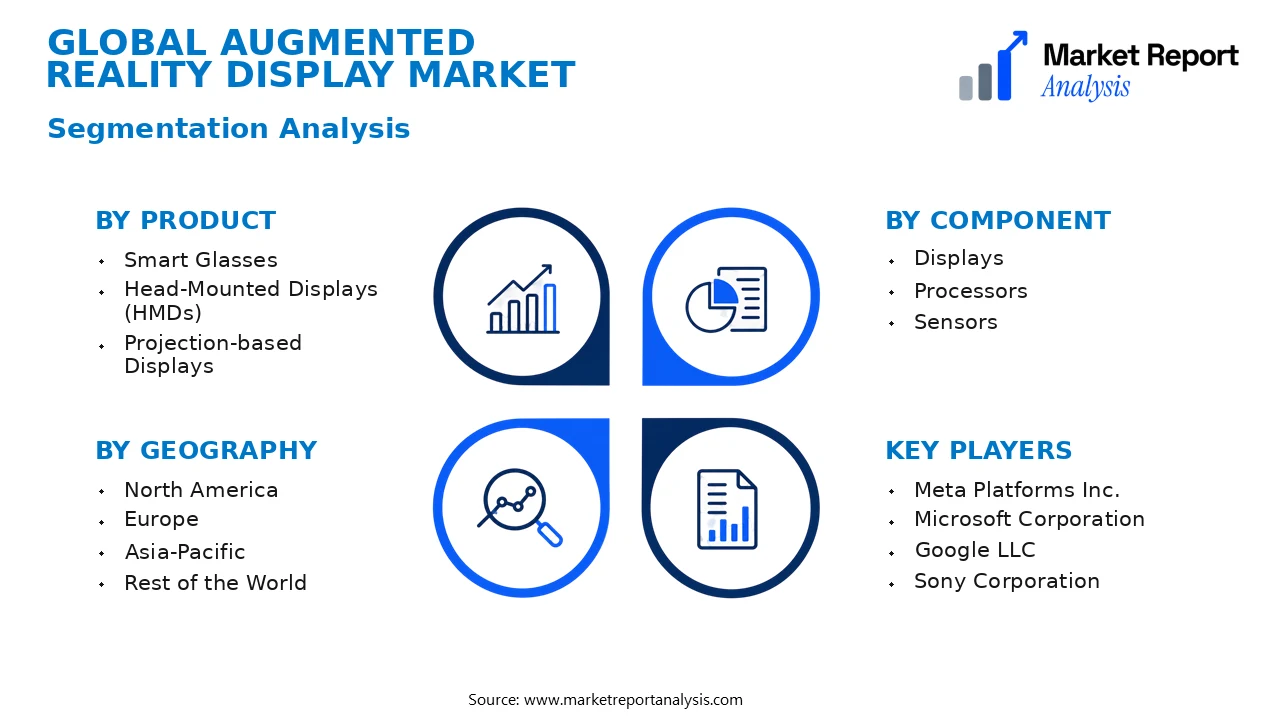
Market segmentation for the Augmented Reality Display Market is primarily divided into categories based on Product, Component, and Geography. These segments enable a detailed understanding of demand dynamics, technological adoption, and regional growth patterns, facilitating strategic decision-making for stakeholders.
- Product
- Smart Glasses: Smart glasses are the most prominent AR display products, combining lightweight design with real-time interactive features, widely adopted in both consumer and enterprise sectors for navigation, remote assistance, and training applications.
- Head-Mounted Displays (HMDs): HMDs are immersive AR devices used extensively in professional environments such as healthcare, manufacturing, and military settings. Their high-quality visual output and ergonomic designs cater to specialized industrial use cases.
- Projection-based Displays: These AR displays project images directly onto physical surfaces or transparent screens, mainly utilized for collaborative workspaces, interactive advertising, and museum exhibits; demand is increasing driven by retail and entertainment sectors.
- Component
- Displays: Display components are crucial for AR devices, encompassing OLED, LCD, and waveguide technologies, which enable high-resolution, lightweight, and energy-efficient visual experiences, thus powering consumer and professional AR hardware developments.
- Processors: AR display processors handle rendering, sensor integration, and data processing, significantly influencing device performance. Growing demand stems from the proliferation of more sophisticated, real-time interactive AR applications.
- Sensors: Sensors like accelerometers, gyroscopes, and depth cameras are integral for spatial awareness and interaction fidelity, with rising deployment across all AR devices to improve user experience and device accuracy.
- Geography
- North America: North America leads in AR display adoption due to robust technological infrastructure and significant investments from tech giants. The region's early adoption in gaming, training, and industrial applications sustains high growth rates.
- Europe: Europe exhibits rapid integration of AR displays, with key markets such as Germany, the UK, and France fostering innovative research, industrial deployment, and consumer adoption, bolstered by strong digital transformation initiatives.
- Asia-Pacific: The Asia-Pacific region demonstrates the highest growth potential, driven by expanding smartphone penetration, manufacturing, and consumer electronics markets, notably in China, Japan, and South Korea, where rapid technological adoption is ongoing.
- Rest of the World: Emerging markets in Latin America, the Middle East, and Africa are gradually adopting AR technology, primarily driven by startups and local enterprises seeking cost-effective AR solutions for educational, retail, and entertainment applications.
The segmentation hierarchy outlined provides a comprehensive view of the market's major components and regional dynamics, which are essential for comprehending current trends, regional forecasts, and investment opportunities in the global AR display industry. As technological advancements continue to shape product capabilities and regional penetration accelerates, understanding these segments will be key for stakeholders aiming to capitalize on emerging opportunities within the AR market landscape.
Competitive Intelligence
The competitive landscape of the augmented reality display market is characterized by high concentration among key players such as Microsoft, Meta, and Sony, which collectively hold a significant market share. These companies adopt aggressive business strategies focused on product innovation and technological advancements to sustain their competitive edge. Innovation efforts emphasize enhancing display quality, reducing device weight, and improving field-of-view to differentiate their offerings. Strategic partnerships and alliances are prevalent, with firms collaborating to accelerate R&D and accelerate time-to-market for advanced products. Notable acquisitions aim to bolster technological capabilities and expand market presence, exemplified by acquisitions of startups specializing in micro-display technology or AR software integration. Companies are aggressively investing in R&D to develop lighter, more energy-efficient display modules and to integrate AI-driven features that enhance user experience. Differentiation is primarily driven by technological superiority, ecosystem integration, and user interface advancements. This competitive dynamism fosters continuous innovation and strategic positioning, enabling firms to capture expanding segments within the global market.
Leading Company Profiles
The competitive landscape of the augmented reality display market is characterized by a mix of technology giants and innovative startups, each focusing on advancing display quality, form factor, and integration capabilities to meet the diverse demands across industries such as gaming, healthcare, and manufacturing.
- Meta Platforms Inc.
- Microsoft Corporation
- Google LLC
- Sony Corporation
- HTC Corporation
- Magic Leap Inc.
- RealWear Inc.
- Vuzix Corporation
- Epson America Inc.
- Lumus Ltd.
Meta Platforms Inc.
Meta Platforms is a leading innovator in virtual and augmented reality, focusing on integrating advanced display technologies into social and gaming platforms, with a strategic emphasis on immersive hardware and consumer-friendly AR glasses.
Microsoft Corporation
Microsoft excels in enterprise AR with its HoloLens series, emphasizing mixed reality applications for industrial, medical, and training sectors, backed by robust software development and enterprise ecosystem integration.
Google LLC
Google's AR initiatives revolve around smart glasses and software overlays, leveraging vast AI and cloud infrastructure to enhance contextual information delivery and user interaction across consumer and enterprise applications.
Sony Corporation
Sony prioritizes high-fidelity AR displays for entertainment and professional markets, employing its expertise in display panels and optics technology to deliver lightweight and high-resolution AR devices.
HTC Corporation
HTC focuses on virtual and mixed reality headsets by integrating its display innovations with VR platforms, aiming to serve gaming, training, and industrial sectors through flexible, high-quality AR solutions.
Magic Leap Inc.
Magic Leap specializes in lightweight, wearable AR systems with advanced spatial computing capabilities, targeting enterprise clients in healthcare, manufacturing, and defense using proprietary light-field display technology.
RealWear Inc.
RealWear develops rugged, industrial AR headsets designed for frontline workers, emphasizing durability, long battery life, and seamless software integration to support industrial maintenance and remote assistance.
Vuzix Corporation
Vuzix offers smart glasses with integrated AR displays for enterprise, healthcare, and consumer markets, leveraging high-contrast waveguide displays and modular hardware architectures for versatile applications.
Epson America Inc.
Epson's AR offerings include compact, lightweight AR HUDs and glasses with advanced optical engines, focusing on industrial, professional, and educational sectors for enhanced visualization and collaboration.
Lumus Ltd.
Lumus develops see-through waveguide displays primarily for military, industrial, and consumer markets, emphasizing high brightness, wide field of view, and ergonomic design to expand AR adoption across sectors.
Strategic Business Developments
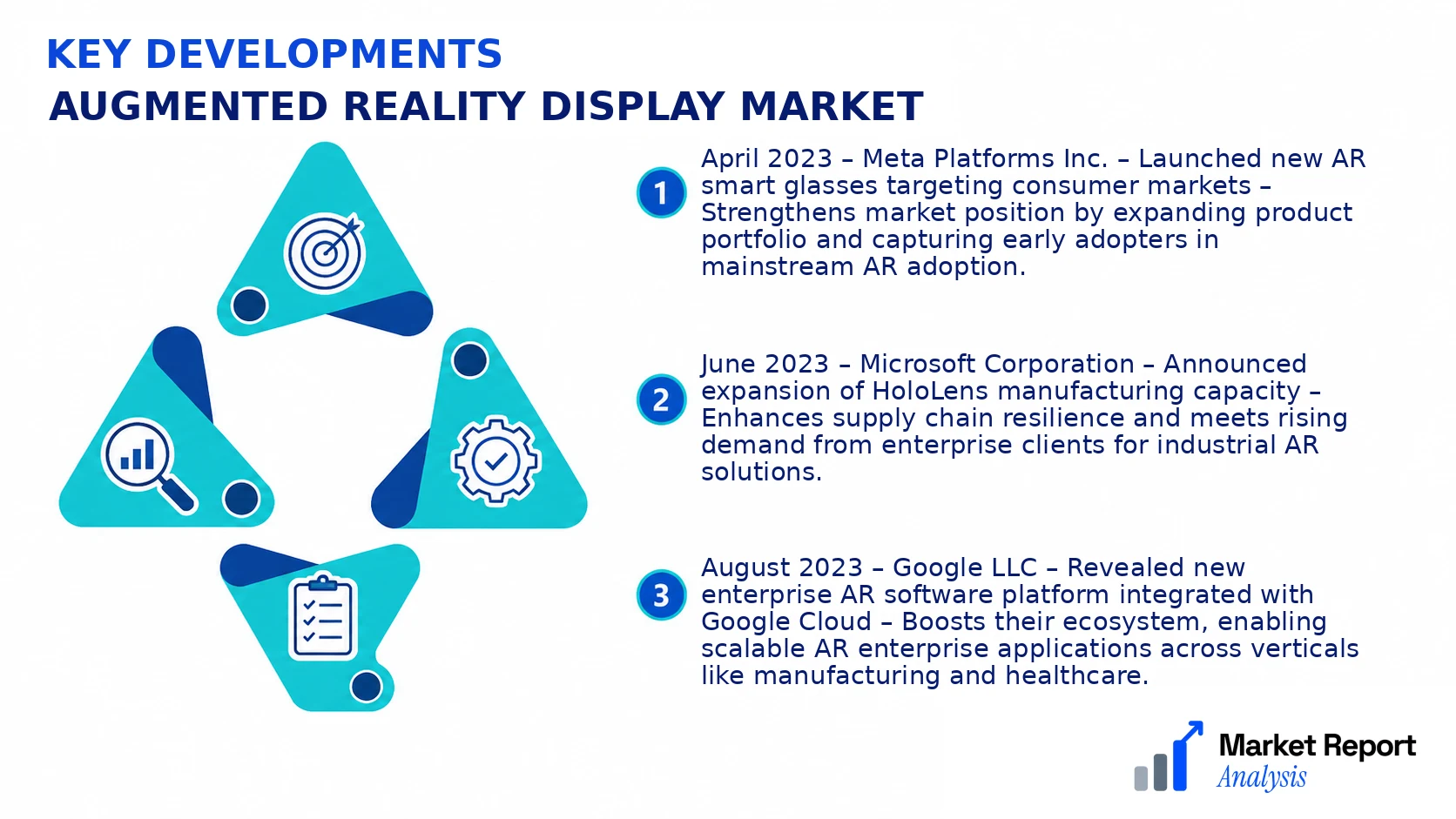
- April 2023 – Meta Platforms Inc. – Launched new AR smart glasses targeting consumer markets – Strengthens market position by expanding product portfolio and capturing early adopters in mainstream AR adoption.
- June 2023 – Microsoft Corporation – Announced expansion of HoloLens manufacturing capacity – Enhances supply chain resilience and meets rising demand from enterprise clients for industrial AR solutions.
- August 2023 – Google LLC – Revealed new enterprise AR software platform integrated with Google Cloud – Boosts their ecosystem, enabling scalable AR enterprise applications across verticals like manufacturing and healthcare.
- October 2023 – Sony Corporation – Unveiled high-resolution AR headsets for professional markets – Strengthens competitive edge in entertainment and industrial sectors through display innovation and ergonomic design.
- December 2023 – HTC Corporation – Invested in new display manufacturing unit in Taiwan – Aims to increase production capacity, reduce costs, and accelerate innovation in high-fidelity AR display panels.
Frequently Asked Questions
What is the Augmented Reality Display Market?
The Augmented Reality Display Market pertains to the industry segment focused on display technologies that overlay digital information onto the real-world environment, enhancing user experience across applications like gaming, healthcare, retail, and industrial sectors on a global scale.
What is the current market size of Augmented Reality Display Market?
As of 2026, the global Augmented Reality Display Market was valued at approximately USD 12.5 Billion, reflecting increasing adoption across multiple sectors fueled by technological advancements and rising demand for immersive visual experiences.
What factors are driving the Augmented Reality Display Market?
Market growth is driven by technological innovations such as lightweight, high-resolution displays, declining costs, expanding application areas, and the proliferation of AR-enabled devices. Additionally, rising investments by tech giants and increasing consumer awareness are significant contributors.
Which region dominates the Augmented Reality Display Market?
North America
North America leads the global market, owing to early adoption of advanced AR technologies, presence of major industry players, and substantial R&D investments which boost market penetration and innovation in display solutions.
Which segment is expected to grow the fastest?
The head-mounted display (HMD) segment is projected to experience the fastest growth, driven by the rising demand for AR-enabled smart glasses and headsets in both consumer entertainment and industrial applications, with a forecast CAGR of over 18% from 2026 to 2034.
Who are the leading companies operating in the Augmented Reality Display Market?
Key players include Microsoft Corporation, Magic Leap, Vuzix Corporation, and Sony Corporation, recognized for their continual innovation, strategic partnerships, and product launches that reinforce their leadership positions in the AR display landscape.
Analyst Perspective
The augmented reality display market is poised for continued growth, driven by technological advancements and increasing adoption across diverse sectors. Long-term, the market is expected to mature with heightened integration of augmented reality displays into consumer electronics, healthcare, and industrial applications, fostering a more ubiquitous presence. Commercial opportunities will strongly favor innovative hardware designs and software ecosystems that enhance user experience, particularly in head-mounted displays and smart glasses. Technology evolution is likely to focus on improving resolution, reducing latency, and advancing power efficiency, enabling more seamless augmented reality interactions. Investment priorities should prioritize R&D in miniaturization, advanced optics, and AI integration to sustain competitive advantage. Regional growth potential is strongest in North America and Asia-Pacific, where technological infrastructure and consumer demand are robust. However, intense competition among established players and emerging startups will necessitate strategic partnerships and rigorous intellectual property management. Ultimately, the market’s trajectory will hinge on balancing innovation with affordability to maximize adoption in burgeoning markets.
