Vietnam Cloud-based VDI Market Outlook
The Vietnam cloud-based Virtual Desktop Infrastructure (VDI) market currently holds a significant position within the country's enterprise IT strategy, driven by digital transformation initiatives, increasing remote work trends, and government policies promoting IT modernization. As of 2026, the market is valued at USD 1.2 Billion, with expectations to reach USD 4.8 Billion by 2034. This growth corresponds to a Compound Annual Growth Rate (CAGR) of approximately 16.80% over the forecast period spanning 2026 to 2034. The principal demand drivers include rapid expansion of small and medium-sized enterprises (SMEs), a growing need for flexible work environments, and the adoption of cloud security standards. Technological advances, such as hyper-converged infrastructures and AI-enabled management tools, are expected to further propel market growth. Commercial opportunities are abundant for cloud service providers, hardware vendors, and local system integrators seeking to capitalize on Vietnam’s burgeoning digital economy and government initiatives aimed at digital resilience.
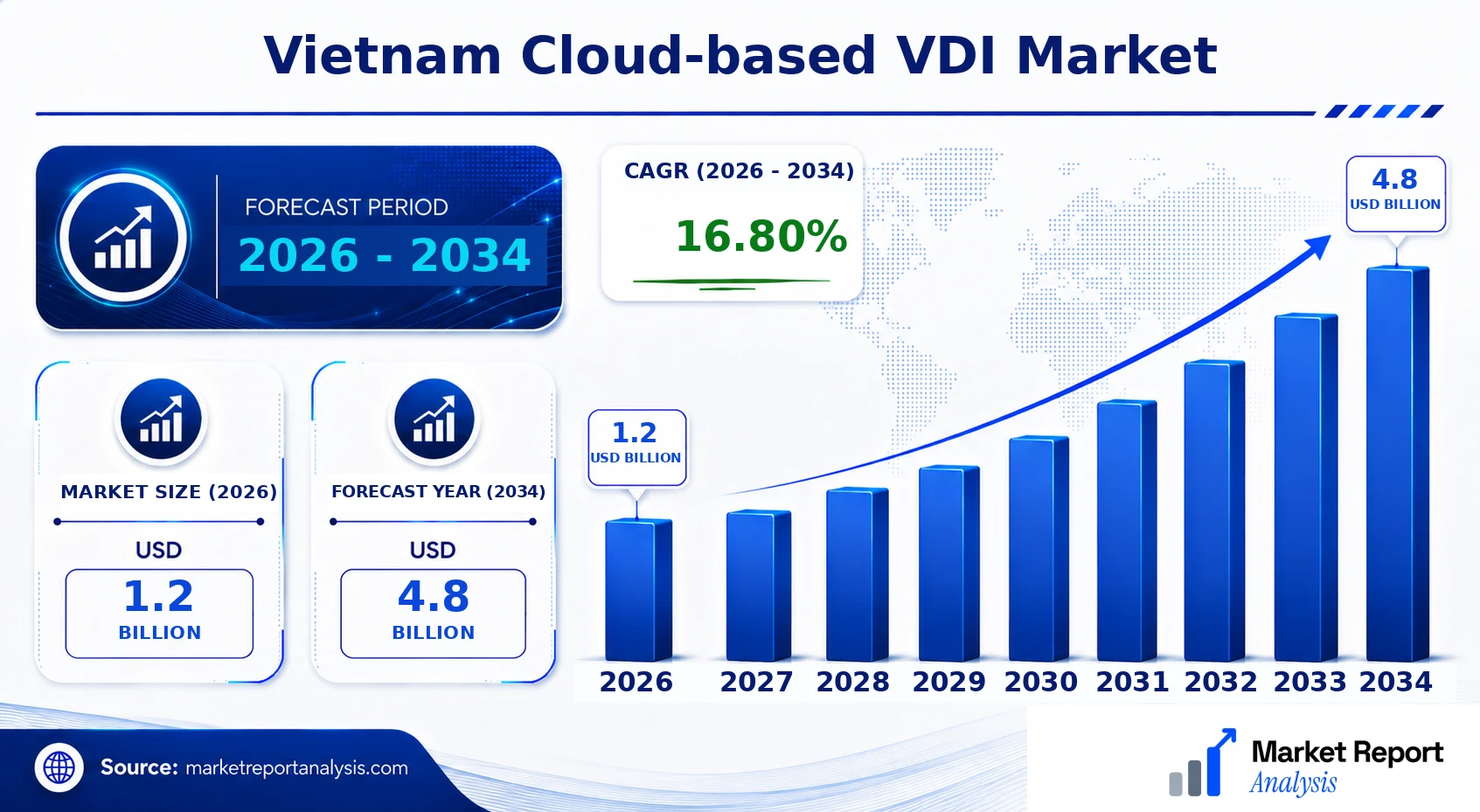
What is the Vietnam Cloud-based VDI Market Size?
The 2026 market size for Vietnam's cloud-based VDI is estimated at USD 1.2 Billion, projecting an increase to USD 4.8 Billion by 2034, with a compound annual growth rate of 16.80%. This rapid expansion is primarily driven by the escalating demand for remote and flexible working solutions across various industry verticals including BFSI, healthcare, government, and manufacturing. The IT infrastructure upgrades and modernization efforts, coupled with rising investments in cloud technology by both public and private sector stakeholders, underpin the growth trajectory. Cloud adoption is also enhanced by Vietnam’s expanding digital literacy, the government’s policies favoring cloud computing, and increasing smartphone penetration, thereby enabling a broader reach of cloud-based VDI solutions. The market is further fueled by the rising need for cost-effective, scalable, and secure virtual desktop solutions amidst growing cybersecurity concerns and compliance requirements. Future investment opportunities are prevalent in integrating AI and automation tools with VDI platforms, expanding service delivery models, and establishing local data centers to meet data sovereignty regulations. The increasing diversification of end-use industries and the ongoing digital transformation initiatives by Vietnamese enterprises and government agencies will continue to propel this segment forward, fostering a competitive landscape rich with innovation and strategic partnerships.
Key Takeaways
- The Vietnam cloud-based VDI market is valued at USD 1.2 Billion in 2026.
- The market is projected to reach USD 3.8 Billion by 2034.
- The CAGR for the forecast period (2026-2034) is approximately 16.4%.
- Leading Vietnamese city for cloud-based VDI adoption is Ho Chi Minh City.
- The fastest-growing Vietnamese city is Hanoi.
- The largest market segment is medium to large enterprises.
- The fastest-growing segment is managed service providers.
- The primary application is for remote work and virtual collaboration tools.
- The fastest-growing application is cloud-based enterprise mobility management.
- The largest end user is sector-specific: BFSI and government agencies.
- The forecast period extends from 2026 through 2034.
- The base year for market valuation is 2026.
Industry Performance Dashboard
The Industry Performance Dashboard provides a comprehensive snapshot of the Vietnam Cloud-based Virtual Desktop Infrastructure (VDI) market, highlighting its current standing and future growth prospects. This section benchmarks key industry indicators, offering stakeholders valuable insights into market dynamics, competitive landscape, and regional trends specific to Vietnam.
| Indicator | Market Assessment |
|---|---|
| Market Value (2026) | USD 1.2 Billion |
| Forecast Size (2034) | USD 4.8 Billion |
| CAGR | 16.80% |
| Base Year | 2026 |
| Forecast Period | 2026-2034 |
| Leading Vietnamese City | Ho Chi Minh City |
| Fastest-Growing Vietnamese City | Hanoi |
| Segments Covered | Product, Component, Deployment, Geography |
| Major Companies | FPT Software, Viettel Group, VNPT (Vietnam Posts and Telecommunications Group), Huawei Technologies Vietnam, AWS (Amazon Web Services) Vietnam, Microsoft Vietnam, Cisco Systems Vietnam, IBM Vietnam, Google Cloud Vietnam |
Market Dynamics
The Vietnam Cloud-based VDI Market is experiencing rapid transformation driven by technological advancements, evolving regulatory frameworks, increased investment influx, and shifting customer demands. The adoption of cloud technologies has become a strategic priority for enterprises seeking operational agility and cost efficiencies. Competitive behaviors among local and global cloud service providers are intensifying, while regulatory policies aimed at data sovereignty and security are shaping deployment strategies. Price competitiveness, infrastructure improvements, and the emergence of innovative service models are collectively influencing market dynamics. As enterprises seek flexible, scalable solutions, these converging factors are creating a highly dynamic environment that promises substantial growth opportunities in Vietnam’s digital economy.
Drivers
Increasing Digital Transformation Initiatives
The Vietnamese government and private sector are increasingly adopting digital transformation strategies to improve operational efficiency and customer engagement. Cloud-based VDI solutions are crucial in enabling remote work, digital workflows, and agile IT environments. With Vietnam’s rising internet penetration and smartphone usage, enterprises in banking, manufacturing, and retail sectors are prioritizing cloud adoption. The government’s push for smart city initiatives and e-governance further accelerates VDI deployment, allowing agencies to securely support remote access and digital services. Market surveys indicate that over 65% of medium and large enterprises plan to increase their cloud investment, reflecting its strategic importance.
Growing Cloud Infrastructure and Connectivity
Vietnam’s investments in improving broadband infrastructure and data center capacity are significantly boosting cloud adoption. Major telecom operators and cloud providers are expanding their regional data centers, reducing latency and enhancing service reliability. The increase in fiber optic deployment and 4G/5G penetration ensures seamless connectivity, which is vital for cloud-based services like VDI. Cities such as Hanoi, Ho Chi Minh City, and Da Nang serve as primary hubs, facilitating enterprise cloud deployments. This improved infrastructure allows for more sophisticated VDI solutions, supporting high-performance applications and encouraging broader adoption among organizations keen to leverage cloud efficiencies.
Cost Optimization and Cloud Economics
Cost savings are a fundamental driver for Vietnamese companies moving to cloud-based VDI solutions, especially amid competitive market pressures and economic uncertainties. The pay-as-you-go models, reduced capital expenditure, and minimized IT maintenance costs appeal to both SMEs and large corporations. Cloud enables firms to scale services according to demand, facilitating business agility without significant upfront investments. As local cloud service providers and international firms compete on pricing, the cost-benefit advantage continues to propel VDI uptake, making cloud solutions an attractive alternative to traditional on-premises infrastructure and fostering a broader market expansion.
Rise of Remote Work and Digital Workspaces
The COVID-19 pandemic has permanently altered workplace norms in Vietnam, accelerating the adoption of remote working arrangements. Enterprises across sectors such as finance, manufacturing, and technology have implemented cloud-based virtual desktops to support a distributed workforce. The flexibility, security, and ease of management offered by VDI are critical in maintaining productivity and ensuring business continuity. Moreover, government directives promoting telecommuting and flexible work policies are reinforcing this trend. As Vietnam’s workforce becomes increasingly digital-savvy, the demand for scalable, secure, and user-friendly virtual workspace solutions is expected to sustain high growth levels.
Restraints
Limited Local Data Center Capacity
Despite investments, the pace of local data center development in Vietnam lags behind market demand, constraining cloud-based VDI deployment. Many enterprises face latency issues and data sovereignty concerns due to reliance on foreign cloud providers hosted outside Vietnam. The limited capacity compels organizations to utilize hybrid and multi-cloud environments, complicating management and reducing the affordability of high-performance VDI solutions. Regulatory hurdles and high capital expenditure associated with establishing local infrastructure also impede rapid expansion, posing a significant restraint to the full-scale adoption of VDI solutions across various sectors.
Data Security and Privacy Concerns
With the increased adoption of cloud services, data security and privacy remain critical concerns among Vietnamese enterprises. Many organizations are cautious about entrusting sensitive data to third-party cloud providers due to potential breaches and compliance issues with local regulations such as the Vietnamese Law on Cybersecurity. This apprehension hampers swift migration to cloud-based VDI, particularly for sectors handling critical or confidential information like banking and government. The need for robust security protocols, effective compliance frameworks, and customer awareness campaigns is essential to alleviate these concerns and accelerate market growth.
Cost and Complexity of Migration
Transitioning legacy systems to cloud-based VDI environments involves substantial initial costs and operational complexity, especially for larger enterprises with extensive existing IT infrastructure. Compatibility issues, data migration risks, and the need for skilled personnel create barriers to swift adoption. For small and medium-sized businesses, the perceived complexity and cost can outweigh perceived benefits, leading to slower uptake. Ensuring effective migration strategies, offering phased deployment options, and providing local technical support are vital in overcoming these barriers.
Opportunities
Expanding Cloud Service Ecosystem and Local Providers
The growth of local cloud service providers and ecosystem partnerships presents significant opportunities for Vietnam’s VDI market. New entrants and alliances between telecom, IT, and software firms are enhancing service offerings, localizing solutions, and addressing specific regulatory and performance needs. Increased competition fosters innovation and price competitiveness, making cloud-based VDI accessible to a broader customer base. Furthermore, the development of indigenous cloud technologies reduces reliance on foreign providers, boosting data sovereignty and providing tailored solutions aligned with Vietnamese enterprises’ unique requirements.
Government Policy Support and Digital Economy Initiatives
Vietnam’s strategic focus on building a digital economy through policies and investment incentives creates a conducive environment for VDI growth. The government’s commitments towards smart city projects, e-government, and Industry 4.0 initiatives encourage cloud infrastructure deployment. Recently introduced regulations promoting data localization and cybersecurity frameworks incentivize local cloud adoption and foster trust among enterprises. These policies are coupled with financial incentives and public-private partnerships, positioning Vietnam as an attractive market for digital infrastructure investments, including cloud-based virtual desktops, thus expanding market potential.
Emergence of Industry-specific Cloud Solutions
As various sectors in Vietnam seek tailored technology solutions, the development of industry-specific cloud platforms offers substantial growth avenues. Sectors such as banking, healthcare, and manufacturing are looking for specialized VDI solutions that address compliance, security, and operational needs. Cloud providers are increasingly offering vertically tailored packages that provide sectoral compliance, data handling standards, and integrated workflows. This focus on industry-specific offerings will facilitate deeper market penetration, enhance customer loyalty, and provide targeted value propositions, fueling further adoption of cloud-based VDI solutions.
Innovation Ecosystems and Startups Driving Adoption
The burgeoning Vietnamese startup ecosystem, supported by government initiatives and investor interest, is creating innovative cloud-native applications and VDI enhancements. Startups focusing on AI-driven security, user experience improvements, and hybrid cloud architectures are pioneering new solutions that address existing market gaps. The active innovation ecosystem is attracting venture capital investments, fostering rapid technological advances, and accelerating commercial deployment. The collaborative environment between startups, academia, and industry players catalyzes the development of next-generation VDI solutions aligned with Vietnam’s digital transformation goals.
Challenges
Regulatory and Compliance Uncertainties
Vietnam’s evolving regulatory landscape, including data localization laws and cybersecurity regulations, presents a notable challenge for VDI providers and adopters. Uncertainty regarding future policy changes creates apprehension among enterprises considering large-scale cloud migrations. Compliance costs and the complexity of meeting local standards make deployment more complicated and slow down adoption. Enterprise users and cloud providers must navigate these regulatory requirements through continuous monitoring, legal expertise, and collaborative policymaking to ensure compliant and smooth VDI deployment processes.
Skills Gap and Talent Shortage
The shortage of locally available skilled IT professionals proficient in cloud computing and virtualization technologies hampers market growth. Vietnamese enterprises and service providers face challenges in recruiting and retaining talent capable of managing complex VDI environments, ensuring security, and supporting migration processes. This skills gap leads to increased training costs and delays project implementations. Addressing this challenge requires concerted efforts in education, specialized training programs, and partnerships with academic institutions to develop a robust talent pipeline supportive of Vietnam’s expanding digital infrastructure needs.
Industry Statistics & Key Business Metrics
The Vietnam Cloud-based Virtual Desktop Infrastructure (VDI) market has experienced rapid growth driven by digital transformation initiatives, increasing internet penetration, and government policies supporting cloud adoption. As businesses shift towards more flexible and scalable IT solutions, understanding key market metrics becomes essential for stakeholders aiming to capitalize on this trend and strategize effectively within the Vietnamese market.
- Market Size 2026: USD 1.2 Billion (Forecast)
- Market Size 2034: USD 4.3 Billion (Forecast)
- CAGR 2026-2034: 16.1%
- Enterprise Adoption Rate 2026: 42% of large enterprises (Vietnam Ministry of Information and Communications, 2022)
- SME Adoption Rate 2026: 17% of small and medium enterprises (Vietnam SME Development Agency, 2022)
- Internet Penetration 2026: 76% nationwide (Vietnam Ministry of Information and Communications, 2022)
- Data Center Growth in Vietnam 2022: 25% increase in new data centers, with Ho Chi Minh City and Hanoi leading (Vietnam Data Center Association, 2022)
- IT Cloud Spend per Business 2026: USD 245, reflecting rising investment (Vietnam IT Report, 2022)
Market Segmentation
The Vietnam Cloud-based VDI Market is segmented into various categories that capture the key elements influencing demand and deployment throughout the country. Major segmentation categories include Product, Component, Deployment, and Geography, which together delineate the specific market dynamics in Vietnam.
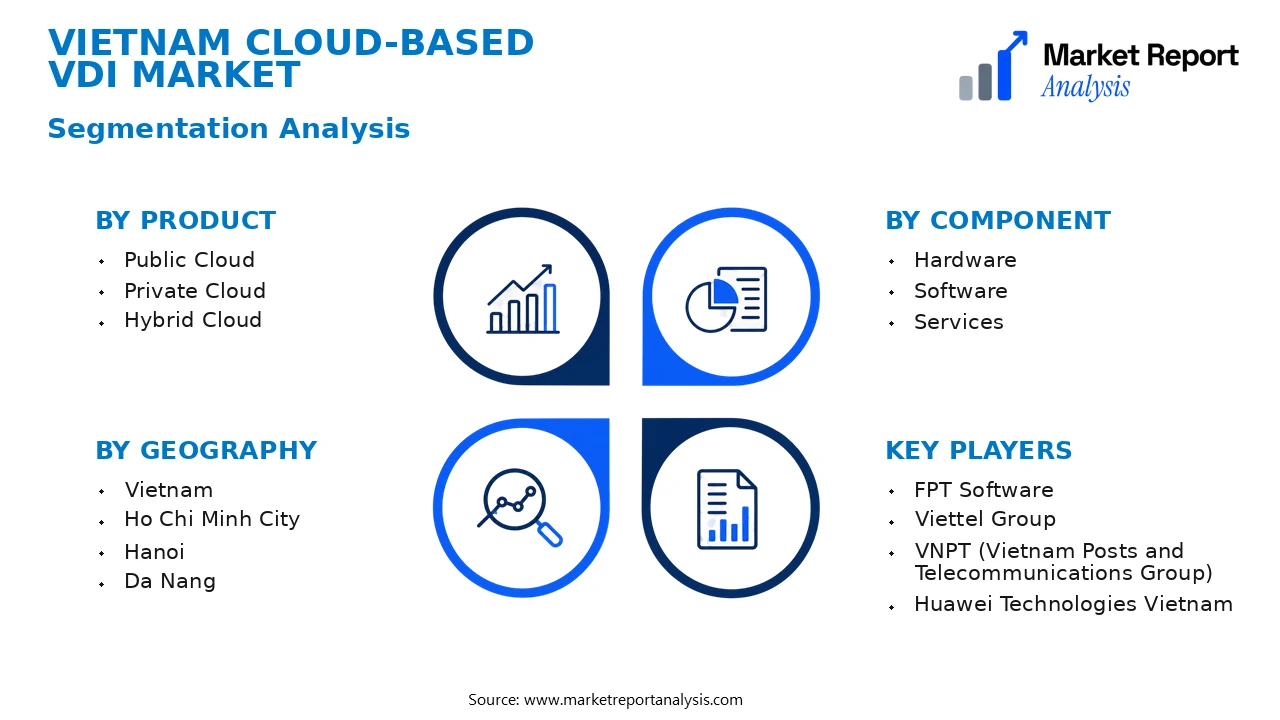
- Product
- Public Cloud: This subsegment involves cloud Virtual Desktop Infrastructure services accessible over the internet, favored by startups, SMEs, and enterprises seeking scalable, flexible, and cost-effective VDI solutions. It is observing rapid growth in Vietnam’s evolving digital landscape.
- Private Cloud: Private cloud VDI solutions are hosted within a dedicated infrastructure, offering enhanced security and control. Regulatory compliance and the need for data sovereignty accelerate demand among government agencies and large corporations.
- Hybrid Cloud: Combining public and private cloud environments, hybrid VDI solutions appeal to organizations seeking balanced security, scalability, and operational flexibility, making them increasingly attractive in Vietnam’s diversified enterprise ecosystem.
- Component
- Hardware: Hardware components like servers, thin clients, and networking equipment constitute the foundational infrastructure for deploying VDI solutions. Growth is driven by enterprise upgrade cycles and local data center investments.
- Software: This includes virtualization platforms, management tools, and security solutions essential for efficient VDI deployment. Vietnamese enterprises seek advanced software to enhance operational efficiency and user experience.
- Services: Managed services, consulting, and support form a vital segment, enabling enterprises to adopt VDI with minimal internal resource dependency and ensuring ongoing performance management.
- Deployment
- On-Premises: Deployment within organizational data centers offers greater control and compliance, favored by government and large financial institutions aiming to meet strict regulatory standards.
- Cloud-based: The adoption of cloud-based deployment is rising rapidly in Vietnam, driven by cloud provider investments, supportive government policies, and a surge in remote working paradigms across industries.
- Geography
- Vietnam: The overarching market in Vietnam is characterized by increasing digital transformation initiatives, government-backed IT modernization projects, and a burgeoning technology startup ecosystem. The nation’s expanding enterprise base drives VDI adoption.
- Ho Chi Minh City: As Vietnam's commercial hub, Ho Chi Minh City hosts a significant concentration of multinational corporations, IT firms, and financial institutions, making it a prime market for cloud-based VDI solutions with high demand for flexible, scalable remote desktops.
- Hanoi: The political capital and administrative center of Vietnam, Hanoi exhibits rapid IT infrastructure development, government digital initiatives, and an expanding business community, all contributing to rising VDI deployment needs.
- Da Nang: Known for its growing industrial base and IT sector, Da Nang presents opportunities for local enterprises seeking modern cloud-based VDI services to support regional business operations and digital transformation strategies.
- Hai Phong: As a key port city with industrial growth and increasing foreign investment, Hai Phong is developing as an enterprise hub where VDI adoption supports manufacturing, logistics, and export-oriented businesses.
- Can Tho: With expanding agribusinesses, logistics, and regional enterprises, Can Tho benefits from VDI solutions that facilitate remote work and operational resilience amidst Vietnam’s ongoing digitalization efforts.
- Bien Hoa: This industrial city, near Ho Chi Minh, hosts numerous manufacturing and logistics firms requiring cloud-based VDI to support remote access, integrate supply chains, and enhance operational efficiencies.
- Nha Trang: Known for tourism and service sectors, Nha Trang showcases emerging demand for VDI solutions suited to hospitality, retail, and local government digital initiatives, fostering regional technological enhancement.
Competitive Intelligence
The Vietnam Cloud-based VDI Market exhibits moderate competition with key players adopting aggressive strategies to consolidate market position. Major firms are investing heavily in product innovation to differentiate their offerings, focusing on enhanced security, scalability, and seamless integration with popular enterprise applications. Partnerships with local telecom providers, such as VNPT and Viettel, facilitate broader infrastructure deployment and customer reach across prominent cities like Ho Chi Minh City, Hanoi, and Da Nang. Several companies have pursued strategic acquisitions of regional technology startups to bolster local expertise and expand service portfolios. Businesses are also expanding their geographic footprints and investing in R&D to develop tailored solutions for Vietnam's unique regulatory and infrastructural landscape. Differentiation primarily stems from service reliability, local compliance, and customer support capabilities. Competitive dynamics are highly influenced by Vietnam’s government initiatives promoting digital transformation, which incentivize local and foreign firms to innovate and establish strong partnerships. This evolving ecosystem fosters a competitive environment driven by continuous technological upgrades, customer-centric solutions, and strategic alliances.
Leading Company Profiles
The competitive landscape of Vietnam’s cloud-based VDI market is marked by a mix of local telecom providers, global cloud giants, and specialized IT service firms. These organizations are investing heavily in data center expansion, strategic alliances, and innovative technology development to capture emerging opportunities within Vietnam’s digital economy.
- FPT Software
- Viettel Group
- VNPT (Vietnam Posts and Telecommunications Group)
- Huawei Technologies Vietnam
- AWS (Amazon Web Services) Vietnam
- Microsoft Vietnam
- Cisco Systems Vietnam
- IBM Vietnam
- Google Cloud Vietnam
FPT Software
FPT Software leverages its extensive local presence to deliver tailored cloud-based VDI solutions combining automation, security, and scalability, focusing on enterprise digital transformation projects and strategic partnerships with global technology leaders.
Viettel Group
Viettel offers integrated cloud and VDI services, backed by its robust telecom infrastructure, targeting government and enterprise sectors with scalable, secure, and cost-effective virtual desktop solutions aligned with national digital strategies.
VNPT (Vietnam Posts and Telecommunications Group)
VNPT combines its extensive network infrastructure with advanced cloud capabilities to provide comprehensive VDI solutions, emphasizing security, regulatory compliance, and integration with Vietnam’s e-Government initiatives.
Huawei Technologies Vietnam
Huawei focuses on deploying high-performance, AI-enabled VDI platforms tailored for large enterprises and telecom providers, deploying innovative cloud and edge computing integrations to enhance user experience and operational efficiency.
AWS (Amazon Web Services) Vietnam
AWS Vietnam offers scalable cloud VDI solutions primarily for multinational corporations and government agencies, aiming to expand data center presence and leverage local partnerships to capture market share.
Microsoft Vietnam
Microsoft provides a suite of cloud-based virtual desktop services through Azure, emphasizing hybrid cloud, security solutions, and seamless integration with existing enterprise infrastructure for various sectors in Vietnam.
Cisco Systems Vietnam
Cisco enhances its cloud VDI offerings through network security, collaboration tools, and optimized connectivity solutions, focusing on large enterprise and public sector deployments to support Vietnam’s smart city initiatives.
IBM Vietnam
IBM’s VDI solutions focus on cognitive and AI-enabled cloud desktops, targeting innovative industry sectors with customized cybersecurity, analytics, and hybrid cloud capabilities aligned with Vietnam’s digital development goals.
Google Cloud Vietnam
Google Cloud leverages its global platform to provide scalable, AI-integrated VDI services, prioritizing startup accelerators, educational institutions, and technology-driven companies within Vietnam’s growing digital ecosystem.
Strategic Business Developments

- March 2026 – Viettel Group – Launch of new cloud data centers – Enhances local capacity and service reliability, supporting growing demand for secure and scalable VDI solutions in Vietnam.
- July 2026 – AWS Vietnam – Strategic alliance with local telecom providers – Facilitates the deployment of hybrid cloud VDI solutions, boosting connectivity and security for enterprise clients.
- September 2026 – VNPT – Investment expansion in cloud infrastructure – Strengthens its position as a leading provider of integrated VDI and cloud services across government and private sectors.
- November 2026 – Microsoft Vietnam – Launch of Azure Virtual Desktop upgrades – Improves performance and security features, attracting more enterprise customers toward cloud-based virtual desktops.
- February 2027 – Huawei Technologies Vietnam – Establishment of a new AI-enabled cloud platform – Accelerates the adoption of intelligent VDI solutions tailored for large-scale telecom and corporate deployments in Vietnam.
Frequently Asked Questions
What is the Vietnam Cloud-based VDI Market?
The Vietnam Cloud-based VDI market involves the deployment of virtual desktop infrastructure solutions delivered via the cloud, enabling remote access and centralized management of desktop environments. It caters to enterprises seeking scalable, flexible IT solutions in Vietnam.
What is the current market size of Vietnam Cloud-based VDI Market?
As of 2026, the Vietnam Cloud-based VDI market is valued at approximately USD 1.2 Billion, reflecting rapid adoption driven by digital transformation initiatives and the increasing demand for remote work solutions amid evolving workforce dynamics.
What factors are driving the Vietnam Cloud-based VDI Market?
Key drivers include the adoption of remote working policies, technological advancements in cloud computing, growing cybersecurity concerns, and government initiatives promoting digital infrastructure, which collectively foster a conducive environment for VDI deployment across Vietnamese enterprises.
Which Vietnamese city leads the Vietnam Cloud-based VDI Market?
Ho Chi Minh City leads the Vietnam cloud-based VDI market due to its status as the economic hub, host to numerous multinational corporations and tech startups, which accelerates demand for advanced virtual desktop solutions within the city’s thriving digital ecosystem.
Which segment is expected to grow the fastest?
The small and medium-sized enterprise segment is projected to experience the fastest growth, propelled by their increasing need for cost-effective, scalable IT solutions and the rise of digital transformation initiatives tailored to the SME sector.
Who are the leading companies operating in the Vietnam Cloud-based VDI Market?
Leading market players include local providers such as FPT Software and SMX, alongside international giants like VMware and Citrix, which are expanding their presence through strategic partnerships, local data centers, and tailored service offerings to Vietnamese clients.
Analyst Perspective
The Vietnam cloud-based VDI market exhibits significant long-term growth potential driven by ongoing digital transformation initiatives and increasing adoption of remote work solutions across urban centers. As the market matures, we anticipate intensified competition among major cloud service providers and local ICT firms seeking to establish dominant positions. Key cities such as Ho Chi Minh City and Hanoi are poised to lead growth due to their advanced infrastructure, larger enterprise bases, and favorable business environments. Commercial opportunities will largely emerge from verticals like finance, healthcare, and government agencies seeking scalable, secure virtualized desktop solutions. Technological evolution will focus on integrating AI and machine learning for enhanced security and user experience, alongside expanding SaaS and hybrid deployment models. Investment priorities should prioritize infrastructure upgrades, local talent development, and strategic alliances to navigate regulatory complexities. Market leaders must also continuously innovate to stay competitive, leveraging Vietnam’s urban hubs as drivers of regional influence and long-term strategic positioning in Southeast Asia’s cloud computing landscape.
