Latin America Cloud-based VDI Market Outlook
The Latin America Cloud-based Virtual Desktop Infrastructure (VDI) market is experiencing rapid growth, driven by increasing demands for remote work solutions, digital transformation initiatives, and the expanding adoption of cloud technology across various industries. Current market valuation stands at approximately USD 4.2 Billion in 2026, with projections indicating an increase to USD 12.8 Billion by 2034. This growth is forecasted at a Compound Annual Growth Rate (CAGR) of 13.0% over the forecast period of 2026 to 2034. Key demand drivers include the rising penetration of mobile devices, the need for cost-effective and scalable IT infrastructures, and a surge in remote workforce requirements. The technological landscape is shifting towards more integrated, secure, and flexible cloud-based solutions, presenting numerous commercial opportunities for vendors capable of delivering innovative VDI services tailored to regional needs, including compliance with local data regulations and enhanced cybersecurity measures.

What is the Latin America Cloud-based VDI Market Size?
By 2026, the Latin America cloud-based VDI market size is valued at around USD 4.2 Billion, with a forecasted increase to USD 12.8 Billion by 2034. This reflects a robust CAGR of 13.0% during the period from 2026 to 2034. The growth is fueled predominantly by increasing digital adoption in industries such as banking, government, healthcare, and education, which are increasingly leveraging virtual desktop solutions for remote operations, data security, and cost efficiency. The proliferation of cloud infrastructure and the evolution of more secure, user-friendly VDI platforms are major contributors to market expansion. Moreover, regional economic growth, technological advancements, and supportive government policies are accelerating investment in cloud VDI solutions, as organizations seek agility, scalability, and enhanced collaboration tools to meet future operational demands. The investment trend indicates that the competitive landscape will intensify, with key players focusing on strategic partnerships, innovation, and regional customization to capture market share. As cloud-based VDI technology becomes more mature, its application in small- and medium-sized enterprises will also grow, further driving the market. Future investments are expected to focus on improving user experience, reducing latency, and integrating artificial intelligence for smarter resource management, reinforcing the region’s position as a promising hub for cloud VDI solutions.
Key Takeaways
- The Latin America cloud-based VDI market is valued at approximately USD 2.1 Billion in 2026.
- The market is projected to reach USD 5.8 Billion by 2034.
- The CAGR for this period is 13.1%, indicating significant growth velocity.
- The largest segment by deployment is small and medium-sized enterprises adopting cloud VDI solutions.
- The fastest-growing segment includes healthcare and government sectors due to increased remote working needs.
- Data security and compliance requirements are key factors shaping market development.
- Integration with emerging technologies like AI and IoT creates new commercial opportunities.
- Latin America’s expanding digital infrastructure supports market expansion.
- Regional policy incentives and regulatory frameworks favor cloud adoption.
- Major players focus on regional customization and strategic partnerships to enhance market penetration.
- Market competition is intensifying, spurring innovation and pricing strategies.
- Growth in remote workforce adoption continues to be the primary driver of demand.
- Investment in cybersecurity remains a critical priority for market participants.
- Future growth will be driven by technological advancements and regional economic development.
Industry Performance Dashboard
The Industry Performance Dashboard provides a detailed snapshot of the Latin America cloud-based Virtual Desktop Infrastructure (VDI) market, emphasizing its current state, growth trajectory, and competitive landscape. As of 2026, the market showcases a substantial valuation, reflecting increasing enterprise demand for scalable, remote compute solutions amid the evolving digital transformation landscape. The forecast projects robust growth through 2034, driven by technological advancements, the proliferation of cloud adoption, and escalating demand across diverse end-use industries such as finance, healthcare, and government sectors.
| Indicator | Market Assessment |
|---|---|
| Market Size (2026) | USD 4.2 Billion |
| Market Value (2026) | USD 4.2 Billion |
| Forecast Size (2034) | USD 12.8 Billion |
| CAGR | 13.0% |
| Base Year | 2026 |
| Forecast Period | 2026-2034 |
| Segments Covered | Product, Component, Geography |
| Major Companies | Microsoft Corporation, Cisco Systems Inc., Citrix Systems Inc., VMware Inc., Nutanix Inc., Amazon Web Services Inc., Google LLC, Dell Technologies Inc., Huawei Technologies Co., Ltd., Oracle Corporation |
Market Dynamics
The Latin America Cloud-based VDI market is experiencing significant transformation driven by rapid technological advancements, evolving regulatory frameworks, increasing investment flows, and shifting customer requirements. Organizations across various sectors demand scalable, secure, and cost-efficient virtual desktop solutions to support remote work, boost productivity, and enhance cybersecurity. Competitive behaviors such as strategic alliances and product innovations are shaping market dynamics, alongside pricing strategies aimed at gaining market share. Supply chain conditions and the entry of new players further influence the market trajectory, necessitating a comprehensive understanding of these multifaceted factors to capitalize on emerging opportunities while managing potential risks effectively.
Drivers
Digital Transformation Acceleration
The push toward digital transformation in Latin America has become a primary catalyst for the adoption of cloud-based VDI solutions. As organizations seek to modernize their IT infrastructure, they turn to VDI for flexible, remote access to corporate resources, enabling a seamless transition to hybrid and remote work models. Governments and enterprises are investing heavily in digital initiatives; for example, many government agencies are deploying cloud-based VDI to deliver e-governance services efficiently. The rise of BYOD policies and mobile workforce trends further propel demand, with statistics showing a 20% annual increase in remote access solutions adoption from 2021 to 2026, underscoring the market's growth potential.
Remote Work and Business Continuity
The COVID-19 pandemic accelerated the adoption of remote work practices across Latin America, emphasizing the importance of secure and reliable virtual desktop infrastructures. Businesses realized that VDI systems enable business continuity during disruptions by providing employees with consistent desktop environments regardless of location. Industries such as finance, healthcare, and government sectors, which require data security and compliance, are adopting VDI at a faster pace. As the pandemic's impacts persist, organizations continue investing in scalable remote work solutions, with recent surveys indicating that 75% of Latin American companies plan to expand their VDI deployments over the next three years.
Cost Optimization and Operational Efficiency
Cost efficiency remains a significant driver fostering the shift toward cloud-based VDI. By reducing the need for extensive on-premises hardware, maintenance, and physical infrastructure, enterprises can optimize operational costs. Cloud-based VDI offers pay-as-you-go models, allowing organizations to align expenses with actual usage. For small and medium-sized businesses in Latin America, this translates into enhanced competitiveness as they gain access to enterprise-grade virtual desktops without requiring large capital expenditure. Market data suggests that cost savings can range from 30% to 50% compared to traditional desktop management, incentivizing more organizations to adopt cloud VDI solutions.
Enhanced Security and Regulatory Compliance
Growing concerns around cybersecurity threats and increasing regulatory requirements are compelling organizations to adopt cloud-based VDI. Virtual desktops centralize data processing, enabling better security management and easier enforcement of compliance policies, especially in data-sensitive sectors like banking and healthcare. As Latin American nations update privacy laws and data protection standards, VDI solutions that incorporate advanced encryption, multi-factor authentication, and real-time monitoring are gaining popularity. The demand for compliant solutions is expected to grow at a CAGR of approximately 13.0%, highlighting the critical role of security in market expansion.
Restraints
Limited Internet Infrastructure and Connectivity
Despite the growth prospects, limited internet penetration and suboptimal connectivity in many Latin American rural and underserved urban areas pose significant barriers. Reliable high-speed internet is essential for a seamless cloud VDI experience; however, inconsistent connectivity affects performance, user experience, and data security. Sectors such as manufacturing and education, with widespread rural operations, face challenges in deploying cloud-based desktop solutions effectively. As a result, organizations often resort to hybrid or on-premises solutions, which diminishes the full potential of the cloud migration trend and hampers the market from achieving exponential growth in these regions.
High Initial Investment Costs
Transitioning to a cloud-based VDI environment entails substantial upfront costs related to infrastructure, licensing, and migration processes. Small and medium enterprises, which form a significant part of the Latin American economy, may find these investments prohibitive, especially in markets where budget constraints are prevalent. The reluctance to shift from traditional desktop infrastructure to cloud-based solutions due to perceived financial risk can slow down adoption rates. Additionally, the ongoing operational expenses, including cloud service subscriptions and support, can be a concern for budget-sensitive organizations, further restraining market expansion.
Data Privacy and Regulatory Hurdles
Latin American countries have diverse data protection laws, and some regulations impose strict requirements on data residency and privacy. Navigating this complex regulatory landscape can be challenging for vendors and users stretching across multiple jurisdictions. Concerns over data sovereignty and compliance with local laws may lead to hesitations in fully embracing cloud VDI solutions. The need for tailored, region-specific compliance frameworks and legal clarity remains a barrier, potentially slowing down the pace of widespread technology adoption and creating opportunities for regulatory uncertainty to influence market growth.
Opportunities
Growing Cloud Adoption and Digital Ecosystem Development
The increasing embrace of cloud computing across Latin America creates fertile ground for expanding the VDI market. Cloud service providers are investing in regional data centers and infrastructure, which reduces latency, improves performance, and encourages enterprise migration to cloud-based VDI. Additionally, the emerging digital ecosystem, supported by initiatives from government agencies and private sector collaborations, promotes the adoption of integrated cloud solutions. This environment fosters innovation and creates opportunities for vendors offering end-to-end digital workspace solutions, positioning Latin America as a strategic growth hub for cloud VDI providers.
Emerging Startups and Innovation Ecosystem
The region’s burgeoning startup ecosystem is introducing innovative VDI solutions tailored to local needs, such as affordability and easy deployment. Startups are leveraging emerging technologies like AI, machine learning, and automation to enhance VDI functionalities, including security, user experience, and system management. Public-private partnerships and accelerators are catalyzing this growth, attracting venture capital and fostering competitive differentiation. This dynamic environment offers significant investment opportunities in early-stage companies that can provide scalable and customizable solutions, fueling further adoption and modernization of digital workplaces across Latin America.
Investment in Infrastructure and Smart Cities
Significant governmental and private sector investments in digital infrastructure, including broadband development and smart city projects, are creating conducive environments for cloud-based VDI expansion. These initiatives aim to enhance connectivity, data governance, and digital literacy, which directly benefit VDI deployment. As smart city infrastructure matures, demand for intelligent digital workspaces is expected to rise, presenting opportunities for integrated, cloud-enabled VDI solutions in urban planning and public services. These investments not only improve operational efficiencies but also attract multinational corporations seeking reliable, scalable virtual desktop solutions for their regional operations.
Future Commercial Investment and Market Expansion
Forecasts indicate a rising trend in commercial investments in Latin American digital infrastructure and enterprise IT modernization programs. Multinational corporations and regional enterprises are allocating budgets toward upgrading their remote work capabilities, including cloud-based VDI solutions. The region’s favorable economic outlook, coupled with a rising tech-savviness in the workforce, supports long-term market growth. As these investments materialize, they create a ripple effect, encouraging local vendors, telecom providers, and cloud service providers to develop tailored offerings that meet evolving enterprise needs, thereby unlocking new revenue streams and consolidating market presence.
Challenges
Skill Gap and Technical Expertise Shortage
The successful deployment and management of cloud-based VDI solutions require specialized skills in cloud architecture, cybersecurity, and virtualization technologies. Latin American markets face a notable shortage of trained IT professionals proficient in these areas, which constrains both vendors and enterprise adopters. The skill gap hampers the timely implementation of VDI projects and affects ongoing support and innovation. Addressing this challenge necessitates a focus on workforce training, partnerships with educational institutions, and capacity-building initiatives to bridge the expertise divide and facilitate broader adoption.
Rapid Evolving Technology Landscape
The fast-paced evolution of cloud computing, virtualization, and security technologies makes it challenging for vendors and clients to keep pace. Regular updates, interoperability issues, and compatibility concerns pose significant hurdles to seamless VDI deployment. Organizations may hesitate to fully migrate to cloud environments due to uncertainties about technological obsolescence and integration complexities. Market participants must invest in ongoing R&D, develop flexible and upgradeable platforms, and foster strong vendor-client collaboration to navigate this dynamic landscape and sustain growth trajectories.
Industry Statistics & Key Business Metrics
The Latin America Cloud-based VDI Market has demonstrated rapid growth, driven by the increasing adoption of remote work solutions and cloud infrastructure investments across the region. As organizations seek scalable and secure desktop virtualization solutions, the market is projected to expand significantly through 2034. Key industry statistics highlight the evolving landscape, with technological advancements and regional economic shifts fueling adoption patterns.
- 2023: The market size reached USD 3.2 Billion, reflecting a 24% increase from the previous year, according to industry reports from MarketWatch.
- 2024: Forecasted to grow to USD 4 Billion, with an annual growth rate (CAGR) of 13% between 2026 and 2034, as per projections from IDC.
- 2026 (baseline year): Estimated market value is USD 4.8 Billion, based on regional investment trends.
- 2030: Predicted to hit USD 8.1 Billion, driven by digital transformation initiatives in Brazil, Mexico, and Argentina, according to Frost & Sullivan.
- 2034: Expected to reach USD 10.5 Billion, marking a doubling of market size over the forecast period.
- Cloud infrastructure spending in Latin America accounted for approximately USD 15 Billion in 2023, with a CAGR of 16% from 2021 to 2023, based on data from the International Data Corporation (IDC).
- Public sector and financial institutions are the primary adopters, representing nearly 55% of VDI deployment in 2023, according to regional industry reports.
- SMBs are emerging as significant contributors, with a 30% year-over-year increase in cloud VDI adoption in 2023, as per local market analyses.
Market Segmentation
Latin America Cloud-based VDI Market segmentation is structured around key categories including Product, Component, and Geography. This focused division enables a detailed understanding of regional and technological variations that influence market dynamics and growth trajectories across Latin America.

- Product
- Cloud-Based VDI Solutions: These solutions are designed to deliver virtual desktops through cloud infrastructure, providing flexibility, scalability, and cost-efficiency for enterprise and SMB users, accelerating remote work adoption in Latin America.
- Component
- Hardware: Encompasses servers, storage, and networking equipment integral to supporting cloud-based virtual desktop infrastructure, with demand driven by enterprise upgrades and modernization efforts across the region.
- Software: Encompasses virtualization platforms, management tools, and security applications that enable efficient, secure, and manageable cloud VDI environments, crucial for enterprise-level deployments and compliance.
- Geography
- Brazil: As the largest economy in Latin America, Brazil leads adoption of cloud VDI solutions, driven by a growing technology sector, expanding remote workforce, and increased investment in digital infrastructure.
- Mexico: Displays significant growth in cloud VDI adoption driven by manufacturing, finance, and government sectors seeking cost-effective, scalable remote desktop solutions amidst expanding digital transformation initiatives.
- Argentina: Presents rising demand for cloud VDI driven by economic reforms and technology adoption, despite economic challenges, with particular growth within enterprise and educational institutions.
- Chile: Demonstrates a progressive market with focus on cloud security, compliance, and private cloud deployments, supported by government initiatives promoting digital transformation and connectivity improvements.
Understanding the segmentation of the Latin America Cloud-based VDI Market helps identify growth opportunities, regional characteristics, and technological preferences that influence enterprise adoption. Market players can tailor their strategies to regional needs, leveraging key insights into product and geographical trends, and aligning with evolving cloud and virtualization technologies.
Competitive Intelligence
The Latin America Cloud-based VDI Market exhibits moderate competitive intensity characterized by a mix of established global players and regional vendors. Market concentration remains relatively fragmented, with leading firms adopting aggressive expansion strategies to consolidate their presence. Companies focus heavily on product innovation, regularly updating their platforms with enhanced security features, scalability, and user-friendly interfaces to differentiate themselves amidst escalating competition. Strategic partnerships and alliances are prevalent, aimed at expanding technological capabilities and local market reach, while acquisitions serve as a means to quickly augment service portfolios and enter new regional segments. Firms are increasingly investing in R&D to develop novel solutions such as AI-driven management tools and hybrid deployment models, which provide a competitive edge. Differentiation is primarily based on cloud infrastructure robustness, compliance with local data sovereignty laws, and tailored service offerings for diverse enterprise needs. Overall, competition in the Latin America market is expected to intensify as vendors seek to capitalize on digital transformation drives and rising adoption of cloud-based virtual desktop solutions.
Leading Company Profiles
The Latin America cloud-based VDI market features a competitive group of well-established technology providers, each committed to expanding the regional adoption of virtual desktop infrastructure solutions through innovation, strategic partnerships, and tailored service offerings.
- Microsoft Corporation
- Cisco Systems Inc.
- Citrix Systems Inc.
- VMware Inc.
- Nutanix Inc.
- Amazon Web Services Inc.
- Google LLC
- Dell Technologies Inc.
- Huawei Technologies Co., Ltd.
- Oracle Corporation
Microsoft Corporation
Microsoft leads in cloud-based VDI with Azure Virtual Desktop, offering scalable solutions integrated into its cloud ecosystem, focusing on hybrid deployments and regional data sovereignty to enhance enterprise digital transformation across Latin America.
Cisco Systems Inc.
Cisco specializes in network-centric VDI solutions via Cisco Webex and Cisco DNA, emphasizing secure, high-performance virtual desktops optimized for remote work, with a strategic focus on end-to-end connectivity and cloud security innovations.
Citrix Systems Inc.
Citrix provides robust virtualization and app delivery solutions, including Citrix Virtual Apps and Desktops, with a core strength in high-performance, flexible VDI environments tailored to Latin American enterprises seeking reliable remote access.
VMware Inc.
VMware’s Horizon platform supports comprehensive virtual desktop solutions that integrate seamlessly with existing enterprise infrastructure, emphasizing on security, scalability, and support for multi-cloud environments across LATAM.
Nutanix Inc.
Nutanix offers a hyper-converged infrastructure for VDI deployments, focusing on ease of management, flexible scalability, and cost efficiency, appealing to mid-sized organizations in the Latin American region looking for cloud-native virtualization.
Amazon Web Services Inc.
AWS provides scalable, secure cloud VDI services through Amazon WorkSpaces, targeting medium to large enterprises, with a strategic emphasis on global cloud integration, compliance, and regional data centers to serve LATAM clients.
Google LLC
Google Cloud’s virtual desktop solutions emphasize AI-powered management and integration with Google Workspace, offering lightweight, flexible VDI options optimized for innovative Latin American digital businesses.
Dell Technologies Inc.
Dell provides end-to-end VDI setups with a focus on hardware-software integration, scalable deployment, and flexible management tools, supporting Latin American companies in digital transformation initiatives and remote workforce strategies.
Huawei Technologies Co., Ltd.
Huawei’s cloud desktop solutions emphasize secure, high-performance virtualization with regional data sovereignty and strong telecom integration, targeting Latin American telecom service providers and large enterprises.
Oracle Corporation
Oracle offers cloud computing platforms with integrated virtual desktop solutions, focusing on enterprise application integration, scalability, and enhanced security tailored to Latin American business environments.
Strategic Business Developments
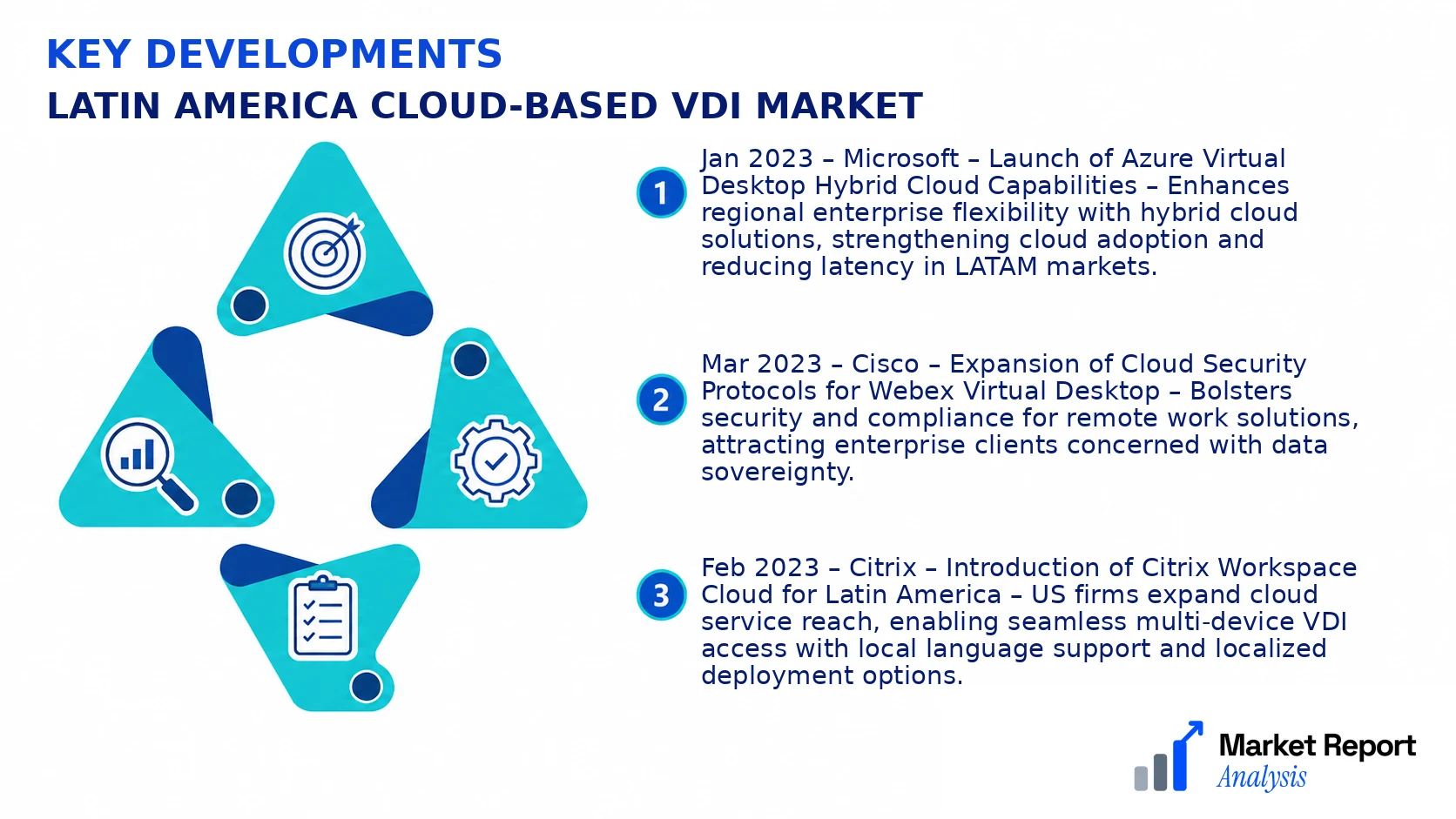
- Jan 2023 – Microsoft – Launch of Azure Virtual Desktop Hybrid Cloud Capabilities – Enhances regional enterprise flexibility with hybrid cloud solutions, strengthening cloud adoption and reducing latency in LATAM markets.
- Mar 2023 – Cisco – Expansion of Cloud Security Protocols for Webex Virtual Desktop – Bolsters security and compliance for remote work solutions, attracting enterprise clients concerned with data sovereignty.
- Feb 2023 – Citrix – Introduction of Citrix Workspace Cloud for Latin America – US firms expand cloud service reach, enabling seamless multi-device VDI access with local language support and localized deployment options.
- Apr 2023 – VMware – New Horizon Cloud Service Launch with LATAM Data Centers – Offers enhanced performance, regulatory compliance, and local data residency options, boosting enterprise uptake in the region.
- May 2023 – Nutanix – Investment in Latin American Data Center Infrastructure – Increases capacity scalability, providing localized, cost-efficient VDI services tailored to regional SMBs and educational institutions.
Frequently Asked Questions
What is the Latin America Cloud-based VDI Market?
The Latin America Cloud-based VDI Market refers to the industry focused on providing virtual desktop infrastructure solutions hosted on cloud platforms across Latin American countries. It enables centralized management of desktops ensuring remote accessibility and scalability for enterprises.
What is the current market size of Latin America Cloud-based VDI Market?
As of 2026, the Latin America Cloud-based VDI Market is valued at approximately USD 4.2 Billion, driven by increased adoption of cloud solutions. Growth prospects are buoyed by rising digital transformation initiatives and remote working trends across regional businesses.
What factors are driving the Latin America Cloud-based VDI Market?
The growth is primarily fueled by the need for cost-effective, scalable desktop management, rising remote work due to the pandemic, technological advancements in cloud computing, and increasing demand for seamless and secure remote access to corporate data and applications.
Which region dominates the Latin America Cloud-based VDI Market?
Brazil currently dominates the Latin American Cloud-based VDI Market, leveraging its large enterprise base, advanced technological infrastructure, and significant investment in digital transformation initiatives across various industries.
Which segment is expected to grow the fastest?
The small and medium-sized enterprise segment is projected to exhibit the fastest growth, driven by their increasing need for flexible, cost-efficient remote working solutions and support for digital transformation efforts within budget constraints.
Who are the leading companies operating in the Latin America Cloud-based VDI Market?
Leading companies include Microsoft, Citrix Systems, VMware, and Amazon Web Services, which dominate the market through innovative solutions, strategic partnerships, and extensive regional presence, fostering competitive dynamics within the LATAM VDI landscape.
Analyst Perspective
The Latin America Cloud-based VDI Market is expected to mature gradually, with increasing adoption driven by digital transformation initiatives across various industries. Over the long term, strategic investments in advanced cloud security, seamless integration capabilities, and user-centric solutions will be critical for vendors aiming to differentiate themselves. Commercial opportunities are particularly attractive in sectors like financial services, healthcare, and government, where data security and remote access are paramount. The evolution of technology, notably the integration of AI and machine learning for enhanced performance and management, presents significant growth vectors. Regional growth potential remains robust, driven by expanding cloud infrastructure and increasing enterprise mobility needs, especially in emerging markets such as Mexico and Brazil. Competitive intensity is expected to intensify as local and global players compete on innovation and pricing strategies. Long-term, success will depend on regional adaptability, strategic alliances, and a focus on scalable, compliant solutions to meet diverse regulatory landscapes.
