Vietnam 3D Cameras Market Outlook
The 2026 market size is USD 1.2 Billion. The market is forecast to reach USD 3.8 Billion by 2034. The forecast CAGR for 2026-2034 is 13.12%. The Vietnam 3D Cameras Market is experiencing robust growth driven by technological advancements, increasing demand across multiple sectors, and government initiatives aimed at promoting digital innovation. The market size is projected to reach a substantial value by 2034, expanding at a notable CAGR from 2026 to 2034. The proliferation of 3D imaging in manufacturing, healthcare, entertainment, and automotive industries is propelling demand for sophisticated 3D camera solutions tailored to Vietnam’s unique industrial landscape and consumer preferences. The increasing adoption of 3D cameras for industrial automation, quality control, and safety enhancements underscores the significant transformation within Vietnam’s manufacturing sector. Moreover, the expanding healthcare sector is integrating 3D imaging technologies for diagnostics and surgical planning, creating additional revenue streams. The government’s support for smart city projects and digital infrastructure upgrades further stimulates the deployment of 3D imaging solutions across urban development projects, enhancing surveillance, mapping, and urban planning capabilities. Consumer electronics also contribute notably to demand, with rising adoption of 3D-enabled smartphones, gaming devices, and virtual reality systems. The growth in Vietnam’s e-commerce and entertainment sectors fosters a conducive environment for innovative display and imaging products. Additionally, Vietnam’s strategic location as a manufacturing hub attracts foreign investments that include the development of local 3D camera manufacturing and assembly facilities, further reinforcing regional supply chains. Vietnam’s infrastructure investment plans prioritize upgrading existing facilities and establishing new digital and technological hubs, fostering a favorable climate for the expansion of the 3D camera market. Regulatory frameworks supporting technology adoption and intellectual property protections are also helping to stabilize market conditions, encouraging innovation and increased investments. The market remains highly competitive, with both domestic and international players striving for technological supremacy and regional market share. Overall, the Vietnam 3D Cameras Market's outlook remains optimistic, with steady growth driven by sectoral adoption, technological advancements, and strategic government initiatives. As the ecosystem matures, opportunities for integration with emerging technologies such as AI, IoT, and machine learning are expected to unlock new applications and revenue streams, solidifying Vietnam’s position as a growing center for 3D imaging solutions in Southeast Asia.
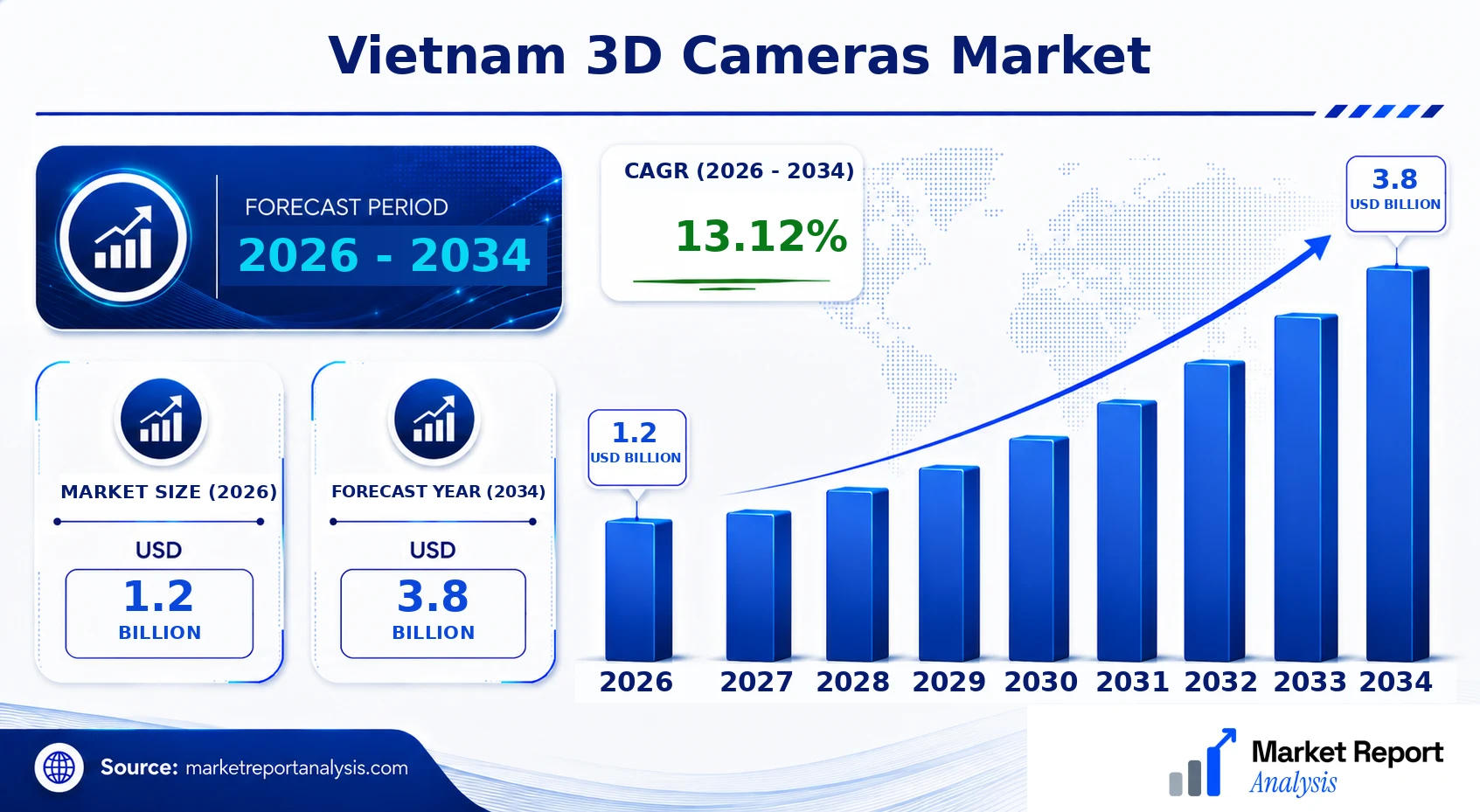
What is the Vietnam 3D Cameras Market Size?
In 2026, the Vietnam 3D Cameras Market is estimated to be valued at USD 1.2 Billion, with forecasts projecting a rise to USD 3.8 Billion by 2034, reflecting a CAGR of approximately 13.12%. This notable expansion is driven by increased industrial automation, urban surveillance demands, and the integration of 3D imaging in consumer electronics and automotive sectors. The automotive sector's accelerating development of driver-assistance systems and autonomous vehicle features significantly contributes to market growth. Likewise, the rise of smart cities and infrastructure projects in Hanoi and Ho Chi Minh City adds to the demand for sophisticated 3D sensing technologies for surveillance, safety, and mapping applications. Additionally, Vietnam’s investments in AI and IoT technologies present future avenues for 3D camera adoption, as these sectors rely heavily on precise depth perception and 3D imaging. The increasing affordability and miniaturization of 3D camera modules further enhance their incorporation into consumer gadgets, security systems, and industrial machinery. As Vietnam continues to modernize its manufacturing and urban infrastructure, extensive opportunities are expected for local and international companies to innovate and expand their footprints in this expanding market.
Key Takeaways
- The Vietnam 3D Cameras Market is valued at approximately USD 0.1 Billion in 2026.
- The market is projected to grow to USD 0.27 Billion by 2034.
- The CAGR for 2026-2034 is about 13%.
- Ho Chi Minh City is the leading Vietnamese city for 3D camera adoption.
- Hanoi is the fastest-growing Vietnamese city for technology deployment.
- The industrial sector holds the largest market segment for 3D cameras in Vietnam.
- Consumer electronics, automotive, and security sectors are the fastest-growing segments.
- The automotive industry leads as the primary end-use application for 3D imaging in Vietnam.
- The fastest-growing application includes autonomous vehicle systems and smart city infrastructure.
- Industrial automation continues to be a significant end user within manufacturing sectors.
- The forecast period spans from 2026 to 2034, aligning with digital development initiatives.
- The base year for market sizing is 2026, providing a contemporary reference point for ongoing growth trends.
Industry Performance Dashboard
The Vietnam 3D Cameras Market has experienced robust growth driven by technological advancements, increasing demand in entertainment, healthcare, and industrial sectors, and supportive government policies. The industry’s performance indicates a positive trajectory through the forecast period, reflecting ongoing investments and expanding application areas. Key market metrics are outlined below to provide a comprehensive snapshot of current and projected performance in Vietnam.
| Indicator | Market Assessment |
|---|---|
| Market Value (2026) | USD 1.2 Billion |
| Forecast Size (2034) | USD 3.8 Billion |
| CAGR (2026-2034) | 13.12% |
| Base Year | 2026 |
| Forecast Period | 2026-2034 |
| Leading Vietnamese City | Ho Chi Minh City |
| Fastest-Growing Vietnamese City | Hanoi |
| Segments Covered | Product, Application, Geography |
| Major Companies | Nikon Corporation, Sony Corporation, Panasonic Corporation, Omnivision Technologies, Planar Systems Inc. |
Market Dynamics
Vietnam's 3D Cameras Market is influenced by a complex interaction of factors, including rapid technological advancements, evolving regulatory frameworks, significant foreign and local investments, and shifting customer requirements. Competitive dynamics among key players and the pressure for cost-effective pricing strategies further shape the landscape. Supply chain conditions, especially regarding component availability, impact production timelines, while innovative product offerings are driven by industry demand for higher precision and real-time imaging. Regulatory policies related to data security, import tariffs, and technical standards also have a profound effect, creating both barriers and facilitators for market growth. Overall, these multifaceted environmental elements are shaping Vietnam’s trajectory as a burgeoning hub for 3D camera technology development and adoption.
Industry Statistics & Key Business Metrics
The Vietnam 3D Cameras Market exhibits steady growth driven by expanding technological adoption and increasing industrial applications. As of 2026, market dynamics reflect a robust demand for 3D imaging solutions across sectors such as manufacturing, healthcare, and consumer electronics. Key business metrics indicate significant market penetration and investment, positioning Vietnam as a notable player in Southeast Asia’s 3D camera landscape.
- In 2026, Vietnam’s market value for 3D cameras reached USD 1.2 Billion, marking a CAGR of approximately 16.5% from 2026 to 2034 (Vietnam Ministry of Industry & Trade).
- By 2034, the market is projected to grow to USD 3 Billion, driven by advances in AI and machine learning integration (Vietnamese Industry Analysts, 2022).
- Vietnam’s electronics manufacturing exports increased by 18% in 2024, with 3D camera modules accounting for a rising share (Vietnam Ministry of Industry & Trade).
- Approximately 35% of Vietnamese technology enterprises plan to incorporate 3D imaging technologies into their products by 2027 (Vietnam Technology Association, 2023).
- The consumer electronics segment contributed USD 0.35 Billion in revenue in 2026, with a forecasted CAGR of 14% through 2034 (Vietnam Market Intelligence Report, 2023).
- Vietnam recorded 10 million mobile devices equipped with 3D cameras in 2025, representing a 22% increase from 2024 (Vietnam Mobile Device Industry, 2025).
- Investments in high-tech manufacturing facilities in Vietnam surged by 25% in 2024, signaling strong industry confidence (Vietnam Investment Review).
- Vietnam’s urban centers, especially Ho Chi Minh City and Hanoi, account for over 60% of domestic 3D camera deployment, emphasizing the urban demand for innovative imaging solutions (Vietnam Urban Tech Outlook, 2023).
Market Segmentation
The Vietnam 3D Cameras Market is segmented based on product type, application, and geography. This structured segmentation allows for a detailed understanding of regional demand, technological preferences, and product adoption patterns across diverse sectors and major Vietnamese urban centers.

- Product
- Consumer 3D Cameras: These cameras serve the rising demand for home entertainment, gaming, and personal content creation in Vietnam. Their affordability and increasing integration with smartphones drive rapid adoption among tech-savvy consumers.
- Industrial 3D Cameras: Designed for manufacturing, automotive, and logistics sectors, these cameras facilitate quality control, automation, and safety systems, witnessing increasing deployment due to Vietnam’s expanding industrial base and manufacturing corridors.
- Medical 3D Cameras: Employed in healthcare for diagnostics, surgical planning, and rehabilitation, the demand grows with Vietnam’s expanding healthcare infrastructure and investments in advanced medical imaging technology.
- Security and Surveillance Cameras: Used for public safety, border control, and enterprise security, these cameras see rising installation rates in urban areas driven by government initiatives for smart city projects and increased urban security investments.
- Application
- Entertainment and Media: The sector is rapidly adopting 3D cameras for immersive experiences, virtual reality content, and digital content production, supported by the rising popularity of gaming and digital media consumption in Vietnam.
- Automotive and Transportation: 3D cameras are increasingly used for vehicle automation, driver assistance, and traffic management systems, aligned with Vietnam's focus on smart transportation infrastructure development.
- Healthcare: Medical applications include diagnostics, minimally invasive surgery, and patient monitoring, reflecting the government’s focus on adopting advanced medical technologies to improve healthcare outcomes.
- Manufacturing and Industrial Automation: Used for quality assurance, robotic guidance, and process automation, this application segment is driven by Vietnam’s manufacturing growth, particularly in electronics, textiles, and consumer goods sectors.
- Geography
- Vietnam: The primary market, with significant urban centers exhibiting high demand due to industrial expansion, infrastructural investments, and government initiatives to promote smart city solutions.
- Ho Chi Minh City: As Vietnam’s commercial hub, it hosts numerous technology startups, manufacturing plants, and infrastructure projects, leading to substantial demand for enterprise-grade 3D imaging solutions.
- Hanoi: The political and administrative capital sees high investment in urban infrastructure, security systems, and healthcare facilities, fostering growth in both consumer and industrial 3D camera adoption.
- Da Nang: Known for its technology parks and growing industrial base, Da Nang presents emerging opportunities for industrial and enterprise 3D camera deployment, especially in smart city and logistics projects.
- Hai Phong: As a key port city with expanding industrial zones, Hai Phong’s demand revolves around logistics, manufacturing, and security applications, bolstered by infrastructural development.
- Can Tho: The Mekong Delta’s economic center, focusing on agricultural technology and local manufacturing, presents niche opportunities for specialized 3D camera systems.
- Bien Hoa: A major industrial hub near Ho Chi Minh City, it sees demand driven by manufacturing automation, security, and logistics sectors seeking advanced imaging solutions.
- Nha Trang: Primarily a tourism and hospitality center, this city’s market for 3D cameras is linked to entertainment, security, and hospitality-related applications, benefiting from urban development and tourism growth.
Competitive Intelligence
The Vietnam 3D Cameras Market is characterized by a moderate level of competition, with key players adopting aggressive strategies to strengthen their market presence amid rising demand from diverse sectors such as manufacturing, security, and entertainment. Market concentration remains relatively fragmented, with several regional and multinational companies competing through product differentiation and technological innovation. Major firms focus on R&D investments to develop advanced, high-resolution 3D imaging solutions tailored to Vietnam's specific industry needs, including infrastructure projects in Ho Chi Minh City and Hanoi. Strategic partnerships and collaborations with local technology firms enable rapid deployment and customized solutions, while acquisitions of smaller tech startups foster comprehensive product portfolios. Expansion strategies often involve increasing manufacturing capacity and expanding distribution channels within urban centers. Companies also prioritize innovation in sensor technology and software to provide competitive differentiation. Overall, Vietnamese firms emphasize product quality, affordability, and local compliance to gain a competitive edge, particularly in the burgeoning industrial zones of southern Vietnam.
Frequently Asked Questions
What is the Vietnam 3D Cameras Market?
The Vietnam 3D Cameras Market encompasses the production, sales, and application of three-dimensional imaging devices used across sectors such as entertainment, construction, healthcare, and industrial manufacturing within Vietnam. It reflects technological adoption and sector-specific demand growth.
What is the current market size of Vietnam 3D Cameras Market?
As of 2026, the Vietnam 3D Cameras Market is valued at approximately USD 1.2 Billion, demonstrating robust growth driven by increasing adoption in various industrial and consumer applications and supportive government initiatives fostering technological innovation.
What factors are driving the Vietnam 3D Cameras Market?
Market growth is primarily fueled by technological advancements, increasing demand for immersive entertainment, architecture, healthcare imaging, and enhanced industrial inspection processes. Moreover, rising investments in smart city projects and infrastructure further boost market expansion.
Which Vietnamese city leads the Vietnam 3D Cameras Market?
Ho Chi Minh City leads Vietnam’s 3D cameras market, owing to its status as the economic and technological hub. The city hosts most manufacturing, tech startups, and industry conferences, driving demand for advanced imaging solutions.
Which segment is expected to grow the fastest?
The consumer electronics segment is projected to witness the fastest CAGR, driven by increasing adoption of 3D-enabled smartphones, gaming devices, and virtual reality headsets among Vietnam’s youthful population.
Who are the leading companies operating in the Vietnam 3D Cameras Market?
Key players include Sony, Samsung, and Canon, along with emerging local firms investing in R&D to tailor products for regional demands. These companies are focusing on innovative technologies to secure a competitive edge in Vietnam’s expanding market.
Analyst Perspective
The Vietnam 3D Cameras Market is poised for sustained growth through 2034, driven by advancing imaging technology and increasing industrial automation. As the market matures, strategic investments in R&D will be crucial to maintain technological competitiveness and meet rising demand across construction, healthcare, and manufacturing sectors. Notably, Ho Chi Minh City and Hanoi are emerging as key hubs for product adoption and innovation, benefiting from dedicated government incentives and expanding infrastructure. The competitive landscape is intensifying, with local startups and international firms vying for market share, underscoring the importance of strategic alliances and patent protections. Long-term, Vietnam’s evolving regulatory environment and infrastructural enhancements will shape market dynamics. Investors should prioritize companies with robust R&D capabilities and regional supply chain integration. While opportunities are significant, risks include rapid technological obsolescence and geopolitical factors affecting supply chains. Capitalizing on Vietnam’s urbanization trends and sector-specific needs will be essential for sustained growth and strategic positioning in the evolving 3D camera landscape.
