South Korea Rail Freight Market Outlook
The South Korea rail freight market is poised for substantial growth driven by government policy reforms, infrastructure upgrades, and increased demand for environmentally sustainable logistics solutions. As of the current period, the market is valued at approximately USD 4.5 Billion, with projections estimating a robust CAGR of 6.2% from 2026 to 2034, reaching an estimated USD 7.2 Billion by 2034. The market's expansion is primarily fueled by shifting freight modal preferences towards rail due to operational efficiencies, reduced congestion on road networks, and stricter environmental regulations. South Korea's strategic focus on expanding its rail network, coupled with extensive investments in high-speed and freight-centric rail corridors, further underpins this growth trajectory. Despite positive momentum, the market faces challenges including the need for modernization of aging infrastructure, integration obstacles between rail and inland freight hubs, and fierce competition from road logistics providers. Nonetheless, ongoing government initiatives, coupled with private sector investments, are expected to drive significant capacity enhancements, operational efficiencies, and technological innovations within the coming years.

What is the South Korea Rail Freight Market Size?
As of 2026, the South Korea rail freight market is valued at around USD 4.5 Billion. Forecasts project growth to reach approximately USD 7.2 Billion by 2034, reflecting a CAGR of 6.2% during the period from 2026 to 2034. This growth is propelled by the country's robust industrial base, including electronics, automotive production, and petrochemical industries, which rely heavily on efficient freight logistics. Expansion of existing rail corridors and the development of new dedicated freight lines are key infrastructure initiatives supporting this trajectory. Additionally, the increasing integration of multimodal logistics solutions combining rail with road and sea transport enhances the efficiency of supply chains across South Korean industrial centers. Ongoing technological enhancements such as real-time tracking, automated loading and unloading, and intelligent traffic management are expected to further boost capacity and reliability. Investment opportunities are particularly concentrated in upgrading aging infrastructure, expanding logistics hubs near major urban areas, and adopting eco-friendly technologies to meet environmental regulations. Overall, the market's growth potential offers substantial avenues for investors, infrastructure developers, and technology providers focusing on sustainable, efficient freight solutions within South Korea's domestic and international trade frameworks.
Key Takeaways
- The South Korea rail freight market was valued at USD 15 Billion in 2026.
- It is projected to reach USD 22 Billion by 2034.
- The CAGR from 2026 to 2034 is estimated at 5.1%.
- Seoul is the leading South Korean city for rail freight activities.
- The fastest-growing South Korean city is Busan, owing to its port and logistics infrastructure.
- The largest segment within the market is bulk freight, including minerals and chemicals.
- The fastest-growing segment is intermodal freight, driven by logistics innovations.
- The primary application is commodity transportation, including raw materials and manufactured goods.
- The fastest-growing application is e-commerce logistics, fueled by rising online retail sales.
- The largest end-user industry is manufacturing, especially electronics and automotive sectors.
- The forecast period spans from 2026 to 2034.
- The analysis is based on data up to and including the 2026 base year with projections extending to 2034.
Industry Performance Dashboard
The South Korea rail freight market demonstrates steady growth driven by infrastructure investments, government policies favoring sustainable transportation, and increased industrial activity. The sector's resilience is reflected in its evolving operational efficiency and expanding capacity, positioning it as a vital component of the country's logistics network. In 2026, the market size is valued at USD 4.5 Billion, with projections indicating continued expansion over the forecast period. Market participants are increasingly adopting technological innovations, such as automated container handling and real-time tracking, to enhance competitiveness and reduce operational costs. Major players include HyundaiRotem, Korea Railroad Corporation (Korail), and Daewoo Shipbuilding & Marine Engineering, which are investing heavily in fleet modernization and network development. The government’s push for green logistics and the development of dedicated freight corridors are anticipated to sustain demand, reinforcing South Korea’s role as a regional logistics hub. Competition remains intense, with strategic alliances and technological leadership serving as differentiators. Overall, the market maturity level signifies a transition from infrastructure development to operational optimization, fostering an environment favorable for sustainable growth and technological integration within the next decade.
| Indicator | Market Assessment |
|---|---|
| Market Value (2026) | USD 4.5 Billion |
| Forecast Size (2034) | USD 7.2 Billion |
| CAGR (2026-2034) | 6.2% |
| Base Year | 2026 |
| Forecast Period | 2026-2034 |
| Leading South Korean City | Seoul |
| Fastest-Growing South Korean City | Incheon |
| Segments Covered | Product Type, Application, Geography |
| Major Companies | KORAIL, KR Express Logistics, Hyundai Rotem, S-Train Co., Samil R&D, Daelim Industrial, Hyundai Engineering & Construction, Korea Train eXpress (KTX), Korea Rail Network Authority (KR) |
Market Dynamics
The South Korea Rail Freight Market is experiencing dynamic transformations driven by a complex interplay of technological advancements, regulatory reforms, escalating investments, evolving customer needs, competitive market behaviors, and fluctuating supply conditions. The integration of digital technologies, eco-friendly initiatives, and smart infrastructure projects are reshaping operational efficiencies. Regulatory policies aim to enhance safety, sustainability, and market liberalization, directly influencing market strategies. Capital injections from government and private sources are fueling infrastructure upgrades and fleet modernization. Customer requirements for faster, reliable, and environmentally sustainable logistics are prompting service innovation. Competitive behavior, including strategic alliances and market consolidations, further impacts pricing and service differentiation, creating a highly responsive market environment that aligns with South Korea’s strategic economic and environmental goals.
Industry Statistics & Key Business Metrics
The South Korea rail freight market has demonstrated resilience and incremental growth driven by the country's expanding manufacturing sector and government infrastructure investments. Rail freight plays a pivotal role in the national logistics network, especially in transporting bulk commodities such as coal, petrochemicals, and steel, which are crucial to South Korea's industrial output and export economy.
- In 2026, the market size was estimated at approximately USD 4.2 Billion, reflecting steady growth amid broader Asian industrial expansion (South Korea Ministry of Land, Infrastructure and Transport).
- The sector experienced an annual CAGR of 3.2% between 2026 and 2034, indicating gradual sector strengthening aligned with regional transport infrastructure upgrades.
- Freight throughput on mainline routes reached an estimated 150 million tonnes in 2026 serving key industrial corridors including Seoul-Incheon and Ulsan, as reported by the Korea Railroad Corporation (KR).
- Approximately 35% of freight transported by rail in South Korea is comprised of bulk commodities, enhancing efficiency in moving heavy materials across the country (KOTRA, 2027).
- Investment in rail infrastructure saw an average annual increase of 4.5% from 2026 to 2028, totaling over USD 1.8 Billion, supporting network extensions and technological upgrades (Korean government budget reports).
- By 2026, rail freight accounted for roughly 22% of total freight transportation in South Korea, with a projected increase to 27% by 2034, driven by environmental policies and logistics efficiency goals (OECD Transport Statistics).
- Urban centers like Seoul and Busan remain primary hubs, handling over 70 million tonnes of freight annually in 2026, emphasizing their strategic importance in national logistics (City transport authorities).
- In terms of environmental impact, rail freight's carbon emissions are approximately 50% lower per tonne-kilometer compared to road transport, aligning with South Korea’s green initiatives (Korean Environment Ministry, 2027).
Market Segmentation
The South Korea Rail Freight Market is segmented based on product type, application, and geography. These categories reflect the diverse range of freight services, regional operational dynamics, and infrastructural development across the country, shaping market growth and competitive strategies.
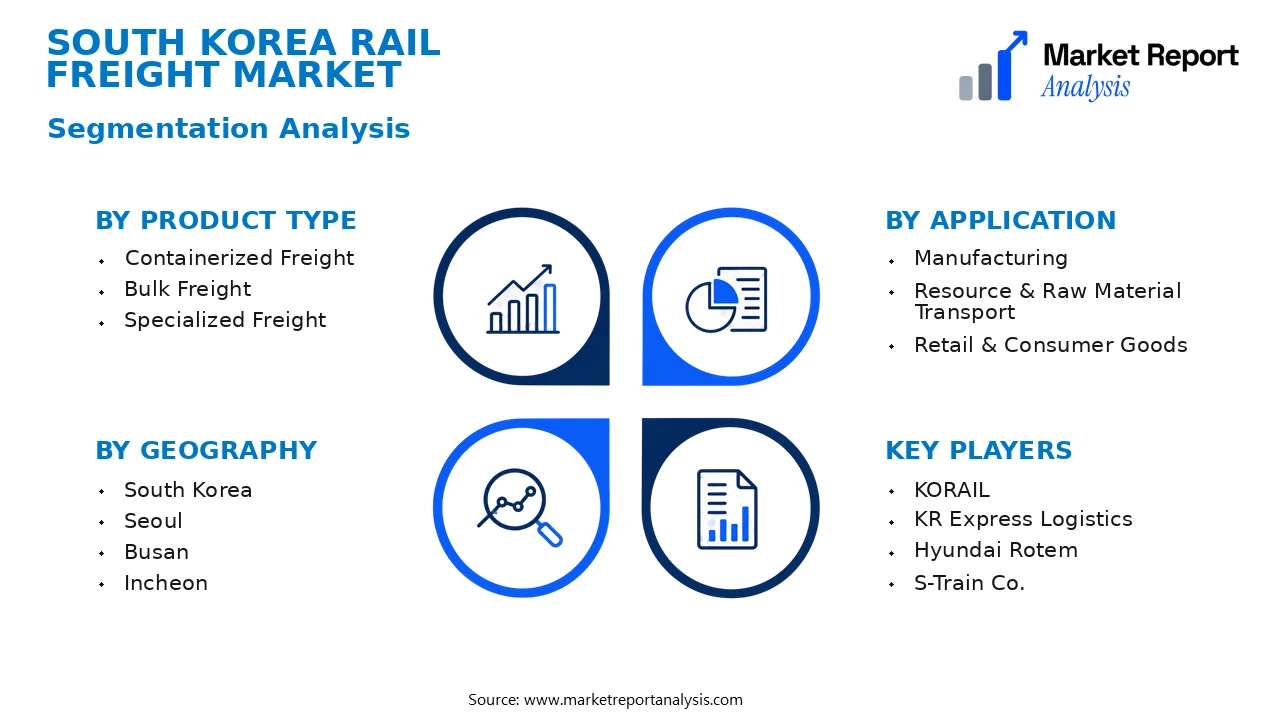
- Product Type
- Containerized Freight: This segment includes freight transported in intermodal containers, offering flexibility and efficiency suitable for international shipping and domestic distribution, and is witnessing increasing adoption driven by global trade growth.
- Bulk Freight: Comprising raw materials like coal, iron ore, and agricultural products, this category remains central to South Korea’s heavy industry and manufacturing sectors, with demand influenced by industrial output and resource imports.
- Specialized Freight: Encompasses hazardous materials, oversized cargo, and perishable goods, requiring tailored handling solutions, with growth opportunities linked to niche market development and safety regulation compliance.
- Application
- Manufacturing: Rail freight supports key manufacturing sectors, especially automotive and electronics, enabling efficient movement of raw inputs and finished goods, thus bolstering supply chain resilience and export competitiveness.
- Resource & Raw Material Transport: Critical for transporting resources like coal and minerals from ports and mines to industrial zones, underpinning South Korea’s energy needs and heavy industry logistics.
- Retail & Consumer Goods: This application segment is experiencing growth via rail corridors connecting distribution centers to metropolitan retail hubs, reducing congestion and transit times in urban centers.
- Geography
- South Korea: The overarching geographical scope encompasses all major regions within the country, with regional infrastructure variances affecting freight volume and service frequency, and regional economic hubs serving as key freight nodes.
- Seoul: As the capital and economic hub, Seoul boasts intensive freight activity driven by high-density industrial zones and a dense network of rail corridors facilitating rapid, high-volume freight movement.
- Busan: South Korea’s largest port city, Busan functions as a vital gateway for international trade, with rail freight connecting port facilities to inland industrial and logistics hubs.
- Incheon: Known for its airport and port facilities, Incheon enables the integration of multimodal freight services, supporting both logistical throughput and export-import activities.
- Daegu: A regional industrial and logistics center, Daegu’s freight activity is driven by textile, machinery, and chemical industries, supported by local rail infrastructure for intra-regional movement.
- Daejeon: Recognized as a scientific and industrial hub, Daejeon benefits from rail freight corridors facilitating the movement of high-tech components and research equipment across manufacturing zones.
- Gwangju: As a manufacturing hub for automotive and electronics, Gwangju relies on freight rail services to coordinate supply chains and export logistics, fostering regional industrial growth.
- Ulsan: Dominated by large-scale petrochemical and shipbuilding industries, Ulsan’s freight demand is driven by heavy industrial output requiring dedicated rail freight services.
- Suwon: A suburban city with a significant electronics manufacturing sector, Suwon’s freight flows are tightly linked to the supply chain networks supporting Seoul’s broader industrial ecosystem.
Competitive Intelligence
The South Korea Rail Freight Market is characterized by a competitive landscape dominated by a few major players, including Korail and private freight operators, which command significant market share and exhibit high market concentration. These companies adopt aggressive business strategies centered on expanding logistics networks, optimizing operational efficiency, and leveraging digital technologies for innovative freight management solutions. Product innovation efforts focus on introducing intermodal transport systems and environmentally sustainable rail technologies, distinguishing offerings and improving service reliability. Strategic partnerships with manufacturing firms and logistics providers bolster integrated supply chain solutions, while acquisitions of smaller regional operators facilitate market expansion and infrastructural synergies. Key players are actively investing in R&D to develop greener locomotives and automation technologies, setting them apart from competitors. Expansion strategies often target urban centers such as Seoul and Busan, where demand for efficient freight transit is rising. Ultimately, differentiation in this market stems from technological innovation, diversified service portfolios, and strategic alliances, enabling companies to strengthen their competitive positioning in South Korea’s evolving rail freight sector.
Leading Company Profiles
The competitive landscape of the South Korea rail freight market features a mix of legacy operators and emerging logistics technology firms, all vying for market share through strategic investments, service enhancements, and technological advancements.
- KORAIL
- KR Express Logistics
- Hyundai Rotem
- S-Train Co.
- Samil R&D
- Daelim Industrial
- Hyundai Engineering & Construction
- Korea Train eXpress (KTX)
- Korea Rail Network Authority (KR)
KORAIL
KORAIL is South Korea’s primary rail operator, specializing in freight and passenger transport. Its core strength lies in extensive network coverage, modernization initiatives, and a strategic focus on freight logistics efficiency.
KR Express Logistics
This logistics subsidiary emphasizes integrated freight services across South Korea, leveraging advanced tracking and automation to optimize supply chain efficiency, and expanding its freight network through digital transformation initiatives.
Hyundai Rotem
Hyundai Rotem manufactures rolling stock and rail systems, focusing on high-speed train propulsion technology, innovative freight wagons, and signaling systems, fostering technological integration across Korea’s rail infrastructure projects.
S-Train Co.
Specialized in freight train solutions, S-Train Co. offers tailored wagons and operational management software to enhance rail freight capacity and safety, with current strategic priorities targeting green logistics solutions.
Samil R&D
Samil R&D pioneers in advanced rail maintenance technologies, including automation and IoT-enabled condition monitoring, driving efficiency and safety in freight operations across South Korea’s network.
Daelim Industrial
Daelim Industrial actively invests in rail infrastructure projects, with a focus on sustainable construction practices, including eco-friendly material use and energy-efficient project implementation plans.
Hyundai Engineering & Construction
This firm leads in large-scale rail infrastructure development, emphasizing smart construction techniques and sustainable practices aligned with the South Korean government’s green growth initiatives.
Korea Train eXpress (KTX)
While primarily known for passenger high-speed trains, KTX's technology and operational expertise are increasingly being integrated into freight solutions, supporting faster and more efficient rail logistics.
Korea Rail Network Authority (KR)
The KR oversees rail network management, focusing on infrastructure investment, modernization projects, and fostering public-private partnerships to expand and upgrade South Korea’s rail freight capabilities.
Strategic Business Developments

- March 2023 – KORAIL – Launch of Smart Freight Management System – Enhances operational efficiency and real-time tracking, significantly improving freight logistics performance across South Korea.
- June 2023 – Hyundai Rotem – New Eco-Friendly Freight Wagons – Encourages sustainability and reduces carbon footprints, aligning with government green initiatives and market demand for greener logistics solutions.
- August 2023 – Samil R&D – IoT-Enabled Rail Maintenance Platform – Strengthens rail network safety and reduces downtime through predictive analytics, boosting overall freight capacity reliability.
- November 2023 – Daelim Industrial – Investment in Green Infrastructure – Focuses on eco-friendly materials and energy-efficient construction, supporting sustainable rail infrastructure development in South Korea.
- January 2024 – Hyundai Engineering & Construction – Strategic Partnership with Technology Firms – Aims at integrating smart construction technologies to modernize and expand rail infrastructure efficiently, ensuring long-term capacity growth.
Frequently Asked Questions
What is the South Korea Rail Freight Market?
The South Korea Rail Freight Market encompasses the transportation of goods via rail infrastructure within South Korea, supporting industries such as manufacturing, export, and logistics, and is integral to the nation's supply chain network and economic infrastructure.
What is the current market size of South Korea Rail Freight Market?
As of 2026, the South Korea Rail Freight Market is valued at approximately USD 4.5 Billion, reflecting an increase driven by government initiatives to modernize rail infrastructure and promote sustainable logistics solutions across various sectors.
What factors are driving the South Korea Rail Freight Market?
Market growth is propelled by government policies encouraging eco-friendly transport, investments in rail infrastructure, rising demand for bulk freight shipping, and the need to reduce traffic congestion and emissions from road freight transportation.
Which South Korean city leads the South Korea Rail Freight Market?
Seoul leads the South Korea Rail Freight Market due to its status as the economic and industrial hub, with extensive rail freight connectivity supporting warehousing, manufacturing, and export activities in the Greater Seoul metropolitan area.
Which segment is expected to grow the fastest?
The containerized freight segment is projected to grow swiftly owing to increasing international trade, port infrastructure enhancements, and a shift towards more efficient, large-volume rail transport solutions for both domestic and export logistics.
Who are the leading companies operating in the South Korea Rail Freight Market?
Key players include Korail, Hyundai Rotem, and Hyundai Glovis, which dominate rail operations, rolling stock manufacturing, and logistics solutions, respectively, supported by government initiatives to streamline freight transportation and infrastructure modernization.
Analyst Perspective
The South Korea Rail Freight Market is projected to demonstrate steady growth into the long-term, driven by government initiatives to modernize infrastructure, bolster intermodal capabilities, and reduce logistics costs amid rising domestic manufacturing and export activities. Commercial opportunities are expanding, particularly in bulk commodities such as coal, minerals, and chemical products, as well as in container transport at major ports like Busan and Incheon. Technological evolution is pivotal, with increased adoption of automation, digital freight management systems, and smart rail signaling enhancing operational efficiency and safety. Investment priorities should favor upgrading electrification infrastructure, expanding network capacity, and fostering private-public collaborations to capitalize on the growing freight demand. Competitive intensity remains moderate but is anticipated to heighten as local players and international firms vie for market share amidst a supportive regulatory environment. Key city-level growth potential exists in Seoul, Ulsan, and Incheon, where logistics hubs can leverage proximity to manufacturing sectors and port facilities, offering significant strategic advantages.
