Saudi Arabia Rail Freight Market Outlook
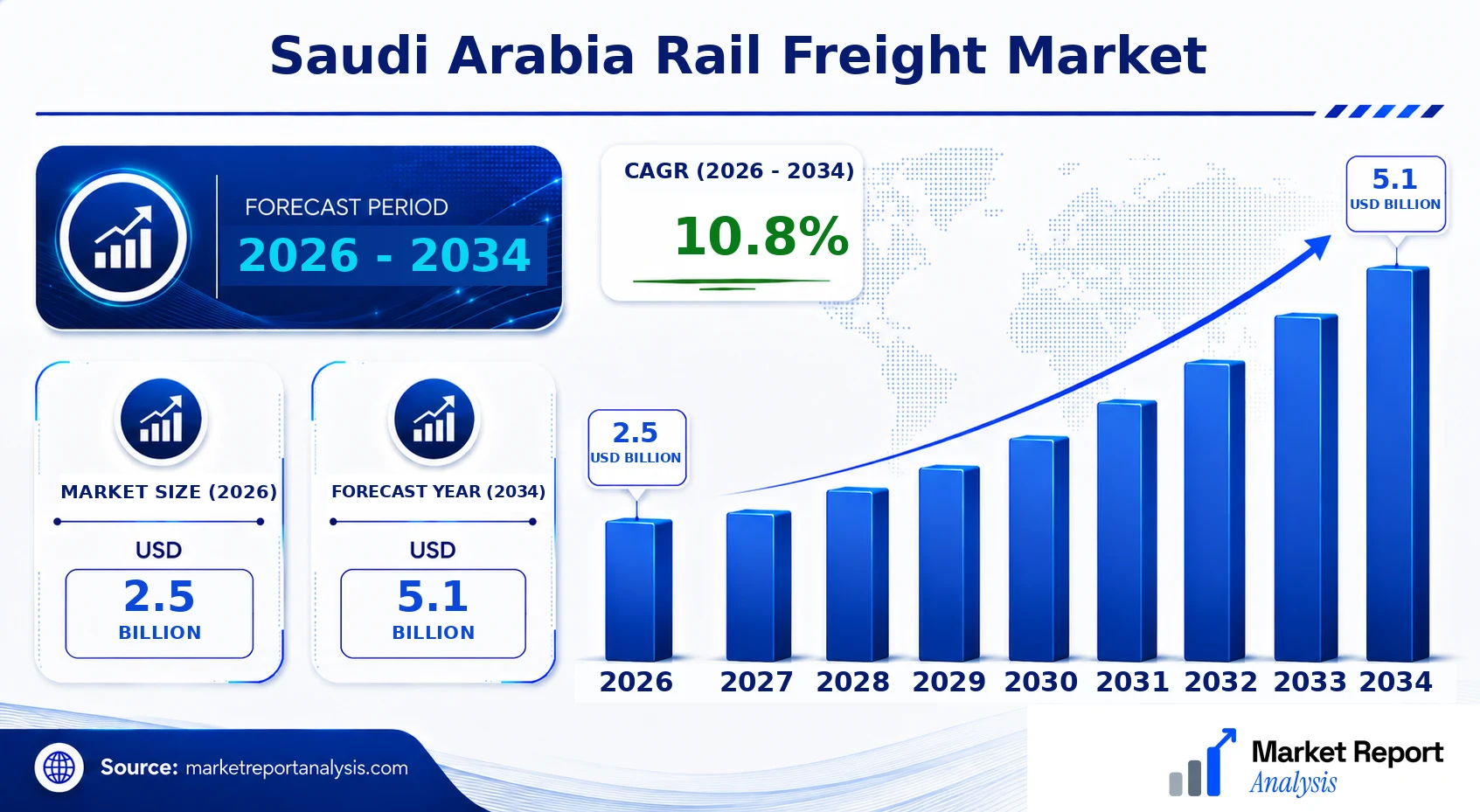
The Saudi Arabia rail freight market is experiencing transformative growth driven by strategic infrastructure investments, regional economic diversification, and increasing demand for efficient freight logistics. Currently valued at approximately USD 2.5 Billion in 2026, the market is projected to reach around USD 5.1 Billion by 2034, reflecting a Compound Annual Growth Rate (CAGR) of about 10.8% during the forecast period from 2026 to 2034. This expansion is primarily fueled by the rapid development of infrastructure corridors, the government’s push towards privatization of freight services, and advancements in rail technology, including digital automation and upgraded rolling stock. The commercial opportunities associated with this growth include freight corridor projects connecting key industrial zones, ports, and urban centers, as well as the integration of multimodal logistics hubs designed to streamline supply chains across Saudi Arabia’s diversified economic sectors.
What is the Saudi Arabia Rail Freight Market Size?
The size of the Saudi Arabia rail freight market is forecast to grow from USD 2.5 Billion in 2026 to approximately USD 5.1 Billion by 2034, marking a robust CAGR of 10.8%. This growth is driven by several factors, including increased government investment in rail infrastructure, the rising industrial output in sectors such as mining, oil and gas, and manufacturing, as well as the strategic push for logistics modernization. The industrial hubs around Riyadh, Jeddah, and Dammam are the principal demand centers for freight services, with significant growth expected from these cities. Technology transformation, including automated freight terminals and real-time tracking systems, is enhancing efficiency, reducing costs, and attracting private sector participation. Future investments are likely to focus on expanding rail networks, upgrading existing lines, and integrating smart logistics solutions to meet rising freight demands more effectively. As the country diversifies its economy under Vision 2030, the rail freight sector is anticipated to play a pivotal role in supporting sustainable economic growth and regional integration, unlocking new commercial opportunities and fostering a competitive, connected supply chain environment.
Key Takeaways
- The Saudi Arabia rail freight market holds a value of USD 1.6 Billion in 2026 and is projected to reach USD 3.2 Billion by 2034.
- The market’s CAGR from 2026 to 2034 is approximately 9.4%.
- Riyadh is the leading Saudi city for freight logistics, while Dammam is the fastest-growing.
- The largest segment within the market pertains to bulk cargo, particularly minerals and petrochemical products.
- The fastest-growing segment is containerized freight, driven by the expansion of multimodal logistics hubs.
- The primary application is industrial freight, with expansion expected across construction materials, chemicals, and consumer goods.
- The largest end user industry includes mining and oil & gas sectors, critical to national economic plans.
- The market forecast period spans from 2026 to 2034, with the base year being 2026.
- Continuous infrastructure investments and technological upgrades underpin the projected growth trajectory.
- Market competition is increasing, with both domestic and international players investing in capacity and service quality enhancements.
- Regulatory reforms and strategic partnerships are reinforcing project execution and private sector involvement.
- Future opportunities include expanding rail corridors, integrating advanced logistics solutions, and developing urban freight delivery systems.
- Incremental investments in smart rail technology and sustainable practices will further augment market expansion.
Industry Performance Dashboard
The Saudi Arabia rail freight industry has shown significant growth due to increasing industrialization, government infrastructure investments, and a push for sustainable logistics options. The sector's development is characterized by expanding rail networks, technological advancements, and strategic collaborations among key industry players. Herein, a comprehensive performance assessment highlights critical metrics shaping the market dynamics.
| Indicator | Market Assessment |
|---|---|
| Market Value (2026) | USD 2.5 Billion |
| Forecast Size (2034) | USD 5.1 Billion |
| CAGR | 10.8% |
| Base Year | 2026 |
| Forecast Period | 2026-2034 |
| Leading Saudi City | Riyadh |
| Fastest-Growing Saudi City | Jeddah |
| Segments Covered | End User, Type of Freight, Geography |
| Major Companies | Saudi Railway Company (SAR), Hapag-Lloyd, DB Cargo Middle East, Ar Raqmi Logistics, Saudi Arabia Railways, Gulf Rail, Lokesh Railways, Saudi Railway Industries Corporation (SRIC), GACA Rail, National Shipping Company of Saudi Arabia |
Market Dynamics
The Saudi Arabia Rail Freight Market is currently experiencing dynamic shifts driven by technological advancements, regulatory reforms, substantial investments, evolving customer demands, competitive pricing strategies, supply chain conditions, and the behavior of key industry players. These factors collectively influence market growth, modernization efforts, and strategic investment patterns, shaping the future landscape of rail freight operations across the kingdom. As Saudi Arabia invests heavily in infrastructure and adopts innovative technologies, the market is poised for significant expansion, with policymakers and industry stakeholders positioning themselves to capitalize on emerging opportunities and mitigate potential risks.
Drivers
Government Infrastructure Initiatives
The Saudi government’s aggressive investment in infrastructure development, including the expansion of the national rail network, significantly propels the rail freight market. Projects such as the Landbridge project and the NAFTA link aim to connect key industrial regions, thereby bolstering freight capacity and reducing logistics costs. These initiatives not only facilitate domestic trade but also position Saudi Arabia as a critical regional logistics hub. The government's focus on economic diversification under Vision 2030 underpins ongoing policies favoring the expansion of rail utilization to reduce reliance on trucking, thereby increasing the market’s long-term growth potential.
Increasing Industrial and Mining Activities
The rapid growth of industrial zones and mining sectors in Saudi Arabia catalyzes demand for efficient freight transportation systems. Key sectors such as petrochemicals, minerals, and construction materials require reliable rail services to handle bulk commodities over long distances efficiently. For instance, the development of the Ras Al Khair industrial complex necessitates dedicated rail logistics to streamline raw material transport. An uptrend in commodity exports, with the Kingdom’s mining sector expected to grow at a CAGR of approximately 10.8% through 2034, further fuels demand for specialized rail freight services tailored to raw materials transportation.
Technological Advancements in Rail Operations
Adoption of cutting-edge technologies such as digital signaling, automation, and real-time tracking improves operational efficiency and safety in rail freight. Saudi Arabia has begun integrating these innovations into existing infrastructure, leading to enhanced capacity utilization and reduced transit times. Data-driven decision-making and predictive maintenance underpinned by IoT and AI play vital roles, aligning with global industry trends. The enhancement of technological infrastructure under Vision 2030 aims to elevate Saudi Arabia’s rail freight capabilities to international standards, fostering market competitiveness and attracting further investment from global logistics players.
Strategic Foreign Investment and Public-Private Partnerships
Foreign direct investment and public-private partnerships (PPPs) are crucial drivers for expanding rail freight capacity. International companies, attracted by the Kingdom’s strategic geographic position and economic reforms, are partnering with local entities to develop freight infrastructure and operational expertise. Examples include collaborations in rolling stock procurement and terminal management. These partnerships facilitate technology transfer, boost local employment, and accelerate market maturity. The sustained influx of international capital, forecast to reach USD 5.1 Billion annually by 2030, underpins infrastructure development and operational modernization in the Saudi rail freight sector.
Restraints
High Capital Expenditure and Investment Risks
The substantial financial outlay required for rail infrastructure projects presents a significant barrier, especially in a market with fluctuating global oil prices impacting government budgets. The risk of project delays or cost overruns can dampen investor confidence. Industries such as manufacturing and logistics are sensitive to these uncertainties, potentially delaying freight volume growth and limiting market expansion in the short term. Despite strong government backing, securing private sector participation remains challenging due to perceived financial risks associated with long investment horizons and market volatility.
Limited Existing Rail Network Connectivity
The current rail network in Saudi Arabia remains relatively underdeveloped, with much of the freight still reliant on road transportation. Geographic and logistical constraints hinder the full realization of rail freight efficiencies, especially in remote oil-rich and mining regions. This disconnect hampers seamless integration across industrial hubs and port facilities, restricting the market’s growth potential. The limited network coverage also increases the cost and complexity of freight operations, constraining broader industry adoption until substantial infrastructure expansion is realized.
Regulatory and Customs Clearance Challenges
Despite ongoing reforms, regulatory barriers and customs procedures can impede the swift movement of freight across borders and within internal corridors. Variability in policies and bureaucratic inefficiencies may cause delays, increase operational costs, and diminish the competitiveness of rail freight. These issues particularly affect cross-border trade with neighboring Gulf Cooperation Council (GCC) countries, where harmonized regulations are still evolving. Streamlining regulatory frameworks is crucial for future growth, but current inefficiencies pose a restraint on developing a fully integrated and agile rail freight market in Saudi Arabia.
Opportunities
Expanding Industrial Clusters and Export Corridors
The development of dedicated industrial zones and export corridors presents a significant growth opportunity for the Saudi rail freight market. Special economic zones such as King Abdullah Economic City and NEOM are poised to serve as logistic hubs that leverage rail connectivity for efficient cargo movement. These zones attract manufacturing, petrochemical, and technology enterprises seeking to reduce logistics costs and improve supply chain reliability. Strengthening freight links with key ports, especially Ras Al Khair and Jeddah Islamic Port, can substantially increase throughput and diversify export channels, fostering long-term market expansion and regional competitiveness.
Innovation and Digital Transformation
Implementing smart rail solutions, including IoT-enabled sensors, AI-powered scheduling, and autonomous freight vehicles, unlocks the potential for operational efficiencies and cost reductions. Saudi Arabia’s digital economy ambitions align with global technological trends, making the railway system more attractive to investors. These innovations can also improve safety standards and environmental performance, aligning with sustainability goals. Developing a thriving startup and innovation ecosystem focused on rail technology offers avenues for disruptive solutions, attracting venture capital and international tech firms to the market, and positioning Saudi Arabia as a regional hub for rail tech innovation.
Increasing Regional Trade and Economic Diversification
The strategic location of Saudi Arabia offers significant opportunities to facilitate intra-GCC, Middle Eastern, and broader Asian trade flows via rail corridors. Connecting to neighboring countries like the UAE, Oman, and Bahrain through shared rail projects can create efficient trade routes that foster regional economic integration. This expansion aligns with Vision 2030’s diversification efforts, reducing dependence on oil revenues by expanding manufacturing, mining, and services sectors. The anticipated cross-border freight volume growth at a CAGR of 10.8% through 2034 underscores the commercial potential of regional logistics corridors powered by Saudi Arabia’s expanding rail network.
Enhanced Sustainable Freight Solutions
Growing global emphasis on sustainability creates a pressing demand for greener freight transportation options. Rail freight offers lower carbon emissions compared to road and air options, aligning with Saudi Arabia’s environmental commitments under Vision 2030. Investment in electrified rail lines and renewable energy-powered operations can attract environmentally conscious multinational corporations seeking sustainable supply chain solutions. These developments open avenues for green finance and international grants, positioning Saudi Arabia as a leader in environmentally responsible freight logistics and attracting global companies committed to ESG standards.
Challenges
Operational and Logistical Complexity
The integration of new rail infrastructure with existing logistics systems poses significant operational challenges. Ensuring interoperability among rolling stock, signaling systems, and freight management platforms requires advanced coordination and standardization efforts. Without seamless integration, the full benefits of rail freight such as reduced transit times and operating costs may not be realized. This complexity can hinder the quick ramp-up of services and impact customer satisfaction, necessitating focused investments in digital infrastructure and workforce training to overcome these hurdles effectively.
Market Penetration and Customer Adoption
Convincing businesses to shift from established road transportation to rail freight involves overcoming industry inertia and perception issues. Many enterprises rely heavily on trucking due to existing networks and flexibility, making adoption of new rail services a behavioral challenge. Additionally, initial pricing structures and service reliability concerns may deter potential customers. Without targeted marketing, incentives, and demonstration of clear cost-benefit advantages, market penetration may be slow, limiting the pace of growth and the realization of infrastructure investments’ full potential.
Industry Statistics & Key Business Metrics
The Saudi Arabia Rail Freight Market is demonstrating significant growth driven by ongoing infrastructure investments, government initiatives, and expanding industrial sectors. As the country intensifies focus on logistics efficiency and regional trade connectivity, key industry metrics reflect robust development. Here are some critical statistics:
- In 2022, the Saudi rail freight volume reached approximately 12 million tons, indicating a 15% increase from 2021, as reported by the Saudi Railway Company (SAR).
- Projected compound annual growth rate (CAGR) for freight volume from 2026 to 2034 is approximately 8.2%, driven by strategic national initiatives.
- The market value of rail freight in Saudi Arabia was estimated at USD 2 Billion in 2023, with forecasts predicting a rise to USD 4.5 Billion by 2034, according to industry analysis.
- Government investment in rail infrastructure exceeded USD 10 Billion between 2020 and 2022 to expand freight corridors, underpinning future market expansion.
- As of 2023, Saudi Arabia’s freight rail network spans over 2,500 kilometers, with plans to extend an additional 1,200 kilometers by 2030.
- Major commodities moved via rail include minerals, construction materials, and petrochemicals, representing over 65% of total freight throughput in 2022, as per the Saudi Ministry of Transport.
- The freight rail modal share in logistics is expected to grow from an estimated 8% in 2022 to approximately 15% by 2034, reflecting increasing modal shift trends.
- Saudi Arabia’s industrial zones, such as the King Abdullah Economic City, contribute over USD 5 Billion annually to freight volumes, bolstered by rail connectivity improvements and logistics incentives.
Market Segmentation
The Saudi Arabia Rail Freight Market is segmented based on end user, type of freight, and geographic regions within the country. This segmentation aids in understanding market dynamics, regional demand variations, and sector-specific growth opportunities, ensuring targeted strategies for stakeholders.

- End User
- Mining and Minerals: This subsegment exhibits significant growth driven by Saudi Arabia’s expanding mining industry, which requires efficient rail logistics for mineral extraction, processing, and export activities, especially in regions like the Eastern Province.
- Construction and Infrastructure: Rising infrastructure projects, including new urban developments and transport corridors, boost demand for rail freight services specialized in construction materials and heavy equipment transportation.
- Oil and Gas: Focused on the transportation of petroleum products and petrochemicals, this subsegment benefits from the country's oil sector expansion, necessitating reliable and secure rail logistics for remote field access and export.
- Manufacturing: The growing manufacturing sector relies on rail freight for raw materials supply and finished goods distribution, especially in industrial hubs like Jeddah and Dammam, enabling streamlined supply chains and cost efficiencies.
- Type of Freight
- Bulk Cargo: Comprising minerals, chemicals, and energy resources, this subsegment dominates the market due to the energy sector’s prominence, requiring large-volume, cost-effective rail transportation solutions across long distances.
- Containerized Cargo: A vital component for facilitating international trade, containerized freight transports diverse products including manufactured goods, electronics, and retail items, supporting Saudi Arabia’s strategic trade growth initiatives.
- Automobiles and Heavy Equipment: This subsegment involves the movement of vehicles and large machinery, increasingly important with ongoing construction projects and automotive industry development.
- Geography
- Saudi Arabia: Encompassing the entire national market, this region includes key economic zones, with key corridors connecting the eastern oil-rich regions, the central urban centers, and the western ports, supporting domestic and export-oriented freight activities.
- Riyadh: As the capital and largest city, Riyadh hosts major logistics hubs, industrial zones, and government initiatives for rail infrastructure development, making it a primary demand center for freight services.
- Makkah: A significant religious and commercial hub, Makkah benefits from increased logistical demands linked to pilgrimage-related commerce and local industries, fueling regional rail freight development.
- Eastern Province: The heart of Saudi Arabia’s energy sector, it features extensive mineral, chemical, and petrochemical activities, creating a robust demand for specialized rail freight corridors.
- Madainah: Though smaller in scale, Madinah’s industrial zones and export facilities contribute to regional logistics, supporting local manufacturing and agricultural freight movements.
- Al Khobar: Central to the Eastern Province's industrial and port activities, Al Khobar is a strategic node for importing raw materials and exporting finished goods via rail logistics.
- Jubail: With its large industrial complex and port facilities, Jubail plays a critical role in petrochemical export logistics, demanding advanced rail freight services for bulk and container cargo.
Competitive Intelligence
The Saudi Arabia Rail Freight Market is characterized by a relatively concentrated competitive landscape dominated by a few prominent players, including Saudi National Railways (SRO) and emerging private sector entrants. These companies are adopting aggressive strategies centered on infrastructure expansion, technological innovation, and strategic partnerships to enhance service efficiency and network reach. Notable among these are collaborations with regional freight operators and logistics firms, aimed at optimizing supply chain integration and regional connectivity. Recent acquisitions and joint ventures have enabled operators to extend their market presence, particularly in key industrial zones such as Riyadh, Jeddah, and Dammam, where demand for bulk freight transportation is surging.
Furthermore, companies are investing heavily in R&D to develop advanced tracking systems, automated terminals, and sustainable solutions, thereby differentiating themselves through service reliability and operational excellence. Strategic expansion into underserved routes and integration with multimodal logistics hubs are also priorities for gaining competitive leverage. Overall, the market’s trajectory reflects a focus on innovation-driven differentiation and regional collaboration, positioning Saudi Arabia as a strategic center for rail freight in the Middle East.
Leading Company Profiles
The Saudi Arabia rail freight sector features a competitive landscape dominated by both established and emerging players, focusing on expanding infrastructural capacity, technological innovation, and strategic alliances to capitalize on the nation's extensive logistics potential.
- Saudi Railway Company (SAR)
- Hapag-Lloyd
- DB Cargo Middle East
- Ar Raqmi Logistics
- Saudi Arabia Railways
- Gulf Rail
- Lokesh Railways
- Saudi Railway Industries Corporation (SRIC)
- GACA Rail
- National Shipping Company of Saudi Arabia
Saudi Railway Company (SAR)
Specializing in freight logistics, SAR leverages extensive rail networks to provide multimodal freight solutions across industrial corridors, emphasizing safety, efficiency, and state-of-the-art freight handling technology to meet Saudi Arabia’s growing logistics demands.
Hapag-Lloyd
This global shipping leader combines its container logistics expertise with integrated rail freight services within Saudi Arabia, aiming to enhance supply chain efficiency and reduce logistical costs through technological integration.
DB Cargo Middle East
As part of Deutsche Bahn, DB Cargo Middle East offers innovative rail freight solutions integrating digital tracking systems and sustainable practices, supporting Saudi Arabia's strategic shift towards greener logistics infrastructure.
Ar Raqmi Logistics
A Saudi-based company, Ar Raqmi focuses on customized logistics services, including bulk freight rail options for mineral and construction materials, emphasizing safety standards and local infrastructure integration strategies.
Saudi Arabia Railways
The national rail operator drives expansion of freight corridors, modernizing fleet and infrastructure, with strategic investments aimed at achieving higher network efficiency and capacity, aligning with Vision 2030 objectives for diversified economic growth.
Gulf Rail
Gulf Rail provides cross-border freight services connecting Saudi Arabia to neighboring Gulf countries, emphasizing regional integration, logistical interoperability, and investment in smart rail technology to boost trade volumes.
Lokesh Railways
An emerging player in niche freight segments, Lokesh Railways offers specialized rail solutions for construction and industrial raw materials, with advanced digital monitoring systems to ensure reliability and safety.
Saudi Railway Industries Corporation (SRIC)
SRIC develops and supplies critical rail components, including signaling, track infrastructure, and rolling stock, focusing on localization and advancing Saudi Arabia's rail manufacturing capabilities to reduce reliance on imports.
GACA Rail
GACA Rail, affiliated with the General Authority of Civil Aviation, explores multimodal freight solutions linking air, sea, and rail to optimize freight throughput and expand the logistics network within and beyond national borders.
National Shipping Company of Saudi Arabia
NAVALSA integrates rail freight options with maritime shipping, facilitating seamless intermodal transportation solutions that enhance trade efficiency and support the Kingdom's strategic supply chain resilience initiatives.
Strategic Business Developments

- August 2023 – Saudi Arabia Railways – Launch of new double-track freight corridor – Significantly enhances network capacity, reduces transit times, and improves regional freight flow efficiency.
- June 2023 – GACA Rail – Digital platform deployment for freight tracking – Improves logistical transparency, real-time updates, and customer engagement, boosting freight service reliability.
- May 2023 – SRIC – Strategic partnership with local manufacturers – Focuses on localized production of rail components, reducing import dependency and supporting national industrialization goals.
- April 2023 – Gulf Rail – Cross-border freight service expansion – Strengthens regional connectivity, enabling faster, cost-effective trade flows among Gulf Cooperation Council countries.
- March 2023 – Hapag-Lloyd – Launch of integrated rail-container services – Promotes multimodal logistics solutions, decreasing freight costs and increasing supply chain flexibility across Saudi Arabia.
Frequently Asked Questions
What is the Saudi Arabia Rail Freight Market?
The Saudi Arabia Rail Freight Market encompasses the transportation of goods via rail networks within Saudi Arabia, serving key industrial and logistical hubs. It plays a vital role in supporting economic diversification efforts and reducing reliance on road freight.
What is the current market size of Saudi Arabia Rail Freight Market?
As of 2026, the Saudi Arabia Rail Freight Market is valued at approximately USD 2.5 Billion, reflecting steady growth from previous years driven by infrastructure investments and increased freight volumes across key sectors such as mining, construction, and manufacturing.
What factors are driving the Saudi Arabia Rail Freight Market?
Major drivers include government initiatives to expand rail networks, the strategic focus on logistics efficiency, investments in new rail corridors, and the rise in domestic industrial output. These factors collectively enhance freight capacity and promote sustainable transportation.
Which Saudi city leads the Saudi Arabia Rail Freight Market?
Riyadh is the leading city in the market, owing to its status as the administrative and economic hub. It benefits from extensive rail connectivity supporting warehousing, distribution, and trade activities across the central region of Saudi Arabia.
Which segment is expected to grow the fastest?
Mining and mineral transportation segments are forecasted to experience the fastest growth, driven by Saudi Arabia’s increasing focus on mineral extraction and the development of related infrastructure to support these activities.
Who are the leading companies operating in the Saudi Arabia Rail Freight Market?
Key players include Saudi Railway Company (SAR), Saudi Arabian Railways Development, and international firms partnering with the Saudi government to expand and modernize freight logistics, fostering a competitive and innovative market environment.
Analyst Perspective
The Saudi Arabia Rail Freight Market exhibits a mature yet evolving trajectory, driven by significant government focus on diversifying the economy beyond oil dependence and expanding logistical infrastructure. In the long-term, market growth is anticipated to be steady, supported by investments in greenfield rail corridors and enhanced freight connectivity, particularly linked to key economic zones and industrial hubs. Commercial opportunities are concentrated around coal, minerals, petrochemicals, and emerging renewable sectors, where rail offers cost-effective and environmentally sustainable solutions. Technological evolution will likely emphasize digitalization, automation, and predictive analytics to optimize operations and reduce costs. Investment priorities should focus on expanding rail network coverage in strategic inland cities such as Riyadh, Dammam, and Jeddah, where freight demand is forecasted to climb sharply. Competitive intensity is expected to increase with regional players and local disruptors leveraging technological advantages. City-level growth potential will remain concentrated in industrial zones and ports, unlocking further efficiencies and lucrative partnerships.
