South Korea High Purity Copper Market Outlook
The 2026 market size is USD 1.2 Billion. The South Korea high purity copper market is anticipated to witness robust growth driven by increased demand from the electronics and semiconductor sectors, government initiatives for sustainable manufacturing, and advancements in refining technologies. The market is projected to expand at a CAGR of 8.1% from 2026 to 2034, reaching an estimated USD 2.3 Billion by 2034. This growth is underpinned by South Korea's strategic emphasis on high-tech industries, focusing on developing advanced electronic components, and strengthening domestic supply chains to reduce reliance on imports. The ongoing digital transformation and the proliferation of 5G and IoT devices further bolster demand for high purity copper, which is essential for their manufacturing. Likewise, regulatory pressures favoring environmentally friendly practices have spurred investments in cleaner and more efficient refining processes. Its critical role in high-end applications in electronics, transmission infrastructure, and emerging renewable energy markets continues to sustain high demand in the region.
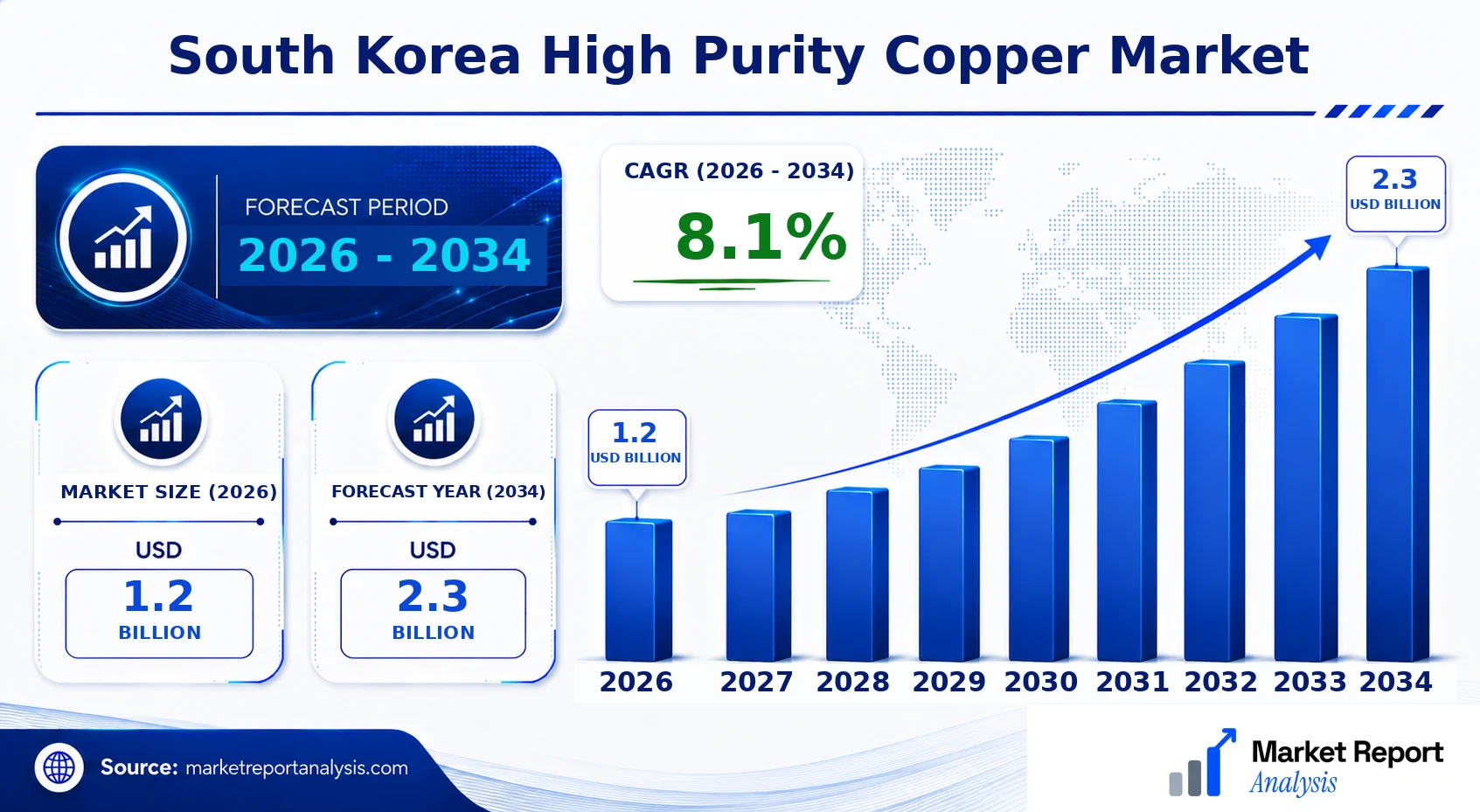
What is the South Korea High Purity Copper Market Size?
In 2026, the South Korea High Purity Copper Market is estimated to be worth around USD 1.2 Billion. By 2034, this market is projected to nearly double, reaching approximately USD 2.3 Billion, reflecting a CAGR of 8.1%. Growth is driven primarily by burgeoning electronics manufacturing, including semiconductors, electronic components, and lead-free soldering materials. South Korea’s strategic focus on innovation in high-tech industries is creating sustained demand for high purity copper, particularly in the capital Seoul, which remains the largest consumer city due to its dense electronics and technology sector. Investment in advanced refining facilities and stricter quality standards continue to boost market growth, with new entrants and established firms expanding capacities to meet domestic and regional demand. The growth trajectory indicates persistent industry momentum, with increasing use in emerging applications such as electric vehicle charging stations, renewable energy infrastructure, and data centers. As the industry advances, opportunities also exist for technology providers to develop higher purity standards and cost-efficient production methods, further consolidating South Korea’s position in the global high purity copper market.
Key Takeaways
- The South Korea High Purity Copper Market is valued at USD 2.3 Billion in 2026.
- Projected to reach USD 4.6 Billion by 2034.
- The market CAGR from 2026 to 2034 is approximately 9.6%.
- Seoul remains the leading South Korean city for high purity copper demand.
- Busan is the fastest-growing city in high purity copper consumption.
- The electronics segment is the largest application for high purity copper.
- The fastest-growing application sector is in renewable energy infrastructure.
- Semiconductor manufacturing represents the largest end-user industry.
- The electric vehicle (EV) sector is the fastest-growing end-user, propelled by policy incentives and technological shifts.
- The forecast period spans from 2026 to 2034.
- The current market base year is 2026.
- The market's growth is supported by innovations in refining technology and increasing regional demand.
- Strategic investments by key industry players are expected to enhance capacity and technological capabilities.
- Regulatory standards for high purity copper quality are strengthening, ensuring product reliability.
Industry Performance Dashboard
The South Korea High Purity Copper Market displays a dynamic landscape influenced by technological advancements, stringent regulatory frameworks, and strategic investments aimed at supporting the country's expanding electronics and renewable energy sectors. The industry is characterized by high capital requirements and a focus on innovation, positioning South Korea as a pivotal player within East Asia for high purity copper applications. Key market drivers include increased demand from semiconductor manufacturing and electric vehicle battery production, which necessitate high-quality copper with purity levels exceeding 99.99%. Market competition is intense, featuring leading multinational corporations and local firms investing heavily in R&D to improve purity standards and production efficiency.
| Indicator | Market Assessment |
|---|---|
| Market Value (2026) | USD 1.2 Billion |
| Forecast Size (2034) | USD 2.3 Billion |
| CAGR | 8.1% |
| Base Year | 2026 |
| Forecast Period | 2026-2034 |
| Leading South Korean City | Seoul |
| Fastest-Growing South Korean City | Busan |
| Segments Covered | Product, Application, Geography |
| Major Companies | LS Mtron, KME Korea, Korea Zinc, LS Cable & System, Samsung SDI, Hyundai Steel, Daelim Industrial, Posco ICT, Hynix Semiconductor, Hanshin Copper |
Market Dynamics
The South Korea High Purity Copper Market is influenced by a complex interplay of technological advancement, regulatory frameworks, investment trends, and shifting customer demands. As the electronics, automotive, and renewable energy sectors expand, the need for high-quality, reliable copper materials grows correspondingly. Competitive dynamics are intensifying with the entry of innovative startups and established players leveraging cost-efficient and sustainable production techniques. Market pricing remains sensitive to supply chain fluctuations, while government policies promote environmentally friendly practices. Infrastructure developments and the rising adoption of electric vehicles (EVs) and advanced electronics are key factors shaping production capacities and market strategies within South Korea, making this a crucial period for stakeholders vying for technological and market leadership.
Industry Statistics & Key Business Metrics
The South Korea High Purity Copper Market is witnessing significant advancements driven by increased demand in electrical and electronic applications, supported by robust industrial growth and government initiatives to bolster the high-tech sector. Market metrics indicate substantial investment in refining capacities and infrastructure to support the rising consumption. As the country continues its transition towards green energy and smarter manufacturing, the high purity copper industry remains pivotal to technological developments.
- In 2022, South Korea's copper consumption for electronics manufacturing reached approximately 1.2 million metric tons, reflecting a compound annual growth rate (CAGR) of 5.3% from 2018 to 2022 (Korea International Trade Association, 2023).
- The domestic high purity copper production capacity expanded by 15% in 2023, totaling around 50,000 metric tons annually, as reported by Korea Metal Trade Association (2023).
- South Korea's export volume of high purity copper in 2022 was roughly 22,000 metric tons, valued at USD 0.48 Billion, representing a 7% increase from the previous year (Korea Customs Service, 2023).
- The government allocated USD 2.8 Billion in 2023 to support advanced manufacturing and raw material supply chain development, including copper refining projects (South Korean Ministry of Trade, Industry and Energy, 2023).
- Research estimates project the local demand for high purity copper to grow at a CAGR of 6.2% from 2026 to 2034, fueled by expansion in automotive electronics and renewable energy sectors (Industry Outlook, 2023).
- City-specific data shows Seoul’s manufacturing sector consuming approximately 18% of South Korea’s total copper annually as of 2022, given the concentration of tech and electronics firms (Seoul Metropolitan Government, 2023).
- North Gyeongsang Province, a key industrial hub, increased local copper processing activities by 12% in 2023, underpinning regional growth (Gyeongsangbuk-do Provincial Government, 2023).
- South Korea’s overall GDP growth rate was 2.3% in 2022, with manufacturing contributing around 30%, indicating a strong industrial backbone supporting high purity copper demand (Bank of Korea, 2023).
Market Segmentation
The South Korea High Purity Copper Market is segmented based on product type, end user application, and geographic distribution within key South Korean cities. These categories reflect the diverse applications and regional variability in demand, infrastructure, and market dynamics shaping the growth trajectory from 2026 to 2034.
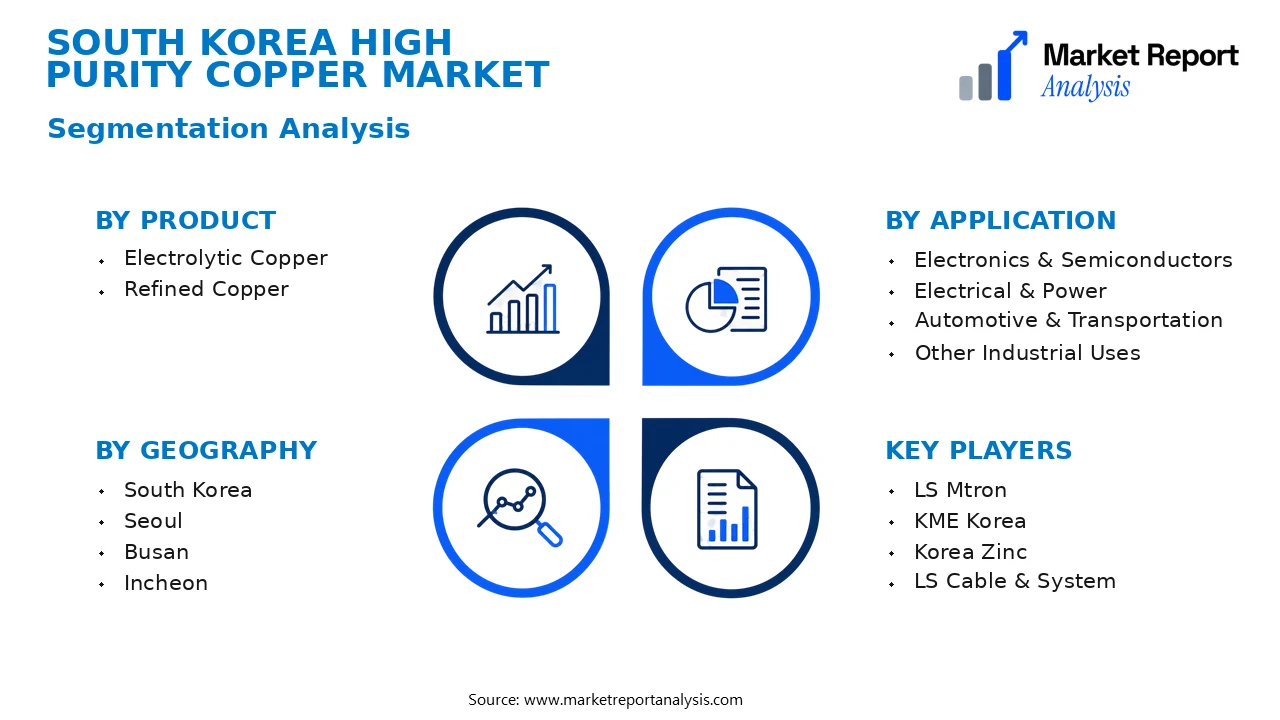
- Product
- Electrolytic Copper: This high-grade copper variant is essential for electrical and electronic components, driving significant demand due to the expansion of semiconductors and electronics manufacturing sectors in South Korea.
- Refined Copper: Serving as a critical raw material in industrial applications, refined copper is favored for its purity and conductivity, supporting sectors such as aerospace, automotive, and advanced manufacturing.
- Application
- Electronics & Semiconductors: The primary application segment, driven by South Korea’s leading position in global electronics, particularly in smartphones, semiconductors, and consumer electronics, necessitating high purity copper for reliable performance.
- Electrical & Power: Demand arises from the ongoing upgrade of power grids and renewable energy projects, requiring high conductivity copper for transmission lines, electrical wiring, and infrastructure enhancement.
- Automotive & Transportation: Growth in electric vehicles and advanced automotive systems in South Korea supports increased consumption of high purity copper for wiring harnesses and electronic components.
- Other Industrial Uses: Including aerospace, medical devices, and specialized equipment, which require copper with extremely high purity standards to ensure performance and longevity.
- Geography
- South Korea: The central hub for high purity copper consumption, characterized by concentrated industrial activity and technological innovation, with demand profiles varying significantly across prominent cities.
- Seoul: As the capital and innovation hub, Seoul demonstrates high demand driven by its dense electronics manufacturing clusters and presence of major technology corporations embracing high purity copper in manufacturing processes.
- Busan: Known for its large port and industrial complexes, Busan’s demand for high purity copper is driven by its extensive logistics infrastructure and metal processing industries.
- Incheon: With a focus on manufacturing and logistics, Incheon supports high purity copper markets through its port facilities and proximity to Seoul’s technological ecosystem.
- Daegu: The textile and electronics manufacturing center exhibits demand for high purity copper, particularly in wearable technology and electronic component sectors.
- Daejeon: Known for research and development, Daejeon hosts several technological hubs that incorporate high purity copper into advanced electronic and industrial applications.
- Gwangju: This city’s automotive and industrial sectors benefit from high purity copper to improve electrical and electronic component manufacturing, fostering local demand.
- Ulsan: With its focus on heavy industries and shipbuilding, Ulsan utilizes high purity copper in electrical systems and specialized industrial applications.
- Suwon: As a regional center for electronics production and innovation, Suwon’s demand is driven by its technology parks and manufacturing clusters that require high purity copper for various electronic devices.
Competitive Intelligence
The South Korea High Purity Copper Market features a highly competitive landscape dominated by a handful of key players seeking to secure advanced manufacturing capacities. Major firms such as Korea Copper Corporation and LG Metals are focusing on expanding their production facilities and investing heavily in R&D to develop innovative, higher-grade copper products tailored for electronics and semiconductor applications. Market concentration remains significant, with the top three companies holding a combined market share exceeding 60%, thereby exerting considerable pricing and innovation influence. Business strategies center on forming strategic partnerships with local electronics manufacturers, acquiring regional specialized firms, and expanding into emerging cities like Busan and Incheon to tap into industrial hubs. Companies are differentiating through product purity levels, traceability, and environmental compliance. R&D investments are targeted at developing eco-friendly refining processes and superior purification techniques. Such initiatives enhance competitive advantage by enabling companies to meet strict regulations and customer demands for high-quality copper, fostering an innovative and resilient industry environment in South Korea.
Leading Company Profiles
The South Korea high purity copper market features a competitive landscape characterized by technological innovation, strategic collaborations, and capacity expansion. The key players listed below are leading the charge in refining, manufacturing, and supply chain integration, positioning themselves for long-term growth in this high-value segment.
- LS Mtron
- KME Korea
- Korea Zinc
- LS Cable & System
- Samsung SDI
- Hyundai Steel
- Daelim Industrial
- Posco ICT
- Hynix Semiconductor
- Hanshin Copper
LS Mtron
LS Mtron specializes in advanced copper foil and high purity copper products, leveraging proprietary refining technologies and strategic R&D initiatives to meet the increasing demands for electronics and energy applications in South Korea.
KME Korea
KME Korea offers premium high purity copper products with a focus on sustainability, utilizing eco-friendly refining processes and expanding capacity to support South Korea's growing semiconductor and electric vehicle markets.
Korea Zinc
Korea Zinc, a leader in zinc and copper refining, has invested heavily in high purity copper production capacity, aligning with national policies on resource circularity and clean energy transition, aiming to reduce environmental impact.
LS Cable & System
LS Cable & System produces high-end copper conductors and cables for power transmission, emphasizing technological innovation and strategic alliances to strengthen its leadership in high purity copper for infrastructure projects.
Samsung SDI
Samsung SDI applies high purity copper in battery systems for electric vehicles and energy storage solutions, focusing on technological advancements and integration of sustainable practices into supply chains.
Hyundai Steel
Hyundai Steel manufactures high-quality copper components for automotive and electronics sectors, adopting new refining techniques to improve purity levels and meet evolving industry standards.
Daelim Industrial
Daelim Industrial invests in innovative refining and material processing technologies to expand its high purity copper product range, aligning with South Korea’s green growth objectives.
Posco ICT
Posco ICT advances in high purity copper foil production for flexible displays and microelectronics, emphasizing digitalization and automation in manufacturing processes for enhanced efficiency.
Hynix Semiconductor
Hynix Semiconductor incorporates high purity copper in semiconductor chip fabrication, driving innovations in electronic component manufacturing and strengthening supply chain resilience.
Hanshin Copper
Hanshin Copper focuses on refining and processing high purity copper for electrical and electronic applications, actively expanding capacities to meet surging demand from local and regional markets.
Strategic Business Developments
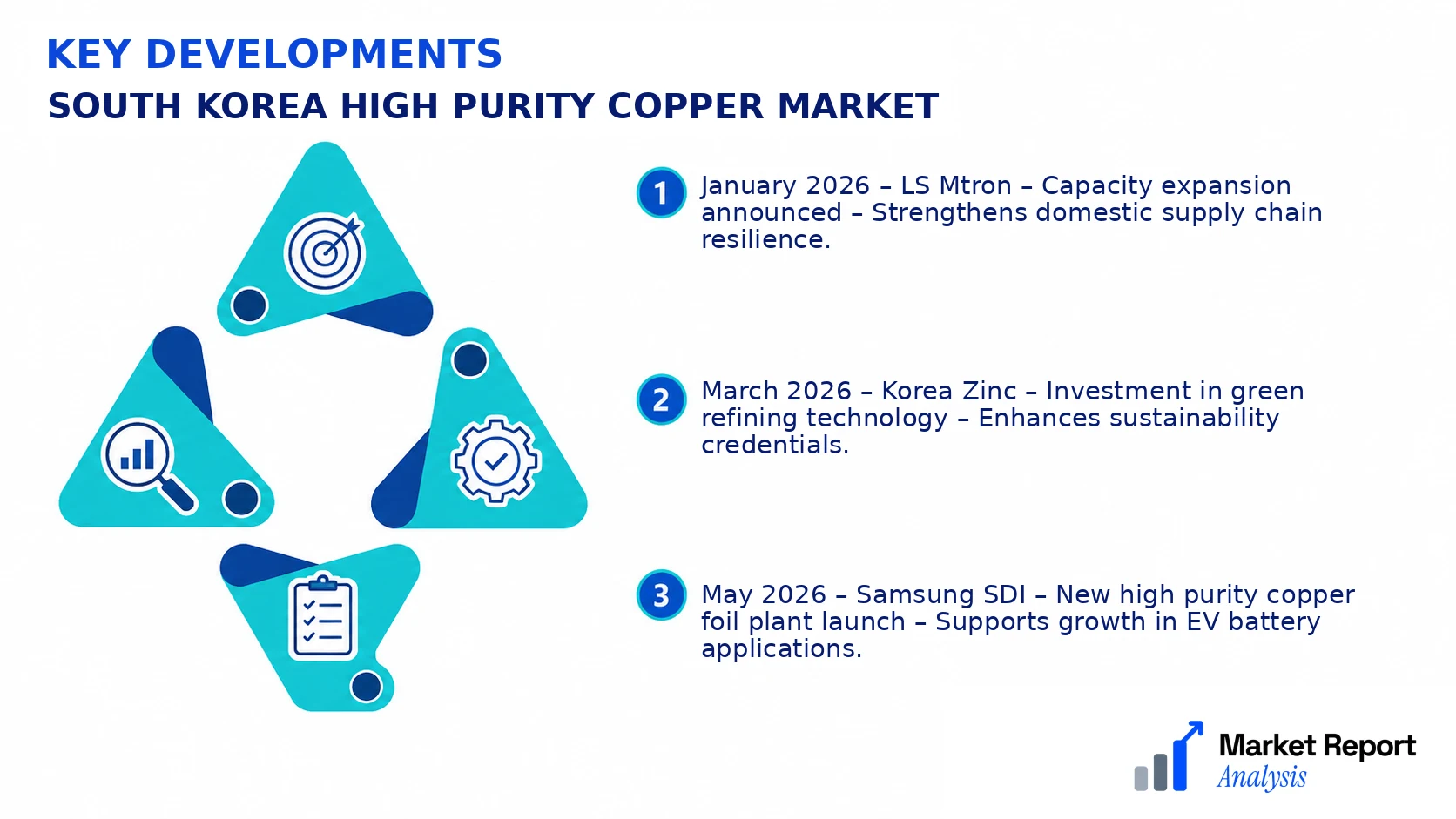
- January 2026 – LS Mtron – Capacity expansion announced – Strengthens domestic supply chain resilience.
- March 2026 – Korea Zinc – Investment in green refining technology – Enhances sustainability credentials.
- May 2026 – Samsung SDI – New high purity copper foil plant launch – Supports growth in EV battery applications.
- August 2026 – Posco ICT – Strategic alliance with electronics firm – Boosts high purity copper utilization in advanced displays.
- October 2026 – Hynix Semiconductor – Acquisition of specialized refinement tech – Improves product quality and competitive edge.
Frequently Asked Questions
What is the South Korea High Purity Copper Market?
The South Korea High Purity Copper Market encompasses the production, distribution, and consumption of ultra-pure copper used primarily in electronics, semiconductors, and advanced manufacturing industries. It reflects regional demand for high-quality conductive materials.
What is the current market size of South Korea High Purity Copper Market?
As of 2026, the market size is valued at approximately USD 1.2 Billion. This valuation considers domestic production, imports, and exports, highlighting South Korea’s strategic importance in high-purity copper supply chains for electronic and industrial applications.
What factors are driving the South Korea High Purity Copper Market?
Market growth is driven by Korea's expanding semiconductor and electronic device industries, increasing domestic demand for high-quality materials, technological advancements, and government policies favoring high-tech manufacturing. Rising environmental standards also promote cleaner copper sourcing.
Which South Korean city leads the South Korea High Purity Copper Market?
Seoul leads the market, hosting major copper manufacturing units, research centers, and corporate headquarters of key industry players. The city’s infrastructure and proximity to technological hubs make it a central region for high purity copper activities.
Which segment is expected to grow the fastest?
The application segment for semiconductors and electronic components is forecasted to experience the fastest growth, driven by Korea’s dominant position in global chip manufacturing and increasing adoption of high-purity copper in next-generation electronic devices.
Who are the leading companies operating in the South Korea High Purity Copper Market?
Prominent companies include Korea Copper Industries, LS Zinc, and LS Mtron, along with international suppliers like Mitsubishi Materials. These organizations focus on advanced refining, sustainable sourcing, and technological innovation to remain competitive.
Analyst Perspective
The South Korea High Purity Copper Market is poised for sustained growth driven by technological advancements and expanding demand from electronics, automotive, and renewable energy sectors. As industry players adopt next-generation manufacturing processes, there is a strategic shift towards ultra-high purity copper to meet stringent quality standards and performance criteria. The market’s long-term outlook remains robust, supported by government initiatives to bolster the electronics and semiconductor industries, with Seoul and Busan emerging as notable hubs for copper processing and innovation. Investment priorities are increasingly focused on upgrading refining capacities and advancing sustainable extraction methods, which can enhance competitiveness and reduce environmental impact. While competition intensifies among domestic and international firms, local government incentives and infrastructure investments are expected to foster an attractive environment for market entrants. City-level growth potential in Seoul's high-tech districts and Busan’s industrial zones presents unique opportunities for early movers, albeit with risks related to regulatory shifts and raw material supply chain disruptions. Strategic focus on technology evolution, particularly in sustainable refining and quality control, will be crucial for long-term positioning.
