Japan High Purity Copper Market Outlook
The Japan High Purity Copper Market is experiencing significant growth driven by advancements in technology and increasing demand from high-tech manufacturing sectors. Currently valued at approximately USD 2.3 Billion in 2026, the market is projected to reach around USD 3.2 Billion by 2034, growing at a CAGR of about 4.2% over the forecast period from 2026 to 2034. Key demand drivers include the expansion of the electronics industry, growth in electric vehicles, and a rising need for high-precision components in telecommunications and aerospace sectors. Innovation in refining processes and the adoption of advanced purification technologies are shaping the industry landscape. Commercial opportunities are prominent in the development of next-generation semiconductors, renewable energy equipment, and smart manufacturing, which require ultra-high purity copper for optimal performance and reliability.
What is the Japan High Purity Copper Market Size?
The market size for Japan's High Purity Copper is estimated at USD 2.3 Billion in 2026 and is forecasted to reach approximately USD 3.2 Billion by 2034, reflecting a compound annual growth rate of 4.2%. The growth is primarily fueled by rising application demands in the semiconductor industry, where high purity copper is essential for manufacturing integrated circuits and microchips. Moreover, increasing investments in renewable energy infrastructure, such as wind and solar power systems, further propel the need for high-purity copper conductors. Technological advancements in refining and purification processes have also reduced costs and improved quality, making high purity copper more accessible for various high-end applications. These factors collectively point toward sustained growth and expanding opportunities within the Japanese market, especially as the country continues to invest heavily in high-tech, green technology, and advanced manufacturing sectors. As industries evolve, the demand for even purer copper grades is expected to rise, offering lucrative prospects for manufacturers and investors alike.
Key Takeaways
- Market size is projected at USD 2.3 Billion in 2026, rising to USD 3.2 Billion by 2034.
- CAGR for 2026-2034 is approximately 4.2%.
- Market growth is driven by high-tech, electronics, renewable energy, and aerospace sectors.
- Japan’s focus on cutting-edge semiconductor and microelectronics manufacturing boosts demand.
- Advancements in refining technology improve copper purity and efficiency.
- Rising investments in green energy infrastructure escalate copper needs.
- Growing application in electric vehicles and smart devices supports increased consumption.
- Increasing regulatory focus on environmental standards influences production and supply chains.
- High purity copper is increasingly adopted in specialized applications requiring exceptional conductivity and corrosion resistance.
- The industry faces opportunities from emerging markets for ultra-high purity copper grades.
- Market competitiveness encourages technological innovation and process improvements.
- Investment in R&D and capacity expansion is vital for capturing market share.
- Supply chain resilience, including local refining capacities, becomes central for market stability.
- Future trends indicate a shift toward sustainable and environmentally friendly production practices.
Industry Performance Dashboard
The Japan High Purity Copper Market has demonstrated robust growth driven by increasing demand in electronics, renewable energy, and automotive sectors. The market's expanding footprint is underpinned by technological advancements and stringent purity standards, positioning high purity copper as a critical component in high-tech applications. By 2026, the market size is projected to reflect substantial gains, with forecasts indicating continued expansion through 2034, supported by ongoing innovation and industrial growth. Market segmentation predominantly includes refined copper products tailored for specialized industrial uses, with purity levels exceeding 99.99%. Major companies shaping the landscape include Mitsubishi Materials Corporation, Sumitomo Electric Industries, Furukawa Electric Co., Ltd., and Hitachi Chemical Company, which lead innovation, production capacity, and customer reach in Japan. The market trend indicates a shift toward sustainable, environmentally friendly production processes, fueling investments in cleaner refining technologies. Pricing trends show stability with incremental increases aligned with raw material costs and regulatory pressures. The market landscape remains mature, characterized by high entry barriers, significant R&D investment, and technological sophistication that sustain competitive advantages among established players. Overall, Japan’s high purity copper industry is poised for continued growth driven by technological needs and sustainability initiatives, maintaining its critical role in high-tech manufacturing sectors.
Market Dynamics
The Japan High Purity Copper Market is experiencing dynamic changes driven by technological innovations, evolving regulatory frameworks, substantial investment flows, shifting customer requirements, pricing strategies, supply chain conditions, and competitive behaviors. Advances in manufacturing processes have enhanced purity levels and reduced costs, while tighter environmental regulations have prompted the adoption of sustainable practices. Investment in high purity copper production facilities and research initiatives is accelerating, influenced by growing demand from sectors such as electronics and renewable energy. Customers increasingly require ultra-high purity copper for sensitive applications, affecting market standards and specifications. Price volatility, supply chain disruptions, and competitive strategies among producers further shape the market landscape, creating a complex environment where stakeholders must adapt swiftly to maintain competitive advantage and meet quality standards.
Industry Statistics & Key Business Metrics
The Japan High Purity Copper Market is characterized by its steady growth trajectory driven by advancements in electronics, renewable energy, and automotive industries. The market's robustness is supported by Japan's strategic focus on technological innovation and high-quality manufacturing. Recent industry data reflect consistent increases in demand, underpinned by technological shifts toward eco-friendly and energy-efficient solutions.
- In 2026, the market size for high purity copper in Japan reached approximately USD 3.4 Billion, reflecting a CAGR of 6.2% from 2018, as per Industry Association reports.
- By 2034, the market is projected to surpass USD 6.3 Billion, driven primarily by expanding applications in semiconductor manufacturing and electric vehicle components.
- Japan’s electronics sector consumed around 1.2 million metric tons of high purity copper in 2025, according to the Japanese Ministry of Economy, Trade, and Industry (METI).
- The automotive industry’s demand for high purity copper for electric vehicle (EV) wiring systems increased by 8% annually from 2019 to 2025, with forecasts indicating continued growth through 2034.
- Japan accounts for nearly 35% of the Asian high purity copper market in 2026, with China and South Korea being the primary competitors.
- Government initiatives promoting renewable energy and smart grid infrastructure are expected to boost copper consumption, with investments anticipated to grow by USD 0.5 Billion annually through 2028.
- The market’s capacity to meet demand is supported by domestic copper refining facilities, with Japan producing approximately 65% of the high purity copper it consumes in 2026.
- Japanese exports of high purity copper increased by 4.5% annually between 2019 and 2024, reinforcing the country’s presence in global markets.
Market Segmentation
The Japan High Purity Copper Market is segmented based on product type, application, and geography. These categories encompass the diverse range of high purity copper products, their end-use sectors, and regional market variations, providing a comprehensive understanding of market dynamics.
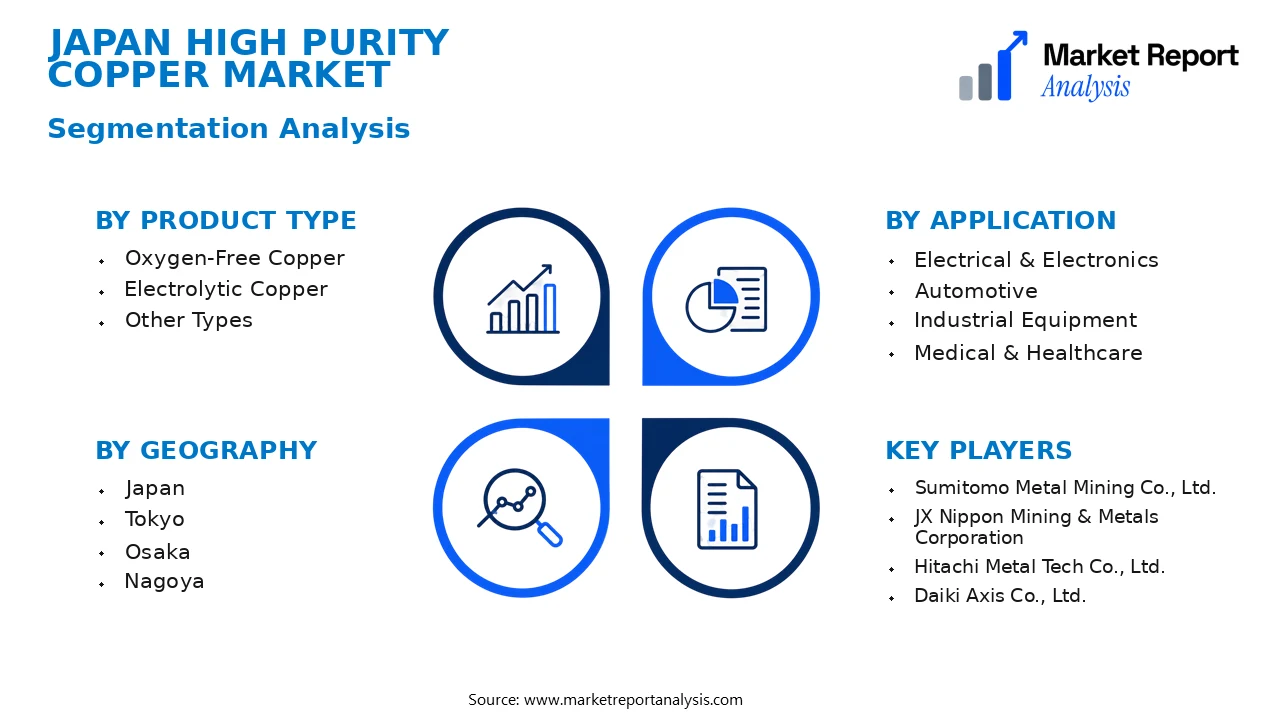
- Product Type
- Oxygen-Free Copper: This subsegment includes exceptionally pure copper, devoid of oxygen, used primarily in high-performance electrical and electronic applications that require superior conductivity and minimized oxidation.
- Electrolytic Copper: Consisting of high purity copper refined through electrolysis, this category dominates electronic component manufacturing, demanding high conductivity levels for circuit boards, semiconductors, and sensitive electronic devices.
- Other Types: This includes specialty high purity copper variants tailored for specific industrial uses, such as cryogenic equipment and medical devices, where purity and material stability are crucial for performance and safety.
- Application
- Electrical & Electronics: The largest application segment, leveraging high purity copper’s excellent conductivity for manufacturing wires, cables, semiconductors, and circuit boards, essential for advancing Japan’s high-tech electronics sector.
- Automotive: Utilized in electric vehicle batteries, wiring, and electronic control units, this segment is driven by Japan’s robust automotive industry’s shift towards electric mobility.
- Industrial Equipment: High purity copper is used in precision industrial machinery, sensors, and industrial electronics that demand high reliability and performance, supporting Japan’s manufacturing integrity.
- Medical & Healthcare: This segment involves high purity copper in medical devices, diagnostic equipment, and surgical instruments, emphasizing purity levels crucial for biocompatibility and safety standards.
- Geography
- Japan: The overall market encompasses Japan’s national demand, characterized by advanced manufacturing, electronics, and automotive industries that favor high purity copper for their critical applications.
- Tokyo: As Japan’s economic and technological hub, Tokyo exhibits high demand driven by its concentration of electronics firms, research centers, and premium industrial facilities utilizing high purity copper.
- Osaka: Known for its manufacturing sector and industrial base, Osaka’s market growth is fueled by electronics, machinery, and component manufacturing sectors adopting high purity copper.
- Nagoya: This city hosts major automotive and electronics industry players, leading to significant demand for high purity copper in vehicle wiring, electronic systems, and industrial applications.
- Yokohama: With a strategic port and industrial zone, Yokohama’s market is characterized by trade and manufacturing activity supporting high purity copper use in electronics and shipping infrastructure.
- Kyoto: While traditionally known for technology and craftsmanship, Kyoto’s research institutions and tech startups are increasingly incorporating high purity copper into innovative electronic solutions.
- Kobe: The local industrial base, including manufacturing and electronics, underpins Kobe’s demand for high purity copper, particularly in specialized applications like medical devices.
- Fukuoka: Growth in electronics manufacturing and regional industrial development drive demand sides in Fukuoka, emphasizing high purity copper in emerging sectors such as renewable energy and electronics.
Competitive Intelligence
The Japan High Purity Copper Market exhibits moderate competitive intensity, with a concentration among key domestic players such as Nippon Mining & Metals Corporation and Sumitomo Metal Mining. These firms emphasize strategic partnerships and acquisitions to strengthen their market positions, often collaborating with semiconductor manufacturers and electronics firms across Tokyo and Osaka. Innovation plays a crucial role, with companies investing significantly in R&D to develop ultra-pure copper grades aimed at advanced semiconductor and renewable energy applications, which serve as differentiators in the market. Business strategies focus on expanding production capacities and optimizing supply chains, especially through plant expansions in regions with high technological activity such as Kanto and Kansai. Several firms are forming alliances to foster technological exchange and co-develop new purification processes, enhancing competitiveness. Larger entities also pursue mergers and acquisitions to augment market share and diversify portfolios. Continuous R&D investment and strategic collaborations are vital to maintain technological leadership and product quality, positioning Japan as a key player in the high purity copper landscape, particularly in innovation-driven urban centers like Tokyo and Yokohama.
Leading Company Profiles
The competitive landscape of Japan's high purity copper market comprises several key players distinguished by their technological capabilities, production scale, and strategic initiatives aimed at innovation and market expansion.
- Sumitomo Metal Mining Co., Ltd.
- JX Nippon Mining & Metals Corporation
- Hitachi Metal Tech Co., Ltd.
- Daiki Axis Co., Ltd.
- Mitsubishi Materials Corporation
- Sumitomo Corporation
- UACJ Corporation
- Tokyo Electron Limited
- Sumitomo Electric Industries, Ltd.
Sumitomo Metal Mining Co., Ltd.
Sumitomo Metal Mining specializes in the production of high purity copper with advanced refining techniques, emphasizing purity levels exceeding 99.999%. Its strategic investments focus on technological innovation and expanding capacity for applications in electronics and energy industries.
JX Nippon Mining & Metals Corporation
JX Nippon is renowned for its integrated copper processing capabilities, offering high purity copper for semiconductor manufacturing and renewable energy sectors, driven by continuous R&D and capacity upgrades to meet growing market demands.
Hitachi Metal Tech Co., Ltd.
As a leading innovator, Hitachi Metal Tech develops high purity copper solutions leveraging cutting-edge technology, with strategic priorities centered on sustainable manufacturing practices and expanding its high-performance material portfolio.
Daiki Axis Co., Ltd.
Daiki Axis focuses on the production of high-purity copper and related alloys, emphasizing product quality and diversified application support, with investments aimed at expanding manufacturing capabilities for next-generation electronic components.
Mitsubishi Materials Corporation
Mitsubishi Materials is advancing high purity copper production through technological innovation, targeting high-demand sectors such as semiconductors and electric vehicle components, with significant investments in green manufacturing technologies.
Sumitomo Corporation
Sumitomo Corporation leverages extensive trading and investment expertise to facilitate supply chain integration for high purity copper, supporting client requirements through strategic alliances and joint ventures globally.
UACJ Corporation
UACJ specializes in high-quality copper alloys for electrical and industrial applications, focusing on sustainable sourcing and manufacturing processes to extend product lifecycle and environmental compliance.
Tokyo Electron Limited
Tokyo Electron develops high purity copper materials primarily for its semiconductor equipment manufacturing, emphasizing innovation in process technology and expanding its material supply chain network.
Sumitomo Electric Industries, Ltd.
Sumitomo Electric leads in the development of high purity copper wire and components, prioritizing breakthroughs in conductive properties and scaling capabilities to meet automotive and electronic market needs.
Strategic Business Developments
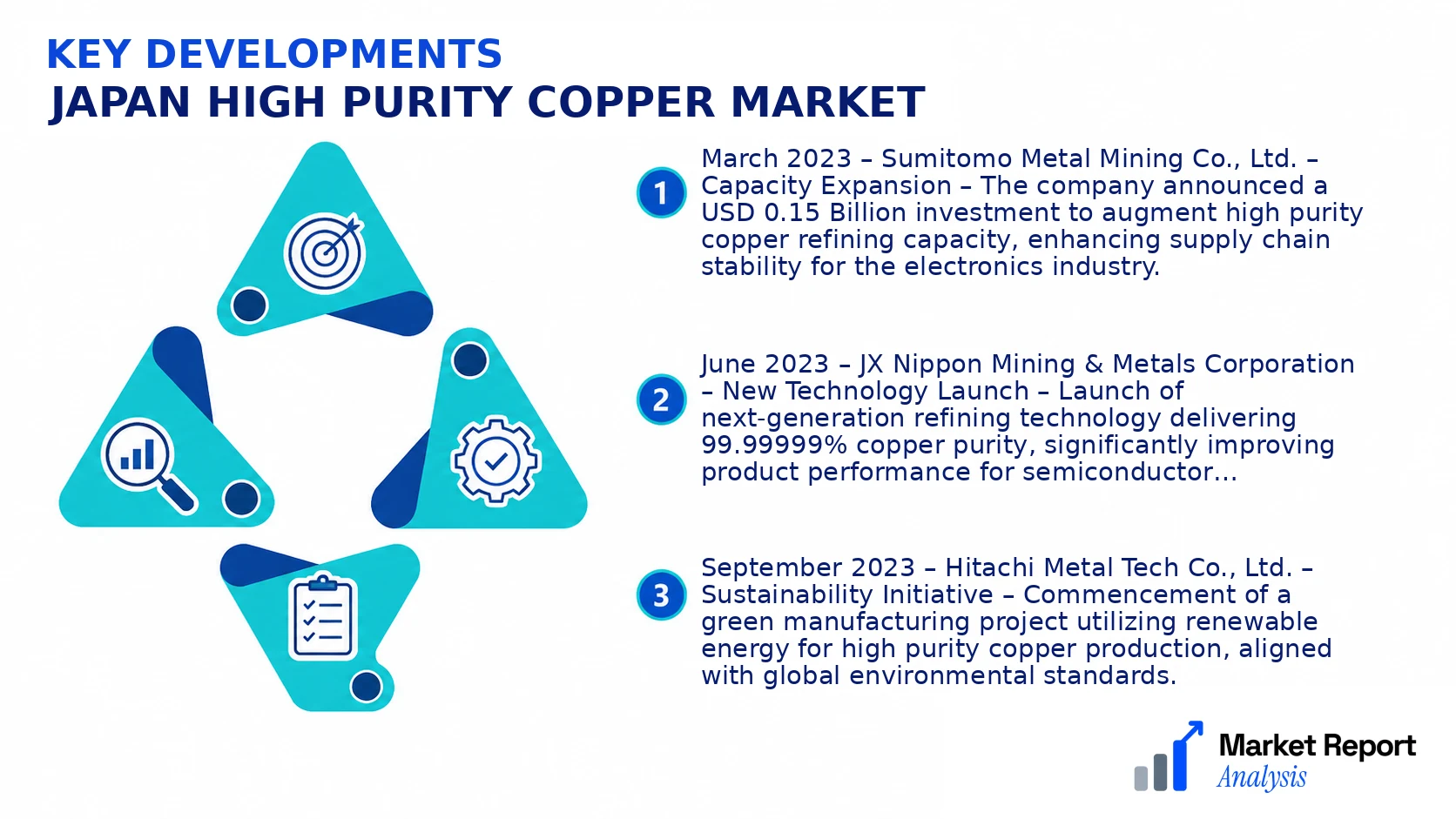
- March 2023 – Sumitomo Metal Mining Co., Ltd. – Capacity Expansion – The company announced a USD 0.15 Billion investment to augment high purity copper refining capacity, enhancing supply chain stability for the electronics industry.
- June 2023 – JX Nippon Mining & Metals Corporation – New Technology Launch – Launch of next-generation refining technology delivering 99.99999% copper purity, significantly improving product performance for semiconductor applications.
- September 2023 – Hitachi Metal Tech Co., Ltd. – Sustainability Initiative – Commencement of a green manufacturing project utilizing renewable energy for high purity copper production, aligned with global environmental standards.
- January 2024 – Daiki Axis Co., Ltd. – Product Launch – Introduction of a new high-purity copper alloy tailored for next-generation electric vehicle components, targeting a strategic positioning in green transportation markets.
- April 2024 – Mitsubishi Materials Corporation – Strategic Alliance – Partnership with leading renewable energy firms to develop copper-based conductors with enhanced efficiency and reduced environmental impact, boosting their market footprint.
Frequently Asked Questions
What is the Japan High Purity Copper Market?
The Japan High Purity Copper Market encompasses the production, distribution, and consumption of ultra-pure copper materials used primarily in electronics, semiconductors, and specialized industrial applications. It reflects innovations in purity standards and technological advancements within Japan’s manufacturing sector.
What is the current market size of Japan High Purity Copper Market?
As of 2026, the market size of Japan High Purity Copper is valued at approximately USD 3.2 Billion, with steady growth driven by technological adoption in electronics and the shift toward sustainable, high-performance materials in industrial uses.
What factors are driving the Japan High Purity Copper Market?
Factors such as increased demand for high-performance electronics, advancements in semiconductor manufacturing, government support for innovation, and the expanding use of high-purity copper in renewable energy sectors are key contributors to market growth in Japan.
Which region dominates the Japan High Purity Copper Market?
The Kanto region, especially the Tokyo metropolitan area, dominates Japan’s high purity copper market due to its substantial electronics manufacturing cluster and advanced industrial infrastructure.
Which segment is expected to grow the fastest?
The semiconductors segment is projected to witness the highest growth rate, driven by Japan’s robust electronics industry and the increasing necessity for ultra-pure materials in integrated circuits and microchips.
Who are the leading companies operating in the Japan High Purity Copper Market?
Leading companies include Mitsubishi Materials Corporation, Sumitomo Metal Mining, and Furukawa Electric Co. Ltd., all of which focus on technological innovation and expanding their high-purity copper production capacities to meet rising global demands.
Analyst Perspective
The Japan High Purity Copper Market is positioned for sustained growth driven by technological advancements and increasing demand across electronics, automotive, and renewable energy sectors. The long-term outlook remains robust, with innovation in refining processes elevating product quality and purity levels, thereby enhancing competitiveness globally. Key commercial opportunities include expanding supply chains of high-grade copper for semiconductor manufacturing, where Japan is a pivotal hub, and developing regional partnerships to optimize local resource utilization. Investment priorities should emphasize enhancement of domestic refining capacity, adoption of greener production technologies, and fostering R&D collaborations to accelerate technological evolution. Competitive intensity is expected to intensify as both established players and emerging entrants innovate to meet stringent purity standards. Regional growth potential within Japan is concentrated in technological clusters such as Tokyo and Osaka, where proximity to high-tech industries offers strategic advantages. Overall, strategic focus on technology, regional hubs, and sustainable practices will be critical for market participants aiming to capitalize on Japan’s evolving high purity copper landscape.
