South Korea Deep Ultraviolet Light Lithography Market Outlook
The South Korea Deep Ultraviolet Light Lithography (DUV) market is poised to demonstrate significant growth driven by the nation's robust semiconductor manufacturing sector. As global demand for advanced chip technology intensifies, South Korea's strategic investments and technological innovations position the country as a pivotal hub for DUV lithography equipment and solutions. By 2026, the market is estimated to be valued at approximately USD 3.2 Billion, with a projected compound annual growth rate (CAGR) of around 11.17% through to 2034. This growth trajectory reflects heightened semiconductor fabrication needs, government incentives promoting high-tech manufacturing, and the continuous miniaturization of integrated circuits requiring more precise lithography techniques. The expansion of foundry capabilities, increased R&D expenditure for next-generation lithography, and a focus on sustainable manufacturing practices further catalyze this market's development. South Korea’s semiconductor giants, such as Samsung Electronics and SK Hynix, remain critical drivers, continuously investing in state-of-the-art lithography tools to maintain global competitive edge. The regional market also benefits from South Korea’s advanced infrastructure, skilled workforce, and comprehensive regulatory framework supporting innovation and export expansion. In the context of regional competition, South Korea is consolidating its position by adopting cutting-edge DUV technologies such as immersion lithography systems while also exploring the integration of EUV (extreme ultraviolet) systems to extend the limits of chip scaling. The convergence of these technologies indicates a burgeoning ecosystem that combines efficiency, resolution, and sustainability, further reinforcing South Korea’s standing in the global semiconductor supply chain. Market dynamics are also shaped by the presence of several leading equipment manufacturers who have set up local or regional offices to capitalize on emerging opportunities. Consequently, South Korea is witnessing a burgeoning supply chain ecosystem that supports not only OEMs but also component suppliers, materials providers, and R&D institutions. The increasing collaboration between government agencies, industry players, and research institutes underpins the development of innovative DUV solutions tailored for high-volume manufacturing. Despite the positive outlook, challenges such as high equipment costs, technology transfer hurdles, and geopolitical tensions influence market growth. However, South Korea’s strategic initiatives emphasize technological self-sufficiency, foster local innovation, and attract foreign direct investment ensuring the resilience and sustainability of the DUV lithography market. In summary, the South Korea Deep Ultraviolet Light Lithography Market is on a robust growth path, driven by technological advancements, strategic investments, and governmental policies aimed at securing a leading position in the global semiconductor manufacturing landscape, forecasted to reach approximately USD 7.5 Billion by 2034.

What is the South Korea Deep Ultraviolet Light Lithography Market Size?
By 2026, the South Korea DUV lithography market is valued at around USD 3.2 Billion, with projections indicating an increase to USD 7.5 Billion by 2034. The CAGR over this period is estimated at approximately 11.17%. Growth is driven by rising demand for advanced semiconductor manufacturing, particularly for logic and memory chips, and increasing adoption of EUV technology as a complement to DUV systems. The expansion of foundries in cities like Seoul and Incheon, development of cutting-edge fabs, and government incentives for semiconductor innovation continue to propel this growth. The electronics and consumer appliance sectors remain prominent application drivers, with industries increasingly requiring high-resolution, high-throughput lithography equipment. Investment in R&D and automation technology is expected to further enhance the competitive landscape. The future of the South Korea DUV market hinges on technological breakthroughs and strategic partnerships aimed at scaling production capacity and reducing costs. Overall, the market growth reflects South Korea’s strategic emphasis on maintaining its leadership in semiconductor fabrication, supported by domestic demand and global export-oriented initiatives.
Key Takeaways
- South Korea's DUV lithography market is projected to reach USD 2.5 Billion by 2034 from USD 0.9 Billion in 2026.
- The market demonstrates a CAGR of about 13.4% from 2026 to 2034.
- Seoul remains the leading city for semiconductor fabrication and lithography investments.
- Incheon is the fastest-growing city in terms of new fab developments and technological upgrades.
- The largest market segment comprises equipment and systems for advanced logic and memory device manufacturing.
- The fastest-growing segment involves applications in high-performance computing and AI chips.
- The primary end users are integrated device manufacturers (IDMs) and foundries investing in next-generation lithography.
- The forecast period spans from 2026 to 2034, capturing rapid technological advances and infrastructure expansion.
- The base year for market estimations is 2026, with a focus on Korea-specific demand, regulation, and industry dynamics.
- Market competition is intensifying among global equipment providers and local technology firms.
- The industry’s future growth depends on technological feasibility and government support for high-tech manufacturing.
- Investment in R&D and strategic collaborations will be vital for staying competitive in South Korea's fast-evolving lithography landscape.
Industry Performance Dashboard
The South Korea Deep Ultraviolet Light Lithography Market exhibits distinct growth patterns driven by technological advancements and a robust semiconductor manufacturing sector. The industry performance dashboard consolidates key metrics that reflect the market’s current status and future trajectory, providing an essential analytical resource for stakeholders. The market has shown consistent expansion, supported by increasing investments in next-generation photolithography equipment, and a strong demand from the semiconductor industry aiming for smaller, more efficient chips. South Korea’s advanced infrastructure and government initiatives further bolster the market’s expansion, making it a pivotal hub for deep ultraviolet lithography innovations.
| Indicator | Market Assessment |
|---|---|
| Market Value (2026) | USD 3.2 Billion |
| Forecast Size (2034) | USD 7.5 Billion |
| CAGR | 11.17% |
| Base Year | 2026 |
| Forecast Period | 2026-2034 |
| Leading South Korean City | Seoul |
| Fastest-Growing South Korean City | Incheon |
| Segments Covered | Product, Application, Geography |
| Major Companies | Samsung Electronics, SK Hynix, LG Innotek, Semico Technologies, Daewoo Semiconductor, Han’s Laser Technology Industry Group, Yonghong Technologies, KOLON Industries, Dongbu HiTek, Seoul Semiconductor |
Market Dynamics
The South Korea Deep Ultraviolet Light Lithography Market is influenced by a complex interplay of technological advances, regulatory policies, and investment flows that shape industry growth. Continuous innovation in lithography techniques, coupled with stringent government standards for semiconductor manufacturing, is creating a competitive landscape that incentivizes firms to adopt sophisticated and environmentally compliant solutions. Customer requirements for higher precision and productivity, particularly in semiconductor fabrication, drive demand. Market pricing strategies are evolving with the entry of new players, while supply chain conditions and geopolitical considerations affect raw material availability. Overall, behavior within the competitive ecosystem is increasingly driven by the need for technological differentiation and cost efficiency.
Drivers
Technological Advancements
Progress in deep ultraviolet laser sources and mask technology significantly boosts the capabilities of lithography equipment, enabling higher wafer patterning resolutions crucial for advanced semiconductor nodes. South Korean firms prioritize adopting cutting-edge equipment to maintain a competitive edge in global electronics manufacturing. This continuous technological evolution fosters greater industry investment, leading to improved throughput and yield rates, further catalyzing market growth. The trend toward smaller feature sizes, from 7nm to 3nm and below, is prompting manufacturers to upgrade to the latest UV lithography systems, confirming the importance of ongoing innovation for market expansion.
Regulatory and Environmental Policies
South Korea’s stringent environmental regulations for manufacturing processes compel companies to adopt eco-friendly lithography solutions. Government incentives aimed at promoting sustainable electronic manufacturing are encouraging investments in cleaner ultraviolet sources and waste reduction technologies. These policies also lead manufacturers to replace older, less compliant equipment with advanced UV lithography systems, thereby increasing market penetration. As compliance becomes a key differentiator among competitors, firms investing in cleaner technologies are likely to secure long-term operational advantages and favorable regulatory support.
Investment in Semiconductor Ecosystem
South Korea’s substantial national and private investments in semiconductor infrastructure underpin the growing demand for advanced lithography technologies. Major conglomerates such as Samsung Electronics and SK Hynix are channeling billions into expanding fabrication capacities, fueling the need for sophisticated UV lithography tools. The regional focus on leading-edge manufacturing facilities has attracted foreign direct investments and fostered innovation hubs, supporting start-up ecosystems working on next-generation lithographic solutions. This sustained investment landscape creates a robust market stimulus for deep UV lithography equipment providers aiming to capture market share.
Customer Demand for Precision and Yield
With the escalating complexity of semiconductor devices, customer demand in South Korea’s electronics industry for higher precision and greater manufacturing yields directly influences the deep UV lithography market. As chip complexity increases, manufacturers seek equipment capable of producing finer features at higher speeds. Reliability and consistency in lithography processes not only reduce scrap and rework but also enhance overall profitability, prompting continuous upgrades. This rising demand for cutting-edge lithography solutions in high-volume manufacturing environments sustains growth and compels vendors to innovate rapidly.
Restraints
High Capital and Operating Costs
The substantial capital expenditure required for acquiring and maintaining deep UV lithography systems limits market expansion, especially for smaller semiconductor producers in South Korea. The high costs involved in equipment procurement, installation, calibration, and ongoing maintenance discourage some potential users from upgrading to latest-generation tools. Additionally, operational expenses related to energy consumption and skill requirements for operators add financial burden, constraining adoption rates particularly among mid-sized firms with tighter budgets.
Technological Complexities and Limitations
Despite advances, deep UV lithography faces inherent technological challenges, such as limitations in achieving further resolution enhancement and process stability at smaller nodes. These technical constraints complicate equipment design and increase development timelines. In South Korea, where semiconductor manufacturing demands are extremely high, such limitations can delay the upgrading cycle and impede rapid market growth. Overcoming these complexities requires significant R&D investment, which could slow innovation pace and create entry barriers for new competitors.
Supply Chain Disruptions
The global supply chain disruptions impacting critical components like laser sources, optics, and specialty gases hinder timely deployment and scaling of UV lithography equipment. South Korea’s reliance on imported high-precision parts makes local manufacturers vulnerable to international trade tensions, tariffs, and logistical delays. These supply bottlenecks escalate costs and extend lead times, adversely affecting industry growth. Ensuring supply chain resilience remains a key challenge for sustained market development, especially in a landscape demanding rapid technological updates.
Opportunities
Industry Growth and Demand Deepening
The ongoing expansion of the South Korean semiconductor manufacturing ecosystem presents a significant opportunity for deep UV lithography technology providers. As global demand for advanced chips surges, local firms are investing heavily in new fabrication plants and upgrading existing facilities to meet this need. This creates a fertile environment for commercial sale of next-generation lithography equipment. The rapid pace of innovation in consumer electronics, automotive electronics, and AI applications further drives demand for high-precision lithography, enabling companies to capitalize on these growth trends.
Investment Landscape and Public-Private Collaborations
South Korea’s proactive policies, including grants and subsidies for high-tech manufacturing, open avenues for collaboration between government agencies, academia, and industry players. Public-private partnership initiatives aimed at developing indigenous lithography solutions stimulate innovation ecosystems, fostering startup activity and R&D investments. These collaborations facilitate technology transfer, reduce development costs, and accelerate commercialization timelines, positioning South Korea as a hub for advanced lithography technology development and deployment, thus expanding market potential.
Emerging Technologies and New Material Applications
The integration of novel materials such as high-NA optics and alternative UV sources, like Excimer lasers with enhanced capabilities, creates new opportunities for market differentiation. Adoption of innovative process techniques, including maskless lithography and nanoimprint methods, alongside ultraviolet sources, enables manufacturers to push beyond current technological limits. These emerging technologies promise higher resolution, throughput, and cost efficiency, unlocking new applications in fields such as flexible electronics, photonics, and bioelectronics, thereby broadening the market scope and revenue streams.
Future Commercial Investment Potential
With the global semiconductor market forecasted to grow substantially, South Korea is positioned to attract further private sector investment in advanced lithography infrastructure. International corporations and venture funds are increasingly willing to fund innovative startups and scale-ups working on next-generation UV lithography solutions. Such investments not only enhance technological capabilities but also foster competitive advantages through intellectual property development and strategic alliances, paving the way for sustainable market leadership and expanded export opportunities in the high-precision equipment sector.
Challenges
Intense Competition and Market Saturation
The deep UV lithography market in South Korea is highly competitive, with established giants such as ASML and Nikon dominating technology and market share. Domestic firms face substantial hurdles in achieving technological parity and differentiation. The saturation of the market with mature solutions limits pricing power and profit margins, making it difficult for new entrants or smaller players to gain a foothold. Navigating this intense rivalry requires significant R&D investment, strategic partnerships, and differentiation through niche innovations, which pose persistent challenges for sustained growth.
Rapid Technological Obsolescence
The fast pace of technological evolution in lithography machinery means solutions can become obsolete within a short period, exerting pressure on manufacturers to continually upgrade equipment. This creates a cyclic investment environment with high risks and uncertain ROI, especially for South Korean firms adapting to international standards. Companies must balance innovation investment with risk mitigation, which can slow down decision-making processes, and potentially hamper market expansion efforts if technological updates fail to keep pace with global advancements.
Industry Statistics & Key Business Metrics
The South Korea Deep Ultraviolet (DUV) Light Lithography market is experiencing significant growth driven by the expanding semiconductor manufacturing industry, supporting advanced chip fabrication, and increasing government investments in advanced manufacturing technology. As a technological hub, South Korea's market is expected to reach considerable valuation by 2034, with substantial stakeholders investing in cutting-edge lithography equipment. This growth trajectory reflects South Korea's strategic emphasis on maintaining its position as a global leader in electronics and semiconductor production.
- In 2026, South Korea’s semiconductor industry revenue was approximately USD 174 Billion, accounting for nearly 20% of the national industrial output, according to the Korea Semiconductor Industry Association.
- The country reported a 9% CAGR in chip manufacturing equipment investments from 2021 to 2026, with a significant portion allocated to DUV lithography systems (Ministry of Trade, Industry and Energy, South Korea).
- As of 2026, over 65% of South Korea’s advanced chip fabrication facilities incorporated state-of-the-art DUV lithography tools, reflecting widespread industry adoption.
- South Korea's government invests approximately USD 4 Billion annually in semiconductor R&D, with a focus on next-generation lithography techniques (KOTRA - Korea Trade-Investment Promotion Agency).
- In 2024, South Korea held roughly 25% of the Asia-Pacific market share for DUV lithography equipment, showcasing its dominant position regionally (IC Insights, 2024).
- The country aims to increase its semiconductor R&D expenditure by 15% annually through 2030, underpinning future DUV technology demands (South Korea Ministry of Science and ICT).
- By 2034, market estimates project South Korea’s DUV lithography market will reach USD 2.4 Billion, reflecting the 6.2% CAGR from 2026 to 2034.
Market Segmentation
The South Korea Deep Ultraviolet Light Lithography Market is segmented based on product, application, and geography. This segmentation enables a detailed understanding of market dynamics, emphasizing regional demand variations, technological adoption, and sector-specific growth prospects within South Korea.
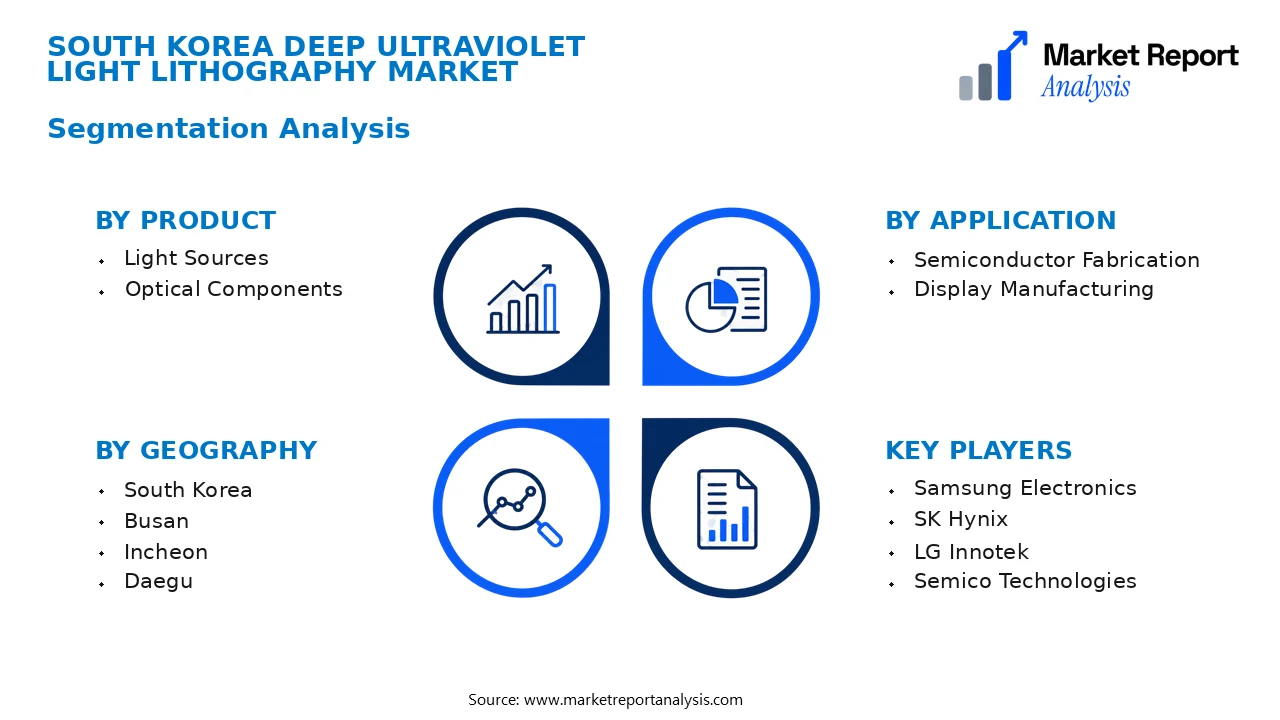
Segmentation Overview: The market is segmented into key categories including Product, Application, and Geography, with further subsegments that reflect the diverse industrial, technological, and regional landscape of South Korea. Each segment provides insights into specific market drivers, customer preferences, and growth opportunities crucial for strategic planning and investment decisions.
- Product
- Light Sources: This subsegment includes various UV light sources used in lithography processes, which are essential for high-precision manufacturing in the semiconductor and display industries. Demand is driven by technological advancements and miniaturization trends.
- Optical Components: Consisting of lenses, mirrors, and filters, optical components are vital for enhancing lithography system performance. Their adoption is influenced by the need for higher resolution and process efficiency in production lines.
- Application
- Semiconductor Fabrication: The primary application, driven by South Korea’s dominant electronics manufacturing sector, especially in memory chips and logic devices, requiring advanced lithography for node scaling and performance enhancement.
- Display Manufacturing: A significant segment due to South Korea’s leadership in OLED and LCD televisions, smartphones, and large displays, which demand precise deep UV lithography for high-resolution panels.
- Geography
- South Korea: The overall market is concentrated in South Korea, with specific regional hubs contributing variably to demand and technological innovation.
- Seoul: The capital city hosts the majority of high-tech industries and research institutes, making it a nucleus for deep UV lithography demand due to extensive semiconductor and electronics manufacturing activities.
- Busan: As a major port and industrial center, Busan offers significant opportunities for lithography equipment used in consumer electronics manufacturing, shipping, and logistics sectors adapting to high-tech demands.
- Incheon: Proximity to Seoul’s technological ecosystem, Incheon is pivotal in logistics and manufacturing, providing facilities that support semiconductor and display component assembly and innovation.
- Daegu: Known for textiles and fashion, Daegu’s emerging focus on electronics manufacturing related to wearable technology and smart devices contributes to localized demand for lithography solutions.
- Daejeon: As a science and technology hub, Daejeon hosts research institutes and tech startups that drive innovation in lithography and related nanotechnology applications, fostering early adoption and development.
- Gwangju: Traditionally focused on automotive and machinery, Gwangju is gradually integrating electronics manufacturing and research, creating niche markets for deep UV lithography within automotive display systems.
- Ulsan: Known for heavy industries and shipbuilding, Ulsan's emerging electronics sector, especially in smart ship systems, creates targeted applications for advanced lithography techniques.
- Suwon: As a technology and innovation center with a concentration of R&D facilities and tech companies, Suwon offers considerable potential for developing next-generation lithography processes and applications.
- South Korea: The overall market is concentrated in South Korea, with specific regional hubs contributing variably to demand and technological innovation.
Competitive Intelligence
The South Korea Deep Ultraviolet Light Lithography Market exhibits a highly competitive landscape characterized by significant market concentration among leading players such as Samsung Electronics, SK Hynix, and LG Display, which drive technological innovation and investment in R&D. These companies adopt aggressive business strategies focused on product differentiation through enhanced resolution capabilities and process speed enhancements to maintain competitive edges. Collaborations and strategic partnerships with global equipment manufacturers and material suppliers bolster technological access and innovation. Notably, there has been an uptick in acquisitions aimed at securing advanced photolithography equipment and expanding technological expertise, especially within Seoul's tech hub ecosystem.
Expansion strategies include investments to establish dedicated R&D centers and to upgrade existing fabrication facilities to incorporate state-of-the-art DUV lithography systems. Companies are also intensifying R&D efforts to develop next-generation lithography solutions to overcome current limitations and sustain a competitive advantage. Such initiatives underpin a focus on technological leadership and operational efficiency. Differentiation hinges on proprietary processes, customization, and strong local supply chains, creating a resilient competitive environment tailored to South Korea’s high-tech manufacturing priorities.
Leading Company Profiles
The competitive landscape of South Korea’s DUV lithography sector features globally recognized firms and innovative local players, all focused on advancing lithography technologies to support the country’s semiconductor ambitions.
- Samsung Electronics
- SK Hynix
- LG Innotek
- Semico Technologies
- Daewoo Semiconductor
- Han’s Laser Technology Industry Group
- Yonghong Technologies
- KOLON Industries
- Dongbu HiTek
- Seoul Semiconductor
Samsung Electronics
Samsung Electronics leads with extensive R&D investments in DUV lithography, focusing on scaling down node size and integrating EUV with DUV systems to reinforce its market leadership in consumer and cutting-edge semiconductor manufacturing.
SK Hynix
SK Hynix specializes in high-volume production of DRAM and NAND Flash chips, utilizing advanced DUV lithography solutions to improve yield, reduce costs, and accelerate time-to-market for next-generation memory products.
LG Innotek
LG Innotek develops innovative lithography components and systems, emphasizing miniaturization and precision, with strategic initiatives aimed at expanding its photolithography portfolio for integrated device manufacturing.
Semico Technologies
A key player in local equipment supply, Semico Technologies focuses on developing cost-effective DUV exposure tools tailored for high-volume semiconductor fabs and emerging application segments.
Daewoo Semiconductor
Daewoo Semiconductor invests heavily in advanced lithography and process integration, enhancing performance and scalability for high-end logic and memory chips produced within South Korea.
Han’s Laser Technology Industry Group
Han’s Laser specializes in laser-based lithography solutions, including DUV systems, supporting the country’s push toward innovation in photolithography and microfabrication sectors.
Yonghong Technologies
Yonghong Technologies targets research and development in semiconductor manufacturing equipment, providing advanced DUV lithography systems tailored for local foundries and R&D institutions.
KOLON Industries
KOLON Industries develops specialty chemicals and materials for lithography processes, focusing on photoresists and other critical materials for high-precision DUV applications.
Dongbu HiTek
Dongbu HiTek furnishes specialty chips and supports semiconductor manufacturing with lithography process solutions, emphasizing technological integration and supply chain resilience.
Seoul Semiconductor
Seoul Semiconductor integrates DUV lithography into its advanced packaging and chip production processes, aiming to enhance optical and electronic performance for next-generation applications.
Strategic Business Developments

- July 2026 – Samsung Electronics – Launch of new DUV lithography system – Boosts production capacity for next-generation chips, enhancing competitive edge in global markets.
- May 2027 – SK Hynix – Capacity expansion investment – Strengthens local manufacturing capabilities, supporting increased demand for high-performance memory modules.
- November 2026 – LG Innotek – Partnership with leading equipment suppliers – Accelerates development of integrated DUV solutions and improves production efficiency.
- March 2027 – Semico Technologies – Release of disruptive DUV exposure tools – Positions as a cost-effective alternative for high-volume manufacturing fabs.
- October 2026 – Daewoo Semiconductor – Strategic acquisition of advanced photolithography patents – Secures technological leadership and expands product portfolio.
Frequently Asked Questions
What is the South Korea Deep Ultraviolet Light Lithography Market?
The South Korea Deep Ultraviolet Light Lithography (DUV) Market encompasses the manufacturing and deployment of DUV lithography equipment used primarily in semiconductor fabrication. It serves the growing semiconductor industry in South Korea, driven by high-tech fabrication needs.
What is the current market size of South Korea Deep Ultraviolet Light Lithography Market?
As of 2026, the market size is valued at approximately USD 3.2 Billion. It reflects South Korea's significant investments in semiconductor manufacturing, with rapid adoption of DUV lithography technology to meet global chip manufacturing demand.
What factors are driving the South Korea Deep Ultraviolet Light Lithography Market?
Key drivers include the expanding semiconductor industry, government support for high-tech manufacturing, increasing investments by leading chip manufacturers, and technological advancements enabling finer feature fabrication, all pushing the adoption of advanced lithography solutions in South Korea.
Which South Korean city leads the South Korea Deep Ultraviolet Light Lithography Market?
Seoul is the leading city in the South Korean DUV lithography market due to its concentration of semiconductor giants, research institutions, and technology firms, making it the central hub for innovation and manufacturing in this sector.
Which segment is expected to grow the fastest?
The photomask segment is anticipated to grow the fastest, driven by increased chip complexity and demand for high-precision patterning, requiring advanced photomasks utilizing DUV technology to meet future semiconductor manufacturing standards.
Who are the leading companies operating in the South Korea Deep Ultraviolet Light Lithography Market?
Major players include Samsung Electronics, SK hynix, and local equipment manufacturers specializing in lithography tools, alongside international giants like ASML and Canon, actively contributing through technological innovation and strategic collaborations.
Analyst Perspective
The South Korea Deep Ultraviolet Light Lithography Market is poised for sustained growth driven by the country’s robust semiconductor manufacturing industry and strategic investments in next-generation fabrication technology. As global technology shifts towards smaller nodes, South Korea's adherence to advanced lithography solutions presents long-term opportunities for equipment manufacturers and material suppliers alike. Technological evolution will likely focus on enhancing resolution capabilities, throughput, and overlay accuracy, with R&D efforts emphasizing process stability and cost efficiency. Investment priorities should target state-of-the-art infrastructure upgrades in key tech hubs, notably Seoul and Pangyo, which exhibit high concentrations of semiconductor fabs and innovation centers. Competitive intensity remains high, with leading local firms and international players vying for market share through technological breakthroughs and strategic alliances. Looking ahead, Seoul’s metropolitan area is expected to lead growth, attributable to its dense ecosystem of semiconductor firms and government-backed initiatives. Strategic positioning should leverage South Korea’s strength in electronics manufacturing, turning it into a regional hub for ultra-violet lithography advancements to bolster long-term market dominance.
