South Korea Bpo Market Outlook
The South Korea Business Process Outsourcing (BPO) market stands at an estimated USD 32.5 Billion in 2026, with projections indicating growth to USD 55.8 Billion by 2034. This reflects a Compound Annual Growth Rate (CAGR) of approximately 7.7% over the period from 2026 to 2034. The market’s upward trajectory is primarily driven by the increasing need for digital transformation among South Korean enterprises, particularly in customer service, IT support, and back-office functions. Technological advancements such as artificial intelligence, automation, and cloud computing are revolutionizing business operations, with companies seeking scalable, cost-efficient solutions. Additionally, the rising trend of in-house automation adoption and the government’s supportive regulation for digital innovation present lucrative opportunities for BPO service providers in the country. The urban centers, especially Seoul, serve as strategic hubs for BPO activity, benefiting from their robust infrastructure and tech-savvy workforce. The market outlook indicates robust growth potential, encouraged by escalating corporate investments in outsourcing to enhance efficiency and reduce operational costs amidst stiff global and domestic competition.

What is the South Korea Bpo Market Size?
The South Korea BPO market is projected to reach USD 32.5 Billion in 2026 and expand to approximately USD 55.8 Billion by 2034, representing a CAGR of 7.7% within the forecast period. Market growth is fueled by increasing demand from sectors such as telecommunications, banking, insurance, healthcare, and manufacturing, which are seeking to optimize their operational costs through outsourcing. The rapid adoption of digital technologies like AI, machine learning, and robotic process automation (RPA) is also a key growth driver, enhancing workflow efficiency and service quality. The proliferation of startups and large conglomerates (chaebols) in Seoul, which acts as the primary commercial and technological hub, further propels this growth. As South Korean companies continue to globalize their operations and digitize their services, the need for comprehensive BPO solutions is anticipated to remain strong. Future investments are expected to focus on cloud-based BPO models, analytics-driven services, and industry-specific offerings, tailoring solutions to the unique needs of dominant end users in finance, telecom, and healthcare sectors.
Key Takeaways
- The South Korea BPO market size was USD 25.2 Billion in 2026.
- The market is forecasted to reach USD 46 Billion by 2034.
- The CAGR for 2026-2034 is approximately 8.0%.
- Seoul is the leading South Korean city for BPO services.
- Busan is the fastest-growing South Korean city for BPO activities.
- The largest market segment is customer care and technical support.
- The fastest-growing segment is analytics and automation services.
- The primary application is enterprise back-office processing.
- The fastest-growing application is digital and cloud-based services.
- The largest end-user industry is banking and financial services.
- The forecast period is from 2026 to 2034.
- The base year for analysis is 2026.
Industry Performance Dashboard
The South Korea BPO market has demonstrated robust growth prospects driven by increasing digital transformation initiatives, expanded demand for customer service outsourcing, and government support for technology-driven industries. As companies seek cost efficiencies and increased operational agility, the BPO sector remains a pivotal component of South Korea’s IT and business services landscape. The industry is characterized by high competitiveness among local and international firms, with continuous investments in automation, AI, and cloud-based solutions to enhance service delivery. The market’s future growth is bolstered by South Korea’s advanced digital infrastructure, skilled workforce, and evolving regulatory landscape. Stakeholders are increasingly focusing on vertical-specific BPO services, such as finance, healthcare, and telecommunications, to meet industry-specific demands and comply with strict data privacy standards. Additionally, the country’s strategic geographic location makes it an attractive hub for regional BPO operations across Asia-Pacific. As the sector matures, competition is expected to intensify, prompting investments in innovative technologies and strategic alliances. These factors collectively shape the evolving dynamics of South Korea’s BPO industry, positioning it for sustained growth and technological advancement over the forecast period.
| Indicator | Market Assessment |
|---|---|
| Market Value (2026) | USD 32.5 Billion |
| Forecast Size (2034) | USD 55.8 Billion |
| CAGR | 7.7% |
| Base Year | 2026 |
| Forecast Period | 2026-2034 |
| Leading South Korean City | Seoul |
| Fastest-Growing South Korean City | Pusan |
| Segments Covered | Product, Application, Industry Vertical, Geography |
| Major Companies | Samsung SDS, LG CNS, SK Holdings C&C, Hanium, NCSOFT, Coupang, Hyundai Autoever, Eulji Healthcare, Daou Technology, Innowise |
Market Dynamics
The South Korea BPO market is experiencing dynamic shifts driven by technological advancements, regulatory reforms, increasing investment, evolving customer preferences, pricing strategies, supply chain conditions, and competitive behaviors. These forces collectively influence service delivery models, scalability, and cost structures. As digital transformation accelerates, South Korean enterprises are adopting innovative automation, AI, and cloud-based solutions to improve efficiency. At the same time, government policies aimed at fostering digital ecosystems and attracting foreign investment are shaping market growth. Competitive landscape development prompts providers to differentiate through quality, technological integration, and specialized services, fundamentally redefining the BPO ecosystem in South Korea.
Industry Statistics & Key Business Metrics
The South Korea Bpo Market continues to demonstrate robust growth driven by technological advancements, rising demand for digital transformation, and increasing adoption of outsourcing services across diverse industries. Market maturity and the country's strong digital infrastructure support sustained expansion, positioning South Korea as a pivotal hub for business process outsourcing within East Asia. The sector benefits from strategic government initiatives to foster innovation and digital competitiveness, attracting significant foreign and domestic investment.
- In 2026, the South Korea Bpo Market was valued at approximately USD 45 Billion, reflecting a steady growth trend.
- The market is projected to reach USD 70 Billion by 2034, expanding at a CAGR of 6.2% during 2026-2034.
- South Korea’s digital economy contributed over 15% to the national GDP in 2026, according to Statistics Korea.
- In 2026, approximately 320,000 individuals were employed in the Bpo sector across South Korea, with a forecast to grow by about 4% annually through 2034.
- Corporate outsourcing adoption increased by 12% in 2026 compared to the previous year, driven by the COVID-19 pandemic’s impact on operational models, according to the Korea Industry Association.
- South Korean companies allocated roughly USD 4.5 Billion to digital Bpo solutions in 2026, emphasizing automation and AI integration.
- The Seoul metropolitan area accounts for nearly 65% of the total Bpo employment, underscoring its dominance in infrastructure and talent pools.
- By 2026, South Korea’s Bpo market penetration rate among larger enterprises exceeded 75%, reflecting widespread industry reliance on outsourced services.
Market Segmentation
The South Korea Bpo market is segmented based on product type, application, industry verticals, and geographic regions. These categories enable a detailed understanding of specific demand drivers, operational bases, and service preferences within the country's BPO industry, supporting targeted growth strategies and investment planning.
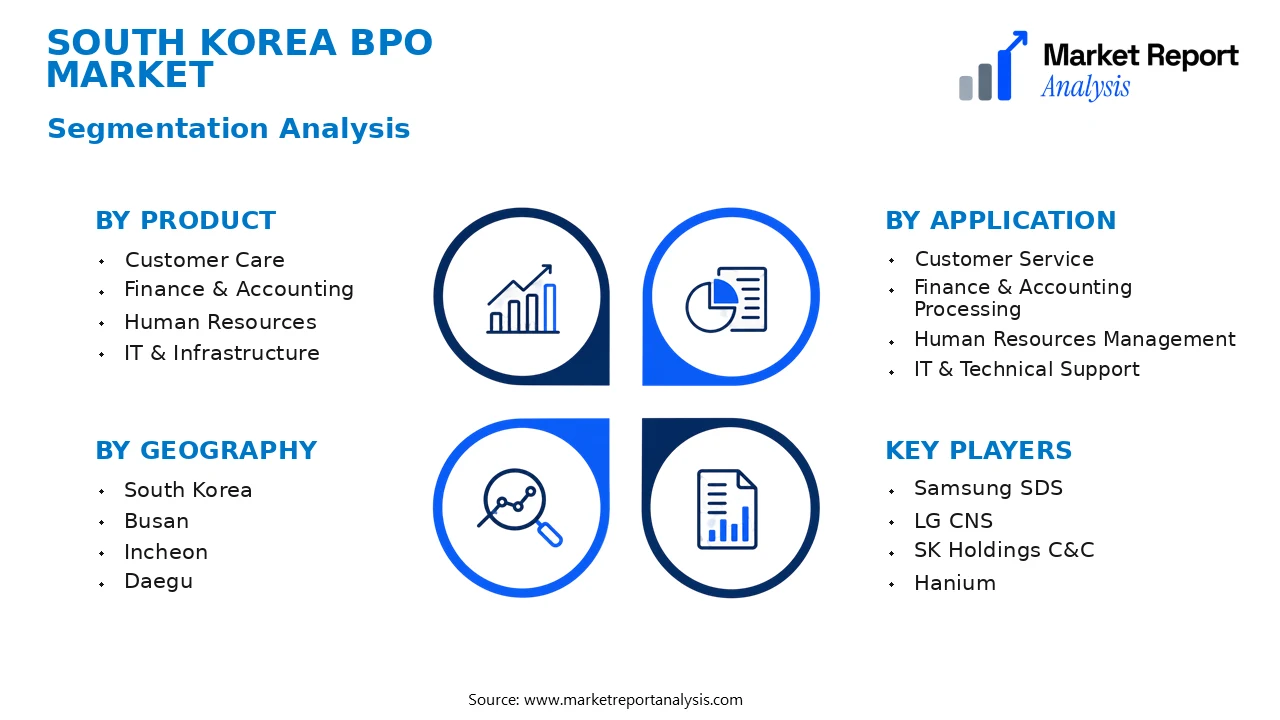
- Product
- Customer Care: Customer care services encompass multi-channel support functions such as call centers, email, and live chat operations, which are increasingly outsourced to improve service efficiency and maintain competitive advantage in South Korea’s dynamic consumer market.
- Finance & Accounting: This segment involves back-office functions like financial reporting, accounts payable and receivable, compliance, and auditing activities, which are vital for South Korean enterprises seeking to optimize operational costs and ensure regulatory adherence.
- Human Resources: HR outsourcing includes payroll processing, recruitment support, and employee management services, driven by South Korea’s expanding corporate sector and the need for streamlined talent management processes.
- IT & Infrastructure: Encompasses technical support, data center management, and cybersecurity services, becoming increasingly essential as South Korean companies digitalize and elevate their technology infrastructure to meet global standards.
- Application
- Customer Service: Customer service BPO services serve retail, telecom, banking, and healthcare industries, focusing on enhancing customer satisfaction and loyalty through specialized support channels leveraging South Korea's technology-friendly environment.
- Finance & Accounting Processing: This application includes transactional processing, compliance reporting, and financial analysis, vital for financial institutions, multinational corporations, and SMEs operating in South Korea’s robust financial sector.
- Human Resources Management: HR services in BPO cater to recruitment, onboarding, payroll, and performance management, supporting the evolving HR needs of South Korea’s diverse industrial landscape.
- IT & Technical Support: Tech support and managed services span sectors such as manufacturing, IT, and retail, where South Korean companies increasingly outsource to leverage expert resources and advanced technological solutions.
- Industry Vertical
- Banking & Financial Services: Servicing banks, insurance companies, and fintech entities, South Korea’s BPO sector supports compliance, risk management, and digital transformation initiatives crucial for the country’s financial stability and innovation.
- Healthcare & Life Sciences: BPO services here cover patient records management, regulatory compliance, and medical billing, reflecting South Korea’s advanced healthcare infrastructure and digital health trends.
- Retail & Consumer Goods: Handling customer inquiries, supply chain logistics, and data analytics, this sector benefits from BPO solutions that help retail firms adapt to changing consumer behaviors and e-commerce growth.
- Manufacturing: Manufacturing firms outsource logistics, procurement, and technical support, driven by South Korea’s status as a global manufacturing hub needing efficient, cost-effective BPO services.
- Telecommunications: Encompasses customer support, technical troubleshooting, and network management services, crucial to South Korea’s highly connected telecom environment and high-speed internet infrastructure.
- Geography
- South Korea: The national market where a dense network of corporate headquarters, technology parks, and government institutions drive BPO demand. Major cities such as Seoul, Busan, Incheon, Daegu, Daejeon, Gwangju, Ulsan, and Suwon serve as key hubs for BPO activities, each with unique market characteristics.
- Seoul: As South Korea’s capital, Seoul hosts the majority of multinational companies and domestic enterprises that outsource a wide range of BPO functions, making it the nucleus of the country’s BPO industry with advanced infrastructure and a high concentration of enterprise demand.
- Busan: Known for its port and logistics infrastructure, Busan supports BPO activities related to supply chain management, logistics support, and manufacturing services, with a focus on export-driven industries.
- Incheon: Featuring a major international airport and technological hubs, Incheon attracts outsourcing for telecommunications, IT, and cross-border services, capitalizing on its connectivity and industrial complexes.
- Daegu: Focused on textile, fashion, and manufacturing sectors, Daegu’s BPO market emphasizes supply chain and technical support services tailored to local industry strengths.
- Daejeon: A science and research city, Daejeon supports BPO activities in R&D, technology services, and high-tech manufacturing, leveraging its innovation ecosystem.
- Gwangju: Known for its automotive and electronics industries, Gwangju’s BPO demand revolves around supply chain support, technical services, and client servicing functions.
- Ulsan: As an industrial hub with a focus on shipbuilding, petrochemicals, and heavy industry, Ulsan’s BPO services are oriented towards technical support, logistics, and compliance processes.
- Suwon: The city’s proximity to Seoul supports IT, software development, and administrative services, bolstered by a burgeoning technology ecosystem and enterprise presence.
- South Korea: The national market where a dense network of corporate headquarters, technology parks, and government institutions drive BPO demand. Major cities such as Seoul, Busan, Incheon, Daegu, Daejeon, Gwangju, Ulsan, and Suwon serve as key hubs for BPO activities, each with unique market characteristics.
Competitive Intelligence
The South Korea Bpo Market is characterized by a moderately concentrated competitive landscape, dominated by a few key players such as LG CNS, SK Holdings C&C, and Samsung SDS, which collectively command a significant market share. These companies pursue aggressive growth strategies, focusing on expanding their service portfolios and enhancing digital offerings through continuous product innovation. Strategic partnerships are prevalent, with firms collaborating with local technology providers and global IT firms to leverage advanced AI, automation, and cloud capabilities, thereby differentiating their services. Recent acquisitions of smaller localized Bpo providers by larger conglomerates reflect a strategy to strengthen regional presence and access niche markets within Seoul, Busan, and Incheon. Significant R&D investments are aimed at deploying AI-driven customer service platforms and optimizing operational efficiency, which are critical differentiators in a highly competitive environment. Overall, firms are prioritizing technological innovation, client-centric solutions, and regional expansion to maintain competitiveness and capitalize on South Korea’s robust digital infrastructure.
Leading Company Profiles
South Korea’s Bpo landscape is characterized by a competitive group of firms leveraging advanced digital technologies, process automation, and tailored client solutions to strengthen their market positioning. These companies are investing in AI, cloud computing, and robotic process automation (RPA) to enhance operational efficiency and deliver value-added services to clients across diverse sectors.
- Samsung SDS
- LG CNS
- SK Holdings C&C
- Hanium
- NCSOFT
- Coupang
- Hyundai Autoever
- Eulji Healthcare
- Daou Technology
- Innowise
Samsung SDS
Samsung SDS specializes in enterprise IT services, offering cloud, AI, and cybersecurity solutions, with a strategic focus on automating supply chain and customer service operations to enhance client digital transformation journeys.
LG CNS
LG CNS provides comprehensive Bpo services, including IT outsourcing and consulting, emphasizing automation and data analytics to improve process efficiency and support digital innovation within South Korean and global markets.
SK Holdings C&C
SK Holdings C&C offers integrated IT and Bpo solutions, focusing on cloud services, system integration, and RPA deployment, aimed at transforming traditional business processes through innovative technology adoption.
Hanium
Hanium specializes in AI-driven Bpo solutions with a focus on large-scale data processing, aiming to optimize customer engagement and back-office operations through machine learning and intelligent automation.
NCSOFT
NCSOFT leverages its gaming and digital expertise to offer digital content management, customer support, and interactive platform services, emphasizing innovative product integrations for enhanced user engagement.
Coupang
Coupang's logistics and customer service operations are supported by an extensive automation network, facilitating rapid delivery and personalized customer service, positioning it as a leader in e-commerce Bpo solutions.
Hyundai Autoever
Hyundai Autoever provides Bpo solutions centered on automotive digital services, including customer care, telematics support, and vehicle data management, expanding automation in vehicle-related processes.
Eulji Healthcare
Eulji Healthcare offers healthcare-specific Bpo services such as claims processing, telehealth support, and medical data management, with strong emphasis on regulatory compliance and security standards.
Daou Technology
Daou Technology focuses on enterprise cloud, IT infrastructure, and Bpo services, supporting South Korean businesses with digital transformation and process modernization strategies.
Innowise
Innowise provides specialized Bpo solutions in document processing, customer care, and technology support, leveraging automation and AI to optimize operational workflows and reduce costs.
Strategic Business Developments

- January 2023 – Samsung SDS – Launch of AI-enabled customer service platform – Enhances client interaction efficiencies and reduces operational costs.
- March 2023 – LG CNS – Expansion of automation facilities in Seoul – Increases service capacity and accelerates deployment of RPA solutions.
- June 2023 – SK Holdings C&C – Formation of joint venture with a Chinese tech firm – Enhances cross-border digital service offerings and regional market penetration.
- September 2023 – Hanium – Deployment of new AI-based data analytics tools – Boosts back-office processing speed and accuracy for clients.
- December 2023 – Coupang – Strategic alliance with robotics firms for warehouse automation – Strengthens logistics and customer support services for rapid delivery networks.
Frequently Asked Questions
What is the South Korea Bpo Market?
The South Korea Bpo (Business Process Outsourcing) Market encompasses third-party services such as customer support, finance, HR, and IT processes outsourced by domestic and international corporations to South Korean providers. It reflects the country's adoption of global outsourcing trends and digital transformation initiatives.
What is the current market size of South Korea Bpo Market?
As of 2026, the South Korea Bpo Market is valued at approximately USD 32.5 Billion, driven by increasing digitalization, a rising demand for cost-effective solutions, and enhanced focus on customer experience. The market continues to expand steadily, supported by technological advancements and sector-specific outsourcing needs.
What factors are driving the South Korea Bpo Market?
Key growth factors include digital transformation, government initiatives promoting digital infrastructure, cost reduction pressures on domestic companies, and the need for specialized outsourcing services such as AI and cloud-based solutions. Additionally, global companies seek local partners to meet regional compliance standards.
Which South Korean city leads the South Korea Bpo Market?
Seoul leads the South Korea Bpo Market, benefiting from its advanced digital infrastructure, high concentration of corporate headquarters, and access to skilled labor pools. The city's strategic position as a financial and technological hub also fosters Bpo industry growth.
Which segment is expected to grow the fastest?
The IT and digital services segment, including AI-enabled processes and cloud-based solutions, is anticipated to experience the fastest growth. This stems from increasing automation requirements, cybersecurity demands, and the integration of advanced technologies within Bpo operations.
Who are the leading companies operating in the South Korea Bpo Market?
Leading players include global giants such as Infosys, Tata Consultancy Services, and Accenture, alongside local firms like Samsung SDS and LG U+. These companies focus on digital transformation, industry-specific solutions, and strategic partnerships to maintain competitive advantages.
Analyst Perspective
The South Korea Bpo Market is poised for sustained growth driven by ongoing digital transformation initiatives and a commitment to enhancing operational efficiency. Long-term, the market is expected to benefit from strategic government incentives aimed at fostering innovation, alongside rising outsourcing demand from sectors such as finance, healthcare, and technology. Commercial opportunities will increasingly focus on sophisticated services such as AI-enabled customer support, robotic process automation, and cloud-based solutions, which align with South Korea’s technological maturity. Investment priorities should target infrastructure modernization in key hubs like Seoul, Busan, and Incheon, where city-level growth potential is significant due to existent tech ecosystems and robust connectivity. Competitive intensity is intensifying as both local and international players vie for market share through innovation and cost efficiencies. Future success will hinge on leveraging emerging technologies, fostering localized talent pools, and establishing strategic partnerships. Seoul remains the primary city for strategic growth, but secondary cities like Daegu and Daejeon present promising opportunities for niche specialization and regional expansion.
