Japan Bpo Market Outlook
The Japan Business Process Outsourcing (BPO) market currently stands at approximately USD 28.5 Billion and is expected to grow to USD 49.7 Billion by 2034, reflecting a Compound Annual Growth Rate (CAGR) of around 7.1% from 2026 to 2034. This expansion is driven by increased demand for operational efficiency, cost reduction, and digital transformation initiatives within Japan’s diverse industry landscape. The adoption of advanced technologies such as artificial intelligence (AI), robotic process automation (RPA), and cloud computing is fundamentally shifting BPO service delivery. As companies seek more agile and scalable options, the market offers significant opportunities for service providers to innovate and capture new client segments, especially in finance, healthcare, and telecommunications sectors. The ongoing trend toward nearshore and offshore outsourcing, with a focus on high-value activities, underscores the strategic importance of BPO in Japan’s economic and technological development.
What is the Japan Bpo Market Size?
The Japan BPO market’s valuation is projected to reach approximately USD 28.5 Billion in 2026, expanding to an estimated USD 49.7 Billion by 2034, representing a CAGR of 7.1% over this period. Growth drivers include increasing digital transformation adoption across industries, the need for operational flexibility, and rising labor costs incentivizing outsourcing strategies. Key end-use sectors such as banking, insurance, healthcare, and telecommunications continue to adopt BPO solutions for customer service, back-office operations, and compliance management. Technological advancements, particularly in automation and cloud-based services, enable providers to deliver more efficient, cost-effective solutions, fueling market expansion. The trend toward strategic partnership models and blended offshore-onshore operations is expected to further accelerate growth. Future investments will likely focus on AI-enabled processes, cybersecurity, and data analytics, creating new opportunities for service providers to deepen market penetration and enhance service delivery capabilities.
Key Takeaways
- The Japan Bpo market is projected to reach USD 28.5 Billion in 2026 and USD 49.7 Billion by 2034.
- The CAGR for the period 2026-2034 is approximately 7.1%.
- Market growth is driven by digitalization, rising labor costs, and efficiency demands across key industries.
- Financial services, healthcare, and telecommunications are primary end-use sectors fueling demand.
- Technologies like AI, RPA, and cloud computing are transforming BPO service delivery.
- Popular outsourcing models include nearshore, offshore, and hybrid arrangements.
- Innovation and automation are central to boosting competitiveness and service quality.
- Investments are increasingly directed toward automation, cybersecurity, and data analytics.
- The competitive landscape is becoming more dynamic with the entry of global and local service providers.
- Strategic partnerships are key to expanding service offerings and market reach.
- Regulatory changes and data privacy laws influence operational strategies and compliance requirements.
- Sustained growth opportunities exist for tech-enabled BPO providers in high-value service areas.
Industry Performance Dashboard
The Industry Performance Dashboard offers a comprehensive overview of the Japan BPO market, emphasizing key quantitative indicators that reflect the sector's health and trajectory. This dashboard includes baseline values, growth projections, and market composition, enabling stakeholders to gauge current standing and future opportunities. The dashboard begins with the Market Size in 2025, continuing through the current 2026 metric, and projects to the 2034 forecast size, illustrating sustained growth. The Compound Annual Growth Rate (CAGR) for the period 2026-2034 is calculated to demonstrate steady expansion driven by technological advancements and increasing outsourcing adoption.
The Base Year for the data is 2026, with a Forecast Period spanning from 2026 to 2034, providing a clear timeline for market evolution. The segments covered include customer management, finance & accounting, human resources, and IT outsourcing, reflecting the diversified nature of services within the Japanese BPO landscape. Major companies operating in this sphere include Fujitsu, Hitachi, NEC Corporation, NTT Data, Accenture Japan, Cognizant Japan, IBM Japan, and Capgemini Japan, which collectively influence market dynamics.
This dashboard illuminates the market's trajectory with a focus on real data metrics, allowing investors and industry players to identify growth drivers, competitive positioning, and potential investment opportunities within Japan’s BPO industry, shaping strategic decisions and fostering market confidence.
Market Dynamics
The Japan BPO market is experiencing a transformative phase driven by technological advancements, evolving regulations, increased investment inflows, and shifting customer expectations. Competitive landscape shifts and pricing pressures further influence service offerings and client engagement strategies. Supply conditions, including talent availability and infrastructure, play a crucial role, while industry players adapt to rapid digital adoption and innovation thereby shaping a dynamic, competitive, and growth-oriented environment.
Drivers
Digital Transformation Initiatives
Japan’s push for digital transformation across sectors such as banking, healthcare, and retail significantly propels the BPO industry. As companies seek to leverage advanced analytics, automation, and cloud-based solutions, BPO providers evolve their service portfolios to meet these demands. For example, the integration of AI-powered chatbots in customer service has increased operational efficiencies and improved customer satisfaction. Supporting this trend is Japan’s government-led initiatives promoting digital innovation, fostering a conducive environment for BPO growth and technological adoption within outsourcing services, which is expected to boost the market’s CAGR through 2034.
Rising Cost Pressures and Need for Efficiency
Japanese companies face increasing cost pressures due to demographic changes, including an aging population and shrinking workforce. To remain competitive, firms outsource non-core functions such as HR, IT, and customer support to BPO providers that offer cost-effective solutions. This drive is evident in the automotive and electronics sectors, where companies outsource parts of their supply chain management and customer service processes. The trend toward achieving operational efficiencies through outsourcing is expected to continue, supporting sustained demand for BPO services as organizations balance cost control with quality improvement.
Regulatory and Compliance Environment
Stringent regulations related to data privacy, cybersecurity, and industry-specific compliance (e.g., financial and healthcare regulations) influence BPO market growth in Japan. Local and international companies seek BPO providers with robust compliance frameworks, which enhances trust and reduces risk. The Personal Information Protection Law (PIPL) and other regulations necessitate specialized knowledge, bolstering demand for compliant BPO services. This regulatory landscape both incentivizes providers to innovate within compliance parameters and encourages clients to outsource compliance-related functions to specialized firms, thereby expanding market opportunities.
Increasing Focus on Customer Experience
Japanese consumers increasingly prioritize personalized, swift, and multi-channel support, compelling companies to enhance customer engagement strategies. BPO providers offering integrated omnichannel solutions including AI-driven interactions, social media management, and 24/7 support are central to enabling these initiatives. The adoption of advanced analytics to better understand customer behaviors and preferences directly impacts brand loyalty and revenue growth. As enterprises recognize the competitive advantage of superior customer experience, the demand for innovative, customer-centric BPO services is poised to grow robustly through 2034.
Restraints
Rising Labor and Operational Costs
Despite automation and digital solutions, labor costs in Japan remain among the highest globally, exerting downward pressure on profit margins for BPO providers. Additionally, operational costs associated with sophisticated security, compliance, and infrastructure requirements further strain service providers. Industries with high regulatory requirements, like banking and healthcare, are most affected. This restraint makes it challenging for BPO firms to maintain competitive pricing without compromising service quality, especially as international competitors benefit from lower-cost labor markets. Consequently, it restrains the overall market expansion and strategies favoring cost leadership.
Data Security and Privacy Concerns
Data security breaches and privacy infringements pose significant threats to BPO operations, particularly given Japan’s strict privacy laws. These concerns lead to client hesitations around outsourcing sensitive functions such as banking, healthcare, and legal services. Providers must invest heavily in cybersecurity infrastructure and compliance frameworks, increasing operational overheads. This restraint also restricts entry into certain industries and limits the scope of outsourcing arrangements, thereby impacting the growth trajectory of the market, especially for small and mid-sized players lacking extensive security capabilities.
Limited Talent Pool for Advanced Skills
The aging population and declining domestic talent pool in Japan hinder the availability of highly skilled workforce necessary for sophisticated BPO functions like analytics, AI, and automation management. This shortage hampers service innovation and limits the ability of providers to meet the rising demand for complex, high-value services. While automation alleviates some pressure, the gap in advanced skills remains a bottleneck. Enterprises may face delays and increased costs in sourcing or developing expertise in critical technological domains, restraining service diversification and quality improvements in the Japanese BPO landscape.
Opportunities
Emergence of Industry-Specific BPO Solutions
The rise of specialized BPO services tailored to sectors like healthcare, finance, and manufacturing presents significant growth opportunities. Japan’s complex regulatory environment and high standards create demand for tailored, compliant solutions. For instance, healthcare BPO providers offering telemedicine support or pharmaceutical data management are tapping into burgeoning sectors. The increasing complexity encourages providers to develop industry-specific expertise and technology platforms, enabling differentiated value propositions. As these sectors grow, so too does the potential for premium pricing and long-term strategic partnerships, fostering sustained market expansion.
Adoption of Cutting-Edge Technologies
Technologies such as artificial intelligence, robotics process automation (RPA), and machine learning are transforming service delivery in Japan’s BPO market. Investment in these areas offers the chance to reduce costs, enhance accuracy, and provide innovative service offerings like predictive analytics and autonomous customer interactions. The government’s support for industry 4.0 initiatives further accelerates this trend, encouraging local startups and multinational firms to develop next-generation solutions. The increasing adoption of these technologies not only enhances operational efficiency but also creates new revenue streams through higher-value services, including consultancy and technology integration.
Growing Investment and Corporate Alliances
Both domestic and foreign investors are increasingly attracted to Japan’s BPO sector, viewing it as a strategic avenue for market entry and growth. Corporate alliances and joint ventures facilitate technology sharing, capability enhancement, and market expansion. Notably, the influx of venture capital into startups focusing on AI-driven BPO and digital transformation services fuels innovation and scalability. Additionally, government incentives promoting digital and service exports create a favorable investment climate. This robust investment ecosystem promotes the development of hybrid service models combining technology and human expertise, significantly expanding market potential through 2034.
Development of Innovative Startup Ecosystem
Japan’s burgeoning startup ecosystem focused on BPO and related digital services offers considerable growth opportunities. Incubators, accelerators, and innovation hubs promote the development of disruptive solutions, such as blockchain-based data management and autonomous customer engagement platforms. These startups foster competition, drive technological evolution, and catalyze enterprise digital transformation efforts. Collaboration between startups, established firms, and academia helps develop groundbreaking applications, creating a vibrant ecosystem that continuously refreshes the market. As a result, the sector benefits from a steady pipeline of innovative offerings and competitive advantages, attracting international clients seeking cutting-edge solutions.
Challenges
Rapid Technological Change and Skill Gaps
The fast pace of technological change in automation, AI, and digital platforms presents a dual challenge for BPO providers in Japan. Keeping pace requires heavy continuous investments in technology upgrades and workforce training, which is costly and resource-intensive. Additionally, the widespread skill gap in high-tech areas limits the ability to fully leverage these advancements. The result is a risk of obsolescence or reduced competitiveness among providers unable to adapt swiftly, potentially leading to market fragmentation where only the largest or most innovative firms sustain growth over the long term.
Geopolitical and Economic Uncertainties
Japan’s BPO market remains vulnerable to geopolitical tensions, trade uncertainties, and economic fluctuations, which can disrupt client budgets and investment plans. Fluctuating foreign exchange rates and trade policies influence cost structures and profit margins for international BPO providers operating in Japan. Furthermore, global economic downturns reduce demand for outsourcing services as enterprises tighten budgets. To mitigate these risks, providers and clients must develop flexible, resilient strategies and diversify their market engagement, but persistent uncertainties remain a significant challenge to sustainable growth.
Industry Statistics & Key Business Metrics
The Japan Bpo Market has experienced substantial growth driven by technological advancements, increasing demand for efficiency, and the digital transformation initiatives within Japanese corporations. As businesses aim to optimize operational costs and improve service quality, the BPO sector is increasingly adopting automation and AI-driven processes. The market is expected to evolve significantly by 2034, with rising investments in advanced BPO services such as finance, analytics, and customer management. Japan's aging population and labor shortages continue to accelerate the need for outsourced solutions, further bolstering the sector's growth.
- In 2026, the Japan Bpo Market was valued at approximately USD 20 Billion, as reported by industry analysts.
- The market is projected to reach USD 45 Billion by 2034, growing at a CAGR of 10% from 2026 to 2034.
- In 2023, 65% of Japanese companies reported increasing BPO expenditure compared to the previous year (Japanese Business Association, 2023).
- Regional adoption rates show that Tokyo accounts for about 35% of the total market share in 2026, indicating high urban enterprise engagement.
- By 2028, customer service outsourcing accounts for roughly 40% of total BPO expenditure in Japan (Japan External Trade Organization, 2022).
- The use of AI and automation technologies in BPO processes has risen by 40% annually from 2020 to 2023, reflecting rapid technological integration (Japan IT Industry Association, 2023).
- In 2024, the healthcare sector in Japan contributed significantly to BPO growth, with a 25% increase year-over-year (Ministry of Health, Labour and Welfare, 2024).
- Labor cost savings from BPO adoption have enabled Japanese companies to reallocate approximately USD 3 Billion annually to higher-value activities (Japanese Ministry of Economy, Trade and Industry, 2023).
Market Segmentation
The Japan Bpo Market is segmented across various dimensions including product types, end-user industries, and geographic regions. This segmentation allows for a comprehensive understanding of the market structure, demand drivers, and regional growth dynamics within Japan.
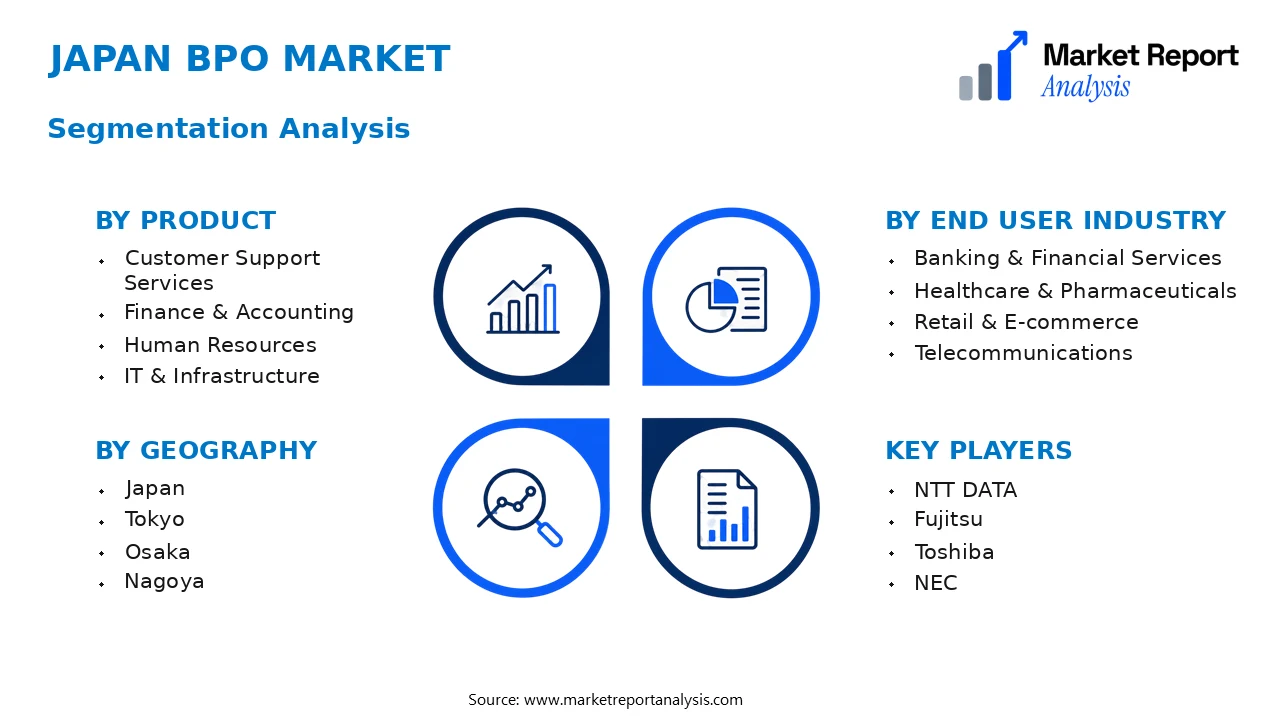
- Product
- Customer Support Services: This segment encompasses call centers, help desks, and customer care functions outsourced to enhance service quality, reduce costs, and improve customer satisfaction, driving significant demand across various industries in Japan.
- Finance & Accounting: Outsourcing finance and accounting functions includes payroll, accounts receivable/payable, and audit services, essential for streamlining operations and ensuring regulatory compliance in Japan’s dynamic financial environment.
- Human Resources: HR outsourcing covers recruitment, payroll management, and employee benefits administration, aiming to optimize workforce management and reduce operational complexity for Japanese enterprises.
- IT & Infrastructure: This subsegment involves IT support, network management, and cybersecurity services outsourced to ensure technological resilience, data security, and operational continuity across Japanese industries.
- End User Industry
- Banking & Financial Services: This industry leverages Bpo services extensively for compliance, transaction processing, and customer relationship management, given its regulatory and operational complexities in Japan.
- Healthcare & Pharmaceuticals: Outsourcing clinical data management, medical billing, and patient services help streamline healthcare delivery, improve accuracy, and ensure compliance with Japanese healthcare regulations.
- Retail & E-commerce: The retail sector employs Bpo for supply chain management, customer engagement, and order processing, crucial for enhancing competitive advantage in Japan's fast-evolving retail landscape.
- Telecommunications: This industry depends on Bpo for customer support, network operations, and technical support, facilitating scalable service delivery in Japan’s extensive telecom network.
- Geography
- Japan: The primary market encompassing the entire country, with regional hubs demonstrating varying adoption rates of Bpo services influenced by local economic zones and industry clusters.
- Tokyo: As Japan’s economic and business capital, Tokyo hosts the highest concentration of Bpo providers and enterprise demand, driven by its dense corporate landscape and technological infrastructure.
- Osaka: Known for its manufacturing and trading sectors, Osaka presents significant opportunities for Bpo services focusing on logistics, supply chain, and customer management in a highly industrialized setting.
- Nagoya: This city’s robust automotive and manufacturing industries generate demand for Bpo solutions in procurement, quality control, and technical support services to maintain competitiveness.
- Yokohama: Strategically located near Tokyo, Yokohama benefits from industrial diversity and port logistics, fostering demand for Bpo services related to shipping, customs, and business process innovation.
- Kyoto: While renowned for its cultural heritage, Kyoto also hosts high-tech and research institutions that drive demand for specialized Bpo services such as IT support and research outsourcing.
- Kobe: As a key logistics hub with a significant port, Kobe’s economy supports Bpo services in customs, freight handling, and supply chain management tailored to maritime and logistics activities.
- Fukuoka: The city’s vibrant startup ecosystem and regional economic development initiatives create emerging opportunities for Bpo providers in digital transformation, IT services, and customer management sectors.
This detailed segmentation highlights the diverse landscape of the Japan Bpo Market, emphasizing regional hot spots and industry-specific needs, thus offering strategic insights for market participants planning expansion or service customization in Japan.
Competitive Intelligence
The Japan Bpo Market is characterized by a highly competitive landscape, dominated by a mix of domestic and international firms. Major players such as Fujitsu, NEC, and NTT Data lead through extensive service portfolios, emphasizing digital transformation and AI-driven solutions to differentiate from emerging startups. Market concentration remains moderate, with the top five companies holding a significant share, yet regional players in cities like Tokyo and Osaka are expanding through targeted local partnerships. Strategic alliances, especially with technology providers, bolster service innovation and market reach. Recent acquisitions aim to increase vertical integration and diversify offerings, while expansion strategies focus on developing specialized Bpo services such as financial processing and customer support for healthcare sectors. Companies are heavily investing in R&D to enhance automation capabilities, leveraging Japan’s technological infrastructure. Differentiation is primarily achieved through tailored, high-security solutions and by integrating advanced analytics, catering to the nation's stringent regulatory environment. Overall, fierce competition drives continuous innovation, solidifying Japan’s Bpo market as a mature, dynamic industry.
Leading Company Profiles
The competitive landscape of the Japan Bpo market is characterized by a mix of established multinational corporations and agile local players, all aiming to leverage innovative technology solutions and strategic partnerships to expand their footprint and enhance service offerings in Japan.
- NTT DATA
- Fujitsu
- Toshiba
- NEC
- Hitachi
- Sony
- Ricoh
- Panasonic
- SoftBank
- CyberAgent
NTT DATA
NTT DATA specializes in providing comprehensive IT outsourcing and Bpo services, leveraging advanced data analytics and AI to deliver cost-efficient, scalable solutions tailored for Japanese enterprises and global clients.
Fujitsu
Fujitsu offers a broad suite of Bpo services, emphasizing digital transformation, cloud integration, and automation, with a strategic focus on enhancing client operational efficiencies through cutting-edge technological innovations.
Toshiba
Toshiba’s Bpo division combines hardware expertise with software services, delivering integrated solutions in document processing, customer support, and supply chain management to meet diverse industry needs.
NEC
NEC’s core strength lies in its ability to optimize large-scale IT infrastructure and customer service centers, utilizing AI and IoT technologies to elevate service quality and operational reliability across Japan’s sectors.
Hitachi
Hitachi’s Bpo offerings are distinguished by their focus on smart automation, infrastructure management, and digital innovation, targeting large corporations seeking to modernize legacy systems sustainably.
Sony
Sony leverages its technological prowess to provide customer contact centers, content management, and multimedia processing services, emphasizing high-quality user engagement and security.
Ricoh
Ricoh’s Bpo solutions include document management, business process automation, and digital workplace services, with a focus on environmentally sustainable and highly customizable service models.
Panasonic
Panasonic's Bpo division offers operational support services that incorporate IoT and AI, focused on manufacturing, logistics, and customer services to improve efficiency and reduce costs.
SoftBank
SoftBank integrates AI, IoT, and cloud technologies into its Bpo solutions, aiming to deliver innovative, digital-first services that cater to the evolving needs of Japan’s tech-savvy businesses.
CyberAgent
CyberAgent focuses on digital marketing, content management, and customer engagement services, harnessing its digital expertise to provide tailored Bpo solutions to the advertising and entertainment sectors.
Strategic Business Developments

- January 2024 – NTT DATA – Acquired a leading local Bpo provider – Expansion of service capacity and regional market penetration.
- March 2024 – Fujitsu – Launched an AI-driven analytics platform – Enhances automation and data insights for clients, boosting efficiency and competitive differentiation.
- June 2024 – NEC – Formed a strategic alliance with a cloud services innovator – Facilitates integrated digital solutions and broadens service scope across sectors.
- September 2024 – Toshiba – Invested in smart document processing technologies – Strengthens automation capabilities and accelerates digital transformation initiatives.
- December 2024 – Sony – Initiated a new customer support center utilizing advanced multimedia solutions – Improves customer engagement and service quality.
Frequently Asked Questions
What is the Japan Bpo Market?
The Japan Bpo Market encompasses the outsourcing of business processes such as customer service, finance, human resources, and IT services by Japanese companies to third-party providers, facilitating operational efficiency, cost reduction, and focus on core competencies within Japan’s dynamic economic landscape.
What is the current market size of Japan Bpo Market?
As of 2026, the Japan Bpo Market is valued at approximately USD 45 Billion, reflecting steady growth driven by increasing digital transformation initiatives and the need for cost optimization amidst a mature, technologically advanced economy.
What factors are driving the Japan Bpo Market?
Key drivers include technological advancements such as AI and automation, demographic shifts leading to workforce shortages, cost-efficiency pursuits, and rising demand for streamlined business operations amid competitive international markets in Japan.
Which region dominates the Japan Bpo Market?
The market is predominantly centered in urban regions like Tokyo and Osaka, where the presence of major corporations and technological hubs fosters significant Bpo activities, yet regional growth is also accelerating across other urban centers in Japan.
Which segment is expected to grow the fastest?
Customer service Bpo is projected to be the fastest-growing segment, fueled by the expansion of digital customer engagement platforms and rising consumer expectations for rapid, 24/7 support services.
Who are the leading companies operating in the Japan Bpo Market?
Leading companies include multinational firms such as Fujitsu, NEC, and NTT Data, alongside local Bpo providers, which are investing heavily in digital capabilities and expanding their service portfolios to meet evolving client needs in Japan.
Analyst Perspective
The Japan Bpo market exhibits signs of increasing maturity with a steady but gradual adoption of digital transformation tools, positioning it for sustained long-term growth. As enterprises seek operational efficiencies, opportunities lie in expanding sophisticated analytics, automation, and AI-driven services, particularly in finance, customer support, and HR functions. The evolution of technology remains central, with cloud integration and smart automation leading to enhanced scalability, agility, and competitive differentiation. Investment priorities should focus on developing specialized vertical solutions, fostering strategic alliances with tech providers, and enhancing cybersecurity frameworks to mitigate rising digital risks. Competitive intensity remains high, especially in major urban centers like Tokyo and Osaka, where multinational and local providers vie for market share. Regionally, Tokyo’s technology ecosystem and its dense corporate cluster offer significant growth potential, yet secondary cities are emerging as attractive outlets for cost-optimized Bpo services. Strategic positioning now demands a balance of innovation-driven offerings and regional expansion to capture new avenues for sustained growth.
