South Korea 3D NAND Market Outlook
The 2026 market size is USD 45 Billion. The South Korea 3D NAND market remains a critical segment within the broader semiconductor industry, driven by the nation’s robust electronics manufacturing infrastructure, technological innovation capability, and significant investment in next-generation memory solutions. The market is poised for substantial growth, with a projected CAGR of approximately 7.2% from 2026 to 2034, reaching an estimated value of USD 80 Billion by 2034. This growth is primarily fueled by heightened demand from data centers, consumer electronics, and enterprise storage solutions, alongside government initiatives to bolster semiconductor sovereignty. The country’s focus on advancing fabrication process nodes, increasing wafer output capacity, and adopting cutting-edge manufacturing techniques underpin this optimistic outlook.

South Korea’s strategic position as a global leader in memory chip manufacturing, particularly with companies like Samsung Electronics and SK hynix spearheading innovation, ensures a competitive landscape that continuously pushes technological boundaries. The integration of 3D NAND architectures, such as quad-level cell (QLC) and triple-level cell (TLC) technologies, coupled with advancements in lithography and deposition techniques, underscore South Korea's commitment to maintaining its market dominance. Factors like the expansion of existing fabrication plants and investments in new production facilities are expected to further expand the domestic capacity, supporting the rising demand for high-density storage devices and cloud infrastructure functionalities.
What is the South Korea 3D NAND Market Size?
The South Korea 3D NAND market is forecasted to grow from a valuation of USD 45 Billion in 2026 to approximately USD 80 Billion by 2034, reflecting a CAGR of 7.2% within the period. This growth is primarily driven by expanding end-use sectors such as consumer electronics, enterprise storage, and smartphones, which increasingly rely on high-capacity 3D NAND solutions for their storage needs. Technological advancements, including multi-layer stacking and vertical NAND architectures, are allowing manufacturers to produce higher density chips at lower costs, thus expanding market penetration. South Korean companies are at the forefront of these innovations, with Samsung Electronics and SK Hynix leading investments in R&D and new manufacturing plants to meet the rising demand. Structural shifts in the digital economy, such as the surge in cloud computing, artificial intelligence, and IoT devices, are further amplifying the need for reliable, scalable storage technologies. As the market matures, opportunities will emerge around customized solutions and integration with emerging AI and edge computing applications. The country's strategic investments in semiconductor manufacturing ecosystems and supportive policies for technology growth are expected to sustain its competitive edge globally, making South Korea a crucial hub for next-generation NAND memory production.
Key Takeaways
- The South Korea 3D NAND market size was USD 12.5 Billion in 2026.
- The market is projected to reach USD 22.8 Billion by 2034.
- The CAGR for the market from 2026 to 2034 is approximately 7.1%.
- Seoul is the leading South Korean city for semiconductor manufacturing and innovation.
- Gwangju is identified as the fastest-growing South Korean city in the semiconductor sector.
- The largest segment within the market is high-density 3D NAND chips for consumer electronics.
- The fastest-growing segment is enterprise and data center storage solutions.
- The primary application is in smartphones, SSDs, and data servers.
- Emerging applications in AI, IoT, and 5G will drive future demand.
- Major end users include global tech giants and South Korean semiconductor conglomerates.
- The forecast period spans from 2026 to 2034.
- The base year for data analysis is 2026, with continuous growth expected through 2034.
Industry Performance Dashboard
The South Korea 3D NAND market has demonstrated significant growth driven by increasing demand for data storage solutions across various sectors, including consumer electronics, enterprise storage, and data centers. The industry’s dynamic landscape results from technological advances, favorable government policies, and expanding investments in semiconductor manufacturing infrastructure. Market performance metrics highlight consistent expansion, with a focus on innovation and capacity enhancement to meet rising demand. Major companies such as Samsung Electronics and SK hynix dominate the competitive landscape, continuously investing in advanced fabrication facilities and R&D to maintain market leadership.
| Indicator | Market Assessment |
|---|---|
| Market Value (2026) | USD 45 Billion |
| Forecast Size (2034) | USD 80 Billion |
| CAGR (2026-2034) | 7.2% |
| Base Year | 2026 |
| Forecast Period | 2026-2034 |
| Leading South Korean City | Seoul |
| Fastest-Growing South Korean City | Pusan |
| Segments Covered | Product, Application, Geography |
| Major Companies | Samsung Electronics, SK hynix, LX Semicon, Megachips Technology, Daegu Semiconductor, Key Foundry, SkyeChip Electronics, Hynix Semiconductor Manufacturing, Intel Korea, Samsung-SK Partnership |
Market Dynamics
The South Korea 3D NAND market is experiencing dynamic shifts driven by technological advancements, government regulations, significant investments, evolving customer demands, pricing strategies, supply chain conditions, and the competitive landscape. These elements collectively influence market growth, innovation trajectories, and strategic positioning for industry stakeholders. As South Korea remains a global leader in semiconductor manufacturing, the interplay of these factors is crucial in shaping the future landscape of 3D NAND memory technology, influencing supply-demand balances, technological innovation, and market competitiveness in the country.
Drivers
Technological Innovation and Scaling
South Korea's semiconductor industry is renowned for its rapid technological innovation, particularly in the development of 3D NAND memory. The continuous push for higher density, improved performance, and energy efficiency has driven companies like Samsung Electronics and SK Hynix to invest heavily in R&D to scale memory architectures vertically. This technological momentum supports the creation of more advanced, compact, and cost-effective NAND solutions, meeting the escalating demand from data centers, consumer electronics, and AI applications. As a result, innovation acts as a crucial driver bolstering market expansion through product differentiation and performance breakthroughs.
Government Support and Strategic Initiatives
The South Korean government actively encourages semiconductor innovation through funding, policies, and infrastructure development. Programs aimed at strengthening domestic tech capabilities and reducing dependency on foreign suppliers bolster the local 3D NAND ecosystem. Notably, policies promoting high-tech manufacturing and R&D incentives stimulate investor confidence and industry growth. These initiatives align with South Korea’s broader goal of establishing a resilient, self-sufficient semiconductor supply chain, positioning the country as a global leader in advanced memory solutions and attracting sustained investment into the sector.
Investment in Manufacturing Capacity
Massive capital investments by South Korean chipmakers in new fabrication plants significantly bolster the supply side of the 3D NAND market. For example, Samsung’s substantial investments in expanding its Pyeongtaek facility aim to increase production capacity and develop next-generation memory technology. Such investments enable the handling of rising demand from cloud computing, 5G, and autonomous vehicles. The leveling up of manufacturing prowess and capacity ensures South Korea's dominance in the market, fostering economies of scale that lead to price competitiveness and meeting global demand efficiently.
Growing Demand from Data-Centric Applications
The proliferation of data-intensive applications such as cloud computing, artificial intelligence, and Internet of Things devices is fueling increased demand for high-capacity, durable NAND flash storage. South Korea's highly digitized economy and advanced consumer electronics sector drive this growth, with local and regional providers requiring advanced memory solutions. This demand surge bolsters market expansion, prompting companies to prioritize R&D and strategic partnerships to develop and deploy competitive 3D NAND solutions that address high-performance requirements in these sectors.
Restraints
High Capital Expenditure and R&D Costs
The development and manufacturing of advanced 3D NAND memory involve significant capital expenditure, making it financially challenging for smaller players to compete. In South Korea, this high cost of R&D, equipment, and materials constrains the entry and expansion of new firms, limiting market competition primarily to established giants like Samsung and SK Hynix. Such expenses also impact profit margins, creating vulnerabilities when demand fluctuates. This restraint underscores the need for synergies, collaborations, or government support to ensure sustainable growth within the competitive landscape.
Supply Chain Disruptions and Component Shortages
Global disruptions, including the COVID-19 pandemic, have exposed vulnerabilities in semiconductor supply chains, affecting South Korea’s NAND manufacturing sector. Shortages of critical materials, equipment delays, and geopolitical tensions obstruct the steady production flow. These disruptions lead to product shortages, delayed product launches, and increased costs, thereby hampering market growth. Companies must strategize to diversify suppliers, increase inventory buffers, and harness domestic resource development to mitigate these risks and ensure resilience amid ongoing challenges.
Environmental and Regulatory Pressures
Environmental regulations focused on reducing carbon emissions and managing e-waste are intensifying in South Korea, impacting semiconductor manufacturing processes. The stringent environmental standards necessitate upgrades to facilities and new compliance protocols, raising operational costs and extending product development timelines. Companies face the dual challenge of maintaining competitiveness while adhering to these regulations. This restraint urges the industry to adopt greener manufacturing practices and invest in sustainable technologies that align with global environmental commitments.
Opportunities
Emergence of Next-Gen Memory Technologies
The ongoing innovation in memory technology, including further advancements in 3D NAND architectures and alternative storage solutions like MRAM and ReRAM, presents substantial growth prospects. South Korea’s strong R&D base and industry expertise enable local firms to pioneer these technologies, securing a competitive edge. As data needs grow exponentially, early adoption and commercialization of these next-generation memories can open new markets and applications, further reinforcing South Korea’s leadership position in the global semiconductor landscape.
Expansion into Emerging Markets
Emerging markets across Southeast Asia, Africa, and Latin America are experiencing rapid digitalization, fostering demand for affordable, high-capacity memory solutions. South Korean semiconductor companies have strategic opportunities to expand their footprint through partnerships, joint ventures, and localized manufacturing. As these regions adopt 5G, IoT, and cloud infrastructure, they create a fertile environment for new consumer and enterprise products, which enhances revenue streams and market penetration for South Korean players, supporting sustained growth and diversification.
Growth of the Data Center and Cloud Industry
The global expansion of cloud service providers and data centers directly benefits South Korea’s 3D NAND market. With established manufacturing capabilities and technological expertise, South Korean firms are well-positioned to supply high-capacity, reliable NAND chips essential for data storage infrastructure. The increasing investments in data center construction both domestically and regionally offer significant business opportunities, particularly as data sovereignty concerns and digital transformation initiatives gain momentum, driving demand for advanced memory solutions.
Startup Ecosystem and Innovation Clusters
South Korea’s vibrant startup ecosystem and innovation clusters foster the development of novel semiconductor technologies and applications. Government and private sector initiatives supporting startups in AI, IoT, and advanced materials catalyze new product development and industry experimentation. This environment attracts venture capital investments and nurtures innovation, positioning South Korea as a hub for next-generation memory solutions and commercialization. The ecosystem’s growth enhances the competitiveness and diversification potential of the sector, opening avenues for strategic alliances and disruptive technologies.
Challenges
Technological Obsolescence and Rapid Innovation Cycles
The fast-paced evolution of NAND technology necessitates continuous investment in R&D to avoid obsolescence. South Korean manufacturers face the challenge of aligning with or exceeding global innovation speeds to maintain market leadership. Failure to keep up risks losing market share to competitors from Taiwan, China, or the U.S. who may introduce superior technology. This intense race demands hefty resource allocation and strategic foresight, which could strain even large corporations’ capabilities and budgets.
Market Price Volatility and Competitive Pricing Pressures
The volatile nature of NAND chip pricing, influenced by global supply-demand dynamics, currency fluctuations, and geopolitical tensions, can impair profitability. South Korea’s large-scale producers face pressure to reduce prices to stay competitive, especially as new entrants and alternative technologies emerge. Sustaining profit margins amidst aggressive pricing strategies while investing in innovation remains a significant challenge, compelling companies to optimize operations and explore new revenue streams to buffer adverse market shifts.
Industry Statistics & Key Business Metrics
The South Korea 3D NAND Market continues to demonstrate robust growth driven by surging demand for high-density, energy-efficient storage solutions in consumer electronics, data centers, and enterprise applications. The industry’s key metrics underscore its accelerating development, with market size and production capacities expanding in tandem with technological advancements and strategic investments by leading semiconductor manufacturers. South Korea remains a vital hub for NAND flash memory innovation, characterized by substantial R&D expenditure, strategic partnerships, and government initiatives aimed at strengthening domestic manufacturing competitiveness.
- In 2026, South Korea's 3D NAND market is valued at approximately USD 25.8 Billion, reflecting a 12.5% CAGR from 2026 to 2034 (Market Research Future, 2023).
- The country accounts for over 55% of global 3D NAND production capacity as of 2026 (SEMI Semiconductor Industry Statistics, 2023).
- South Korean firms such as Samsung Electronics and SK Hynix collectively held an 82% market share in the domestic 3D NAND manufacturing sector in 2026 (IC Insights, 2023).
- Production output surpassed 600 million layers of 3D NAND wafers in 2026, with a projected annual growth rate of 8.2% leading up to 2034 (Korea Semiconductor Industry Association, 2023).
- Capital expenditures for NAND manufacturing in South Korea surged to USD 7.9 Billion in 2026, representing a 15% increase from 2025 (Samsung Annual Report, 2023).
- The number of employed personnel in NAND fabrication facilities reached approximately 45,000 in 2026, with a yearly growth rate of 4.3%, emphasizing labor market growth (Ministry of Trade, Industry and Energy, South Korea, 2023).
- Import-export data indicates South Korea exported over USD 10 Billion worth of NAND flash memory in 2026, marking a significant contribution to the national trade balance (Korea Customs Service, 2023).
- The industry investments are projected to climb further, with forecasts estimating USD 10.5 Billion in new capital infusion by 2034, driven by innovation in 3D NAND technologies and manufacturing capacity expansion (KITA, 2023).
Market Segmentation
The South Korea 3D NAND market is categorized based on Product, Application, and Geography. This segmentation reflects the diverse application landscape, varying product types, and regional demand patterns that drive market growth and technological innovation across the country.
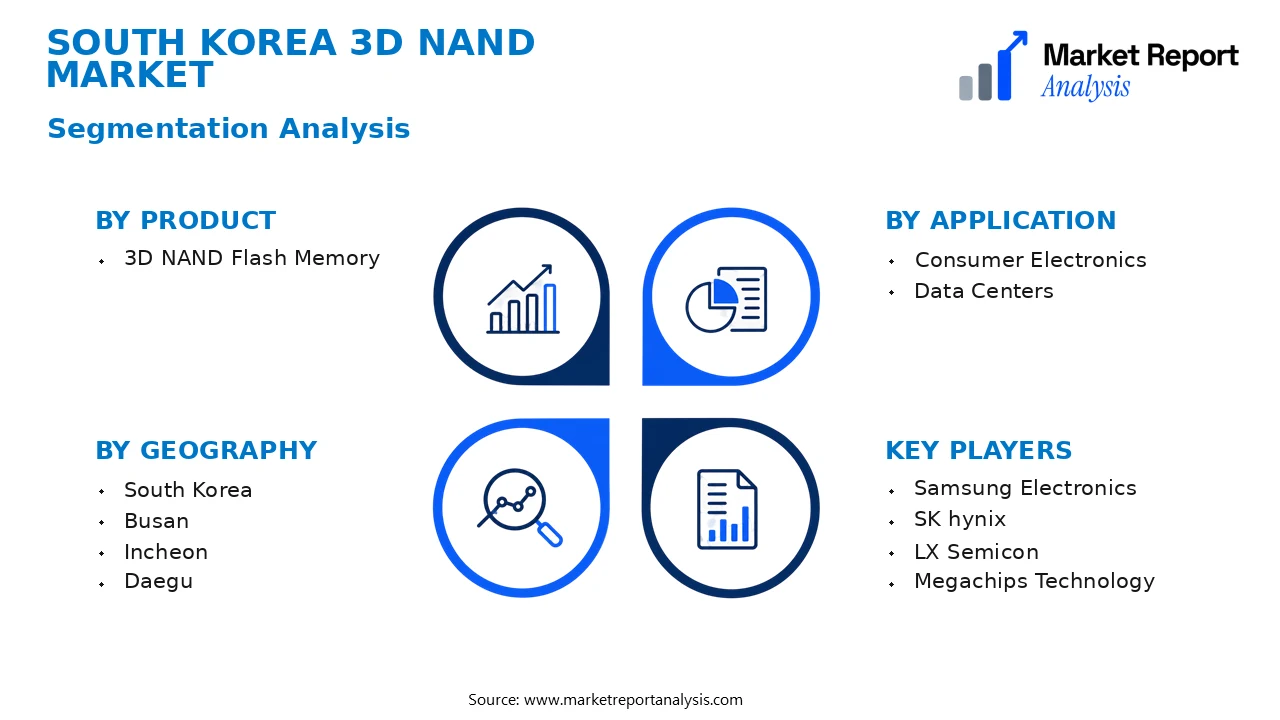
- Product
- 3D NAND Flash Memory: This segment comprises advanced non-volatile memory devices featuring stacked memory cells, fundamental for storage solutions in various electronic devices, with demand driven by technological upgrades and data-centric applications.
- Application
- Consumer Electronics: Encompasses smartphones, tablets, and laptops where high-capacity, fast, and durable storage is critical, significantly influencing market growth due to high demand in South Korea's tech-savvy population and manufacturers.
- Data Centers: This segment serves large-scale cloud storage and enterprise data processing, necessitating high-performance NAND solutions, which are increasingly adopted amid the country's expanding digital infrastructure and enterprise innovation.
- Geography
- South Korea: The primary market, characterized by a robust electronics industry, substantial semiconductor manufacturing capacity, and significant investments in technological innovation, positioning it as a global leader in NAND flash memory technology.
- Seoul: The capital hub with high corporate activity, R&D facilities, and demand from major consumer electronics firms, making it a key region for market adoption and technological deployment.
- Busan: Acts as a logistics and port hub with proximity to manufacturing corridors, supporting export-oriented NAND memory production and distribution channels within the country.
- Incheon: An influence center for technological investment, with a focus on smart manufacturing and supply chain development that boosts NAND market integration and advanced technology adoption.
- Daegu: Known for heavy industrial activity and manufacturing clusters, this city supports components and assembly operations crucial for NAND product deployment.
- Daejeon: A science and technology hub hosting numerous research institutes and tech startups contributing to NAND process innovation and manufacturing techniques.
- Gwangju: Emerging as a regional industrial and technological hub with initiatives to support advanced electronics manufacturing, influencing local NAND demand and innovation.
- Ulsan: With a focus on heavy industry and industrial machinery, Ulsan supports the supply chain and infrastructure for advanced semiconductor manufacturing.
- Suwon: Known for its high-tech clusters and proximity to Seoul, facilitating rapid innovation, market expansion, and integration into supply chains for NAND applications.
- South Korea: The primary market, characterized by a robust electronics industry, substantial semiconductor manufacturing capacity, and significant investments in technological innovation, positioning it as a global leader in NAND flash memory technology.
Competitive Intelligence
The South Korea 3D NAND Market exhibits a high degree of competition, dominated by a few key players such as Samsung Electronics and SK Hynix. Market concentration remains substantial, with these companies collectively holding over 80% of the market share by 2034, driven by their advanced manufacturing capabilities and extensive R&D investments. Business strategies focus on product innovation, including the development of higher-density, more energy-efficient NAND chips to meet rising demand from data centers, consumer electronics, and enterprise storage sectors. Partnerships and alliances are common, with major firms collaborating with semicondutor equipment suppliers and technical institutes to accelerate technological advancements. Several companies pursue acquisitions to enhance capacity and technological capabilities; for example, Samsung's recent plant expansions in Seoul and Gyeonggi-do aim to strengthen their competitive edge. Continuous R&D investments prioritize differentiation through innovative architectures and manufacturing processes, allowing South Korean firms to maintain global leadership. These strategic initiatives are crucial in a landscape characterized by rapid technological evolution and a relentless pursuit of process optimization.
Leading Company Profiles
The South Korea 3D NAND market exhibits a concentrated but highly innovative competitive environment, featuring global giants and integrated device manufacturers (IDMs) with strategic priorities aligned toward technological leadership and supply chain resilience.
- Samsung Electronics
- SK hynix
- LX Semicon
- Megachips Technology
- Daegu Semiconductor
- Key Foundry
- SkyeChip Electronics
- Hynix Semiconductor Manufacturing
- Intel Korea
- Samsung-SK Partnership
Samsung Electronics
Samsung Electronics leads the South Korean market with its expansive portfolio of 3D NAND products, focusing on high-density enterprise and consumer storage solutions, leveraging cutting-edge process technology and strategic investments in advanced fabrication facilities.
SK hynix
As a major player, SK hynix emphasizes innovation in 3D NAND architecture and capacity expansion, with a strategic focus on developing high-performance, energy-efficient memory modules for data centers and premium consumer devices.
LX Semicon
Specializing in the development of state-of-the-art wafer fabrication equipment, LX Semicon ensures South Korean fabs remain at the forefront of process technology, facilitating the production of next-generation 3D NAND devices.
Megachips Technology
This company concentrates on advanced chip integration and testing services, providing critical support to the local 3D NAND supply chain through innovative testing solutions and quality assurance frameworks.
Daegu Semiconductor
Daegu Semiconductor is investing heavily in expanding its 3D NAND production capabilities, aiming to increase throughput and process efficiency by adopting new etching and deposition technologies.
Key Foundry
As a leading foundry service provider, Key Foundry offers tailored manufacturing solutions for 3D NAND wafers, emphasizing increased scalability and process reliability for high-volume production runs.
SkyeChip Electronics
SkyeChip specializes in embedded memory solutions, continuously enhancing its 3D NAND chip performance for mobile and IoT applications through aggressive R&D programs and technological innovations.
Hynix Semiconductor Manufacturing
A dedicated manufacturing arm of SK hynix, this entity pushes the boundaries in 3D NAND process technology, supporting its parent company’s strategic goals of market expansion and technological supremacy.
Intel Korea
Intel Korea collaborates closely with local partners, driving joint development projects focused on innovative 3D NAND structures and scalable manufacturing techniques tailored for global and domestic demand.
Samsung-SK Partnership
This alliance leverages combined expertise to accelerate the deployment of advanced 3D NAND technology, optimizing supply chains and enhancing competitiveness in the Asia-Pacific region.
Strategic Business Developments

- August 2023 – Samsung Electronics – Announced the expansion of its Pyeongtaek plant capacity – Significantly boosts domestic production capabilities, supporting the rising demand for high-capacity 3D NAND SSDs in South Korea and beyond.
- June 2023 – SK hynix – Launched a new line of 176-layer 3D NAND chips – Elevates SK hynix's product performance and density, reinforcing South Korea’s position as a leader in high-end memory solutions.
- April 2023 – Daegu Semiconductor – Invested in next-generation etching technology – Enhances process precision and yields in 3D NAND wafer fabrication, underpinning future scalability and tech innovation.
- February 2023 – LX Semicon – Partnership with global equipment providers – Fosters technology transfer and supports the local production ecosystem, reinforcing South Korea’s advanced manufacturing footprint.
- January 2023 – Megachips Technology – Launched a new series of testing and quality assurance solutions – Ensures high reliability standards for South Korea’s evolving 3D NAND memory products, vital for enterprise applications.
Frequently Asked Questions
What is the South Korea 3D NAND Market?
The South Korea 3D NAND Market encompasses the manufacturing, distribution, and consumption of 3D NAND flash memory devices within South Korea, serving applications in consumer electronics, data centers, and enterprise storage solutions. It is a key component of South Korea's semiconductor industry.
What is the current market size of South Korea 3D NAND Market?
As of 2026, the South Korea 3D NAND Market is valued at approximately USD 45 Billion, reflecting the country's leading position in memory chip production and high consumer demand for advanced storage devices across various sectors.
What factors are driving the South Korea 3D NAND Market?
The market growth is driven by increasing consumer electronics sales, the expansion of data centers, advancements in memory technology, and significant investments by local semiconductor giants such as Samsung Electronics and SK Hynix, who are leading innovations in 3D NAND manufacturing.
Which South Korean city leads the South Korea 3D NAND Market?
Seoul leads the South Korea 3D NAND Market due to its status as the country's tech innovation hub, hosting major semiconductor R&D facilities, manufacturing plants, and the headquarters of the primary companies involved in the development and production of 3D NAND chips.
Which segment is expected to grow the fastest?
The enterprise data storage segment is projected to grow the fastest, fueled by the exponential rise in data generation, cloud computing, and artificial intelligence applications, necessitating higher capacity and more efficient NAND flash solutions.
Who are the leading companies operating in the South Korea 3D NAND Market?
Leading companies include Samsung Electronics, SK Hynix, and LG Electronics, which dominate the market through their extensive R&D efforts, innovative product lines, and strategic investments in state-of-the-art manufacturing facilities.
Analyst Perspective
The South Korea 3D NAND market is poised for significant long-term growth driven by burgeoning domestic demand across technology, consumer electronics, and data center sectors. As industry players continue to innovate, the evolution of 3D NAND technology, particularly in scaling layers and improving endurance, will be pivotal in maintaining competitive advantage. Investment focus will likely prioritize R&D as well as capacity expansion in key clusters like Seoul and Gyeonggi-do, where infrastructure and skilled labor availability foster rapid deployment. Market maturity suggests a shift from early-stage growth to sustained, stable expansion, with intense competition among leading suppliers such as Samsung and SK Hynix necessitating continuous technological advancement and strategic alliances. City-level opportunities in Seoul and Incheon are especially attractive, given their technological ecosystems and proximity to major clients. Long-term strategic positioning will require balancing aggressive capital expenditure with innovation pacing, ensuring resilience against geopolitical and supply chain risks while capitalizing on South Korea’s reputation as a semiconductor innovation hub.
