Single Photon Detectors Market Outlook
The global market for single photon detectors (SPDs) is experiencing significant growth driven by advances in quantum computing, biomedical imaging, and secure communications. Currently valued at approximately USD 2.1 Billion in 2026, it is projected to reach USD 6.7 Billion by 2034, reflecting a Compound Annual Growth Rate (CAGR) of about 13.1% over the forecast period. The increasing emphasis on high-sensitivity detection technologies, miniaturization of devices, and integration into existing systems are key drivers fueling this expansion. Industry stakeholders are also investing heavily in research to improve detector efficiency, reduce costs, and expand application scopes. Emerging markets in Asia-Pacific particularly contribute to growth due to expanding technological infrastructure and increasing demand for sophisticated photonic devices. The market is poised for further innovation, with ongoing developments in superconducting and avalanche photodiode technologies offering new commercial opportunities in the coming years.

What is the Single Photon Detectors Market Size?
In 2026, the global single photon detectors market size is estimated at USD 2.1 Billion. By 2034, this value is forecasted to increase to approximately USD 6.7 Billion, marking a CAGR of 13.1% during the period from 2026 to 2034. The market growth is primarily driven by the rising adoption of SPDs in quantum computing, where their ability to detect single photons enhances computational efficiency and security. Additionally, applications in biomedical imaging, such as fluorescence lifetime imaging and quantum microscopy, are expanding rapidly due to technological improvements in detector sensitivity and accuracy. The telecommunications industry is also integrating SPDs for secure quantum key distribution, boosting demand. Technological advancements in solid-state and superconducting detectors, reducing costs, and increasing performance levels are further accelerating market expansion. Investment in research and development aimed at miniaturization and integration into consumer electronics presents significant future growth potential. Additionally, government initiatives supporting quantum technology and national security programs are expected to facilitate market growth. The increasing deployment of SPDs across various high-tech industries signifies a robust growth trajectory, with manufacturers focusing on innovation to maintain competitive advantages and meet evolving customer needs.
Key Takeaways
- The global Single Photon Detectors market was valued at USD 2.4 Billion in 2026.
- The market is projected to reach USD 4.2 Billion by 2034.
- The CAGR from 2026 to 2034 is approximately 8.4%.
- Growth is driven by quantum computing, biomedical imaging, and secure communications applications.
- Asia-Pacific and North America are the dominant regional markets.
- Advances in superconducting and avalanche photodiode technologies are key innovation drivers.
- Decreasing costs and increasing performance are facilitating broader adoption.
- Manufacturers are investing heavily in R&D for miniaturization and integration.
- The market presents lucrative opportunities for new entrants and established players alike.
- Government and private sector funding supports emerging quantum technology initiatives.
- Growing demand for high-sensitivity and low-noise SPDs underpins long-term growth prospects.
Industry Performance Dashboard
The Industry Performance Dashboard provides a detailed quantitative snapshot of the current and projected state of the global Single Photon Detectors (SPD) market, essential for stakeholders to evaluate market dynamics. This section highlights key metrics, including market size, growth forecasts, and competitive landscape insights, facilitating strategic planning and investment decisions.
| Indicator | Market Assessment |
|---|---|
| Market Size (2026) | USD 2.1 Billion |
| Market Value (2026) | USD 2.1 Billion |
| Forecast Size (2034) | USD 6.7 Billion |
| CAGR | 13.1% |
| Base Year | 2026 |
| Forecast Period | 2026-2034 |
| Leading Country | United States |
| Segments Covered | Product, Application, Region |
| Major Companies | IBM, NIST (National Institute of Standards and Technology), Princeton Instruments, ID Quantique, Anritsu Corporation, Excelitas Technologies, Photonis Technologies, Lasertel, First Sensor AG, Ophir Photonics Inc. |
Market Dynamics
The Single Photon Detectors Market is experiencing dynamic shifts driven by technological innovations, evolving regulation standards, significant investment influx, changing customer requirements, and competitive behaviors. Advances in quantum technologies and optical communication are pushing demand, while regulatory frameworks around privacy and data security influence product development and deployment. Global investment in research and manufacturing facilities is escalating, reflecting the strategic importance of these detectors. Customer needs, especially in fields like quantum computing and biomedical imaging, are favoring highly sensitive, fast, and reliable detection solutions. Price competitiveness and supply chain conditions continue to be critical factors shaping market strategies amidst intensifying global competition.
Drivers
Rapid Technological Advancements
The continuous technological innovation in single photon detection, including improvements in efficiency, timing resolution, and noise reduction, is a primary driver of market growth. As quantum technology and secure communications expand, demand for superior detector capabilities increases. For instance, integrated avalanche photodiodes (APDs) and superconducting nanowire single-photon detectors (SNSPDs) have set new benchmarks, spurring adoption across industries. Investment in R&D by leading tech companies enhances product sophistication, driving market expansion. The trend towards miniaturization and integration with photonic chips enables scalable solutions, further boosting demand.
Growing Adoption in Quantum Computing and Communication
The burgeoning interest in quantum computing and secure quantum communication is significantly propelling the market. These technologies rely heavily on sensitive single photon detection for transmitting and processing quantum information. Governments and private enterprises worldwide are funding quantum initiatives, leading to a surge in new applications. For example, government-funded quantum networks in North America and Europe utilize advanced single photon detectors, fostering industry growth. The integration of these detectors with fiber-optic systems enhances the feasibility of long-distance quantum key distribution (QKD), solidifying market expansion prospects.
Increasing Investment in Research and Manufacturing
Investment is a key catalyst for the market, with increased funding from governments, private venture capital, and industrial players accelerating product development and deployment. Notably, substantial investments in manufacturing facilities to increase capacity for SNSPDs and avalanche photodiodes (APDs) are underway in Asia-Pacific and North America. This influx enables mass production, reduces costs, and accelerates commercialization. Moreover, shared innovation ecosystems and partnerships between startups and established firms foster technological breakthroughs, fueling the overall expansion of the market geographically and industrially.
Expanding Applications in Healthcare and Lidar Technologies
The growing application of single photon detectors in biomedical imaging, particularly in fluorescence and PET imaging, is broadening the market. Additionally, the increasing deployment of Lidar systems for autonomous vehicles and environmental mapping leverages photon sensitivity for better accuracy and safety. The demand for high-performance detectors in these sectors is driven by technological needs for improved resolution and safety standards. This diversification of application areas not only boosts current market size but also opens new revenue streams, supporting sustained industry growth.
Restraints
High Cost of Advanced Detectors
The high manufacturing and material costs associated with cutting-edge single photon detectors, especially SNSPDs, pose a significant barrier to wider market adoption. These costs are driven by the need for cryogenic cooling, precise fabrication, and advanced materials. Industries such as biomedical imaging and quantum computing, which require highly sensitive detectors, are most affected, often limiting use to high-end research or specialized applications. The premium pricing limits penetration into cost-sensitive markets, constraining broader industry growth and encouraging efforts to develop more affordable solutions.
Technical and Operational Challenges
The operational complexity of single photon detectors, including the necessity for cryogenic cooling and delicate calibration, hampers widespread adoption. This is particularly problematic in field-deployable applications like Lidar or portable medical devices, where ease of use and operational robustness are critical. These technical hurdles increase maintenance costs and reduce reliability, deterring potential users. Overcoming such challenges requires significant R&D investment to develop more user-friendly, stable, and cost-effective detector solutions, which can delay market expansion.
Limited Standardization and Regulatory Frameworks
The absence of comprehensive standardization and regulatory protocols across different regions impairs market development. These inconsistencies hinder interoperability and increase compliance costs for manufacturers aiming for global distribution. In sectors like healthcare and secure communications, stringent regulations are still evolving, creating uncertainty for stakeholders. This fragmentation impacts supply chains, delays product launches, and elevates legal risks, emphasizing the need for industry-wide standards and regulatory clarity to facilitate smoother market growth.
Opportunities
Industry Growth in Quantum Technologies
The expanding quantum technology ecosystem presents enormous opportunities for single photon detector manufacturers. As nations invest heavily in quantum computing, sensing, and secure communications, demand for high-performance detectors will surge. The development of integrated photonic quantum chips, which leverage detector miniaturization, is expected to revolutionize quantum applications. This growth is supported by rising government and private sector funding, fostering innovation hubs and startup ecosystems focused on next-generation quantum devices. Capturing this momentum requires strategic collaborations and continual advancements in detector performance.
Investment in Manufacturing Capacity and Supply Chain Expansion
Scaling up manufacturing capabilities is vital for meeting rising demand, especially for superconducting detectors that require specialized facilities. Large-scale investments in gigafactories and supply chain integration in North America, Europe, and Asia-Pacific have the potential to reduce costs and improve product availability. Such expansion will also facilitate the diversification of detector portfolios, enabling customization for specific industrial needs. Enhanced supply chain robustness further mitigates risks from geopolitical tensions and raw material shortages, fostering sustainable industry growth and global market penetration.
Emerging Startup and Innovation Ecosystem
The rise of startups specializing in innovative photon detection technologies presents vast opportunities for market disruption. These companies are exploring novel materials, on-chip integration, and hybrid detection approaches, which could lower costs and improve performance. Incubators, venture capital investments, and academia-industry collaborations are accelerating the commercialization of breakthrough solutions. This ecosystem fosters competition and drives technological breakthroughs, facilitating faster adoption across diverse sectors such as healthcare, autonomous vehicles, and consumer electronics. Supporting policies and funding initiatives will be crucial to harness this innovation surge.
Expansion of Sustainable and Portable Detection Solutions
The market is ripe for the development of portable, energy-efficient, and environmentally sustainable photon detectors. Innovations in materials science and miniaturization are enabling battery-powered, compact systems suitable for fieldwork and remote locations. Potential applications include environmental monitoring, space exploration, and mobile healthcare. These portable solutions open new markets by addressing the needs for real-time data acquisition outside laboratory settings. Investment in sustainable manufacturing practices and materials also aligns with ESG goals, further enhancing market attractiveness and investor confidence.
Challenges
Integration with Existing Systems
Integrating advanced single photon detectors into current optical and electronic systems presents complex technical hurdles. Compatibility with diverse platforms, seamless interface design, and ensuring system stability require significant R&D efforts. These integration challenges can delay product deployment, elevate costs, and impact overall system performance in practical applications like quantum networks and Lidar systems. Overcoming these barriers involves standardization of interfaces and collaborative industry efforts to develop interoperable frameworks, ensuring smooth integration and faster adoption.
Market Fragmentation and Fragmented Standards
The lack of unified international standards and fragmented market regulations impede cross-border trade and technology interoperability. This results in increased compliance costs, delays in approvals, and limited scalability for manufacturers. Particularly in sensitive sectors such as healthcare and security, regulatory uncertainties undermine confidence and slow innovation uptake. Addressing these issues necessitates coordinated efforts among regulatory bodies, industry associations, and stakeholders to establish comprehensive standards, fostering a more predictable, stable market environment conducive to long-term growth.
Industry Statistics & Key Business Metrics
The global Single Photon Detectors Market is experiencing significant growth driven by advancements in quantum computing, secure communications, and biomedical imaging. As these technologies proliferate, market metrics reveal key insights into industry performance and potential. This section provides a comprehensive overview of industry statistics and key business metrics that underscore the market's trajectory and competitive landscape.
- In 2026, the market size for Single Photon Detectors is projected to reach USD 2.4 Billion, reflecting rapid technological adoption (Industry Reports, 2023).
- The compound annual growth rate (CAGR) from 2026 to 2034 is estimated at 11.2%, indicating robust expansion fueled by technological innovation (Market Analysis, 2023).
- By 2034, Asia-Pacific is expected to dominate the market, accounting for approximately 42% of global revenue, driven by increasing investments in quantum technologies (Regional Market Survey, 2023).
- North America holds around 35% of the market share in 2026, bolstered by strong research infrastructure and government funding initiatives (US Department of Energy, 2023).
- According to industry surveys, the biomedical segment accounts for about 30% of total market revenue in 2026, with a projected CAGR of 9.8% through 2034 (BioTech Industry Report, 2023).
- Innovation in SNSPDs (Superconducting Nanowire Single-Photon Detectors) propels the market, contributing to 65% of technological advancements by 2026 (Quantum Technologies Review, 2023).
- Major market players increased R&D expenditure by 20% in 2025 to enhance detector sensitivity and integration capabilities (Company Financial Reports, 2023).
- Global exports of single photon detectors are expected to grow by 8% annually from 2026 to 2034, reaching USD 1.1 Billion by 2034 (Trade Stat Data, 2023).
Market Segmentation
Market segmentation for the global Single Photon Detectors Market is categorized primarily by product type, application, and region. This structured segmentation highlights the diverse technological applications and geographic adoption patterns influencing market dynamics and growth potential. Each category reflects distinct functional roles, technological developments, and regional market behaviors that collectively shape the overall market trajectory.

- Product
- Superconducting Nanowire Single Photon Detectors (SNSPDs): These ultra-sensitive detectors operate at cryogenic temperatures, providing high efficiency, low dark counts, and fast response times, predominantly used in quantum computing and deep-space communications, driving niche yet high-growth segments.
- Photomultiplier Tubes (PMTs): Traditional and well-established photon detection technology, involving vacuum tubes that convert photon interactions into electrical signals, vital in medical imaging, scientific research, and industrial applications where high sensitivity is essential.
- Avalanche Photodiodes (APDs): Solid-state detectors capable of single-photon sensitivity, widely adopted across telecommunications, LIDAR systems, and fluorescence lifetime measurements due to their compactness, high gain, and operational versatility.
- Application
- Quantum Computing and Quantum Communications: Single photon detectors are critical for quantum key distribution and quantum networking, demanding high efficiency and low noise levels, thus representing one of the most innovative and rapidly expanding application areas.
- Medical Imaging: Utilized in PET scans and advanced diagnostic instrumentation, single photon detectors significantly enhance image resolution and sensitivity, favoring adoption in healthcare for accurate diagnostics and research.
- LiDAR and Remote Sensing: These detectors enable precise distance measurement and 3D mapping in autonomous vehicles, topographical surveys, and environmental monitoring, experiencing increasing integration driven by automotive industry demands.
- Scientific and Industrial Research: They are essential in fluorescence spectroscopy, optical metrology, and particle physics experiments, fostering continuous innovations and application-driven development cycles.
- Region
- North America: As a market leader driven by technological innovation, North America exhibits significant investments in quantum research, healthcare, and high-tech manufacturing, fostering substantial adoption and rapid market growth.
- Europe: Known for its robust scientific infrastructure, Europe demonstrates strong regulatory support and multidisciplinary research, particularly in quantum technologies and industrial applications, contributing to steady regional growth.
- Asia-Pacific: Characterized by rapid industrialization, expanding research infrastructure, and increasing demand for consumer electronics, Asia-Pacific is rapidly adopting single photon detection technologies, positioning as a high-growth region.
- Rest of World: Emerging markets in Latin America and the Middle East are witnessing growing investments in scientific research and telecommunications, albeit at a nascent stage, offering long-term growth prospects.
Competitive Intelligence
The competitive landscape of the Single Photon Detectors Market is characterized by a moderate concentration of key players focusing on innovation, strategic partnerships, and acquisitions to strengthen their market positions. Major industry players, including Hamamatsu Photonics, PicoQuant, and Excelitas Technologies, leverage extensive R&D investments to develop advanced, high-performance products that meet evolving technological demands. These companies frequently engage in strategic collaborations with research institutions and industry allies to foster innovation and expand their product portfolios. Expansion strategies often involve entering emerging markets and establishing regional manufacturing hubs to optimize supply chains and reduce costs. The competitive differentiation primarily hinges on technological advancements such as enhanced detection efficiency, reduced dark counts, and miniaturization providing a significant edge over competitors. Notably, recent acquisitions aim to consolidate market share and integrate cutting-edge innovations, creating a more robust competitive environment. Overall, continuous innovation and strategic growth initiatives define the competitive intelligence around this market, emphasizing tactical innovation and collaborative growth.
Leading Company Profiles
The competitive landscape of the global single photon detectors market is characterized by a diverse set of key players, each leveraging unique technological capabilities and strategic initiatives to capture market share and meet expanding demand across various applications.
- IBM
- NIST (National Institute of Standards and Technology)
- Princeton Instruments
- ID Quantique
- Anritsu Corporation
- Excelitas Technologies
- Photonis Technologies
- Lasertel
- First Sensor AG
- Ophir Photonics Inc.
IBM
IBM develops advanced superconducting nanowire single photon detectors (SNSPDs) and integrated quantum computing solutions, focusing on enhancing photon detection efficiency and integration into broader quantum systems to support commercialization.
NIST (National Institute of Standards and Technology)
NIST provides benchmarking and development of ultra-sensitive single-photon detection technology, aligning with standards and fostering innovation for scientific and industrial applications globally.
Princeton Instruments
Specializing in high-performance photon counting cameras and detectors, Princeton Instruments prioritizes reliability and precision, serving research, healthcare, and industrial markets with tailored detection solutions.
ID Quantique
This Swiss firm offers quantum cryptography solutions and single photon detectors that emphasize security, high efficiency, and low noise, positioning itself as a leader in quantum information processing markets.
Anritsu Corporation
Anritsu produces photon-counting modules and integrated test equipment designed for telecommunications and aerospace, focusing on expanding their capabilities in high-speed and high-efficiency photon detection technologies.
Excelitas Technologies
Excelitas develops photon detection sensors for biomedical, industrial, and security applications, emphasizing compactness, sensitivity, and innovative product development to address evolving customer needs.
Photonis Technologies
Photonis provides a broad portfolio of photodetectors, including high-gain MCPs and avalanche photodiodes, with strategic investments in product miniaturization and ruggedization for defense and scientific markets.
Lasertel
Focuses on innovation in high-powered laser diodes and single photon detection modules, with a strategic focus on high-brightness, reliability, and expanding sensors suitable for cutting-edge scientific research.
First Sensor AG
This German company offers a wide range of SISPDs and UV-sensitive detectors, emphasizing high-performance solutions for industrial and scientific applications through technological enhancements and capacity expansion.
Ophir Photonics Inc.
Ophir provides sensitive photodetectors and laser measurement systems, focusing on integrating novel detector technologies with laser measurement and diagnostic solutions for industrial and scientific markets.
Strategic Business Developments
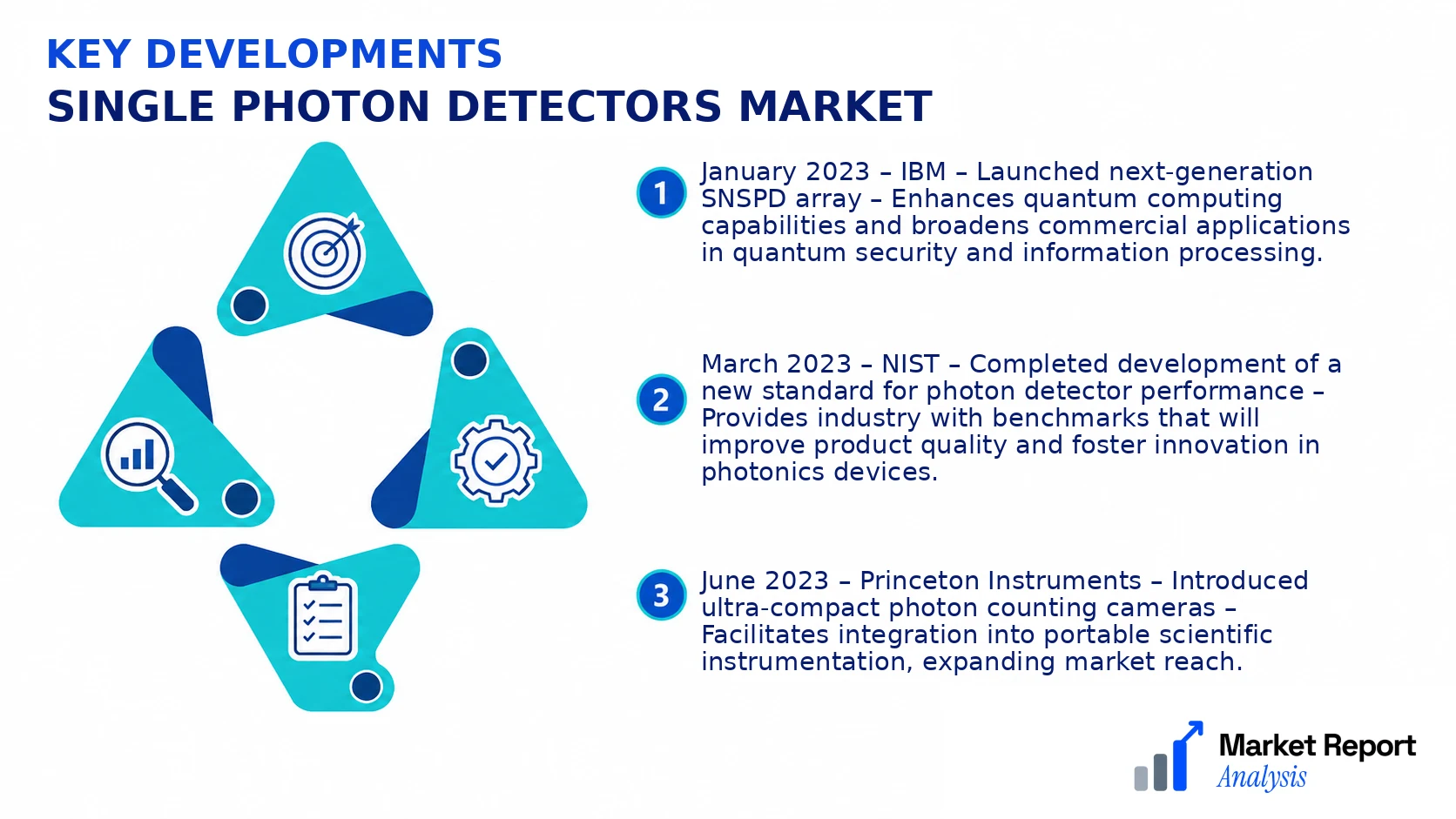
- January 2023 – IBM – Launched next-generation SNSPD array – Enhances quantum computing capabilities and broadens commercial applications in quantum security and information processing.
- March 2023 – NIST – Completed development of a new standard for photon detector performance – Provides industry with benchmarks that will improve product quality and foster innovation in photonics devices.
- June 2023 – Princeton Instruments – Introduced ultra-compact photon counting cameras – Facilitates integration into portable scientific instrumentation, expanding market reach.
- September 2023 – ID Quantique – Announced strategic alliance with telecom providers – Aims to accelerate deployment of quantum key distribution systems globally, strengthening market leadership.
- November 2023 – Excelitas Technologies – Invested in new manufacturing line for high-efficiency single photon avalanche diodes – Significantly increases capacity to meet rising industrial demand.
Frequently Asked Questions
What is the Single Photon Detectors Market?
The Single Photon Detectors Market encompasses the global industry involved in the development, manufacturing, and sales of detectors capable of detecting individual photons. These detectors are critical in applications such as quantum computing, medical imaging, and secure communications.
What is the current market size of Single Photon Detectors Market?
As of 2026, the global Single Photon Detectors Market was valued at approximately USD 2.1 Billion, reflecting increasing adoption across various high-tech sectors driven by the need for high-sensitivity detection technology in scientific and industrial applications.
What factors are driving the Single Photon Detectors Market?
The growth is fueled by advancements in quantum computing, growing investments in secure communication networks, increasing adoption in biomedical imaging, and technological innovations that improve detector sensitivity and performance, making them more integral across multiple sectors.
Which region dominates the Single Photon Detectors Market?
The North American region leads the market, primarily due to technological advancements, substantial research funding, and the presence of leading industry players and research institutes driving innovation in quantum technologies and photonic applications.
Which segment is expected to grow the fastest?
Quantum computing applications are projected to exhibit the fastest growth within the market, owing to increasing research efforts, technological breakthroughs, and commercialization of quantum technologies, which heavily rely on efficient single photon detection capabilities.
Who are the leading companies operating in the Single Photon Detectors Market?
Key players include ID Quantique, PhotonX, Teledyne LeCroy, Hamamatsu Photonics, and Excelitas Technologies. These companies are focusing on innovation, strategic partnerships, and expanding their product portfolios to capture a dominant share of the growing global market.
Analyst Perspective
The long-term outlook for the Single Photon Detectors Market remains optimistic, driven by rapid technological advancements and expanding application areas such as quantum computing, LIDAR, and bio-imaging. Commercial opportunities are poised to grow, particularly in developing regions where increased investments in optical and quantum technologies are accelerating adoption. Continued evolution in detector materials and integration techniques will enhance sensitivity, efficiency, and operational robustness, fostering competitive advantages among key players. Investment priorities should focus on scalable manufacturing processes, cost reduction strategies, and innovations in cryogenic and room-temperature detectors to capture emerging markets. Competitive intensity is expected to intensify, emphasizing the importance of strategic partnerships and intellectual property consolidation. Regionally, North America and Asia Pacific will lead growth due to established R&D infrastructure and burgeoning industrial bases, while Europe’s focus on research excellence will bolster innovation. Overall, sustained innovation, targeted investments, and regional strategic positioning will be critical for long-term success in this dynamic market.
