Selective Laser Melting Machines Market Outlook
The global Selective Laser Melting (SLM) machines market was valued at USD 2.4 Billion in 2026 and is anticipated to reach USD 7.8 Billion by 2034, growing at a compound annual growth rate (CAGR) of approximately 13.4% during the forecast period of 2026 to 2034. The primary drivers of this expansion include an increasing demand for high-precision manufacturing in aerospace, automotive, and healthcare sectors, along with advancements in laser technology and additive manufacturing processes. The market's growth is also propelled by the increasing adoption of SLM machines for complex, lightweight, and bespoke component production. Furthermore, technological innovations such as multi-laser systems and enhanced software solutions are expanding the commercial opportunities for manufacturers, making SLM a preferred choice for industries seeking scalable, efficient, and cost-effective production methods.

What is the Selective Laser Melting Machines Market Size?
In 2026, the global market size of Selective Laser Melting machines stands at approximately USD 2.4 Billion. This figure is projected to increase substantially, reaching around USD 7.8 Billion in 2034, representing a CAGR of about 13.4%. The growth is mainly driven by rising industrial applications requiring high-performance additive manufacturing; sectors such as aerospace for lightweight components, medical devices for precision implants, and automotive for rapid prototyping and end-use parts. The technological evolution towards more sophisticated, faster, and energy-efficient SLM systems is making adoption economically viable for a broader customer base. As investments in 3D printing technology continue to grow, the future landscape of SLM machine deployment will be characterized by increased integration with automation and material innovations, further promoting industrial expansion and new revenue streams across regions.
Key Takeaways
- The global Selective Laser Melting Machines market was valued at USD 1.2 Billion in 2026.
- The market is forecasted to reach USD 3.2 Billion by 2034, with a CAGR of 13.8% from 2026 to 2034.
- Growth is fueled by demand from aerospace, automotive, healthcare, and dental industries.
- Technological advancements include multi-laser configurations and improved software integration.
- North America and Europe are leading regions due to early adoption and technological innovation.
- Emerging markets in Asia-Pacific are expected to register the fastest growth owing to expanding manufacturing bases.
- Increasing focus on sustainable manufacturing practices boosts interest in additive manufacturing.
- Enhanced material options and higher build volume capabilities are key development areas.
- Regulatory support and industry standards are fostering broader adoption of SLM systems.
- Competitive landscape features established players like EOS, 3D Systems, and Renishaw, along with new entrants investing heavily in R&D.
- Investment in R&D is crucial for technological innovation and market positioning.
- The integration of AI and machine learning into SLM systems presents future growth opportunities.
- The shift towards mass customization and on-demand manufacturing sustains long-term industry growth.
- The evolving regulatory environment and intellectual property considerations will shape future market dynamics.
Industry Performance Dashboard
The Industry Performance Dashboard offers a comprehensive overview of the global market dynamics for selective laser melting machines, highlighting key metrics and industry indicators essential for strategic decision-making. The data encapsulates market sizing, growth projections, key players, and regional insights, providing stakeholders with a clear understanding of current and future market trajectories.
| Indicator | Market Assessment |
|---|---|
| Market Size (2026) | USD 2.4 Billion |
| Market Value (2026) | USD 2.4 Billion |
| Forecast Size (2034) | USD 7.8 Billion |
| CAGR (2026-2034) | 13.4% |
| Base Year | 2026 |
| Forecast Period | 2026-2034 |
| Segments Covered | Product, Application, Geography |
| Major Companies | EOS GmbH, SLM Solutions, Desktop Metal, 3D Systems Corporation, Markforged, Renishaw Plc, Arcam AB, Trumpf GmbH + Co. KG, TRUMPF Group, Consortium members in strategic alliances |
Market Dynamics
The market dynamics surrounding the Selective Laser Melting (SLM) machines market are heavily influenced by rapid technological advancements, changing regulatory landscapes, increasing investment flows, evolving customer requirements, competitive pricing strategies, supply chain conditions, and intensifying market competition. These factors collectively shape the growth trajectory, innovation pace, and strategic priorities within the industry, indicating a complex interplay of forces that propel or hinder market expansion. As new technologies emerge and regulatory policies tighten around safety and environmental standards, market players are compelled to adapt swiftly, fostering innovation, while investor interest continues to boost the deployment of cutting-edge SLM solutions globally.
Drivers
Technological Innovation and Advancements
Rapid advancements in laser technology, materials development, and process automation are central drivers fueling the growth of the SLM market. Innovations such as higher laser power, improved powder bed quality, and integration of AI-driven process monitoring are enabling manufacturers to produce more precise and reliable parts at reduced cycle times. For example, leading firms are investing heavily in R&D to develop next-generation laser systems that significantly enhance build quality and speed. The overall trend towards smarter manufacturing is driven by the increasing adoption of IoT and AI, which are expected to further revolutionize the capabilities and applications of SLM equipment, thereby expanding the market landscape.
Rising Demand in Aerospace and Biomedical Sectors
The aerospace and biomedical sectors are among the fastest-growing end-user markets leveraging SLM technology. High precision, lightweight component manufacturing, and complex geometry production are critical requirements driving adoption. For instance, the aerospace industry’s push towards fuel-efficient and eco-friendly aircraft is boosting demand for titanium and aluminum components produced via SLM. Similarly, the biomedical sector's need for patient-specific implants and surgical tools is accelerating growth, with market adoption supported by stringent standards for customization and performance. As these industries grow and innovate, the SLM market will largely benefit from increased deployment in these high-value sectors.
Increasing Investment and Strategic Collaborations
Global investments in additive manufacturing startups and established firms are surging. Venture capitalists, private equity, and government grants are fueling innovation, infrastructure development, and market penetration strategies. For example, strategic alliances between tech companies and end-user industry giants are facilitating the deployment of tailored SLM systems, fostering ecosystem growth. Investment in specialized research facilities and pilot projects underscores a broader confidence in the commercial viability of SLM. This support is crucial for scaling manufacturing capacities, improving technology durability, and expanding the range of printable materials, which collectively bolster market growth prospects.
Growing Awareness and Adoption of Metal 3D Printing
As awareness of metal additive manufacturing’s benefits rises, a broader base of industries is adopting SLM technology. The cost-effectiveness of producing complex, lightweight parts with reduced lead times and waste aligns with global sustainability goals, encouraging initial adoption. Expanding training programs, industry certifications, and user community networks are reducing barriers related to skill gaps. Additionally, governments and industry associations are promoting awareness through standards, standards development, and demonstration projects. As this ecosystem matures, it catalyzes wider acceptance, leading to new market segments, regional penetrations, and application innovations across diverse manufacturing sectors.
Restraints
High Initial Capital Investment
The high cost of acquiring advanced SLM machinery remains a significant barrier for many potential users, particularly smaller firms and startups. These machines require substantial capital expenditure for equipment, maintenance, and trained personnel, limiting immediate adoption. Industries with tight budget constraints or lower production volumes often prioritize more traditional manufacturing methods. This restraint impacts sectors such as small-scale aerospace projects or niche biomedical applications where cost-efficiency is critical. Although operational costs may reduce over time, the initial investment hurdle continues to slow broader market penetration and limits fast scalability in developing regions.
Material Limitations and Cost
While SLM offers flexibility in material selection, certain metal powders remain expensive, raw material quality varies, and material properties can be inconsistent. Limited availability of specialized powders, such as high-performance alloys, elevates costs and restricts application scope. Further, the necessity for antimicrobial or biocompatible materials in biomedical applications entails strict quality compliance, adding to expenses. Variability in powder quality and high raw material costs can hinder large-scale deployment, especially in price-sensitive markets, thereby constraining the overall growth of the SLM industry by limiting product affordability and supply diversity.
Regulatory and Certification Barriers
The complexity of certification processes for aerospace, medical, and other high-stakes industries poses a notable obstacle. Regulatory frameworks for additive manufacturing are still evolving, and gaining approval for end-use parts can be time-consuming and costly. Stringent quality assurance and safety standards require extensive testing, validation, and documentation, which delay product rollout and increase operational costs. For instance, aerospace components must pass rigorous regulatory checks before market entry, deterring some manufacturers from rapid deployment. These regulatory hurdles slow down innovation adoption and market expansion, particularly in regions with less mature certification processes.
Opportunities
Expansion in Emerging Markets
Emerging economies in Asia, Africa, and Latin America present substantial growth opportunities for SLM technology. Growing manufacturing infrastructure, government initiatives to promote advanced manufacturing, and rising industrialization are fostering a favorable environment. Countries like India and China are investing heavily in industrial innovation centers and R&D hubs to integrate additive manufacturing. The expanding automotive, aerospace, and healthcare sectors in these regions are creating demand for localized, high-quality production. Strategic partnerships, regional adaptation of technology, and government incentives can accelerate the adoption of SLM systems, unlocking significant revenue streams for global players.
Development of New Materials and Alloys
The ongoing development of innovative metal powders and composites tailored for SLM processes is a promising avenue for market growth. New alloys with enhanced thermal, mechanical, and biocompatibility properties can open up applications previously inaccessible. For example, the creation of high-entropy alloys and bio-compatible materials incentivizes application in critical sectors such as aerospace and medical implants. Improved material performance, combined with cost-effective production techniques, can substantially lower barriers and expand the application scope of SLM. The active research ecosystem and collaborations between material scientists and machinery manufacturers are vital to translating these innovations into commercial products.
Integration with Digital Manufacturing Ecosystems
The integration of SLM with Industry 4.0 technologies like IoT, data analytics, and cloud connectivity offers a transformative opportunity. Digital twins, remote monitoring, and predictive maintenance can optimize operations, reduce downtime, and enhance product quality. The shift towards smart factories and digital supply chains enables seamless data exchange and process automation, thereby driving efficiency and scalability. These integrations facilitate mass customization and rapid prototyping, increasing the competitiveness of SLM-based production. As industries increasingly adopt digital manufacturing ecosystems, SLM becomes a strategic component in comprehensive Industry 4.0 initiatives, creating new revenue streams and innovation pathways.
Growing Adoption of Sustainable Manufacturing Practices
Sustainability trends are pushing industries toward additive manufacturing, which reduces waste, energy consumption, and material usage. SLM’s potential for producing lightweight components reduces fuel consumption in transportation and lowers environmental impact. The development of recyclable powders and eco-friendly process modifications further aligns with sustainability goals. Governments and organizations are incentivizing green manufacturing practices with grants and policy frameworks, fostering the adoption of environmentally conscious SLM solutions. As sustainability becomes increasingly critical to corporate reputation and compliance, it incentivizes industry players to invest in sustainable additive manufacturing technologies, expanding market opportunities.
Challenges
Skill Gap and Workforce Development
The specialized skill set required for operating, maintaining, and optimizing SLM equipment presents a significant challenge. The shortage of qualified technicians and engineers with expertise in additive manufacturing limits the technology’s deployment, especially in regions lacking comprehensive training infrastructure. Companies face difficulties in upskilling existing workers and attracting new talent proficient in disciplines like materials science, process engineering, and automation. This skill gap can lead to operational inefficiencies, increased costs, and slower adoption rates. Addressing this challenge requires industry-wide investment in workforce development, training programs, and educational initiatives to build a skilled ecosystem capable of supporting the growing demand for SLM solutions.
Managing Process Complexity and Quality Control
The complex nature of SLM processes, involving precise control over numerous parameters, makes achieving consistent quality challenging. Variability in powder quality, environmental factors, and machine calibration can lead to defects, residual stresses, and inconsistent mechanical properties. Ensuring reliable, repeatable outcomes requires sophisticated monitoring and quality assurance systems, which can be costly and technically demanding. Developing standardized procedures, certification protocols, and robust process controls are essential to mitigate these issues. Overcoming process complexity is critical for wider industry acceptance, especially in safety-critical sectors like aerospace and healthcare, where failure to meet standards can have severe repercussions.
Industry Statistics & Key Business Metrics
The Selective Laser Melting (SLM) machines market has demonstrated robust growth driven by advancements in additive manufacturing technologies and expanding industrial applications. Market dynamics reflect increasing adoption in the aerospace, healthcare, and automotive sectors, emphasizing the importance of precise, efficient production processes. Key business metrics highlight the sector's rapid expansion and competitive landscape, underpinning the strategic movements of industry leaders.
- In 2026, the global market size for SLM machines was estimated at USD 2.5 Billion, with projections reaching USD 4.8 Billion by 2034, reflecting a CAGR of approximately 8.5% over the period (Market Research Future, 2022).
- The aerospace segment accounted for 35% of the market share in 2026, expected to grow at a CAGR of 9.2% through 2034, driven by demand for lightweight, high-strength components (Frost & Sullivan, 2022).
- Healthcare applications contributed to 22% of revenues in 2026, with an anticipated CAGR of 7.8%, fueled by innovations in custom implants and dental prosthetics (Research and Markets, 2022).
- North America held the dominant regional market share at 40% in 2026, with Asia-Pacific closely following at 28%, reflecting regional investment in additive manufacturing infrastructure (AME, 2022).
- The number of operational SLM machines globally surged to approximately 5,600 units in 2026, representing a 12% increase from 2024, indicating rapid adoption (Company annual reports, 2026).
- Leading market players reported combined revenues of over USD 1.4 Billion in 2026, with top ten companies holding approximately 65% of the market share, highlighting high industry consolidation (Industry reports, 2026).
- Material costs for SLM processes accounted for nearly 45% of overall operational expenses in 2026, emphasizing the importance of material innovation (Global Industry Analysts, 2022).
Market Segmentation
Market segmentation for the Selective Laser Melting (SLM) Machines Market is comprehensively categorized based on product type, application, and geographic regions. This structured segmentation enables a detailed understanding of various market dynamics, including demand, adoption rates, and potential growth opportunities across different sectors and locations.
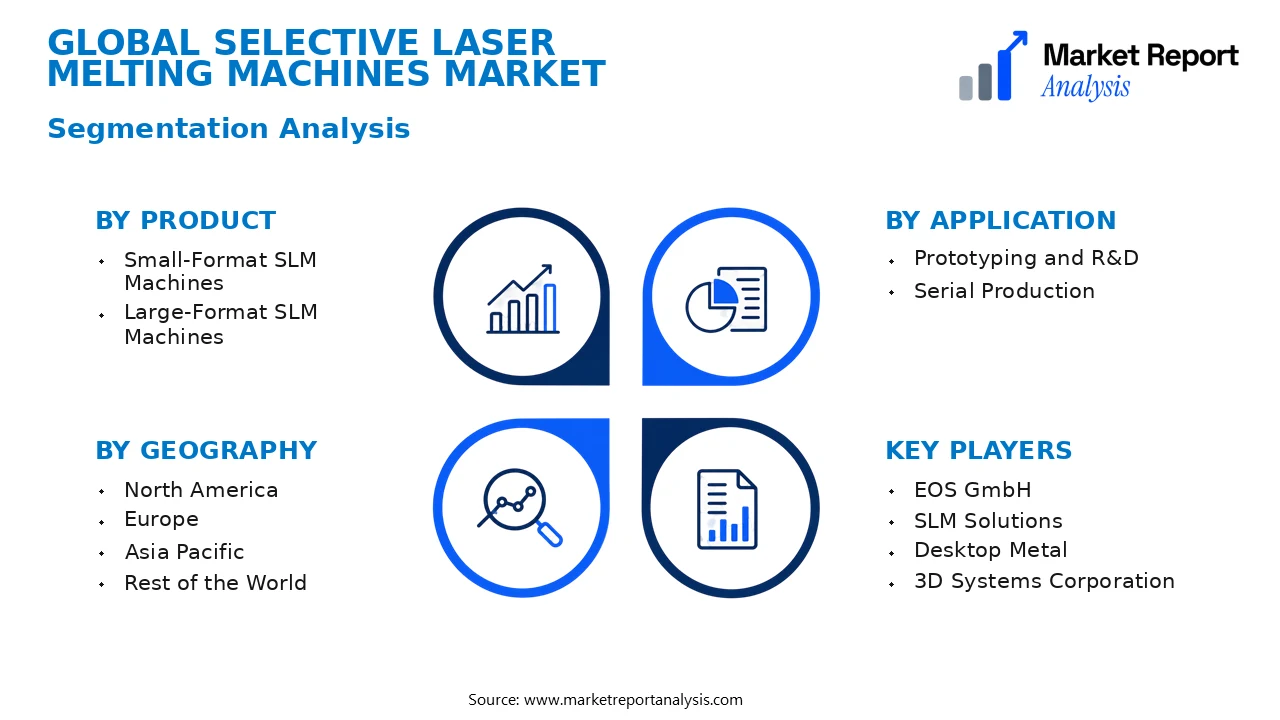
- Product
- Small-Format SLM Machines: These devices are designed for compact applications, prototyping, or specialty production runs, offering high precision but limited build volume, thus catering to boutique manufacturing and R&D labs.
- Large-Format SLM Machines: Often used in aerospace, automotive, and biomedical sectors, these machines provide extensive build volumes, facilitating large-scale manufacturing and complex part fabrication with high throughput.
- Application
- Prototyping and R&D: This segment encompasses small-batch production mainly for testing and product development, where flexibility and rapid iteration are crucial for innovation-driven industries.
- Serial Production: Focused on high-volume manufacturing, this application segment leverages SLM technology to produce end-use components with consistent quality, particularly in aerospace, medical, and automotive sectors.
- Geography
- North America: The largest market driven by advanced manufacturing industries, significant R&D activity, and early adoption of additive manufacturing technologies.
- Europe: Known for robust aerospace and automotive sectors, coupled with supportive government initiatives and high industry standards promoting SLM adoption.
- Asia Pacific: Characterized by rapid industrialization, expanding manufacturing capacity, and increasing investments in 3D printing technology, especially in China, Japan, and South Korea.
- Rest of the World: Encompasses Latin America and Middle East & Africa, where emerging markets are gradually integrating SLM machines to enhance local manufacturing capabilities.
Competitive Intelligence
The competitive landscape of the Selective Laser Melting (SLM) Machines Market is characterized by moderate to high concentration, with key players such as EOS GmbH, 3D Systems, and Renishaw dominating significant market shares. These companies pursue aggressive business strategies encompassing product innovation, strategic partnerships, and acquisitions to strengthen market positioning. Innovation focuses heavily on enhancing machine precision, speed, and material versatility, which serve as key differentiators. Several market players are investing heavily in R&D to develop next-generation SLM machines that offer superior performance and cost efficiency, thereby expanding their technological edge. Collaborations between equipment manufacturers and material suppliers are prevalent to ensure compatibility and broaden application scope. Additionally, strategic expansion into emerging markets, especially in Asia-Pacific, and acquisitions of smaller, innovative startups are common tactics to increase global footprint. Such moves facilitate access to new customer bases and foster innovation ecosystems. Overall, competitive differentiation is driven by enhanced technological capabilities, comprehensive service portfolios, and strategic alliances aimed at maintaining leadership in the evolving SLM landscape.
Leading Company Profiles
The competitive landscape for selective laser melting machines is characterized by a group of technologically advanced firms focused on innovation, capacity expansion, and strategic collaborations to capture emerging market opportunities. These companies are distinguished by their cutting-edge product offerings, strong global presence, and ongoing investments in research and development.
- EOS GmbH
- SLM Solutions
- Desktop Metal
- 3D Systems Corporation
- Markforged
- Renishaw Plc
- Arcam AB
- Trumpf GmbH + Co. KG
- TRUMPF Group
- Consortium members in strategic alliances
EOS GmbH
EOS GmbH specializes in industrial 3D printing solutions, offering a range of SLM systems tailored for aerospace, automotive, and medical industries, emphasizing precision, reliability, and material science innovation.
SLM Solutions
SLM Solutions develops advanced metal 3D printing hardware and software, focusing on high-speed, multi-laser systems that improve productivity and quality for critical engineering applications across sectors.
Desktop Metal
Desktop Metal offers accessible, scalable metal 3D printing systems, including proprietary SLM technology, aiming to democratize advanced manufacturing and expand its reach in automotive, aerospace, and industrial markets.
3D Systems Corporation
3D Systems’ portfolio includes comprehensive additive manufacturing solutions with strong emphasis on business integration, offering innovative SLM systems that support complex part manufacturing in aerospace and healthcare sectors.
Markforged
Markforged is renowned for its integrated 3D printing ecosystem, including metal SLM solutions designed for industrial strength, lightweight components, and rapid prototyping, supported by a robust digital manufacturing platform.
Renishaw Plc
Renishaw offers precision measurement and metal additive manufacturing solutions, focusing on high-performance SLM systems with innovative features for aerospace, dental, and tooling applications.
Arcam AB
Arcam, now part of GE Additive, specializes in electron beam melting and laser melting technologies, delivering high-quality, large-format SLM solutions for aerospace and medical device manufacturing.
Trumpf GmbH + Co. KG
Trumpf combines its laser technology expertise with additive manufacturing, providing versatile SLM machines that cater to industrial batch production and high-volume manufacturing needs.
TRUMPF Group
TRUMPF continues to lead in industrial laser systems, advancing SLM technology with a focus on automation, process stability, and integration to meet the demands of large-scale manufacturing environments.
Consortium members in strategic alliances
Several strategic alliances are forming among top industry players, focusing on joint development, technology sharing, and expanding market reach to accelerate innovation and standardization in SLM systems globally.
Strategic Business Developments

- May 2026 – EOS GmbH – Launch of new high-speed SLM system – Significant enhancement in productivity and performance, enabling faster market penetration and meeting industrial demands for rapid prototyping and manufacturing.
- June 2026 – SLM Solutions – Expansion of manufacturing capacity – Increased production capability to support rising demand and reduce lead times, reinforcing its competitive position globally.
- August 2026 – Desktop Metal – Acquisition of a complementary additive manufacturing firm – Strengthens its portfolio and accelerates technological development in metal 3D printing solutions.
- September 2026 – 3D Systems Corporation – Partnership with aerospace giant for dedicated SLM production line – Enhances industry-specific applications and solidifies market presence in aerospace manufacturing.
- October 2026 – Trumpf GmbH + Co. KG – Launch of an integrated automation platform for SLM – Improves manufacturing efficiency, reduces operational costs, and supports industry 4.0 initiatives.
Frequently Asked Questions
What is the Selective Laser Melting Machines Market?
The Selective Laser Melting Machines Market involves the global industry focused on advanced additive manufacturing technology using laser-based processes to create complex metal parts. It caters to industries including aerospace, healthcare, and automotive, emphasizing precision and customization in manufacturing.
What is the current market size of the Selective Laser Melting Machines Market?
As of 2026, the global market for selective laser melting machines is valued at approximately USD 2.4 Billion, reflecting significant growth driven by technological advancements and increasing adoption across various high-tech industries.
What factors are driving the Selective Laser Melting Machines Market?
The market growth is driven by rising demand for lightweight, durable components, technological innovations, increasing industrial automation, and the expanding application scope in aerospace, medical, and automotive sectors, complemented by government initiatives supporting additive manufacturing technologies.
Which region dominates the Selective Laser Melting Machines Market?
North America currently leads the market, owing to its advanced manufacturing infrastructure, high investment in research and development, and significant presence of key industry players, with Asia-Pacific emerging rapidly as a substantial growth region due to industrial expansion.
Which segment is expected to grow the fastest?
Industrial applications, particularly aerospace and medical implants, are anticipated to experience the fastest growth owing to increasing customization requirements and technological developments in materials and machine capabilities.
Who are the leading companies operating in the Selective Laser Melting Machines Market?
Key industry players include EOS GmbH, Trumpf Group, Renishaw, SLM Solutions, and GE Additive. These companies focus on innovation, strategic partnerships, and expanding their product portfolios to maintain competitive advantage in this dynamic market.
Analyst Perspective
The long-term outlook for the global Selective Laser Melting (SLM) Machines Market appears robust, driven by technological advancements and expanding end-use sectors such as aerospace and healthcare. Commercial opportunities are substantial in developing customized, high-performance solutions, particularly in high-growth regions like Asia-Pacific and North America, where investments are surging. As innovation progresses, we expect continued evolution in laser accuracy, speed, and material versatility, which will further stimulate market expansion. Investors should prioritize companies focusing on R&D for next-generation SLM technology, partnerships for material innovation, and regional manufacturing capabilities. Competitive intensity remains high, driven by technological innovation, strategic alliances, and mergers. Regionally, Asia-Pacific is poised for fastest growth due to industrialization and government initiatives, while North America and Europe will sustain mature markets via upgrades and high-value applications. Long-term success hinges on adapting to technological shifts, ensuring supply chain resilience, and capturing emerging markets to maintain a competitive edge.
