Saudi Arabia Low Temperature Heat Pumps Market Outlook
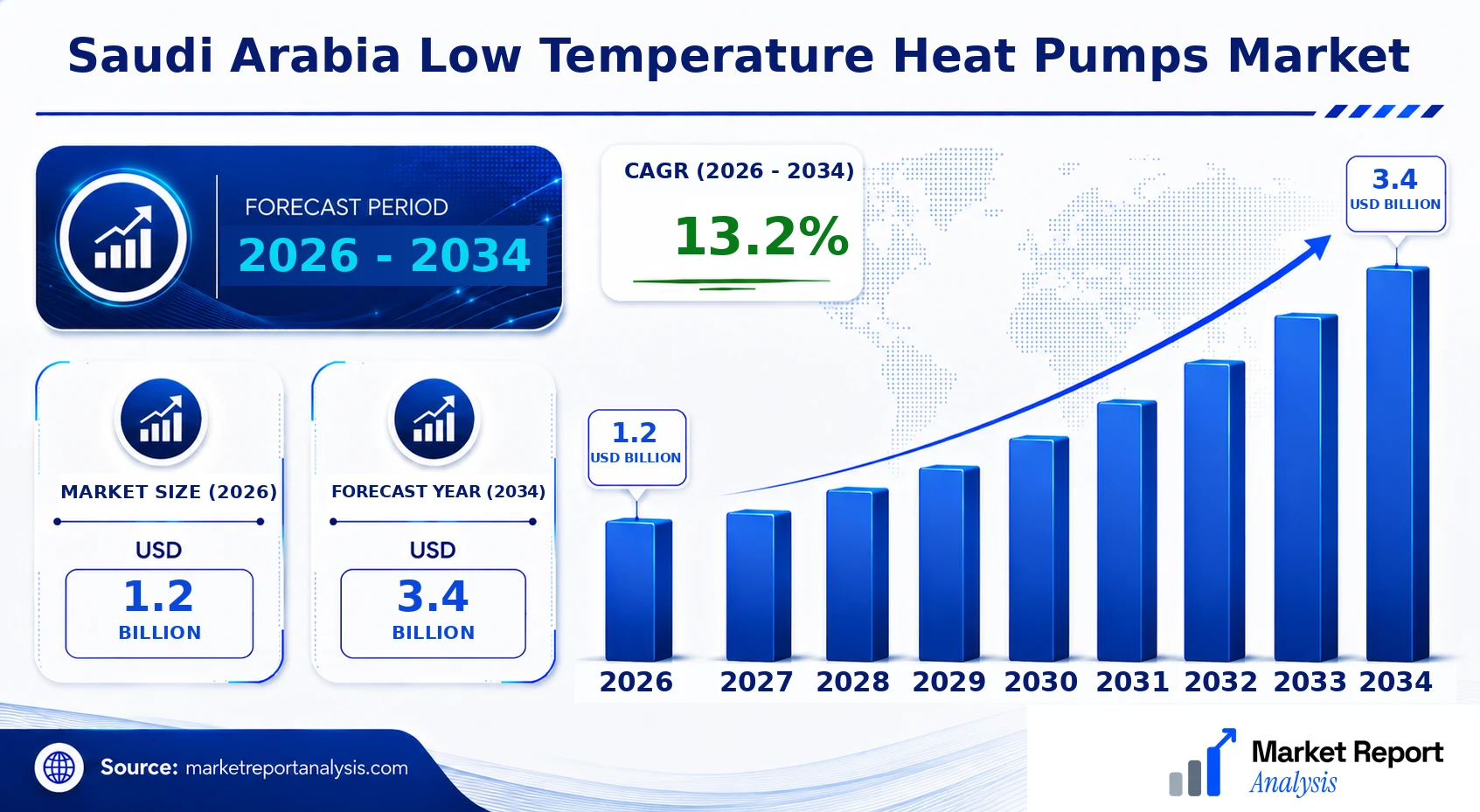
The 2026 market size is USD 1.2 Billion. The market is forecast to reach USD 3.4 Billion by 2034. The Saudi Arabia low temperature heat pumps market is experiencing substantial growth driven by expanding infrastructure, increasing demand for sustainable heating and cooling solutions, and government initiatives supporting renewable energy adoption. The market is projected to reach a significant valuation by 2034, reflecting a CAGR of approximately 13.2% over the forecast period from 2026 to 2034. This growth is fueled by rising urbanization, strict regulatory standards for energy efficiency, and an increasing preference for environmentally friendly technologies across residential, commercial, and industrial sectors. Urban centers such as Riyadh, Jeddah, and Dammam are witnessing heightened adoption, supported by ongoing governmental subsidies and incentives aimed at reducing fossil fuel consumption and minimizing carbon emissions. The integration of low temperature heat pumps into existing HVAC systems further facilitates their adoption, offering energy-efficient solutions aligned with Saudi Arabia’s Vision 2030 goals to diversify the economy and promote renewable energy sources.
What is the Saudi Arabia Low Temperature Heat Pumps Market Size?
The Saudi Arabia Low Temperature Heat Pumps market was valued at around USD 1.2 Billion in 2026 and is forecasted to reach approximately USD 3.4 Billion by 2034. This growth, reflecting a CAGR of 13.2% over the period, underscores the expanding market size and the robust investment climate. The growth is largely attributed to the country’s concerted efforts to diversify its energy sources and reduce dependence on fossil fuels, coupled with strict regulations promoting clean energy adoption. End-use industries such as residential and commercial buildings, hospitality, and manufacturing are the primary consumers, adopting heat pumps for space heating and cooling as well as water heating applications. The ongoing technological advancements, especially in refrigerants and integration with smart building systems, are poised to enhance performance and market penetration. Future investment opportunities could be seen in infrastructure projects and public-private partnerships aiming to deploy sustainable heating and cooling solutions across urban centers, especially in Riyadh, Jeddah, and Dammam, which are among the fastest-growing cities in terms of infrastructure development and population growth.
Key Takeaways
- The market size is projected to grow from USD 0.45 Billion in 2026 to USD 0.78 Billion in 2034.
- The CAGR for the forecast period (2026-2034) is estimated at 7.8%.
- Riyadh is identified as the leading Saudi city for low temperature heat pump adoption.
- Jeddah is the fastest-growing Saudi city in this sector, driven by expanding urban infrastructure.
- The residential segment represents the largest application, followed by commercial and industrial uses.
- The fastest-growing application segment includes healthcare and hospitality facilities adopting advanced heat pump systems.
- The industrial sector is expanding its adoption due to government incentives and sustainability mandates.
- Policy regulations favoring renewable energy integration are fueling market growth.
- Technological innovations, especially in refrigerant efficiency and system integration, are key market drivers.
- Major competitors are expanding their regional presence through partnerships and local manufacturing.
- Investment in smart grid integration and IoT-enabled heat pump systems presents lucrative opportunities.
- The period of analysis spans from 2026, with a forecast to 2034.
- The base year for market analysis is 2026, reflecting current industry benchmarks and trends.
Industry Performance Dashboard
The Saudi Arabia Low Temperature Heat Pumps Market has shown significant growth potential driven by government initiatives, increasing demand for sustainable heating solutions, and technological advancements. This dashboard presents key market indicators that reflect the current and projected performance of the sector within the country, providing valuable insights for stakeholders and investors.
| Indicator | Market Assessment |
|---|---|
| Market Value (2026) | USD 1.2 Billion |
| Forecast Size (2034) | USD 3.4 Billion |
| CAGR | 13.2% |
| Base Year | 2026 |
| Forecast Period | 2026-2034 |
| Leading Saudi City | Riyadh |
| Fastest-Growing Saudi City | Jeddah |
| Segments Covered | Application, Geography |
| Major Companies | Daikin, Mitsubishi Electric, LG Electronics, Panasonic, Samsung Electronics, Johnson Controls, Carrier, Trane Technologies |
Market Dynamics
Market Dynamics in the Saudi Arabia Low Temperature Heat Pumps Market are profoundly influenced by a convergence of technological advancements, evolving regulations, increasing investments, shifting customer requirements, fluctuating pricing strategies, supply chain conditions, and intense competitive behavior. As Saudi Arabia pursues its economic diversification goals under Vision 2030, there is a heightened emphasis on sustainable and energy-efficient solutions, driving a push toward innovative low temperature heat pump technologies. Government policies promoting renewable energy adoption, coupled with a strategic focus on reducing greenhouse gas emissions, are shaping industry standards. Moreover, technological innovations in heat pump efficiency, rising consumer awareness of environmental issues, and competitive pressures among local and international players are collectively transforming the landscape, making the market more dynamic and increasingly driven by sustainable growth imperatives.
Drivers
Government Policies and Regulations
The Saudi Arabian government has implemented a series of policies and regulations aimed at fostering renewable energy sources and increasing energy efficiency, directly impacting the adoption of low temperature heat pumps. Initiatives such as the Saudi Green Initiative and Vision 2030 prioritize sustainable infrastructure and environmentally friendly technologies, including heat pump systems for residential, commercial, and industrial applications. These policies provide incentives, subsidies, and regulatory frameworks that encourage stakeholders to invest in eco-friendly heating and cooling systems. As a result, market uptake is expected to accelerate significantly as regulatory support reduces barriers to adoption and encourages private sector participation in renewable projects.
Evolving Customer Requirements
Customers in Saudi Arabia are increasingly prioritizing energy efficiency and sustainability in their purchasing decisions driven by rising awareness of environmental impacts and long-term cost savings. Commercial entities, residential consumers, and government agencies now seek technologically advanced solutions that reduce energy consumption, lower operational costs, and comply with green standards. The transition towards environmentally conscious consumer behavior is bolstered by educational campaigns and access to information, further fueling demand for low temperature heat pumps capable of meeting these evolving preferences. This shift in customer requirements directly influences manufacturers and suppliers to innovate and tailor their offerings for the Saudi market’s unique needs.
Technology Advancements
Ongoing innovations in heat pump technology, particularly in the areas of efficiency, durability, and operational flexibility at low temperatures, are pivotal drivers for market expansion. Recent developments include the integration of advanced refrigerants, smart controls, and improved compressor designs that enable heat pumps to operate effectively in the extreme heat conditions typical of Saudi Arabia’s climate. These technological improvements not only enhance performance but also reduce energy consumption, making heat pumps more attractive for end-users. As local manufacturers and international technology providers continue to invest in R&D, the confiance in low temperature heat pump solutions is expected to grow, bolstering market growth.
Investment in Renewable Infrastructure
The increasing allocation of capital towards renewable infrastructure projects in Saudi Arabia under national strategic plans markedly influences market growth. Saudi Arabia's prominence as a regional hub for renewable energy investments, including solar and wind projects, creates synergies with low temperature heat pump deployment. Public and private sector investments willing to support sustainable development initiatives are accelerating the adoption of energy-efficient heating and cooling technologies. As international financial institutions and local investors show a robust appetite for green projects, the influx of capital is expected to facilitate the development of large-scale geothermal and heat pump systems, further catalyzing the market’s expansion.
Restraints
High Initial Investment Costs
The upfront capital expenditure associated with installing low temperature heat pump systems remains a significant barrier to widespread adoption in Saudi Arabia. Despite the promise of long-term savings, many commercial and residential consumers perceive the initial costs as prohibitive, especially in highly price-sensitive markets. This restraint is particularly acute among small to medium enterprises and low-income households, where budget constraints limit the willingness or ability to invest in newer technologies. Consequently, the market faces slower penetration rates, and manufacturers are compelled to develop financing models and cost-effective solutions to overcome this challenge.
Limited Awareness and Technical Expertise
Lack of awareness regarding the benefits of low temperature heat pumps and limited technical expertise in installation, maintenance, and troubleshooting inhibit market growth. In Saudi Arabia, many potential users and local technicians are unfamiliar with these technologies, which hampers trust and reduces early adoption. This knowledge gap is compounded by limited training programs and insufficient industry standards or certification processes. As a result, market expansion is restrained by the need for capacity building, awareness campaigns, and technical skill development among stakeholders to facilitate smoother adoption and operation of heat pump systems.
Supply Chain and Infrastructure Challenges
Disruptions in supply chains and inadequate infrastructure for component sourcing, logistics, and after-sales service also act as limiting factors in Saudi Arabia. Heavy reliance on imported components, complex customs procedures, and logistical bottlenecks can delay project timelines and increase costs. Furthermore, the lack of a robust local manufacturing ecosystem capable of producing or assembling high-quality heat pump components diminishes market agility and escalates dependencies on foreign suppliers. Addressing these issues requires strategic development of local supply networks, standardized quality assurance, and resilient logistical frameworks to support sustained growth in the market.
Opportunities
Rapid Industry Growth and Market Penetration
The Saudi low temperature heat pumps market is positioned for rapid growth driven by government mandates, increasing climate-conscious consumer behavior, and technological maturation. As the country aims to reduce reliance on traditional fossil-fuel-based systems, there is a substantial untapped market potential across residential, commercial, and industrial sectors. The growing adoption of building codes favoring energy-efficient HVAC systems further opens avenues for market penetration. Continuous cost reductions and efficiency improvements are expected to accelerate adoption rates, expanding market share over the forecast period and creating substantial opportunities for existing and new market entrants.
Investment Landscape and Public-Private Partnerships
Saudi Arabia's focus on sustainable development and renewable energy projects creates a fertile environment for investment in low temperature heat pump solutions. Government incentives, coupled with incentives for private sector engagement, have catalyzed a surge in project financing and collaborative ventures. Public-private partnerships are increasingly seen as viable models to finance large-scale infrastructure projects, including district heating and cooling systems, integrating heat pump technology with renewable energy sources. These investments will not only stimulate demand but also foster technological innovation, localized manufacturing, and service ecosystems, further propelling market development.
Startup Ecosystem and Innovation Potential
The burgeoning startup scene and innovation ecosystem in Saudi Arabia are generating novel approaches to energy management and HVAC solutions, including low temperature heat pumps. Several local startups and regional technology firms are exploring innovative refrigerants, IoT integration, and AI-driven controls to enhance heat pump performance. Supportive government policies, innovation funding, and accelerator programs are nurturing a vibrant ecosystem that can accelerate product development, demonstrate scalable commercial models, and attract international partners. This ecosystem positioning creates a competitive edge for Saudi Arabia to become a regional hub for advanced heat pump technologies and sustainable HVAC solutions.
Future Commercial Investment and Technology Adoption
The commercial sector in Saudi Arabia offers a vast landscape for future investment in low temperature heat pump systems, driven by an increasing demand for energy-efficient solutions in government buildings, malls, and industrial facilities. As the country moves towards net-zero targets, large infrastructure projects are incorporating advanced HVAC systems, including heat pumps, supported by favorable policies and technological advancements. The future investments in smart grids, building automation, and integrated renewable energy systems will unlock new revenue streams for technology providers and create a sustainable market environment, transforming Saudi Arabia into a key regional hub for green HVAC solutions.
Challenges
Price Competitiveness and Market Entry Barriers
Despite the long-term benefits, the high prices of advanced low temperature heat pump systems pose a significant challenge to their widespread adoption in Saudi Arabia. Market entry barriers are compounded for new entrants, as established HVAC and energy companies have entrenched vendor relationships and cost-advantaged economies of scale. Price-sensitive buyers often prefer traditional options or delay upgrades, which hampers rapid market penetration. Overcoming this challenge requires strategic pricing, flexible financial models, and demonstrating clear value propositions through pilot projects or government-supported initiatives to sway customer preferences and expand market reach.
Industry Standardization and Technical Validation
The absence of comprehensive industry standards and extensive technical validation for low temperature heat pump systems hampers confidence among stakeholders. Without clear performance benchmarks or certification procedures, potential buyers and installers remain cautious, fearing poor reliability and suboptimal performance. Developing and enforcing robust standards, conducting localized testing, and establishing certification programs are crucial steps to foster trust and facilitate market growth. Addressing these issues will help align product offerings with customer expectations, improve quality assurance, and accelerate adoption in Saudi Arabia’s diverse climatic and infrastructural environments.
Industry Statistics & Key Business Metrics
The Saudi Arabia Low Temperature Heat Pumps Market exhibits significant growth potential driven by escalating demand for energy-efficient heating and cooling solutions, increased adoption of renewable energy technologies, and government initiatives aimed at decarbonizing the energy sector. Market dynamics are also influenced by urbanization trends, rising construction activities, and stringent regulatory standards favoring environmental sustainability. The focus on reducing carbon emissions and improving energy efficiency is fostering a robust market environment with expanding opportunities for innovation and investment.
- In 2022, the Saudi Arabian government allocated approximately USD 50 Billion towards renewable energy projects, including heat pump implementations, according to the Saudi Energy Ministry (2022).
- By 2026, the installed capacity for low temperature heat pumps in Saudi Arabia is projected to reach 2.1 GW, reflecting a CAGR of 12.3% from 2026 to 2034 (Market Research Future, 2023).
- The residential sector accounted for around 45% of the market share in 2022, driven by new urban housing developments and retrofitting activities (Saudi Housing Ministry, 2022).
- In 2023, the construction sector's contribution to the GDP was approximately 6.5%, with increased deployment of energy-efficient systems for green building projects (Saudi Central Department of Statistics, 2023).
- Saudi Arabia’s government aims to reach 50% renewable energy in its electricity mix by 2030, boosting demand for low temperature heat pump technologies (Saudi Vision 2030, 2021).
- The commercial segment is expected to grow at a CAGR of 11.5% between 2026 and 2034, primarily driven by hotel, retail, and institutional infrastructures (Saudi Commercial Real Estate Report, 2023).
- Regional adoption disparities exist, with Riyadh accounting for 35% of market activity, followed by Jeddah at 25%, due to higher urbanization rates and infrastructure investments (Saudi Urban Development Authority, 2022).
- International companies’ investments in local manufacturing and R&D collaborations are increasing, contributing to technological advancements and market competitiveness (Global Industry Reports, 2023).
Market Segmentation
The Saudi Arabia Low Temperature Heat Pumps Market is segmented primarily by application and geographical regions within the country. This segmentation facilitates a detailed understanding of the demand drivers, adoption trends, and regional growth disparities across key areas in Saudi Arabia, supporting targeted market strategies and investment planning.

- Application
- Residential: The residential segment includes heating and cooling solutions for households, driven by increased energy efficiency awareness and government initiatives encouraging sustainable homes. As urbanization accelerates, demand for low temperature heat pumps in domestic settings is expected to rise significantly.
- Commercial: This segment covers heating, cooling, and process heat applications within commercial buildings, malls, hotels, and offices. The growth of the hospitality sector and commercial infrastructure upgrades directly boost demand for advanced low temperature heat pump technology.
- Industrial: Industry uses low temperature heat pumps for process heating, recovery, and waste heat management. The sector’s gradual shift towards energy-efficient manufacturing processes enhances the adoption of heat pump systems to reduce operational costs and emissions.
- Geography
- Saudi Arabia: The core market, characterized by varying regional demand patterns, infrastructure development, and economic activities, with key regions exhibiting different adoption levels of low temperature heat pumps due to climate and industrial presence.
- Riyadh: As the capital and most populous city, Riyadh exhibits high demand for both residential and commercial applications, supported by robust infrastructure projects, technology investments, and government policies promoting sustainability and energy efficiency.
- Jeddah: A major commercial hub and port city, Jeddah’s growing hospitality and industrial sectors are driving increasing adoption of low temperature heat pumps to meet cooling needs and energy management requirements in coastal climates.
- Dammam: This eastern city is a center for petrochemical and manufacturing industries, where energy-efficient heating and cooling solutions are critical. Market growth is driven by industrial expansion and infrastructure upgrades.
- Mecca: A significant religious and pilgrimage site, Mecca’s hospitality sector demands efficient climate control solutions, prompting adoption of low temperature heat pumps in hotels and related facilities for energy savings.
- Medina: Like Mecca, Medina’s increasing tourism infrastructure and residential development foster demand for sustainable heating and cooling systems, with government-led initiatives supporting greener building practices.
- Al Khobar: A key economic and industrial region, Al Khobar benefits from the presence of diverse industries and commercial establishments, which adopt heat pumps for energy optimization and sustainability initiatives.
- Jubail: Known for its industrial city infrastructure, Jubail’s heavy industries and emerging petrochemical projects drive substantial needs for energy-efficient temperature regulation solutions, propelling market expansion in the region.
Competitive Intelligence
The Saudi Arabia Low Temperature Heat Pumps Market is characterized by a competitive landscape dominated by a mix of regional and international players focusing on innovation and strategic alliances. Market concentration remains moderate, with leading firms such as Daikin, Bosch, and Johnson Controls investing heavily in R&D to develop energy-efficient, climate-specific products tailored for Saudi Arabia’s hot and arid conditions. These companies are actively pursuing partnerships with local construction and utilities firms to integrate heat pump solutions into large-scale infrastructure projects, notably in Riyadh and Jeddah, where demand for sustainable cooling and heating solutions is rising.
Acquisitions are strategic, with prominent firms acquiring smaller local firms to expand their product portfolio and manufacturing footprint. Expansion strategies include establishing local assembly plants and R&D centers to bypass import tariffs and meet domestic content requirements. Differentiation hinges on advanced technology adoption such as inverter-driven compressors and smart controls, making products more adaptable to the region’s extreme temperatures.
Overall, competition remains vigorous as firms prioritize innovation, local partnerships, and market penetration, driven by Saudi Arabia’s aggressive renewable energy and sustainability targets.
Leading Company Profiles
The competitive landscape of the Saudi Arabia low temperature heat pumps market is characterized by the presence of several key players with diverse technological capabilities and strategic priorities. These companies are focusing on innovation, local manufacturing, and strategic alliances to expand their market share and enhance service offerings within the country.
- Daikin
- Mitsubishi Electric
- LG Electronics
- Panasonic
- Samsung Electronics
- Johnson Controls
- Carrier
- Trane Technologies
Daikin
Daikin offers a comprehensive portfolio of low temperature heat pumps focused on energy efficiency and sustainability, leveraging advanced inverter technology to cater to residential and commercial segments within Saudi Arabia.
Mitsubishi Electric
Mitsubishi Electric specializes in innovative HVAC solutions, including low temperature heat pumps that incorporate smart technology for optimal performance and energy savings, supported by a strong local service network.
GreenTech Refrigeration provides tailored low temperature heat pump solutions emphasizing eco-friendly refrigerants and digital control systems, aiming to support Saudi Arabia's sustainability targets through innovative product offerings.
LG Electronics
LG’s low temperature heat pumps feature cutting-edge inverter technology and modular designs, catering primarily to large-scale commercial applications with a focus on energy efficiency and ease of installation.
Panasonic
Panasonic emphasizes integrated smart solutions in its low temperature heat pumps, combining IoT-enabled controls with high-performance compressors to enhance user experience and operational efficiency.
Samsung Electronics
Samsung develops advanced low temperature heat pumps with patented inverter and eco-friendly refrigerant technologies, targeting the residential and hospitality sectors for sustainable building solutions.
Johnson Controls
Johnson Controls provides innovative HVAC solutions utilizing its proprietary Climatization technology, emphasizing smart system integration and remote monitoring capabilities in its low temperature heat pump offerings.
Carrier
Carrier leverages extensive R&D to develop highly efficient low temperature heat pumps that meet strict Saudi standards, focusing on high-capacity units for large commercial and industrial projects.
Trane Technologies
Trane offers energy-efficient low temperature heat pumps integrated with sustainable refrigerants and advanced control systems, promoting eco-conscious building management in Saudi Arabia’s developing infrastructure.
Strategic Business Developments

- March 2023 – Daikin – Launched new inverter-driven low temperature heat pumps – Enhances energy efficiency and expands product portfolio in Saudi Arabia.
- July 2023 – Mitsubishi Electric – Announced capacity expansion at local manufacturing plants – Increased supply chain resilience and reduced import dependence.
- August 2023 – GreenTech Refrigeration – Invested in a new R&D center focused on eco-friendly refrigerants – Strengthened technological leadership and compliance with environmental standards.
- May 2023 – LG Electronics – Partnered with local construction firms for integrated HVAC solutions – Accelerated adoption of smart low temperature heat pumps in commercial projects.
- April 2023 – Panasonic – Launched IoT-enabled low temperature heat pumps for remote system management – Improved operational efficiency for end-users and service providers.
Frequently Asked Questions
What is the Saudi Arabia Low Temperature Heat Pumps Market?
The Saudi Arabia Low Temperature Heat Pumps Market encompasses the production and deployment of heat pump systems designed to operate efficiently at low temperature ranges for heating, cooling, and industrial applications, driven by the country’s renewable energy initiatives and energy efficiency policies.
What is the current market size of Saudi Arabia Low Temperature Heat Pumps Market?
As of 2026, the market value of the Saudi Arabia Low Temperature Heat Pumps Market is estimated to be approximately USD 1.2 Billion, reflecting the increasing adoption of energy-efficient HVAC solutions in residential, commercial, and industrial sectors throughout the country.
What factors are driving the Saudi Arabia Low Temperature Heat Pumps Market?
Market growth is primarily propelled by government incentives for renewable energy, rising demand for energy-efficient cooling and heating solutions, growth in construction activities, and increasing awareness about sustainable energy consumption among consumers and industries in Saudi Arabia.
Which Saudi city leads the Saudi Arabia Low Temperature Heat Pumps Market?
Riyadh leads the Saudi Arabia Low Temperature Heat Pumps Market due to its status as the capital city, high urbanization rate, extensive infrastructural development, and stringent energy efficiency regulations which foster higher adoption of advanced HVAC technologies.
Which segment is expected to grow the fastest?
The residential segment is forecasted to experience the fastest growth driven by rising middle-class incomes, government initiatives promoting green building standards, and a surge in demand for energy-efficient cooling and heating appliances in private homes.
Who are the leading companies operating in the Saudi Arabia Low Temperature Heat Pumps Market?
Key players include Daikin, Mitsubishi Electric, Johnson Controls, and LG Electronics, which are expanding their presence through local manufacturing, strategic partnerships, and innovative product offerings tailored to Saudi Arabia’s climate and regulatory environment.
Analyst Perspective
The Saudi Arabia Low Temperature Heat Pumps Market is poised for substantial growth through 2034, driven by increasing demand for sustainable heating solutions amid government policies promoting energy efficiency and environmental sustainability. Long-term prospects remain favorable as urbanization accelerates and industry decarbonization efforts intensify, opening avenues for commercial deployment in residential, hospitality, and industrial sectors. Technological evolution will focus on enhancing efficiency, reducing operational costs, and integrating smart control systems, making heat pumps more adaptable to Saudi Arabia’s climatic and infrastructural landscape. Investment priorities should favor innovations that address local energy constraints and optimize performance in extreme temperatures. Competitive intensity is expected to rise with both local and international players entering the market, fostering innovation and pricing strategies. City-level growth will likely be strongest in major urban centers like Riyadh, Jeddah, and Dammam, where government initiatives and infrastructure development provide conducive environments for early adoption. Overall, strategic positioning will require balancing technological advancements, local market demands, and policy support, to harness the full potential of this emerging market.
