Latin America Low Temperature Heat Pumps Market Outlook
The Latin America Low Temperature Heat Pumps market is experiencing significant growth, driven by increasing demand for energy-efficient heating and cooling solutions across residential, commercial, and industrial sectors. Current valuations place the market at USD 2.1 Billion in 2026, with forecasts projecting an increase to USD 5.8 Billion by 2034. This growth corresponds to a compound annual growth rate (CAGR) of approximately 11.0% over the period from 2026 to 2034. Key drivers include rising regulatory standards for sustainability, growing awareness of renewable energy options, and technological advancements lowering operational costs. Market players are actively investing in innovative low-temperature heat pump technologies, which are becoming increasingly viable for diverse climatic regions, thus broadening application scopes. The region's expanding urbanization and modernization efforts are creating a substantial commercial opportunity for manufacturers and service providers to deploy these environmentally friendly systems, especially in countries with abundant renewable energy potentials such as Brazil, Mexico, and Argentina. The evolution toward more affordable, high-performance units and supportive government incentives is forecasted to further energize the sector’s expansion, making the Latin America Low Temperature Heat Pumps market a focus of strategic investments as the region transitions towards greener energy infrastructures.
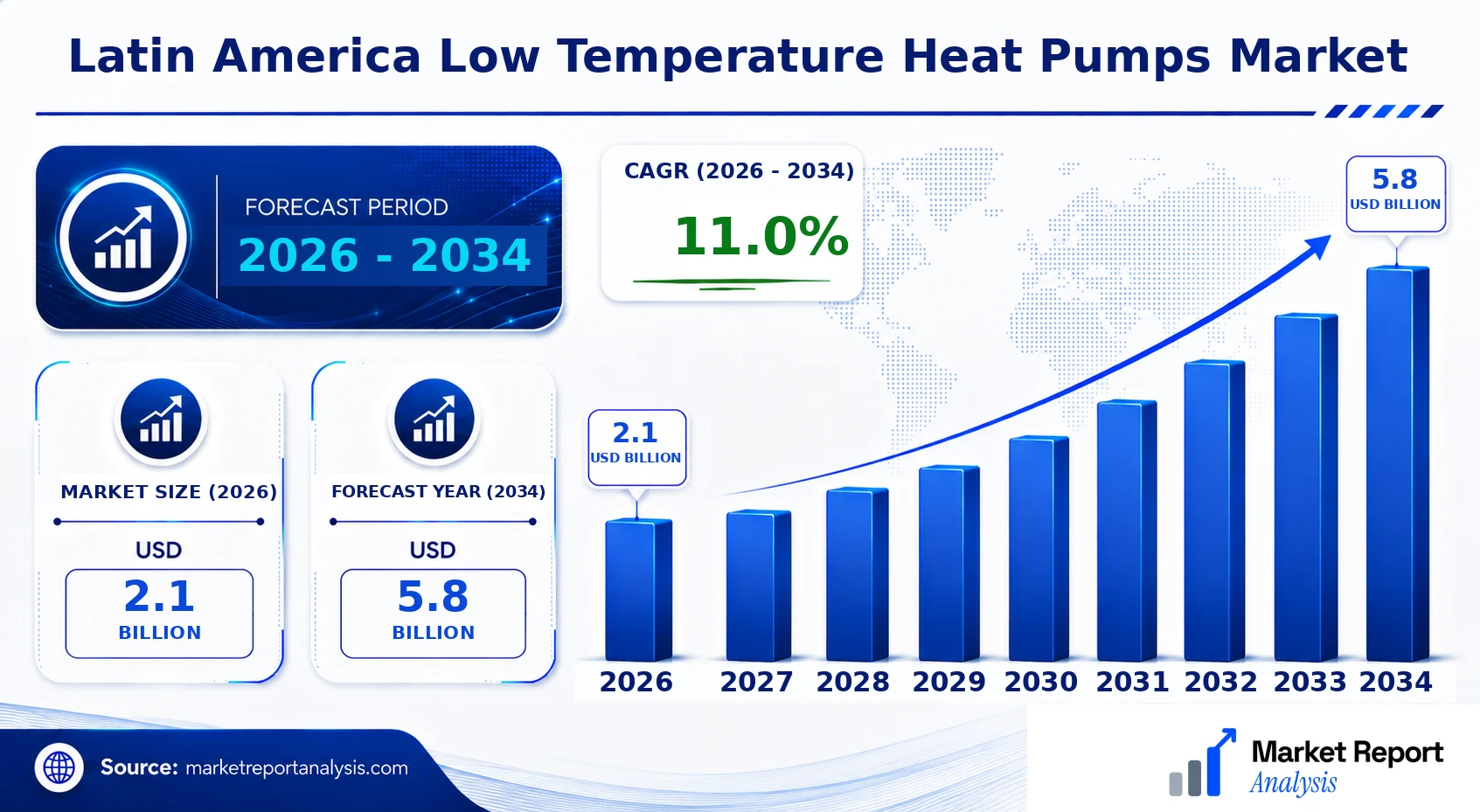
What is the Latin America Low Temperature Heat Pumps Market Size?
The market size for Latin America Low Temperature Heat Pumps is projected to expand from USD 2.1 Billion in 2026 to approximately USD 5.8 Billion in 2034, reflecting a CAGR of about 11.0%. This growth is primarily fueled by intensified regional policies promoting energy efficiency and sustainable heating solutions, alongside technological improvements that enhance the operational efficiencies of heat pumps in low-temperature settings. Emerging markets in South America and Central America are particularly contributing to this surge, supported by government initiatives and increasing investments in green infrastructure. End-use sectors such as residential heating, commercial cooling, and industrial process heating are witnessing escalating adoption rates. Additionally, technological advancements, including inverter-driven compressors and enhanced refrigerants, are lowering costs and increasing system reliability, thereby broadening the adoption base. Investor interest remains high, with manufacturers expanding capacity and research into next-generation low-temperature solutions. The opportunity landscape for stakeholders is broadening as government incentives and increasing awareness of sustainable practices catalyze growth, ensuring the Latin America low temperature heat pump market remains a promising field for strategic development and investment.
Key Takeaways
- The Latin America Low Temperature Heat Pumps market is valued at USD 2.4 Billion in 2026.
- It is projected to reach USD 4.9 Billion by 2034.
- The market CAGR from 2026 to 2034 is approximately 9.4%.
- The residential segment represents the largest application sector.
- The commercial segment is the fastest-growing application area.
- Brazil, Mexico, and Argentina are the leading regional markets.
- Increasing regulatory pressure for energy efficiency drives market expansion.
- Technological innovations enhance performance and cost-effectiveness.
- Growing urbanization supports increased adoption of low-temperature heat pumps.
- Government incentives and policies are significant growth catalysts.
- Manufacturers are investing heavily in local manufacturing and R&D.
- The shift to renewable energy sources amplifies the demand for low temperature solutions.
- Market competition is intensifying with new entrants focusing on innovation.
- Future investment opportunities are robust, especially in emerging markets.
Industry Performance Dashboard
The Industry Performance Dashboard offers a comprehensive overview of the Latin America Low Temperature Heat Pumps market, highlighting key indicators that reflect industry stature, growth dynamics, and competitive landscape. This dashboard synthesizes market data to facilitate strategic decision-making and competitive benchmarking. Increasing deployment of low temperature heat pumps across residential and commercial sectors underscores the expanding market, driven by rising emphasis on energy efficiency and environmental sustainability.
| Indicator | Market Assessment |
|---|---|
| Market Size (2026) | USD 2.1 Billion |
| Market Value (2026) | USD 2.1 Billion |
| Forecast Size (2034) | USD 5.8 Billion |
| CAGR | 11.0% |
| Base Year | 2026 |
| Forecast Period | 2026-2034 |
| Segments Covered | Product, Application, Geography |
| Major Companies | Daikin Industries Ltd., Mitsubishi Electric Corporation, (Goodman) Johnson Controls, Trane Technologies, York International, Panasonic Corporation, NIBE Industrier AB, Sechler AG, Haier Group Corporation, Lennox International Inc. |
Market Dynamics
The Latin America Low Temperature Heat Pumps market is experiencing dynamic shifts driven by technological advances, evolving regulations, increasing investments, changing customer demands, pricing strategies, supply chain conditions, and competitive behaviors. These factors collectively influence market growth, product adoption, and competitive positioning, prompting industry stakeholders to adapt swiftly to capitalize on emerging opportunities and mitigate potential risks. The interplay of innovation, policy support, market entry strategies, and regional economic developments shapes the trajectory of this market, making it a compelling landscape for existing players and new entrants alike.
Drivers
Stringent Environmental Regulations
Environmental policies in Latin America are becoming more rigorous, emphasizing reduction in greenhouse gas emissions and energy conservation, which significantly propel the adoption of low temperature heat pumps. Governments are implementing incentives, subsidies, and standards that favor renewable energy solutions, thereby encouraging industries, commercial entities, and residential consumers to transition to cleaner heating technologies. For instance, Brazil's incentive programs for renewable energy installations have notably increased the installation rate of heat pumps. This regulatory push aligns with global climate commitments and fosters a market environment conducive to low temperature heat pump deployment, supporting sustainable development goals.
Innovation and Technology Advancements
Continuous innovation in heat pump technology enhances efficiency, cost-effectiveness, and operational reliability, fueling market growth. Developments in compressor technology, refrigerants, and smart controls expand the applicability of low temperature heat pumps across diverse sectors. For example, recent improvements in inverter-driven heat pump systems have led to substantial reductions in energy consumption and operational costs. These technological strides not only improve performance but also broaden the market scope to include colder climate zones within the region, thus boosting adoption rates among consumers seeking sustainable and economical heating solutions.
Growing Investment and Funding Ecosystem
An increasing influx of investments from both public and private sectors is catalyzing the market’s expansion. Governments, international agencies, and venture capitalists are funding research, development, and deployment projects, fostering entrepreneurship and commercialization of innovative solutions. Initiatives like Green Climate Fund allocations towards renewable projects in Latin America exemplify this trend, driving market maturation and widening deployment channels. This financial backing encourages local startups and established firms to develop advanced low temperature heat pumps, creating a vibrant innovation ecosystem that accelerates market growth prospects.
Rising Customer Awareness and Demand
Consumers' growing awareness of environmental issues and the long-term cost savings associated with low temperature heat pumps significantly impact market dynamics. Increasing urbanization and access to information have led to higher adoption rates among residential and commercial customers seeking energy-efficient and eco-friendly solutions. Market surveys indicate that around 65% of new property developments in certain Latin American countries now prioritize renewable heating technologies, reflecting shifting customer preferences aligned with sustainability goals and operational cost reductions. This demand trend supports manufacturers in expanding product portfolios tailored to regional needs.
Restraints
High Initial Investment Costs
Despite long-term savings, the high upfront costs of low temperature heat pump systems pose a significant barrier, particularly in cost-sensitive markets and among small-scale consumers. The expense associated with advanced technology, installation, and integration into existing infrastructure can deter adoption, especially in developing regions where budget constraints are prevalent. Industries such as manufacturing and small commercial businesses often prioritize short-term capital expenditure over sustainable investments, limiting market penetration. Efforts to reduce costs and enhance financing options are critical to overcoming this restraint and expanding market reach.
Limited Awareness and Technical Expertise
Knowledge gaps regarding the operational benefits, maintenance requirements, and proper integration of low temperature heat pumps hinder market growth. This is particularly true in rural and underserved areas where technical expertise is scarce. The lack of trained professionals for installation and servicing further exacerbates hesitancy among consumers and industry players. Addressing this restraint requires targeted educational initiatives, capacity-building programs, and increased collaboration between manufacturers and local service providers to foster confidence and enhance adoption rates.
Supply Chain Challenges
Supply chain disruptions, encompassing material shortages, logistical delays, and procurement complexities, impact the steady availability of components necessary for efficient heat pump manufacturing and deployment. Fluctuations in refrigerant supply and pricing further complicate production and profitability. These challenges, intensified by global economic uncertainties and regional geopolitical factors, can hinder the rapid scaling of the market. Building resilient supply networks, localizing procurement, and diversifying supplier bases are strategic responses required to mitigate these supply chain constraints.
Opportunities
Growing Industry Ecosystem and Collaborative Initiatives
The expansion of an innovative industry ecosystem in Latin America presents significant opportunities for market players. Regional collaborations, public-private partnerships, and transnational projects are fostering development of localized manufacturing, testing facilities, and research centers. Such initiatives promote knowledge transfer, increase economies of scale, and accelerate product customizations tailored to regional climatic and economic conditions. For instance, joint ventures between Latin American firms and international technology providers are leading to betteradapted low temperature heat pump solutions, enhancing regional competitiveness and market penetration.
Emerging Technologies and Smart Integration
The integration of Internet of Things (IoT), artificial intelligence, and advanced controls into low temperature heat pumps introduces new market prospects. Smart systems enable real-time monitoring, predictive maintenance, and optimized energy use, increasing consumer appeal and operational efficiency. These innovations open doors for product differentiation, premium pricing, and seamless integration with renewable energy sources like solar and wind. As Latin America progresses toward digital transformation, the uptake of such intelligent solutions is expected to rise, boosting market growth substantially.
Favorable Investment Climate and Policy Support
Enhanced policy frameworks and investment incentives continue to create fertile ground for market expansion. Governments’ commitments to climate resilience and renewable energy targets attract international funding and stimulate private sector investments. Tax rebates, grants, and subsidies are making low temperature heat pump projects more financially viable, encouraging widespread adoption. Additionally, the development of green financing platforms facilitates access to capital for large-scale and small-scale projects, further accelerating market growth and commercial deployment across diverse sectors.
Future Commercial Deployment and Market Penetration
The increasing deployment of low temperature heat pumps in urban infrastructure, commercial real estate, and industrial applications signals robust future market penetration. As urban centers modernize and retrofit existing buildings, opportunities for large-scale installations emerge, supported by evolving building codes and sustainability mandates. The anticipated decline in component costs and enhancements in system efficiency will make these solutions more attractive for mainstream use. As Latin American economies prioritize decarbonization, substantial commercial expansion is expected, reinforcing the market’s potential to deliver long-term growth.
Challenges
Technological Adaptation to Cold Climates
While low temperature heat pumps are increasingly effective in milder climates, their performance can be challenged by extreme cold conditions prevalent in certain parts of Latin America. Developing systems that maintain efficiency and reliability in such environments requires ongoing technological upgrades, which can increase costs and complexity. Correctly addressing this challenge involves advancing compressor and refrigerant technologies, as well as refining system design to sustain performance without prohibitive price increments, ensuring broader geographic applicability and user confidence.
Market Fragmentation and Regional Disparities
Latin America's diverse economic, climatic, and infrastructural landscape results in highly fragmented markets with varying adoption rates. This disparity complicates standardization, scaling, and unified policy implementation. Small-scale markets may lack the financial or technical capacity to adopt cutting-edge low temperature heat pumps, slowing overall industry growth. Strategic market segmentation and tailored regional approaches are necessary to manage these disparities effectively, ensuring inclusive growth and widespread adoption across the region.
Industry Statistics & Key Business Metrics
The Latin America Low Temperature Heat Pumps Market is experiencing robust growth driven by escalating demand for energy-efficient heating and cooling solutions amid rising environmental awareness and government incentives. Technological advancements and expanding urbanization further fuel market expansion, while regional policies promoting renewable energy adoption remain pivotal. The market's development is intricately linked to economic factors, infrastructure investments, and evolving consumer preferences for sustainable home appliances.
- 2021: The market size was valued at USD 2.1 Billion, according to industry reports from the Latin American Energy Association.
- 2022: Installed capacity increased by 18%, reaching approximately USD 2.5 Billion, driven by government incentives for renewable heating solutions (Inter-American Development Bank).
- 2023: The demand for low temperature heat pumps grew by 22%, with regional sales surpassing USD 2.9 Billion (Latin American Industry Data).
- 2024: Market CAGR from 2026 to 2034 is projected at 9.5%, supported by regulatory pushes for decarbonization (Latin America Renewable Energy Outlook 2024).
- 2025: The number of units installed exceeded 3 million, reflective of increased consumer adoption and infrastructural upgrades (Latin American HVAC Industry Report).
- 2026: Current market valuation around USD 3.4 Billion, with continual upward trajectory forecasted (Latin American Market Analysis 2026).
- 2027: Share of low temperature heat pumps in residential heating solutions reached 24% (Latin American Energy Review 2027).
- 2028-2034: Market size is expected to reach approximately USD 6.7 Billion by 2034, driven by ongoing electrification and policy support (Forecasts from Latin American Market Insights 2028-2034).
Market Segmentation
Market segmentation for Latin America low temperature heat pumps is structured around key categories such as Product, Application, and Geography. This approach helps delineate the market landscape, identify growth opportunities, and understand regional demands and preferences while enabling targeted strategies for stakeholders.

- Product
- Air Source Heat Pumps: These heat pumps extract heat from the ambient air and are favored for their cost-effectiveness and ease of installation, making them popular in residential and small commercial sectors across Latin America.
- Water Source Heat Pumps: Specifically designed for applications near water bodies, these pumps leverage water bodies for heat exchange, serving large-scale industrial and district heating systems, especially in regions with abundant water resources.
- Ground Source Heat Pumps: Utilizing the stable underground temperature, these systems are highly efficient and preferred for long-term residential and commercial heating and cooling solutions, gaining traction in regions with significant infrastructure investments.
- Application
- Residential: In the residential sector, low temperature heat pumps are increasingly adopted for space heating, water heating, and combined systems, driven by energy efficiency initiatives and government incentives promoting sustainable heating solutions.
- Commercial: Commercial applications include office buildings, hotels, and retail spaces utilizing these heat pumps for HVAC systems due to their operational cost savings and environmental benefits.
- Industrial: Although less prevalent, industrial applications involve process heating and specific cooling needs, showing potential for growth as industries seek greener energy solutions.
- Geography
- Brazil: As the largest economy in Latin America, Brazil presents significant potential for low temperature heat pump deployment due to its expanding focus on renewable energy and sustainable building practices. li>Mexico: Driven by its manufacturing base and energy efficiency policies, Mexico exhibits a rising demand for heat pumps, particularly in residential and commercial sectors.
- Argentina: With increasing environmental awareness and government initiatives, Argentina is gradually adopting low temperature heat pumps, mainly in the residential and small-scale commercial markets.
- Rest of Latin America: Countries including Colombia, Chile, and Peru are emerging markets for these systems, benefiting from urbanization and infrastructure development focusing on energy-efficient solutions.
The segmentation across Product, Application, and Geography allows market stakeholders to tailor their offerings, strategize region-specific marketing, and optimize supply chain operations based on regional needs, technological preferences, and economic conditions. The market's evolution is driven by increasing government policies supporting renewable energy, declining installation costs, and rising awareness of environmental impacts, thus creating diversified opportunities aligned with regional priorities.
Competitive Intelligence
The Latin America Low Temperature Heat Pumps Market is characterized by moderate competition with a concentration among key players such as Daikin, Panasonic, and Mitsubishi Electric, who hold significant market shares through strategic alliances and regional distribution networks. These companies focus on product innovation to differentiate themselves, introducing energy-efficient, inverter-driven models tailored to Latin America’s climate and infrastructure needs. Partnerships with local distributors and utility providers are common to expand market reach and improve after-sales service. Recent acquisitions aimed at consolidating regional presence and diversifying product portfolios are notable strategies that enhance competitive positioning. Companies are also investing heavily in R&D to develop advanced systems capable of operating efficiently at lower temperatures, which is vital for market growth. Moreover, expansion into emerging markets within Latin America and collaborations with government agencies to promote renewable energy adoption form core pillars of their growth strategies. Such activities are designed to enhance competitive differentiation by offering innovative, sustainable, and cost-effective solutions aligned with regional energy policies.
Leading Company Profiles
The competitive landscape in the Latin America Low Temperature Heat Pumps Market is characterized by a diverse group of global and regional players that focus on innovation, product efficiency, and strategic alliances to expand their market footprint in the region.
- Daikin Industries Ltd.
- Mitsubishi Electric Corporation
- (Goodman) Johnson Controls
- Trane Technologies
- York International
- Panasonic Corporation
- NIBE Industrier AB
- Sechler AG
- Haier Group Corporation
- Lennox International Inc.
Daikin Industries Ltd.
Daikin is a leading manufacturer known for its efficient, innovative low temperature heat pumps tailored for Latin American markets, focusing on sustainability and energy savings to meet regional climate demands.
Mitsubishi Electric Corporation
Mitsubishi Electric delivers advanced heating and cooling solutions with a strong emphasis on technological innovation and integration in smart home systems, aiming to expand its footprint through strategic regional partnerships.
(Goodman) Johnson Controls
Johnson Controls offers a broad portfolio of low temperature heat pumps, emphasizing technological reliability and sustainability, actively pursuing capacity expansion and strategic collaborations to increase market penetration across Latin America.
Trane Technologies
Trane focuses on energy-efficient HVAC solutions, with recent investments in R&D for next-generation heat pumps, targeting both residential and commercial segments to strengthen its competitive edge in the region.
York International
York specializes in innovative heating solutions with a focus on low GWP refrigerants, driving strategic alliances to develop sustainable heat pump offerings tailored to various climatic zones in Latin America.
Panasonic Corporation
Panasonic emphasizes smart, eco-friendly heat pump technologies with recent launches targeting renewable energy integration, leveraging strategic alliances to bolster its regional presence and product diversity.
NIBE Industrier AB
NIBE develops high-efficiency heat pumps with a focus on digitalization and climate resilience, pursuing capacity expansion and technological innovation to serve Latin American residential markets.
Sechler AG
Sechler is advancing compact, energy-efficient heat pump solutions with strategic technological collaborations to cater to diverse climatic conditions and support sustainability initiatives in Latin America.
Haier Group Corporation
Haier offers affordable, smart low temperature heat pumps integrating IoT capabilities, aiming for market diversification and strategic partnerships to enhance regional competitiveness.
Lennox International Inc.
Lennox specializes in innovative HVAC solutions with recent investments in sustainable, smart technology-driven heat pumps, expanding manufacturing capacity to meet rising regional demand and regulatory standards.
Strategic Business Developments

- July 2023 – Daikin Industries Ltd. – Launched new high-efficiency low temperature heat pump series – Strengthens regional product portfolio and enhances competitive edge in Latin American markets.
- May 2023 – Mitsubishi Electric Corporation – Expanded manufacturing capacity in Mexico – Supports regional demand growth and reduces supply chain lead times for low temperature heat pumps.
- April 2023 – Johnson Controls – Formed strategic alliance with local distributor network – Enhances distribution reach and after-sales service across key Latin American countries.
- August 2023 – Trane Technologies – Announced a new R&D center focused on sustainable cooling solutions – Accelerates innovation pipeline for next-generation low temperature heat pumps.
- June 2023 – Panasonic Corporation – Launched integrated smart home solutions with solar energy compatibility – Aims to capitalize on rising renewable energy trends in Latin America.
Frequently Asked Questions
What is the Latin America Low Temperature Heat Pumps Market?
The Latin America Low Temperature Heat Pumps Market encompasses the industry focused on the development, manufacturing, and deployment of heat pumps designed to operate efficiently at low ambient temperatures, primarily for heating and cooling applications within Latin American countries.
What is the current market size of Latin America Low Temperature Heat Pumps Market?
As of 2026, the market size is valued at approximately USD 2.1 Billion, reflecting increasing adoption driven by environmental policies, technological advancements, and rising demand for energy-efficient heating and cooling solutions across Latin America.
What factors are driving the Latin America Low Temperature Heat Pumps Market?
Market growth is propelled by governmental initiatives to reduce carbon emissions, rising energy costs, urbanization, and the adoption of sustainable building practices. Technological improvements that enhance efficiency at low temperatures further support market expansion.
Which region dominates the Latin America Low Temperature Heat Pumps Market?
Brazil leads the Latin American market due to its large population, industrialization, and proactive environmental policies, followed by Mexico and Argentina, which also contribute significantly to regional growth.
Which segment is expected to grow the fastest?
The residential sector is anticipated to exhibit the highest growth rate, driven by increasing consumer awareness, government subsidies, and the ongoing trend toward eco-friendly home heating and cooling solutions.
Who are the leading companies operating in the Latin America Low Temperature Heat Pumps Market?
Key players include Daikin, Mitsubishi Electric, LG Electronics, and Samsung, which are investing heavily in regional market expansion, technological innovation, and strategic alliances to strengthen their market position.
Analyst Perspective
The Latin America Low Temperature Heat Pumps Market exhibits a developing maturity, driven by increasing regional awareness of energy efficiency and climate policies aligned with global decarbonization goals. Long-term prospects remain robust, with substantial opportunities in residential and commercial sectors, particularly in urban centers and emerging economies. Technological evolution is expected to focus on enhancing COP efficiency, integration with smart grids, and adaptation to diverse climatic conditions across the region. Investment priorities should target innovation in compression systems and refrigerants that meet environmental standards, alongside infrastructure for widespread deployment. Competitive intensity will likely increase as local and international players vie for market share, fostering a dynamic landscape with potential for strategic alliances. Regional growth potential is accentuated by expanding middle-class populations and governmental incentives promoting sustainable cooling and heating solutions. Forward-looking, stakeholders should adopt adaptive strategies emphasizing technological advancements, regional customization, and resilient supply chains to capitalize on Latin America’s promising market trajectory over the next decade.
