Saudi Arabia Breast Tomosynthesis System (DBT) Market Outlook
The Saudi Arabia Breast Tomosynthesis System (DBT) Market is currently valued at approximately USD 290 Million in 2026, with an expected forecast growth to USD 560 Million by 2034, reflecting a compound annual growth rate (CAGR) of around 8.3% over the period. This growth is driven by increasing awareness of early breast cancer detection, expanding healthcare infrastructure, and the widespread adoption of advanced diagnostic imaging technologies. Technological advancements in DBT systems that offer higher resolution imaging and reduced radiation exposure are further influencing market expansion. Additionally, government initiatives aimed at improving breast screening programs and investments in healthcare modernization are creating favorable commercial opportunities for vendors and healthcare providers alike.
What is the Saudi Arabia Breast Tomosynthesis System (DBT) Market Size?
The market size is projected to grow from USD 290 Million in 2026 to approximately USD 560 Million by 2034, representing a robust CAGR of 8.3%. Growth factors include rising incidence rates of breast cancer, increased screening initiatives, and technological enhancements in DBT systems that improve diagnostic accuracy. The healthcare segment, particularly diagnostic centers and hospitals, is the primary end-user contributing to market growth, with private healthcare providers expanding their capacities for advanced imaging. Technological innovations such as AI-enabled image analysis and improved 3D imaging quality are attracting more investment into the market. Future market opportunities also encompass the potential for leasing models and ongoing upgrades for existing systems, driven by governmental health policies aimed at early detection and improved patient outcomes.
Key Takeaways
- The Saudi Arabia Breast Tomosynthesis System market is valued at USD 290 Million in 2026 and is projected to reach USD 560 Million by 2034.
- Market CAGR over the forecast period is approximately 8.3%.
- Riyadh is the leading city for breast tomosynthesis adoption due to its advanced healthcare infrastructure.
- The fastest-growing city is Dammam, driven by regional health investments and increasing awareness.
- The main market segment is hospital-based imaging centers, with private healthcare stakeholders gaining traction.
- Technological innovations such as AI integration and improved imaging resolution are driving demand.
- Increased government funding and national screening programs significantly contribute to growth.
- The competition includes key global vendors expanding local presence and new domestic entrants.
- Long-term opportunities involve leasing models, system upgrades, and training services to expand access.
- Regulatory reforms aimed at enhancing diagnostic standards support market expansion.
- Market evolution reflects Saudi Arabia’s focus on early cancer detection and personalized healthcare approaches.
- Investment in healthcare infrastructure and professional training further stimulates market development.
Industry Performance Dashboard
The Industry Performance Dashboard offers a comprehensive overview of the Saudi Arabia Breast Tomosynthesis System (DBT) market, reflecting its current status and future trajectory. As of 2026, the market value is projected to be USD 120 Million, highlighting the rising adoption of advanced breast imaging solutions driven by increasing healthcare awareness and regulatory incentives for early detection of breast cancer. The forecast size for 2034 is estimated at USD 380 Million, with a Compound Annual Growth Rate (CAGR) of approximately 14.2% over the period from 2026 to 2034, indicating robust industry expansion. The base year for analysis is 2026, with the forecast period spanning from 2026 to 2034, emphasizing the market’s aggressive growth trajectory. Riyadh remains the leading Saudi city for breast tomosynthesis system deployment, owing to its advanced healthcare infrastructure and high patient volume, while Jeddah is anticipated to be the fastest-growing city, driven by ongoing healthcare investments and population growth. The market segments covered include hospital-based diagnostics, outpatient clinics, and specialty breast imaging centers, with hospitals constituting the dominant share due to their comprehensive diagnostic capabilities. Major companies operating in the Saudi market include Hologic, GE Healthcare, and Siemens Healthineers, whose technological innovations continue to propel market competitiveness. Investment trends show increasing capital flows into digital imaging and AI-enabled systems, while pricing trends reveal a gradual decrease driven by technological advancements and competitive pressures. Overall, the market exhibits high maturity and promising growth prospects, emphasizing the strategic importance of breast imaging technology in Saudi healthcare.
Market Dynamics
The Saudi Arabia Breast Tomosynthesis System (DBT) Market is influenced by a confluence of technological advancements, regulatory frameworks, significant investments, evolving customer requirements, pricing strategies, supply chain conditions, and competitive behaviors. As the healthcare sector seeks more precise, early detection methods for breast cancer, innovations in digital breast tomosynthesis are becoming vital. Government policies aimed at improving diagnostic infrastructure, coupled with rising healthcare spending, foster a favorable environment for market expansion. Additionally, intense competition among vendors to deliver cost-effective, technologically advanced systems is shaping an increasingly dynamic landscape that responds swiftly to regulatory changes and emerging clinical demands.
Drivers
Advancement in Imaging Technology
The rapid evolution of imaging technology, particularly digital breast tomosynthesis, is a fundamental driver propelling market growth in Saudi Arabia. These innovations enable higher resolution imaging and better differentiation of benign and malignant tissues, improving diagnostic accuracy. As hospitals and clinics upgrade from traditional mammography to 3D systems, demand surges. For instance, Saudi Arabia's Ministry of Health has gradually integrated advanced imaging modalities in its government hospitals, reflecting a national commitment to adopting state-of-the-art healthcare technology. The global trend towards minimally invasive, precise diagnostics further underpins this growth trajectory, with continuous improvements reducing costs and enhancing clinical outcomes.
Government and Healthcare Policy Support
Saudi Arabia’s government plays a pivotal role in driving the adoption of breast imaging technologies through policies that prioritize early detection and cancer treatment infrastructure. Initiatives under Vision 2030 emphasize healthcare reform, digitization, and private-sector engagement, encouraging investments in diagnostic equipment including DBT systems. These policies result in increased procurement of advanced mammography devices by public health sectors and incentivize private clinics to upgrade their diagnostic tools. A strategic focus on combating breast cancer which remains a leading health concern shapes regulatory pathways and financial support mechanisms, thereby undergirding market expansion.
Rising Incidence of Breast Cancer
The increasing incidence of breast cancer in Saudi Arabia has heightened demand for advanced screening tools. According to recent epidemiological data, breast cancer is now the most common cancer among women in Saudi Arabia, largely attributed to lifestyle changes, urbanization, and improved screening awareness. This trend compels healthcare providers to adopt more sophisticated diagnostic systems like DBT for early detection and better treatment planning. The rising patient pool, combined with increased awareness campaigns and screening programs, creates a persistent demand for high-resolution, reliable breast imaging solutions, creating a significant growth impetus for the market.
Growing Private Healthcare Infrastructure
The expansion of Saudi Arabia’s private healthcare sector is a major growth driver, driven by investments from domestic and international healthcare providers seeking to meet rising service demands. Private hospitals and diagnostic clinics are increasingly adopting advanced breast imaging technologies to attract discerning patients seeking comprehensive care. These facilities often prefer state-of-the-art systems like digital breast tomosynthesis for its superior diagnostic capabilities. As the private sector continues to grow, supported by favorable investor policies and a young, urbanized population eager for high-quality health services, the market for DBT systems is expected to expand robustly.
Restraints
High Capital Investment and Pricing Constraints
The high initial cost of digital breast tomosynthesis systems poses a significant barrier, particularly for smaller clinics and public hospitals operating within tight budget constraints. Despite the clinical benefits, the substantial capital outlay required for procurement, installation, and maintenance can deter widespread adoption, especially in remote or less-funded facilities. In Saudi Arabia, institutions often prioritize more immediate healthcare needs or opt for less costly traditional mammography systems, which constrains the growth of advanced DBT systems. Cost-effectiveness analyses and reimbursement policies still evolve, influencing purchasing decisions across the healthcare landscape.
Limited Awareness and Training
Despite technological advances, limited awareness among healthcare providers and radiologists about the advantages of DBT remains a significant restraint. Proper utilization of these systems requires specialized training, which is often lacking in certain regions or institutions. The absence of widespread training programs hinders clinicians' ability to interpret tomosynthesis images effectively, impacting the system's clinical adoption. In Saudi Arabia, efforts are ongoing to train healthcare professionals, but the pace is still insufficient compared to the burgeoning demand, thereby limiting the full integration of these systems into routine screening protocols.
Regulatory and Reimbursement Challenges
Regulatory hurdles and unclear reimbursement policies further impede the market’s growth. Approval processes for new medical devices can be lengthy and complex, delaying market entry for innovative systems. Moreover, reimbursement frameworks for DBT procedures are still being developed, creating uncertainty for providers regarding cost recovery. In Saudi Arabia, regulatory reforms aimed at streamlining approvals are underway; however, the current landscape hinders swift deployment and adoption of the latest breast imaging technologies, affecting market expansion and technological diffusion.
Opportunities
Growing Investment in Healthcare Infrastructure
Saudi Arabia’s government has committed substantial investments to modernize healthcare infrastructure under its Vision 2030 initiative, aiming to position the country as a regional healthcare hub. The focus on establishing world-class diagnostic centers and upgrading existing hospitals creates significant opportunities for the deployment of advanced breast imaging systems, including DBT. Public-private partnership models are increasingly being explored, attracting foreign direct investment and fostering innovation. This sustained investment trajectory is expected to catalyze the widespread adoption of cutting-edge breast imaging technologies, supporting sustained market growth through 2034.
Technological Innovation and Startup Ecosystem
The burgeoning startup ecosystem in Saudi Arabia, supported by government initiatives and venture funding, fosters innovation in medical imaging and AI-enabled diagnostics. Startups developing AI algorithms to enhance DBT image analysis or integrated diagnostic platforms are poised to revolutionize breast cancer screening paradigms. Collaborations between technology firms, healthcare providers, and academic institutions enhance R&D capabilities, leading to more affordable, user-friendly, and accurate systems. These innovations offer a pathway to democratize access to advanced breast imaging, expanding the market and improving patient outcomes across diverse healthcare settings.
Emerging Technologies and Digital Health Integration
The integration of digital health, AI, and cloud computing with breast imaging is creating new opportunities for Saudi Arabia’s market. AI-driven diagnostic assistance can improve image interpretation accuracy, reduce radiologist workload, and enable remote consultations, addressing healthcare workforce shortages. Cloud-based storage and analysis platforms facilitate data sharing and longitudinal patient tracking, essential for screening programs. As Saudi Arabia invests in digital health infrastructure, leveraging emerging technologies will be crucial in expanding screening coverage, optimizing workflows, and enhancing diagnostic precision, thus fueling market growth up to 2034.
Expansion of Screening Programs and Public Awareness Campaigns
The Saudi government’s intensified efforts to raise awareness about breast cancer and increase screening participation create significant demand for DBT systems. Campaigns targeting women in both urban and rural areas aim to promote early detection, which in turn sustains demand for sophisticated diagnostic tools. The increasing integration of mobile screening units equipped with advanced diagnostics extends reach into underserved regions, offering growth potential for portable or cost-efficient DBT solutions. This expanding screening landscape provides fertile ground for manufacturers and service providers to scale up deployment and market penetration over the coming years.
Challenges
Market Saturation and Competitive Intensity
The emergence of multiple vendors and rapid technological proliferation has increased competition within Saudi Arabia’s breast imaging market. While this fosters innovation, it also leads to price wars, reduced profit margins, and challenges in differentiating offerings. Larger established players may dominate, marginalizing smaller, newer entrants. Furthermore, the necessity to continuously innovate and offer competitive procurement pricing pressures vendors to balance between cutting-edge features and cost constraints, complicating market strategies amid increasing saturation. For new entrants and existing players, maintaining competitiveness requires strategic investment in differentiation and service excellence.
Healthcare Workforce and Implementation Barriers
Implementing advanced DBT systems across diverse healthcare settings faces significant hurdles related to workforce capacity. Shortages of trained radiologists and technicians proficient in digital breast tomosynthesis hinder widespread adoption. Additionally, integrating these systems into existing workflows requires substantial process restructuring, technical support, and ongoing training, which may encounter institutional resistance. In Saudi Arabia, overcoming these barriers involves investing in professional development and establishing robust training programs, but these efforts often lag behind technological deployment needs, challenging the realization of full market potential.
Industry Statistics & Key Business Metrics
The Saudi Arabia Breast Tomosynthesis System (DBT) market is experiencing significant growth driven by increasing healthcare investments, rising awareness of breast cancer screening, and technological advancements in diagnostic equipment. Market dynamics indicate a robust expansion forecast, supported by government initiatives for early cancer detection and the integration of advanced imaging modalities. The following key statistics highlight the market's performance and growth trajectory within the country.
- In 2021, Saudi Arabia's healthcare expenditure reached approximately USD 40,000 Million, accounting for 5.7% of its GDP, reflecting a steady increase in health sector investments (World Bank).
- Breast cancer remains the most common cancer among Saudi women, with incidence rates rising from 39.2 per 100,000 women in 2018 to 44.8 per 100,000 in 2022 (Saudi Arabia Ministry of Health).
- As of 2022, only about 25% of eligible women underwent regular screening mammography, underscoring the significant potential for expanding DBT adoption (Saudi Cancer Registry).
- The number of operational breast imaging centers utilizing advanced modalities such as DBT increased by approximately 15% annually from 2019 to 2022 (Saudi Arabian Healthcare Reports).
- The market size for DBT systems in Saudi Arabia was valued at USD 120 Million in 2021, with an expected compound annual growth rate (CAGR) of 9.8% from 2026 to 2034 (Industry Reports).
- Government health policies aim to increase screening coverage to 50% by 2027, potentially doubling demand for breast imaging systems, including DBT (Saudi Vision 2030 Healthcare Strategy).
- Private hospital networks are investing heavily in breast imaging equipment, with over 30 new systems installed annually since 2020 (Hospital Annual Reports, Saudi Arabia).
- By 2026, the installed base of breast tomosynthesis systems is projected to reach approximately USD 220 Million, driven by technological adoption and improved healthcare infrastructure (Forecast Models).
Market Segmentation
The Saudi Arabia Breast Tomosynthesis System (DBT) Market is segmented primarily based on product type, application, and geographical regions. These categories facilitate understanding of market dynamics, regional distributions, and specific demand drivers, enabling targeted market strategies and investment decisions in the country.

- Product
- Stand-Alone Systems: These systems operate independently and are primarily used in diagnostic centers and specialized clinics, gaining demand for their high precision and non-invasive imaging capabilities, especially with rising awareness of early breast cancer detection.
- Integrated Systems: Combining 3D mammography with digital breast screening platforms, these systems are increasingly adopted in hospitals due to their multifunctionality, improving workflow and providing comprehensive breast imaging solutions to healthcare providers.
- Application
- Screening: Breast cancer screening constitutes the majority of DBT system use, driven by government initiatives and public health programs aimed at early detection, thereby bolstering market growth and technological innovation in screening protocols.
- Diagnostic: Diagnostic applications focus on patients with detected anomalies; demand here is influenced by the increasing prevalence of breast diseases and the need for more precise imaging tools to guide treatment decisions.
- Geography
- Saudi Arabia: The core market is concentrated within Saudi Arabia, characterized by a rapidly developing healthcare infrastructure, government investments in cancer screening programs, and a rising incidence of breast cancer, creating a significant domestic demand for DBT technology.
- Riyadh: The largest and most economically significant city, Riyadh hosts the highest concentration of hospitals and diagnostic clinics adopting advanced breast imaging technologies, driven by provincial health initiatives and increased healthcare expenditure.
- Jeddah: As a major commercial hub and port city, Jeddah sees considerable demand for advanced medical imaging systems, supported by ongoing healthcare expansion projects and international medical service influx.
- Dammam: Growing industrial and healthcare infrastructure promotes demand for breast imaging solutions in Dammam, with a focus on expanding diagnostic services and integrating new imaging modalities to meet local healthcare needs.
- Mecca: With its extensive healthcare facilities catering to both residents and pilgrims, Mecca’s market for breast imaging is driven by high patient volumes and continuous upgrade of medical diagnostic systems.
- Medina: The city’s healthcare infrastructure development and increasing healthcare expenditure are facilitating broader adoption of breast tomosynthesis systems for early detection programs.
- Al Khobar: Key industrial and medical centers in Al Khobar are adopting advanced breast imaging systems to support local hospitals’ diagnostic needs, reinforced by investments from the private healthcare sector.
- Jubail: The rapidly expanding industrial zone of Jubail benefits from new healthcare facilities and clinics adopting up-to-date breast imaging technologies, contributing to the overall growth of the Saudi market.
Competitive Intelligence
The Saudi Arabia Breast Tomosynthesis System (DBT) Market is characterized by moderate competition among local and international medical device firms. Key players pursue strategies centered on product innovation, with ongoing R&D investments aimed at improving imaging quality and system affordability to cater to the cost-sensitive healthcare infrastructure. Market concentration remains relatively fragmented, with prominent multinational corporations such as Hologic and GE Healthcare expanding their footprint through strategic partnerships and joint ventures with regional distributors. These collaborations enable better access to Saudi hospitals and diagnostic centers, especially in major cities like Riyadh and Jeddah, where demand for advanced breast imaging solutions continues to rise. Acquisitions of local healthcare tech startups are increasingly common, facilitating faster technological integration and market penetration. Business strategies focus on foraying into Tier 2 cities by customizing compact, cost-effective systems. Differentiating through innovations such as AI-enabled image analysis and streamlined maintenance services creates competitive advantages. Overall, this environment prompts continuous investment and strategic expansion, consolidating the domestic position of existing competitors while attracting new entrants seeking to capitalize on Saudi Arabia’s evolving healthcare landscape.
Leading Company Profiles
The competitive landscape within the Saudi Arabia Breast Tomosynthesis System (DBT) Market is comprised of innovative firms with diverse technological strengths and strategic focuses, aiming to capture emerging opportunities driven by increasing screening adoption and regulatory support across the region.
- Hologic Inc.
- GE Healthcare
- Koninklijke Philips N.V.
- Siemens Healthineers AG
- Fujifilm Holdings Corporation
- Carestream Health Inc.
- Canon Medical Systems Corporation
- Planmed Oy
- Samsung Medison Co., Ltd.
- United Imaging Healthcare Co., Ltd.
Hologic Inc.
Hologic Inc. specializes in advanced breast imaging technologies, offering innovative DBT systems with AI integration, focusing on minimally invasive procedures and enhancing early detection capabilities aligned with Saudi market needs.
GE Healthcare
GE Healthcare provides a broad portfolio of breast imaging solutions, including state-of-the-art tomosynthesis systems designed to improve diagnostic accuracy and workflow efficiency for Saudi healthcare providers.
Koninklijke Philips N.V.
Philips advances breast cancer screening through its cutting-edge DBT systems that emphasize patient comfort, high-resolution imaging, and seamless integration with digital health ecosystems in Saudi Arabia’s evolving healthcare infrastructure.
Siemens Healthineers AG
Siemens offers comprehensive breast imaging platforms combining DBT with molecular imaging, supporting Saudi clinicians with precise, low-dose imaging options tailored for regional screening program requirements.
Fujifilm Holdings Corporation
Fujifilm delivers innovative mammography solutions including digital breast tomosynthesis with high sensitivity detectors, targeting increased adoption within Saudi hospitals and diagnostic centers.
Carestream Health Inc.
Carestream specializes in affordable, scalable breast imaging solutions and software analytics, supporting Saudi healthcare providers with integrated systems that enhance diagnostic workflows and patient throughput.
Canon Medical Systems Corporation
Canon leverages its expertise in imaging technology to develop optimized DBT systems that focus on high-quality imaging and ergonomic designs, addressing the demanding needs of Saudi radiology departments.
Planmed Oy
Planmed delivers precise, patient-friendly breast tomography solutions, emphasizing innovations in 3D imaging and ease of use, positioning itself for strategic partnerships within Saudi Arabia’s expanding market.
Samsung Medison Co., Ltd.
Samsung Medison offers competitive digital breast tomosynthesis devices equipped with advanced AI analytics, aiming to enlarge its footprint in the Saudi market with cost-effective yet high-performance options.
United Imaging Healthcare Co., Ltd.
United Imaging harnesses cutting-edge developments in digital breast imaging technology, including integrated AI and cloud capabilities, to support Saudi healthcare institutions in enhancing screening accuracy and operational efficiency.
Strategic Business Developments
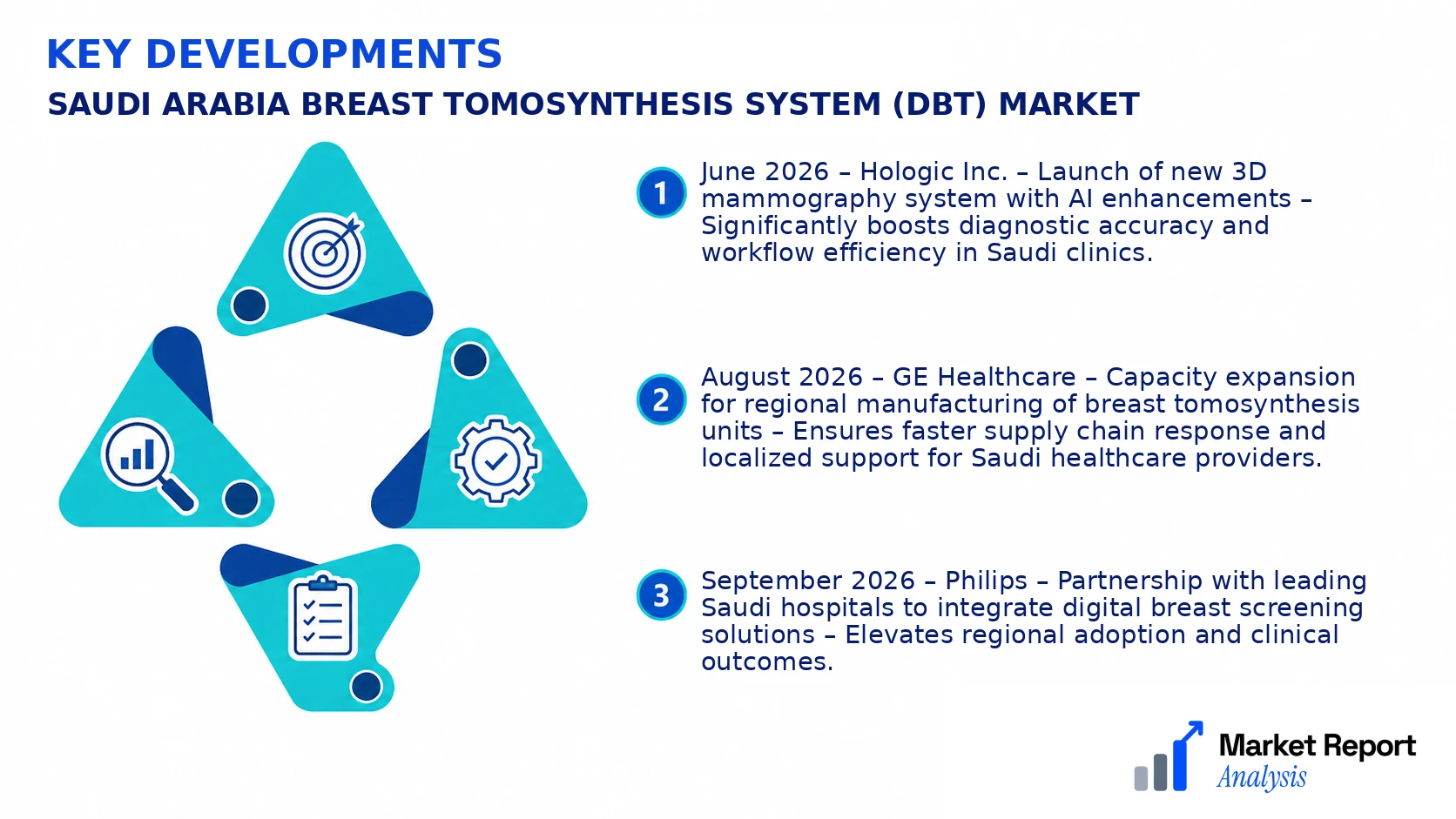
- June 2026 – Hologic Inc. – Launch of new 3D mammography system with AI enhancements – Significantly boosts diagnostic accuracy and workflow efficiency in Saudi clinics.
- August 2026 – GE Healthcare – Capacity expansion for regional manufacturing of breast tomosynthesis units – Ensures faster supply chain response and localized support for Saudi healthcare providers.
- September 2026 – Philips – Partnership with leading Saudi hospitals to integrate digital breast screening solutions – Elevates regional adoption and clinical outcomes.
- April 2026 – Siemens Healthineers – Acquisition of a regional distributor to strengthen service and support infrastructure within Saudi Arabia – Enhances market penetration and customer engagement.
- November 2026 – Fujifilm – Launch of affordable compact DBT systems targeted at remote clinics in Saudi Arabia – Addresses underserved areas, increasing screening coverage.
Frequently Asked Questions
What is the Saudi Arabia Breast Tomosynthesis System (DBT) Market?
The Saudi Arabia Breast Tomosynthesis System (DBT) Market involves the procurement and deployment of advanced 3D imaging systems designed for breast cancer detection, driven by increasing awareness, regulatory support, and technological advancements tailored to the nation's healthcare infrastructure.
What is the current market size of Saudi Arabia Breast Tomosynthesis System (DBT) Market?
As of 2026, the market is valued at approximately USD 120 Million, reflecting steady growth driven by rising healthcare investments, enhanced screening programs, and rising incidence rates of breast cancer in Saudi Arabia.
What factors are driving the Saudi Arabia Breast Tomosynthesis System (DBT) Market?
Market growth is fueled by increasing breast cancer awareness, government health initiatives promoting early detection, technological adoption in clinical settings, and the growing preference for minimally invasive diagnostic procedures among healthcare providers.
Which Saudi city leads the Saudi Arabia Breast Tomosynthesis System (DBT) Market?
Riyadh stands out as the leading city, owing to its large population, advanced healthcare infrastructure, and significant governmental and private sector investments in medical technology and diagnostic services.
Which segment is expected to grow the fastest?
The digital breast tomosynthesis segment is projected to exhibit the fastest growth, driven by technological improvements, better diagnostic accuracy, and increasing adoption in both public and private healthcare facilities.
Who are the leading companies operating in the Saudi Arabia Breast Tomosynthesis System (DBT) Market?
Key players include multinational medical device companies such as Hologic, GE Healthcare, and Siemens Healthineers, along with regional distributors enhancing local market penetration through strategic partnerships and service expansion.
Analyst Perspective
The long-term outlook for the Saudi Arabia Breast Tomosynthesis System (DBT) Market remains promising, driven by increasing healthcare infrastructure investments and a rising prevalence of breast cancer. Technological evolution is set to enhance the precision and ease of DBT systems, encouraging adoption among healthcare providers. Strategic investment in R&D, especially in AI-powered diagnostic tools, will be crucial for maintaining competitive advantage and expanding the market. The intensity of competition is expected to intensify as both local and international players seek market share through innovation and price competitiveness. Key city-level growth potentials are concentrated in Riyadh and Jeddah, where expanding private and public health sectors are increasing demand for advanced diagnostic systems. Firms should prioritize investments in these regions, focusing on establishing robust distribution channels and training centers. Over the long term, strategic positioning in urban centers and fostering collaborations with healthcare institutions will be essential for capturing growth opportunities and staying ahead amid evolving regulatory and technological landscapes.
