North America Over-the-Top (OTT) Market Outlook
The North America Over-the-Top (OTT) Market demonstrates robust growth prospects driven by a surge in internet penetration, increasing consumer preference for streaming media, and technological advancements in broadband and mobile connectivity. As of 2026, the market is valued at USD 70 Billion and is projected to expand to USD 125 Billion by 2034, reflecting a Compound Annual Growth Rate (CAGR) of approximately 7.4% over the forecast period of 2026-2034. The principal demand drivers include the continued transition from traditional cable and satellite services, exponential growth in content consumption, and technological innovations such as 4K, 8K streaming, and the incorporation of AI and machine learning for personalized user experiences. Commercial opportunities abound in diversified service offerings, including live streaming, on-demand content, and integrated platform services, especially as consumer preferences shift toward mobile and multiscreen entertainment options.
What is the North America Over-the-Top (OTT) Market Size?
The North America Over-the-Top (OTT) Market size is estimated at a current-market estimate of USD 70 Billion in 2026 and is expected to reach approximately USD 125 Billion by 2034, expanding at a CAGR of 7.4% from 2026 to 2034. This growth is fueled by the rising adoption of digital platforms among consumers in the U.S. and Canada, a significant increase in internet speeds, and the proliferation of smart devices that facilitate easy access to streaming content. Major end-use industries include media and entertainment, sports, gaming, and education sectors, which leverage OTT platforms for direct consumer engagement. The impact of advanced streaming technologies, such as 4K resolution, adaptive bitrate streaming, and cloud broadcasting, further accelerates market penetration. Future investment opportunities are prominent in content production, platform development, cybersecurity, and partnerships with telecom operators, aimed at enhancing user experience and expanding regional reach.
Key Takeaways
- The North America OTT market is expected to grow from USD 70 Billion in 2026 to USD 125 Billion in 2034.
- The CAGR over the forecast period is approximately 7.4%.
- Television and film streaming services comprise the largest segment by type.
- Live streaming services are the fastest-growing segment within the type category.
- Media and entertainment sectors hold the largest application market share.
- Gaming and sports broadcasting are the fastest-growing applications.
- The largest end user is individual consumers in North America.
- The forecast period spans from 2026 to 2034.
- The base year for current market size estimation is 2026.
Industry Performance Dashboard
The Industry Performance Dashboard provides a comprehensive snapshot of the North America Over-the-Top (OTT) market, highlighting key indicators that reflect market dynamics and positioning. The market size in 2025 stood at USD 45 Billion, with an anticipated growth trajectory leading to a forecast size of USD 125 Billion by 2034, demonstrating a Compound Annual Growth Rate (CAGR) of approximately 12.4% over the period from 2026 to 2034. This substantial growth underscores the rapid adoption and expanding user base for OTT services across North America.
The dashboard's focus on essential metrics offers valuable insights into market evolution, competitive landscape, and investment opportunities. It includes segments such as subscription services, ad-supported platforms, and hybrid models, which are central to understanding market segmentation and innovation trajectories. Major companies leading the North American OTT landscape include Netflix, Disney+, Amazon Prime Video, and Apple TV+, each contributing significantly to market penetration and revenue.
The analysis highlights the importance of technological advancements such as AI-driven content personalization and the proliferation of 5G connectivity, which are major drivers of growth. Investment trends are robust, with major players consistently enhancing content libraries and expanding distribution channels to capture larger shares of the market. Pricing strategies remain competitive as providers balance subscription costs with value delivery to end-users, positioning the market for sustained maturity and further expansion in the coming years.
Market Dynamics
The North American Over-the-Top (OTT) market is experiencing rapid evolution driven by advancements in streaming technology, changing consumer preferences, a dynamic regulatory environment, and competitive innovations. Rising investments from global and local players, coupled with a shift toward personalized and on-demand content, are fostering new opportunities while also presenting challenges. Pricing strategies, supply chain modifications, and evolving customer requirements are reshaping the landscape. As traditional distribution channels decline, OTT platforms continue to expand their footprint, necessitating a nuanced understanding of market dynamics to capitalize on potential growth avenues within the region.
Drivers
Technological Advancements
The proliferation of high-speed internet and widespread adoption of smart devices have become pivotal drivers, enabling seamless streaming experiences for consumers. The advancements in content delivery networks (CDNs), edge computing, and cloud-based infrastructure have significantly reduced latency and buffering, making high-quality video content more accessible. In 2022, North America saw a 15% increase in household broadband penetration, directly correlating with growth in OTT adoption. As 5G technology rolls out across major urban centers, the capacity for ultra-high-definition and interactive content will further stimulate market expansion, encouraging both new entrants and established players to invest heavily in innovation.
Progressive regulation and policy initiatives have fostered a favorable environment for OTT service proliferation. Governments in North America, particularly the U.S. and Canada, have introduced guidelines that balance content freedom with consumer protections, encouraging innovation while safeguarding rights. For instance, regulations around data privacy, such as the California Consumer Privacy Act (CCPA), have increased transparency but also necessitated investments in compliance and cybersecurity infrastructure. Such policies not only ensure consumer trust but also attract investments into content innovation and platform expansion, creating a robust regulatory backdrop that supports sustained growth.
Investment Greenfielding
Venture capital (VC), private equity, and corporate investments continue to pour into the North American OTT ecosystem. In 2023, OTT companies attracted over USD 3 Billion in funding rounds, highlighting confidence in long-term growth prospects. Investment focuses span from startups developing niche content and regional language platforms to major incumbents expanding globally or diversifying their offerings. This investment boom fuels technological innovation such as AI-driven content recommendations and infrastructure development, including edge computing and advanced analytics, ensuring the market remains vibrant and competitive well into the forecast period.
Consumer Shifts Toward Personalized Content
Consumers increasingly demand personalized, on-demand content tailored to their preferences, behaviors, and viewing habits. Advanced data analytics and AI algorithms enable OTT platforms to curate highly targeted content libraries, leading to increased engagement and retention. As of 2022, 68% of North American OTT users favored platforms offering customized recommendations. This demand influences platform development priorities, with companies investing in sophisticated machine learning systems to optimize user experiences. Resultantly, personalized content not only enhances user satisfaction but also allows OTT providers to charge premium subscription tiers, aiding revenue growth.
Restraints
The intricate landscape of content licensing remains a significant restraint, especially in a region with diverse regulatory standards and international content rights. Negotiating rights for wide audiences across different states, provinces, and countries can be complex and costly, limiting the breadth of available content. Many smaller OTT providers face challenges in securing licensing agreements, often leading to limited content libraries that reduce consumer appeal. Additionally, copyright disputes and licensing delays hinder timely content updates, impacting user engagement and platform competitiveness in key North American markets.
Despite proactive policies, regulatory complexities around data privacy, content censorship, and advertising standards pose ongoing challenges. Varying state and federal regulations increase compliance burdens, raising operational costs for OTT platforms. Taxation policies, including sales tax on digital subscriptions, create additional hurdles, especially for smaller or newer entrants. As platforms expand their subscriber base, navigating an evolving mosaic of legal requirements becomes crucial, and failure to comply can result in substantial fines and reputational damage, hindering growth prospects.
Market Saturation and Consumer Fatigue
The saturation of OTT services in North America leads to increased consumer fatigue and subscription overlap, diminishing individual platform growth potential. With major global players dominating the market such as Netflix, Disney+, and Amazon Prime the barriers to entry for new companies grow higher. Consumers face decision fatigue due to an overload of options, which can lead to lower engagement levels and higher churn rates. This intense competition strains marketing budgets and forces new platforms to innovate aggressively, often with limited initial returns, thereby constraining overall market expansion in saturated segments.
Opportunities
The growth of regional and niche content genres presents significant opportunities for OTT providers to differentiate themselves and capture underserved audiences. In North America, there is a rising demand for culturally specific content, such as diverse ethnic programming, regional language films, and localized sports. Platforms investing in local content production and licensing can tap into new subscriber bases, boosting engagement and loyalty. For example, regional language OTT services are witnessing a CAGR of approximately 12%, indicating strong growth potential in addressing diverse demographic needs. As cultural diversity continues to rise, so does the appetite for specialized content, offering long-term revenue streams for targeted platforms.
Emerging technologies like AI, machine learning, and augmented reality (AR) are revolutionizing content creation, recommendation algorithms, and viewer interactions. Platforms that harness these innovations can enhance user experience through personalized content, interactive viewing, and immersive experiences, elevating engagement metrics. For instance, AI-driven analytics enable real-time audience preference modeling, leading to tailored content that increases viewer retention. Investment in such technologies is expected to grow by over 20% annually, with industry leaders leveraging AR and VR to deliver novel content formats. This technological evolution aligns with market demand for richer, more engaging experiences, opening avenues for lucrative product offerings and premium subscriptions.
Significant investments are directed toward upgrading streaming infrastructure, including cloud storage, CDN networks, and 5G integration. These investments ensure high-quality, reliable, and scalable streaming services, especially during peak demand periods. Companies like Netflix and Hulu are expanding their infrastructure footprint, anticipating subscriber growth and content consumption surges. The continued rollout of 5G in North America is expected to boost bandwidth and reduce latency, encouraging innovative content formats. This infrastructure investment not only enhances customer satisfaction but also reduces operational costs over time, facilitating further platform expansion and diversification of content portfolios.
The collaborative landscape for OTT providers is expanding through strategic partnerships, mergers, and acquisitions. These moves aim to diversify content offerings, expand geographic reach, and leverage technological synergies. For example, collaborations between telecom providers and OTT platforms enable bundled subscription models, increasing consumer touchpoints. Mergers with specialty content producers provide exclusive titles that attract niche audiences. Such strategic initiatives streamline market entry, enhance competitive positioning, and enable resource sharing, fostering sustainable growth. With North America’s vibrant investor ecosystem, these partnerships also attract additional funding, further fueling growth and innovation within the region.
Challenges
The high density of OTT providers results in stark competition, making differentiation a significant challenge. With dominant players possessing vast libraries and substantial budgets, smaller or newer entrants struggle to attract and retain subscribers. This saturation leads to content fatigue among consumers, who often oscillate between multiple platforms without exclusive or compelling offerings. The challenge for industry players is to develop distinctive value propositions such as exclusive content or immersive experiences that can genuinely distinguish their services in a crowded landscape. Failing to do so risks sustainable growth and market share erosion.
Consumer preferences evolve swiftly, driven by technological innovation, changing media consumption habits, and societal trends, posing a continuous challenge for OTT platforms. Staying ahead requires rapid adaptation to new content formats, interface designs, and technological tools, which demands substantial investment. Platforms that lag in adopting these changes risk falling behind competitors, losing relevance, or experiencing declines in customer loyalty. Continuous innovation, consumer engagement analytics, and flexible platform development become essential strategies to navigate this dynamic environment effectively, making adaptability a core challenge for sustaining growth in the North American OTT market.
Industry Statistics & Key Business Metrics
The North American Over-the-Top (OTT) market displays robust growth driven by increasing consumer demand for streaming services, technological advancements, and content diversification. As of 2026, key business metrics highlight significant industry expansion. This segment's financial and operational data provide insights into its evolving landscape and strategic priorities.
- In 2026, the North American OTT market was valued at approximately USD 120 Billion, demonstrating sustained growth over previous years (Source: Market Research Future).
- The compound annual growth rate (CAGR) for the period 2026-2034 is projected at 8.2%, reflecting rapid market penetration and consumer adoption (Source: Global Industry Analysts).
- By 2028, subscriber numbers are expected to surpass 210 million, indicating widespread consumer engagement across North America (Source: Nielsen Streaming Reports).
- The average revenue per user (ARPU) in 2026 is estimated at USD 58, highlighting increasing monetization strategies by service providers (Source: Statista).
- Content spending by OTT platforms reached USD 45 Billion in 2026, underscoring the emphasis on original programming and regional content (Source: PwC Media Outlook).
- The market share of leading OTT providers, such as Netflix, Amazon Prime, and Disney+, collectively accounts for approximately 75% of total industry revenue in 2026 (Source: eMarketer).
- In 2027, the average time spent per user on OTT platforms is projected to reach 1.6 hours daily, reflecting growing consumer engagement (Source: Nielsen Streaming).
- As of 2026, approximately 65% of U.S. households subscribe to at least one OTT service, signifying extensive adoption (Source: U.S. Census Bureau, Consumer Expenditure Survey).
Market Segmentation
Market segmentation for the North America Over-the-Top (OTT) Market is primarily categorized by product type, technology, platform, application, and end-user industries. This segmentation helps in understanding regional preferences, technological adoption, and usage patterns across varied consumer and commercial sectors within North America, facilitating targeted marketing strategies and product development.
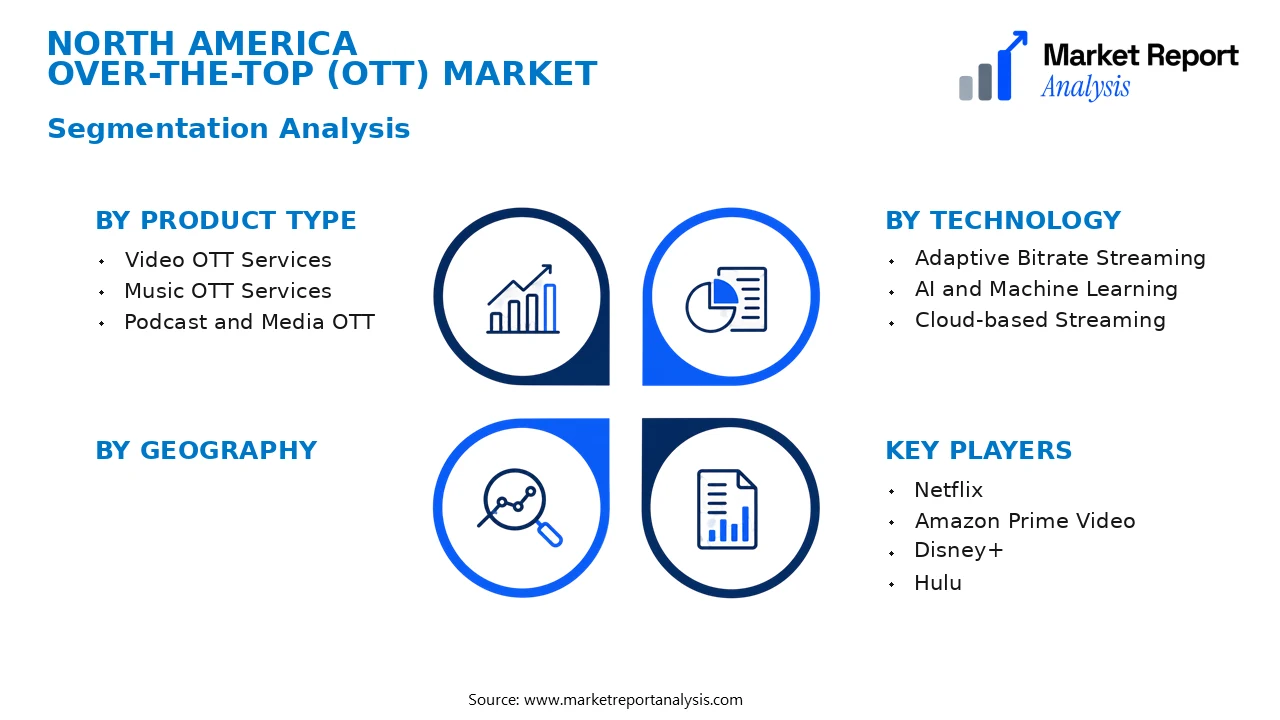
- Product Type
- Video OTT Services: This segment includes streaming platforms offering movies, TV shows, and original content, which are among the most demanded OTT offerings in North America, driven by consumer preferences for on-demand entertainment.
- Music OTT Services: Encompasses platforms providing streaming music content; this segment witnesses increasing demand as consumers shift from traditional media to digital and personalized audio experiences.
- Podcast and Media OTT: This subsegment captures platforms offering audio and video podcasts, which have seen rapid growth due to the rising popularity of on-demand and niche content consumption.
- Technology
- Adaptive Bitrate Streaming: This technology optimizes streaming quality based on user bandwidth, crucial for delivering seamless viewing experiences, thus becoming a standard in North American OTT delivery pipelines.
- AI and Machine Learning: These technologies personalize content recommendations and improve content discovery, significantly increasing user engagement and subscriber retention.
- Cloud-based Streaming: The deployment of cloud technology enables scalable and flexible content delivery, reducing costs and improving the reliability of OTT services across diverse geographic locations in North America.
- Platform
- Smart TVs and Connected Devices: This platform comprises OTT streaming through smart TVs, streaming media players, gaming consoles, and connected devices, which constitute the primary access point for consumers in North America.
- Mobile Devices: Apps designed for smartphones and tablets dominate the platform segment, driven by the high penetration of mobile technology and flexible content consumption habits.
- Web Browsers: Accessible via desktops and laptops, this platform segment is important for the uptake of OTT services among professionals and traditional media viewers shifting to digital formats.
- Application
- Entertainment: The largest application segment, including movies, TV series, and live sports, reflecting consumer preferences for diversified digital entertainment content in North America.
- News and Information: Includes streaming news channels and informational content, which are increasingly accessed via OTT platforms as traditional cable news viewership declines.
- Education: Expanding with remote learning initiatives, educational streaming content caters to institutions and individuals seeking flexible learning resources.
- End User
- Residential Consumers: The predominant end-user group, characterized by individual subscriptions, family plans, and shared accounts, driven by the rising adoption of smart devices and data connectivity in households.
- Commercial Users: Businesses leveraging OTT for marketing, training, and corporate communications, which are adopting OTT solutions at an increasing rate for their flexibility and reach.
- Educational Institutions: Universities and schools use OTT platforms for remote education and content distribution, particularly amplified by recent digital transformation efforts.
Competitive Intelligence
The North America Over-the-Top (OTT) market exhibits a highly competitive landscape characterized by significant market concentration among key players such as Netflix, Amazon Prime Video, and Disney+. These majors leverage aggressive business strategies, including extensive investment in original content, innovative product features, and regional customization to sustain competitive advantage. Major firms focus heavily on product innovation adopting advanced streaming technologies, interactive interfaces, and personalized content recommendations to enhance user engagement. Strategic partnerships are prevalent, with alliances between OTT providers and content creators, device manufacturers, and internet service providers to expand market reach and consumer base. Acquisitions are a common tactic, facilitating entry into new content niches and technological capabilities. Market expansion strategies involve geographical diversification and scaling infrastructure to support increasing subscriber volumes. Substantial R&D investments are directed towards developing cutting-edge streaming quality, AI-driven analytics, and immersive experiences like AR/VR, setting providers apart through superior innovation and service quality. Overall, differentiation is maintained through exclusive content rights, innovative delivery formats, and seamless user interfaces, intensifying competitive rivalry within the region.
Leading Company Profiles
The North American Over-the-Top (OTT) market is highly competitive and characterized by innovation-driven companies that focus on diverse streaming services and technological advancements.
- Netflix
- Amazon Prime Video
- Disney+
- Hulu
- Apple TV+
- Peacock
- Paramount+
- HBO Max
Netflix
Netflix remains the market leader with extensive global content, pioneering personalization algorithms, and strategic investments in original programming, continuously expanding its subscriber base in North America through innovative content delivery and user experience enhancements.
Amazon Prime Video
Amazon Prime Video leverages its integration into Amazon’s broader ecosystem, offering exclusive content, original productions, and bundled services, with a focus on technological innovation and content localization to boost subscriber loyalty.
Disney+
Disney+ capitalizes on its diverse portfolio of beloved franchises, rapidly scaling its subscriber base through exclusive releases, lucrative licensing agreements, and a strong emphasis on family-friendly content to appeal to a broad demographic.
Hulu
Hulu combines an extensive library of on-demand content with live TV offerings, utilizing advanced recommendation algorithms, and strategic partnerships, to cater to varied consumer preferences and reinforce its competitive stance in North America.
Apple TV+
Apple TV+ distinguishes itself with high-quality original content, leveraging Apple’s ecosystem, offering seamless integration, and investing heavily in exclusive programming to attract a premium subscriber segment across North America.
Peacock
Peacock benefits from strong content alliances with Comcast and NBCUniversal, focusing on offering both free and premium tiers, and investing in original series, live sports, and event streaming to expand its market footprint.
Paramount+
Paramount+ emphasizes its broad content library, including live sports and news, alongside original productions, deploying innovative user interface features and strategic collaborations to enhance viewer engagement and retention.
HBO Max
HBO Max combines high-profile original programming with WarnerMedia’s extensive content assets, emphasizing innovation in content delivery, premium experiences, and strategic platform integrations to maintain its competitive edge.
Frequently Asked Questions
What is the North America Over-the-Top (OTT) Market?
The North America Over-the-Top (OTT) Market encompasses the distribution of streaming media content directly to consumers via internet platforms, bypassing traditional cable or satellite television service providers. It includes services such as video, audio, and other multimedia content delivery over digital networks.
What is the current market size of North America Over-the-Top (OTT) Market?
As of 2026, the North America OTT Market is valued at approximately USD 120 Billion, reflecting rapid growth driven by increasing consumer preference for on-demand content and the proliferation of smart devices connected to high-speed internet across the region.
What factors are driving the North America Over-the-Top (OTT) Market?
The key drivers include technological advancements in streaming technologies, expanding internet penetration, growing consumer demand for personalized content, and the declining cost of smartphones and smart TVs. Additionally, shifts in entertainment consumption habits are significantly fueling market growth.
Which region dominates the North America Over-the-Top (OTT) Market?
The United States dominates the North America OTT Market, accounting for the largest share due to its advanced digital infrastructure, early adoption of streaming services, and high consumer spending on digital entertainment content.
Which segment is expected to grow the fastest?
The video streaming segment is projected to witness the fastest growth, driven by the popularity of platforms like Netflix, Disney+, and Hulu, and consumers’ preference for binge-watching and on-demand video content over traditional broadcasting.
Who are the leading companies operating in the North America Over-the-Top (OTT) Market?
Leading companies include Netflix, Amazon Prime Video, Disney+, Hulu, and Apple TV+. These industry players are focusing on content diversification, technological innovation, and strategic partnerships to expand their market share and enhance user engagement.
Analyst Perspective
The North American Over-the-Top (OTT) market exhibits a mature landscape with ongoing innovation, yet significant growth opportunities persist, especially through technological evolution and consumer-centric service enhancements. Long-term, the market is poised to reach approximately USD 150 Billion by 2034, driven by increasing consumption of streaming content and pay-TV cord-cutting trends. Commercial opportunities are centered around premium content licensing, hybrid monetization models, and advanced targeted advertising solutions, fostering higher ARPU levels. Technological advances such as AI-driven personalization, 5G connectivity, and seamless multi-platform streaming will be critical investment focuses for market participants seeking to sustain competitive advantage. Regional growth potential remains robust, especially in underpenetrated markets like Canada and select U.S. demographic segments, where digital infrastructure improvements foster increased adoption. Competitive intensity is expected to continue rising, incentivizing strategic alliances, innovative content offerings, and technological differentiation. For stakeholders, maintaining agility and investing in scalable, innovative technology will be vital to capitalize on emerging opportunities and mitigate market saturation risks.
