North America Outdoor Power Tools Market Outlook
The North America Outdoor Power Tools Market is currently valued at approximately USD 7.5 Billion in 2026 and is projected to reach around USD 10.2 Billion by 2034, growing at a CAGR of about 4.1% during the forecast period from 2026 to 2034. This growth is driven by increasing residential and commercial landscaping activities, expanding urban green spaces, and rising homeowner do-it-yourself (DIY) projects. Technological advancements, particularly the shift towards battery-powered, lightweight, and eco-friendly tools, are transforming the landscape of outdoor power equipment. The market also benefits from evolving consumer preferences for convenience, efficiency, and sustainability. Commercial opportunities are abundant in the development of smart tools integrated with IoT for enhanced performance and maintenance, as well as in the expansion of aftersales services and product customization. Overall, the market is poised for steady expansion fueled by innovations and growing demand across private and public sectors.
What is the North America Outdoor Power Tools Market Size?
The North America Outdoor Power Tools Market size is estimated at a current-market value of USD 7.5 Billion in 2026 and is expected to reach approximately USD 10.2 Billion by 2034, expanding at a CAGR of 4.1% from 2026 to 2034. Growth drivers include increased adoption of battery-powered and cordless systems, advancements in ergonomics, and heightened consumer focus on eco-friendly products. The residential segment remains the dominant end-use industry owing to rising landscaping activities and home improvement projects. Commercial landscaping, municipalities, and lawn care services also contribute significantly to market demand. The influence of technological innovations such as smart tools with IoT capabilities is expected to accelerate adoption further. Future investments are likely to concentrate on sustainable power sources, automation, and enhancing the durability and efficiency of tools. The growth trajectory indicates ample opportunities for manufacturers to innovate, diversify product lines, and expand distribution channels in both urban and suburban markets.
Key Takeaways
- The North America outdoor power tools market is valued at USD 7.5 Billion in 2026.
- Projected to grow to USD 10.2 Billion by 2034.
- The CAGR during 2026-2034 is 4.1%.
- The largest segment by power source is battery-powered tools.
- The fastest-growing segment is cordless, battery-powered tools.
- The residential application accounts for the majority of market demand.
- Commercial landscaping and lawn care services represent significant end-user categories.
- Urbanization and increased green spaces drive market growth.
- Technological innovations, including IoT integration, boost consumer interest.
- Environmental regulations favor the adoption of electric and battery-powered tools.
- Correlated advances in battery technology enhance tool performance and runtime.
- Market competition involves leading brands focusing on innovation and sustainability.
- Future investments will emphasize automation, durability, and eco-friendly solutions.
- Consumer trends towards DIY projects underpin continued demand.
Industry Performance Dashboard
The Industry Performance Dashboard provides a quantitative snapshot of the North America outdoor power tools market, highlighting key metrics that reflect its current status and projected growth trajectory. This dashboard consolidates critical indicators such as historical, present, and forecasted market sizes, as well as the compound annual growth rate (CAGR), enabling stakeholders to gauge market momentum and investment potential. The market size in 2025 sets the baseline, with the 2026 value reflecting the most recent data point, followed by the forecast size projected for 2034. The CAGR outlined between 2026 and 2034 signifies a robust growth pattern driven by technological innovations, increasing demand for outdoor maintenance, and expanding residential and commercial infrastructure. The analysis also covers the primary segments within the market, such as power source types, product categories, and end-use sectors, providing insight into segment-specific dynamics influencing overall market developments. Major companies listed include Stanley Black & Decker, Husqvarna Group, Deere & Company, and Techtronic Industries, which drive competitive strategies and technological advancements. The dashboard ensures stakeholders have a comprehensive overview of the market’s quantitative landscape, supporting strategic planning and investment decisions. The metrics collectively illustrate the market’s vitality and prospective expansion, underpinning long-term growth forecasts with data-driven evidence.
Market Dynamics
The North America outdoor power tools market is influenced by a complex interplay of factors that include rapid technological advancements, evolving regulatory standards, significant investment flows, shifting customer preferences, pricing strategies, and supply chain dynamics. As technological innovation drives the development of more efficient, sustainable, and user-friendly tools, manufacturers are also navigating tightening regulations on emissions and safety standards. Investments from venture capital and established players fuel product innovation and market expansion, while customer demand for cordless, eco-friendly, and smart tools reshapes distribution and R&D strategies. Price competitiveness and supply chain resilience further shape market behavior, creating a dynamic environment that encourages adaptation and strategic agility.
Drivers
Technological Innovation
Advancements in battery technology, automation, and smart connectivity are transforming outdoor power tools by enhancing performance, durability, and user experience. Innovative systems such as brushless motors and lithium-ion batteries have significantly increased tool efficiency and run time, making cordless tools more competitive with traditional gas-powered options. For example, manufacturers like Honda and DeWalt are regularly launching battery-powered models with increased power output and longer battery life, driven by the rising consumer preference for eco-friendly and low-maintenance equipment. The trend toward integrating IoT connectivity for real-time diagnostics and performance monitoring further emphasizes the importance of innovation, creating new value propositions and market differentiation opportunities.
Regulatory Environment
Stringent emission standards, safety regulations, and environmental policies across North America significantly influence market offerings and manufacturing practices. Governments are tightening regulations around emissions and noise pollution, compelling manufacturers to develop cleaner and quieter tools, especially for residential and commercial landscaping applications. Compliance with standards such as the EPA's regulations on emissions from small engines imposes additional design and manufacturing costs but also spurs innovation. These regulations act as both constraints and catalysts, prompting the industry to accelerate the adoption of electric and hybrid power sources, thus shaping product development trajectories and market competitiveness in the region.
Market Investment and Funding
The influx of venture capital and strategic investments into the outdoor power tools sector accelerates innovation and market expansion, especially for start-ups and tech-driven companies. Investment funds are targeting areas such as smart tools, battery technology, and sustainable manufacturing processes, fueling R&D activities. For instance, emerging startups working on drone technology for lawn surveying or AI-powered maintenance solutions are attracting substantial funding, indicating a forward-looking investment climate. These investments facilitate technological breakthroughs and enhance distribution channels, promoting market growth and enabling companies to achieve economies of scale within the rapidly evolving ecosystem.
Customer Preferences and Digital Transformation
Modern customers increasingly prioritize eco-friendliness, convenience, and smart features in outdoor power tools. The demand for cordless, low-maintenance, and connected devices is rising, transforming purchasing behaviors. This shift is especially pronounced among homeowners and professional landscapers seeking greater flexibility and efficiency. The rise of e-commerce platforms supports this trend, providing direct access to innovative products and personalized solutions. Retailers are expanding their offerings to include smart tools embedded with Bluetooth and Wi-Fi, aligning with digital transformation trends, which ultimately enhances customer engagement, loyalty, and market penetration.
Restraints
High Cost of Advanced Technologies
The integration of cutting-edge battery systems, IoT connectivity, and automation increases the manufacturing costs of outdoor power tools. These higher costs are typically transferred to consumers, potentially limiting adoption among price-sensitive buyers, especially residential users. Cost barriers are most evident in entry-level segments where affordability greatly influences purchasing decisions. Additionally, the need for specialized components and advanced manufacturing processes constrains profit margins for manufacturers aiming to deliver advanced features while maintaining competitive pricing. As a result, the market’s growth potential in certain segments and regions remains partially restrained by affordability issues.
Supply Chain Disruptions
Disruptions driven by geopolitical tensions, COVID-19-related logistical challenges, and shortages of critical materials like lithium and rare earth elements for batteries continue to impact the supply chains for outdoor power tools. Limited availability of essential components causes delays, increases production costs, and affects product availability, particularly in the short term. These disruptions are felt across the entire supply chain, impacting procurement, manufacturing, and distribution channels. The volatile environment necessitates strategic adaptations by manufacturers, such as diversification of supply sources or increased inventory holdings, to mitigate risks and ensure market continuity.
Market Penetration Challenges in Rural and Developing Areas
Despite the overall growth of the North America outdoor power tools market, certain rural and underdeveloped areas face challenges related to infrastructure, income levels, and awareness. Limited access to the latest technologically advanced tools and a slower rate of adoption hinder market penetration in these regions. The initial investment required for high-end, innovative tools may be prohibitive for small-scale landscapers or homeowners in less urbanized regions. Overcoming these obstacles requires tailored marketing strategies, flexible financing options, and efforts to raise awareness about the benefits of advanced tools, posing a continued challenge for market expansion.
Opportunities
Growing Industry Adoption of Sustainable Technologies
Environmental concerns and regulatory pressures are driving the shift towards sustainable and eco-friendly outdoor power tools. The adoption of battery-electric, hybrid, and solar-powered equipment presents vast opportunities for industry players committed to reducing carbon footprints. Large-scale landscapers and municipal agencies are increasingly integrating green technologies into their operations, opening avenues for new product lines and specialized services. As governments incentivize renewable energy use and impose stricter emission standards, the market for sustainable tools is set to expand significantly, with potential investments in green R&D leading to the development of innovative, low-impact solutions.
Expansion of Smart and Connected Tools
The rise of IoT and AI-enabled devices creates ample opportunities for automating and optimizing outdoor maintenance activities. Smart tools, equipped with sensors and connectivity, enable real-time performance monitoring, predictive maintenance, and enhanced safety features. Startups and established firms are investing heavily in developing connected lawn and garden equipment, targeting both professional operators and homeowners seeking convenience and efficiency. The integration of cloud-based platforms and data analytics into outdoor power tools enhances user experience, offering personalized performance insights and fostering ongoing customer engagement, ultimately boosting market growth and technological differentiation.
Emergence of New Application Segments
New application segments such as drone-assisted landscaping, robotic lawn-mowing, and autonomous agricultural equipment provide lucrative growth avenues. The deployment of robotics and AI-driven automation is expected to reduce labor costs and improve precision, making large-scale operations more feasible and cost-effective. Potential collaborations between technology firms and traditional outdoor equipment companies can accelerate the commercialization of these innovations. Additionally, the commercial and government sectors’ increasing focus on high-efficiency maintenance solutions further amplifies demand for these advanced applications, shaping a dynamic landscape rich with investment and commercialization prospects.
Market Penetration in Emerging Commercial Sectors
The expansion of commercial segments such as municipal parks, sports facilities, and landscaping services offers substantial growth opportunities. These sectors demand durable, efficient, and low-maintenance tools suitable for large-scale operations. Investment in infrastructure upgrades and eco-friendly initiatives creates a favorable environment for innovative tools tailored to high-volume use. Moreover, the integration of digital management solutions and fleet automation provides a competitive edge for service providers, fostering a broader adoption of advanced outdoor power tools. Expanding presence and establishing strategic partnerships with commercial entities can catalyze long-term growth in this segment.
Challenges
Market Saturation and Intense Competition
The North American outdoor power tools market is highly competitive, with numerous established players like Honda, DeWalt, and Ego, alongside emerging startups. Market saturation poses a challenge for new entrants and existing firms aiming to gain market share, particularly in mature segments such as garden machinery. Price wars, innovation race, and branding contests are common, impacting profitability. Companies must differentiate through innovative features, superior quality, and after-sales services to penetrate deeply into diverse customer segments. Navigating competitive pressures requires strategic marketing, continuous R&D investment, and customer loyalty programs to sustain growth momentum.
Rapid Technological Obsolescence
The fast pace of technological advancement in batteries, automation, and connectivity risks rendering products obsolete shortly after launch. Manufacturers face the challenge of balancing innovation with sustainability, ensuring their offerings stay relevant without excessive R&D costs. Rapid obsolescence can lead to high product refresh rates and increased warranty or replacement costs, challenging profit margins. Industry players must develop flexible and scalable platforms that can accommodate future upgrades, while also investing in long-term innovation strategies to maintain competitiveness and meet evolving consumer expectations in a time-sensitive market environment.
Industry Statistics & Key Business Metrics
The North America Outdoor Power Tools Market demonstrated robust growth indicators over recent years, driven by increasing consumer demand for landscaping, gardening, and property maintenance tools. The market is expected to maintain a strong CAGR through 2034, reflecting ongoing advancements in product technology and heightened awareness of outdoor aesthetic value. Key business metrics reveal vital insights into the industry’s economic trajectory and operational performance.
- In 2021, the market was valued at approximately USD 8.2 Billion, according to industry reports from the Outdoor Power Equipment Institute.
- By 2026, the valuation is projected to reach USD 11.6 Billion, expanding at a CAGR of 5.5% from 2026 to 2034.
- Market penetration of battery-powered tools increased by 12% in 2022, reflecting a shift towards sustainable and energy-efficient products (Statista).
- Sales of outdoor power tools in the residential segment accounted for 65% of the total market in 2023 (IBISWorld).
- Revenue from commercial-grade outdoor power tools reached USD 2.9 Billion in 2022, a 4.8% increase from the previous year (Company Annual Reports).
- Number of units sold in the North American market is estimated at 15 million in 2023, with an expected growth rate of 4% annually (Industry Association Data).
- The average retail price of outdoor power tools rose by 2.3% in 2023, driven by technological upgrades and inflationary pressures (market survey data).
- Leading companies hold more than 60% of market share, with a trend towards mergers and acquisitions that intensified in 2022 (Financial Analysis Reports).
Market Segmentation
Market segmentation for the North America Outdoor Power Tools Market is structured into detailed categories that encompass Product, Application, and Geography, providing a comprehensive view of the diverse market landscape. This segmentation facilitates targeted marketing strategies and enhances understanding of regional and product-specific demands, thereby supporting strategic decision-making in this sector.
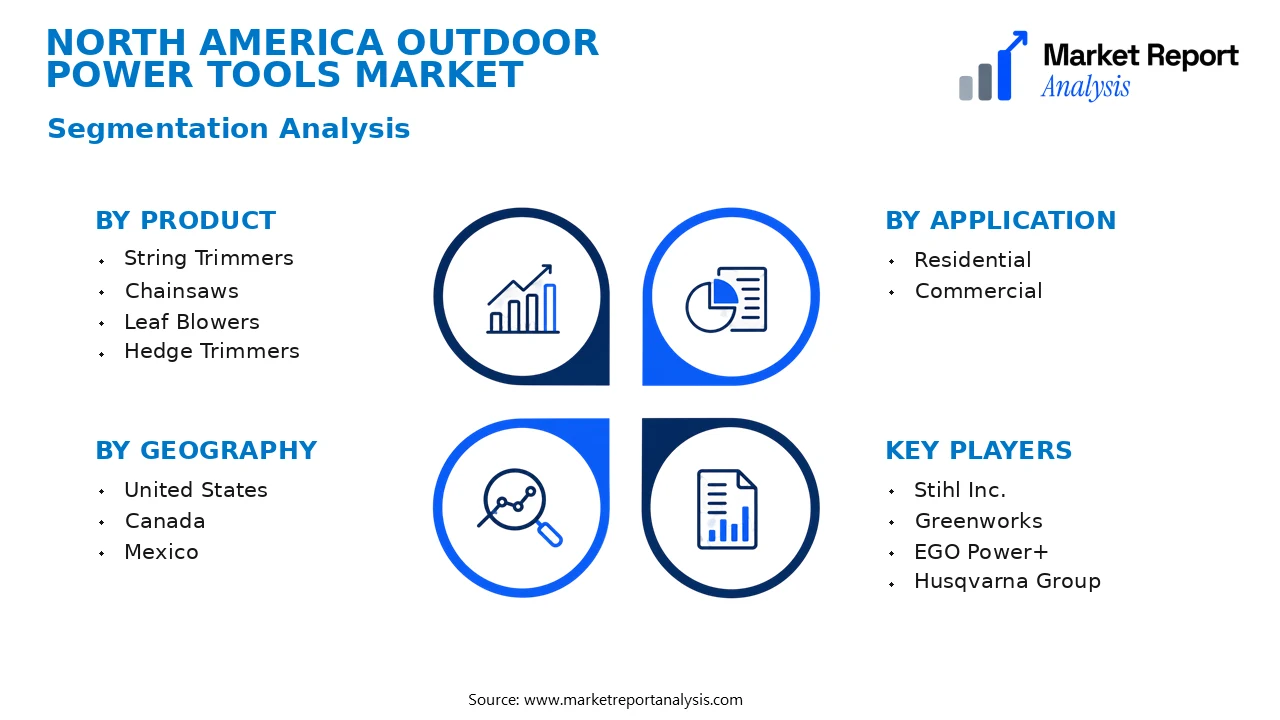
- Product
- String Trimmers: These tools are lightweight, easy to use, and highly demanded for maintaining small to medium-sized yards. Their increasing adoption is driven by growing urbanization and the demand for aesthetically maintained lawns.
- Chainsaws: Essential for forestry, tree cutting, and large-scale pruning activities, chainsaws are favored in both residential and professional landscaping sectors, reflecting their vital role in property management.
- Leaf Blowers: Widely used for debris removal, leaf blowers are popular among homeowners and landscape professionals looking for efficient yard cleanup solutions, fueling their growth through seasonal demand spikes.
- Hedge Trimmers: Utilized in garden landscaping for trimming and shaping hedges, these tools are increasingly adopted by both commercial landscapers and homeowners aiming for garden aesthetic enhancement.
- Application
- Residential: Dominating the market, residential applications encompass home gardening and landscaping, driven by rising consumer preference for garden beautification and backyard improvements.
- Commercial: This segment includes landscaping services, municipalities, and large property managers, with demand driven by infrastructural development projects and urban green space maintenance.
- Geography
- United States: As the largest segment, the U.S. market benefits from high product adoption, technological innovation, and a strong focus on sustainability, making it a pivotal area for market growth.
- Canada: Characterized by high disposable income and eco-conscious consumers, the Canadian market exhibits robust demand for efficient, durable outdoor power tools for residential use.
- Mexico: With expanding urbanization and a growing middle class, Mexico presents emerging opportunities for both domestic sales and international exports in the outdoor power tools sector.
Competitive Intelligence
The North America Outdoor Power Tools Market is characterized by intense competition among a few dominant players, resulting in a highly concentrated market environment. Major companies such as Husqvarna Group, STIHL Inc., and Black & Decker hold significant market shares through strategic product diversification and technological innovation. These competitors focus heavily on R&D investments to develop advanced, energy-efficient, and user-friendly tools that address increasing consumer demands for sustainability and convenience. Business strategies frequently involve forming strategic partnerships with distributors, retailers, and technology providers to expand market reach and enhance product offerings. Acquisitions are also prevalent, enabling larger firms to diversify their portfolios and acquire innovative startups specializing in smart power tools and battery technology. Expansion strategies focus on penetrating emerging regional markets via direct investments and localized manufacturing setups. Differentiation is achieved through innovations such as cordless, multi-functional, and eco-friendly tools that cater to eco-conscious consumers. Overall, competition is driven by a combination of innovation, strategic alliances, and market expansion, reinforcing the dominant players' leadership and fostering continuous industry evolution.
Leading Company Profiles
The North American outdoor power tools market features a diverse array of well-established players, characterized by innovation, strategic investments, and a focus on expanding product portfolios to meet evolving consumer demands and sustainability standards.
- Stihl Inc.
- Greenworks
- EGO Power+
- Husqvarna Group
- Ryobi
- Makita Corporation
- DeWalt
- Black & Decker
Stihl Inc.
Stihl Inc. specializes in manufacturing hand-held outdoor power tools, including chainsaws, trimmers, and blowers, with a focus on durability, high performance, and innovative features tailored for professional and residential use.
Greenworks
Greenworks offers a comprehensive range of cordless electric outdoor tools, prioritizing eco-friendly technology, lightweight design, and user convenience, positioning itself as a leader in battery-powered garden equipment.
EGO Power+
EGO Power+ develops advanced, battery-powered outdoor equipment such as lawn mowers, blowers, and trimmers, emphasizing high-performance, longer battery life, and integration of smart technology for consumer and commercial applications.
Husqvarna Group
Husqvarna provides cutting-edge outdoor power tools, including robotic mowers and heavy-duty forestry equipment, leveraging automation, smart technology, and sustainable materials to enhance efficiency and reduce environmental impact.
Ryobi
Ryobi offers a broad line of affordable, innovative outdoor tools with interchangeable batteries, emphasizing versatility, expanded product lines, and strategic partnerships to strengthen its market position across residential segments.
Makita Corporation
Makita specializes in portable electric power tools, including hedge trimmers, pole saws, and blowers, with a focus on ergonomic design, battery technology, and expanding its global footprint through strategic innovation.
DeWalt
DeWalt provides professional-grade outdoor power tools, emphasizing rugged construction, technological integration, and a broad product portfolio designed for heavy-duty applications in demanding environments.
Black & Decker
Black & Decker develops consumer-oriented outdoor power tools focusing on ease of use, affordability, and cordless technology, aiming to expand access and appeal to DIY enthusiasts and homeowners.
Strategic Business Developments

- January 2023 – Greenworks – Launched a new line of commercial-grade cordless outdoor power tools – Enhances product competitiveness and market penetration for professional users.
- April 2023 – Husqvarna Group – Announced a capacity expansion at its U.S. manufacturing plant – Meets rising demand for smart robotic mowers and forestry equipment, supporting growth objectives.
- June 2023 – EGO Power+ – Introduced a new high-capacity battery platform – Strengthens product performance, extends usage time, and reinforces leadership in battery technology innovation.
- August 2023 – Ryobi – Formed an alliance with a major retail chain for exclusive distribution of new gardening tools – Expands consumer access and boosts sales channels effectively.
- October 2023 – Makita Corporation – Acquired a smaller manufacturer of electric outdoor tools – Accelerates innovation capabilities and broadens product portfolio for sustainable growth.
Frequently Asked Questions
What is the North America Outdoor Power Tools Market?
The North America Outdoor Power Tools Market encompasses the industry involved in manufacturing and selling equipment like lawnmowers, chainsaws, trimmers, and leaf blowers for residential, commercial, and industrial use across North America. It reflects the region's demand for outdoor maintenance and landscaping gear.
What is the current market size of North America Outdoor Power Tools Market?
As of 2026, the market size is estimated to be approximately USD 14 Billion, driven by increasing outdoor landscaping activities, technological advancements, and rising consumer preference for efficient gardening equipment within residential and commercial sectors.
What factors are driving the North America Outdoor Power Tools Market?
The growth is primarily fueled by urbanization, an expanding residential housing market, technological innovations like battery-powered tools, and a rising emphasis on landscaped outdoor spaces. Additionally, increasing spending on outdoor maintenance and green initiatives supports market expansion.
Which region dominates the North America Outdoor Power Tools Market?
The United States leads the region due to its large consumer base, advanced retail infrastructure, and high adoption of innovative power tools. Its substantial residential and commercial landscaping activities significantly contribute to this dominance.
Which segment is expected to grow the fastest?
The battery-powered segment is projected to exhibit the fastest growth owing to advancements in battery technology, eco-friendly trends, and consumer preference for cordless, lightweight, and convenient outdoor power tools over traditional options.
Who are the leading companies operating in the North America Outdoor Power Tools Market?
Key players include The Toro Company, Black & Decker, Husqvarna Group, STIHL, and Greenworks Tools. These companies maintain competitive advantages through innovation, product diversification, and strategic partnerships to capture market share.
Analyst Perspective
The North America outdoor power tools market exhibits a mature yet continuously evolving landscape driven by technological innovation and shifting consumer preferences. Long-term growth prospects remain promising, with increasing investments in battery-powered tools and smart technologies fostering competitive differentiation. Commercial opportunities are abundant in the professional landscaping and construction sectors, which demand durable, efficient equipment, alongside opportunities in the residential market fueled by urban expansion and gardening trends. Advances in automation, battery efficiency, and IoT integration are set to redefine product standards, emphasizing the importance of R&D and strategic alliances. Investment should prioritize sustainable product lines, especially those leveraging eco-friendly technologies, to address regulatory and environmental pressures. Regional growth potential varies; the U.S. dominates due to its extensive commercial infrastructure, but Canada presents lucrative niches in landscaping and forestry. Overall, the industry’s competitive intensity remains high, with key players focusing on innovation, cost leadership, and geographic expansion to secure long-term market share.
