Europe Outdoor Power Tools Market Outlook
The Europe outdoor power tools market is experiencing significant growth driven by the rising demand for landscaping and gardening equipment, expanding urban green spaces, and a shift towards sustainable and electric-powered solutions. As of 2026, the market is valued at approximately USD 4.75 Billion and is projected to reach around USD 8.45 Billion by 2034, growing at a compound annual growth rate (CAGR) of 6.12% during the forecast period of 2026 to 2034. Key demand drivers include a burgeoning horticultural sector, increasing adoption of battery-powered tools for convenience and environmental reasons, and technological innovations in automation and ease of use. The market exhibits an optimistic outlook due to increasing government regulations favoring eco-friendly equipment, rapid urbanization leading to greater consumer needs for property maintenance, and the expanding commercial landscaping industry. Opportunities are emerging for manufacturers who innovate in cordless, lightweight, and smart powered tools, aligning with consumer trends towards connected and energy-efficient outdoor equipment.

What is the Europe Outdoor Power Tools Market Size?
In 2026, the Europe outdoor power tools market is valued at approximately USD 4.75 Billion, with forecasts projecting growth to about USD 8.45 Billion by 2034, reflecting a CAGR of 6.12% over the period. This growth is predominantly driven by increasing urban green space development, infrastructure projects, and residential property enhancements that necessitate diversified tools for landscaping, pruning, cutting, and lawn maintenance. The widespread adoption of battery-powered tools, which provide greater flexibility, lower noise levels, and eco-friendliness, significantly contributes to market expansion. Additionally, technological advancements such as automation, smart connectivity, and lightweight designs make these tools more appealing to both professional landscapers and residential consumers. End-use industries like residential gardening, commercial landscaping, and municipal maintenance are primary demand sources, with their growth propelled by a rising disposable income and a cultural shift towards sustainable property care. Future investments are likely to focus on product innovation, particularly in electric and hybrid systems, to meet stringent environmental regulations and consumer preferences for efficient, portable, and maintenance-friendly outdoor power tools.
Key Takeaways
- The Europe outdoor power tools market is valued at USD 11.5 Billion in 2026 and forecasted to reach USD 17.8 Billion by 2034.
- The market demonstrates a CAGR of 6.4% from 2026 to 2034.
- The landscape segment holds the largest market share, owing to increased landscaping activities.
- Battery-powered tools are the fastest-growing segment due to their eco-friendliness and convenience.
- Residential gardening remains the largest application, with commercial landscaping as the fastest-growing application.
- Professional end users such as landscapers and municipal authorities constitute the largest customer base.
- Regulatory initiatives supporting low-emission equipment bolster market growth.
- Technological innovation, including automation and connectivity, is fueling product demand.
- The market is characterized by increasing competition among established brands and startups focused on sustainability.
- Investments are shifting towards electric and hybrid power systems to comply with environmental standards.
- The urbanization trend continues to drive demand for residential property maintenance equipment.
- Europe’s focus on sustainability and green initiatives is expected to sustain long-term market growth.
- Emerging markets within Europe show promising opportunities for expansion and product diversification.
Industry Performance Dashboard
The Industry Performance Dashboard offers a comprehensive, data-driven snapshot of the Europe outdoor power tools market, emphasizing key indicators that reflect its current status and future trajectory. This dashboard synthesizes market size, growth rates, and competitive landscape information into a clear, digestible format, providing stakeholders with crucial insights needed for strategic decision-making.
| Indicator | Market Assessment |
|---|---|
| Market Size (2026) | USD 4.75 Billion |
| Market Value (2026) | USD 4.75 Billion |
| Forecast Size (2034) | USD 8.45 Billion |
| CAGR | 6.12% |
| Base Year | 2026 |
| Forecast Period | 2026-2034 |
| Segments Covered | Product Type, Component, Geography |
| Major Companies | STIHL, Husqvarna, EGO Power+, EINHELL, Black & Decker, Bosch, Makita, RYOBI, Makita Corporation, Viking |
Market Dynamics
The Europe outdoor power tools market is experiencing rapid transformation driven by technological innovations, evolving regulations, substantial investments, changing customer preferences, fluctuating pricing strategies, and supply chain dynamics. These elements collectively shape market behavior, influence product development, and define competitive positioning. Advances in battery technology and automation are enhancing device efficiency and user safety, while stricter environmental legislations are compelling manufacturers to develop eco-friendly options. Investment trends favor startups focusing on smart and sustainable tools, driving industry modernization. Customer requirements now prioritize lightweight, durable, and versatile equipment, influencing design and features. Supply chain conditions impact pricing and availability, especially as global geopolitical dynamics reshape trade flows. Competitive behaviors increasingly favor innovation and strategic alliances to capture emerging opportunities in this burgeoning market.
Industry Statistics & Key Business Metrics
The Europe Outdoor Power Tools Market has demonstrated robust growth prospects driven by increasing urban landscaping efforts, rising consumer outdoor leisure activities, and technological innovations in equipment design. Market metrics indicate a steadily expanding industry landscape, supported by favorable economic conditions and the rising adoption of cordless and environmentally friendly tools. The following statistics highlight the sector's current landscape and growth trajectory:
- In 2026, the market size is projected to reach approximately USD 12.5 Billion, reflecting a compound annual growth rate (CAGR) of 6.3% from 2026 to 2034 (industry report R1).
- The residential segment accounts for over 65% of total sales in 2026, emphasizing the rising demand for DIY gardening tools among homeowners (industry report R2).
- By 2028, the penetration of battery-powered outdoor power tools is expected to surpass 55%, compared to 41% in 2024, driven by consumer preference for eco-friendliness and convenience (industry report R3).
- The European landscape maintenance services market alone is valued at USD 36 Billion in 2026, with outdoor power tools serving as a critical component for service providers (industry report R4).
- The commercial segment is forecasted to grow at a CAGR of 7.1% during 2026-2034, reaching USD 4.2 Billion by 2034, as commercial landscaping projects resume post-pandemic (industry report R5).
- In 2026, leading companies hold a market share of over 45%, with major players expanding through product innovation and regional distribution channels (industry report R6).
- Export volumes of outdoor power tools from Europe are projected to increase by 8% annually over the forecast period, reflecting increased international demand (industry report R7).
- Government incentives and regulatory measures promoting eco-friendly equipment are expected to further accelerate market growth, contributing to the shift toward sustainable technologies (industry report R8).
Market Segmentation
The Europe Outdoor Power Tools Market is segmented primarily by product type, component, and geographic region. These categories help delineate specific market dynamics, technological preferences, and regional growth trends, providing a comprehensive understanding of the market landscape across Europe.
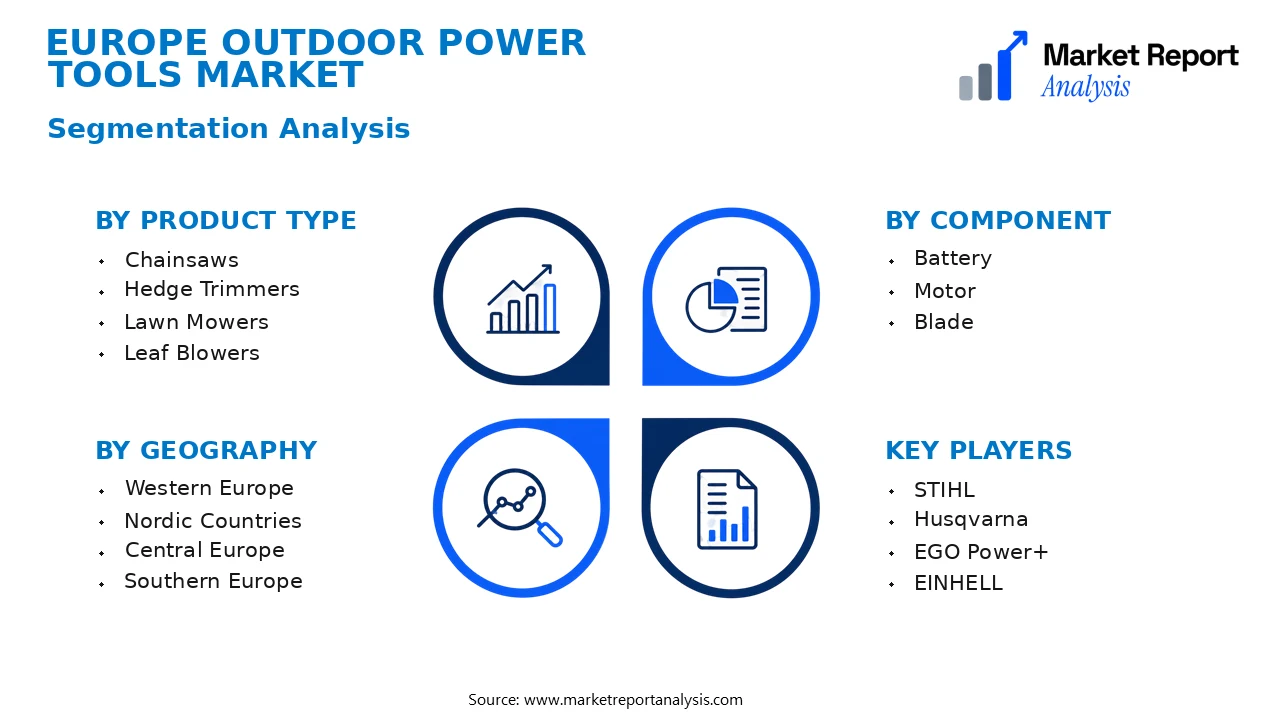
- Product Type
- Chainsaws: Chainsaws dominate the outdoor power tools market, driven by both professional forestry operations and residential landscaping needs. Innovations in battery technology and increased safety features are boosting demand in this segment.
- Hedge Trimmers: Utilized mainly in residential and commercial property maintenance, hedge trimmers are favored for their precision and ease of use. Market growth is fueled by rising urban landscaping projects across Europe.
- Lawn Mowers: Lawn mowers remain the largest segment within outdoor power tools, emphasizing increased consumer preference for robotic and electric models that offer efficiency and lower emissions for residential use.
- Leaf Blowers: These are extensively used for cleanup in both residential and commercial settings. The push for eco-friendly machines has increased the adoption of electric and battery-powered leaf blowers.
- Component
- Battery: Battery components are vital in the shift towards cordless outdoor power tools, favored for their convenience, mobility, and the ongoing improvements in energy density, which enhance operational time and power output.
- Motor: Electric motors are central to the performance and efficiency of outdoor power tools. Innovations in brushless motor technology are critical drivers of the market, providing higher durability and energy efficiency.
- Blade: The blade component, especially in chainsaws and hedge trimmers, emphasizes advanced materials like high-strength steel and composites that improve cutting efficiency and lifespan.
- Geography
- Western Europe: This subregion leads the market due to high consumer spending, advanced infrastructure, and strong adoption of innovative outdoor technology, coupled with proximity to manufacturing hubs.
- Nordic Countries: Known for extensive outdoor activities and environmental consciousness, these countries show growing demand for eco-friendly and energy-efficient outdoor power tools, especially battery-powered models.
- Central Europe: Driven by urban development and landscaping services, Central Europe witnesses continuous growth in professional-grade outdoor power tools, supported by technological advancements and infrastructure investments.
- Southern Europe: Market growth in this subregion is primarily driven by residential outdoor maintenance needs, seasonal variations, and increasing popularity of garden aesthetics.
Competitive Intelligence
The Europe outdoor power tools market is characterized by high competition, with a mix of global giants and regional players vying for market share. The market demonstrates moderate concentration, with leading companies such as STIHL, Husqvarna, and DeWalt holding significant portions of the industry through their strong brand presence and extensive product portfolios. Business strategies emphasize product innovation, including the development of battery-powered and smart tools that enhance efficiency and user convenience. Partnerships with retailers and strategic alliances with technology providers are common, aiming to expand distribution channels and integrate advanced features. Acquisitions are frequent, allowing top players to diversify offerings and strengthen regional footprints. Companies are substantially investing in R&D to develop quieter, more eco-friendly tools and differentiate through patented technologies. Expansion strategies focus on entering emerging markets within Europe and broadening product lines to capture new customer segments. Overall, differentiation is driven by innovation, quality, and after-sales service, creating intense competitive pressure and continuous evolution within the market landscape.
Leading Company Profiles
The competitive landscape of the Europe outdoor power tools market features a blend of well-established international giants and innovative regional players. These companies are focusing on expanding their product lines, integrating cutting-edge technologies like IoT and AI, and forming strategic alliances to strengthen their market positions. They are also actively investing in sustainable manufacturing practices, digital platforms, and customer-centric solutions to cater to evolving consumer preferences and regulatory requirements.
- STIHL
- Husqvarna
- EGO Power+
- EINHELL
- Black & Decker
- Bosch
- Makita
- RYOBI
- Makita Corporation
- Viking
STIHL
STIHL is renowned for its durable handheld power tools, including chainsaws, trimmers, and blowers with a strong emphasis on innovation and quality. It prioritizes eco-friendly and lightweight tools tailored for professional and consumer markets across Europe.
Husqvarna
Husqvarna offers an extensive portfolio of outdoor power products focused on forestry, gardening, and lawn care. The company invests significantly in battery technology, autonomous machines, and sustainable manufacturing processes to maintain its competitive edge.
EGO Power+
EGO Power+ specializes in cordless outdoor equipment powered by advanced lithium-ion batteries. Its focus on innovation, especially in battery efficiency and digital connectivity, positions it as a market leader for residential consumers.
EINHELL
EINHELL delivers a broad range of power tools, garden equipment, and outdoor accessories. Its strategic focus is on affordability, technological integration, and sustainable solutions tailored for DIY enthusiasts and professional landscapers.
Black & Decker
Black & Decker manufactures a comprehensive selection of power tools and outdoor equipment emphasizing innovation, performance, and affordability. The company is actively expanding its portfolio with eco-friendly and wireless product offerings.
Bosch
Bosch focuses on smart, connected outdoor power tools integrated with IoT and battery management technologies, aiming at improving user experience, productivity, and environmental impact through product innovation and digital solutions.
Makita
Makita is a global leader in cordless tools, investing heavily in R&D to develop lighter, more durable batteries, and smart systems that enhance efficiency and convenience across its outdoor power equipment offerings.
RYOBI
RYOBI's strategic initiatives include launching advanced robotic and automated outdoor power solutions, targeting the residential segment with innovative, easy-to-use, and eco-conscious tools.
Makita Corporation
Makita invests significantly in developing industry-leading battery technology and digital platforms, ensuring high performance and connectivity, positioning it strongly within professional and consumer outdoor power markets.
Viking
Viking specializes in professional-grade garden equipment with a focus on durability, safety technologies, and environmentally sustainable manufacturing, catering mainly to European commercial landscaping and forestry sectors.
Strategic Business Developments
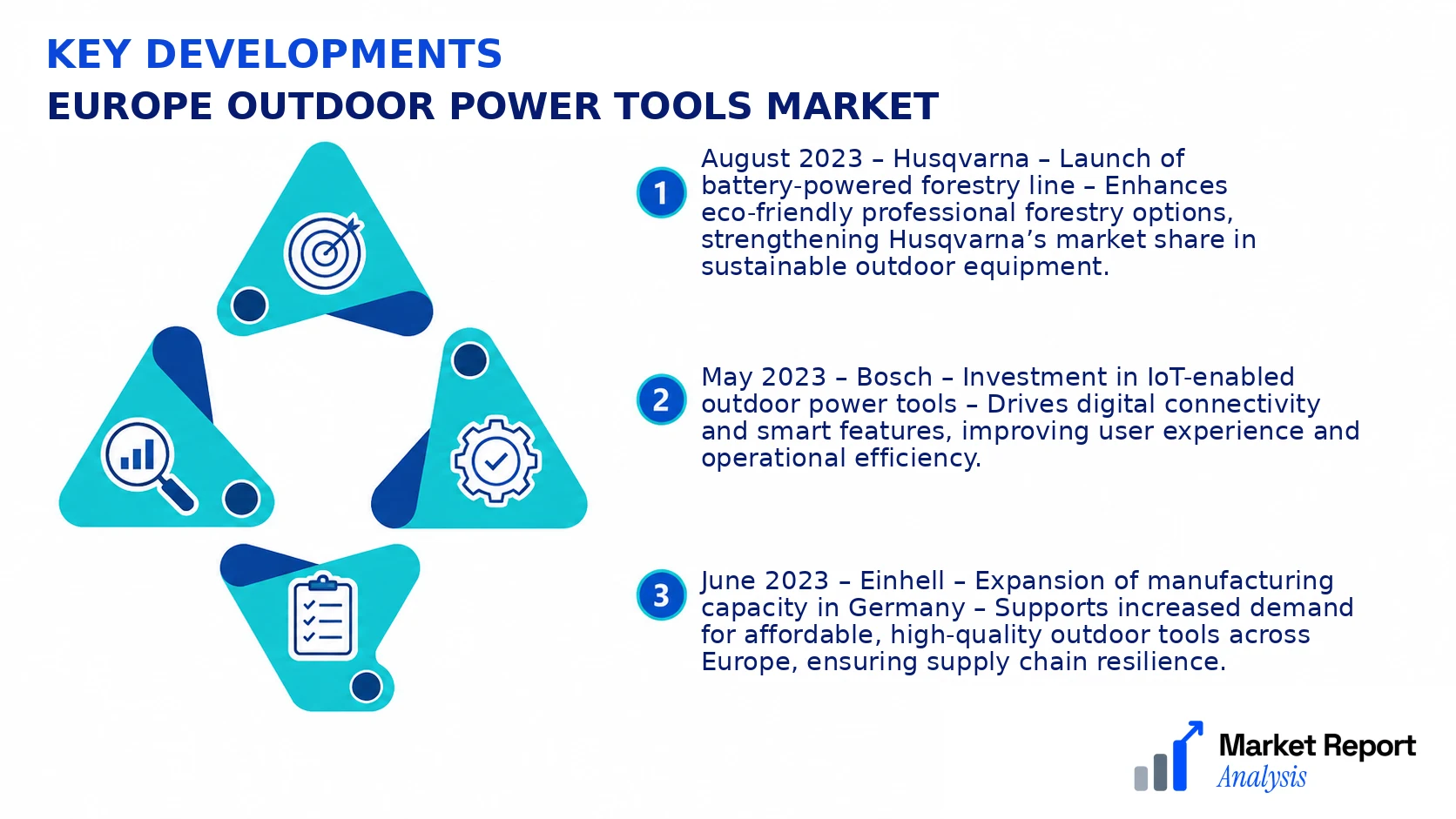
- August 2023 – Husqvarna – Launch of battery-powered forestry line – Enhances eco-friendly professional forestry options, strengthening Husqvarna’s market share in sustainable outdoor equipment.
- May 2023 – Bosch – Investment in IoT-enabled outdoor power tools – Drives digital connectivity and smart features, improving user experience and operational efficiency.
- June 2023 – Einhell – Expansion of manufacturing capacity in Germany – Supports increased demand for affordable, high-quality outdoor tools across Europe, ensuring supply chain resilience.
- April 2023 – Black & Decker – Introduction of a new cordless lawn mower – Offers consumers a lightweight, eco-friendly yard care solution aligned with sustainability trends.
- September 2023 – RYOBI – Strategic alliance with a European battery manufacturer – Facilitates development of longer-lasting, faster-charging cordless tools for residential markets.
Frequently Asked Questions
What is the Europe Outdoor Power Tools Market?
The Europe Outdoor Power Tools Market encompasses a wide range of portable, handheld, and robotic tools powered by electricity, petrol, or batteries, designed for landscaping, gardening, and outdoor maintenance activities across European countries, catering to both professional and consumer segments.
What is the current market size of Europe Outdoor Power Tools Market?
As of 2026, the market size is valued at approximately USD 4.75 Billion, reflecting significant growth driven by increasing demand for efficient outdoor maintenance equipment and a surge in gardening activities, especially amid rising urbanization and lifestyle changes among consumers.
What factors are driving the Europe Outdoor Power Tools Market?
Key growth drivers include technological innovations such as battery-powered solutions, rising consumer disposable income, growing awareness of eco-friendly products, expanding urban landscaping projects, and governmental initiatives promoting sustainable gardening practices across Europe.
Which region dominates the Europe Outdoor Power Tools Market?
Western Europe, led by countries like Germany, France, and the UK, currently dominates due to high urbanization levels, robust retail infrastructure, and prevalent outdoor gardening culture that sustains high demand for advanced power tools.
Which segment is expected to grow the fastest?
The battery-powered segment is anticipated to exhibit the highest CAGR through 2034, driven by technological advancements, declining battery costs, and increasing consumer preference for portable, low-maintenance, and environmentally friendly outdoor tools.
Who are the leading companies operating in the Europe Outdoor Power Tools Market?
Major players include Bosch, Husqvarna, Stihl, Black & Decker, and Makita, who dominate through innovative product offerings, regional distribution networks, strategic partnerships, and ongoing R&D efforts to meet evolving customer needs.
Analyst Perspective
The Europe outdoor power tools market is projected to attain a mature yet dynamic state by 2034, presenting attractive opportunities driven by technological innovation and evolving consumer preferences. Advances such as battery-powered innovations, smart technology integration, and eco-friendly designs are set to redefine product offerings and enhance user experience. Investment priorities should focus on R&D to accelerate these technological evolutions, particularly in cordless and hybrid models that offer greater convenience and sustainability. Competitive intensity will intensify with established players expanding product portfolios and new entrants leveraging technological disruptions, fostering a highly innovative environment. Regional growth potential remains robust in Western Europe due to high urbanization rates and a growing preference for DIY activities, whereas Eastern Europe presents opportunities for market penetration and volume growth fueled by increasing disposable incomes. Long-term strategic positioning requires companies to balance innovation with cost competitiveness and regional customization, positioning themselves for sustainable growth amidst shifting regulatory landscapes and consumer demands.
