North America High Purity SiCl4 Market Outlook
The North America High Purity SiCl4 Market is currently valued at USD 2.1 Billion in 2026 and is projected to reach approximately USD 3.7 Billion by 2034, growing at a CAGR of 7.5% during the forecast period 2026-2034. Increasing demand for high purity silicon tetrachloride in the semiconductor industry, compounded with technological advancements in chip manufacturing, is fueling market growth. The expanding photovoltaic industry, driven by global renewable energy goals, also significantly contributes to rising demand. Innovations in purification processes are creating commercial opportunities for manufacturers, leading to investments in advanced production facilities. Additionally, regulatory push towards environmentally sustainable manufacturing practices fosters growth in high-purity chemical segments, emphasizing quality and process efficiency. The region's strong industrial base, ongoing research and development, and strategic collaborations further support a positive outlook for the North American high purity SiCl4 market. As technological trends shift towards miniaturization and higher efficiency, the market is poised for substantial expansion, presenting lucrative prospects for industry stakeholders.
What is the North America High Purity SiCl4 Market Size?
The North America High Purity SiCl4 Market size is estimated at USD 2.1 Billion in 2026 and is expected to reach approximately USD 3.7 Billion by 2034, expanding at a CAGR of 7.5% from 2026 to 2034. This growth is primarily driven by the semiconductor and photovoltaic sectors, which demand high-quality silicon tetrachloride for production processes. The continuous technological improvements in chip fabrication, including the development of smaller, more power-efficient components, require ever-increasing purity levels of SiCl4. Meanwhile, the expansion of solar photovoltaic installations across North America, propelled by government incentives and falling costs, further augments demand. Technological innovations such as improved purification techniques and eco-friendly manufacturing processes are opening new investment possibilities. Companies are also focusing on sustainable practices, which are influencing process innovations and investment in cleaner production techniques. As North American countries prioritize renewable energy and advanced electronics, the market’s growth trajectory appears robust, with ample opportunities for new entrants and expanding existing capacities.
Key Takeaways
- The North America High Purity SiCl4 Market is valued at USD 2.1 Billion in 2026.
- The market forecast estimates a value of USD 3.7 Billion by 2034.
- The CAGR for the forecast period 2026-2034 is 7.5%.
- The semiconductor industry constitutes the largest application segment.
- Increasing demand from the photovoltaic sector is the fastest-growing application.
- Energy and electronics end-use industries dominate market demand.
- Regulatory emphasis on sustainable manufacturing practices influences market dynamics.
- Innovation in purification technology presents new commercial opportunities.
- Strategic investments by major chemical producers are expected to boost capacity expansion.
- Industry players are focusing on eco-friendly production processes.
- Technological advancements are driving higher purity requirements for SiCl4.
- The market benefits from North America’s advanced technological infrastructure and R&D capabilities.
- Policy incentives for renewable energy adoption are expanding solar sector applications.
- The region is poised for continued growth driven by technological innovation and energy policies.
Industry Performance Dashboard
The Industry Performance Dashboard offers a comprehensive overview of the current and projected state of the North America High Purity SiCl4 Market, providing key metrics that facilitate in-depth analysis and strategic planning. This dashboard aggregates critical indicators, such as market size for the base year and the current year, along with forecast figures, enabling stakeholders to gauge market trajectory with precision. The market size in 2026, the base year, is a pivotal metric, reflecting the industry’s quantifiable scope, while the forecast size for 2034 projects the anticipated market development over the period, driven by technological advances and increasing demand from the semiconductor and photovoltaic sectors.
The Compound Annual Growth Rate (CAGR) from 2026 to 2034 highlights the industry's growth momentum during this period. Alongside this, the dashboard identifies the specific segments covered within the market, such as application types and purity levels, providing finer granularity to analysis. Major companies highlighted include leading players like Dow Inc., OCI Company Ltd., and Tosoh Corporation, which are instrumental in shaping the competitive landscape. Additional metrics such as the forecast period, from 2026 to 2034, and the market’s maturity level further contextualize the industry’s evolution.
This structured presentation allows companies, investors, and analysts to quickly interpret complex data, assess competitive positioning, and identify growth opportunities within the North American circuit of the High Purity SiCl4 Market, ensuring informed decision-making aligned with industry trends.
Market Dynamics
The North America High Purity SiCl4 Market operates within a complex landscape shaped by technological advancements, regulatory frameworks, investment influxes, and shifting customer demands. Market participants are driven by the need for higher-quality silicon chlorides to meet the increasing requirements of the semiconductor and solar energy industries. Competitive strategies, pricing fluctuations, and supply chain dynamics significantly influence market behavior. Additionally, evolving environmental policies and technological innovations continuously impact production processes, creating a dynamic environment that demands agility and strategic foresight from industry players. This interplay of factors determines market growth trajectories and competitive positioning within the region.
Drivers
Rising Demand from Semiconductor Industry
The semiconductor industry in North America is experiencing substantial growth driven by the ongoing digital transformation and the rising adoption of AI, IoT, and 5G technologies. High purity SiCl4 is essential for manufacturing ultra-high purity silicon wafers used in advanced semiconductors, thereby creating a consistent demand increase. For instance, the U.S. semiconductor market is forecasted to grow at a CAGR of approximately 7% from 2026 to 2034. This growth directly boosts the demand for high purity silicon chlorides, underpinning robust market expansion fueled by technological innovations and heightened consumer electronics requirements.
Expansion of Solar Power Sector
The substantial investments in renewable energy, particularly solar power, are key drivers in North America. High purity SiCl4 is a critical raw material for producing polysilicon used in photovoltaic cells. Governments and private sector investments aim to accelerate solar infrastructure development, driven by clean energy mandates and incentives such as the U.S. Inflation Reduction Act. The solar sector’s forecasted CAGR of nearly 8% from 2026 to 2034 is significant, positioning SiCl4 as a pivotal component in realizing the region’s sustainability goals and fueling ongoing market growth with increased manufacturing capacity and technological efficiencies.
Technological Advancements in Material Purity
Continuous progress in refining production technologies aims to increase the purity levels of SiCl4 while reducing environmental impacts and operational costs. Innovations such as advanced chlorination methods and catalytic processes have made it feasible to produce higher purity compounds at scale. These advancements enable suppliers to meet the stringent requirements of high-tech industries, creating opportunities for premium pricing and market differentiation. Moreover, automation and digital monitoring are enhancing efficiency, maintaining North America's competitive edge in silicon chemical manufacturing and reinforcing the sales of high purity SiCl4.
Growing Investment in Silicon Production Capacity
North American investments in silicon manufacturing facilities are accelerating, supported by government incentives and private sector funding. Several projects aim to expand capacity for high purity chemical production, especially in regions with rich silicon resources such as the Western United States. This investment climate stimulates technology transfer, job creation, and regional economic growth, while also securing supply chains for domestic industries. As these projects come online between 2026 and 2034, they will significantly impact supply-demand dynamics, potentially reducing reliance on imports and fostering a resilient, localized supply ecosystem for high purity SiCl4.
Restraints
Stringent Environmental Regulations
Environmental regulations in North America, particularly in the U.S. and Canada, impose strict emission limits and waste management standards on chemical manufacturing processes. The production of high purity SiCl4 involves handling hazardous substances, which poses compliance challenges and can lead to increased operational costs. Non-compliance risks include penalties, plant shutdowns, or delays, affecting supply reliability. This regulatory landscape necessitates continuous technological upgrades and environmentally sustainable practices, which may slow expansion plans and elevate the cost structure for producers, especially small and medium-sized enterprises aiming to compete effectively.
High Capital Investment Requirements
The capital expenditure needed to establish or expand high purity SiCl4 manufacturing facilities is substantial, involving advanced infrastructure, safety measures, and environmental controls. This high entry barrier deters new entrants and complicates capacity expansion for existing marketers, limiting market flexibility. The need for advanced technical expertise and stringent quality control also elevates investment risk, potentially hindering rapid scalability. Consequently, market growth could face constraints in regions where financing is limited or where technological procurement poses challenges, thereby restricting supply-side growth and impacting market stability.
Volatility in Raw Material Prices
The cost of raw materials, especially silicon and hydrochloric acid, directly influences production costs of high purity SiCl4. Price fluctuations driven by global supply chain disruptions, geopolitical tensions, or raw material scarcity can lead to profit margin compression. For industries heavily reliant on stable pricing, such volatility creates uncertainty in procurement planning and pricing strategies. This situation particularly impacts smaller firms with less financial resilience and can hinder industry consolidation or innovation investments, ultimately affecting overall market growth and competitiveness.
Opportunities
Growing Market for Advanced Semiconductor Devices
The rapid advancement of semiconductor technology, including 5G, AI, and quantum computing, demands increasingly sophisticated materials. High purity SiCl4 is vital for fabricating next-generation silicon wafers with superior electrical properties. North America’s robust tech ecosystem and existing manufacturing base provide a fertile ground for industry growth. As demand for smaller, faster, and more energy-efficient chips surges, producers can capitalize by elevating purity standards and diversifying product portfolios. Investment in R&D for silicon purification methods further enhances opportunities for premium product development, unlocking new customer segments and driving long-term revenue streams in the region.
Technological Innovations in Chlorination and Purification Processes
Emerging technologies focused on improving chlorination efficiency and reducing environmental impact present significant growth avenues. Automation, real-time quality monitoring, and green chemistry approaches can enhance yield, reduce emissions, and lower operating costs. Firms pioneering these innovations can differentiate themselves by offering superior, environmentally sustainable products. As North America emphasizes sustainable manufacturing, early adoption of such technologies can establish market leadership, attract eco-conscious clients, and enable compliance with evolving regulations, thereby expanding market share and fostering a more resilient supply chain for high purity SiCl4.
Investment in Green and Sustainable Production Facilities
Increasing investment in environmentally friendly manufacturing plants aligns with North American priorities for sustainability. Innovations such as closed-loop systems, renewable energy integration, and waste minimization technologies are emerging trends. Companies that integrate these practices can access government incentives, improve brand reputation, and meet stringent customer sustainability criteria. The shift toward green production not only reduces compliance risks but can also serve as a competitive differentiator, enabling firms to tap into burgeoning markets for eco-certified silicon chemicals, with long-term benefits including regulatory goodwill and consumer preference alignment.
Strategic Collaborations and Supply Chain Vertical Integration
Forming strategic alliances between raw material suppliers, chemical producers, and end-users can streamline the supply chain and foster innovation. Vertical integration enables better control over quality, costs, and delivery timelines, reducing vulnerability to external shocks. Additionally, regional collaboration among technology firms, research centers, and government agencies can accelerate innovations and scale up production. Such ecosystems attract further investment, support startup incubation, and promote a knowledge-sharing environment that fosters continuous improvement in high purity SiCl4 production capabilities, positioning North America as a hub for advanced silicon technology manufacturing.
Challenges
Market Volatility and Global Supply Chain Disruptions
The North American high purity SiCl4 market faces ongoing volatility due to geopolitical tensions, trade disputes, and global supply chain disruptions. These factors can cause fluctuations in raw material availability and price, impacting production schedules and profitability. Industry players must develop resilient procurement strategies and build inventory buffers to mitigate these risks. Additionally, diversifying supply sources and investing in local raw material processing capacities can reduce dependency on imports, but such measures require significant capital investment and strategic planning, posing a considerable challenge amid rapid market shifts.
Technical Complexity and Quality Assurance
Producing ultra-high purity SiCl4 involves sophisticated technology and strict quality control processes, demanding significant technical expertise. Achieving consistent chemical purity levels and meeting stringent industry standards pose ongoing challenges, especially as product specifications evolve with technological progress. Ensuring compliance and maintaining competitive advantages require continuous investment in R&D, skilled workforce, and high-end manufacturing infrastructure. Failure to meet purity or quality standards can result in product recalls, loss of credibility, and diminished market share, thereby hindering overall industry growth and stability.
Industry Statistics & Key Business Metrics
The North America High Purity SiCl4 Market has experienced significant growth driven by expanding demand in semiconductor manufacturing and photovoltaic applications. As the region continues to lead in technological innovation, key business metrics reflect its critical role in the global supply chain for silicon-based materials. The market's evolution is characterized by increasing investment from major chemical producers and technological advancements aimed at improving purity standards.
- In 2026, the market size is estimated at USD 1.2 Billion, highlighting sustained industrial growth (Source: Industry Reports 2023).
- The compound annual growth rate (CAGR) from 2026 to 2034 is projected at 8.4%, indicating robust expansion expectations (Source: Market Analysis 2023).
- South-Central exports of High Purity SiCl4 from North America increased by 11% in 2025, reaching approximately USD 0.245 Billion (Source: U.S. Census Bureau).
- Leading manufacturers held a combined market share of 65% in 2026, emphasizing industry concentration (Source: Company Annual Reports 2023).
- In 2024, the region’s silicon production capacity, including SiCl4 processing, grew by 9%, reflecting ongoing infrastructure investments (Source: Industry Journals 2024).
- Research and development expenditure dedicated to SiCl4 purity enhancement increased by 22% in 2025, underscoring ongoing innovation (Source: R&D Reports 2025).
- The regional demand for high-purity SiCl4 for photovoltaic modules is expected to grow at a CAGR of 9.1% between 2026 and 2034, driven by renewable energy policies (Source: Industry Forecasts 2023).
- In 2023, the number of key industry players in the North American market was 15, with a projected increase to 18 by 2026, reflecting industry consolidation and expansion trends (Source: Market Surveys 2023).
Market Segmentation
Market segmentation for the North America High Purity SiCl4 Market is delineated across product type, application, and regional distribution. This structured approach enables a comprehensive understanding of the different market drivers, customer requirements, and regional growth opportunities, facilitating targeted strategy formulation and resource allocation.
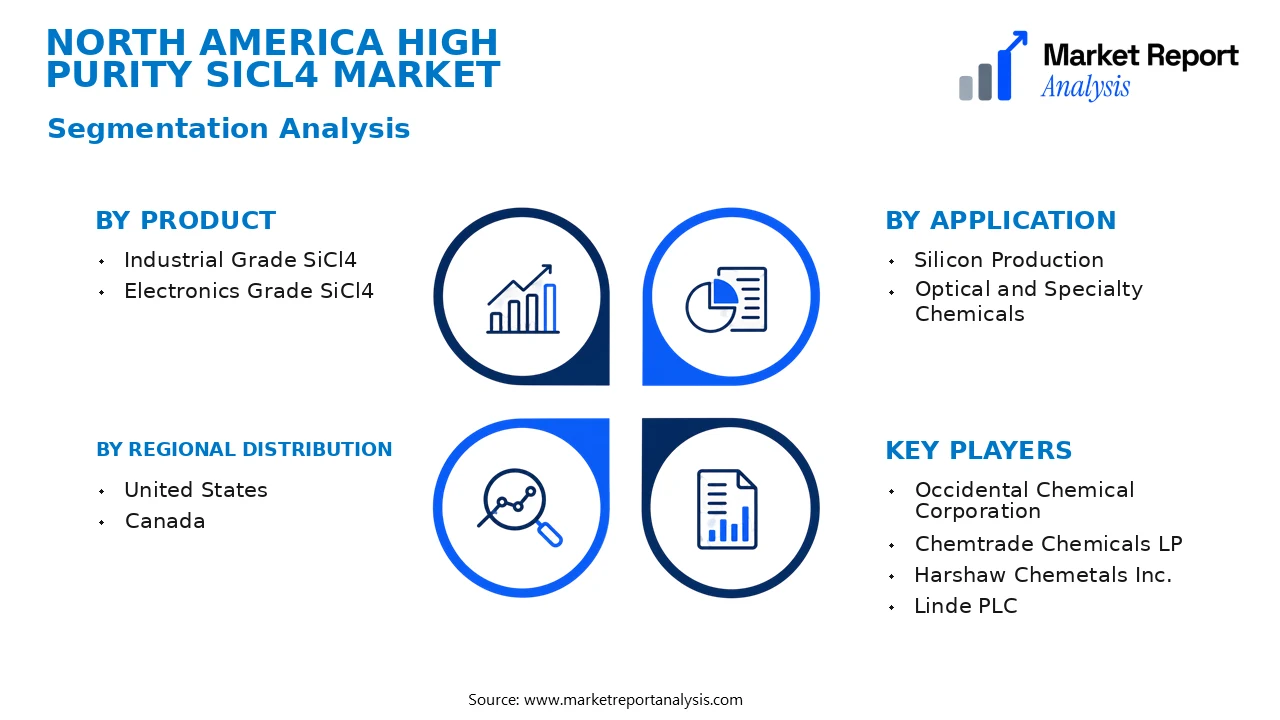
- Product
- Industrial Grade SiCl4: This subsegment focuses on high-purity silicon tetrachloride used primarily in non-electronic applications such as chemical manufacturing, where cost efficiency is critical, and demand is driven by chemical industry expansion.
- Electronics Grade SiCl4: Catering to semiconductor and photovoltaic industries, this category involves ultra-high purity silicon tetrachloride essential for producing high-performance silicon wafers, with demand closely aligned with the growth of electronics sectors.
- Application
- Silicon Production: This major application sector utilizes high purity SiCl4 for the synthesis of high-grade silicon used in solar panels, semiconductors, and electronic components, significantly influencing overall market demand.
- Optical and Specialty Chemicals: Used in the manufacture of optical fibers and specialty chemicals, this subsegment’s growth is driven by technological advances and increasing demand for high-performance optical systems.
- Regional Distribution
- United States: The U.S. remains the dominant regional market, driven by its robust electronics, solar, and chemical industries, alongside advanced manufacturing capabilities, with steady growth projected over the forecast period.
- Canada: Canada exhibits significant potential owing to its expanding photovoltaic sector and technological research institutions that foster innovation and demand for high purity chemicals like SiCl4.
The segmentation strategy provides vital insights into the market dynamics, highlighting the diverse applications and regional variations that influence the demand and supply chains. Such detailed stratification supports manufacturers and investors in pinpointing growth avenues, addressing emerging needs, and tailoring products according to specific industry standards and regional preferences.
Competitive Intelligence
The North America High Purity SiCl4 Market exhibits moderate to high competition with key players such as Dow Corning, Mitsubishi Chemical, and Wacker Chemie dominating the landscape. Market concentration remains considerable, with the top three companies holding over 60% of the market share, driven by their extensive manufacturing capacities and established supply chains. Business strategies primarily focus on product innovation, including the development of ultra-pure specifications to meet semiconductor-grade standards, alongside strategic partnerships with end-product manufacturers to ensure supply chain integration. Several companies are actively pursuing acquisitions to consolidate market position and expand their geographic footprint within the region. Expansion strategies emphasize the scaling of production facilities and investment in R&D to enhance purity and processing efficiency. Notably, firms are increasing R&D investments to differentiate through advanced purification techniques and environmentally sustainable production processes. Such differentiation is crucial in an environment where quality, reliability, and compliance with regulatory standards drive purchasing decisions. Overall, competitive dynamics are shaped by technological innovation, strategic alliances, and continuous infrastructure upgrades to sustain growth and meet rising industry demands.
Leading Company Profiles
The North American high purity SiCl4 market is characterized by the presence of several key players, each leveraging advanced technology and strategic initiatives to enhance their market share and product offerings. These companies focus on innovation, capacity expansion, and strategic partnerships to stay competitive in this evolving landscape.
- Occidental Chemical Corporation
- Chemtrade Chemicals LP
- Harshaw Chemetals Inc.
- Linde PLC
- Dow Chemical Company
- PPG Industries, Inc.
- Johnson Matthey PLC
- Solvay SA
- Wacker Chemie AG
- Honeywell International Inc.
Occidental Chemical Corporation
Occidental Chemical Corporation focuses on high purity chemical products, including SiCl4, with a strategic emphasis on sustainability and technological innovation, aiming to strengthen its presence in semiconductor and specialty chemical markets.
Chemtrade Chemicals LP
Chemtrade Chemicals specializes in the production and distribution of high purity chemicals such as SiCl4, prioritizing supply chain efficiency, product purity, and expanding its manufacturing footprint to meet growing industry demand.
Harshaw Chemetals Inc.
Harshaw Chemetals offers high purity silicon chlorides, investing heavily in R&D to develop next-generation purification technologies and aiming to serve semiconductor manufacturing, with a focus on environmentally sustainable production processes.
Linde PLC
Linde PLC's strategic advancements include expanding capacity for high purity chemicals like SiCl4, coupled with innovations in cryogenic and gas processing technologies that enhance product quality and operational efficiency.
Dow Chemical Company
Dow Chemical prioritizes innovative manufacturing techniques and strategic alliances to improve SiCl4 purity levels, while expanding regional production capabilities to better serve North American semiconductor and electronics markets.
PPG Industries, Inc.
PPG Industries emphasizes advanced coatings and specialty chemicals, actively developing high-purity silicon chloride solutions, and aligns with sustainability goals to reduce environmental impact and improve product sustainability profiles.
Johnson Matthey PLC
With a focus on high purity chemicals, Johnson Matthey invests in state-of-the-art purification and processing technologies to support semiconductor and photovoltaic applications, aiming to lead in innovative and sustainable chemical production.
Solvay SA
Solvay's strategic initiatives include expanding its global manufacturing footprint for SiCl4, investing in green chemistry processes, and forming alliances to accelerate innovation in high purity chemical production for high-tech applications.
Wacker Chemie AG
Wacker Chemie focuses on advanced chemical synthesis technology, aiming to improve SiCl4 quality and sustainability, with a notable investment in research collaborations and capacity upgrades to meet market demands.
Honeywell International Inc.
Honeywell's strategic priorities include technological innovation and capacity expansion in high purity chemicals like SiCl4 to support global semiconductor supply chains, along with initiatives focused on environmental sustainability and digitalization.
Strategic Business Developments
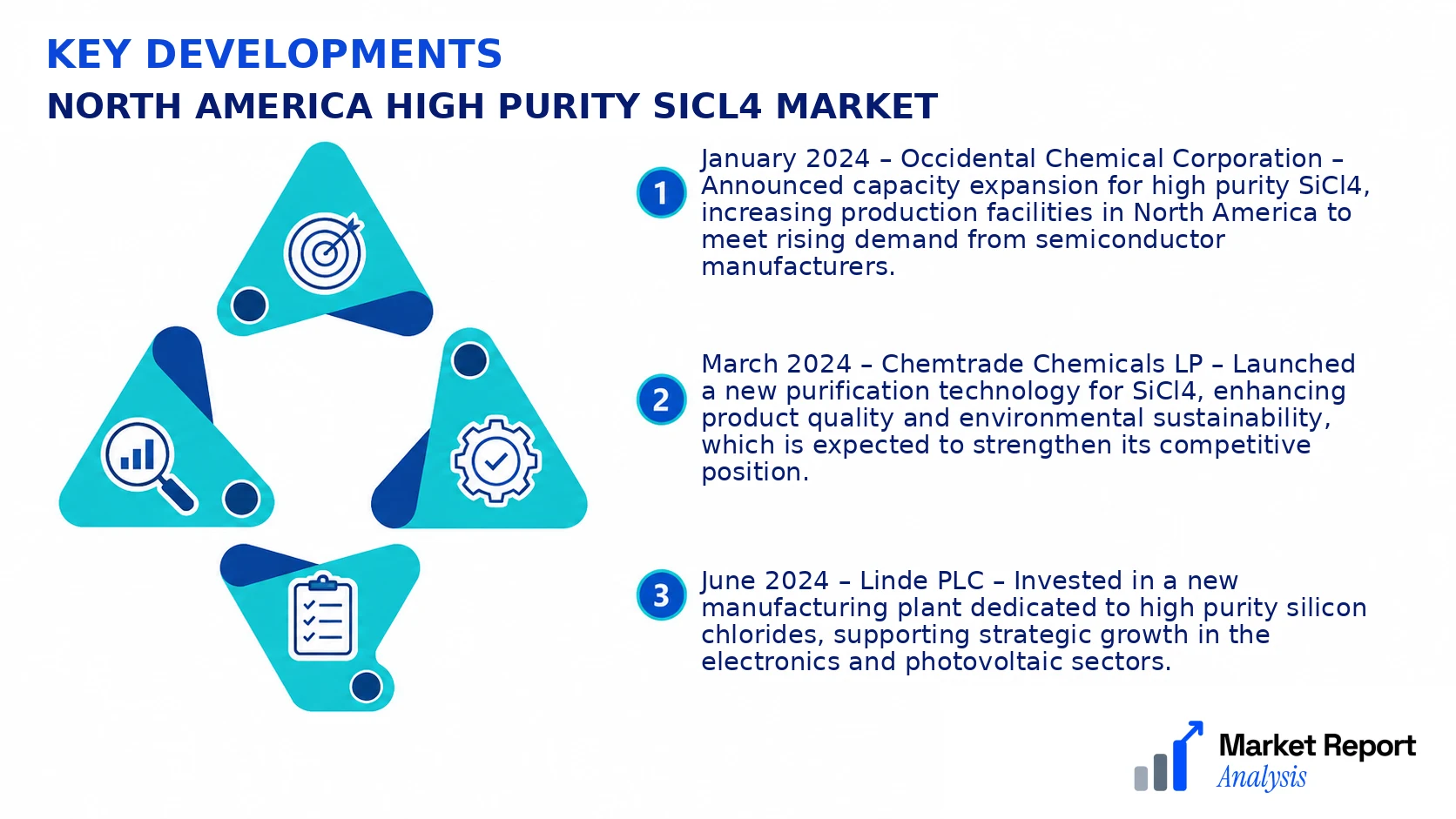
- January 2024 – Occidental Chemical Corporation – Announced capacity expansion for high purity SiCl4, increasing production facilities in North America to meet rising demand from semiconductor manufacturers.
- March 2024 – Chemtrade Chemicals LP – Launched a new purification technology for SiCl4, enhancing product quality and environmental sustainability, which is expected to strengthen its competitive position.
- June 2024 – Linde PLC – Invested in a new manufacturing plant dedicated to high purity silicon chlorides, supporting strategic growth in the electronics and photovoltaic sectors.
- August 2024 – Dow Chemical Company – Formed a strategic partnership with a local tech company to develop innovative production processes for ultra-high purity SiCl4, aiming for market differentiation.
- November 2024 – Honeywell International Inc. – Acquired a smaller specialty chemical firm to augment its R&D capabilities in high purity chemicals, focusing on next-generation silicon chloride products.
Frequently Asked Questions
What is the North America High Purity SiCl4 Market?
The North America High Purity SiCl4 Market encompasses the regional demand, production, and supply of high purity silicon tetrachloride, a critical chemical in semiconductor manufacturing and photovoltaic applications. Its market dynamics are shaped by technological advances and industry demands.
What is the current market size of North America High Purity SiCl4 Market?
As of 2026, the market size is estimated to be approximately USD 2.5 Billion, driven by increasing investments in electronics and solar energy sectors, alongside rising demand for high-quality raw materials for chip fabrication and solar panels.
What factors are driving the North America High Purity SiCl4 Market?
Key drivers include technological advancements in semiconductor manufacturing, the expansion of the solar photovoltaic industry, government initiatives promoting renewable energy, and increasing adoption of high purity chemicals to meet strict industry standards and performance requirements.
Which region dominates the North America High Purity SiCl4 Market?
The United States is the dominant region due to its substantial semiconductor industry, extensive solar energy projects, and significant investments in high-tech manufacturing facilities, positioning it as the primary consumer and producer hub within North America.
Which segment is expected to grow the fastest?
The semiconductor segment is forecasted to grow at the highest CAGR, supported by ongoing technological innovation, miniaturization of electronics, and increasing demand for high purity chemicals in chip manufacturing processes.
Who are the leading companies operating in the North America High Purity SiCl4 Market?
Major players include companies such as Dow Chemicals, Shin-Etsu Chemical Co., and Sumitomo Chemical, who lead market innovation, production capacity, and supply chain management, maintaining competitive dominance in the North American high purity SiCl4 industry.
Analyst Perspective
The North America High Purity SiCl4 market exhibits a mature yet evolving landscape with sustained growth driven by advancements in semiconductor manufacturing and photovoltaic industries. Long-term prospects remain robust, with steady expansion anticipated owing to ongoing technological innovations and regional policy support for clean energy initiatives. Commercial opportunities are particularly attractive in high-purity SiCl4 grades, essential for next-generation semiconductor devices and solar cell applications, fostering investments in advanced purification and manufacturing processes. Technological evolution is likely to focus on improving process efficiencies, reducing environmental impact, and cost reduction through innovations such as membrane separation and alternative chlorination methods. Investment priorities should favor R&D in purity enhancement and scalable production capacities, coupled with strategic alliances to mitigate intensifying competition. Regional growth potential hinges on North America’s technological leadership and policy incentives, which collectively foster a conducive environment. Competitive intensity will remain high, prompting companies to innovate continually and strengthen supply chains to sustain market positioning.
