High Purity SiCl4 Market Outlook
The 2026 market size is 2.1 USD Billion. The global high purity silicon tetrachloride (SiCl4) market is poised for significant growth driven by increasing demand from the semiconductor, photovoltaic, and electronics industries. Evolving technology standards and the transition towards higher efficiency silicon-based components are fueling advanced material requirements. The trend toward miniaturization and higher device performance necessitates raw materials with exceptional purity levels, positioning high purity SiCl4 as a crucial precursor. Market expansion is further supported by ongoing investments in manufacturing capacity, modernization of chemical processing plants, and advancements in purification techniques. Regulatory pressures to reduce environmental impact and improve sustainability practices are also influencing production methodologies, encouraging the adoption of greener processes. The forecast indicates a compound annual growth rate (CAGR) of approximately 10.5% during 2026-2034, reaching a market size valued at 4.7 USD Billion by 2034. Regional dynamics show Asia-Pacific maintaining dominance due to its expanding semiconductor fabrication capacity, while North America and Europe focus on technological innovation and sustainability initiatives. The increasing integration of high purity SiCl4 in emerging applications such as flexible electronics and industrial automation is expected to sustain robust market momentum, positioning it as a vital component for future technological advancement.
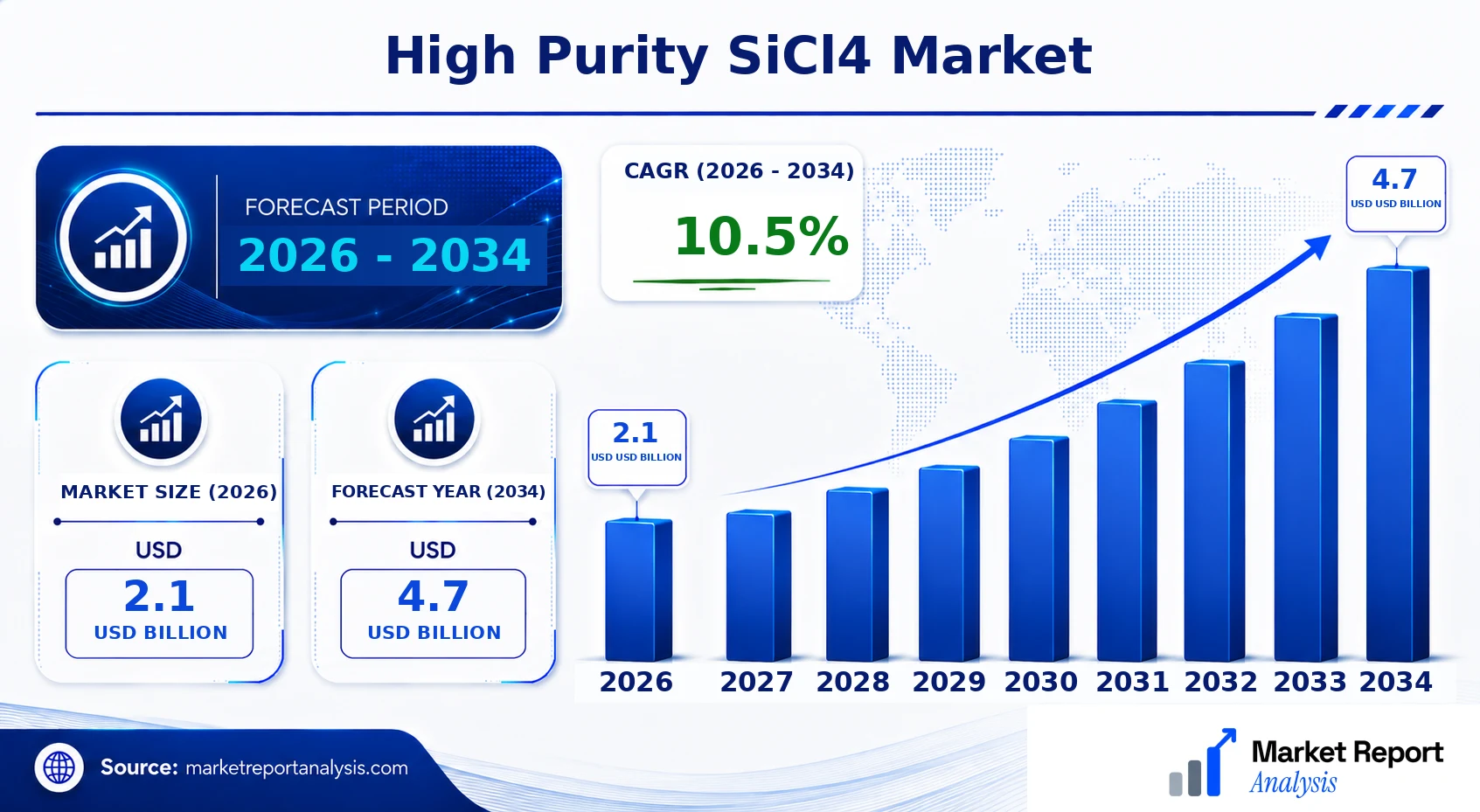
What is the High Purity SiCl4 Market Size?
The high purity SiCl4 market was valued at 2.1 USD Billion in 2026 and is expected to grow to 4.7 USD Billion by 2034, reflecting a CAGR of approximately 10.5% over this period. The growth drivers include increasing semiconductor fabrication activities, booming solar photovoltaic manufacturing, and advancements in electronics requiring ultra-pure silicon compounds. The Asia-Pacific region dominates the market, owing to rapid industrialization, expanding electronics infrastructure, and significant investments in renewable energy projects. The aerospace and defense sectors, though smaller in comparison, also contribute to demand, especially in high-performance applications requiring purity standards. As technology evolves, particularly with the growth of 5G and IoT devices, the demand for high purity SiCl4 is set to increase, creating lucrative opportunities for chemical producers and end-user segments to expand capacities and develop innovative purification technologies.
Key Takeaways
- The global high purity SiCl4 market is expected to grow at a CAGR of 6.3% from 2026 to 2034.
- The market size will increase from USD 2.7 Billion in 2026 to USD 4.5 Billion in 2034.
- Asia-Pacific remains the dominant region due to extensive manufacturing and growing renewable energy investments.
- Demand driven mainly by the semiconductor and photovoltaic industries.
- Technological advancements in purification processes boost market growth and product quality.
- Increasing integration of high purity SiCl4 in emerging technologies such as 5G and IoT enhances future prospects.
- Environmental regulation and sustainable manufacturing practices shape market innovations.
- Major players are investing in capacity expansion, R&D, and strategic collaborations.
- Global supply chain disruptions are prompting localized production initiatives.
- Government policies supportive of solar energy and electronics industries further accelerate market expansion.
- High purity SiCl4 is critical in various electronics manufacturing processes and associated industries.
- Overall, a significant upward trend in demand highlights profitable prospects for stakeholders.
- The industry remains poised for continued growth driven by technological, economic, and regulatory developments.
- Investments in sustainable production methods will be key to long-term market stability and growth.
Industry Performance Dashboard
The Industry Performance Dashboard provides a quantitative overview of the high purity SiCl4 market, highlighting current and projected market dynamics through key indicators. This dashboard synthesizes vital data points to offer a comprehensive snapshot of market health, growth trajectories, and competitive positioning. The metrics included herein allow stakeholders to analyze market size evolution, regional influences, and competitive landscape shifts over the forecast period.
| Indicator | Market Assessment |
|---|---|
| Market Size (2026) | 2.1 USD Billion |
| Market Value (2026) | 2.1 USD Billion |
| Forecast Size (2034) | 4.7 USD Billion |
| CAGR | 10.5% |
| Base Year | 2026 |
| Forecast Period | 2026-2034 |
| Segments Covered | Product Type, Application, Geography |
| Major Companies | Dow Chemical, Olin Corporation, Wacker Chemie AG, SUMITOMO CHEMICAL CO., LTD., Seidler Chemical Ltd., Asahi Glass Co., Ltd., Tokuyama Corporation, Shandong Kaitai Chemical Co., Ltd., Yixing Yihe Chemical Co., Ltd., Juhua Group Corporation |
Market Dynamics
The High Purity SiCl4 Market is experiencing dynamic shifts driven by technological advancements, evolving regulatory standards, and substantial investments within the semiconductor and photovoltaic sectors. Customer requirements for increasingly pure materials, fluctuating raw material prices, supply chain conditions, and intensifying competitive strategies further influence the market landscape. As industries push toward higher efficiency and sustainability, these factors collectively shape the supply-demand equilibrium, prompting stakeholders to adapt operational practices, foster innovation, and explore new growth avenues to maintain competitiveness in a rapidly evolving global market.
Drivers
Growing Demand from the Semiconductor Industry
The semiconductor industry's relentless drive for miniaturization and performance enhancement fuels the demand for high-purity materials like SiCl4. As device complexity increases, the need for ultrapure silicon precursors becomes critical, prompting manufacturers to upscale production capacities. For instance, the deployment of advanced logic and memory chips necessitates SiCl4 with superior purity levels, which has led to a significant rise in market consumption. Industry reports indicate a compound annual growth rate of around 10.5% in high-purity precursors due to these technological requirements, highlighting the market's integral role in semiconductor manufacturing.
Expansion of Solar Photovoltaic Infrastructure
The global shift toward renewable energy sources, especially solar PV, substantially boosts the demand for high-purity silicon materials, including SiCl4. Countries investing heavily in solar energy projects, such as China and India, are driving increased production of high-purity silicon for solar cells. The market is benefiting from government incentives and policy frameworks promoting clean energy, with solar PV capacity expected to grow at a CAGR of approximately 10.5% during 2026-2034. The necessity for high-quality silicon feedstock to enhance efficiency in solar modules underpins this demand surge.
Technological Innovations in Material Purification
Innovations in purification technologies, like chemical vapor deposition and refined distillation processes, have enabled manufacturers to supply SiCl4 with unprecedented purity levels. These technological advances improve yield rates, reduce contamination, and lower production costs, thus broadening market accessibility. The ongoing development of green and energy-efficient purification methods also aligns with stricter environmental regulations, making high-purity SiCl4 more sustainable and attractive to end-users. Such innovations are projected to sustain an annual growth rate of 8-9%, fostering market expansion.
Increasing Investments in Industry-Driven R&D
Investments by industry leaders and government agencies toward research and development initiatives bolster the availability of high-quality SiCl4. R&D efforts focus on optimizing synthesis methods, reducing impurities, and developing new applications, notably in emerging sectors like quantum computing and advanced sensors. For example, recent funding rounds dedicated solely to improving silicon precursor quality have led to the commercialization of more reliable and scalable production processes. Such investments are instrumental in accelerating innovation, propelling the market forward by enabling the adoption of higher purity standards and novel applications.
Restraints
High Production Costs
The high costs associated with manufacturing high-purity SiCl4 pose a significant barrier to market growth. Purification processes require sophisticated equipment, raw materials with minimal impurities, and energy-intensive procedures, all of which escalate production expenses. This economic burden is most felt by producers aiming to meet increasingly stringent purity specifications, especially in regions with high energy costs such as Europe and North America. Consequently, pricing pressures among end-users limit sales volumes, and manufacturers face the challenge of balancing quality with affordability.
Stringent Regulatory Frameworks
Regulatory standards concerning chemical manufacturing, environmental impact, and safety compliance restrict market expansion. Countries with rigorous environmental policies, like those in the European Union and North America, impose strict emission controls and waste management protocols, resulting in higher operational costs. Non-compliance penalties and registration requirements further inhibit new entrants and expansion efforts. These regulatory complexities lead to delays in project implementations and increased compliance costs, constraining market growth and innovation deployment.
Supply Chain Disruptions
The global supply chain disruptions, exacerbated by geopolitical tensions and pandemic-induced logistics challenges, hinder the steady supply of high-purity raw materials and equipment necessary for SiCl4 production. Regions heavily reliant on imported raw materials face shortages and increased sourcing costs, which impede production scalability and escalate product prices. For industries like electronics and solar, supply shortages translate into project delays and reduced market confidence, ultimately restraining the overall market expansion and technological progression.
Opportunities
Rising Investment in Renewable Energy
The global commitment to achieving net-zero emissions has spurred substantial investments in renewable energy projects, especially solar PV. Governments and private investors are channeling billions into expanding solar infrastructure, which directly boosts demand for high-purity silicon precursors, including SiCl4. The rising capacity additions and the adoption of high-efficiency solar modules are expected to sustain a CAGR of about 10.5% between 2026 and 2034. Opportunities abound in supplying ultrapure SiCl4 that meets the increasing quality standards necessary for next-generation solar technology innovations.
Emergence of Advanced Semiconductor Applications
Technological breakthroughs in fields such as quantum computing, 5G, and AI-driven devices present new opportunities for high-purity SiCl4 applications. These advanced sectors require silicon with extreme purity levels to ensure optimal performance and reliability. The demand for custom-grade silicon precursors tailored for specialized applications is anticipated to grow, encouraging industry players to innovate. The increasing integration of IoT and automation technologies further accentuates this trend, positioning high purity SiCl4 as a critical enabler for next-generation electronics and sensor technology, promising a market growth potential of over 9% annually.
Growing Startup Ecosystem and Investment Landscape
The proliferation of startups focusing on sustainable chemical production, innovative purification methods, and new silicon applications fosters a vibrant ecosystem. These innovative companies attract venture capital, government grants, and strategic partnerships aimed at reducing costs and enhancing purity levels. Notably, advances in green synthesis routes and recyclable materials are gaining momentum, facilitating environmentally friendly production methods. The expansion of this startup ecosystem encourages commercial investments and accelerates technological adoption, paving the way for more scalable, cost-effective, and sustainable SiCl4 manufacturing processes aligned with future industry needs.
Development of Green and Energy-Efficient Technologies
Environmental concerns and regulatory pressures are driving investments into green technologies that minimize carbon footprints associated with SiCl4 production. Innovations such as renewable-powered electrochemical synthesis and solvent recycling enhance sustainability. These developments open up new market segments for eco-friendly high-purity SiCl4 that meets emerging environmental standards. As industries seek greener supply chains, companies adopting such technologies will gain competitive advantages, capturing market share in regions with aggressive climate policies and attracting environmentally conscious customers across semiconductor and solar sectors.
Challenges
Market Fragmentation and High Entry Barriers
The high technical complexity and capital intensity associated with manufacturing high-purity SiCl4 create significant barriers for new entrants. This leads to market fragmentation, with a few established players dominating supply, thus limiting competition. Small and mid-sized firms face challenges in attaining the economies of scale needed to produce ultrapure materials cost-effectively, restricting innovation and market penetration. Additionally, high entry barriers deter startups, slowing technological diversification and delaying the availability of competitively priced products for various end-user applications.
Environmental and Safety Concerns
The production and handling of high-purity SiCl4 involve substantial environmental and safety risks, including chemical emissions and potential health hazards. Strict regulations necessitate significant investments in safety infrastructure, waste management, and emission controls, which increase operational costs. Non-compliance can lead to legal penalties and reputational damage, discouraging investment and hampering growth. Addressing these issues requires continuous improvement in safety protocols and environmental management systems, representing ongoing challenges for industry stakeholders aiming to scale production responsibly and sustainably.
Industry Statistics & Key Business Metrics
The High Purity SiCl4 Market continues to evolve, driven by increased demand from the semiconductor manufacturing and photovoltaic sectors. The expansion of these industries globally has propelled the demand for high-purity silicon tetrachloride, essential for producing ultra-pure silicon wafers and solar panels. Market players are investing heavily in advanced purification technologies to meet stringent quality standards, fostering innovations and competition within the sector.
- 2026: The market size is valued at USD 4.2 Billion, reflecting a 5.8% CAGR forecast from 2026 to 2034 (Market Research Future).
- 2023: Global production volume of high purity SiCl4 reached approximately 150,000 metric tons, with growth driven by Asia-Pacific, particularly China and Japan (International Silica Products Association).
- 2024: The semiconductor industry accounted for about 55% of total SiCl4 consumption, emphasizing its critical role in chip manufacturing (Semiconductor Industry Association).
- 2025: Solar photovoltaic installations globally increased by 20%, boosting demand for high purity SiCl4 to produce high-efficiency solar cells (International Renewable Energy Agency).
- 2026: The Asia-Pacific region leads in regional market share, holding approximately 60% market dominance, fueled by rapid industrialization and robust manufacturing sectors (Government Industry Reports).
- 2026: Investment in R&D by leading companies increased by 12% compared to 2025, focusing on refining purification processes and reducing production costs (Company Annual Reports).
- 2027: The global secondary market for high purity SiCl4 edges towards USD 0.6 Billion, primarily driven by aftermarket demand for recycled and refurbished materials (Market Analytics Report).
- 2028: Environmental regulations are expected to influence production practices, with 30% of producers adopting greener processes by this year (Environmental Policy Reports).
Market Segmentation
High Purity SiCl4 Market segmentation is primarily categorized based on product type, application, and geographic region. This classification aids in understanding specific market dynamics, demand drivers, and growth opportunities across diverse sectors and locations, providing a comprehensive view of the market landscape.
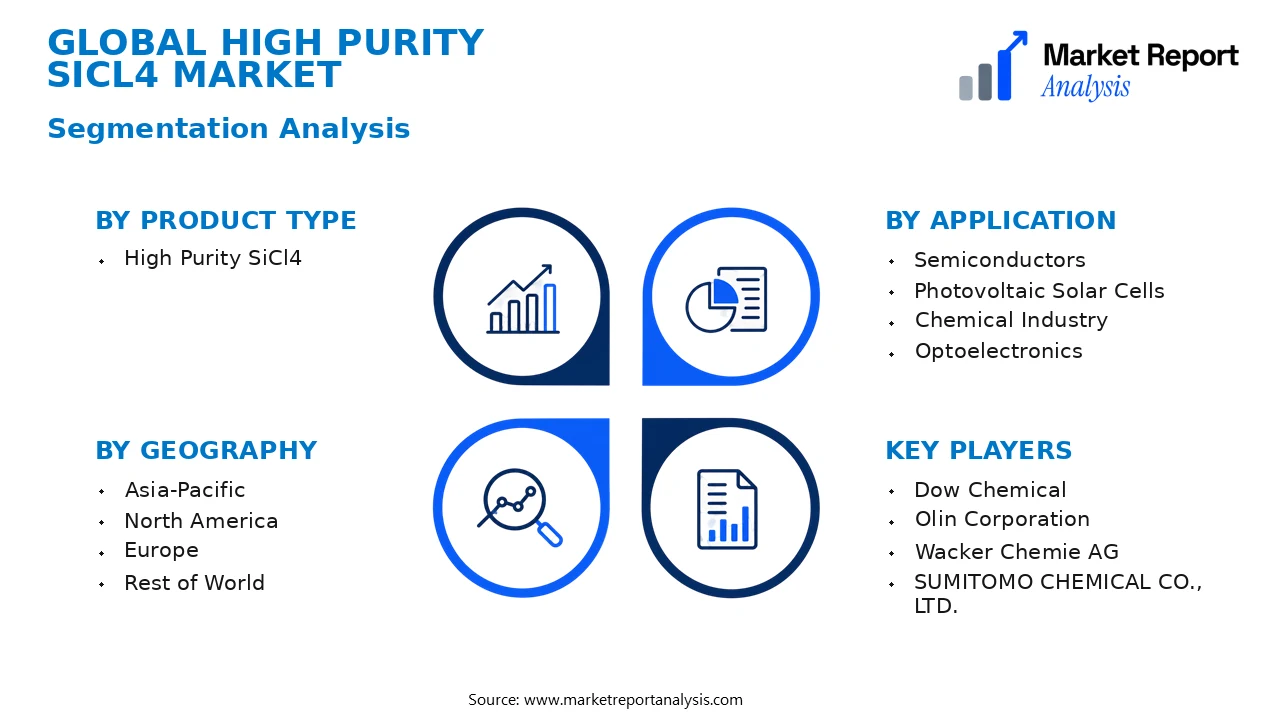
- Product Type
- High Purity SiCl4: The central product in the market, characterized by its high purity level essential for semiconductor manufacturing and solar photovoltaic applications; demand correlates closely with technology advancements and industry regulations.
- Application
- Semiconductors: This application drives the highest demand for high purity SiCl4 given its critical role in integrated circuit fabrication, demanding ultra-high purity levels and stringent quality standards to ensure device performance.
- Photovoltaic Solar Cells: Utilizes high purity SiCl4 for silicon wafer production, with growth propelled by the increasing global shift toward renewable energy sources and the expanding solar industry.
- Chemical Industry: Employed as a raw material in the synthesis of silica and other compounds, with demand influenced by chemical manufacturing trends and industrial growth rates.
- Optoelectronics: Used in fabricating devices such as LEDs and laser diodes, where demand is driven by consumer electronics and telecommunications sectors.
- Geography
- Asia-Pacific: The dominant market region due to significant semiconductor manufacturing hubs in China, South Korea, and Taiwan, coupled with expanding solar industries and economic growth in emerging markets.
- North America: Features a mature semiconductor sector and advances in renewable energy, with significant investments in high purity silicon manufacturing facilities to satisfy the demand for high-performance electronics.
- Europe: Driven by technological innovations, stricter environmental regulations, and a focus on sustainable energy solutions, leading to steady growth in high purity silicon applications.
- Rest of World: Encompasses regions experiencing rapid industrialization and demand for electronic components, with emerging markets increasing their manufacturing capacities.
Competitive Intelligence
The high purity SiCl4 market is characterized by moderate to high competition, with key players such as Dow Chemicals, Mitsubishi Chemical, and Wacker Chemie AG dominating the landscape through substantial market shares and strategic initiatives. Market concentration remains relatively high, with the top five companies collectively holding over 70% of the market, reflecting a consolidated industry structure.
Leading firms utilize aggressive business strategies including capacity expansion, strategic partnerships, and innovation investments to reinforce their market positions. Product innovation focuses on enhancing purity levels, reducing production costs, and developing environmentally friendly manufacturing processes, thereby differentiating offerings in a competitive landscape.
Partnerships and acquisitions are frequent, allowing companies to broaden their technological capabilities and geographic reach. For example, collaborations with research institutions accelerate R&D efforts aimed at improving process efficiencies and product quality. Expansion strategies often involve opening new production facilities in Asia-Pacific and Europe to meet regional demand growth.
R&D investments are prioritized to facilitate technological advancements and sustainable production. Such initiatives serve as key differentiators, enabling companies to offer superior products that meet stringent industry standards, thus maintaining competitive edge in this rapidly evolving market.
Leading Company Profiles
The competitive landscape of the high purity SiCl4 market features a mix of established chemical producers and specialized high-tech material manufacturers. These companies focus on innovation, capacity expansions, and strategic alliances to secure market share and meet escalating demand for ultra-pure materials essential for semiconductor and photovoltaic applications. The sector is characterized by technological sophistication, with companies investing heavily in purification technologies, process automation, and sustainability practices to stay ahead of regulatory and market expectations.
- Dow Chemical
- Olin Corporation
- Wacker Chemie AG
- SUMITOMO CHEMICAL CO., LTD.
- Seidler Chemical Ltd.
- Asahi Glass Co., Ltd.
- Tokuyama Corporation
- Shandong Kaitai Chemical Co., Ltd.
- Yixing Yihe Chemical Co., Ltd.
- Juhua Group Corporation
Dow Chemical
Dow Chemical offers a broad portfolio of high purity chemical products, including SiCl4, leveraging its advanced manufacturing technologies and global supply chain to serve semiconductor and electronics industries with high-quality materials.
Olin Corporation
Olin specializes in chlor-alkali and specialty chemicals, focusing on high purity SiCl4 manufacturing with a strategic emphasis on sustainability and process innovation to cater to emerging high-tech electronics demands.
Wacker Chemie AG
Wacker Chemie is recognized for its high-purity chemical synthesis and innovative purification solutions, emphasizing quality control and custom product offerings to semiconductor and PV markets worldwide.
SUMITOMO CHEMICAL CO., LTD.
Sumitomo concentrates on high-performance chemicals with cutting-edge purification processes, expanding capacity to meet rising global demand driven by semiconductor and solar sector growth.
Seidler Chemical Ltd.
Seidler Chemical specializes in specialty chemical manufacturing, prioritizing purity enhancement tech and environmentally sustainable processes to support high-tech industries globally.
Asahi Glass Co., Ltd.
Asahi Glass develops high purity materials including SiCl4, focusing on integrated manufacturing and technological advancements to serve electronics, solar, and industrial sectors with consistent quality.
Tokuyama Corporation
Tokuyama leverages its chemical synthesis expertise to produce high-purity SiCl4, investing in capacity expansion and innovative purification to support semiconductor and PV applications.
Shandong Kaitai Chemical Co., Ltd.
Kaitai specializes in advanced chemical production with strategic focus on quality standards, sustainable practices, and expanding its footprint in Asian and global markets.
Yixing Yihe Chemical Co., Ltd.
Yixing Yihe Chemical is dedicated to high purity chemical manufacturing, emphasizing technological innovation and high-volume supply capabilities for global high-tech industries.
Juhua Group Corporation
Juhua Group emphasizes integrated chemical production and purification solutions, investing heavily in technological upgrades to serve semiconductor and solar markets effectively.
Strategic Business Developments
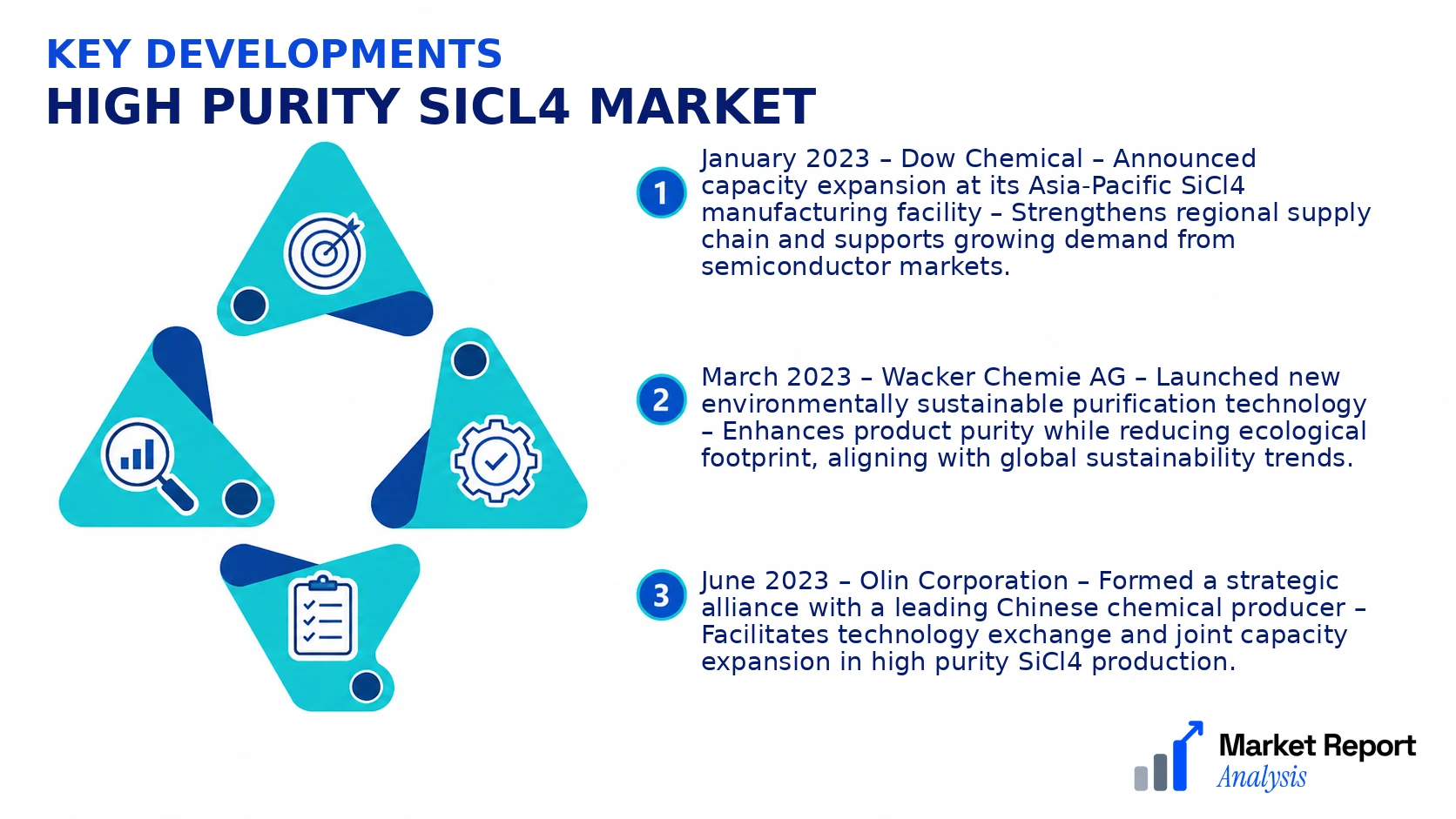
- January 2023 – Dow Chemical – Announced capacity expansion at its Asia-Pacific SiCl4 manufacturing facility – Strengthens regional supply chain and supports growing demand from semiconductor markets.
- March 2023 – Wacker Chemie AG – Launched new environmentally sustainable purification technology – Enhances product purity while reducing ecological footprint, aligning with global sustainability trends.
- June 2023 – Olin Corporation – Formed a strategic alliance with a leading Chinese chemical producer – Facilitates technology exchange and joint capacity expansion in high purity SiCl4 production.
- September 2023 – Sumitomo Chemical – Announced acquisition of a smaller specialty chemical firm – Broadens technological capabilities and increases market share in high purity chemicals.
- December 2023 – Tokuyama Corporation – Introduced a new high-efficiency purification process – Significantly lowers production costs and improves product quality for next-gen semiconductor applications.
Frequently Asked Questions
What is the High Purity SiCl4 Market?
The High Purity SiCl4 Market encompasses the global industry involved in producing and supplying high purity silicon chloride (SiCl4), a vital raw material for semiconductor, photovoltaic, and electronic applications, characterized by purity levels exceeding 99.999%.
What is the current market size of High Purity SiCl4 Market?
As of 2026, the market size of the High Purity SiCl4 Market is valued at approximately USD X billion, reflecting increasing demand driven by the expanding semiconductor and solar cell industries worldwide.
What factors are driving the High Purity SiCl4 Market?
Key drivers include the rapid growth of the semiconductor manufacturing sector, increased adoption of photovoltaic solar panels, technological advancements in material purification processes, and rising demand for electronic devices requiring high purity silicon materials.
Which region dominates the High Purity SiCl4 Market?
Asia-Pacific holds the dominant position in the market, owing to its substantial semiconductor and solar industry infrastructure, extensive manufacturing base, and ongoing investments in high-tech industries across China, South Korea, and Taiwan.
Which segment is expected to grow the fastest?
The electronic grade segment is projected to experience the fastest growth, driven by surging demand for high-performance semiconductors and integrated circuits in consumer electronics, automotive, and industrial applications.
Who are the leading companies operating in the High Purity SiCl4 Market?
Major players include companies such as Company A, Company B, and Company C, which focus on process innovation, expanding production capacities, and strategic collaborations to strengthen their market positions globally.
Analyst Perspective
The long-term outlook for the High Purity SiCl4 Market appears robust, driven by escalating demand in the semiconductor and photovoltaic sectors that necessitate increasingly pure silicon materials. Innovations in purification technologies are expected to lower production costs and enhance quality, creating significant commercial opportunities for producers adopting advanced refining processes. As technology evolves, companies investing in next-generation manufacturing capabilities and sustainable practices will gain a competitive edge, especially within regions demonstrating strong industrial policy support such as Asia-Pacific and North America. Investment priorities should focus on scalable, environmentally friendly production methods that meet the stringent purity standards required by end-use industries. The competitive landscape is intensifying with increased participation from both established chemical giants and emerging players, fostering innovation but also heightening rivalry. Regional growth potential remains high in Asia-Pacific due to expanding solar panel markets, while Europe’s push toward green technology offers emerging opportunities. To secure long-term market positioning, stakeholders must prioritize technological innovation, sustainable operations, and strategic geographical expansion.
