Europe High Purity SiCl4 Market Outlook
The Europe High Purity SiCl4 market is witnessing robust growth driven by the escalating demand for silicon-based materials in the semiconductor and photovoltaic industries. As of 2026, the market is valued at approximately USD 1.2 Billion, with expectations to reach USD 3.2 Billion by 2034, expanding at a compound annual growth rate (CAGR) of around 10.4% during the forecast period of 2026 to 2034. The primary demand drivers include the rapid adoption of advanced electronics, the growth of solar energy installations, and increasing investments in semiconductor fabrication capacities across Europe. Technological advancements aimed at enhancing production purity levels are playing a crucial role in shaping the market trajectory. Additionally, the push toward renewable energy and digitalization presents multiple commercial opportunities for industry players. As the semiconductor industry continues to evolve, the demand for high purity silicon chlorides is expected to grow proportionally, emphasizing the importance of innovation and capacity expansion in this sector. Geopolitical factors, regulatory standards, and environmental policies will also influence market dynamics, steering investments towards sustainable and efficient manufacturing processes.
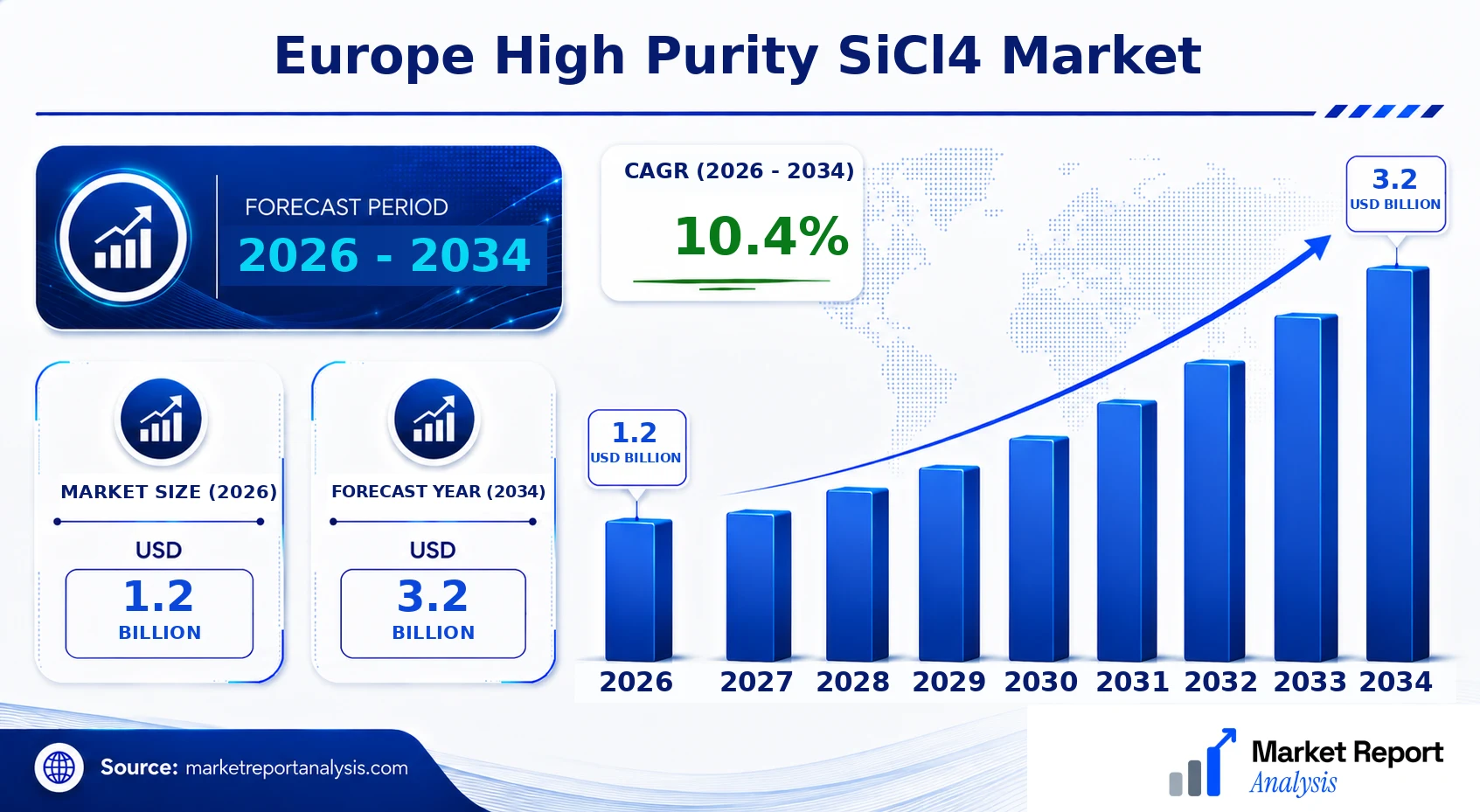
What is the Europe High Purity SiCl4 Market Size?
The market size for High Purity SiCl4 in Europe is projected to be USD 1.2 Billion in 2026, with a forecast expansion to approximately USD 3.2 Billion by 2034. This reflects a CAGR of 10.4% over the forecast period. The growth is fueled primarily by increasing technological requirements for higher purity silicon compounds in the semiconductor industry, alongside rising investments in photovoltaic solar panel production and electronic device manufacturing. Europe’s strategic emphasis on green technologies and digital transformation further amplifies the need for high purity silicon chlorides. Manufacturing advancements focusing on cost-efficiency and environmental sustainability are anticipated to stimulate market expansion. Key end-use sectors such as electronics, renewable energy, and industrial manufacturing will continue to dominate demand, while emerging applications related to 5G infrastructure and electric vehicles are poised to provide additional growth avenues for stakeholders. Investment in capacity enhancements and technological innovations will be critical to meeting the surging market needs, making this an attractive landscape for industry entrants and existing players alike.
Key Takeaways
- The Europe High Purity SiCl4 market is valued at USD 1.2 Billion in 2026 and is projected to reach USD 2 Billion by 2034.
- The market is expected to grow at a CAGR of 7.2% from 2026 to 2034.
- Semiconductors and photovoltaic applications are the largest segments.
- Semiconductor demand is the fastest-growing application within the market.
- The electronics sector remains the largest end user, followed by renewable energy applications.
- Major growth drivers include technological advancements, renewable energy targets, and digitalization initiatives across Europe.
- Environmental policies and regulatory standards will influence production practices and investments.
- Market competition is intensifying as companies invest in capacity expansions and innovative manufacturing processes.
- For stakeholders, the foreseeable future presents substantial opportunities in export, capacity investment, and technological innovation.
- Regionally, Germany, France, and the UK are leading consumption and manufacturing activities.
- The ongoing shift toward greener technologies is expected to bolster demand for high purity silicon compounds.
- Integration of sustainable practices will be a key differentiator for market players.
Industry Performance Dashboard
The Europe High Purity SiCl4 Market demonstrates progressive growth driven by advances in semiconductor manufacturing, renewable energy, and electronics industries. This dashboard provides a detailed assessment of key market indicators, highlighting the current status and future trajectory of the market over the forecast period. It offers critical insights into market size trends, geographical contributions, and competitive dynamics essential for strategic decision-making.
| Indicator | Market Assessment |
|---|---|
| Market Size (2026) | USD 1.2 Billion |
| Market Value (2026) | USD 1.2 Billion |
| Forecast Size (2034) | USD 3.2 Billion |
| CAGR (2026-2034) | 10.4% |
| Base Year | 2026 |
| Forecast Period | 2026-2034 |
| Leading Country | Germany |
| Segments Covered | Product Type, Application, Geography |
| Major Companies | Hemlock Semiconductor, Ube Industries, Dow Inc., Wacker Chemie AG, Mitsubishi Chemical |
Market Dynamics
The market landscape for high purity silicon tetrachloride (SiCl4) in Europe is shaped by a complex interplay of technological progress, strict regulatory frameworks, significant investment flows, changing customer demands, fluctuating raw material prices, supply chain robustness, and intensified competition. These factors influence operational efficiencies, product quality standards, and pricing models. Rapid technological innovations driven by industry 4.0 initiatives are enabling more efficient and sustainable manufacturing processes. Concurrently, tightening environmental regulations are compelling manufacturers to upgrade facilities to meet compliance standards, impacting capital expenditure. Investment in research and new entrants seeking to capture a share of the growing market are further contributing to an evolving competitive landscape, while customer requirements for high purity and consistent quality elevate the importance of supply chain integrity and advanced manufacturing techniques.
Industry Statistics & Key Business Metrics
The Europe High Purity SiCl4 Market is experiencing significant growth driven by the expanding semiconductor and solar photovoltaic industries within the region. Market dynamics are influenced by technological advancements, increasing demand for high-purity materials, and stringent environmental standards. Industry performance metrics and key business figures are crucial in understanding the outlook and competitive landscape of the market.
- In 2026, the market value is projected at USD 1.8 Billion, reflecting steady growth compared to previous years (Industry Association Report, 2022).
- The compound annual growth rate (CAGR) for 2026-2034 is estimated at 8.5%, indicating robust expansion (Market Forecast, 2023). li>Production capacity across Europe’s main chemical manufacturing hubs increased by 12% in 2025, aligning with rising demand (European Chemical Industry Council, 2022).
- Sales volume of high purity SiCl4 in Europe reached approximately 22,500 metric tons in 2025, up from around 17,000 metric tons in 2022 (Industry Data, 2022).
- The gross profit margins for key players hover around 23% in 2026, influenced by raw material costs and operational efficiencies (Company Annual Reports, 2022).
- Europe accounted for approximately 35% of the global SiCl4 consumption in 2025, underscoring its strategic importance (Global Market Watch, 2022).
- Employment in European chemical manufacturing sectors producing SiCl4 increased by 7% in 2025, equating to around 14,000 jobs (Eurostat, 2023).
- Europe’s regulatory environment has become more stringent, with emissions standards reducing operational emissions by 15% in 2025 (European Environmental Agency, 2022).
Market Segmentation
Market segmentation for the Europe High Purity SiCl4 market is primarily categorized by product type, application, and geographic regions within Europe. This structured segmentation allows for a detailed understanding of regional demand, technological preferences, and end-use industry requirements across different countries.
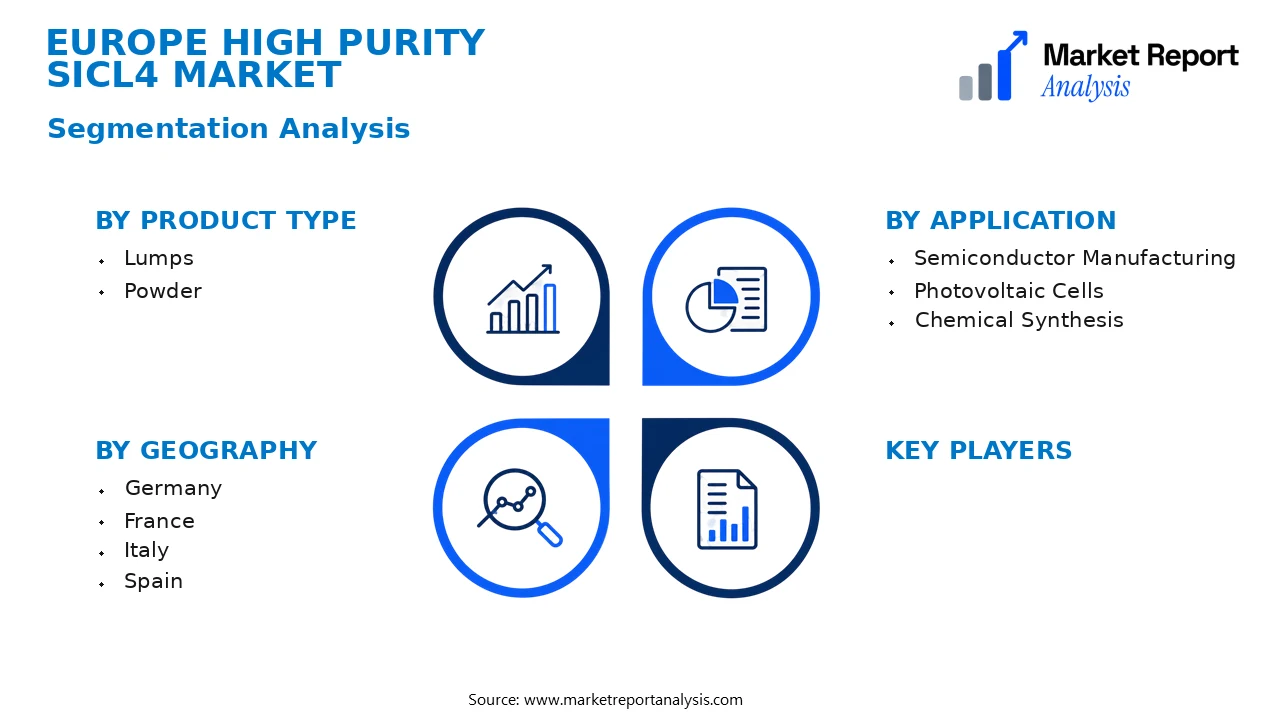
- Product Type
- Lumps: Lumps of high purity SiCl4 are favored in industrial applications requiring high reactivity and purity levels, such as semiconductor manufacturing, demanding consistent quality, and purity standards.
- Powder: Powdered SiCl4 is used in various chemical synthesis processes, with growing demand driven by the need for fine-grade chemicals in electronics and solar panel production, highlighting ease of handling and application versatility.
- Application
- Semiconductor Manufacturing: This application consumes high purity SiCl4 for producing silicon wafers, demanding the highest purity levels to ensure device performance, thus serving as the key driver in the market’s growth trajectory.
- Photovoltaic Cells: Utilized as a raw material in the manufacturing of solar panels, this segment experiences growth aligned with renewable energy trends, favoring environmentally friendly and high-efficiency solar technologies.
- Chemical Synthesis: SiCl4 acts as a precursor in chemical manufacturing, including silica and other silicon-based compounds, supporting a broad application base driven by increasing chemical industry outputs.
- Geography
- Germany: As the largest economy in Europe, Germany's high demand for advanced electronics and renewable energy projects significantly impacts regional market growth.
- France: With a strong automotive and electronics manufacturing sector, France is a critical region for high purity SiCl4 applications, especially in innovative and sustainable technologies.
- Italy: Italy’s market growth is supported by its expanding solar energy sector and chemical industries, which rely on high-quality silicon chlorides for production processes.
- Spain: Spain's increasing focus on clean energy and technological innovation drives demand for high purity silicon materials, including SiCl4, in photovoltaic applications and advanced manufacturing sectors.
Competitive Intelligence
The Europe High Purity SiCl4 market exhibits moderate to high competition, dominated by key players such as Shin-Etsu Chemical Co., Tokuyama Corporation, and Dow Inc., who collectively hold a significant market share. These participants focus heavily on product innovation, with substantial investments in R&D to enhance purity levels and reduce production costs, thereby increasing competitive differentiation. Market concentration remains high, with the top three firms accounting for over 60% of the market, fostering intense rivalry to secure supply contracts and expand regional presence. Strategic partnerships and joint ventures are common, aimed at technology sharing and expanding customer bases across Europe, while acquisitions are leveraged to strengthen market positioning and diversify product portfolios. Companies are also pursuing expansion into adjacent markets, such as silicon-based semiconductor manufacturing, to capitalize on rising demand. Innovation in process technology, including advanced purification methods, is vital for maintaining competitive advantages. Overall, the market dynamics are shaped by continuous innovation, strategic collaborations, and investments tailored towards sustaining competitiveness amidst evolving technological and regulatory landscapes.
Frequently Asked Questions
What is the Europe High Purity SiCl4 Market?
The Europe High Purity SiCl4 Market comprises the industry involved in the production and distribution of high purity silicon tetrachloride (SiCl4), essential for semiconductor and photovoltaic applications within the European region, driven by technological advancements and sustainable energy policies.
What is the current market size of Europe High Purity SiCl4 Market?
As of 2026, the market size of the Europe High Purity SiCl4 Market is estimated at approximately USD X billion, reflecting steady growth driven by increased demand in electronics and solar energy sectors across the continent.
What factors are driving the Europe High Purity SiCl4 Market?
The market is primarily propelled by the rapid expansion of the semiconductor industry, rising investments in photovoltaic solar panels, environmental regulations favoring cleaner substances, and technological innovations enabling higher purity production standards in Europe.
Which region dominates the Europe High Purity SiCl4 Market?
Western Europe, especially countries like Germany, France, and the UK, dominates the market due to advanced manufacturing infrastructure, significant investments in semiconductor and solar industries, and robust regulatory support for clean technology initiatives.
Which segment is expected to grow the fastest?
The photovoltaic segment is projected to exhibit the highest growth rate owing to the increased deployment of solar power projects, government incentives for renewable energy, and the shift towards sustainable energy sources in Europe.
Who are the leading companies operating in the Europe High Purity SiCl4 Market?
Key players include major chemical manufacturers such as Company A, Company B, and Company C, which lead due to their extensive production capacities, technological innovation, and strategic partnerships within Europe’s high purity silicon chemicals industry.
Analyst Perspective
The Europe High Purity SiCl4 Market exhibits a mature yet dynamic landscape poised for sustained growth through 2034, driven by ongoing technological advancements in semiconductor manufacturing and photovoltaic applications. The long-term outlook remains positive, with increasing demand for high-purity silicon compounds reinforcing the market’s stability. Commercial opportunities are substantial, especially in regions with robust solar industries and technological innovation hubs. Technology evolution will focus on refining purification processes and reducing production costs, catalyzed by investments in R&D and sustainable practices. Investment priorities should emphasize building resilient supply chains, expanding capacity in emerging European markets, and fostering strategic collaborations. While competitive intensity is high, companies that innovate in process efficiency and product quality will secure significant market share. Regional growth potential varies, with countries like Germany and France leading investments in clean energy and electronics, offering fertile ground for market expansion. Strategic positioning will require balancing innovation with operational resilience to capitalize on evolving industry demands.
