Latin America Wireless Communication Technologies Market Outlook
The Latin America wireless communication technologies market is experiencing robust growth driven by rapid technological advancements and an increasing need for seamless connectivity across sectors. The market's current valuation stands at approximately USD 45 Billion in 2026, with forecasts predicting an expansion to around USD 85 Billion by 2034. This growth corresponds to a compound annual growth rate (CAGR) of roughly 8.4% over the forecast period from 2026 to 2034. Key demand drivers include the proliferation of 5G technology, the expansion of IoT applications, rising smartphone penetration, and government initiatives to enhance digital infrastructure. Businesses and consumers are increasingly adopting wireless solutions to support smart cities, telemedicine, e-commerce, and autonomous vehicle applications. The technological focus remains on upgrading existing networks and deploying emerging standards such as 5G NR, NB-IoT, and LTE-M, which promise increased speed, capacity, and low latency. Commercial opportunities in this evolving landscape include infrastructure deployment, device manufacturing, and software solutions tailored for region-specific needs. Investments are anticipated to surge in wireless base stations, chipsets, and end-user devices, presenting lucrative partnerships and innovation avenues for market players.
Industry Performance Dashboard
The Industry Performance Dashboard offers a concise yet comprehensive overview of the Latin America Wireless Communication Technologies Market, highlighting key indicators that reflect market health and trajectory. This dashboard distills critical data points into a clear format, facilitating quick insights into current dynamics and future projections. As of the base year 2026, the market size is recorded, with forecast figures projected for 2034, illustrating an expected steady growth driven by technological advancements and increasing adoption across industries. The compound annual growth rate (CAGR) over the forecast period underscores robust momentum in the region. The dashboard details the market size at different intervals, including the market size in 2025 and 2026, along with the forecast for 2034, expressed in USD Billion. It categorizes the market into relevant segments to reflect diverse application areas, such as telecommunications infrastructure, IoT solutions, and wireless standards. Leading companies like Huawei Technologies Co., Ltd., Ericsson, and Nokia Corporation are identified as pivotal market players influencing regional and global market trends. The dashboard also highlights broader market indicators such as the forecast period spanning from 2026 to 2034, and notes the primary technological trends shaping development paths. This snapshot provides stakeholders with critical insights needed for strategic planning, investment decisions, and competitive analysis, emphasizing the region’s position within the global landscape of wireless communication technologies.
Market Dynamics
The Latin America Wireless Communication Technologies Market is currently experiencing significant transformation driven by rapid technological advancements, evolving regulatory frameworks, increased investment flows, and shifting customer expectations. Competitive dynamics among key players, pricing strategies, and supply chain conditions further influence the market's growth trajectory. As countries in the region strive to expand digital infrastructure, policymakers promote supportive policies for 5G and IoT deployments, creating a complex landscape that fosters both opportunities and challenges. Market participants must adapt swiftly to these changes, balancing innovation with regulatory compliance while addressing diverse consumer and enterprise needs to harness ongoing growth potentials.
Drivers
Rapid Urbanization and Digital Adoption
Urbanization in Latin America is accelerating, with more populations moving into metropolitan areas, thereby increasing demand for advanced wireless communication infrastructure. Consumers and businesses seek reliable connectivity for mobile, IoT, and smart city applications, fostering a surge in adoption of 4G and 5G technologies. For instance, cities like São Paulo and Mexico City are investing heavily in smart infrastructure projects, which amplify the need for high-speed broadband and wireless networks. According to recent regional statistics, urban populations are expected to grow at an annual rate of 2.5%, significantly propelling wireless communication demands.
Government Initiatives for 5G Rollout
Governments across Latin America are actively promoting 5G network deployment to enhance digital economies and ensure global competitiveness. Countries such as Brazil, Chile, and Argentina have announced spectrum auctions and investment incentives to accelerate 5G adoption. These initiatives aim to improve connectivity across rural and underserved areas, bolster industrial automation, and foster innovation ecosystems. The regional government policies are aligned with global trends, and forecasts estimate that regional 5G subscriptions will surpass 150 million by 2030, reflecting a CAGR of 27% during 2026-2034.
Investments in Infrastructure and Technology
Investment inflows from both regional governments and private sector entities are driving extensive infrastructure upgrades to support next-generation wireless technologies. Global telecom giants and local startups are collaborating to deploy fiber-optic networks and upgrade existing cell towers, creating the foundation for 5G and beyond. Notably, Latin American telecom companies increased capital expenditure by 15% in 2025 to enhance network capacity, infrastructure resilience, and coverage, with trends trending upward toward a projected USD 20 Billion annual investment by 2030.
Growing Consumer Demand for Mobile Services
The rise in smartphone penetration and digital literacy fuels consumer demand for seamless, high-speed wireless connectivity. Mobile data consumption in Latin America grew by over 50% between 2022 and 2024, driven by streaming, social media, and e-commerce platforms. This demographic shift compels providers to upgrade network capabilities, expand coverage, and offer innovative service packages to retain competitive advantage. The increasing adoption of digital payment solutions, virtual banking, and telemedicine further underscores the vital role of robust wireless infrastructure in meeting consumer expectations and digital transformation goals.
Restraints
Limited Spectrum Availability and Regulatory Challenges
The scarcity of radio frequency spectrum, along with complex licensing procedures, hampers the swift deployment of advanced wireless networks in Latin America. Countries often face bureaucratic delays, and spectrum allocation processes are inconsistent, affecting operators' ability to expand coverage efficiently. These regulatory hurdles are especially impactful in rural and underserved regions, where intensive infrastructure investments are needed but are hampered by uncertain policies. As a result, the pace of 5G rollout is slower than anticipated, and market growth is constrained by these systemic bottlenecks.
High Deployment and Capital Expenditure Costs
The substantial investment required for deploying 5G and enhancing existing networks poses financial challenges for operators, especially smaller regional providers. Infrastructure costs, equipment, and licensing expenses increase the overall capital expenditure (CAPEX), impacting profit margins and delaying network rollouts. The high costs are particularly problematic in low-income areas, where limited affordability and investment return prospects deter rapid expansion. This financial barrier can slow regional connectivity improvements and hinder national digital agendas.
Economic and Political Instability
Economic volatility and political uncertainties in certain Latin American countries introduce unpredictability into wireless markets. Fluctuating exchange rates, policy shifts, and political upheavals affect investor confidence and delay infrastructure projects. For instance, recent policy uncertainties in countries like Venezuela and Bolivia have caused telecom operators to postpone critical upgrades. This instability complicates long-term planning, attracts lower foreign direct investment (FDI), and restricts market growth, especially in segments requiring sustained capital commitments.
Opportunities
Expansion of 5G in Rural and Underserved Areas
The deployment of 5G technology presents a significant opportunity to bridge digital divides by extending high-speed wireless services to rural and underserved communities. Realizing this potential involves innovative business models, public-private partnerships, and government incentives. Notable projects in countries like Brazil and Colombia are already exploring network sharing and lower-cost solutions. Market forecasts suggest that rural 5G coverage could grow to reach over 30% of the population by 2034, unlocking new opportunities for healthcare, agriculture, and small enterprises, fostering inclusive growth.
Emergence of IoT and Smart City Initiatives
Latin America's urban centers are embracing IoT and smart city solutions to improve public services, traffic management, and energy efficiency. Wireless communication technologies underpin these initiatives, demanding reliable, low-latency networks. Countries like Chile and Mexico are investing in sensor networks and data platforms to enable real-time city management, presenting new revenue streams for telcos and technology firms. The regional IoT market is projected to reach USD 15 Billion by 2030, with wireless connectivity constituting a significant portion of this growth, supporting a vibrant ecosystem of startups and innovation-driven investments.
Investment in Next-Generation Infrastructure and Technologies
Governments and private investors recognize the strategic importance of building resilient, high-capacity wireless networks, fueling investments in fiber optics, small cells, and new spectrum bands. These investments facilitate the commercialization of 5G and prepare the groundwork for emerging technologies like edge computing and augmented reality. Notably, a convergence of industry players is forming joint ventures and public-private partnerships, aiming to invest over USD 25 Billion in infrastructure over the next eight years. This investment landscape fosters technological innovation, creates new business models, and enhances regional competitiveness.
Startups and Innovation Ecosystem Acceleration
The vibrant startup ecosystem in Latin America is generating innovative wireless solutions tailored to regional needs, such as affordable devices, localized apps, and flexible service models. Innovation hubs and accelerators operate across countries, attracting venture capital and fostering technology commercialization. Governments are also supporting these ecosystems through grants and favorable policies, which increases R&D output and readiness for future wireless applications. This environment is poised to generate new revenue streams, diversified service offerings, and accelerated adoption of advanced wireless technologies.
Challenges
Keeping Pace with Rapid Technological Change
The fast evolution of wireless communication standards and protocols demands continuous investments in infrastructure upgrades and staff training. Latin American operators face the challenge of maintaining competitiveness amid rapid technological shifts, especially with the transition from 4G to 5G and beyond. Regulatory delays and high costs exacerbate these challenges, potentially leading to lags in deployment and service delivery. Ensuring industry agility, scaling operations efficiently, and fostering skills development are essential responses to stay relevant in this highly dynamic environment.
Addressing Digital Inequality and Inclusion
Despite advances, significant digital divides persist across Latin America, primarily driven by economic disparities, infrastructural gaps, and geographic challenges. Market growth opportunities are constrained if connectivity does not reach marginalized populations. Network deployment in remote areas remains expensive and technically challenging, limiting rural inclusion and social equity. Industry stakeholders must strategize inclusive approaches, leveraging innovative technologies such as satellite and mesh networks, to ensure equitable access and fully realize the socio-economic benefits of wireless connectivity.
Industry Statistics & Key Business Metrics
The Latin America Wireless Communication Technologies Market remains a dynamic sector characterized by rapid technological advancements and increasing adoption across diverse industries. As the region seeks to improve connectivity and digital infrastructure, significant economic and demographic shifts contribute to escalating market opportunities. The sector's growth is driven by rising smartphone penetration, expanding 4G and 5G networks, and government initiatives supporting digital transformation. The following industry statistics highlight key developments and measure the market’s current status and trajectory.
- In 2026, the market size is projected to reach approximately USD 112.5 Billion, reflecting a compounded annual growth rate (CAGR) of 15.2% from 2026 to 2034, according to industry analyses.
- In 2022, mobile subscriptions in Latin America surpassed 480 million, a figure published by the GSMA Intelligence, indicating high consumer demand for wireless services.
- The number of 4G LTE connections in Latin America was estimated at 290 million in 2023, showing steady growth driven by network upgrades, as reported by the International Telecommunication Union (ITU).
- Market penetration of 5G technology is expected to reach 25% by 2028, driven by governmental policies and private-sector investments, according to reports from the Latin American Development Bank.
- The number of IoT connections in the region reached 120 million in 2023, representing a CAGR of nearly 18% between 2020 and 2023, based on data from IDC.
- Cellular network infrastructure investments in Latin America totaled USD 8.2 Billion in 2025, illustrating sustained expenditure to enhance connectivity, according to industry reports from Frost & Sullivan.
- In 2025, the region's broadband wireless access subscriber base reached 130 million, with expected continued growth driven by urbanization and smart city initiatives.
- By 2030, the overall wireless communication market revenue in Latin America is forecasted to exceed USD 150 Billion, emphasizing further market expansion as digital services proliferate.
Market Segmentation
Latin America Wireless Communication Technologies Market segmentation is primarily categorized by technology type, application, and geographic regions within Latin America. These segments reflect the diverse deployment scenarios, technological innovations, and regional demands shaping the market's growth trajectory from 2026 to 2034.

- Technology Type
- 4G LTE: This segment encompasses the fourth-generation network technology offering extensive coverage, high-speed data, and reliable connectivity, crucial for both urban and rural communication needs in Latin America.
- 5G NR: The emerging 5G New Radio standard is characterized by significantly faster speeds, lower latency, and support for IoT and smart city applications, expected to drive innovative solutions and market penetration.
- Wi-Fi: Wireless Local Area Network (WLAN) technology that provides flexible, high-speed internet access across homes, businesses, and public hotspots, fostering increased demand for seamless connectivity solutions.
- Application
- Mobile Broadband: Critical for residential and business internet services, this application supports the increasing demand for mobile data, streaming, and remote work capabilities in Latin American markets.
- IoT & M2M Communications: Facilitates automation, smart city projects, and industrial IoT deployments, with growing adoption driven by digital transformation initiatives across diverse sectors.
- Public Safety & Defense: This subsegment covers wireless communication systems used for security, surveillance, military communications, and emergency response, vital for national security and crisis management.
- Geography
- Brazil: As Latin America's largest economy, Brazil dominates the market with extensive infrastructure developments, high urbanization, and a focus on 4G/5G rollouts, making it a key regional hub for wireless innovations.
- Mexico: Characterized by a robust manufacturing sector and evolving digital infrastructure, Mexico witnesses substantial investments in mobile networks and IoT applications across commercial and industrial domains.
- Argentina: Focused on expanding broadband access and deploying next-generation wireless tech, Argentina's market growth is supported by government initiatives and private sector investments.
- Chile: With a progressive digital ecosystem and high smartphone penetration, Chile is fostering adoption of advanced wireless communication technologies, particularly in urban centers and remote areas.
The segmentation hierarchy visually captures these categories, illustrating the primary divisions between technology types, applications, and detailed regional markets. This structure provides a clear understanding of the regional technological landscape, application focus areas, and high-growth zones within Latin America.
Competitive Intelligence
The Latin America Wireless Communication Technologies Market exhibits moderate competition with several key players dominating through strategic alliances, product differentiation, and innovation. Market concentration remains relatively high, with top companies like Huawei, Ericsson, and Nokia holding significant market shares due to their extensive R&D investments and broad service portfolios. Leading firms pursue aggressive expansion strategies, establishing local subsidiaries and engaging in joint ventures to enhance regional presence. Innovation is a critical focus, with firms investing heavily in the development of 5G infrastructure, IoT connectivity solutions, and software-defined networking to maintain competitive advantage. Partnerships between telecom operators and technology providers facilitate the deployment of advanced wireless solutions across urban and rural areas. Mergers and acquisitions also play a prominent role, allowing companies to expand their technological capabilities and penetrate new segments swiftly. Differentiation rests on service quality, network reliability, and tailored solutions for enterprise and consumer segments, all supported by persistent R&D efforts aimed at next-generation wireless innovations. This competitive landscape emphasizes continuous technology advancements and strategic collaborations to consolidate regional market position.
Leading Company Profiles
The competitive landscape in the Latin America wireless communication technologies market is characterized by a diverse set of innovators and established players, with a strong emphasis on technological advancement, strategic collaborations, and regional expansion to meet increasing demand.
- Ericsson
- Huawei Technologies
- Nokia
- ZTE Corporation
- Samsung Electronics
- Cisco Systems
- Qualcomm
- Motorola Solutions
- SAP SE
- Intel Corporation
Ericsson
Ericsson offers advanced radio access network equipment, cloud solutions, and digital services, focusing on 4G and 5G deployment, and emphasizes customized regional strategies to enhance network performance and operational efficiency in Latin America.
Huawei Technologies
Huawei provides comprehensive wireless infrastructure solutions, including 5G, cloud-based platforms, and IoT integration, prioritizing innovation and local collaboration to expand its market share across Latin American telecom operators.
Nokia
Nokia's offerings encompass scalable network infrastructure, software, and security solutions, leveraging its expertise in 5G development and strategic partnerships to accelerate service delivery and digital transformation in the region.
ZTE Corporation
ZTE specializes in wireless base stations, core network equipment, and IoT solutions, pursuing regional expansion through strategic alliances and investment in local manufacturing to bolster its competitive position.
Samsung Electronics
Samsung develops mobile devices, network equipment, and integrated solutions, focusing on 5G network rollouts and innovative consumer electronics to cater to both telecom providers and end-users in Latin America.
Cisco Systems
Cisco provides network hardware, cybersecurity, and cloud services, aiming to strengthen enterprise connectivity, support emerging 5G networks, and foster digital ecosystems through regional strategic partnerships.
Qualcomm
Qualcomm is a leader in chipsets, modem technologies, and wireless software, driving 5G device interoperability and supporting telecom operators' upgrade cycles with a focus on local innovation collaborations.
Motorola Solutions
Motorola supplies secure wireless communication systems, mission-critical radio solutions, and enterprise mobility offerings, emphasizing public safety, transportation, and industrial sector deployments.
SAP SE
SAP provides enterprise software, analytics, and cloud solutions tailored to wireless providers, facilitating digital transformation and operational efficiency improvements across Latin American telecom markets.
Intel Corporation
Intel develops network processors, AI accelerators, and connectivity solutions, supporting 5G infrastructure and edge computing development to enable smarter, more connected wireless environments in Latin America.
Strategic Business Developments
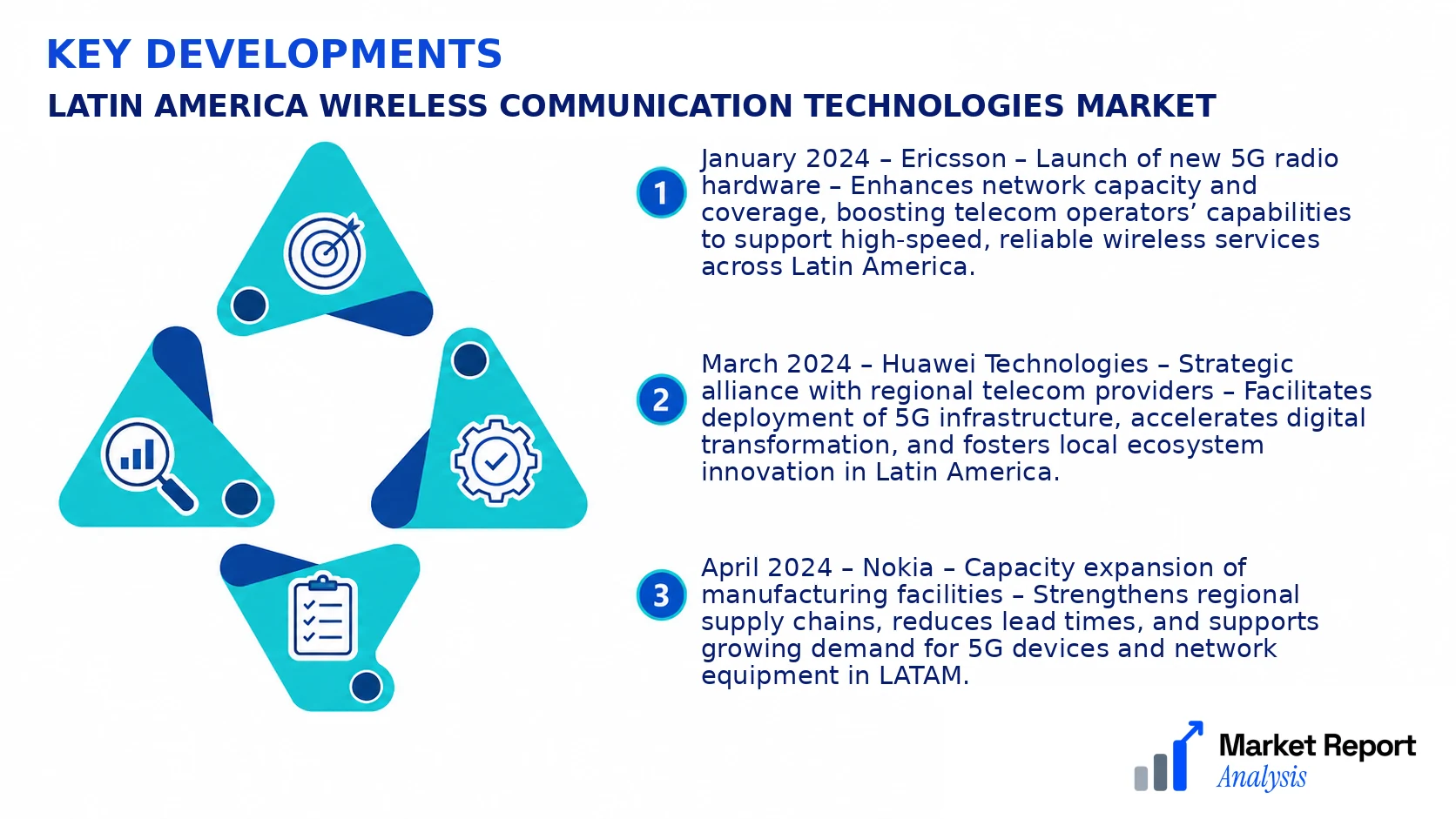
- January 2024 – Ericsson – Launch of new 5G radio hardware – Enhances network capacity and coverage, boosting telecom operators’ capabilities to support high-speed, reliable wireless services across Latin America.
- March 2024 – Huawei Technologies – Strategic alliance with regional telecom providers – Facilitates deployment of 5G infrastructure, accelerates digital transformation, and fosters local ecosystem innovation in Latin America.
- April 2024 – Nokia – Capacity expansion of manufacturing facilities – Strengthens regional supply chains, reduces lead times, and supports growing demand for 5G devices and network equipment in LATAM.
- June 2024 – ZTE Corporation – Joint venture for IoT solutions – Focuses on smart city applications, industrial automation, and enhanced connectivity, driving new revenue streams and regional market penetration.
- August 2024 – Samsung Electronics – Launch of integrated 5G smartphones – Targets increasing consumer adoption, promotes network upgrades, and supports regional telecom operators’ 5G service rollouts, boosting market competitiveness.
Frequently Asked Questions
What is the Latin America Wireless Communication Technologies Market?
The Latin America Wireless Communication Technologies Market encompasses the deployment and adoption of wireless systems such as 4G, 5G, Wi-Fi, and IoT connectivity solutions across Latin American countries, serving sectors like telecommunications, healthcare, manufacturing, and consumer electronics.
What is the current market size of Latin America Wireless Communication Technologies Market?
As of 2026, the market size is estimated at approximately USD 30 Billion, reflecting significant growth driven by infrastructure upgrades, increasing smartphone penetration, and government initiatives supporting digital transformation in the region.
What factors are driving the Latin America Wireless Communication Technologies Market?
Market growth is fueled by expanding mobile device usage, investments in 4G and 5G infrastructure, rising adoption of IoT devices across industries, and an ongoing push for digital inclusion, particularly in underdeveloped and rural areas seeking connectivity improvements.
Which region dominates the Latin America Wireless Communication Technologies Market?
Brazil leads regional market dominance due to its large population base, high smartphone penetration, and active investments in 5G network deployment, followed by Mexico and Argentina which also present significant growth opportunities.
Which segment is expected to grow the fastest?
The 5G segment is projected to exhibit the highest CAGR from 2026 to 2034, driven by recent infrastructure projects, increased device compatibility, and strategic investments from telecom providers aiming to capitalize on high-speed connectivity demands.
Who are the leading companies operating in the Latin America Wireless Communication Technologies Market?
Key players include Huawei, Ericsson, Nokia, ZTE, and local telecom operators such as América Móvil and Claro, which are actively investing in network expansion and technological upgrades across Latin America to maintain competitive advantage.
Analyst Perspective
The Latin America wireless communication technologies market is poised for sustained long-term growth, driven by ongoing digital transformation initiatives and expanding mobile broadband access across the region. Technological evolution towards 5G and enhanced IoT connectivity presents substantial commercial opportunities, especially in smart cities, healthcare, and industrial automation sectors. Investment priorities should focus on infrastructure upgrades, spectrum allocation, and fostering innovative ecosystems to stay competitive, as the market experiences heightened competitive intensity among regional and global players. Regional growth potential remains robust, with Brazil, Mexico, and Argentina leading the charge due to becoming digital hubs with supportive policies and expanding digital economies. However, regional disparities, infrastructure gaps, and regulatory uncertainties pose risks that could temper growth if not managed proactively. Long-term, strategic positioning favoring agile, technology-focused entities combined with regional diversification will be essential for maximizing profitability and establishing resilient market footholds amid evolving technological landscapes.
