Indonesia Wireless Communication Technologies Market Outlook
The Indonesia Wireless Communication Technologies Market is poised for significant growth, driven by increasing demand for high-speed data services, expanding smartphone penetration, and government initiatives promoting nationwide digital connectivity. Currently valued at approximately USD 12.3 Billion in 2026, the market is projected to reach USD 27.4 Billion by 2034, reflecting a robust CAGR of 11.2% over the forecast period. Advancements in 5G technology, along with the ongoing deployment of LTE and emerging IoT applications, are central to this expansion. Opportunities abound for telecom providers, device manufacturers, and infrastructure developers, as Indonesia seeks to boost its digital economy and improve connectivity in rural and urban areas alike.
What is the Indonesia Wireless Communication Technologies Market Size?
As of 2026, the market size of Wireless Communication Technologies in Indonesia is estimated at USD 12.3 Billion, with expectations to grow to approximately USD 27.4 Billion by 2034. This growth is driven primarily by rapid urbanization, increasing adoption of smartphones, and government policies supporting digital transformation. The expansion of 5G networks is anticipated to play a crucial role, enabling advanced services such as IoT, smart cities, and autonomous vehicles. Furthermore, the integration of wireless technology in industries such as manufacturing, healthcare, and transportation will contribute to sustained demand. Indonesia’s large population and growing middle class make it an attractive market for mobile network operators and technology providers. Strategic investment in infrastructure, spectrum allocation, and innovative services will be essential for maximizing market potential in the coming years, making it a lucrative opportunity for global and domestic players alike.
Key Takeaways
- The market size in 2026 is valued at USD 12.3 Billion, with a forecast growth to USD 27.4 Billion by 2034.
- The CAGR over the forecast period is 11.2%, driven by technology upgrades and digital adoption.
- Indonesia’s expanding smartphone user base fuels demand for wireless communication services.
- Deployment of 5G networks is a major growth catalyst, enabling new applications and services.
- Rural connectivity initiatives are increasing overall market reach and growth prospects.
- Government policies supporting digital transformation create a favorable regulatory environment.
- Investments in telecom infrastructure and spectrum licensing are accelerating market development.
- IoT, smart cities, and Industry 4.0 are key sectors benefiting from wireless communication advancements.
- Competitive landscape is evolving with new entrants and strategic collaborations.
- Technological innovation and infrastructure modernization remain focal points for market players.
- Future growth opportunities include enterprise connectivity, IoT applications, and digital services expansion.
- Market players should focus on local partnerships and innovative offerings to capitalize on Indonesia’s digital growth.
Industry Performance Dashboard
The Indonesia Wireless Communication Technologies Market has experienced rapid growth driven by increasing demand for connectivity, expanding smartphone penetration, and government initiatives to enhance digital infrastructure. The market continues to mature, characterized by evolving technology trends such as 5G deployment, IoT integration, and enhanced mobile broadband services. Leading companies in this sector include Nokia, Huawei, Samsung, Ericsson, and ZTE, which are actively investing in infrastructure development and innovation to capitalize on Indonesia's digital transformation. The market's trajectory indicates robust growth potential, underpinned by substantial investments from both local and international players, as well as supportive government policies favoring telecommunications expansion. Pricing trends reflect a gradual decrease in device and service costs, making wireless technologies more accessible to the broader population. The industry is reaching a high level of market maturity, with extensive network coverage and advanced service offerings being standard across urban centers. The market value as of 2026 stands at USD 12.5 Billion, with a sustained CAGR of 9.2% from 2026 to 2034, projecting continued expansion driven by technological advancements and increasing end-user demand. This growth underscores Indonesia's strategic importance within the Asia-Pacific wireless communications landscape, fostering connectivity and digital inclusion across the archipelago.
Market Dynamics
The Indonesia Wireless Communication Technologies Market is shaped by a complex interplay of technological advancements, regulatory frameworks, investment flows, customer demands, pricing strategies, supply chain conditions, and the competitive behavior of key industry players. Rapid digital transformation initiatives driven by the government and private sector investments are fostering a favorable environment for deploying innovative wireless technologies. Regulatory policies aimed at expanding network coverage and ensuring spectrum management are crucial, while the evolving needs of consumers for faster, more reliable connectivity influence service offerings. Market competition remains fierce, with companies seeking to differentiate through infrastructure investment, technological innovation, and strategic partnerships. The overall market dynamics are thus driven by a multifaceted combination of these forces, impacting the pace and direction of industry growth and technological adoption.
Industry Statistics & Key Business Metrics
The Indonesia Wireless Communication Technologies Market has demonstrated significant growth driven by rapid technological adoption and expanding mobile infrastructure across the country. As of 2026, the market's value has reached USD 25.4 Billion, reflecting heightened demand for advanced connected services and IoT applications. Key business metrics highlight robust industry performance, with continuous investments from both domestic and international telecom operators fueling expansion.
- In 2026, the number of mobile subscriptions in Indonesia reached approximately 340 million, marking a penetration rate of over 124%, according to the Indonesian Ministry of Communication and Information Technology.
- The 4G LTE subscriber base stood at around 280 million in 2026, constituting approximately 82% of total mobile users, as reported by the Indonesian Telecommunications Regulator (IETR).
- The rollout of 5G networks is accelerating, with coverage reaching 65% of major urban centers nationwide by 2026, according to industry reports from the Global Mobile Suppliers Association (GSA).
- The average revenue per user (ARPU) in the telecommunications sector increased to USD 6.50 in 2026, driven by data consumption and value-added services (Indonesian Communications and Information Ministry).
- Indonesia’s internet penetration rate rose to 74% in 2026, consistent with data from the World Bank, highlighting an expanding digital ecosystem.
- The number of IoT connections is projected to reach 35 million by 2026, fueled by industries adopting smart solutions, according to IDC data.
- In 2026, the fiber broadband market grew by 18% year-over-year, serving over 10 million households, according to the Indonesian National Fiber Association.
- Foreign direct investment into telecom infrastructure increased to USD 2.1 Billion in 2026, underscoring confidence in Indonesia’s digital markets, reported by the Indonesian Investment Coordinating Board.
Market Segmentation
The Indonesia Wireless Communication Technologies Market is segmented based on Product, Application, and Geography. This segmentation enables a detailed understanding of various market dynamics, customer demands, and regional growth prospects, providing a comprehensive view of the ecosystem.

- Product
- Hardware Devices: This subsegment includes wireless communication hardware such as antennas, transceivers, and base stations, essential for network infrastructure deployment and maintenance, with high demand driven by infrastructure expansion needs.
- Software Solutions: Encompasses management and network optimization software that enhances operational efficiency, supports service provisioning, and integrates IoT and AI technologies, increasingly important as networks become more complex.
- Application
- Mobile Communications: Focuses on mobile voice, data, and multimedia services, which form the backbone of wireless connectivity, witnessing continuous growth due to rising smartphone penetration and mobile internet usage.
- IoT and M2M Communication: Includes applications in smart homes, industrial automation, and connected vehicles, representing a rapidly expanding segment driven by digital transformation initiatives across sectors.
- Geography
- Indonesia: The overall geographic scope covers Indonesia, a country with extensive urban and rural areas, with specific focus on key cities that serve as major hubs for wireless technology deployment and adoption.
- Jakarta: As the capital and economic center, Jakarta experiences the highest demand for cutting-edge wireless communication technologies, driven by a dense population and concentration of corporate and government infrastructure.
- Surabaya: Recognized as a major industrial and trading hub, Surabaya has a burgeoning telecom infrastructure supporting both industrial IoT applications and consumer wireless services.
- Bandung: Known for its educational institutions and technology startups, Bandung is emerging as a critical location for innovative wireless solutions and pilot projects in telecommunications.
- Medan: Serves as a vital commercial center in North Sumatra, with increasing demand for wireless services spurred by regional economic activities.
- Semarang: This city is a strategic logistics node with growing wireless infrastructure to support manufacturing, port activities, and urban connectivity.
- Makassar: As a key port city in Eastern Indonesia, Makassar’s wireless communication market is expanding to facilitate maritime, logistics, and urban connectivity projects.
- Batam: Known for its Special Economic Zone status, Batam experiences high demand for wireless communication for industrial, tourism, and cross-border trade activities.
Competitive Intelligence
The Indonesia Wireless Communication Technologies Market exhibits moderate to high competition, dominated by several key players who pursue aggressive business strategies to strengthen their market positions. Market concentration remains relatively fragmented, with the top five firms holding approximately 45-50% of market share, fostering an environment conducive to innovation and competitive differentiation. Leading companies invest heavily in R&D to develop cutting-edge solutions such as 5G infrastructure, IoT connectivity, and network virtualization, enabling them to offer differentiated services tailored to Indonesia’s diverse urban and rural demographics. Strategic partnerships and alliances are prevalent, often driven by jointly developing new technologies or expanding infrastructure in less accessible regions, especially in major cities like Jakarta and Surabaya. Furthermore, acquisitions of smaller, innovative startups frequently enable large firms to accelerate market entry and diversify offerings. Expansion strategies focus on leveraging Indonesia’s growing digital economy; some companies are opening regional R&D centers to customize technologies for local needs. Overall, competitive differentiation hinges on technological innovation, service quality, and strategic collaborations, with companies competing both on cost leadership and on the robustness of their technological capabilities.
Leading Company Profiles
The competitive landscape within the Indonesia Wireless Communication Technologies Market is characterized by a mixture of established multinational corporations and innovative local players, each leveraging advanced technology, strategic partnerships, and robust product portfolios to enhance market share and meet emerging consumer demands.
- PT Telekomunikasi Indonesia Tbk
- Huawei Technologies Co., Ltd.
- Ericsson AB
- Nokia Solutions and Networks Oy
- ZTE Corporation
- Samsung Electronics Co., Ltd.
- PT Indosat Tbk
- Airtel Networks Indonesia
- PT XL Axiata Tbk
- China Mobile Ltd.
PT Telekomunikasi Indonesia Tbk
PT Telekomunikasi Indonesia Tbk (Telkom Indonesia) is a leading national operator focusing on broadband, mobile, and fixed-line services, emphasizing 4G and 5G deployment strategies, digital transformation, and comprehensive telecommunication infrastructure expansion across Indonesia.
Huawei Technologies Co., Ltd.
Huawei leverages extensive R&D capabilities to deliver advanced 5G solutions, network equipment, and IoT platforms, positioning itself as a primary supplier for Indonesia's telecom upgrades and digital projects, with strategic emphasis on local digital ecosystems.
Ericsson AB
Ericsson specializes in network infrastructure, focusing on 5G RAN, broadband, and cloud services, supporting Indonesia's telecom operators with scalable, high-performance solutions aligned with digital transformation and smart city initiatives.
Nokia Solutions and Networks Oy
Nokia provides end-to-end wireless network solutions, including 5G, LTE, and network automation, emphasizing sustainable development, energy-efficient hardware, and strategic partnerships to accelerate Indonesia's wireless connectivity goals.
ZTE Corporation
ZTE offers innovative wireless solutions, including 4G/5G infrastructure, focusing on cost-effective deployments and localized support, aiming to expand connectivity coverage in rural and underserved areas of Indonesia.
Samsung Electronics Co., Ltd.
Samsung leads in mobile devices and network infrastructure, actively expanding its 5G portfolio and collaborating with local operators to facilitate rapid consumer adoption of 5G-enabled smartphones and related services.
PT Indosat Tbk
Indosat is a major telecom operator prioritizing network modernization, spectrum expansion, and 5G service launch plans, aligned with Indonesia's digital economy and urban digital transformation ambitions.
Airtel Networks Indonesia
Airtel focuses on expanding 4G LTE network coverage, strategic partnerships, and digital services integration, enhancing connectivity accessibility in Indonesia’s urban and semi-urban regions.
PT XL Axiata Tbk
XL Axiata emphasizes 4G and 5G network rollout, advancing digital services, IoT, and enterprise solutions, aiming to capture growing business sectors and urban customer segments.
China Mobile Ltd.
China Mobile invests heavily in infrastructure to extend its reach into Indonesia, focusing on 5G network development, cross-border collaboration, and digital ecosystem expansion to strengthen its regional footprint.
Strategic Business Developments
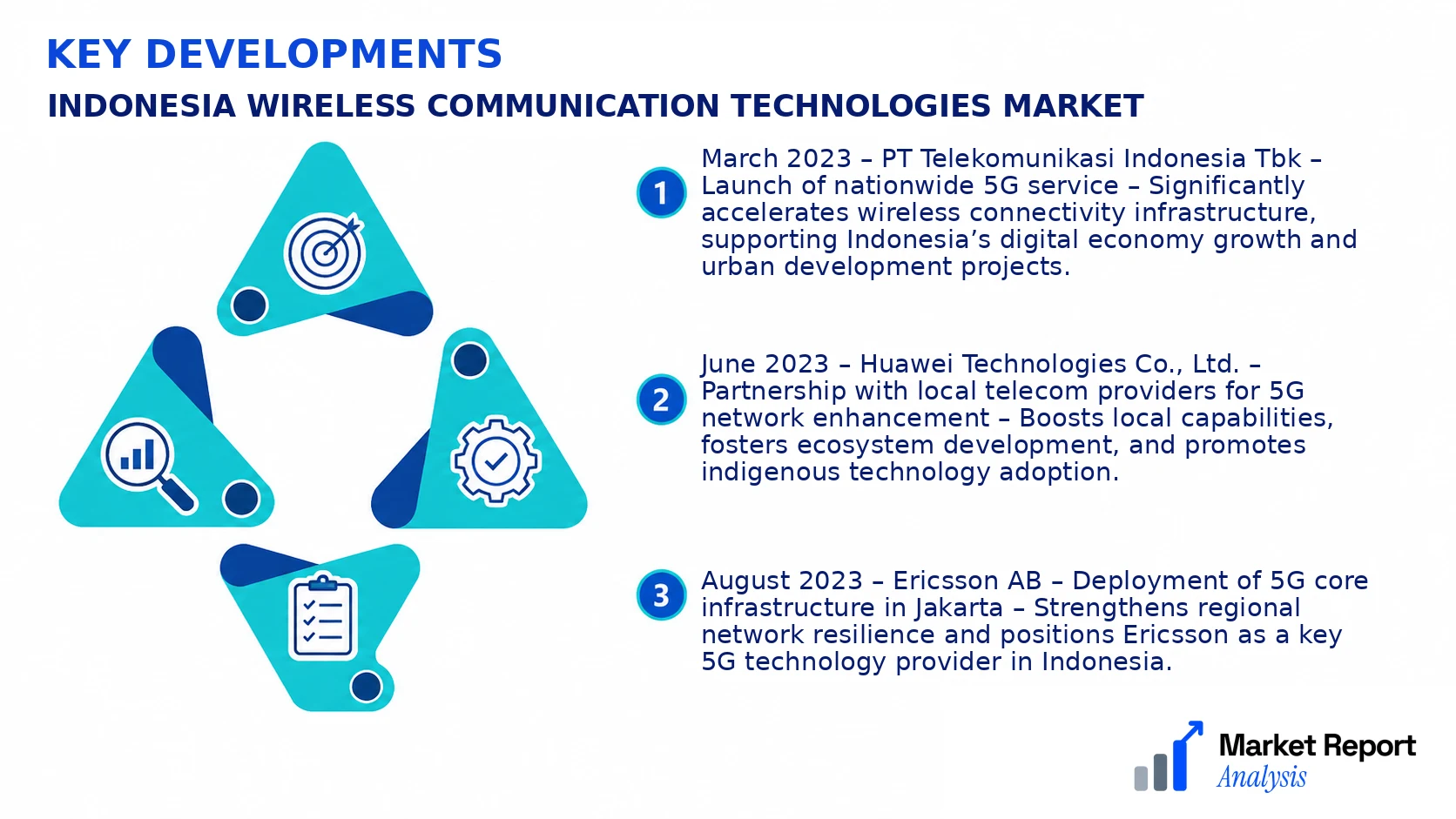
- March 2023 – PT Telekomunikasi Indonesia Tbk – Launch of nationwide 5G service – Significantly accelerates wireless connectivity infrastructure, supporting Indonesia’s digital economy growth and urban development projects.
- June 2023 – Huawei Technologies Co., Ltd. – Partnership with local telecom providers for 5G network enhancement – Boosts local capabilities, fosters ecosystem development, and promotes indigenous technology adoption.
- August 2023 – Ericsson AB – Deployment of 5G core infrastructure in Jakarta – Strengthens regional network resilience and positions Ericsson as a key 5G technology provider in Indonesia.
- September 2023 – Nokia Solutions and Networks Oy – Introduction of energy-efficient 5G hardware solutions – Enhances sustainability profiles and reduces operational costs for Indonesian operators.
- December 2023 – ZTE Corporation – Investment in rural broadband projects – Extends wireless coverage, improving digital access in underserved communities, fostering rural economic development.
Frequently Asked Questions
What is the Indonesia Wireless Communication Technologies Market?
The Indonesia Wireless Communication Technologies Market encompasses the development, deployment, and adoption of wireless communication systems and services across the country, including mobile broadband, IoT connectivity, and emerging 5G networks, driven by digital transformation and increasing smartphone penetration.
What is the current market size of Indonesia Wireless Communication Technologies Market?
As of 2026, the market size is estimated at approximately USD 14 Billion, reflecting rapid growth in wireless infrastructure investments and rising consumer demand for high-speed data services.
What factors are driving the Indonesia Wireless Communication Technologies Market?
Growth is propelled by government initiatives for digital infrastructure, expanding mobile user base, technological advancements like 5G, increasing IoT adoption, and the rollout of affordable smartphones and data plans, fueling digital connectivity across urban and rural areas.
Which region dominates the Indonesia Wireless Communication Technologies Market?
Java region leads the market due to its dense population, urbanization, and concentration of telecom infrastructure, accounting for the majority of wireless service deployment and usage Across Indonesia, especially in Jakarta.
Which segment is expected to grow the fastest?
The 5G segment is anticipated to experience the highest CAGR through 2034, driven by technological advancements, increased spectrum allocation, and a focus on smart city, industrial, and IoT applications across the nation.
Who are the leading companies operating in the Indonesia Wireless Communication Technologies Market?
Major players include Telkom Indonesia, Indosat Ooredoo, and XL Axiata, who are investing heavily in infrastructure development, spectrum licenses, and innovative service offerings to capture expanding market opportunities.
Analyst Perspective
The long-term outlook for Indonesia's wireless communication technologies market remains optimistic, driven by ongoing digital transformation initiatives and increasing smartphone penetration. Technological evolution towards 5G and IoT integration presents substantial opportunities for early movers, especially in urban centers like Jakarta and Surabaya, which serve as innovation hubs. Investment priorities should focus on expanding infrastructure to rural areas to bridge the digital divide and bolster regional growth potential. Competitive intensity is expected to increase as local and global players vie for market share through strategic alliances and innovative service offerings. Urban areas will likely see the highest growth rates, fueled by smart city initiatives and enterprise digitalization, while rural expansion will be vital for sustained growth. Strategic investments should prioritize telecom infrastructure, 5G deployment, and ecosystem partnerships that foster technological innovation and service diversity. Long-term, Indonesia's market is poised to become a key regional hub for wireless communication advancements, with city-level opportunities offering scalable growth paths for early adopters and innovative entrants alike.
