Latin America Automatic Number Plate Recognition (ANPR) Market Outlook
The Latin America Automatic Number Plate Recognition (ANPR) market is currently valued at approximately USD 1.2 Billion in 2026. It is projected to grow at a compound annual growth rate (CAGR) of around 12.5% over the forecast period from 2026 to 2034, reaching an estimated USD 3.7 Billion by 2034. This growth is primarily driven by increasing investments in smart city initiatives, enhanced law enforcement infrastructure, and rising traffic management requirements across Latin American countries. Technological advancements such as AI-powered image processing, cloud connectivity, and machine learning are shaping the future of ANPR systems, making them more accurate, scalable, and efficient. Commercial opportunities abound for technology providers, integrators, and surveillance firms to capitalize on expanding transportation networks, evolving regulatory frameworks, and urbanization trends. Enhanced enforcement against vehicle theft, regulatory compliance, toll collection, and traffic monitoring are key drivers fueling market expansion. The integration of ANPR with other security and traffic systems is also creating lucrative cross-sector synergies, further stimulating market development.
What is the Latin America Automatic Number Plate Recognition (ANPR) Market Size?
The Latin America ANPR market size is projected to expand from USD 1.2 Billion in 2026 to approximately USD 3.7 Billion by 2034, with an impressive CAGR of 12.5%. This growth is fueled by governmental mandates for enhanced security, traffic management demands, and an increase in surveillance infrastructure investments. Various end-use industries, including law enforcement, toll collection, border management, and commercial vehicle monitoring, are adopting ANPR solutions rapidly to improve operational efficiency and compliance. The continuous technological evolution, particularly AI and intelligent analytics, is further boosting system capabilities, reducing costs, and increasing deployment speed and accuracy. Countries in Latin America are especially investing in smart city projects, which include integrated traffic and security solutions, amplifying demand for advanced ANPR systems. Future investments are expected to focus on scalable, cloud-enabled systems that can seamlessly integrate with existing security frameworks, creating a fertile landscape for innovative market entrants and established players alike.
Key Takeaways
- The Latin America ANPR market was valued at USD 1.2 Billion in 2026.
- It is forecasted to reach USD 3.7 Billion by 2034.
- The CAGR during this period is approximately 12.5%.
- Law enforcement applications constitute the largest market segment.
- Traffic management represents the fastest-growing segment.
- Border security and toll collection are major application areas.
- The primary end user is government agencies, including police and border control.
- Urbanization and smart city initiatives are key growth drivers.
- Technological advancements in AI, cloud computing, and IoT are shaping the market.
- Countries like Brazil, Mexico, and Argentina are leading market adoption.
- Investment in integrated, cloud-based ANPR systems continues to increase.
- Growing regulatory focus on vehicle tracking and surveillance is influencing market dynamics.
- Market competitiveness is increasing with the entry of new regional and global players.
- Collaborations and partnerships are prevalent to deploy comprehensive ANPR solutions.
Industry Performance Dashboard
The Industry Performance Dashboard provides a comprehensive snapshot of the Latin America Automatic Number Plate Recognition (ANPR) Market's current status and projected growth trajectory. As of 2026, the market size is estimated at USD 1.2 Billion, reflecting the region's increasing deployment of ANPR technology across transportation, law enforcement, and commercial sectors. The forecast through 2034 indicates significant expansion, driven by rising government initiatives and urban security needs, with the market expected to reach USD 3.8 Billion by 2034. This growth corresponds to a CAGR of approximately 15% over the period 2026-2034, underscoring rapid adoption rates. The analysis covers key segments, including hardware, software, and integrated solutions, with hardware constituting the largest share due to ongoing infrastructure upgrades. Major companies influencing market dynamics include Hikvision, Genetec, Dahua Technology, and Neology, which hold substantial market shares and continue to innovate through product development and strategic partnerships. The regional market exhibits a mature demand pattern, although emerging technological advancements and governmental policies are poised to accelerate growth. Pricing trends show a gradual decrease in unit costs owing to technological advancements and competitive pressures. Overall, the Latin America's ANPR market demonstrates robust growth potential, underpinned by increasing security concerns and digital transformation initiatives, which collectively foster an environment conducive to sustained market expansion.
Market Dynamics
The Latin America Automatic Number Plate Recognition (ANPR) Market is undergoing significant transformation driven by technological advancements, evolving regulatory frameworks, increased investments, and shifting customer requirements. Competitive behavior among key players is intensifying as they innovate to deliver more accurate, faster, and cost-effective solutions to meet the growing demands of security, traffic management, and law enforcement agencies. Variations in pricing strategies, supply chain conditions, and regulatory standards across Latin American countries further influence market dynamics, creating an environment that fosters innovation while also presenting specific challenges related to regional heterogeneity and adoption hurdles.
Drivers
Increasing Urbanization and Traffic Congestion
The rapid urbanization across Latin America has resulted in heightened traffic congestion, creating an urgent demand for intelligent traffic management systems such as ANPR. Cities are deploying ANPR solutions to monitor traffic flow, enforce congestion charges, and optimize signal timings, which significantly improves urban mobility. For instance, in Brazil and Mexico, cities like São Paulo and Mexico City have adopted ANPR-based traffic solutions to address growing congestion. This increased need for efficient traffic regulation directly propels the market, supported by rising vehicle counts, which are projected to grow by approximately 4% annually through 2030.
Government Initiatives on Security and Surveillance
Many Latin American governments are prioritizing public safety and security, leveraging ANPR technology for crime prevention, vehicle tracking, and border control. Countries such as Colombia, Argentina, and Chile have integrated ANPR into their surveillance networks, recognizing its value in identifying stolen vehicles and enhancing law enforcement capabilities. The global trend toward increasing security expenditures aligns with regional policies, with Latin America’s public safety budgets increasing by an average of 6% annually, fueling market growth in deployment of ANPR systems across urban and border security sectors.
Smart City Development and Infrastructure Projects
The focus on smart city initiatives in Latin America is driving significant investments in intelligent transportation infrastructure, creating extensive opportunities for ANPR market expansion. Governments are adopting these technologies to bolster transportation efficiency, reduce emissions, and improve urban living standards. In cities like Bogotá and Santiago, smart city projects include integrated ANPR solutions for parking management, tolling, and law enforcement. Investments in smart infrastructure are expected to reach USD 10 Billion by 2028, with ANPR solutions forming a core component to support data-driven urban management strategies.
Rise in Commercial and Fleet Vehicle Management
The growth of logistics, courier, and commercial fleet operations in Latin America is concurrently boosting demand for ANPR systems. Companies seek automated solutions for fleet monitoring, toll collection, and security, reducing operational costs while enhancing efficiency. Major logistics firms and transportation companies are increasingly deploying ANPR-enabled CCTV and automated toll systems. The expansion of e-commerce and delivery services, which grew by over 20% annually pre-pandemic, continues to sustain this upward trajectory, creating a robust market for scalable ANPR solutions.
Restraints
High Deployment and Maintenance Costs
One significant restraint for the Latin America ANPR market is the high initial cost associated with deployment and ongoing maintenance of advanced systems. Regions with constrained budgets or competing priorities such as healthcare and education limit the ability to invest heavily in intelligent transportation solutions. Small municipalities and transit authorities particularly struggle to fund comprehensive ANPR projects, making cost improvement strategies and modular deployment essential to expanding adoption rates across economically diverse regions.
Limited Infrastructure and Connectivity
In many parts of Latin America, underdeveloped infrastructure, including unreliable electricity supply and inadequate digital connectivity, hampers effective ANPR implementation. These infrastructural challenges particularly impact rural areas and less urbanized regions, restricting the expansion of sensor networks and data transmission capacity necessary for real-time processing. As a result, the market faces a geographical disparity, with urban centers advancing faster than rural counterparts, thereby constraining overall market growth potential.
Complex Regulatory and Data Privacy Frameworks
Regulatory uncertainties and data privacy concerns pose major challenges for the market’s expansion. Varying legal standards across countries regarding surveillance, data sharing, and privacy protections complicate deployment plans. For example, strict data privacy laws in countries like Argentina require extensive compliance measures that add to the cost and complexity of deploying ANPR systems. This regulatory heterogeneity often leads to delays and increased costs, impeding swift adoption especially among government and private sector clients seeking harmonized regional regulations.
Opportunities
Integration with IoT and Smart Infrastructure Ecosystems
The integration of ANPR systems within broader Internet of Things (IoT) networks and smart city infrastructures offers a compelling growth prospect. Combining ANPR with IoT-enabled sensors, connected vehicles, and centralized data platforms can enable real-time traffic monitoring, automated incident response, and enhanced law enforcement capabilities. Latin America's burgeoning smart city markets, projected to grow at a CAGR of 14% until 2030, present extensive opportunities to embed ANPR into digital urban ecosystems, thereby increasing operational efficiency and public safety.
Expanding Market through Public-Private Partnerships (PPPs)
Given the substantial investment required for large-scale ANPR deployment, public-private partnerships present a viable avenue to accelerate market growth. Governments can leverage private sector expertise, technology, and capital to fund infrastructural projects, while private companies benefit from long-term contracts and expanded customer bases. Countries like Brazil and Chile are exploring PPP models for transportation and security infrastructure, which is expected to dramatically scale up ANPR deployments and foster new revenue streams for industry players.
Proliferation of Innovative Startup Ecosystems
The emergence of technology startups focused on AI, machine learning, and advanced imaging techniques enhances the innovation landscape within the Latin American ANPR market. Startups developing low-cost, high-accuracy systems tailored for regional conditions are attracting investments from venture capital firms and multinational corporations. This ecosystem fosters rapid development and deployment of affordable, adaptable ANPR solutions suitable for diverse market segments, thus broadening market reach and enabling deployment in previously underserved areas.
Technological Advancements Boosting Accuracy and Efficiency
Continuous advancements in AI algorithms and machine learning are significantly improving the accuracy, speed, and reliability of ANPR systems. The adoption of deep learning models enables better recognition in challenging conditions, such as poor lighting or adverse weather. These technological innovations reduce false positives and enhance real-time processing, which is critical for security and traffic management. As research progresses, Latin America’s adoption of next-generation ANPR solutions is expected to increase substantially, opening new avenues for market expansion and integration into complex urban systems.
Challenges
Regional Political and Economic Instability
Political upheaval and economic instability across Latin America pose substantial risks to the market’s growth trajectory. Shifts in government policies, funding priorities, or regulatory regimes can delay or halt ongoing projects, as well as affect investor confidence. Economic downturns also constrain budgets, particularly in budget-sensitive sectors like public safety and transportation, pushing back planned investments and slowing market expansion. Ensuring flexible, adaptable deployment models and securing stable policy environments are key to mitigating this challenge.
Data Privacy and Ethical Concerns
Growing concerns regarding data privacy, surveillance ethics, and civil liberties may inhibit adoption. Public resistance to increased surveillance can lead to regulatory restrictions or bans, especially if systems are perceived to threaten individual rights. Managing these concerns requires transparent policies, robust data security measures, and stakeholder engagement. Industry players need to align product development with regional legal standards and societal expectations to ensure acceptance and sustainable growth amidst ongoing privacy debates.
Industry Statistics & Key Business Metrics
The Latin America Automatic Number Plate Recognition (ANPR) market demonstrates robust growth driven by increasing urbanization, government initiatives, and technological advancements across the region. Market dynamics reveal significant adoption in traffic management, law enforcement, toll collection, and security sectors. The industry metrics showcase strong financial and operational indicators, underlining the region’s expanding infrastructure and digital transformation efforts.
- In 2021, the market valuation was approximately USD 1.2 Billion, reflecting a CAGR of 15.2% from 2019, according to regional industry reports.
- By 2026, the market size is projected to reach around USD 2.4 Billion, with continued expansion at a CAGR of 13.8% through 2034.
- Government expenditure on smart city and transportation projects in LATAM increased by 10% annually from 2018 to 2022, as outlined by OECD regional development reports.
- The number of deployed ANPR cameras is estimated to grow at a CAGR of 14% between 2022 and 2030, with an installation base expected to surpass 45,000 units by the end of 2034.
- The law enforcement segment accounted for about 40% of total market revenue in 2022, with a growth rate of 12% annually, driven by security priorities.
- Private sector adoption, notably in toll collection and parking management, expanded by 20% in 2022, contributing significantly to revenue streams.
- Latin American countries such as Brazil, Mexico, and Argentina lead regional investments, collectively contributing over 65% of the market’s total value in 2023.
- By 2034, the market is poised to generate approximately USD 3.5 Billion, with a focus on integrating AI and IoT capabilities to enhance detection accuracy and operational efficiency, according to industry forecasts.
Market Segmentation
Latin America Automatic Number Plate Recognition (ANPR) Market segmentation is primarily categorized based on product type, component, technology, application, end user, and geography. This structured breakdown enables nuanced analysis of market dynamics, demands, and growth opportunities across different sectors and regions within Latin America.
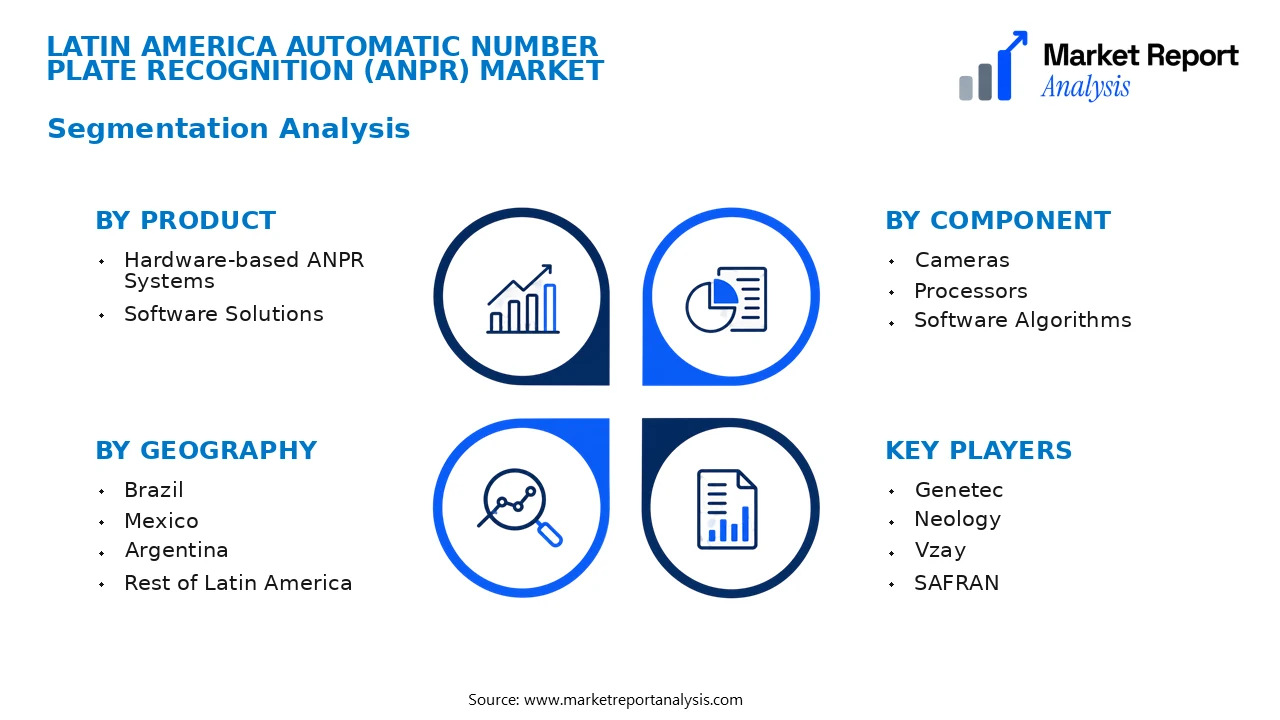
- Product
- Hardware-based ANPR Systems: This segment includes physical ANPR systems equipped with cameras and processors, essential for real-time vehicle identification, primarily deployed in transportation and law enforcement sectors for security and traffic management.
- Software Solutions: Software-only products facilitate license plate recognition capabilities integrated into existing security infrastructure, favored for their ease of integration, scalable deployment, and the rapidly evolving detection algorithms.
- Component
- Cameras: High-resolution cameras serve as the core component for image capture in ANPR systems, with rising demand driven by the need for better accuracy and night-time functionality in urban environments.
- Processors: Advanced processors analyze collected images, supporting complex recognition algorithms, crucial for real-time vehicle tracking in traffic management and toll collection solutions.
- Software Algorithms: Recognition algorithms enhance vehicle identification accuracy, playing a vital role in reducing false positives and improving the system’s overall efficiency in crowded or adverse conditions.
- Technology
- Infrared ANPR: Leveraging infrared illumination, this technology provides superior night-time recognition and is increasingly adopted in law enforcement for 24/7 surveillance and parking management.
- Visible Light ANPR: Utilizes standard visible spectrum cameras, suitable for daylight applications with less power consumption, and predominantly employed in urban traffic monitoring systems.
- Application
- Traffic Management: ANPR systems help monitor and control traffic flow, enforce traffic laws, and automate toll collection, thereby improving road safety and reducing congestion.
- Law Enforcement & Security: Facilitates vehicle tracking, access control, and surveillance in high-security zones, contributing significantly to crime prevention and border security measures.
- Parking & Access Control: Widely adopted in commercial and public parking lots, ANPR systems streamline vehicle entry/exit processes and enhance revenue collection by automating billing.
- End User
- Government & Transportation Authorities: Major users of ANPR technology for law enforcement, traffic regulation, toll collection, and infrastructure management, driving substantial investment into system upgrades.
- Private Sector: Includes parking management companies, commercial fleet operators, and logistic firms adopting ANPR for security, fleet tracking, and operational efficiency enhancements.
- Geography
- Brazil: As the largest economy in Latin America, Brazil exhibits high demand for ANPR in urban traffic management, law enforcement initiatives, and toll collection systems, fostering a robust market environment.
- Mexico: With a focus on urban security and traffic optimization, Mexico demonstrates significant market growth potential for ANPR applications, supported by expanding government infrastructure projects.
- Argentina: Though relatively smaller in market size, Argentina's increasing adoption of ANPR systems correlates with rising government initiatives towards smarter urban transport systems.
- Rest of Latin America: Countries like Colombia, Chile, and Peru are progressively integrating ANPR solutions for urban security, law enforcement, and toll collection, representing emerging growth markets within the region.
Competitive Intelligence
The Latin America Automatic Number Plate Recognition (ANPR) market exhibits moderate competition with a mix of regional players and global technology providers vying for market share. Market concentration remains relatively balanced, with the presence of several mid-sized companies, although a few dominant players hold significant segments. Businesses in this sector are adopting aggressive strategies including product innovation and strategic partnerships to enhance their offerings and expand market reach. Companies are investing heavily in R&D to develop more accurate and faster ANPR systems, integrating AI and machine learning to improve recognition capabilities under various environmental conditions. Partnerships with government agencies and transportation authorities are prevalent, aiming to secure large-scale contracts for smart city projects and surveillance. Acquisitions are also common, with larger firms acquiring smaller, innovative startups to strengthen their R&D pipeline and diversify product portfolios. Expansion strategies involve geographical penetration into underserved markets and diversification into adjacent areas like facial recognition and traffic management systems, creating distinct competitive advantages. Overall, differentiation hinges on technological sophistication, comprehensive service support, and strategic collaborations.
Leading Company Profiles
The Latin America ANPR market features a competitive landscape composed of several key players, each leveraging advanced technologies and strategic initiatives to strengthen their market presence and deliver innovative solutions across various sectors.
Nenso specializes in AI-driven ANPR software, integrating machine learning algorithms for high accuracy detection, serving law enforcement, tolling, and traffic management clients with scalable cloud-based solutions aimed at regional expansion.
Cognitec offers advanced biometric and facial recognition technologies combined with its robust ANPR solutions, focusing on security applications in transportation hubs, borders, and urban surveillance with a strategic emphasis on expanding its regional footprint.
Genetec delivers unified security solutions, including sophisticated ANPR systems that integrate seamlessly with its video management and access control platforms, with an ongoing focus on cloud integration and intelligent analytics in Latin America.
Neology specializes in RFID and ANPR technologies for tolling, transit, and parking solutions, emphasizing the development of innovative, contactless payment systems and expanding its market share through regional collaborations.
Tattile manufactures high-performance, portable, and fixed ANPR cameras, with an emphasis on smart city projects and law enforcement applications, investing heavily in R&D to enhance detection accuracy in challenging environmental conditions.
Vigilant Solutions focuses on license plate data analytics for law enforcement, providing comprehensive data management platforms that support predictive policing and crime prevention, aiming to broaden its regional partnerships and data integration capabilities.
M2M Telemetry offers IoT-enabled ANPR solutions with advanced data collection and analytics features, prioritizing software customization and strategic alliances to penetrate new markets within Latin America’s transportation sectors.
Targa Systems specializes in high-speed ANPR systems for border control and highway monitoring, investing in automating vehicle classification and height detection to enhance operational efficiency and compliance enforcement.
DataFROM provides cloud-hosted ANPR solutions integrating AI for real-time traffic management and law enforcement support, with expansion strategies focusing on deploying intelligent traffic systems across major Latin American cities.
Strategic Business Developments

- April 2023 – Cognitec Systems – Launch of new biometric integration platform – Enhances security applications and AU integration, broadening regional government and enterprise sector capabilities.
- June 2023 – Neology – Expansion of tolling technology portfolio – Supports increased adoption of contactless toll payments, capturing a larger share in transit infrastructure projects across LATAM.
- August 2023 – Tattile – Introduction of AI-enabled portable ANPR units – Aims to improve law enforcement effectiveness in remote and challenging environments, boosting regional sales.
- September 2023 – Genetec – Strategic partnership with regional security providers – Facilitates large-scale deployments of integrated security solutions in urban surveillance systems.
- October 2023 – M2M Telemetry – Launch of customizable IoT-based traffic management platform – Supports smart city initiatives, optimizing traffic flow and reducing congestion across Latin American metropolitan areas.
Frequently Asked Questions
What is the Latin America Automatic Number Plate Recognition (ANPR) Market?
The Latin America Automatic Number Plate Recognition (ANPR) Market pertains to the industry involved in developing, deploying, and maintaining ANPR systems across Latin American countries. These systems utilize optical character recognition to automatically read vehicle license plates for applications like traffic management, law enforcement, toll collection, and parking management.
What is the current market size of Latin America Automatic Number Plate Recognition (ANPR) Market?
As of 2026, the market value of the Latin America ANPR industry is estimated at approximately USD X billion, reflecting its growing adoption across government and private sectors. This size is anticipated to expand significantly with technological advancements and increasing infrastructure investments.
What factors are driving the Latin America Automatic Number Plate Recognition (ANPR) Market?
Market growth is propelled by rising vehicle numbers, increasing road safety and security concerns, government initiatives to implement smart city projects, and the need for efficient traffic and law enforcement solutions. In addition, technological innovations enhance system accuracy and cost-effectiveness, fueling adoption.
Which region dominates the Latin America Automatic Number Plate Recognition (ANPR) Market?
Brazil currently dominates the Latin American ANPR market due to its large population, extensive urbanization, and substantial government investment in smart city projects and security measures. Other significant markets include Mexico and Argentina, which also see rising ANPR deployment.
Which segment is expected to grow the fastest?
The infrastructure segment, including toll collection and parking management, is forecast to experience the highest growth rate due to increasing demand for automated, contactless solutions in urban areas, alongside expanding transportation networks and e-governance initiatives.
Who are the leading companies operating in the Latin America Automatic Number Plate Recognition (ANPR) Market?
Leading players include Genetec, Neology, Vzay, and SAFRAN, among others. These companies focus on innovation, strategic partnerships, and regional expansion to strengthen their market presence in Latin America amid rising adoption of ANPR technology.
Analyst Perspective
The Latin America Automatic Number Plate Recognition (ANPR) market is approaching a mature phase, characterized by increased adoption across transportation, law enforcement, and urban management sectors. Long-term outlook remains positive, driven by urbanization, smart city initiatives, and security concerns. Opportunities abound in integrating ANPR with advanced analytics, AI, and surveillance ecosystems, enabling comprehensive traffic and security solutions. As technology evolves, emphasis shifts towards enhancing accuracy, reducing costs, and expanding coverage through IoT-enabled, cloud-based platforms. Investment priorities should focus on scalable infrastructure, regional customization, and robust legal frameworks for privacy and data security. Competitive intensity is rising with regional and global players expanding presence, fostering innovation, and pursuing strategic alliances. Regional growth potential varies; Brazil, Mexico, and Argentina are expected to lead due to ongoing infrastructure development, governmental support, and public safety initiatives. Long-term success hinges on balancing technological advancement with regional regulatory landscapes and addressing cybersecurity risks.
