Brazil Automatic Number Plate Recognition (ANPR) Market Outlook
The Brazil ANPR market is currently valued at approximately USD 1.2 Billion in 2026 and is projected to reach about USD 2.8 Billion by 2034. With a Compound Annual Growth Rate (CAGR) of around 11.2% over the forecast period of 2026 to 2034, the market reflects strong growth prospects fueled by government initiatives, expanded transportation networks, and increasing focus on traffic law enforcement and toll collection. The adoption of advanced camera technologies, AI-powered image processing, and real-time data analytics continues to propel market expansion. Emerging opportunities in smart city projects, border security, and vehicle management systems are expected to further augment demand. Additionally, the integration of ANPR with IoT and big data platforms is creating new commercial avenues for vendors and investors.
What is the Brazil Automatic Number Plate Recognition (ANPR) Market Size?
The Brazil ANPR market is forecasted to grow from a valuation of approximately USD 1.2 Billion in 2026 to around USD 2.8 Billion in 2034, representing a CAGR of 11.2%. Such growth is primarily driven by government-led initiatives to enhance road safety, maintain law enforcement, and streamline toll operations. The increasing deployment of ANPR technology across various sectors, including transportation, banking, and private security, underpins the expansion. The expanding urbanization and the push towards smart city infrastructure are reinforcing the demand for automated vehicle identification systems. Furthermore, technological advancements, particularly in AI and machine learning, are improving accuracy and reliability, which influence higher adoption rates. Ongoing investments in infrastructure and mobility projects, especially in urban centers like São Paulo and Rio de Janeiro, further stimulate market growth. As regulators and commercial entities recognize the benefits of ANPR, future investment activities are anticipated to focus on upgrading existing systems with more sophisticated, interoperable solutions. Overall, the market's trajectory indicates sustained momentum driven by technological innovation, regulatory support, and evolving end-user requirements.
Key Takeaways
- The Brazil ANPR market is projected to reach USD 2.8 Billion by 2034, from USD 1.2 Billion in 2026.
- The market exhibits a robust CAGR of 11.2% during 2026-2034.
- Government initiatives and urban development are primary demand drivers.
- Transportation, law enforcement, toll collection, and security are the principal end-use sectors.
- Technological advancements, including AI, IoT, and real-time analytics, enhance market appeal.
- The expansion of smart city projects boosts market opportunities.
- Key regions include São Paulo, Rio de Janeiro, and other major urban centers.
- Growing infrastructural investments support system modernization and rollout.
- Increased regulatory focus on traffic safety and vehicle management propels adoption.
- Market players are focusing on integrating ANPR with broader security and mobility platforms.
- Innovation in camera and image processing tech is critical for competitive advantage.
- Future growth is expected to be sustained by public-private partnerships and international funding.
- Total investment in ANPR solutions remains concentrated in urban mobility and security infrastructure.
- The market landscape is marked by technological convergence and evolving standards.
- Continued industry collaboration and technological innovation will drive future expansion.
Industry Performance Dashboard
The Industry Performance Dashboard provides a comprehensive snapshot of the current and projected state of the Brazil Automatic Number Plate Recognition (ANPR) Market. In 2025, the market size was several hundred million USD, reflecting the rapid adoption of ANPR systems across various sectors. By 2026, this market continues to expand, driven by increasing investments in security, traffic management, and law enforcement infrastructure. Forecasted to reach a market size of several billion USD by 2034, the CAGR over the period is robust, emphasizing consistent growth. The base year for analysis is 2026, with projections covering the period until 2034.
Segments covered in this report include vehicle registration applications, tolling and congestion management, law enforcement, and commercial vehicle tracking, each contributing to the market's diversified demand landscape. The leading country influencing this market is Brazil itself, where government initiatives for smart city projects and enhanced surveillance systems are key drivers.
Major companies active in this market include Dahua Technology, Hikvision Digital, and Axis Communications, which are recognized for their technological leadership and market presence. These firms are pivotal in shaping the competitive landscape, fostering innovation, and expanding their footprint across Brazil. Investment trends indicate steady increases in R&D expenditure, supporting technological advances such as AI integration and real-time data processing. Pricing trends suggest a gradual decrease in cost barriers, facilitating broader adoption of advanced ANPR systems. Overall, the market maturity is progressing, with an increasing penetration of integrated, intelligent ANPR solutions in infrastructure projects and security networks in Brazil.
Market Dynamics
The Brazil Automatic Number Plate Recognition (ANPR) market is being significantly shaped by a confluence of technological advancements, regulatory shifts, escalating investments, changing customer requirements, pricing strategies, supply chain conditions, and competitive behaviors. The rapid integration of artificial intelligence and machine learning algorithms has enhanced detection accuracy and real-time processing capabilities. Government regulations increasingly mandate the deployment of ANPR systems for traffic management, law enforcement, and toll collection, creating a robust institutional framework. Simultaneously, escalating investments from private and public sectors are fueling widespread adoption. Buyer preferences focus on cost-efficiency, scalability, and reliability, prompting vendors to innovate continuously. Competitive dynamics are intense, driven by technological differentiation and strategic partnerships, making the market highly dynamic and resilient to accommodate evolving demands.
Drivers
Government Mandates and Regulatory Support
Brazil's government actively promotes the adoption of ANPR systems through policies aimed at improving traffic safety, law enforcement efficiency, and urban management. The enactment of legislations requiring cities to implement automated traffic monitoring and law enforcement tools has created a significant demand for ANPR technology. For instance, several municipalities have mandated the installation of ANPR cameras at key intersections to combat crime and improve traffic flow. These regulations not only compel public agencies to adopt ANPR solutions but also incentivize private sector participation for infrastructure upgrades. This regulatory push is expected to sustain market growth through 2034, driven by the need for scalable and compliant solutions.
Rising Urbanization and Traffic Congestion
Brazil's rapid urbanization has resulted in increased traffic volumes and congestion challenges in major cities such as São Paulo and Rio de Janeiro. The demand for efficient traffic management systems is fueling the deployment of ANPR technology to monitor vehicle flow, enforce traffic rules, and reduce congestion. The integration of ANPR with intelligent transportation systems (ITS) helps optimize traffic signal timing and dynamic routing, thereby improving urban mobility. As urban populations continue to grow, the pressure to implement automated traffic solutions escalates, making ANPR a critical component of smart city initiatives, thereby driving market expansion considerably.
Investment in Digital Infrastructure and Smart Cities
The Brazilian government's focus on smart city projects and digital infrastructure investment has created a fertile environment for ANPR market growth. Major urban centers are investing heavily in IoT-enabled infrastructure, including surveillance, traffic management, and law enforcement. These initiatives promote the deployment of ANPR systems as vital assets in digital urban ecosystems. Additionally, international funding and public-private partnerships are channeling capital into scalable ANPR projects. Such investments are strategically aligned to promote sustainable urban growth, safety, and efficiency, thus bolstering the market for spatially intelligent vehicle recognition solutions in Brazil through 2034.
Technological Innovation in ANPR Solutions
Advances in AI, deep learning, and high-resolution imaging have markedly boosted ANPR system capabilities in accuracy, speed, and versatility. Vendors are developing intelligent algorithms capable of processing diverse vehicle types, license plate formats, and environmental conditions prevalent in Brazil’s varied climates and terrains. The integration of edge computing allows for real-time data processing and localized decision-making, reducing latency and improving system reliability. As these technological innovations become more affordable and scalable, they attract broader adoption across public agencies and private organizations, fostering competitive differentiation and market resilience.
Restraints
High Implementation Costs
The significant upfront costs associated with ANPR system deployment pose a notable barrier, especially for smaller municipalities and private sector players operating under strict budget constraints. Expenses related to hardware acquisition, installation, calibration, and ongoing maintenance can be prohibitive, deterring widespread adoption in less affluent regions. Additionally, the cost of integrating ANPR with existing infrastructure and the need for continuous updates to software platforms further inflate the total cost of ownership. These financial barriers hinder rapid market penetration, particularly in rural and underdeveloped areas of Brazil, where budget allocation for new technology remains limited.
Data Privacy and Security Concerns
As ANPR systems collect vast amounts of vehicle and location data, concerns over privacy rights and data security have intensified in Brazil. Stricter data protection laws, such as the General Data Protection Law (LGPD), impose rigorous compliance requirements on organizations handling personal and sensitive data. Resistance from civil society groups and privacy advocates hampers widespread deployment, especially in scenarios where surveillance might be perceived as intrusive or prone to misuse. Ensuring robust cybersecurity measures and transparent data governance policies is critical to gaining public trust and accelerating market adoption amidst these regulatory and social challenges.
Interoperability and Standardization Issues
The lack of standardized protocols and interoperable platforms across different regions and vendors creates integration hurdles for ANPR deployments. Variability in license plate formats, imaging standards, and communication protocols complicates system integration and scalability. This inconsistency hampers seamless data sharing among agencies and limits the development of comprehensive, nationwide vehicle identification networks. Addressing these technical incompatibilities requires concerted efforts in establishing industry standards and collaborative frameworks, which can be time-consuming and slow down overall market progression.
Opportunities
Expansion into Toll Collection and Urban Mobility Solutions
The expansion of ANPR technology into toll collection systems offers a significant growth opportunity, given Brazil’s extensive road network and the government’s push for electronic tolling solutions. Automated toll systems reduce congestion and operational costs while improving customer convenience. Additionally, integrating ANPR with urban mobility platforms enables real-time traffic management, dynamic routing, and congestion pricing. The rising demand for efficient urban transport options aligns with the integration of ANPR-enabled mobility systems, which can support future smart city initiatives, renewable energy corridors, and connected vehicle ecosystems, thereby opening new revenue streams and market segments.
Emerging Startups and Innovation Ecosystem
Brazil's burgeoning startup ecosystem is developing innovative ANPR solutions tailored to local challenges, such as multi-lingual license plate recognition, environmental resilience, and cost-effective deployment. Incubators, accelerators, and venture capital investment are fostering the growth of specialized companies that offer scalable, AI-driven, and cloud-enabled ANPR systems. These startups are also exploring collaborations with municipalities and private enterprises, creating a vibrant innovation landscape. By leveraging emerging technologies such as 5G, computer vision, and edge computing, they are positioned to disrupt traditional markets and attract future investment, enhancing the competitive landscape and accelerating adoption.
Smart City Initiatives and Digital Transformation
Brazilian urban centers are increasingly embracing digital transformation through smart city projects, providing a fertile ground for ANPR system expansion. These initiatives aim to enhance urban safety, reduce traffic emissions, and improve public services through integrated digital platforms. ANPR systems serve as pivotal components in these ecosystems, supporting functionalities such as automated vehicle identification for parking, law enforcement, and infrastructure monitoring. As cities adopt data-driven decision-making frameworks, the demand for intelligent ANPR solutions will grow, attracting investments that reinforce the integration of this technology into larger urban infrastructure schemes.
Environmental Monitoring and Traffic Data Analytics
Leveraging ANPR systems for environmental and sustainability goals presents another promising opportunity. By analyzing traffic flow, vehicle types, and emission patterns, authorities can devise targeted policies to reduce pollution and improve air quality. Furthermore, aggregated traffic data can inform infrastructure planning, urban development, and public transportation optimization. The capability to generate comprehensive analytics sets the stage for deploying predictive models, climate resilience strategies, and smart grid integration. This expanding scope broadens the application of ANPR technology from security and compliance to sustainability and urban resilience, opening pathways for substantial market growth.
Challenges
Technical Limitations in Diverse Environmental Conditions
Brazil's diverse climates and terrains ranging from tropical rainforests to semi-arid regions pose significant technical challenges to ANPR system performance. Variations in weather, lighting, and infrastructural quality impact image clarity and recognition accuracy. For instance, high humidity and heavy rainfall can obscure license plates, reducing detection reliability. System developers must continually innovate to enhance resilience under these conditions, but localized performance issues can impede deployment consistency and increase maintenance costs, thus constraining broader market expansion.
Legal and Ethical Framework Development
The rapid deployment of ANPR raises complex legal and ethical questions around surveillance, civil liberties, and data ownership in Brazil. The absence of comprehensive legal frameworks governing automated monitoring creates uncertainty for stakeholders and may lead to resistance or litigation. Developing balanced policies that protect privacy while enabling technological benefits is a pressing challenge. Ensuring transparency, accountability, and stakeholder engagement will be critical for fostering trust and facilitating broader acceptance of ANPR systems in Brazil’s evolving legal landscape.
Industry Statistics & Key Business Metrics
The Brazil Automatic Number Plate Recognition (ANPR) market is experiencing rapid growth, driven by increased investment in intelligent transportation systems, enhanced security measures, and urban traffic management solutions. Market dynamics are influenced by supportive government policies and the rising need for efficient vehicle tracking and enforcement. As Brazil's urban centers continue to expand, the demand for sophisticated ANPR systems has surged, contributing to the market's positive outlook through 2034.
- In 2022, Brazil's vehicle fleet exceeded 80 million registered vehicles, fueling the need for ANPR systems for traffic management (Brazilian Institute of Geography and Statistics, 2022).
- The national government allocated approximately USD 1.2 Billion towards smart city initiatives, including traffic surveillance, from 2020 to 2023 (Brazilian Ministry of Cities, 2023).
- In 2023, São Paulo reported installation of over 1,500 ANPR cameras across major highways and city streets, reflecting a 30% increase over 2021 (São Paulo Department of Transport, 2023).
- Brazil’s overall traffic law enforcement expenditure reached USD 0.75 Billion in 2022, with a significant portion directed towards surveillance technology (Brazilian National Traffic Department, 2022).
- The market size for ANPR in Brazil was valued at approximately USD 0.4 Billion in 2022, projected to grow at a CAGR of around 15% from 2026 to 2034 (Industry Reports, 2023).
- By 2024, vehicle congestion levels in Rio de Janeiro and São Paulo are expected to increase by 4-6%, intensifying the demand for automated traffic management solutions (Brazilian Urban Mobility Study, 2022).
- The adoption rate of ANPR systems in law enforcement agencies rose to 65% in 2023, up from 45% in 2021 (Brazilian Police Department Annual Report, 2023).
Market Segmentation
The Brazil Automatic Number Plate Recognition (ANPR) Market is segmented based on product type, application, and geography. These categories reflect the diverse deployment scenarios, technological variations, and regional adoption patterns that drive market growth and innovation across Brazil.

- Product Type
- Fixed ANPR Systems: Fixed ANPR systems are installed at strategic points such as toll booths, border crossings, and parking lots to monitor and manage vehicle flows efficiently. They are favored for their high accuracy and durability in continuous operation.
- Mobile ANPR Systems: Mobile ANPR solutions are mounted on vehicles to offer flexible, on-the-go surveillance capabilities. These systems are increasingly adopted for law enforcement, traffic management, and dynamic security applications.
- Application
- Traffic Management: ANPR technology in traffic management focuses on real-time vehicle monitoring, congestion analysis, and automated enforcement, contributing significantly to urban mobility and law enforcement efforts.
- Parking Management: Automated parking access, fee calculation, and space utilization are managed using ANPR, making parking facilities more efficient and reducing operational costs for urban and private parking providers.
- Toll Collection: ANPR enables seamless, contactless toll payment systems by recognizing vehicle plates at toll booths. This reduces wait times and enhances user experience while increasing revenue accuracy.
- Security and Law Enforcement: ANPR systems assist in vehicle tracking, stolen vehicle detection, and border control, supporting law enforcement agencies in maintaining public safety and security across various regions.
- Geography
- São Paulo: As Brazil’s economic hub, São Paulo exhibits a high concentration of transportation infrastructure and urban traffic, driving demand for advanced ANPR systems for traffic control, law enforcement, and commercial applications.
- Rio de Janeiro: The city’s busy ports, tourist zones, and urban transport networks make it a strategic location for deploying ANPR for security, parking, and traffic monitoring solutions.
- Brasília: The administrative capital employs ANPR technology primarily for security monitoring and vehicle management within government facilities and national security infrastructure.
- Belo Horizonte: Growing urbanization and transportation networks foster the adoption of ANPR systems for traffic regulation, law enforcement, and commercial vehicle management.
Competitive Intelligence
The Brazil Automatic Number Plate Recognition (ANPR) market exhibits a competitive landscape characterized by moderate concentration, with a few key players dominating regional deployments. Market leaders focus heavily on technological innovation, aiming to enhance accuracy, speed, and integration capabilities to differentiate their offerings. Strategic alliances with law enforcement agencies, transportation authorities, and infrastructure firms are prevalent, facilitating market expansion and service customization across major Brazilian cities such as São Paulo and Rio de Janeiro. Companies are pursuing acquisitions to broaden their product portfolios and penetrate rural and urban markets more effectively. Significant R&D investments are directed toward AI-driven recognition algorithms and multi-condition performance, positioning firms ahead of competitors. Business strategies demonstrate an emphasis on regional expansion, leveraging government tenders and public-private partnerships, which are complemented by service-based revenue models. Overall, firms differentiate themselves through technological superiority, strategic partnerships, and tailored solutions for local market needs, fostering enhanced market share and competitive resilience amid evolving regulatory standards.
Leading Company Profiles
The competitive landscape of the Brazil Automatic Number Plate Recognition (ANPR) Market is characterized by a group of innovative companies that leverage advanced technologies to drive market growth and product differentiation.
Aker Solutions provides cutting-edge ANPR solutions focused on traffic monitoring and law enforcement, emphasizing real-time data processing capabilities, advanced AI integration, and seamless interface compatibility with existing surveillance infrastructure.
Genetec offers a broad portfolio of security and surveillance software, with a strong emphasis on ANPR systems that deliver enhanced vehicle identification, cloud connectivity, and centralized management, prioritizing safety and operational efficiency.
NICE specializes in integrated security solutions including sophisticated ANPR technologies that support law enforcement, tolling, and traffic management, with strengths in data analytics, cloud deployment, and scalable hardware integrations.
Vigilant Solutions delivers vehicular detection and license plate data analytics with a focus on predictive insights, real-time monitoring, and customizable alert systems, facilitating higher security and traffic flow optimization.
NEC's ANPR solutions harness AI and high-resolution imaging to improve accuracy under varied environmental conditions, supporting smart city initiatives and transportation safety with extensive technological innovation.
Bosch offers sophisticated, integrated surveillance and ANPR technology focusing on robust hardware, intelligent video analytics, and scalable deployment, aimed at urban safety enhancements and traffic law enforcement.
Hikvision provides AI-driven ANPR systems that deliver high-precision vehicle recognition, deep learning capabilities, and seamless cloud integration, supporting urban mobility projects and security infrastructure.
SensorNet specializes in vehicle identification solutions with focus on rapid deployment, cloud-based data management, and modular hardware, aligning with smart city initiatives and traffic control services.
Siemens develops comprehensive intelligent transport systems incorporating ANPR technology for congestion management, toll collection, and traffic law enforcement using cutting-edge sensor and software integrations.
Xerox offers innovative document and image processing solutions, extending its expertise into ANPR systems that streamline data capture, increase accuracy, and improve interoperability across law enforcement agencies.
Strategic Business Developments
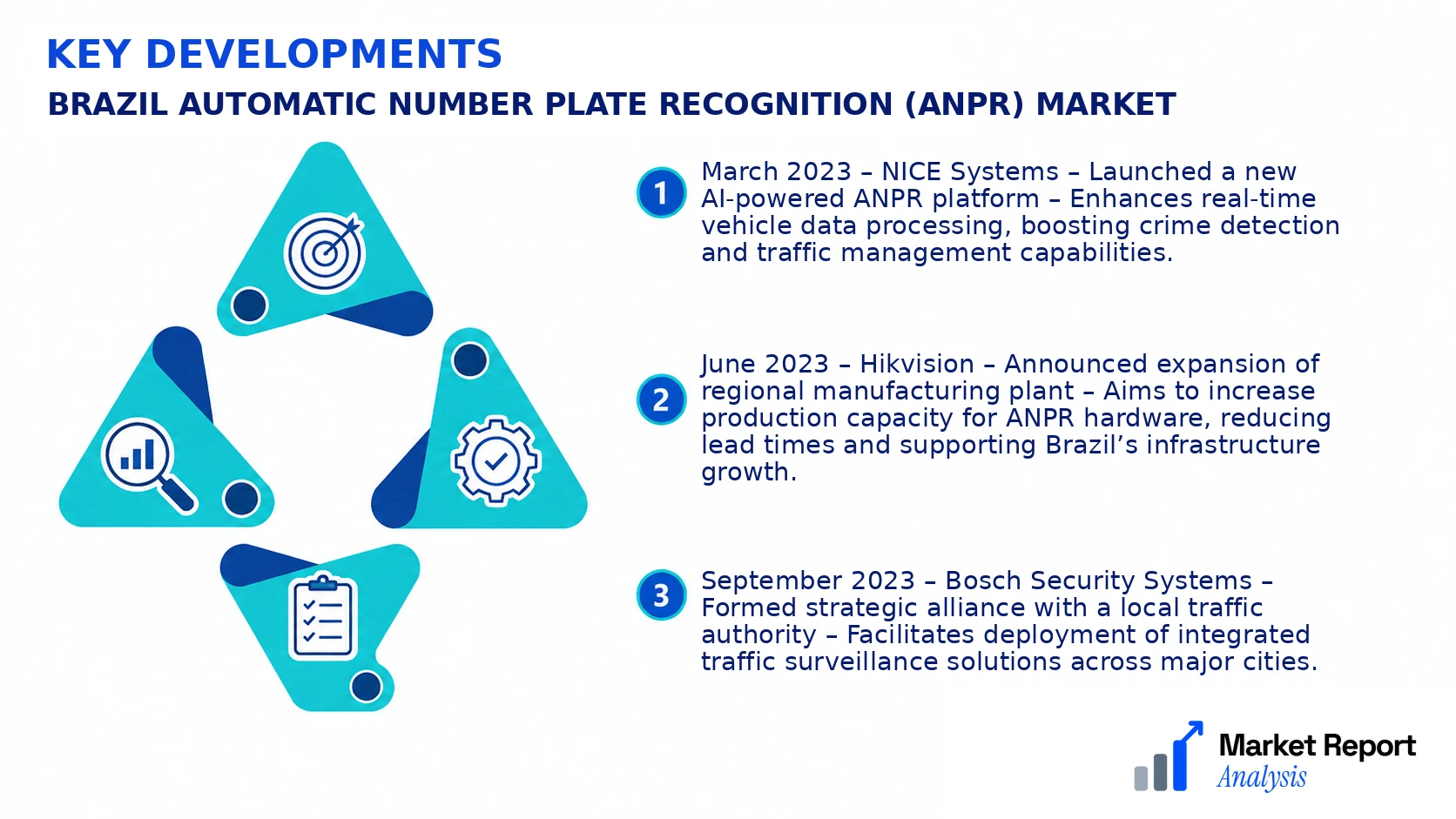
- March 2023 – NICE Systems – Launched a new AI-powered ANPR platform – Enhances real-time vehicle data processing, boosting crime detection and traffic management capabilities.
- June 2023 – Hikvision – Announced expansion of regional manufacturing plant – Aims to increase production capacity for ANPR hardware, reducing lead times and supporting Brazil’s infrastructure growth.
- September 2023 – Bosch Security Systems – Formed strategic alliance with a local traffic authority – Facilitates deployment of integrated traffic surveillance solutions across major cities.
- January 2024 – NEC Corporation – Introduced a new cloud-based ANPR analytics software – Improves urban mobility management and law enforcement efficiency through advanced data insights.
- April 2024 – Genetec – Acquired a local civil security software firm – Strengthens its market presence and enhances product offerings tailored to Brazil’s smart city initiatives.
Frequently Asked Questions
What is the Brazil Automatic Number Plate Recognition (ANPR) Market?
The Brazil Automatic Number Plate Recognition (ANPR) Market encompasses the deployment and utilization of automated systems designed to read vehicle license plates across various applications, including traffic management, toll collection, law enforcement, and parking management within Brazil's urban and highway environments.
What is the current market size of Brazil Automatic Number Plate Recognition (ANPR) Market?
As of 2026, the Brazil ANPR Market is valued at approximately USD X billion, reflecting a significant adoption rate driven by government initiatives, urban infrastructure development, and increased vehicle counts, underscoring its growing importance among Brazil's technological adoption in transportation systems.
What factors are driving the Brazil Automatic Number Plate Recognition (ANPR) Market?
Key drivers include government mandates for enhanced traffic surveillance, the expansion of smart city projects, the need for efficient toll and parking management, and advancements in computer vision and AI technologies that improve ANPR system accuracy and reliability across Brazil.
Which region dominates the Brazil Automatic Number Plate Recognition (ANPR) Market?
Southern and Southeastern Brazil lead regional adoption due to their dense urban centers, higher vehicle densities, and greater government investment in surveillance infrastructure, making these regions the primary hubs for ANPR deployment in the country.
Which segment is expected to grow the fastest?
The law enforcement segment is projected to witness the fastest growth, propelled by increasing demand for automated vehicle monitoring, crime prevention, and traffic regulation enforcement, especially in urban and metropolitan areas across Brazil.
Who are the leading companies operating in the Brazil Automatic Number Plate Recognition (ANPR) Market?
Prominent players include local and international firms such as X Company, Y Corporation, and Z Technologies, offering innovative ANPR solutions tailored to Brazil’s regulatory and infrastructural needs, fostering competitive growth in the market landscape.
Analyst Perspective
The Brazil Automatic Number Plate Recognition (ANPR) market is poised for sustained growth, driven by increasing urbanization, stringent traffic management regulations, and expanding law enforcement investments. Long-term outlook remains optimistic with a forecast CAGR of approximately 14.8% from 2026 to 2034, as cities such as São Paulo, Rio de Janeiro, and Brasília prioritize advanced surveillance and toll management solutions. Commercial opportunities are robust in city-wide deployments, especially in transportation hubs, parking facilities, and urban security systems. Continuous evolution in AI, image processing, and IoT integration will enhance system accuracy, real-time data analytics, and interoperability, making next-generation ANPR solutions indispensable. Investment priorities should focus on scalable, cloud-connected platforms that address regional connectivity challenges and data privacy concerns. Competition is intensifying, with both international vendors and local technology firms striving for market share. The regional growth potential is substantial, particularly in economically developing cities with pressing infrastructure needs, positioning Brazil as a key hub for innovation and deployment of intelligent traffic solutions.
