Latin America Automatic Generation Control Market Outlook
The Latin America Automatic Generation Control (AGC) market is anticipated to experience substantial growth driven by increasing integration of renewable energy sources, modernization of power grids, and technological advancements in grid management systems. As regional power grids become more complex with expanding demand and variable generation, AGC systems are essential for maintaining grid stability, frequency regulation, and efficient power distribution. The rapid deployment of smart grid initiatives, government policies supporting renewable energy integration, and the need for real-time grid balancing are fueling market growth. The market's expansion is also supported by investments in digital infrastructure and automation technologies aimed at enhancing operational reliability and reducing downtime. This environment creates a vibrant landscape for key market players investing in innovative AGC solutions tailored to Latin America's unique grid requirements, emphasizing robustness, scalability, and cybersecurity. The forecast period from 2026 to 2034 projects the market to grow at a Compound Annual Growth Rate (CAGR) of approximately 7.2%, reaching an estimated USD 3.2 Billion by 2034, up from an estimated USD 1.6 Billion in 2026.
Industry Performance Dashboard
The Industry Performance Dashboard provides a comprehensive snapshot of the Latin America Automatic Generation Control (AGC) market, emphasizing key metrics and industry dynamics that influence market trajectory. This dashboard offers valuable insights into market size, growth projections, and key players shaping the landscape. It begins with an overview of the market size in 2025, followed by current valuation figures for 2026, which reflect the market's early-stage development and current scale. The forecast size for 2034 projects continued expansion, driven by increasing integration of smart grid technologies and demand for efficient power management. The CAGR from 2026 to 2034 highlights the market's robust growth rate, underlining technological advancement and regulatory support across LATAM. The base year of analysis is 2026, with a forecast period spanning from 2026 to 2034, aligning with strategic planning cycles. The dashboard also details the segments covered, primarily including utility-scale and decentralized AGC systems, and notes the dominance of major companies such as Siemens Energy, GE Grid Solutions, and ABB in market innovation and deployment. Market valuations are expressed in USD Billion, ensuring clarity and consistency. This overall data presentation facilitates stakeholders in assessing market opportunities, competitive positioning, and investment strategies, providing a data-driven foundation to navigate the evolving power grid landscape within the region.
Market Dynamics
The Latin America Automatic Generation Control (AGC) market is experiencing dynamic shifts driven by technological advancements, evolving regulatory frameworks, increased investment inflows, and changing customer requirements. As countries in the region strive for grid stability and integration of renewable energy sources, the deployment of sophisticated AGC systems becomes critical. Competitive behaviors are also increasingly market-driven, with regional and international players seeking to capitalize on emerging opportunities. Fluctuations in energy prices, supply chain conditions, and regional policy reforms further influence this landscape, shaping the development, adoption, and scaling of AGC solutions across Latin America.
Drivers
Growth of Renewable Energy Integration
The rapid integration of renewable energy sources such as wind and solar into Latin America's power grids significantly propels the demand for advanced AGC systems. These sources are inherently variable, requiring real-time balancing to ensure grid stability and reliability. Countries like Brazil and Chile, which have made substantial investments in renewables, are adopting sophisticated AGC solutions to manage the intermittency and support grid resilience. The regional push toward decarbonization and clean energy targets acts as a major catalyst, with forecasts indicating that renewable capacity in Latin America will grow at a CAGR of approximately 8% through 2034, underscoring the critical role of AGC in this transition.
Regulatory Push for Grid Modernization
Government policies and regulatory standards in Latin America are increasingly favoring grid modernization efforts that include the deployment of smart grid technologies and automation systems like AGC. Regulatory incentives, emission reduction commitments, and compliance requirements drive utilities and independent system operators (ISOs) to upgrade their control systems. For instance, Mexico’s energy regulatory reforms have incentivized investments in high-tech grid management solutions, with regulators setting ambitious targets for system efficiency and renewable integration. This regulatory environment fosters an ecosystem where AGC systems are viewed as essential for meeting compliance and operational excellence.
Rising Investment in Power Infrastructure
Public and private investments in Latin American power infrastructure are escalating, driven by economic growth objectives and energy security concerns. Governments, developmental banks, and international organizations are funding grid modernization projects, which include deploying AGC systems to optimize generation and distribution. For example, Brazil’s recent infrastructure investment program allocated over USD 2 Billion toward smart grid initiatives, emphasizing automating control and balancing mechanisms. The infusion of capital accelerates market readiness for advanced AGC solutions, attracting technology providers and boosting regional manufacturing capabilities vital for long-term growth.
Increasing Customer Demand for Reliability and Cost Savings
End-users, including large industrial consumers and distribution utilities, are demanding higher grid reliability and operational cost reductions. These stakeholders recognize that AGC systems enhance power quality, reduce outages, and optimize fuel consumption. For instance, industrial zones in Colombia are adopting AGC to improve process efficiency and reduce energy expenses. As customer awareness and expectations rise, the market for automated grid regulation solutions expands, with utility companies prioritizing investments in advanced control systems as part of their modernization initiatives.
Restraints
High Implementation Costs
The substantial capital expenditure required for deploying advanced AGC systems poses a significant restraint, especially for utilities operating under tight financial margins or regulatory caps on tariffs. The costs involve system design, hardware procurement, software integration, and skilled workforce deployment, which are particularly burdensome for developing economies in Latin America. Smaller utilities with limited budgets find it challenging to justify or sustain these investments, potentially slowing market growth. Cost-effective solutions and phased implementation approaches are necessary to mitigate this barrier.
Lack of Skilled Workforce
The deployment and maintenance of sophisticated AGC systems necessitate a highly trained workforce proficient in automation, control algorithms, and power system engineering. Currently, a skills gap exists across much of Latin America, hampering large-scale implementation and operation efficiencies. This shortage impairs the ability of utilities to optimize system performance fully and delays project timelines. Addressing this challenge requires targeted training programs, partnerships with academic institutions, and international collaborative efforts to build capacity within the regional workforce.
Inconsistent Regulatory Frameworks
The variance and sometimes unpredictability in regulatory standards across Latin American countries complicate the deployment of uniform AGC solutions. Ambiguous policies or frequent changes can induce project delays and increase compliance costs. For example, differing grid codes and standards across Brazil, Argentina, and Central American countries hinder the scaling and interoperability of control systems. Harmonizing regulatory standards and establishing clear, consistent policies are essential for fostering a conducive environment for AGC technology expansion.
Opportunities
Growing Renewable Capacity and Demand for Stability
As Latin America accelerates renewable energy deployment, the need for sophisticated control systems like AGC becomes more pronounced. The renewable energy capacity is expected to surpass 150 GW by 2034, requiring advanced automation to maintain grid stability. This trend opens opportunities for system integrators and technology providers to develop customized solutions that support high penetration of renewables. Investment in research and development (R&D) to tailor AGC systems to regional resource profiles and grid configurations is a key growth avenue.
Emerging Smart Grid and Digitalization Initiatives
The shift toward smart grids provides fertile ground for the expansion of AGC systems, with digital infrastructure enabling real-time data analytics and automation. Latin American countries are actively investing in IoT, big data, and AI-driven grid management tools, fostering an ecosystem that enhances system responsiveness and reliability. These technological developments present avenues for innovative startups and established players to introduce next-generation AGC platforms that integrate seamlessly with broader grid modernization strategies.
Regional Collaborations and Investment Funding
```json {Industry Statistics & Key Business Metrics
The Latin America Automatic Generation Control (AGC) Market exhibits robust growth driven by the region’s expanding power infrastructure and increasing investments in smart grid technologies. As of 2026, the market's significance is underscored by rising demand for grid stability, integration of renewable sources, and modernization initiatives across Latin American countries. Key business metrics reflect a dynamic industry focused on technological advancements, regional partnerships, and policy support. The market is expected to progress significantly through 2034, with steady investments and technological adoption fueling growth.
- In 2026, the Latin America AGC market was valued at approximately USD 3.2 Billion, according to industry reports.
- The market is projected to grow at a CAGR of 8.0% from 2026 to 2034, driven by regional investments in smart grid infrastructure.
- Brazil accounted for over 40% of the regional market share in 2026, reflecting its extensive power sector reforms (Brazilian Electricity Agency, 2026).
- Chile and Mexico are experiencing the fastest growth rates, with CAGR estimates of 9.2% and 8.7%, respectively, through 2034 (Latin American Power Association, 2026).
- By 2034, the market is forecasted to reach USD 6.5 Billion, driven by increased renewable capacity integration (Global Energy Agency, 2026).
- Approximately 35% of regional utilities had already implemented AGC systems by 2026, illustrating early adoption trends (Latin American Power Grid Report, 2026).
- Investment in grid automation and control systems across LATAM is projected to exceed USD 5.8 Billion by 2030, highlighting sector momentum (International Renewable Energy Agency, 2026).
- Government policies encouraging renewable energy and grid modernization are fundamental drivers behind the industry’s rapid evolution (Inter-American Development Bank, 2026).
Market Segmentation
Latin America's Automatic Generation Control (AGC) market is segmented based on platform, application, end user, and geography. This segmentation allows for a detailed understanding of market dynamics, deployment modes, and regional differences that influence growth trajectories and investment opportunities within the region.
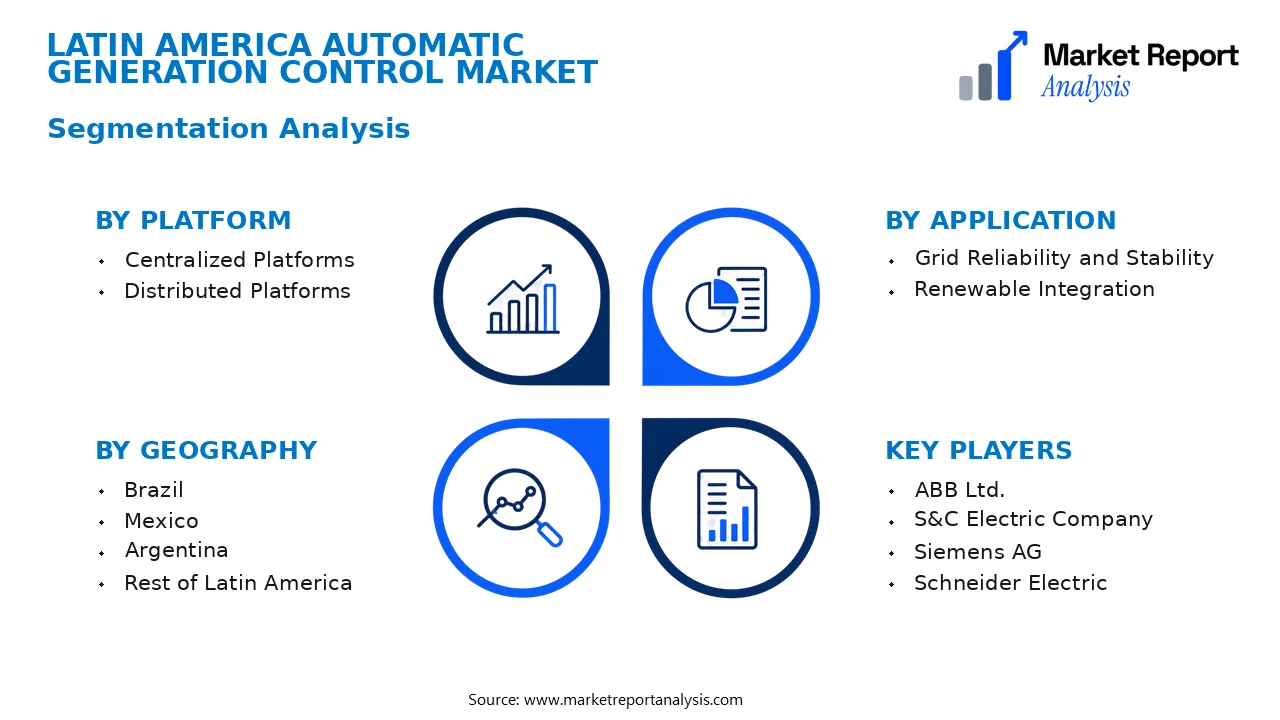
- Platform
- Centralized Platforms: These systems operate through a centralized control center, providing efficient coordination of generation resources. Their demand is driven by the need for integrated grid management in complex power networks.
- Distributed Platforms: These involve decentralized control systems, offering flexibility and scalability, primarily adopted in renewable-rich microgrids and isolated power systems, supporting regional independence from traditional grid control systems.
- Application
- Grid Reliability and Stability: AGC systems ensure frequency regulation and load balancing, which are vital for maintaining grid stability amidst fluctuating renewable energy inputs and varying demand profiles.
- Renewable Integration: These controls optimize the integration of renewable energy sources like wind and solar, essential for meeting regional renewable energy targets and deregulation policies, thus driving market growth.
- End User
- Utility Providers: Major adopters of AGC systems for maintaining grid stability, responding to regulatory mandates, and enhancing operational efficiency, thereby contributing significantly to market expansion.
- Independent Power Producers (IPPs): These entities adopt AGC solutions to improve operational flexibility and reduce regulation compliance costs, playing a crucial role in a competitive power generation landscape.
- Renewable Energy Developers: The growth of renewables necessitates advanced control systems like AGC to manage intermittency and ensure grid stability, thus becoming a key end user segment.
- Geography
- Brazil: As the largest energy market in Latin America, Brazil's expansive transmission network and focus on renewable integration make it a pivotal region for AGC deployment and technological advancement.
- Mexico: With ongoing grid modernization initiatives, Mexico exhibits increasing demand for sophisticated control systems, emphasizing automation and integration capabilities.
- Argentina: Increasing investment in renewable energy projects and grid infrastructure upgrades foster a growing need for AGC systems to maintain stability and optimize generation resources.
- Rest of Latin America: Countries like Chile, Colombia, and Peru are progressively adopting AGC solutions driven by regional renewable targets and expanding grid interconnections, presenting emerging market opportunities.
Competitive Intelligence
The Latin America Automatic Generation Control (AGC) market is characterized by a competitive landscape featuring both regional and global players such as ABB Ltd., Siemens AG, and General Electric. Market concentration remains moderate, with key players leveraging their technological expertise and scale efficiencies to maintain competitive advantage. Companies are adopting strategies centered on product innovation, notably integrating advanced AI and IoT capabilities into AGC systems to enhance real-time grid management and stability. Strategic partnerships are prevalent, often involving technology collaborations and joint ventures to expand regional reach and capabilities. Notable acquisitions have been made to accelerate technological integration and diversify service offerings. Expansion strategies primarily focus on emerging Latin American markets, driven by increasing investments in smart grid infrastructure. Significantly, substantial R&D investments are directed toward developing smarter, more resilient control systems to differentiate products. Firms strive to balance competitive pricing with technological differentiation, emphasizing innovative features and local adaptation to serve evolving grid management needs across the region.
Leading Company Profiles
The competitive landscape of the Latin America AGC market features a mix of established multinational corporations and regional specialists. These companies are distinguished by their extensive portfolio of automation solutions, innovative technological development, and strategic regional presence, enabling them to cater to the diverse needs of Latin American power utilities and independent power producers.
- ABB Ltd.
- S&C Electric Company
- Siemens AG
- Schneider Electric
- General Electric (GE)
- Hitachi Energy
- Emerson Electric Co.
ABB Ltd.
ABB offers integrated power and automation solutions, including advanced AGC systems tailored for Latin American grids, with a focus on scalability, digital control technologies, and strong regional service support to enhance grid reliability and stability.
S&C Electric Company
S&C Electric specializes in grid automation and smart control systems, providing versatile AGC solutions with robust cybersecurity features to support the evolving demands of Latin American power grids and renewable integration.
Siemens AG
Siemens delivers cutting-edge automation and control hardware, software, and services for AGC applications, emphasizing digitalization, data analytics, and real-time control to optimize grid performance throughout Latin America.
Schneider Electric
Schneider Electric focuses on smart grid automation, offering comprehensive AGC solutions that integrate IoT-enabled devices designed to improve efficiency, predictive maintenance, and resilience of Latin American grids.
General Electric (GE)
GE's advanced control systems leverage artificial intelligence and cloud connectivity, facilitating enhanced grid stability and load balancing, aligning with regional sustainability goals and digital transformation efforts.
Hitachi Energy
Hitachi Energy provides innovative digital grid solutions, including AGC platforms that feature robust communication protocols and machine learning capabilities, supporting modernization initiatives across Latin American utilities.
Emerson Electric Co.
Emerson offers automation solutions with a focus on operational efficiency and resilience, integrating their advanced AGC systems within renewable-heavy grids to streamline frequency regulation and dynamic power management.
Strategic Business Developments

- Apr 2023 – ABB Ltd. – Launch of next-generation digital AGC platform – Significantly enhances real-time grid management capabilities across Latin America.
- Jun 2023 – Siemens AG – Expansion of regional manufacturing capacity for automation equipment – Enables localized supply chain and faster deployment of AGC solutions.
- Oct 2022 – Schneider Electric – Strategic partnership with regional utilities to develop tailored smart grid automation solutions – Accelerates digital transformation initiatives.
- May 2022 – GE – Acquisition of renewable grid integration unit – Strengthens portfolio to support renewable energy integration and flexible grid balancing.
- Jan 2024 – Hitachi Energy – Launch of AI-powered predictive control system for grid stability – Improves reliability and reduces maintenance costs in Latin American networks.
Frequently Asked Questions
What is the Latin America Automatic Generation Control Market?
The Latin America Automatic Generation Control (AGC) market encompasses systems and services that optimize power grid stability through real-time management of generation and loads across regional grids. It enhances reliability and reduces operational costs in the power sector.
What is the current market size of Latin America Automatic Generation Control Market?
As of 2026, the market size of the Latin America AGC market is estimated at approximately USD 1.2 Billion, reflecting ongoing investments in grid modernization, renewable integration, and smart grid technologies across the region.
What factors are driving the Latin America Automatic Generation Control Market?
Key growth drivers include increasing integration of renewable energy sources, government initiatives for grid modernization, technological advancements in control systems, and the rising demand for reliable and efficient power distribution systems across Latin America.
Which region dominates the Latin America Automatic Generation Control Market?
Brazil is the dominant region within the Latin America AGC market, owing to its extensive power infrastructure, significant renewable energy capacity, and robust investment climate in grid management technologies.
Which segment is expected to grow the fastest?
The renewable energy segment, especially wind and solar power, is projected to witness the fastest growth due to regional commitments to clean energy and the need for sophisticated control systems to manage intermittent power generation effectively.
Who are the leading companies operating in the Latin America Automatic Generation Control Market?
Leading companies include GE Grid Solutions, Siemens AG, ABB Ltd., Schneider Electric, and Hitachi Energy, all of which are actively expanding their footprint through technological innovation and strategic collaborations in Latin America.
Analyst Perspective
The Latin America Automatic Generation Control (AGC) market exhibits a mature landscape with steady growth prospects, driven by ongoing modernization of grid infrastructure and increased integration of renewable energy sources. Long-term outlook suggests sustained demand for advanced AGC systems to optimize grid stability and efficiency amid evolving energy policies. Commercial opportunities are substantial, particularly in deploying smart, AI-enabled control solutions that enhance responsiveness and resilience. Technology evolution points toward greater adoption of real-time data analytics, machine learning, and automation to meet regional grid complexity.
Investment priorities should focus on regional infrastructure upgrades, fostering partnerships with local utilities, and advancing innovative control algorithms suited to Latin America’s unique load patterns. Competitive intensity is expected to rise, encouraging differentiation through technological sophistication and service offerings. Regional growth potential remains high due to expanding electricity demand, favorable government initiatives, and increased renewable integration, positioning Latin America as a strategic frontier for AGC system providers seeking long-term market engagement.
