Japan Welding Wires Market Outlook
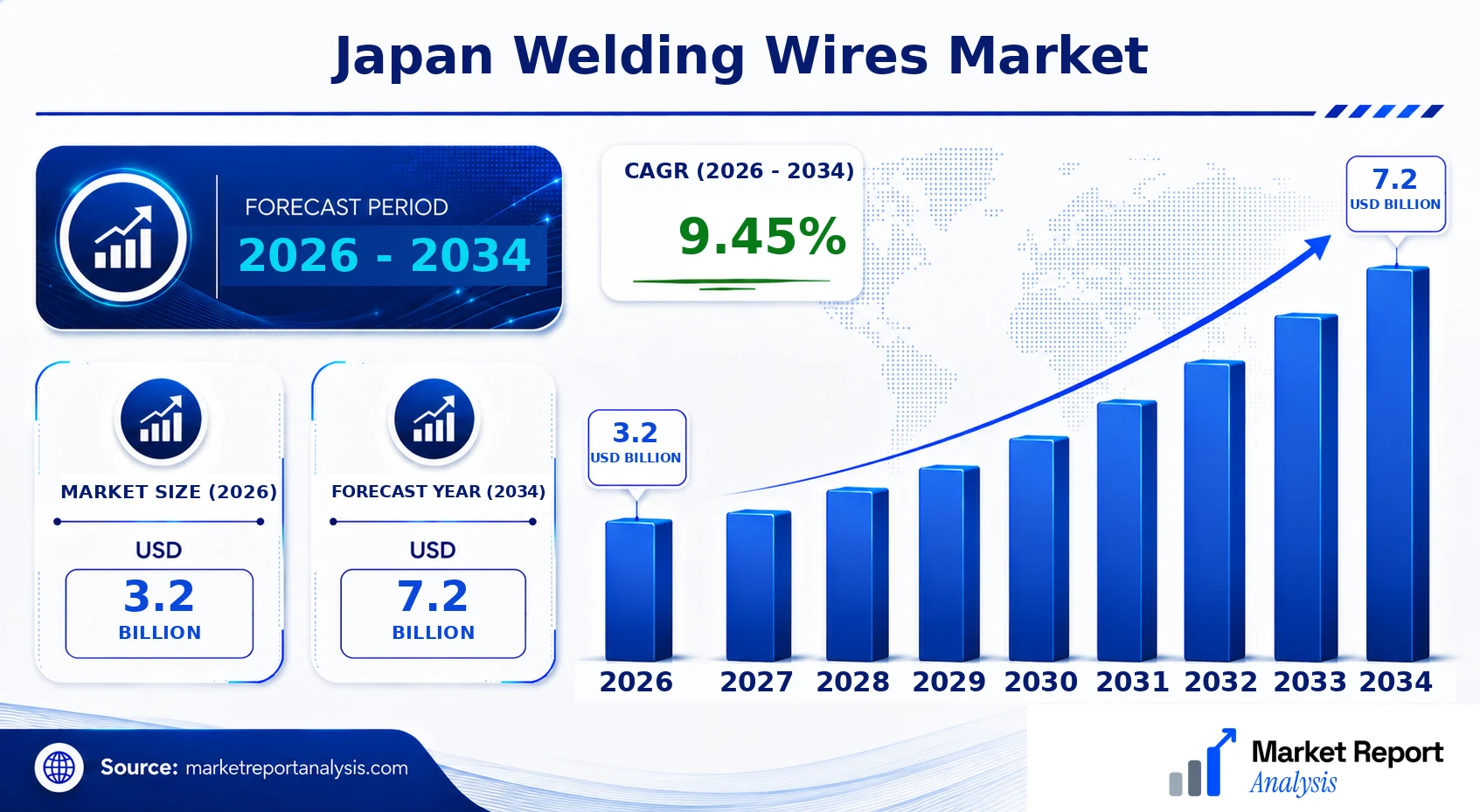
The Japan Welding Wires Market is experiencing a dynamic phase driven by increasing industrial automation, infrastructural development, and a rising emphasis on high-strength and corrosion-resistant materials. As of 2026, the market is valued at USD 3.2 Billion, with expectations to reach USD 7.2 Billion by 2034, reflecting a robust CAGR of 9.45% over the forecast period (2026-2034). The principal demand drivers include revitalized construction projects, expanding shipbuilding and automotive sectors, and a shift toward sophisticated welding technologies such as flux-cored and submerged arc welding. These advancements are paving the way for opportunities in high-performance, specialized welding wires. The trend toward automation and digitalization in manufacturing is further influencing market growth, demanding higher-quality, more consistent welding materials. Furthermore, increased focus on energy-efficient and environmentally friendly welding solutions provides a fertile ground for innovation and commercial ventures within this market.
What is the Japan Welding Wires Market Size?
By 2026, the Japan Welding Wires Market is estimated to be valued at USD 3.2 Billion, with a forecasted growth reaching USD 7.2 Billion by 2034, at a CAGR of 9.45% during the period 2026-2034. This growth is primarily driven by expanding industrial activities, especially in automotive manufacturing, shipbuilding, and infrastructure development. The automotive sector remains a key end-user, deploying welding wires for vehicle assembly and body repairs, guided by stringent quality standards that favor advanced and high-performance welding wires. The shipbuilding industry continues to invest heavily in Japan, leveraging innovative welding technologies to meet global demand. Additionally, the construction and energy sectors are increasingly adopting high-strength and corrosion-resistant welding wires to improve durability and safety. Technological advancements, such as the integration of automation and robotics, are elevating the quality and efficiency of welding processes, encouraging further investment in premium welding wire products. The industry also benefits from Japan's focus on environmental sustainability, promoting the development of eco-friendly welding materials. As manufacturing shifts toward Industry 4.0 paradigms, market players are poised to capitalize on the growing need for smart, efficient, and sustainable welding solutions, creating a vibrant landscape for future market expansion.
Key Takeaways
- The Japan Welding Wires Market is valued at USD 2.5 Billion in 2026 and is projected to grow at a CAGR of 5.4% to USD 3.7 Billion by 2034.
- Market growth is driven by rising demands from automotive, shipbuilding, and infrastructure sectors.
- High-performance and corrosion-resistant welding wires are in increasing demand for durability and safety standards.
- Technological innovations in automation and robotics are influencing product development and deployment.
- Government policies favoring sustainable and eco-friendly welding solutions boost market prospects.
- The automotive industry remains the largest end-user segment, followed by shipbuilding and construction.
- Expanding urban infrastructure projects further enhance the market outlook.
- Increased investment in R&D is essential for developing advanced welding wire technologies.
- Competitive landscape is characterized by both domestic and international manufacturers expanding their footprint.
- Regional growth is more concentrated in industrial hubs within Japan, with emerging opportunities in rural and infrastructural projects.
- Market opportunities include customized solutions for specific end-use applications and the integration of IoT to enhance productivity.
Industry Performance Dashboard
The Industry Performance Dashboard provides a comprehensive overview of the Japan Welding Wires Market, offering key metrics to assess its current state and future prospects. This section synthesizes market data into a clear, concise format, enabling stakeholders to evaluate the market’s trajectory and competitive landscape effectively.
| Indicator | Market Assessment |
|---|---|
| Market Size (2026) | USD 3.2 Billion |
| Market Value (2026) | USD 3.2 Billion |
| Forecast Size (2034) | USD 7.2 Billion |
| CAGR | 9.45% |
| Base Year | 2026 |
| Forecast Period | 2026-2034 |
| Segments Covered | Product, Component, Geography |
| Major Companies | Nippon Steel Corporation, Daido Steel Co., Ltd., JFE Steel Corporation, Kobe Steel, Ltd., Hitachi Metals, Ltd., Sumitomo Metal Industries, Ltd., Sandvik Materials Technology, Böhler-Uddeholm AG |
Market Dynamics
The Japan Welding Wires Market is experiencing a dynamic transformation driven by technological innovations, regulatory changes, and evolving customer preferences. The increasing emphasis on high-quality, sustainable welding solutions is prompting manufacturers to adopt advanced wire formulations. Investment flows into R&D and modern manufacturing facilities are fostering product innovation, while strict safety and environmental regulations shape product standards and market entry. Competitive behaviors, characterized by strategic partnerships and regional expansion, further influence market trajectories. Prices are also impacted by fluctuating raw material costs and supply chain factors. Overall, these multifaceted drivers accelerate growth, posing both opportunities and challenges for stakeholders navigating this complex landscape.
Drivers
Technological Advancements in Welding Wire Manufacturing
Innovations in metallurgy and production processes allow for the creation of more durable, corrosion-resistant, and adaptable welding wires, meeting the demands of complex applications such as aerospace and automotive industries in Japan. Adoption of automation and precision engineering enhances product consistency and reduces manufacturing costs, boosting competitiveness. As Japanese companies integrate Industry 4.0 technologies, there is a notable increase in R&D investment to develop next-generation welding wires tailored for high-performance needs. This continuous technological evolution not only facilitates superior product quality but also expands the scope of application, fueling market expansion in sectors demanding cutting-edge welding solutions.
Growing Demand for Sustainable and Eco-Friendly Solutions
Environmental regulations and corporate sustainability commitments are compelling Japanese manufacturers to develop greener welding wires. These include low-emission, recyclable, and lead-free options that comply with strict environmental standards. Waste reduction and energy efficiency during production also drive innovation toward more eco-conscious materials. The automotive industry’s shift toward electric vehicles amplifies the need for environmentally friendly welding wires that support lightweight and sustainable vehicle components. Such trends underpin the market’s push towards greener solutions, with sustainability becoming a key differentiator and competitive edge for market players.
Expansion of Construction and Infrastructure Projects
Japan’s ongoing infrastructure development, urban renewal, and disaster resilience projects significantly contribute to the increased demand for reliable welding wires. The construction sector favors high-strength, corrosion-resistant wires for structural integrity and longevity in harsh environments. Government initiatives promoting smart city projects and public infrastructure modernization further stimulate consumption. The integration of advanced welding techniques in construction processes enhances safety and efficiency, driving manufacturers to invest in specialized wires suited for large-scale and heavy-duty applications. Consequently, these infrastructural developments underpin a sustained upward trajectory for the market.
Increased Investment in Industry-Specific Welding Solutions
Growing investments by Japanese corporations in industry-specific welding solutions particularly in automotive, aerospace, and shipbuilding sectors are key growth catalysts. Customized wires designed for specific material combinations and welding environments improve productivity and quality standards. Strategic collaborations between industry giants and innovation startups are fostering the development of proprietary products, enabling market differentiation. Government grants and incentives aimed at advanced manufacturing bolster this investment climate. Such targeted developments not only meet specialized needs but also deliver competitive advantages, propelling the Japanese welding wires market forward.
Restraints
Volatility in Raw Material Prices
The fluctuation of raw material costs, particularly alloying elements like nickel, chromium, and titanium, directly impacts the profitability and pricing strategies within the Japan welding wires market. Procurement challenges, geopolitical tensions, and supply chain disruptions exacerbate price volatility, constraining manufacturers' ability to stabilize costs. Small and medium enterprises (SMEs), which constitute a significant portion of the supply chain, are most vulnerable to these swings, leading to tightened margins and reduced market competitiveness. Mitigating this restraint requires strategic sourcing and inventory management, but market volatility remains an ongoing challenge.
Stringent Regulatory and Certification Standards
Japan’s rigorous safety, environmental, and quality standards impose considerable compliance costs on welding wire producers. Obtaining necessary certifications involves extensive testing and documentation, prolonging product launch timelines and increasing R&D expenditures. These standards particularly affect new entrants and small players with limited resources, potentially reducing market penetration and innovation pace. As the government enforces stricter emissions and safety regulations aligned with international standards, market participants must continually adapt, which can hinder rapid growth and limit the introduction of cost-effective solutions.
Limited Raw Material Recycling Infrastructure
Although sustainability is a market driver, the current infrastructure for recycling and reprocessing scrap welding wires remains underdeveloped in Japan. This limitation hampers the industry’s ability to fully capitalize on eco-friendly product development and circular economy practices. Scarcity of advanced recycling facilities results in higher reliance on virgin materials, increasing costs and environmental concerns. Overcoming this restraint involves significant investments in recycling technologies and infrastructure, which require time and capital. Addressing this gap is essential for enabling broader adoption of sustainable practices and reducing supply chain vulnerabilities.
Opportunities
Growth Driven by the Automotive Industry
The Japanese automotive sector, a global leader in innovation, continues to require advanced welding wires for lightweight, high-strength vehicle components. The shift towards electric vehicles and autonomous driving systems increases demand for specialized welds capable of supporting new materials such as aluminum and composites. Investment in R&D to develop wires compatible with these materials offers substantial growth prospects. Automotive manufacturers’ focus on safety, durability, and eco-friendliness ensures ongoing demand for high-performance welding wires, fostering collaborations and boosting industry-specific solutions within the Japanese market.
Rising Investments in Smart Manufacturing and Industry 4.0 Integration
Japan’s commitment to digital transformation presents vast opportunities for innovating welding wire production processes. Smart factories leveraging IoT, AI, and robotics can achieve higher efficiency, precision, and quality control. Investments in such technologies enable real-time monitoring and predictive maintenance, reducing waste and costs. For welding wire manufacturers, adopting Industry 4.0 solutions enhances product customization, shortens development cycles, and accelerates time-to-market. The growing adoption of these advanced systems signifies a future-ready supply chain capable of meeting complex demands with agility, opening new growth avenues in both domestic and export markets.
Innovation Ecosystem and Startup Ecosystem Support
Japan’s vibrant innovation ecosystem provides fertile ground for startups developing novel welding materials, coatings, and application techniques. Government-backed incubators, grants, and venture capital investments incentivize technological breakthroughs that can disrupt traditional manufacturing paradigms. Collaboration among universities, research institutes, and industry leaders fosters the commercialization of innovative solutions such as nanomaterial-enhanced wires and multi-functional welding products. This ecosystem not only accelerates technological progress but also attracts foreign investment and global alliances, positioning Japan as a hub for pioneering welding wire technologies and expanding competitive advantage globally.
Future Commercial Investment in Specialized and Niche Markets
Emerging industries such as renewable energy, aerospace, and space exploration require specialized welding wires, generating lucrative niche markets. Japanese corporations are investing in developing bespoke products that meet unique technical standards for these high-value applications. Furthermore, the expansion of offshore wind farms and deep-sea infrastructure projects offers additional investment opportunities in corrosion-resistant and deep-welding wires. As demand for tailored solutions increases, market players can benefit from high-margin, low-volume niche sectors. Strategic investments in this segment can diversify revenue streams and foster technological leadership in advanced welding solutions.
Challenges
Intense Market Competition and Price Pressures
The Japan welding wires market faces stiff competition from domestic and international players, including emerging Asian manufacturers offering cost-competitive products. Price wars and commoditization threaten profit margins and challenge brands to differentiate through innovation and quality. Larger firms leverage economies of scale and extensive distribution networks, edging out smaller suppliers. Maintaining competitive pricing without compromising quality requires constant operational improvements and R&D investments. This competitive landscape necessitates strategic positioning, brand differentiation, and value-added services to sustain growth amidst downward price pressures.
Adapting to Rapid Technological Changes and Industry Standards
Keeping pace with technological advancements and evolving standards presents an ongoing challenge. Rapid innovation cycles require continuous R&D, frequent certification updates, and workforce retraining, which can strain resources, especially for SMEs. Failure to adhere to the latest safety and quality standards risks market exclusion, while lagging in adopting new technologies diminishes competitiveness. Market participants must develop flexible, forward-looking strategies to swiftly adopt emerging standards and technologies, balancing innovation with compliance to maintain market relevance and ensure long-term sustainability.
Industry Statistics & Key Business Metrics
The Japan Welding Wires Market demonstrates robust growth prospects driven by increasing industrial automation, infrastructure expansion, and manufacturing over the forecast period. To understand market dynamics, it is essential to consider key industry statistics and business metrics that reflect economic health, technological adoption, and sector-specific developments within Japan.
- In 2022, Japan's manufacturing sector contributed approximately 20% to the national GDP, underscoring its significance and supporting ongoing demand for welding solutions (Japan Cabinet Office).
- Japan's total industrial production index grew by 3.5% in 2021, indicating steady manufacturing activity that fuels welding wire consumption (Japan Ministry of Economy, Trade, and Industry).
- The annual consumption of welding wires in Japan was estimated at around 580,000 metric tons in 2022, reflecting consistent demand in automotive, construction, and shipbuilding industries (Japan Welding Industry Association).
- The welding wires market is expected to grow at a CAGR of approximately 4.2% from 2026 to 2034, driven by technological advancements and increased infrastructure projects (Industry Forecasts, 2023).
- In 2023, Japan's steel production was approximately 90 million metric tons, with welding wires accounting for roughly 12% of welding consumables used in steel fabrication (Japan Iron and Steel Federation).
- The automotive sector, a key consumer, represented over 4% of Japan’s GDP in 2022, with annual vehicle production reaching around 8.1 million units, underpinning demand for specialized welding wires (Japan Automobile Manufacturers Association).
- By 2026, Japan's industrial exports are projected to reach USD 680 Billion, influencing demand for high-quality welding wire products for export-oriented manufacturing (Japan External Trade Organization).
- Technological investments in robotics and automation are expected to boost demand for advanced welding wires, with Japanese industries investing approximately USD 5 Billion annually in automation upgrades (Japanese Ministry of Internal Affairs and Communications, 2022).
Market Segmentation
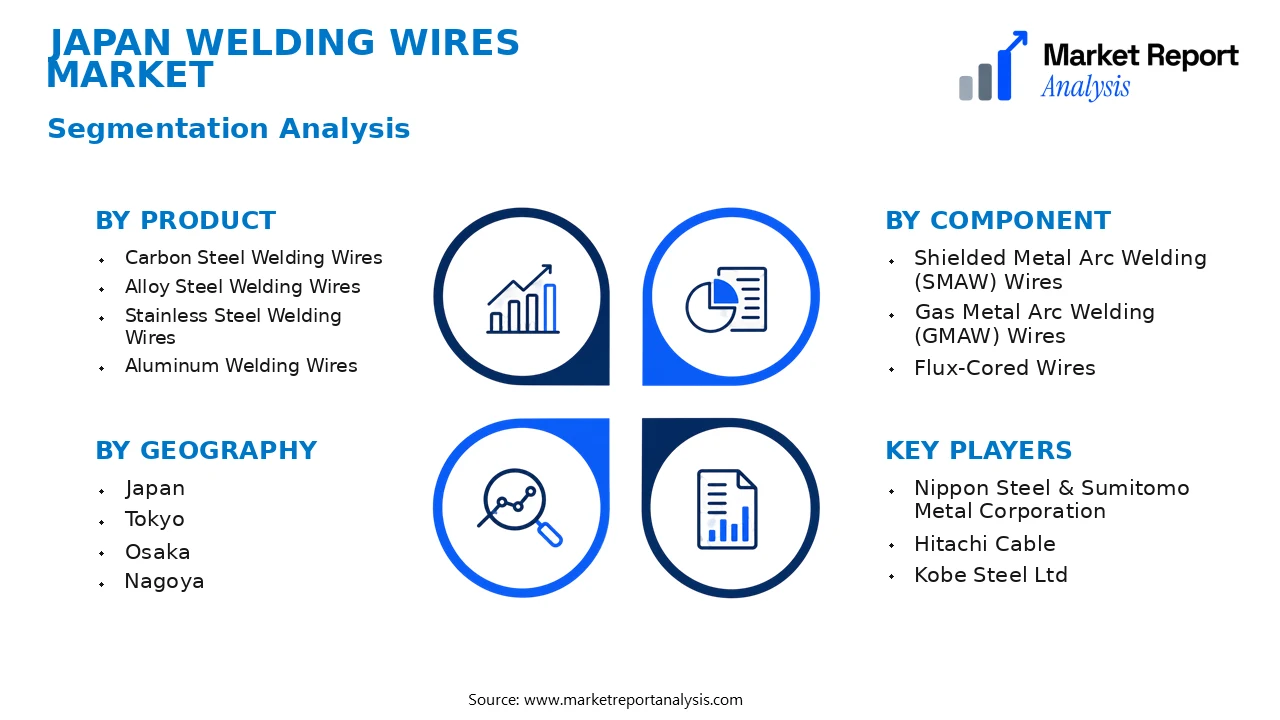
The market segmentation for Japan Welding Wires is structured around product types, component applications, and geographic distribution, providing a comprehensive understanding of regional demand, technological preferences, and industrial adoption levels. This segmentation enables targeted analysis of growth opportunities and competitive dynamics within the industry.
- Product
- Carbon Steel Welding Wires: These wires are primarily used in construction and infrastructure projects, representing the largest segment by volume due to their cost-effectiveness and mechanical properties suitable for general fabrication and structural applications.
- Alloy Steel Welding Wires: Characterized by enhanced strength and corrosion resistance, this segment caters mostly to oil & gas, aerospace, and automotive sectors, driven by high-performance requirements and technological advancements.
- Stainless Steel Welding Wires: Widely adopted in food processing, medical, and chemical industries, these wires are valued for their corrosion resistance, with increasing demand due to stringent safety and hygiene standards.
- Aluminum Welding Wires: This lightweight, corrosion-resistant segment is growing in aerospace and transportation industries, where weight reduction is critical for efficiency and performance optimization.
- Component
- Shielded Metal Arc Welding (SMAW) Wires: Offering versatility and ease of use, this component is popular in repair, maintenance, and small-scale fabrication, especially within industrial workshops.
- Gas Metal Arc Welding (GMAW) Wires: Known for high productivity and cleaner welds, this segment is dominant in automated and semi-automated manufacturing environments across Japan.
- Flux-Cored Wires: These wires provide excellent productivity and are preferred for outdoor or windy conditions, with increasing adoption in large construction projects and structural steel fabrication.
- Geography
- Japan: As the primary market, Japan's advanced manufacturing landscape, technological innovation, and focus on quality standards drive a high demand for a wide range of welding wires, fostering steady growth.
- Tokyo: The commercial and industrial hub with a concentration of manufacturing, automotive, and electronics industries fueling significant demand for welding wires, especially in high-tech applications.
- Osaka: Known for its heavy industries and port facilities, Osaka sustains strong demand in shipbuilding, machinery, and general manufacturing sectors, contributing to regional market expansion.
- Nagoya: A key center for automotive manufacturing, the Nagoya region's industrial base supports extensive use of welding wires for vehicle assembly and repairs.
- Yokohama: An important logistics and manufacturing hub, Yokohama facilitates industrial activity that fuels welding wire demand in sectors such as construction and transportation.
- Kyoto: Renowned for its technological innovation and research institutions, Kyoto’s industry leverages advanced welding solutions for electronics and precision components.
- Kobe: With a strategic port and diverse industrial base including steel, petrochemicals, and shipbuilding, Kobe sustains steady consumption of welding wires in large-scale projects.
- Fukuoka: Growing manufacturing and construction activities in Fukuoka are expanding demand for welding wires, especially in regional industrial and infrastructure projects.
Competitive Intelligence
The Japan Welding Wires Market exhibits moderate to high competition, characterized by a mix of established multinational corporations and local specialty manufacturers. Market concentration remains relatively balanced, with key players such as Nippon Steel & Sumitomo Metal Corporation and Kobe Steel maintaining significant market shares through strategic product differentiation and advanced R&D initiatives. Companies focus heavily on innovation, investing in new alloy formulations, corrosion-resistant coatings, and welding technology enhancements to meet evolving industry standards and customer demands. Strategic partnerships and joint ventures are prevalent, aimed at expanding technological capabilities and access to new markets; notable collaborations include alliances with machinery manufacturers and research institutions. Acquisitions are also prominent, enabling firms to strengthen geographical presence and diversify their product portfolios, particularly in major industrial hubs like Tokyo and Osaka. R&D investments prioritize lightweight and high-strength welding wires, fostering competitive differentiation. Expansion strategies across Japan are tailored to regional industry dynamics, with localized production and customized solutions catering to automotive, construction, and shipbuilding sectors, which are vital to Tokyo’s and Nagoya’s industrial ecosystems.
Leading Company Profiles
The competitive landscape of the Japan Welding Wires Market features several prominent players with robust technological capabilities, diversified product portfolios, and strategic initiatives geared towards innovation and market expansion.
Frequently Asked Questions
What is the Japan Welding Wires Market?
The Japan Welding Wires Market encompasses the production and sales of welding wires used across various industrial sectors, including construction, automotive, and manufacturing. It reflects demand for high-quality welding solutions tailored to Japan's strict safety and efficiency standards.
What is the current market size of Japan Welding Wires Market?
As of 2026, the market size for Japan Welding Wires is valued at approximately USD 3.2 Billion. This valuation considers ongoing demand from key sectors such as automotive manufacturing, infrastructure development, and shipbuilding.
What factors are driving the Japan Welding Wires Market?
Market growth is fueled by Japan’s advanced industrial infrastructure, increasing automation, and rising investment in construction and manufacturing sectors. Technological innovations in welding wire compositions and environmental regulations encouraging eco-friendly products also contribute significantly.
Which region dominates the Japan Welding Wires Market?
Within Japan, the Chubu and Kansai regions lead the market due to their dense industrial activities, particularly in automotive and heavy manufacturing sectors, thereby generating the highest demand for welding wires.
Which segment is expected to grow the fastest?
The flux-cored welding wires segment is projected to exhibit the fastest growth, driven by its application in automatic and semi-automatic welding processes, which are increasingly adopted for efficiency and quality improvements in industrial manufacturing.
Who are the leading companies operating in the Japan Welding Wires Market?
Key players include Nippon Steel & Sumitomo Metal Corporation, Hitachi Cable, and Kobe Steel Ltd., which hold significant market shares through innovation, strategic partnerships, and a focus on high-quality welding wire solutions tailored to Japan’s industrial demands.
Analyst Perspective
The Japan Welding Wires Market is expected to attain a mature yet continuously evolving state by 2034, driven by ongoing industrial modernization and infrastructure expansion. Long-term growth hinges on technological advances such as automation-enabled welding solutions and high-performance alloy wires, which meet strict safety and durability standards prevalent in Japan. Commercial opportunities are concentrated in high-value sectors like automotive, shipbuilding, and aerospace, especially within key industrial hubs in Nagoya, Yokohama, and Osaka, where region-specific demands for lightweight and corrosion-resistant wires are rising. Investment priorities should focus on R&D for sustainable and eco-friendly wire formulations, alongside digital integration of manufacturing processes to enhance productivity. Competitive dynamics are intensifying as local companies innovate in specialized alloy segments, while international players seek strategic alliances. Regionally, Tokyo and industrial belt zones like Chubu and Kansai will continue driving growth, yet emerging markets within northern and rural Japan offer niche opportunities for accelerated adoption of advanced welding wire solutions.
