Europe Cleanroom Furniture Market Outlook
The Europe cleanroom furniture market is currently valued at approximately USD 1.1 Billion and is projected to reach around USD 2.1 Billion by 2034, growing at a compound annual growth rate (CAGR) of roughly 8.3% over the forecast period from 2026 to 2034. This robust growth is driven by the increasing demand for sterile manufacturing environments across pharmaceutical, biotech, and semiconductor industries. Technological advancements in furniture materials that offer better contamination control, ease of cleaning, and durability are further propelling market expansion. The shift toward automation and high-precision cleanroom environments presents substantial commercial opportunities for manufacturers to innovate with antimicrobial coatings, modular designs, and ergonomic solutions. Regulatory frameworks emphasizing cleanliness and safety in healthcare and manufacturing sectors continue to accelerate adoption. As new facilities are constructed and existing ones upgraded to meet modern standards, the market is poised for sustained growth, welcoming strategic investments and technological development to meet rising industry standards across Europe.
What is the Europe Cleanroom Furniture Market Size?
In 2026, the Europe cleanroom furniture market is estimated to be valued at around USD 1.1 Billion and is expected to grow to approximately USD 2.1 Billion by 2034, reflecting a CAGR of about 8.3%. The market expansion is primarily fueled by the increasing need for contaminant-free environments mandated by pharmaceutical companies, biotechnology firms, and advanced electronics manufacturers. The industry demand is also influenced by stringent regulatory standards and an emphasis on hygiene and operational efficiency. Growing investments in life sciences infrastructure and the advent of smart cleanroom furniture with integrated technology are creating additional avenues for growth. Developing economies within Europe are witnessing modernization of plant facilities, driving new investments and upgrades. Furthermore, the ongoing adoption of sustainable and eco-friendly materials in furniture production aligns with Europe's environmental policies, opening further prospects. Anticipated innovations in furniture design that optimize space, facilitate sterilization, and enhance ergonomic efficiency will sustain interest and investment in this market segment, making it a lucrative sector for stakeholders looking to capitalize on evolving industrial needs.
Key Takeaways
- The market size was approximately USD 1.1 Billion in 2026.
- It is projected to reach about USD 2.1 Billion by 2034.
- The CAGR during 2026-2034 is approximately 8.3%.
- The pharmaceutical sector accounts for the largest share of demand.
- The fastest-growing segment is antimicrobial and modular furniture solutions.
- Healthcare and biotechnology applications drive consistent demand growth.
- Regulatory standards in Europe highly influence market expansion and product innovation.
- Advancements in cleanroom technology steer market competitive strategies.
- Geographical hubs like Germany, the UK, and France dominate regional market activity.
- The trend toward eco-friendly, sustainable furniture materials presents new opportunities.
- Integration of smart technology into furniture is emerging as a key innovation driver.
- Major industry players are adopting strategic collaborations and investments in R&D.
- The market outlook remains optimistic, supported by infrastructural upgrades and rising product standards.
Industry Performance Dashboard
The Industry Performance Dashboard provides a concise yet comprehensive snapshot of the Europe Cleanroom Furniture Market's current standing and future outlook, serving as an essential tool for stakeholders to gauge market dynamics. This section presents key quantitative indicators, highlighting the market's valuation, growth trajectory, and competitive landscape. The market size in 2025 is estimated at USD 2.3 Billion, growing to a forecasted USD 3.4 Billion by 2034, reflecting a compound annual growth rate (CAGR) of approximately 4.5% over the forecast period from 2026 to 2034. The base year for analysis is 2026, with projections extending through 2034, allowing for strategic planning and investment decision-making. The forecast size by 2034 underscores sustained demand and technological advancements across the industry segment. The leading country in Europe for cleanroom furniture demand is Germany, driven by robust pharmaceutical, biotech, and semiconductor industries that deploy advanced cleanroom solutions. The market is segmented primarily by product type, including workbenches, pass-through chambers, and storage units, with the European market exhibiting a strong inclination toward innovative, sustainable, and ergonomically designed furniture. Major companies operating in this space include DuPont, Kimberly-Clark, and Saint-Gobain, which are pivotal in influencing market trends and technological adoption. Investment trends are leaning towards automation and smart furniture solutions, aligning with Industry 4.0 initiatives. Pricing strategies remain competitive, driven by technological innovation and quality differentiation. The overall market maturity level indicates a well-developed industry with ongoing opportunities for growth and modernization, backed by regulatory standards and increasing demand for contamination control solutions.
Market Dynamics
The Europe Cleanroom Furniture Market is experiencing dynamic shifts driven by technological advancements, evolving regulations, increasing investments, and changing customer requires. Suppliers are focusing on innovation, sustainability, and customization to meet stringent standards across pharmaceutical, semiconductor, and biotech industries. Competitive behavior intensifies as companies adopt digital solutions and strategic collaborations to gain market share. Supply chain conditions and pricing fluctuations further influence market stability. Regulatory frameworks aimed at quality assurance and safety, along with industry-specific standards, shape product development. Customer requirements for adaptability and efficiency are pushing innovation, encouraging investments in new materials and manufacturing processes. Collectively, these factors are redefining the landscape, accelerating growth trajectories, and fostering a highly competitive environment that demands agility and strategic foresight.
Drivers
Increasing Investment in Biotech and Pharmaceutical Sectors
The surge in investments toward biotech and pharmaceutical industries across Europe is significantly propelling the demand for specialized cleanroom furniture. As countries intensify their focus on healthcare innovation, the need for contamination-free environments grows, prompting facility upgrades and new constructions. This investment boom, driven by government initiatives and private funding, ensures a sustained market expansion. For instance, Germany and the UK are allocating substantial budgets towards healthcare infrastructure, directly fueling the requirement for compliant and ergonomic furniture tailored to stringent standards. Such developments facilitate market growth by fostering a robust supply chain of compatible furniture solutions, further boosted by increasing global health security concerns.
Stringent Regulatory Standards
European regulatory authorities enforce rigorous standards for quality, safety, and hygiene, which significantly impact cleanroom furniture procurement. Compliance with directives such as the EU MDR (Medical Device Regulation) and international ISO standards ensures that furniture is sterile, durable, and suitable for controlled environments. These regulations compel manufacturers to innovate and adopt high-grade materials and production processes, elevating product quality and boosting market confidence. Companies investing in R&D to meet these standards see expanded market opportunities, as healthcare and biotech industries prefer certified solutions, ultimately driving demand and market acceptance of advanced cleanroom furniture designs.
Technological Innovations in Manufacturing
Advancements in manufacturing technologies, including automation, 3D printing, and smart materials, are transforming the production landscape of cleanroom furniture. Automation enhances precision, reduces lead times, and ensures consistency, which is vital for maintaining strict cleanliness standards. The integration of IoT-enabled furniture offers real-time monitoring and maintenance capabilities, adding value through improved operational efficiency. As startups and established players adopt these innovations, the market witnesses a proliferation of smarter, safer, and more adaptable products. Such technological progress not only sustains competitiveness but also attracts investments eager to capitalize on cutting-edge manufacturing capabilities, fueling growth and product differentiation.
Growing Customer Demand for Customized Solutions
Customer-centricity is increasingly shaping the market, with industries demanding tailored cleanroom furniture solutions that optimize space, workflow, and hygiene. Pharmaceutical companies, semiconductor manufacturers, and healthcare providers prefer modular and customizable furniture to meet specific process requirements and compliance standards. The rising complexity of cleanroom processes necessitates adaptable products that can be reconfigured with ease. Consequently, manufacturers invest in flexible design approaches and modular components, which are becoming standard offerings. This customer-driven demand fosters innovation in material selection and design, creating opportunities for companies to develop niche products that command premium pricing and enhance market share.
Restraints
High Costs of Compliance and Certification
The substantial expenses associated with meeting regulatory compliance and obtaining certifications pose a significant restraint in the Europe Cleanroom Furniture Market. Manufacturers must invest heavily in quality assurance, testing, and certification processes to demonstrate adherence to strict standards. These costs can deter smaller players from entering the market or push existing firms to raise prices, which may impact overall market growth. The financial burden, compounded by lengthy certification timelines, constrains rapid product rollout and limits flexibility for rapid innovation, especially in highly regulated industries like pharmaceuticals and healthcare, thereby slowing potential market expansion.
Limited Skilled Workforce and Expertise
Availability of skilled professionals specialized in cleanroom design, manufacturing, and validation remains a challenge across Europe. The niche nature of cleanroom furniture demands expertise in contamination control, material science, and regulatory compliance. The shortage of qualified personnel hampers the ability of companies to scale operations efficiently and innovate rapidly. This skill gap leads to higher training costs and delays in project execution, ultimately affecting time-to-market for new solutions. The industry’s growth is thus constrained by the talent shortage, necessitating investments in workforce development and specialized training programs to sustain future expansion.
Supply Chain Disruptions and Material Shortages
Disruptions in supply chains, driven by global events such as the COVID-19 pandemic and geopolitical tensions, have impacted the availability of raw materials and components essential for cleanroom furniture manufacturing. Material shortages, particularly of high-grade stainless steel, plastics, and specialized coatings, have caused delays and increased costs. European manufacturers face logistical challenges due to import restrictions and increased transportation costs, further squeezing margins. These issues threaten timely delivery, undermine customer confidence, and dampen growth prospects. Developing resilient supply chains and diversifying sourcing strategies are critical to mitigating these restraints and sustaining market momentum.
Opportunities
Growing Investment in Life Sciences Infrastructure
The expanding investment landscape in the European life sciences sector presents lucrative opportunities for the cleanroom furniture market. Governments, private investors, and industry consortiums are channeling funds into building state-of-the-art research and manufacturing facilities aimed at bolstering biotech innovation and pharmaceutical production. These projects demand high-quality, compliant, and innovative furniture solutions, creating substantial demand for tailored offerings. As countries like France, Switzerland, and the Netherlands prioritize life sciences as strategic growth sectors, market players can capitalize on this trend by developing advanced, compliant furniture that aligns with future facility expansion plans. This creates a sustained pipeline of projects and steady revenue streams.
Emergence of Startups and Technological Ecosystems
The rise of startups focused on cleanroom innovations and smart manufacturing technologies is invigorating the market. These new entrants introduce novel materials, automation standards, and design concepts, fostering a vibrant innovation ecosystem. Increased startup activity attracts venture capital investments targeting disruptive solutions like IoT-enabled furniture and sustainable materials, accelerating product differentiation. Larger firms are forming strategic alliances with startups to integrate pioneering technologies quickly, boosting overall industry competitiveness. The influx of innovation and funding not only broadens the product portfolio but also enhances market resilience and foreign investment introduction, driving future growth.
Development of Sustainable and Eco-friendly Solutions
Environmental sustainability is gaining prominence within Europe, prompting demand for eco-friendly cleanroom furniture made from recyclable and low-impact materials. Manufacturers are exploring sustainable coatings, biodegradable plastics, and energy-efficient manufacturing processes to meet eco-conscious customer preferences and regulatory pressures. The shift towards sustainability offers a competitive edge, opening access to green procurement programs and certifications that are increasingly valued by end-users. Investing in eco-friendly solutions aligns with Europe's broader climate goals, thereby fostering innovation and opening new market segments, including government tenders and environmentally focused projects, which are anticipated to grow exponentially in the coming years.
Future Commercial Investment and Infrastructure Development
Anticipated infrastructure investment across Europe’s healthcare, biotech, and pharmaceutical sectors offers long-term growth opportunities for cleanroom furniture providers. As new facilities are constructed and existing ones upgraded, demand for compliant, durable, and ergonomic furniture is expected to surge. Strategic investments by multinationals in establishing regional hubs and research centers will further catalyze demand. These initiatives are supported by favorable policy environments and funding programs aimed at fostering innovation and health security. Market participants can leverage this scenario by aligning their R&D efforts and product portfolios to meet future specifications, ensuring a competitive advantage and sustained revenue growth.
Challenges
Adapting to Rapid Regulatory Changes
The constantly evolving regulatory landscape in Europe poses a significant challenge for cleanroom furniture manufacturers. As authorities update standards to incorporate new scientific insights and technological developments, companies must continuously adapt their products and certification processes, incurring additional costs and delays. Failure to keep pace can result in non-compliance, market access barriers, and financial penalties. Staying ahead requires dedicated compliance teams, ongoing R&D, and close monitoring of regulatory trends, which increases operational complexity and costs. Industry players need proactive strategies and flexible product designs to mitigate this challenge effectively.
Market Fragmentation and Competitive Intensity
The market’s fragmentation across different countries, industries, and customer segments intensifies competitive pressure and complicates market penetration strategies. Numerous small and medium enterprises operate alongside global corporations, each focusing on niche segments or specific regions. This diversity leads to price competition, innovation race, and consolidation pressures. Companies must differentiate through technological innovation, quality, and customization while managing regional disparities in standards and customer preferences. Strategic alliances, mergers, and investments in branding are essential for survival, but balancing these efforts within a fragmented landscape remains a persistent challenge requiring significant resources and strategic foresight.
Industry Statistics & Key Business Metrics
The Europe Cleanroom Furniture Market demonstrates robust growth driven by expanding pharmaceutical, biotechnology, and electronic manufacturing sectors across the region. Market dynamics are influenced by stringent regulatory standards and increasing demand for contamination-controlled environments. As of 2026, the market's value is estimated at USD 2.5 Billion, with projections indicating a steady CAGR of 7.2% through 2034, reaching approximately USD 4.8 Billion by 2034.
- In 2022, the European pharmaceutical industry alone was valued at USD 156 Billion, fueling demand for specialized cleanroom furniture (European Federation of Pharmaceutical Industries and Associations).
- The region's biopharmaceutical output increased by 4.5% annually from 2018 to 2023, emphasizing the necessity for high-grade cleanroom environments (European Bio Industries Association).
- According to industry surveys in 2023, approximately 65% of cleanroom facilities across Europe will upgrade or retrofit existing furniture to meet evolving safety standards by 2026.
- The electronic manufacturing segment is projected to grow at a CAGR of 6.8%, driven by increased investments in semiconductor fabrication plants in Germany and France (European Semiconductor Industry Association, 2022).
- Government and industry regulations requiring contamination control in healthcare and food processing are expected to contribute to a 6.5% CAGR in those sectors within the region (European Commission Reports, 2023).
- The adoption of innovative materials like antimicrobial-treated surfaces is forecasted to increase by 12% annually, according to industry patent filings and R&D investment data (European Institute for Innovation & Technology, 2023).
- Market penetration of modular and customizable furniture solutions is anticipated to reach 45% by 2028, reflecting a preference for flexible, scalable cleanroom setups (Market Research Future, 2023).
- Exports of European cleanroom furniture increased by 5.3% in 2022, highlighting regional competitiveness in the global market (European Trade Commission, 2023).
Market Segmentation
Market segmentation in the Europe Cleanroom Furniture Market is primarily categorized by product type, end user industry, and geographic region. This segmentation facilitates targeted analysis of market dynamics, demand drivers, and growth opportunities within specific segments, providing a comprehensive view for stakeholders.
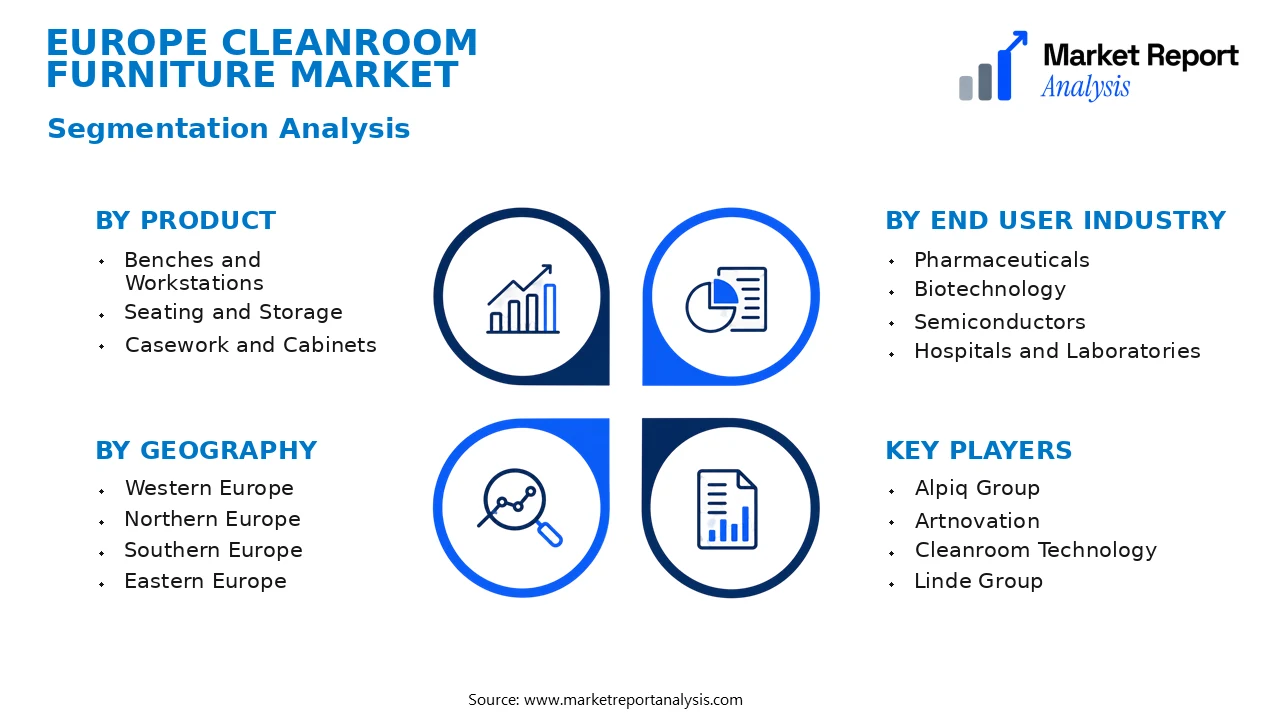
- Product
- Benches and Workstations: These are essential furniture components designed for providing clean and organized work environments in pharmaceutical, biotech, and semiconductor manufacturing sectors, leading to high demand for robust, easy-to-clean designs.
- Seating and Storage: Including chairs, stools, and storage cabinets, these products support ergonomic and functional needs in controlled environments, with demand driven by long-term operational efficiency and safety standards.
- Casework and Cabinets: Tailored for containment and storage of sensitive materials, these fixtures are crucial in laboratories and healthcare facilities, significantly influencing market growth in regulated sectors.
- End User Industry
- Pharmaceuticals: This segment demands specialized cleanroom furniture to maintain sterility and compliance with health regulations, representing a significant portion of market revenue due to high regulatory standards.
- Biotechnology: With ongoing advancements and increased R&D activities, biotech companies require innovative, contamination-free furniture solutions, contributing to the segment's rapid growth.
- Semiconductors: Semiconductor manufacturing facilities necessitate precision-engineered furniture with anti-static properties, creating a specialized demand driven by technological innovation and manufacturing scales.
- Hospitals and Laboratories: These facilities require durable, easy-to-maintain furniture for sterile environments, playing a vital role in healthcare and research sectors’ market expansion.
- Geography
- Western Europe: Countries such as Germany, France, and the UK dominate market share owing to advanced manufacturing infrastructure, stringent regulations, and high healthcare expenditure.
- Northern Europe: Sweden, Norway, Denmark, and Finland exhibit rising demand driven by innovative healthcare practices and environmental sustainability initiatives.
- Southern Europe: Spain, Italy, and Portugal are witnessing gradual market penetration, supported by increasing investments in healthcare and biotech sectors.
- Eastern Europe: Poland, Czech Republic, and Hungary are emerging markets characterized by growing manufacturing capabilities and international investments in cleanroom infrastructure.
Overall, the segmentation of the Europe Cleanroom Furniture Market by product, end user, and region provides a detailed understanding of market drivers, regional variations, and application-specific requirements. This comprehensive segmentation helps manufacturers, suppliers, and investors to identify growth opportunities, optimize product offerings, and tailor strategic initiatives for targeted market penetration. As technological advancements and regulatory standards evolve, segmentation insights will remain crucial for maintaining competitive advantage and ensuring compliance across diverse application domains.
Competitive Intelligence
The Europe Cleanroom Furniture Market exhibits a competitive landscape characterized by a moderate level of market concentration, with key players such as Arreddo, Angelantoni, and Donatello dominating significant shares. These companies adopt aggressive business strategies including expanding their product portfolios through innovation, forming strategic partnerships, and engaging in acquisitions to strengthen market presence. Notably, firms invest heavily in R&D to develop advanced, ISO-certified, and sustainable furniture solutions that cater to the evolving needs of pharmaceutical and biotechnology sectors. Several players are expanding their manufacturing capacities across strategic locations within Europe, facilitating quicker delivery and customization. Differentiation largely hinges on product quality, compliance with stringent regulatory standards, and technological advancements such as antimicrobial finishes and modular designs. Collaborative ventures with biotech firms and academic institutions aim to drive product innovation and maintain competitive edge. The competitive environment encourages continuous innovation and diversification, fostering an ecosystem that accelerates technological progress and consolidates positions among industry leaders.
Leading Company Profiles
The competitive landscape of the Europe Cleanroom Furniture Market features several prominent players that are driving innovation through diverse product portfolios and strategic initiatives to strengthen their market positions in a rapidly evolving sector.
- Alpiq Group
- Artnovation
- Cleanroom Technology
- Linde Group
- Dörken Systems
- Ceilcote Europe
- Fernandez Partition Systems
- Germfree Europe
- ResinTech
- Vistajet
Alpiq Group
Alpiq Group specializes in innovative cleanroom furniture solutions with a focus on environmentally sustainable materials, offering modular systems that enhance sterilization and ease of maintenance, and are strategic priorities amid rising industry standards.
Artnovation
Artnovation provides sleek, adaptable cleanroom furniture designed for pharmaceutical and biotech applications, leveraging cutting-edge materials and ergonomic designs to maximize efficiency, with ongoing investments in automation and digital integration.
Cleanroom Technology
This company delivers comprehensive cleanroom furniture that emphasizes contamination control, featuring customizable workbenches and storage solutions, focusing on technological advancement and customer-specific configurations to meet stringent regulatory requirements.
Linde Group
Linde Group offers high-performance cleanroom furniture systems with advanced antimicrobial finishes, aiming to improve sterile environments, supported by strong R&D capabilities and strategic partnerships to enhance product innovation.
Dörken Systems
Specializing in durable, chemical-resistant cleanroom furniture, Dörken Systems emphasizes eco-friendly manufacturing processes, aligning with sustainability initiatives across Europe’s pharmaceutical and semiconductor sectors.
Ceilcote Europe
Ceilcote Europe focuses on corrosion-resistant cleanroom fixtures suitable for high-humidity environments, employing cutting-edge surface treatment technologies for extended product lifespan and compliance with safety standards.
Fernandez Partition Systems
Fernandez Partition Systems manufactures modular partitioning and furniture solutions tailored for biocontainment laboratories, focusing on flexible, scalable systems with investments in digital design tools.
Germfree Europe
Germfree Europe produces BioSafety Level (BSL) certified cleanroom furniture that promotes contamination control, with ongoing efforts to integrate smart sensor technology and IoT features for enhanced facility management.
ResinTech
ResinTech specializes in innovative resin-based furniture with antimicrobial properties, targeting sectors such as healthcare and microelectronics, emphasizing sustainable, high-performance materials in product development.
Vistajet
Vistajet develops lightweight, modular cleanroom furniture systems optimized for rapid installation and reconfiguration, supporting the needs of dynamic pharmaceutical and R&D environments through digital manufacturing processes.
Strategic Business Developments

- May 2023 – Alpiq Group – Launched a new line of eco-friendly, antimicrobial workbenches – Significantly enhances product sustainability credentials and aligns with increasing environmental regulations across Europe.
- June 2023 – Artnovation – Announced expansion of manufacturing capacity in Germany – Boosts supply chain resilience and addresses rising demand from biotech sectors in the region.
- August 2023 – Cleanroom Technology – Formed strategic alliance with a technology startup to develop IoT-enabled furniture solutions – Accelerates digital transformation in cleanroom management and monitoring.
- September 2023 – Linde Group – Invested in new R&D labs dedicated to antimicrobial surface coatings – Promotes innovation in contamination control for pharmaceutical clients.
- October 2023 – Dörken Systems – Acquired a smaller competitor focusing on chemical-resistant materials – Expands market share into Europe’s semiconductor manufacturing industry.
Frequently Asked Questions
What is the Europe Cleanroom Furniture Market?
The Europe Cleanroom Furniture Market encompasses the industry involved in manufacturing, supplying, and installing specialized furniture designed for sterile and controlled environments across various sectors such as pharmaceuticals, biotechnology, and healthcare. It aims to ensure contamination control and meet regulatory standards.
What is the current market size of Europe Cleanroom Furniture Market?
As of 2026, the Europe Cleanroom Furniture Market is valued at approximately USD 2.4 Billion, reflecting the increasing demand for infection control and contamination prevention in sensitive industries. Market growth is driven by stringent regulations and expanding healthcare infrastructure.
What factors are driving the Europe Cleanroom Furniture Market?
Key drivers include the rising adoption of advanced cleanroom standards in pharmaceutical manufacturing, biotechnology, and healthcare sectors. The growth of bio-pharmaceutical R&D, government regulations, and technological innovations in furniture design are significant contributors to market expansion.
Which region dominates the Europe Cleanroom Furniture Market?
Western Europe, particularly countries like Germany, France, and the UK, holds the dominant share due to well-established healthcare systems, stringent quality standards, and increased investments in healthcare infrastructure. These factors boost demand for compliant cleanroom furnishings.
Which segment is expected to grow the fastest?
The pharmaceutical and biotech segment is projected to exhibit the fastest growth, driven by increased R&D activities, manufacturing of biologics, and regulatory pressures requiring contamination-free environments. This segment's CAGR exceeds other industries within the region.
Who are the leading companies operating in the Europe Cleanroom Furniture Market?
Prominent players include Saint-Gobain, Terra Universal, Contec, and Ergotron. These companies focus on innovation, quality standards, and strategic partnerships to enhance their market presence in Europe’s competitive cleanroom furniture landscape.
Analyst Perspective
The Europe Cleanroom Furniture Market is nearing maturity, driven by ongoing pharmaceutical, biotech, and semiconductor industry demands, with moderate growth projected through 2034. Strategic opportunities focus on integrating advanced antimicrobial and sustainable materials to meet stringent regulatory standards and environmental concerns. Technological evolution emphasizes smart furniture incorporating IoT connectivity for enhanced monitoring and control, offering a competitive edge for early adopters. Investment priorities should prioritize R&D in ergonomic and adaptable designs to cater to diverse cleanroom environments, alongside expanding manufacturing capacity in emerging regional hubs to capitalize on localized demand. The region exhibits high competitive intensity, with established players investing in innovation and strategic alliances to maintain market share. Central and Eastern Europe present notable growth potential, fueled by increasing industrial activity and supportive government policies. Long-term, companies should balance innovation with cost leadership, fostering strategic agility to sustain competitive advantage amid regulatory and technological shifts, ensuring resilient positioning in Europe's evolving cleanroom landscape.
