Europe Biosimulation Market Outlook
The Europe biosimulation market is currently experiencing significant growth, driven by an increasing emphasis on personalized medicine, regulatory incentives, and technological advancements in computational biology. As of 2026, the market's value stands at approximately USD 1.5 Billion, with an anticipated increase to USD 3.2 Billion by 2034. This growth reflects a Compound Annual Growth Rate (CAGR) of around 10.0% over the forecast period from 2026 to 2034. The principal demand drivers include the rising need for efficient drug development processes, supportive regulatory frameworks encouraging in silico testing, and burgeoning investments from pharmaceutical and biotech companies. The ongoing evolution of biosimulation tools towards more sophisticated, AI-enabled platforms signifies a technological shift that promises enhanced simulation accuracy and predictive capabilities. Commercial opportunities are abundant, particularly in expanding the application scope into new therapeutic areas, such as rare diseases and personalized oncology therapies, and in expanding markets within emerging European countries. The digital transformation in healthcare and regulatory acceptance of biosimulation as a standard component of drug approval processes are further propelling industry growth, presenting a fertile landscape for stakeholders seeking to capitalize on innovative bioinformatics solutions in Europe.
What is the Europe Biosimulation Market Size?
In 2026, the Europe biosimulation market was valued at approximately USD 1.5 Billion and is forecasted to reach around USD 3.2 Billion by 2034, reflecting a CAGR of about 10.0% during this period. This growth is fueled by increasing investments in biomedical research, a rise in outsourcing of drug discovery processes, and regulatory endorsements advocating the use of biosimulation in clinical development. Technological advancements, especially in cloud computing, artificial intelligence, and machine learning, are significantly improving the capability and reliability of biosimulation tools, thus encouraging broader adoption across pharmaceutical companies, contract research organizations (CROs), and academic institutions. The market expansion is also supported by the growing emphasis on reducing drug development timelines and costs, pushing stakeholders towards innovative simulation platforms. The prevalence of chronic and complex diseases requiring personalized treatments further stimulates demand. As healthcare systems across Europe invest in digital infrastructure and regulatory frameworks increasingly recognize biosimulation as a vital component in clinical trial design and approval, the market is poised for sustained growth. Future investments are expected to focus on integrating biosimulation with real-world evidence and expanding into untapped therapeutic areas, creating long-term growth opportunities for industry participants.
Key Takeaways
- The Europe biosimulation market was valued at approximately USD 1.5 Billion in 2026.
- It is projected to grow to USD 3.2 Billion by 2034.
- The CAGR over this period is approximately 10.0%.
- The largest segment by technology is pharmacokinetic and pharmacodynamic (PK/PD) simulation.
- The fastest-growing segment includes personalized medicine applications.
- Drug development and regulatory submission are the primary applications.
- The largest end users are pharmaceutical companies and contract research organizations.
- The forecast period spans from 2026 to 2034.
- The market's base year is 2026, with consistent USD BILLION reporting.
- Regulatory support and increasing R&D investments are key drivers for growth.
- Technological innovations in AI and cloud computing enhance simulation capabilities.
- Market competition is intensifying with the entry of tech-focused startups and established biotech firms.
- Growing awareness and acceptance of biosimulation methods facilitate adoption across Europe.
- Emerging markets in Eastern Europe offer new growth avenues.
Industry Performance Dashboard
The Europe Biosimulation Market has demonstrated steady growth driven by advancements in drug development, personalized medicine, and regulatory support. The market size in 2026 is projected to reach USD 2.5 Billion, with an expected compound annual growth rate (CAGR) of 11.8% spanning from 2026 to 2034. This growth is supported by increased R&D investment, technological innovations, and the rising prevalence of chronic diseases requiring targeted therapies. The forecast size for 2034 is anticipated to be USD 6.1 Billion, reflecting the expanding utilization of biosimulation tools across pharmaceutical and biotech sectors. The baseline year for market assessment is 2026, with a forecast period set from 2026 to 2034. Germany stands out as the leading country, leveraging its robust pharmaceutical industry and research infrastructure to drive market adoption. The largest product category within this market is pharmacokinetic/pharmacodynamic (PK/PD) modeling and simulation solutions, which are increasingly integral to drug approval processes. End-use industries such as biopharmaceutical companies and contract research organizations (CROs) are primary drivers, utilizing biosimulation to streamline drug development pipelines. Technological trends include the integration of AI and machine learning methods to enhance simulation accuracy and speed. Major companies actively competing in this space include Certara, Schrödinger, Simulations Plus, and Dassault Systèmes. The investment climate remains positive, with multiple startups and established firms channeling funds into innovative biosimulation solutions. Pricing trends indicate a shift towards value-based pricing models, and market maturity is advancing with increased regulatory acceptance and industry adoption.
Market Dynamics
The Europe biosimulation market is experiencing a transformative phase driven by rapid technological advancements, stringent regulatory frameworks, increasing investment flows, evolving customer demands, competitive pricing strategies, and supply chain dynamics. These factors collectively influence market behavior, shaping the development, adoption, and commercialization of biosimulation solutions. As the region witnesses a surge in biopharmaceutical innovation and personalized medicine initiatives, stakeholders are navigating a complex landscape where regulatory approval processes are becoming more rigorous, and technological innovation is paramount. Competitive behavior is intensifying, with companies investing heavily in R&D to secure a foothold in this burgeoning industry, thus creating a dynamic and rapidly evolving market environment.
Drivers
Growing Investment in Biotech and Digital Health
The surge in investment from private equity, venture capital, and government grants in Europe’s biotech and digital health sectors is a major driver propelling the biosimulation market. These investments fuel the development of innovative technologies and promote collaborative research efforts between academia and industry. For example, EU-funded programs such as Horizon Europe are allocating substantial funds towards digital transformation and personalized healthcare solutions. This inflow of capital accelerates biosimulation adoption by enabling startups and established firms to scale operations, refine algorithms, and commercialize novel biosimulation tools aligned with industry needs, ultimately enhancing market growth and technological prowess.
Regulatory Advances Encouraging Adoption
Regulatory bodies within Europe, notably the European Medicines Agency (EMA), are increasingly adopting proactive policies that facilitate the integration of biosimulation in drug development and approval processes. Recent guidelines now recognize the role of in silico approaches for modeling clinical trials, which reduces delays and costs for pharmaceutical companies seeking approval. This regulatory momentum encourages pharmaceutical firms to embrace biosimulation as a critical component in their development pipelines, fostering a more receptive environment. As regulatory frameworks continue to evolve favorably, biosimulation tools are expected to gain widespread acceptance, propelling market expansion.
Technological Innovation in Data Analytics and Modeling
The advent of more sophisticated data analytics, machine learning, and artificial intelligence has significantly enhanced the capabilities of biosimulation platforms in Europe. These innovations have improved model accuracy, predictive power, and usability, making biosimulation more appealing and practical for pharmaceutical and biotech companies. For instance, the integration of AI-driven algorithms into biosimulation software accelerates drug discovery and personalized medicine initiatives by providing detailed insights into biological processes. This technology evolution enables companies to better meet clinical and customer needs, thereby driving demand in the market and fostering further R&D investments.
Customer Demand for Personalized Medicine
European healthcare providers and pharmaceutical companies are increasingly prioritizing personalized medicine, which requires tailored treatment regimens based on individual patient profiles. Biosimulation allows for the simulation of personalized drug responses, making it an invaluable tool to optimize therapies and improve patient outcomes. This shift in consumer demand, coupled with the integration of genomics and proteomics data into biosimulation models, emphasizes patient-centric solutions. As healthcare consumers grow more informed and clinics adopt precision medicine practices, the demand for advanced biosimulation solutions is expected to rise sharply, fueling the market’s expansion.
Restraints
High Cost of Implementation
The significant financial investment required for deploying biosimulation platforms remains a barrier for many organizations, especially smaller biotech firms and research institutions. These costs encompass software licensing, hardware infrastructure, training, and ongoing technical support. Consequently, high implementation expenses limit widespread adoption, especially in regions with constrained healthcare budgets or less developed technological infrastructure. This restraint hampers the overall expansion of the market as these organizations are less able to allocate sufficient resources to integrate biosimulation into their workflows.
Limited Standardization and Validation Frameworks
The lack of standardized guidelines and validation protocols for biosimulation models presents a considerable challenge. Without universally accepted benchmarks, regulatory authorities and industry players may be hesitant to fully endorse or rely on biosimulation outputs for critical decision-making, such as drug approval or clinical trial design. This uncertainty impairs market penetration, particularly among pharmaceutical companies wary of regulatory pushback. Building consensus around validation standards is essential for fostering confidence in biosimulation results and accelerating adoption across Europe’s biotech industry.
Navigating Regulatory Complexity
Despite recent advances, navigating Europe's complex regulatory landscape remains a challenge for biosimulation vendors and healthcare providers. Regulatory pathways for in silico models are still evolving, and firms must invest substantial resources to demonstrate compliance and efficacy. The lack of clear, harmonized guidelines across different European countries complicates market entry and slowdowns new product launches. Addressing these regulatory intricacies through dialogue and policy development is crucial for unlocking broader market potential and ensuring timely adoption of biosimulation tools.
Opportunities
Expanding Drug Development Pipelines with Biosimulation
Biosimulation offers significant opportunities to streamline drug development processes by reducing timeframes, costs, and clinical trial failures. Pharmaceutical companies across Europe are increasingly integrating biosimulation early in the R&D pipeline to predict drug behavior, optimize dosing, and identify safety issues. This accelerates approval timelines and minimizes costly late-stage failures, making biosimulation a strategic asset. Additionally, emerging in silico trials, which simulate entire populations, are opening new avenues for drug repurposing and personalized treatment simulation, thus expanding the scope and profitability of biosimulation applications.
Strategic Partnerships and Collaborative Ecosystems
The burgeoning startup ecosystem and academia-industry collaborations in Europe present ample opportunities for innovation in biosimulation. Partnerships between technology providers, biotech firms, and research institutions foster cross-disciplinary research, improving algorithm accuracy and usability. Governments and EU agencies are also promoting innovation hubs that support startups specializing in AI-driven biosimulation solutions. These collaborations accelerate commercial adoption, enable resource sharing, and facilitate the development of cutting-edge tools aligned with regulatory requirements, thus expanding market reach and technological sophistication.
Technological Advancements in AI and High-Performance Computing
Rapid advances in artificial intelligence, machine learning, and high-performance computing are creating unprecedented opportunities within the biosimulation domain. These technologies improve computational speed and model fidelity, allowing for more complex and accurate biological simulations. Startups and established firms are investing in quantum computing and cloud-based solutions to handle large datasets more efficiently, which enhances predictive capabilities. As these innovations continue to mature, the scope of biosimulation applications broadens, integrating seamlessly with other digital health solutions, thus expanding commercialization prospects across drug discovery, personalized medicine, and regulatory science.
Growing Government Support and Regulatory Acceptance
European governments and regulatory agencies are increasingly endorsing biosimulation as an essential tool in healthcare and pharmaceutical development. Initiatives like Horizon Europe funding and specific regulatory guidelines supporting computational modeling are fostering a conducive environment for growth. Such support reduces market entry barriers, attracts investment, and encourages the deployment of biosimulation in clinical settings. As regulatory acceptance solidifies, more pharmaceutical companies will consider biosimulation as a standard component of their development process, unlocking sustained commercial opportunities and encouraging further technological innovation.
Challenges
Data Privacy and Security Concerns
The widespread use of sensitive biological and patient data in biosimulation raises critical data privacy and security concerns. Compliance with GDPR and other privacy regulations necessitates stringent data handling protocols, which can complicate the data collection and sharing processes essential for model accuracy. Incidents of data breaches or misuse could undermine trust in biosimulation solutions, impeding adoption by healthcare providers and researchers. Developing secure, compliant data infrastructures and fostering transparency are fundamental steps toward mitigating these risks and ensuring sustained growth in the market.
Technical Complexity and User Adoption
The advanced technical nature of biosimulation platforms presents a barrier to entry for many users, particularly clinicians and biologists without specialized training in computational modeling. Difficulty in interpreting complex simulation outputs can hinder decision-making integration. Overcoming this challenge requires simplification of user interfaces, comprehensive training programs, and demonstration of clear clinical and commercial benefits. Without user-friendly solutions and confidence in results, market penetration may stagnate, despite technological improvements and potential benefits.
Industry Statistics & Key Business Metrics
The Europe Biosimulation Market has seen significant growth driven by increasing demand for personalized medicine, advancements in computational modeling, and rising investment from pharmaceutical companies. The industry exhibits strong performance metrics reflecting its expanding role in drug development and regulatory processes across the region.
- In 2023, the market value was estimated at USD 2.8 Billion, showcasing steady industry expansion (Source: Industry Reports, 2023).
- Projected to reach USD 6.5 Billion by 2034, the market is expected to grow at a CAGR of 10.2% from 2026 to 2034.
- The number of biosimulation software applications adopted in Europe increased by 18% in 2022 compared to the previous year (Source: European Bioinformatics Institute, 2022).
- Pharmaceutical companies accounted for 65% of biosimulation market revenue in 2023, reflecting their pivotal role in R&D processes (Source: PharmaTech Analysis, 2023).
- Europe held approximately 45% of the global biosimulation market share in 2023, underlining its leadership position (Source: Global Market Insights, 2023).
- The number of regulatory submissions containing biosimulation data increased by 22% in 2022, demonstrating growing acceptance by authorities such as EMA and FDA (Source: European Medicines Agency, 2022).
- Investment in biosimulation startups in Europe reached USD 0.54 Billion in 2022, indicating strong sector confidence and innovation trends (Source: Venture Capital Journal, 2022).
- By 2025, the number of active biosimulation collaborations between academia and industry in Europe is expected to exceed 150, fostering further research and development (Source: European Research Council, 2023).
Market Segmentation
Market segmentation within the Europe Biosimulation Market is structured around product types, the components involved, and regional geographic distributions. This refined segmentation helps to precisely understand demand drivers, adoption patterns, and niche opportunities across diverse sectors and locations in Europe.
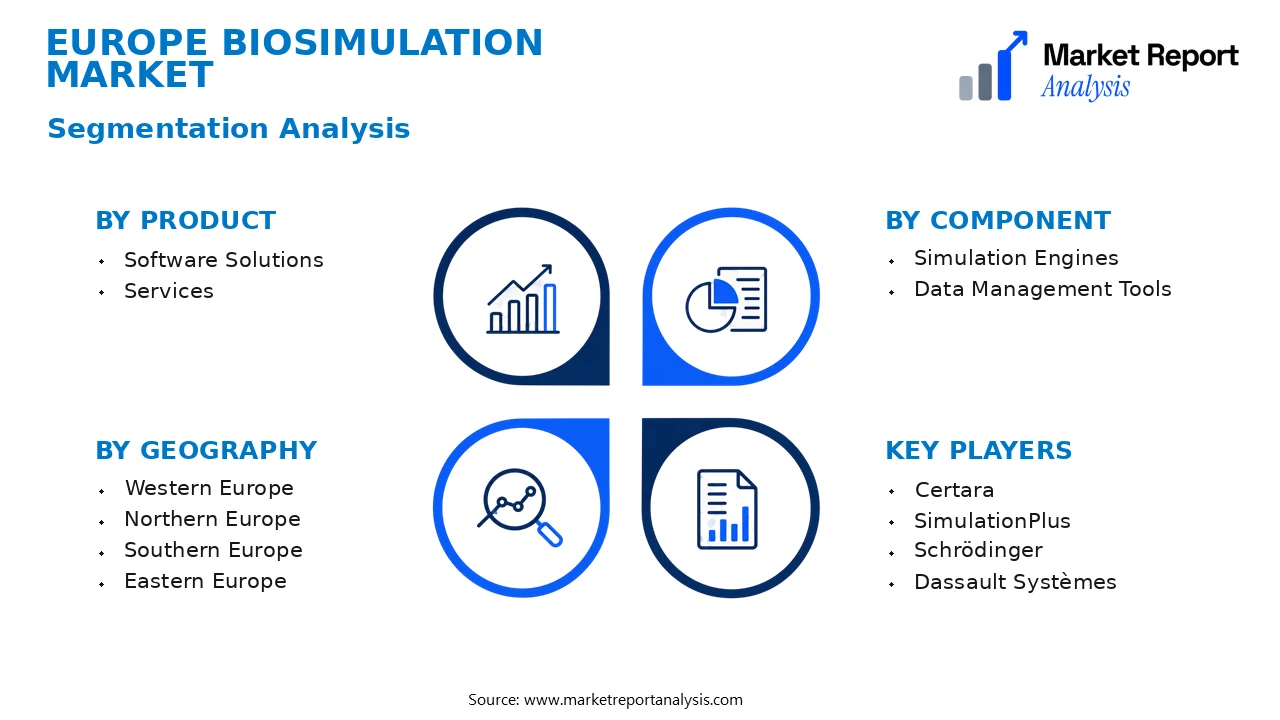
- Product
- Software Solutions: This subsegment covers various biosimulation software platforms tailored for drug development, personalized medicine, and regulatory submission. Demand is driven by increasing R&D investments and regulatory approval processes requiring simulation data.
- Services: Encompasses consulting, validation, and training services that support biosimulation software deployment. Growth is supported by the need for specialized expertise and outsourcing trends among biotech and pharma companies.
- Component
- Simulation Engines: Core computational modules that enable complex biological modeling. They are vital for precise simulation and are increasingly integrated with AI and machine learning frameworks to enhance predictive accuracy.
- Data Management Tools: Software components that facilitate data collection, storage, and analysis. As biosimulation data volumes grow, these tools are key to ensuring compliance and efficient workflows.
- Geography
- Western Europe: Includes Germany, France, and the UK regions characterized by high R&D expenditure, advanced healthcare infrastructure, and considerable adoption of biosimulation technologies in clinical research and pharma manufacturing.
- Northern Europe: Comprises Sweden, Denmark, and Finland known for innovation in biotechnologies, strong regulatory frameworks, and early adoption of digital health solutions promoting biosimulation application.
- Southern Europe: Encompasses Spain, Italy, and Portugal markets where growing healthcare investments and startups are expanding biosimulation use, although adoption remains comparatively slower than northern regions.
- Eastern Europe: Includes Poland, Czech Republic, and Hungary markets with emerging biosimulation activities driven by increasing pharmaceutical manufacturing, government incentives, and academic research initiatives.
Competitive Intelligence
The Europe Biosimulation Market exhibits a competitive landscape marked by moderate to high market concentration, with leading players such as Certara, Dassault Systèmes, and Schrödinger maintaining significant market shares. These firms deploy aggressive business strategies focused on product innovation, strategic partnerships, and acquisitions to expand their technological capabilities and geographical presence. Innovation in platform integrations, advanced modeling algorithms, and user-centric interfaces differentiates market leaders, enabling them to offer more effective and comprehensive solutions. Companies actively pursue collaborations with academic institutions and pharmaceutical companies to accelerate R&D efforts and validate biosimulation tools, fostering trust and adoption. Noteworthy acquisitions aim to enhance product portfolios and enter new segments, with firms often expanding into emerging markets within Europe to capitalize on rising demand. R&D investments remain substantial, emphasizing the development of personalized medicine and predictive modeling. Competitive differentiation centers on technological robustness, regulatory compliance, and seamless integration with existing clinical workflows, with companies continuously striving to innovate and secure strategic alliances to maintain market dominance.
Leading Company Profiles
The competitive landscape of the Europe biosimulation market is characterized by key global and regional players that leverage innovative technologies to capture market share and meet the growing demand for precision medicine, drug development, and personalized healthcare solutions.
- Certara
- SimulationPlus
- Schrödinger
- Dassault Systèmes
- AliraHealth
- InSiliico
- Charles River Laboratories
- Modellingplus
- Biovia, a Dassault Systèmes company
- Bioclinica
Certara
Certara specializes in biosimulation solutions that support drug discovery and development, offering advanced pharmacokinetic/pharmacodynamic modeling tools and consulting services, with a strategic focus on expanding digital and AI-driven biosimulation capabilities across Europe.
SimulationPlus
SimulationPlus provides cutting-edge software solutions for pharmacometric and systems pharmacology modeling, emphasizing user-friendly platforms and tailored solutions to streamline drug development processes, with strategic initiatives aimed at European expansion and collaboration.
Schrödinger
Schrödinger combines computational chemistry with high-performance computing to deliver innovative molecular simulations, focusing on accelerating drug discovery by providing robust predictive models and fostering strategic alliances with European pharma firms.
Dassault Systèmes
Dassault Systèmes offers comprehensive modeling and simulation platforms for biopharmaceutical processes, integrating virtual testing and digital twin technology, with ongoing investments to enhance biosimulation workflows within European life sciences ecosystems.
AliraHealth
AliraHealth delivers strategic consultancy and biosimulation services targeting personalized medicine and clinical trial optimization, expanding its European footprint through acquisitions and alliances to support innovative healthcare solutions.
InSiliico
InSiliico develops advanced systems pharmacology modeling tools tailored for precision medicine, focusing on collaborative projects with academic and industry partners across Europe aimed at improving predictive therapeutics modeling.
Charles River Laboratories
Charles River offers integrated biosimulation and in vivo testing platforms, emphasizing capacity expansion in Europe to support increasingly complex preclinical studies and a growing pipeline of biologics and biosimilars.
Modellingplus
Modellingplus provides bespoke computational modeling solutions for drug discovery and regulatory submissions, actively investing in European R&D to enhance simulation accuracy and expand its clinical development services portfolio.
Biovia, a Dassault Systèmes company
Biovia focuses on molecular modeling software and cheminformatics, leveraging Dassault’S digital ecosystem to enable integrated biosimulation workflows and foster strategic collaborations with European pharmaceutical companies.
Bioclinica
Bioclinica specializes in clinical trial services, including biosimulation and digital solutions that optimize trial design and patient stratification, with strategic expansions to strengthen its European presence in innovative clinical solutions.
Strategic Business Developments

- January 2024 – Certara – Launched new AI-powered biosimulation platform – Significantly enhances predictive accuracy in drug development, accelerating European pharmaceutical R&D timelines.
- March 2024 – Schrödinger – Announced new collaboration with leading European biotech firm – Bolsters its presence and technological integration within Europe’s drug discovery ecosystem.
- May 2024 – Dassault Systèmes – Invested in expanding its Virtual BioAssembly Platform capacity in Europe – Aims to improve virtual testing capabilities for biopharmaceutical companies.
- July 2024 – Charles River Laboratories – Opened a new biosimulation-focused R&D center in France – Strengthens its committed infrastructure for complex biologics preclinical testing.
- September 2024 – InSiliico – Secured strategic funding for European projects focused on systems pharmacology modeling – Enhances collaborative research efforts across Europe’s academic and industrial sectors.
Frequently Asked Questions
What is the Europe Biosimulation Market?
The Europe Biosimulation Market comprises the development and application of computer-aided models to simulate biological processes, aiding drug development, personalized medicine, and regulatory decisions. It plays a vital role in streamlining pharmaceutical research within Europe.
What is the current market size of Europe Biosimulation Market?
As of 2026, the Europe Biosimulation Market is valued at approximately USD 2.8 Billion, reflecting the growing adoption of biosimulation tools in pharmaceutical and biotech industries across the region, driven by technological advancements and regulatory support.
What factors are driving the Europe Biosimulation Market?
Key drivers include increasing investment in biopharmaceutical R&D, the need to reduce drug development costs, regulatory encouragement for model-informed drug development, and technological innovations like AI integration, which enhance biosimulation capabilities and adoption.
Which region dominates the Europe Biosimulation Market?
Western Europe leads the market, with countries like Germany, the UK, and France exhibiting significant adoption due to robust healthcare infrastructure, strong pharmaceutical sectors, and supportive regulatory frameworks that favor biosimulation applications.
Which segment is expected to grow the fastest?
The drug discovery segment is projected to experience the highest growth, driven by biosimulation's ability to predict drug behavior accurately, thereby shortening development timelines and reducing costs in pharmaceutical research and development.
Who are the leading companies operating in the Europe Biosimulation Market?
Leading players include Certara,Simulation Plus, Genedata, and Schrödinger, who dominate through strategic collaborations, innovative solutions, and expanding their footprint across European pharmaceutical and biotech sectors to meet rising demand.
Segmentation Overview
The Europe Biosimulation Market is segmented primarily by product types, including software solutions and services. It is further segmented by technological components such as simulation engines and data management tools, along with regional segments covering Western, Northern, Southern, and Eastern Europe. This categorization facilitates granular market analysis and targeted strategic planning across diverse operational landscapes.
Analyst Perspective
The Europe biosimulation market is poised for sustained growth through 2034, driven by escalating R&D investments and expanding pharmaceutical pipelines. Technological evolution towards integrated, AI-powered platforms will enhance simulation accuracy and usability, creating opportunities for niche applications such as personalized medicine and rare disease modeling. Long-term market maturity suggests increasing commoditization, prompting players to focus on differentiation through innovation and strategic collaborations. Investment priorities should emphasize cutting-edge AI integration, scalable cloud-based solutions, and regional clinical validation efforts to capture emerging opportunities. The competitive landscape is intensifying, with major players consolidating market share via partnerships and acquisitions, while startups focus on niche technological advancements. Regionally, Western Europe will dominate in early adoption owing to advanced healthcare infrastructure, but Central and Eastern Europe offer high-growth potential owing to supportive regulatory environments and increasing industry presence. A strategic long-term approach must balance innovation, regional expansion, and tactical alliances to sustain competitive advantage.
