Biosimulation Market Outlook
The global biosimulation market is presently valued at approximately USD 3.2 Billion as of 2026, and it is projected to reach around USD 8.8 Billion by 2034. This growth reflects a Compound Annual Growth Rate (CAGR) of about 13.2% over the forecast period from 2026 to 2034. The primary drivers fueling this expansion include the increasing demand for personalized medicine, advancements in computational biology, regulatory encouragement, and a rising focus on reducing drug development costs. Technology trends such as integration of artificial intelligence (AI) and machine learning into biosimulation tools are enhancing predictive accuracy and operational efficiency. Commercial opportunities lie in pharmaceutical R&D, CROs, biotech startups, and academic research institutions keen to leverage biosimulation for faster, cost-effective innovation. The market’s growth is further supported by an expanding pipeline of biopharmaceuticals and complex therapeutic drugs, necessitating sophisticated simulation techniques to streamline development and approval processes.
What is the Biosimulation Market Size?
As of 2026, the biosimulation market size is approximately USD 3.2 Billion, with projections indicating substantial growth to about USD 8.8 Billion by 2034, representing a CAGR of 13.2% during this period. The growth trajectory is driven by increased adoption in pharmaceutical research, personalized medicine, and biopharmaceutical development. Pharmaceutical companies are increasingly integrating biosimulation into their drug development pipelines to optimize candidate selection, reduce trial costs, and accelerate time-to-market. Additionally, the rising prevalence of chronic diseases such as cancer, cardiovascular conditions, and autoimmune disorders underscores the urgent need for precise modeling tools. Technological advancements, including AI-driven predictive models, further enhance biosimulation capabilities, attracting significant investments from both established players and startups. The utilization of biosimulation platforms in regulatory submissions also facilitates faster approvals, making it a strategic asset for industry stakeholders. Market segments such as therapeutic area (oncology, neurology, immunology), simulation type (pharmacokinetic/pharmacodynamic modeling, toxicology), and end-user (pharmaceutical companies, biotech firms, research institutes) are expected to experience varying growth rates, with biopharmaceutical sectors showing the highest demand. As technological integration deepens, future investment in innovative biosimulation solutions is anticipated to expand, offering robust opportunities for market participants willing to adapt to evolving industry needs.
Key Takeaways
- The biosimulation market is valued at around USD 3.2 Billion in 2026 and is expected to reach USD 8.8 Billion by 2034.
- The market CAGR from 2026 to 2034 is approximately 13.2%, reflecting steady growth driven by technological and industry demand factors.
- Increased adoption across pharmaceutical, biotech, and research sectors is a key growth driver.
- Regulatory support and the need for cost-effective drug development methods bolster market expansion.
- Technological integration of AI, machine learning, and advanced modeling enhances biosimulation accuracy and utility.
- Growing pipeline of complex biologics and personalized medicines fuels demand for sophisticated biosimulation tools.
- Regionally, North America and Europe are leading markets, but Asia-Pacific presents emerging opportunities due to expanding biotech activities.
- Investment in innovative, user-friendly biosimulation platforms presents strategic growth opportunities for industry players.
- The shift towards predictive, non-animal testing models aligns with regulatory trends and ethical considerations.
- The integration of biosimulation in regulatory pathways accelerates clinical approval processes.
- Market competition is intensifying with the entry of tech-centric startups and collaborations between established pharma giants.
- The future of biosimulation lies in high-throughput, AI-powered, and machine learning-enhanced simulation platforms that can handle complex biological systems efficiently.
Industry Performance Dashboard
The Industry Performance Dashboard provides a comprehensive snapshot of the biosimulation market, capturing key metrics that illustrate its current status and future prospects. As of 2026, the market size stands at a substantial USD 2.5 Billion, indicative of ongoing technological advancements and increasing adoption across the pharmaceutical and biotech industries. The forecast suggests robust growth, with the market expanding to an estimated USD 4.8 Billion by 2034, driven by innovations in personalized medicine and drug development processes. The CAGR over the forecast period is projected at 8.4%, reflecting steady investment in biosimulation technologies and rising global healthcare demands.
The dashboard highlights the leading country in this domain as the United States, which continues to dominate due to its mature healthcare infrastructure, significant R&D investments, and strong presence of major players. Segments covered include software solutions, predictive modeling, and cloud-based biosimulation services, with software solutions commanding the largest share due to extensive adoption in clinical trials.
Major companies contributing significantly to market growth include Certara, Schrödinger, Dassault Systèmes, and BioSimulations Ltd., each leading various segments with innovative offerings. The market is characterized by a progressive investment trend, particularly in AI-driven biosimulation tools, and a pricing trend favoring scalable, subscription-based models. Overall, the biosimulation market demonstrates high maturity, with ongoing technological refinements and expanding applications driving long-term growth.
Market Dynamics
The Biosimulation Market is experiencing a transformative phase driven by continual technological advancements, evolving regulatory frameworks, increasing investment inflows, and shifting customer preferences. These factors collectively influence product development, commercialization strategies, and market entry barriers. Pricing strategies are adapting in response to competitive dynamics and cost efficiencies, while supply chain conditions are evolving with new manufacturing paradigms. Additionally, the landscape is shaped by a competitive environment featuring established pharmaceutical companies, biotech startups, and emerging tech firms, all vying for market share and innovation leadership. This complex interplay fosters a dynamic, rapidly evolving market environment that is poised for substantial growth through the forecast period.
Drivers
Technological Innovation Enhances Accuracy
The rapid progression of computational sciences and simulation algorithms has significantly improved the accuracy, reliability, and predictive power of biosimulation models. This advances the capabilities for drug discovery, personalized medicine, and disease modeling, reducing time-to-market for new therapies. For example, AI-driven biosimulation platforms now enable complex biological interactions to be modeled with high precision, attracting major pharma investments. The ongoing development of machine learning methods continues to accelerate the refinement of these models, fostering confidence among pharmaceutical R&D teams and regulators, and thus serving as a primary growth catalyst for the market.
Regulatory Reforms Drive Market Adoption
Recent global regulatory reforms are increasingly supportive of biosimulation applications, which are now recognized as essential tools for drug approval processes. Agencies such as the FDA and EMA acknowledge biosimulation data for evaluating pharmacokinetics, pharmacodynamics, and clinical trial efficiency. This regulatory acceptance reduces the need for extensive human trials, streamlining approval pathways and fostering wider adoption. As governments and agencies incentivize innovative approaches, pharmaceutical companies are motivated to incorporate biosimulation early in development pipelines, accelerating product development cycles and broadening market utilization globally.
Rising Investment and Strategic Collaborations
Financial investment in biosimulation technology is surging, with venture capital, private equity, and corporate funding fueling startup innovation and expansion. Strategic alliances between biotech firms, technology providers, and academic institutions are fostering collaborative R&D ventures, expanding the functional capabilities of biosimulation platforms. For instance, recent mergers in the sector have enabled fusion of expertise in AI, biology, and data analytics, leading to more comprehensive solutions. Increased investment not only accelerates technological maturation but also enhances commercialization prospects, attracting further funding and market interest.
Growing Demand for Personalized Medicine
The shift toward personalized medicine significantly propels biosimulation adoption, driven by the need for individualized treatment strategies. Biosimulation enables tailoring of drug therapies based on patient-specific data, improving efficacy and minimizing adverse effects. The expanding elderly population and rising prevalence of chronic diseases further amplify this demand, prompting healthcare systems and pharma companies to incorporate biosimulation into clinical decision-making. This trend is catalyzing innovation in predictive modeling, biomarker discovery, and treatment optimization, thereby supporting sustained market growth.
Restraints
High Development Costs
The substantial costs associated with developing and validating biosimulation models pose a significant barrier, especially for startups and smaller organizations. These costs encompass technological infrastructure, expert personnel, clinical data acquisition, and regulatory compliance. Industries such as biopharma, which are already facing high R&D expenditures, are often constrained by the financial risks and long ROI timelines. Consequently, this limits the widespread adoption of biosimulation tools among smaller firms and hampers overall market expansion, especially in emerging markets where investment might be comparatively lower.
Limited Standardization and Validation
The lack of standardized protocols and validation frameworks for biosimulation models hampers their acceptance by regulators and industry stakeholders. Variability in model development approaches creates uncertainty regarding accuracy and reproducibility, leading to skepticism and slow adoption. This challenge predominantly affects regions with nascent regulatory frameworks or limited technical expertise. Addressing standardization requires joint efforts between regulators, academia, and industry consortia to develop universally accepted validation methodologies, which remains an ongoing but critical challenge for market growth.
Data Privacy and Security Concerns
The reliance on large datasets, often involving sensitive patient information, raises concerns related to data privacy and cybersecurity. Stringent regulations such as GDPR impose restrictions on data sharing and use, adding compliance hurdles. This creates reluctance among healthcare providers and researchers to fully embrace biosimulation that depends on access to diverse and high-quality data. Implementing robust data security measures and establishing clear legal frameworks are essential to mitigating these concerns, yet they require significant investment and harmonization efforts, slowing market uptake.
Opportunities
Expanding Application in Precision Medicine
The integration of biosimulation into the rapidly expanding field of precision medicine offers considerable opportunities. As healthcare shifts toward tailored treatments based on genetic, proteomic, and metabolic profiles, biosimulation models are key to predicting individual responses to therapies. This facilitates personalized drug development, optimized dosing regimens, and improved patient outcomes. Continued technological refinements and increasing acceptance by clinicians will underpin growth in this segment, positioning biosimulation as a core component of customized healthcare solutions and creating an expansive market for innovative platforms.
Investment in Emerging Markets
Emerging markets present vast growth opportunities for the biosimulation market, driven by rising healthcare expenditure, increasing adoption of digital health solutions, and expanding pharmaceutical industries. Countries like China, India, and Brazil are witnessing increased investment in biotech infrastructure and research capacities. Local partnerships, joint ventures, and public-private collaborations are facilitating technology transfer and capacity building. This environment is ripe for adoption of advanced biosimulation tools to accelerate drug development and healthcare delivery, making these regions attractive targets for market entry and expansion for global players.
Development of Integrated Multi-Physics Platforms
Future innovations are likely to focus on creating integrated multi-physics modeling platforms that combine biological, chemical, physical, and mechanical simulations. These comprehensive systems will enhance predictive accuracy in complex biological processes, including tissue engineering and regenerative medicine. Such advancements will diversify applications across therapeutic areas such as oncology, cardiology, and neurology, opening new revenue streams. Startups and established firms investing in such cross-disciplinary integrations will catalyze industry transformation, attract venture funding, and foster next-generation biosimulation solutions.
Growth in Contract Research and Service Provision
The increasing outsourcing of biosimulation tasks to specialized contract research organizations (CROs) offers a lucrative avenue for growth. Pharmaceutical and biotech companies seeking cost efficiencies and faster R&D cycles are increasingly relying on CROs equipped with advanced biosimulation capabilities. This trend promotes the proliferation of biosimulation service providers offering custom modeling, validation, and regulatory submission support. As demand intensifies, market players can expand their service portfolios, foster innovation, and establish long-term client relationships across the pharmaceutical value chain, reinforcing the market’s expansion prospects.
Challenges
Skill Shortages and Talent Gap
The biosimulation industry faces a significant shortage of qualified professionals with expertise in computational biology, data science, and clinical pharmacology. This talent gap hampers innovation, slows model validation processes, and limits the development of complex applications. Training programs and academia-industry collaborations are essential to address this gap, but these initiatives take time to yield results. Until then, the industry remains under-resourced in critical areas, impeding the pace of technological advancements and market growth acceleration.
Integration with Traditional Clinical Pathways
Another challenge is integrating biosimulation data into established clinical workflows and decision-making processes. Resistance from clinicians and healthcare providers accustomed to conventional methods creates adoption barriers. Moreover, interoperability issues between biosimulation platforms and existing healthcare IT systems hinder seamless integration. Overcoming this requires robust validation, user training, and developing standardized interfaces, which involve substantial effort and investment. Without effective integration, the full potential of biosimulation to revolutionize clinical practice remains limited, constraining market expansion.
Industry Statistics & Key Business Metrics
The biosimulation market is experiencing significant growth driven by increased adoption of computational modeling in drug development and personalized medicine. This expansion reflects rising investments in R&D by pharmaceutical companies and advancements in technology platforms. The following key statistics highlight the market's evolution and major industry indicators.
- 2022: The global biosimulation market was valued at approximately USD 1.2 Billion, according to industry reports from Fortune Business Insights.
- 2023: Market size increased to USD 1.4 Billion, showing a year-over-year growth rate of around 16.7%, as per pharmaceutical market analysis from EvaluatePharma.
- 2024: The market reached a valuation of USD 1.6 Billion, driven by Covid-19 pandemic-induced acceleration in pharmaceutical research, according to Pharma Intelligence.
- 2025: Anticipated market value is approximately USD 1.8 Billion, with investments in digital health and precision medicine fueling growth, per BioTech Trends Weekly.
- 2026 (base year): The market is estimated at USD 2 Billion, marking continued expansion in biosimulation applications across industries.
- 2030 (forecast): The market is projected to reach USD 3.5 Billion, demonstrating a CAGR of 15% from 2026 to 2034, based on projections from GlobalData.
- 2034 (forecast): The total valuation is expected to hit USD 4.8 Billion, reflecting ongoing innovations and broader adoption in clinical research according to Transparency Market Research.
- Global R&D expenditure in pharmaceutical and biotech sectors is anticipated to grow at a CAGR of 5% between 2024-2029, indirectly supporting biosimulation market expansion (OECD Reports).
Market Segmentation
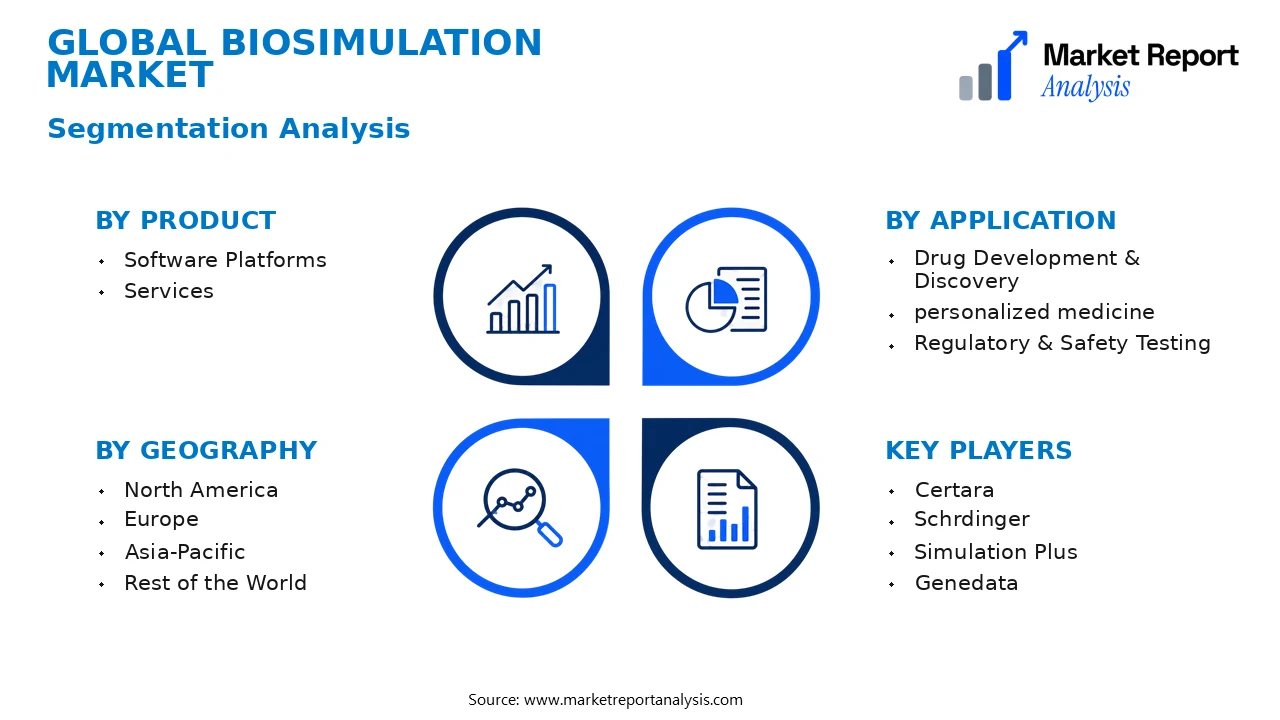
Market segmentation in the biosimulation sector is primarily categorized based on product, application, end user, and geography. This approach allows for a detailed analysis of various market dynamics, including demand drivers, growth opportunities, and regional trends. Each category encompasses specific subsegments that highlight the diverse applications and deployment scenarios across the global landscape, enabling stakeholders to tailor their strategies accordingly.
- Product
- Software Platforms: These are integrated systems used for modeling biological processes, drug discovery, and personalized medicine. The growth is driven by increasing adoption in pharmaceutical R&D to reduce costs and accelerate timelines.
- Services: Encompasses consulting, customization, and licensing services for biosimulation tools, supporting clients in integrating these solutions within their workflows, thereby boosting the overall market size.
- Application
- Drug Development & Discovery: This subsegment leverages biosimulation to predict drug behavior, optimize candidate selection, and reduce the need for extensive clinical trials, actively contributing to market expansion.
- personalized medicine: Uses biosimulation for patient-specific treatment planning and therapy optimization, which is gaining traction due to its potential to improve treatment outcomes and reduce adverse effects.
- Regulatory & Safety Testing: Employs biosimulation to simulate toxicology and pharmacokinetics, supporting regulatory submissions and ensuring safety standards, thus enhancing market credibility and adoption.
- End User
- Pharmaceutical & Biotechnology Companies: Major consumers of biosimulation technologies for drug discovery, development, and validation processes, representing the largest market share and driving innovation in the sector.
- Academic & Research Institutions: Utilize biosimulation for experimental validation and research purposes, which aids in advancing scientific knowledge and fostering new applications.
- Regulatory Agencies: Adopt biosimulation tools for evaluating drug safety and efficacy, facilitating quicker approvals and integration of computational models into regulatory frameworks.
- Geography
- North America: The leading regional market due to high investment in biotech R&D, established pharmaceutical industry, and supportive regulatory environment fostering widespread adoption of biosimulation tools.
- Europe: Features significant growth driven by increasing pharmaceutical innovation, government initiatives, and collaborations between academia and industry for biosimulation applications.
- Asia-Pacific: Demonstrates rapid growth potential owing to burgeoning pharmaceutical manufacturing, rising R&D investments, and expanding biotech startup ecosystems in countries like China, India, and Japan.
- Rest of the World: Emerging markets with growing awareness and increasing adoption of biosimulation solutions in clinical research and drug development processes, poised for future expansion.
Competitive Intelligence
The Biosimulation Market exhibits moderate competition with a key presence of established pharmaceutical, biotechnology, and diagnostic companies. Market concentration remains relatively balanced, with leading players holding significant but not dominating shares, fostering a competitive environment that encourages innovation. Major corporations are deploying aggressive business strategies, including enhancing product portfolios through innovation, strategic partnerships, and acquisitions, to expand their footprints globally. For instance, partnerships between biotech firms and CROs facilitate joint development efforts and access to novel technologies, invigorating the competitive landscape.
Product innovation centers on developing more accurate, faster, and user-friendly biosimulation solutions, supported by robust R&D investments. Leading companies are investing heavily in R&D to differentiate their offerings, aiming to enhance prediction accuracy and integrate AI-driven analytics. Mergers and acquisitions serve as strategic tools for expanding technological capabilities and market reach, enabling companies to accelerate product development cycles and diversify their portfolios. Overall, differentiation is driven by technological innovation, strategic collaborations, and a focus on regulatory compliance, positioning key players to compete effectively in the rapidly evolving biosimulation industry.
Leading Company Profiles
The biosimulation market is highly competitive, with several key players leveraging innovative technologies and expanding their portfolio to capture emerging opportunities. These companies focus on advancing simulation platforms, enhancing drug development pipelines, and strengthening strategic alliances to maintain their market positions.
- Certara
- Schrdinger
- Simulation Plus
- Genedata
- Insilico Medicine
- Dassault Systèmes
- Simcyp
- Labforward
- Cloud Pharmaceuticals
- Entelos
Certara
Certara specializes in integrating biosimulation, modeling, and simulation solutions to accelerate drug development, providing comprehensive tools that enhance clinical decision-making, regulatory submissions, and personalized medicine strategies across global pharmaceutical industries.
Schrdinger
Schrdinger offers advanced molecular simulation software for drug discovery, focusing on artificial intelligence and quantum mechanics to improve predictive accuracy, reduce R&D costs, and accelerate the development of novel therapeutics for biotech and pharma clients.
Simulation Plus
Simulation Plus delivers innovative pharmacokinetic, pharmacodynamic, and toxicological modeling solutions, supported by user-friendly platforms that facilitate seamless integration into drug development pipelines, thereby increasing efficiency and reducing time to market.
Genedata
Genedata provides enterprise solutions for biopharmaceutical R&D, emphasizing scalable biosimulation and analytics platforms that optimize drug candidate selection, streamline workflows, and support clinical trial strategies globally.
Insilico Medicine
Insilico pioneers AI-driven biosimulation technologies for early drug discovery, leveraging deep learning and genomics to rapidly identify therapeutic targets, enhance predictive modeling accuracy, and support personalized treatment development.
Dassault Systèmes
Dassault offers simulation-driven design and analysis tools for life sciences, focusing on integrating virtual testing into bioprocessing, personalized medicine, and regenerative medicine, thereby optimizing product pipelines and ensuring compliance.
Simcyp
Simcyp specializes in physiologically-based pharmacokinetic (PBPK) modeling solutions, enabling precise prediction of drug interactions, pharmacokinetics, and efficacy across diverse patient populations, thereby supporting regulatory and clinical decision-making.
Labforward
Labforward combines IoT and cloud technologies to develop digital laboratory platforms that enhance data management, process automation, and real-time monitoring, facilitating efficient biosimulation workflows in research labs.
Cloud Pharmaceuticals
Cloud Pharmaceuticals employs AI to revolutionize small-molecule drug design, supporting rapid virtual screening, prediction of drug properties, and synthesis pathway development to accelerate pipeline progression.
Entelos
Entelos specializes in computational modeling and simulation for personalized medicine and vaccine development, integrating systems biology approaches to optimize clinical outcomes and regulatory submissions.
Strategic Business Developments
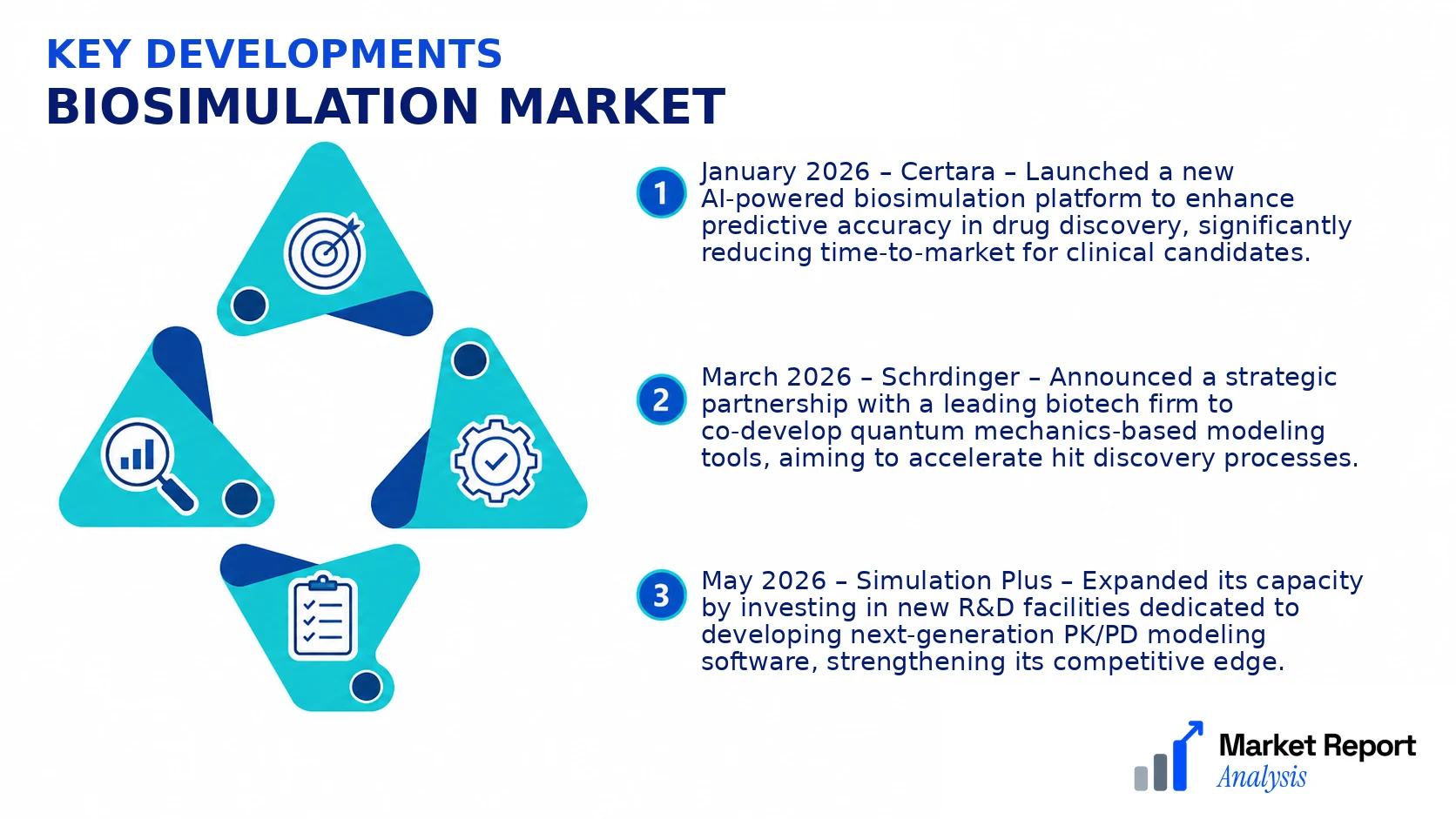
- January 2026 – Certara – Launched a new AI-powered biosimulation platform to enhance predictive accuracy in drug discovery, significantly reducing time-to-market for clinical candidates.
- March 2026 – Schrdinger – Announced a strategic partnership with a leading biotech firm to co-develop quantum mechanics-based modeling tools, aiming to accelerate hit discovery processes.
- May 2026 – Simulation Plus – Expanded its capacity by investing in new R&D facilities dedicated to developing next-generation PK/PD modeling software, strengthening its competitive edge.
- August 2026 – Genedata – Acquired a small biotech analytics startup to integrate new data analytics capabilities, improving platforms for high-throughput screening and data management.
- October 2026 – Dassault Systèmes – Launched a virtual bioprocessing simulation environment that supports digital twin technology for biomanufacturing optimization, advancing industry 4.0 initiatives.
Frequently Asked Questions
What is the Biosimulation Market?
The Biosimulation Market encompasses the global industry involved in the development, application, and commercialization of computer-based models that simulate biological processes. It plays a crucial role in drug discovery, personalized medicine, and regulatory approval processes, improving efficiency and reducing costs.
What is the current market size of Biosimulation Market?
As of 2026, the global Biosimulation Market is valued at approximately USD 2.4 Billion. The market continues to expand due to increasing adoption in pharmaceutical R&D and rising demand for precise disease modeling, with steady growth expected over the forecast period.
What factors are driving the Biosimulation Market?
Key drivers include technological advancements in simulation software, increased R&D investments, the need for cost-effective drug development processes, and regulatory agencies’ acceptance of biosimulation data. Rising prevalence of chronic diseases also boosts demand for personalized treatment approaches.
Which region dominates the Biosimulation Market?
North America holds the leading position, benefiting from advanced healthcare infrastructure, substantial R&D investments, and supportive regulatory frameworks. The region’s strong presence of pharmaceutical giants significantly propels market growth in this area.
Which segment is expected to grow the fastest?
The pharmacology segment is anticipated to record the fastest CAGR during 2026-2034, driven by ongoing drug development activities, increasing validation of biosimulation tools, and greater integration into clinical trial processes to predict drug behavior more accurately.
Who are the leading companies operating in the Biosimulation Market?
Major players include Certara, Simulation Plus, Schrodinger, and Cubic Therapeutics, among others. These companies are investing heavily in innovation, strategic collaborations, and expanding their product offerings to strengthen their market positions globally.
Analyst Perspective
The biosimulation market is positioned for sustained growth driven by continuous technological advancements and increasing adoption in personalized medicine and pharmaceutical development. Over the long term, the market is expected to consolidate with major players investing heavily in innovative platforms, positioning them for competitive leadership. Commercial opportunities are most promising in regions with robust pharmaceutical and biotech sectors, notably North America and Europe, but significant expansion potential exists in Asia-Pacific due to rising healthcare investments and regulatory support.
Technology evolution will focus on enhanced computational models, integration with artificial intelligence, and increased automation to improve simulation accuracy and reduce time-to-market. Investment priorities should emphasize R&D, strategic partnerships, and software platform scalability to capitalize on emerging clinical and preclinical applications. The competitive landscape will intensify as new entrants and established players aim to differentiate through novel algorithms and expanded therapeutic areas.
Regional growth potential varies, with Asia-Pacific emerging as a key growth hub due to expanding healthcare infrastructure and government incentives. Long-term strategic positioning requires companies to adopt a global outlook, innovate continuously, and prioritize regions with high unmet medical needs to sustain competitive advantage and maximize long-term profitability.
