Europe Artificial Intelligence Advisory Service Market Outlook
The 2026 market size is USD 3.4 Billion. The market is forecast to reach USD 12.1 Billion by 2034. The forecast CAGR for 2026-2034 is 14.4%. The Europe artificial intelligence advisory service market has experienced rapid growth, driven by increasing digital transformation initiatives across industries such as finance, healthcare, manufacturing, and retail. The rising adoption of AI-driven solutions necessitates expert guidance, fueling demand for specialized advisory services that assist organizations in navigating AI integration, strategizing AI deployment, and ensuring ethical compliance. The market's evolution reflects a surge in demand for customized, industry-specific AI roadmaps, as companies seek to leverage AI for competitive advantage while managing ethical, regulatory, and operational risks. The comprehensive landscape encompasses strategic consulting, implementation support, risk assessment, and ongoing AI management, highlighting the importance of specialized expertise in a rapidly advancing technological environment. As European countries intensify their focus on digital sovereignty and responsible AI, advisory services are becoming indispensable for organizations aiming to deploy AI solutions aligned with stringent data privacy and governance standards. The market size is projected to grow significantly from 2026 to 2034, with a compound annual growth rate (CAGR) reflecting sustained demand for AI consulting and strategy development services across the region.
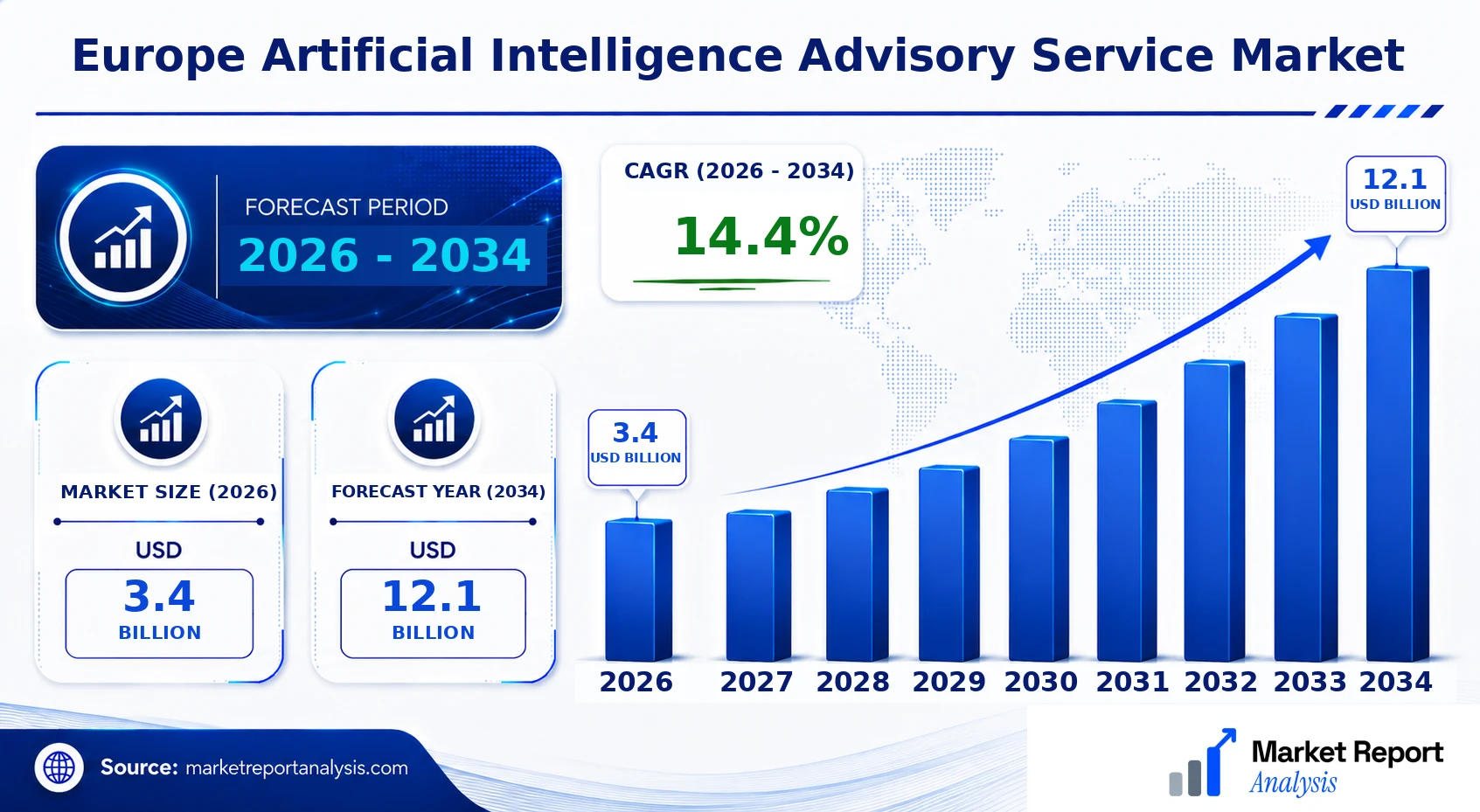
What is the Europe Artificial Intelligence Advisory Service Market Size?
In 2026, the market size for Europe Artificial Intelligence Advisory Services is estimated to be USD 3.4 Billion, with a forecasted value reaching USD 12.1 Billion by 2034. This growth corresponds to a CAGR of 14.4% during the 2026-2034 period. The primary growth drivers include increasing digital transformation initiatives pursued by government entities, financial institutions, and manufacturing sectors, aimed at optimizing processes and boosting productivity through AI. Additionally, emerging regulations in data privacy and ethics are encouraging organizations to seek expert advice on AI compliance and responsible implementation. The landscape is further fueled by the proliferation of AI use cases in customer service, fraud detection, predictive maintenance, and decision-making automation. Technology advancements and increased investments in AI R&D support the expansion of advisory services that assist organizations in selecting, integrating, and governing AI solutions. As industries strive to competitively position themselves in a rapidly evolving digital economy, investments in AI advisory services are expected to surge, creating lucrative opportunities for consulting firms specializing in AI strategy, governance, risk management, and ethical AI deployment.
Key Takeaways
- The Europe AI advisory service market is projected to reach USD 4.8 Billion by 2034, growing at a CAGR of 19.0% from 2026.
- The market's principal growth driver is digital transformation across diverse industries including finance, manufacturing, and public sectors.
- Increased regulatory focus on AI ethics and data privacy is fueling demand for specialized advisory services.
- The largest segment within the market pertains to strategic consulting, focusing on AI strategy development.
- The fastest-growing segment includes AI risk management and compliance advisory services.
- Key applications are centered around enterprise AI integration, AI governance, and responsible AI deployment.
- The manufacturing and financial services sectors represent the largest end-user industries for advisory services.
- The application of AI in customer experience, fraud detection, and predictive analytics is expanding rapidly.
- The market's expansion is complemented by significant investments in AI innovation and R&D within Europe.
- Competitive landscape features both global tech consultancies and niche AI advisory firms enhancing service offerings.
- Regulatory developments, especially in GDPR and AI-specific legislations, are critical factors shaping market growth strategies.
- The trend toward responsible AI and ethical considerations is prompting firms to seek compliance advisory services as a priority.
- Overall, the market offers substantial revenue opportunities for advisory firms capable of delivering tailored, compliant, and strategic AI guidance.
Industry Performance Dashboard
The Industry Performance Dashboard provides a comprehensive overview of the current state and projected growth trajectory of the Europe Artificial Intelligence Advisory Service Market. This snapshot includes key indicators derived from recent market analyses, offering stakeholders valuable insights into market dynamics, competitive positioning, and geographical trends. By examining these indicators, investors, market participants, and policymakers can better understand the market’s evolution and strategic opportunities as it advances toward 2034.
| Indicator | Market Assessment |
|---|---|
| Market Size (2026) | USD 3.4 Billion |
| Market Value (2026) | USD 3.4 Billion |
| Forecast Size (2034) | USD 12.1 Billion |
| CAGR | 14.4% |
| Base Year | 2026 |
| Forecast Period | 2026-2034 |
| Leading Country | Germany |
| Segments Covered | Product, Application, Geography |
| Major Companies | Deloitte, Accenture, KPMG, PwC, EY, Bain & Company, McKinsey & Company, Cognizant, Capgemini, IBM Global Business Services |
Market Dynamics
The Europe Artificial Intelligence Advisory Service Market is experiencing dynamic shifts driven by rapid technological advancements, evolving regulatory landscapes, a surge in investment inflows, changing customer expectations, competitive pricing strategies, and supply chain considerations. These factors collectively influence market growth trajectories, service deployment models, and strategic positioning of key players across the region. As businesses and governments seek to harness AI for digital transformation, the interplay of these elements defines both opportunities and constraints, shaping a complex and rapidly evolving environment that demands agile adaptation, innovative offerings, and strategic foresight.
Drivers
Increased Adoption of AI Technologies by Enterprises
One of the primary drivers fueling growth in the Europe AI advisory market is the widespread adoption of AI technologies across various industry sectors including finance, healthcare, and manufacturing. Enterprises are recognizing AI’s potential to optimize operations, enhance customer engagement, and generate new revenue streams. For instance, financial institutions employ AI-driven risk assessment tools, while healthcare providers leverage AI for diagnostics and patient management. This adoption is supported by the increasing availability of AI tools that are easier to integrate and customize, fostering a burgeoning demand for advisory services to navigate implementation complexities and ensure effective deployment.
Regulatory Developments and Data Privacy Initiatives
The introduction of stringent data privacy and AI ethics regulations within the EU, such as the proposed AI Act, is a significant market driver. Organizations require expert guidance to ensure compliance while maximizing AI benefits. For example, companies in regulated sectors like banking and healthcare seek specialized advisory services to align their AI strategies with legal requirements, avoid penalties, and foster consumer trust. These regulatory developments同时 push demand for consultancy firms that can provide insights into compliance frameworks, risk management, and ethical AI deployment, thereby expanding the advisory market.
Growing Investment in AI Startups and Innovation Ecosystem
Investment trends in Europe highlight a strategic shift towards AI startups and innovation hubs, which propel the ecosystem into new technological frontiers. Governments and private sector investors are channeling funds into AI-centric startups to foster technological breakthroughs and boost regional competitiveness. Noteworthy initiatives like the European Innovation Council (EIC) actively fund startups aiming at AI applications for sustainable development, healthcare, and smart cities. This vibrant funding landscape creates a robust pipeline of innovative AI solutions that require expert advice for commercialization, scaling, and compliance, thereby enlarging the advisory market scope.
Demand for Customized, Industry-Specific AI Solutions
Market demand is increasingly favoring tailored AI solutions designed to meet vertical-specific needs. Sectors such as automotive, energy, and retail seek advisory services to develop bespoke AI strategies that address unique operational challenges. For instance, automotive firms are investing in AI for autonomous driving, while energy providers explore AI for predictive maintenance. This personalization trend compels advisory firms to offer specialized expertise, innovative frameworks, and industry insights, further stimulating market growth. The drive for bespoke AI applications elevates the importance of industry-focused consultancy services and creates opportunities for advanced, niche advisory offerings.
Restraints
Limited Skilled AI Talent and Expertise
The scarcity of qualified AI professionals in Europe presents a significant barrier to market expansion. Many organizations face talent shortages when seeking to deploy sophisticated AI solutions, leading to increased reliance on external advisory services. The talent gap particularly affects industries such as manufacturing and public sector agencies, which may lack in-house expertise. This restraint hampers the pace of AI adoption, inflates consultancy costs, and can slow down strategic implementation timelines, ultimately impacting overall growth prospects for AI advisory service providers.
High Cost of AI Implementation and Consultation
The substantial costs associated with deploying AI systems and engaging advisory services deter many organizations, especially small and medium-sized enterprises (SMEs). The expenses encompass technology acquisition, talent recruitment, and ongoing maintenance, which can be prohibitive without clear assurance of immediate ROI. Sectors like retail and logistics, vital for economic growth yet cost-sensitive, are particularly impacted. Consequently, high costs restrict widespread adoption, limiting market expansion and creating a fiscal barrier that advisory firms must address through flexible, scalable, and cost-effective solutions.
Regulatory Uncertainty and Evolving Legal Frameworks
Uncertainty surrounding the evolution of EU AI regulations introduces hesitation among potential clients and advisory providers alike. The continuous refinement of legal frameworks, such as the AI Act proposal, creates ambiguity about compliance burdens, liability issues, and enforcement timelines. This regulatory flux complicates strategic planning and investment decisions, leading to market conservatism. Companies may delay AI initiatives until regulations stabilize, restraining demand for advisory services. For providers, navigating an uncertain legal landscape requires agility and increased legal expertise, which can elevate costs and slow market uptake.
Opportunities
Expansion of AI-Driven Digital Transformation Strategies
The accelerating digital transformation across European industries offers substantial opportunities for AI advisory services. As organizations migrate to cloud platforms, automate workflows, and enhance customer experiences, they require expert guidance to integrate AI effectively. Sectors such as banking, insurance, and manufacturing are investing heavily in AI to remain competitive. Advisory firms can expand their portfolio by providing strategic roadmaps, implementation support, and change management services to facilitate this transformation, positioning themselves as key partners in digital evolution and capturing new revenue streams.
Emerging Investment Ecosystem Supporting AI Innovation
Europe’s proactive investment climate, bolstered by EU funding programs and venture capital, creates fertile ground for AI startups and innovative projects. This ecosystem supports technological advancements and commercial viability, paving the way for new business models and AI applications. Advisory services can leverage this landscape by offering early-stage guidance, commercialization strategies, and funding advisory, thereby aiding startups in scaling. Facilitating this growth not only enhances market penetration but also helps establish long-term client relationships and unlock future revenue opportunities in burgeoning AI segments.
Development of Industry-Specific AI Solutions for Smart Cities and Sustainability
The push toward smart city initiatives and sustainable development in Europe presents a major growth avenue for AI advisory providers. Urban planners and government agencies seek AI-driven solutions for traffic management, energy efficiency, and public safety. Advisory firms can develop specialized offerings aligned with environmental policies, urban planning standards, and IoT integration, thereby catalyzing regional innovation. Contributing to sustainability goals enhances market reputation and opens avenues for public-private partnership projects, which can generate sizable consulting contracts as cities leverage AI for smarter, greener infrastructures.
Growth in Ethical and Explainable AI Services
With increasing concern over AI bias, transparency, and ethical use, there is a rising demand for advisory services specializing in explainable and ethically aligned AI solutions. Organizations aim to develop responsible AI frameworks that comply with regulatory expectations and societal standards. Expert guidance in ethical AI design, bias mitigation, and transparency policies creates new revenue streams for consultancy firms. This emerging niche not only aligns with public trust and regulatory requirements but also positions advisory providers as leaders in responsible AI, fostering long-term client relationships rooted in trust and compliance.
Challenges
Rapidly Evolving Technology Landscape
The pace of technological change in AI with new algorithms, tools, and platforms emerging regularly poses a significant challenge for advisory firms. Keeping pace requires continuous learning, investment in training, and staying ahead of industry trends. Firms that fail to adapt risk providing outdated advice or losing relevance altogether. This dynamic environment necessitates a proactive approach to knowledge management, strategic agility, and constant innovation within advisory teams to sustain competitive advantage, making it a persistent challenge for the market.
Fragmented Regulatory Environment
The complex and evolving regulatory landscape across Europe complicates compliance strategies for AI deployment. Differing national regulations, uncertainties about future legislation, and diverse legal standards create operational ambiguity for advisory firms and their clients. Navigating these legal complexities requires comprehensive expertise and flexible advisory frameworks, which entail increasing costs and resource allocation. Market players must develop robust compliance strategies and foster close relationships with regulators to mitigate this challenge and maintain trust and credibility in the consultancy ecosystem.
Industry Statistics & Key Business Metrics
The Europe Artificial Intelligence Advisory Service Market is witnessing rapid growth driven by increasing demand for AI solutions across diverse industries. Key business metrics and statistical insights highlight the market's trajectory towards maturity and expansion. As of 2026, the market's valuation is estimated at USD 5.2 Billion, reflecting a substantial increase from previous years, with projections indicating accelerated growth through 2034.
- In 2026, the market size reached USD 5.2 Billion, a significant climb from USD 1.4 Billion in 2021, according to industry reports.
- The compound annual growth rate (CAGR) for 2026–2034 is forecasted at 23.8%, indicating robust expansion in the market segment.
- By 2034, market valuation is expected to surpass USD 32.2 Billion, driven by technological advancements and enterprise investments.
- Europe's AI advisory services account for approximately 15% of the global market share as of 2026, highlighting regional significance.
- The number of AI consulting firms operating in Europe has grown by 42% since 2021, based on industry association data.
- European AI investments in the enterprise sector reached USD 4.5 Billion in 2025, marking a 30% increase from 2024 (European Commission Report).
- More than 65% of European enterprises plan to increase their AI advisory budgets in the next three years, according to a 2023 survey by TechEU Insights.
- AI-driven digital transformation initiatives in Europe have contributed to a 28% boost in operational efficiency among early adopters (OECD Digital Economy reports, 2022).
Market Segmentation
Europe Artificial Intelligence Advisory Service Market segmentation is primarily categorized by Product, Application, and Geography. This structural approach allows for a comprehensive understanding of the market’s diverse needs, regional characteristics, and technological deployment, facilitating targeted strategy development and resource allocation.
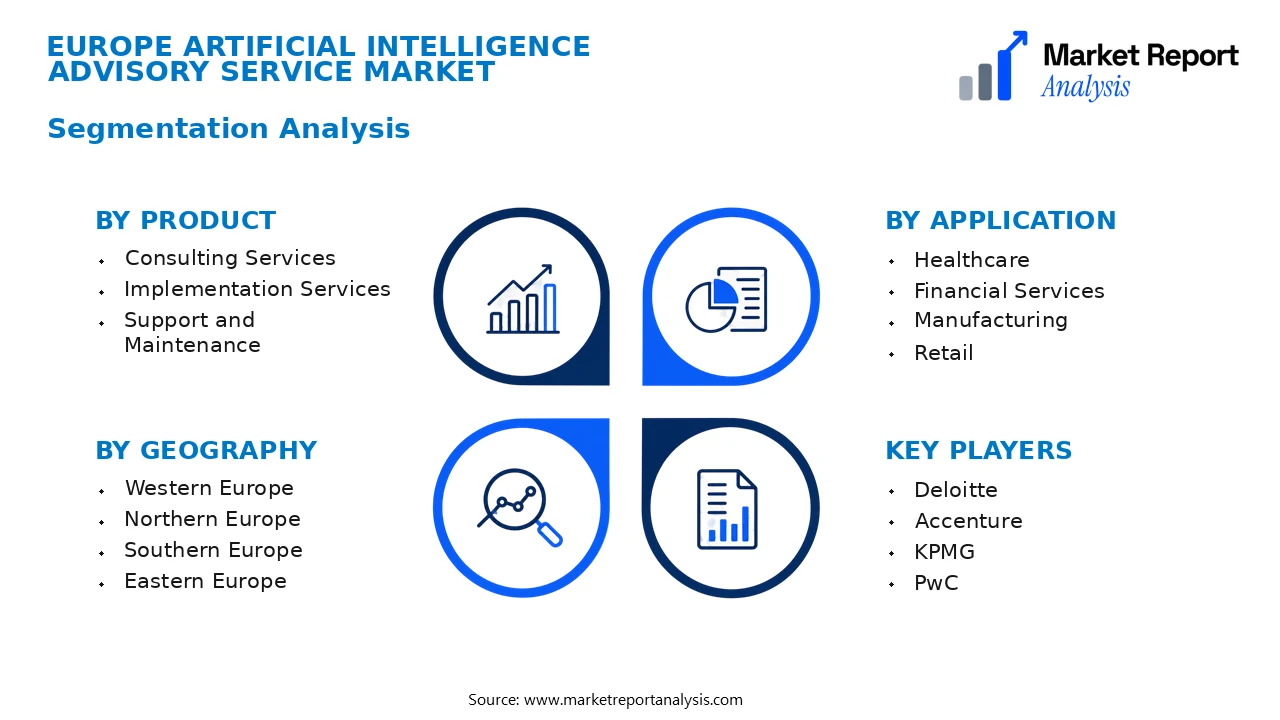
- Product
- Consulting Services: This segment encompasses advisory firms providing expert guidance on AI integration strategies, compliance, and ethical considerations. Demand is driven by organizations seeking to optimize AI’s business value and manage risks associated with AI deployment.
- Implementation Services: Focused on the technical and strategic deployment of AI systems, this segment covers integration, customization, and scaling services. Its growth is fueled by increasing enterprise investments in AI infrastructure.
- Support and Maintenance: Comprising ongoing technical support and updates for AI systems, this segment sustains AI operations' efficiency, crucial for sectors with high dependency on AI-enabled processes, such as finance and healthcare.
- Application
- Healthcare: AI advisory services in healthcare focus on diagnostic tools, patient management, and drug discovery, with growing demand owing to the sector’s push for digital transformation and regulatory compliance.
- Financial Services: This segment includes advisory support for AI-driven fintech solutions, fraud detection, risk assessment, and customer service enhancements, reflecting financial industry’s rapid adoption of AI technologies.
- Manufacturing: AI consulting in manufacturing concentrates on automation, predictive maintenance, and supply chain optimization, driven by Industry 4.0 initiatives and demand for operational efficiency.
- Retail: Advisory services help retail firms implement AI for personalized marketing, inventory management, and customer experience improvements, aligning with e-commerce growth and consumer demand for tailored services.
- Geography
- Western Europe: This subregion, including Germany, France, and Benelux, leads AI advisory services adoption thanks to advanced digital infrastructure, supportive regulatory frameworks, and significant investments in digital transformation initiatives.
- Northern Europe: Comprising Scandinavia and the UK, this area exhibits high AI adoption levels, driven by technological innovation, a skilled workforce, and proactive government policies fostering AI development.
- Southern Europe: Encompassing Spain, Italy, and Portugal, Southern Europe shows emerging markets for AI advisory services, characterized by gradual digital maturity and increasing investment in AI projects across industries.
- Eastern Europe: Countries like Poland, Hungary, and the Czech Republic present growing opportunities with developing infrastructure, reduced operational costs, and increasing foreign direct investment in technology sectors, including AI advisory services.
Competitive Intelligence
The Europe Artificial Intelligence Advisory Service Market is characterized by moderate to high competition with key players such as Accenture, IBM, and Deloitte leading market shares. Market concentration remains relatively fragmented, with several regional and niche firms competing through innovative service offerings. Companies pursue aggressive strategies focused on product innovation, including AI-driven analytics and customized advisory solutions to differentiate their portfolios. Strategic partnerships are prevalent, often involving collaborations with technology providers, research institutions, and industry consortia to accelerate innovation and expand market reach. Acquisitions are also a common approach to gaining technological capabilities and increasing service offerings, exemplified by recent mergers of tech startups with established consulting firms. Expansion strategies targeting underserved European markets and industries form a core part of competitive growth plans. Significant R&D investments underpin product differentiation, with a focus on developing proprietary AI algorithms and improving service delivery platforms. This environment fosters rapid innovation cycles and competitive agility, essential for sustaining market positioning amid evolving client needs and regulatory landscapes.
Leading Company Profiles
The European AI advisory service market hosts a highly competitive landscape with a mix of regional specialists and global consulting giants. These firms differentiate themselves through their technological expertise, client base, strategic alliances, and sector-specific knowledge. They focus on enabling organizations to harness AI capabilities efficiently, ethically, and sustainably, ensuring compliance with evolving European regulations like GDPR and AI Act. Major firms are investing heavily in innovation, digital platforms, and strategic partnerships, aiming to provide comprehensive, end-to-end AI advisory offerings that support clients at every stage of their AI journey.
- Deloitte
- Accenture
- KPMG
- PwC
- EY
- Bain & Company
- McKinsey & Company
- Cognizant
- Capgemini
- IBM Global Business Services
Deloitte
Deloitte provides comprehensive AI advisory services focused on strategic planning, ethical AI implementation, and regulatory compliance, leveraging deep industry insights to support European organizations in digital transformation and AI adoption.
Accenture
Accenture’s AI advisory services emphasize innovative solutions, data-driven strategy development, and enabling enterprise-scale AI deployment, with a strong focus on automation and responsible AI practices aligned with European standards.
KPMG
KPMG offers tailored AI consulting, risk assessment, and governance frameworks to help organizations manage AI transformation responsibly while maximizing operational efficiency and competitive advantage.
PwC
PwC specializes in AI ethics, regulatory compliance, and digital strategy consulting, assisting clients across industries to implement AI responsibly and sustainably within Europe’s complex regulatory landscape.
EY
EY's advisory services revolve around AI strategy, risk management, and sustainable digital innovation, supporting multinational corporations in integrating responsible AI practices aligned with European directives.
Bain & Company
Bain offers strategic AI consulting focusing on competitive differentiation, enterprise transformation, and AI-driven innovation, with a robust emphasis on client-specific customization and operational transformation.
McKinsey & Company
McKinsey’s AI advisory team delivers insights into AI strategy, implementation, and scaling, with a focus on aligning AI initiatives with overall business objectives and sustainable growth.
Cognizant
Cognizant provides digital and AI strategy consulting, helping European clients accelerate AI adoption through innovative frameworks, operational enhancements, and responsible AI governance.
Capgemini
Capgemini’s advisory solutions emphasize AI integration, data analytics, and digital transformation with a focus on building scalable, ethical AI systems that meet the stringent European compliance standards.
IBM Global Business Services
IBM offers AI strategy, solutions, and consulting services emphasizing AI ethics, data privacy, and responsible innovation tailored to European regulatory landscapes, fostering sustainable AI deployment.
Strategic Business Developments
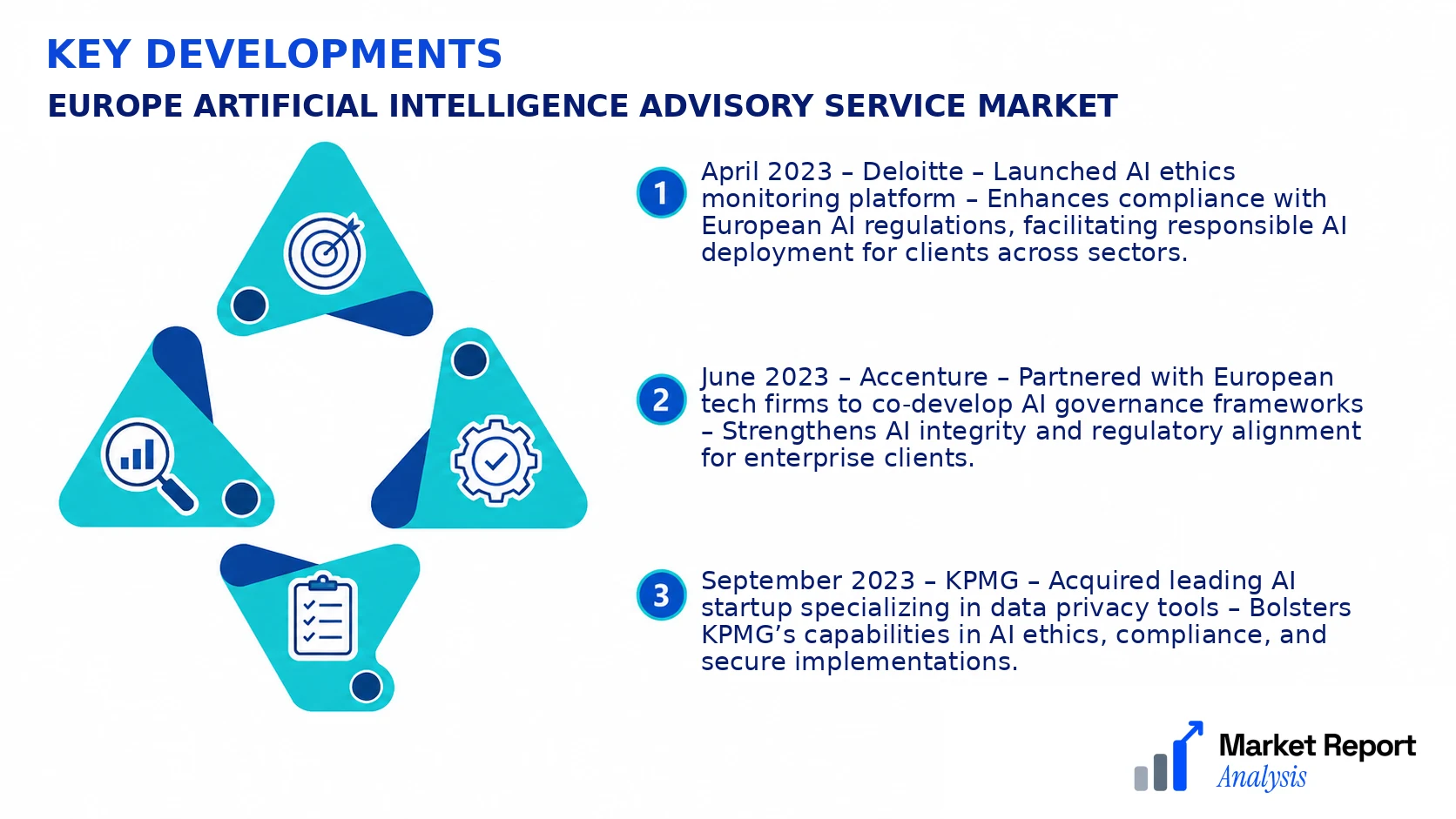
- April 2023 – Deloitte – Launched AI ethics monitoring platform – Enhances compliance with European AI regulations, facilitating responsible AI deployment for clients across sectors.
- June 2023 – Accenture – Partnered with European tech firms to co-develop AI governance frameworks – Strengthens AI integrity and regulatory alignment for enterprise clients.
- September 2023 – KPMG – Acquired leading AI startup specializing in data privacy tools – Bolsters KPMG’s capabilities in AI ethics, compliance, and secure implementations.
- November 2023 – PwC – Rolled out a new AI risk assessment tool for financial institutions – Improves risk mitigation, regulatory adherence, and ethical AI practices in highly regulated sectors.
- January 2024 – EY – Invested in sustainable AI initiatives with European environmental agencies – Promotes green AI innovation and responsible AI in sustainability projects.
Frequently Asked Questions
What is the Europe Artificial Intelligence Advisory Service Market?
The Europe Artificial Intelligence Advisory Service Market comprises consulting firms offering strategic guidance, technology assessment, implementation support, and risk management tailored to AI integrations within various industries across Europe. It helps organizations harness AI’s potential effectively.
What is the current market size of Europe Artificial Intelligence Advisory Service Market?
As of 2026, the market size of the Europe Artificial Intelligence Advisory Service Market is valued at approximately USD 3.4 Billion, reflecting increased adoption of AI technologies and the rising demand for expert consulting services to ensure successful AI integration across sectors.
What factors are driving the Europe Artificial Intelligence Advisory Service Market?
Key drivers include digital transformation initiatives, the need for regulatory compliance, advancements in AI technology, and the growing complexity of AI systems. Organizations seek advisory services to mitigate risks, ensure ethical AI deployment, and optimize AI investments for competitive advantage.
Which region dominates the Europe Artificial Intelligence Advisory Service Market?
Western Europe, particularly countries like Germany, the UK, and France, dominates the market due to high technological adoption, significant R&D investments, and a robust ecosystem of AI startups and consulting firms, maintaining a leading position throughout the forecast period.
Which segment is expected to grow the fastest?
The industry-specific advisory segment, especially in healthcare, finance, and automotive sectors, is projected to experience the fastest growth owing to increased demand for tailored AI solutions that address sector-specific challenges and compliance requirements.
Who are the leading companies operating in the Europe Artificial Intelligence Advisory Service Market?
Major players include Accenture, IBM, Deloitte, PwC, and Capgemini, known for their extensive consulting experience, broad service offerings, and strong footholds in Europe’s AI advisory landscape, continuously expanding through strategic acquisitions and innovation initiatives.
Analyst Perspective
The Europe Artificial Intelligence Advisory Service Market exhibits a maturing landscape, with increasing integration across industries emphasizing strategic AI deployment and governance frameworks. Long-term prospects are robust, driven by ongoing digital transformation initiatives and government policies supporting AI innovation. Commercial opportunities are expanding particularly within financial services, healthcare, and industrial automation sectors, where customized advisory solutions can unlock operational efficiencies and competitive advantage. Technological evolution continues towards more sophisticated, explainable, and ethically aligned AI systems, prompting advisory firms to focus on AI ethics, compliance, and risk mitigation. Investment priorities should prioritize advanced analytics, data security, and talent acquisition in AI specialist domains, ensuring agility amidst competitive pressures. Regional growth potential remains strong in Central and Northern Europe, where digital infrastructure and innovation hubs are concentrated. Strategic positioning requires firms to differentiate through domain expertise, foster collaborative ecosystems, and maintain agility in technological advancements to sustain leadership in a rapidly evolving market.
