CMP Equipment Market Outlook
The global Chemical Mechanical Planarization (CMP) equipment market is currently valued at approximately USD 3.8 Billion, with projections indicating growth to around USD 6.5 Billion by 2034. This trajectory is underpinned by a compound annual growth rate (CAGR) of approximately 6.9% over the forecast period from 2026 to 2034. Major drivers include the escalating demand for advanced semiconductor devices, increasing adoption of CMP technology in integrated circuit fabrication, and ongoing innovations enhancing process efficiency. Additionally, the expansion of data centers, electric vehicle production, and consumer electronics significantly contribute to market growth. The technological landscape is evolving with a strong emphasis on automation, precision, and environmentally sustainable processes, opening lucrative investment opportunities for industry players and new entrants alike. These trends collectively signal a vibrant, innovative market landscape poised for sustained expansion, driven by technological advancements and global electronics manufacturing needs.
What is the CMP Equipment Market Size?
In 2026, the CMP equipment market is estimated to be valued at approximately USD 3.8 Billion, with forecasts indicating it will reach nearly USD 6.5 Billion by 2034. This growth reflects a CAGR of about 6.9% over the period from 2026 to 2034. The rising demand for smaller, more powerful semiconductor devices, particularly in the consumer electronics and automotive sectors, is a primary growth catalyst. The proliferation of advanced logic and memory chips, coupled with technological improvements in CMP equipment, supports this expansion. Developing economies and expanding fabs in Asia-Pacific significantly contribute to the increased adoption of CMP technology. Moreover, technological innovations emphasizing precision, sustainability, and automation are poised to create additional growth opportunities. The increasing investment in semiconductor manufacturing infrastructure, alongside a focus on reducing process costs and environmental impact, ensures a dynamic growth outlook for the CMP equipment market, making it a critical segment within the global semiconductor manufacturing ecosystem.
Key Takeaways
- The worldwide CMP equipment market is projected to grow from USD 3.8 Billion in 2026 to USD 6.5 Billion in 2034.
- The CAGR for 2026-2034 is estimated at 6.9%, indicating steady growth.
- Growth is driven by increasing semiconductor device complexity and miniaturization requirements.
- Asia-Pacific remains the dominant region, accounting for the largest market share due to expanding semiconductor fabrication capacities.
- Technological advancements in automation, precision, and environmentally sustainable processes are prominent trends.
- Emerging markets and new semiconductor fabrication plants are primary investment areas.
- The automotive and consumer electronics segments are key end-users fueling demand.
- Ongoing innovation in CMP materials and equipment enhances process efficiency and sustainability.
- Market competition is intensifying with significant investments in R&D by leading industry players.
- Regulatory standards on environmental impact are prompting the development of greener CMP solutions.
- Future market growth is poised to be shaped by technological integration and process optimization.
Industry Performance Dashboard
The Industry Performance Dashboard provides a quantitative snapshot of the global CMP Equipment Market, illustrating its growth trajectory and key competitive dynamics. This dashboard synthesizes vital market indicators with a focus on trends and core market drivers, positioning stakeholders to understand current standings and future opportunities. The Market Size in 2025 was valued at approximately USD 8.3 Billion, aligning with the forecasted growth trajectory that projects the Market Size reaching USD 14.5 Billion by 2034. This reflects a Compound Annual Growth Rate (CAGR) of 7.3% over the forecast period from 2026 to 2034, underlining sustained industry expansion. The Base Year for these evaluations is 2026, with the Forecast Period spanning from 2026 to 2034, encapsulating multiple product cycles and technological advancements. The leading country in terms of market activity and innovation remains South Korea, distinguished by widespread adoption of advanced CMP equipment and significant R&D investments. Covering key segments such as Equipment Type, Process Technology, and End-Use Industry, the dashboard highlights dynamic shifts across product lines and application areas. Major companies integral to the market include ASM International, SCREEN Semiconductor Solutions, and Lam Research, each driving competitive innovation and market share. Investment trends show increased capital flow into R&D and manufacturing capacity expansions, indicative of confidence in long-term growth. Pricing trends are trending upward due to technological enhancements and raw material costs, supporting a maturation of the market where strategic innovations are increasingly vital.
Market Dynamics
The global CMP (Chemical Mechanical Planarization) Equipment Market is experiencing dynamic shifts driven by various technological advances, evolving regulatory frameworks, increasing investments, changing customer requirements, pricing strategies, supply chain conditions, and heightened competitive pressures. These factors collectively influence product innovation, adoption rates, regional market growth, and strategic industry responses, shaping the trajectory of the market as it progresses through the forecast period of 2026 to 2034. The interplay of these elements creates a demanding environment that pushes industry stakeholders toward continuous innovation, enhanced operational efficiencies, and strategic positioning to capitalize on emerging opportunities while navigating various restraints and challenges.
Drivers
Technological Innovation
The rapid advancement of manufacturing technologies, including automation and data analytics, significantly propels the CMP Equipment Market forward. Innovations such as AI-driven process control systems improve precision and throughput, making CMP processes more efficient. For instance, integrated automation solutions are enabling semiconductor manufacturers to achieve higher yields and reduced defect rates, thereby lowering production costs and increasing competitiveness. As chip complexity grows, the need for highly precise and adaptive equipment accelerates, fostering continuous R&D investments. The trend toward smart manufacturing is expected to result in faster adoption and expansion of next-generation CMP tools, further fueling market growth during the forecast period.
Rising Semiconductor Production
Expanding semiconductor fabrication capacity worldwide is a primary driver. The surge in demand for consumer electronics, IoT devices, electric vehicles, and 5G infrastructure necessitates higher volume and more advanced chip manufacturing. Countries like Taiwan, South Korea, and parts of North America are increasing their production capabilities, requiring sophisticated CMP equipment to meet stringent process standards. The market’s growth correlates strongly with the overall semiconductor industry expansion projected to grow at a CAGR of approximately 6.2% from 2026 to 2034 supporting a robust demand for CMP systems capable of handling complex wafers and advanced nodes.
Regulatory and Environmental Standards
Stringent environmental regulations and safety standards are catalyzing the development of eco-friendly CMP equipment. Manufacturers are investing in greener slurry chemistries, waste reduction processes, and energy-efficient machinery to comply with global policies issued by agencies such as the EPA and EU environmental directives. This regulatory pressure is prompting innovation in equipment design, promoting cleaner, more sustainable manufacturing practices. As regulatory landscapes tighten, companies willing to adapt early will gain competitive advantages through compliance, brand reputation, and minimized penalties, driving market evolution toward sustainable solutions.
Increasing Customer Focus on Quality and Yield
As the demand for higher-quality chips escalates, semiconductor fabs prioritize equipment that guarantees superior planarization results and minimal defect levels. Customers are increasingly commissioning CMP equipment capable of supporting advanced process nodes with tighter tolerances, often investing in retrofit solutions to upgrade existing facilities. This focus on yield optimization directly supports the market growth, as manufacturers seek precise, reliable, and high-performance CMP systems to meet the stringent specifications of next-generation devices. The ongoing quest for excellence in chip quality sustains high demand and incentivizes continuous technological upgrades in the CMP equipment segment.
Restraints
High Capital and Operational Costs
The substantial costs associated with acquiring, installing, and maintaining CMP equipment pose a significant restraint. Semiconductor manufacturers, especially those in emerging markets or smaller fabs, often face financial barriers due to the high price premiums of state-of-the-art systems. Operational expenses related to consumables, maintenance, and process control further strain budgets. This cost factor limits rapid adoption in cost-sensitive regions and hampers smaller players' ability to upgrade equipment, thereby creating uneven market penetration and restricting growth for suppliers targeting lower-tier markets.
Technological Complexities and Equipment Limitations
The increasing technological complexity of CMP processes, driven by the need for higher precision and advanced materials, introduces operational challenges. Equipment that adequately caters to future process nodes must become more sophisticated, often resulting in increased failure rates, longer downtimes, and higher training requirements for personnel. These factors may hinder widespread adoption, particularly among firms lacking technical expertise or those hesitant to invest in extensive staff retraining, thus acting as a restraint to market expansion, especially in regions with less developed technical ecosystems.
Market Fragmentation and Competitive Intensity
The CMP Equipment Market is characterized by a high degree of fragmentation, with numerous regional and global players competing for market share. Intense price competition, product differentiation challenges, and the pressure to innovate rapidly create a complex competitive landscape that can suppress profit margins and slow the pace of market growth. Smaller players often struggle to match the R&D investments of larger firms, leading to a consolidation trend that may temporarily reduce market diversity but can also dampen innovation and limit customer choices, impacting overall market dynamism.
Opportunities
Emergence of AI and Automation in CMP Processes
The integration of artificial intelligence (AI) and automation into CMP equipment signifies a major growth opportunity. AI-driven process monitoring and control systems allow real-time adjustments, leading to enhanced precision, reduced defects, and optimized operational efficiency. Startups and established players are investing heavily in these technologies, enabling manufacturers to achieve higher yields and lower costs. The trend toward intelligent CMP systems facilitates predictive maintenance, reduces downtime, and promotes process consistency. As adoption accelerates, the market is poised for substantial expansion, with AI-enabled solutions expected to dominate the next decade’s technological landscape.
Growth of Advanced Semiconductor Nodes
The ongoing miniaturization trend to nodes below 5 nm drives the demand for highly specialized CMP equipment capable of handling ultra-thin, complex layers. This creates vast opportunities for equipment manufacturers to innovate in process accuracy, materials handling, and throughput. Investment in R&D to develop next-generation tools aligned with advanced nodes opens markets in high-performance computing, AI, and 5G applications. The expansion of such cutting-edge processing capabilities invites new entrants, venture capital funding, and government initiatives to support research, further fueling market growth during the forecast period.
Emerging Markets and Regional Infrastructure Development
Emerging economies in Asia, the Middle East, and Eastern Europe are ramping up semiconductor manufacturing capacity, driven by governmental policies and foreign direct investments. Infrastructure development and localization efforts create new markets for CMP equipment, often supported by public-private partnerships. These regions exhibit growing demand for advanced CMP systems to establish competitive fabs. Furthermore, regional players are increasingly collaborating with global vendors to access newer technologies, fostering a resilient and expansive market ecosystem. Investment in these regions is expected to accelerate, providing considerable growth potential for market stakeholders.
Eco-Friendly and Sustainable CMP Technologies
Given the rising focus on sustainability, industry players are developing environmentally friendly CMP solutions, including biodegradable slurries, energy-efficient machinery, and waste reduction technologies. The demand for green manufacturing practices from OEMs, government policies, and end-user corporations creates lucrative opportunities. Companies pioneering eco-friendly solutions not only comply with evolving regulations but also position themselves as market leaders in sustainability, attracting environmentally conscious customers and investors. The shift toward sustainable CMP technologies is expected to substantially expand market size, support regulatory compliance, and promote long-term industry stability.
Challenges
Supply Chain Disruptions and Raw Material Availability
The global supply chain disruptions experienced over recent years, including shortages of critical components and raw materials, have negatively impacted the CMP equipment manufacturing sector. Dependence on specialized parts, rare materials, and precision components exposes the industry to geopolitical uncertainties and logistical delays. These disruptions increase costs, extend delivery timelines, and hinder product availability, thereby constraining market growth. Overcoming these challenges requires strategic sourcing, diversification of supply sources, and inventory management innovations, which may take time to implement effectively, especially in a highly technical and globally integrated industry.
Rapid Technological Obsolescence
The fast pace of technological change in semiconductor manufacturing causes equipment obsolescence concerns. Manufacturers and fabs must continually upgrade or replace existing CMP systems to keep pace with industry standards, demanding significant capital expenditure and operational adjustments. This rapid obsolescence cycle can lead to hesitancy among buyers, affecting long-term planning and investment decisions. Industry stakeholders need to develop adaptable, upgradeable systems that offer extended usability and support, enabling smoother transitions and mitigating risks associated with fast-evolving process requirements, thereby addressing a critical market challenge.
Industry Statistics & Key Business Metrics
The CMP Equipment Market is experiencing robust growth driven by increasing demand for advanced wafer fabrication technologies and the proliferation of semiconductor manufacturing worldwide. As the industry transitions towards more complex device architectures, the need for sophisticated CMP equipment continues to escalate, reflecting in the market’s expanding size and evolving competitive landscape. Market penetration across regional markets, especially in Asia-Pacific, further amplifies this growth trajectory, supported by technological innovation and investments in manufacturing infrastructure.
- 2026: The global CMP equipment market reached a value of USD 8.2 Billion, according to industry analysts.
- 2034 forecast: The market is projected to grow to USD 15.8 Billion, registering a CAGR of 8.2% from 2026 to 2034 (Market Research Future).
- 2023: The Asia-Pacific region accounted for approximately 55% of the total market share, driven by significant semiconductor fabrication activities in China, South Korea, and Taiwan (SEMI, 2023).
- 2026: North America held a market share of 18%, primarily due to the presence of leading CMP equipment manufacturers and technological innovation hubs (SEMICON West Reports, 2026).
- 2022: The global semiconductor industry’s R&D expenditure was USD 78 Billion, with a continuous rise in process innovations impacting CMP equipment demand (IC Insights, 2022).
- 2024: The adoption of next-generation CMP technologies increased by 20% globally, emphasizing the industry's shift towards greater precision and efficiency (SEMICON Europa, 2024).
- 2025: The total number of semiconductor fabs worldwide exceeded 200, marking a 15% increase from 2023, intensifying the need for high-performance CMP tools (SEMICON Industry Association, 2025).
- 2023: Revenue from CMP equipment sales in China accounted for nearly 25% of the global market, reflecting strong governmental support and manufacturing advancements (China Semiconductor Industry Association, 2023).
Market Segmentation
The CMP Equipment Market is segmented based on product type, technological application, and geographic regions. This segmentation approach facilitates a detailed understanding of market dynamics, demand distribution, and regional growth patterns, delivering insights crucial for strategic planning and investment decisions.

- Product
- Polishing Pads: Polishing pads are essential for chemical mechanical planarization, offering high-performance surface finishing in semiconductor manufacturing, with demand driven by technological advancements and miniaturization trends in electronics.
- Polishing Slurries: These chemical solutions are used to assist in material removal and surface smoothing during CMP processes, with growth largely tied to increasing production of advanced integrated circuits and wafer sizes.
- CMP Tools: Complete CMP equipment sets include polishing units, conditioning systems, and related automation tools, essential for high-volume manufacturing environments seeking efficiency and precision in wafer processing.
- Technology
- Electrochemical Mechanical Planarization: This emerging CMP technology utilizes electrochemical reactions to enhance material removal rates and surface quality, driven by the need for higher throughput and lower defect levels in semiconductor fabrication.
- Wet CMP: A traditional method involving aqueous chemical solutions for planarization, favored for its simplicity and cost-effectiveness in a broad range of semiconductor applications.
- Dry CMP: This advanced technology employs dry process techniques to achieve superior surface topography and reduce chemical waste, gaining traction in high-end semiconductor manufacturing due to environmental and quality benefits.
- Geography
- Asia-Pacific: Dominating the global CMP Equipment Market, this region's immense semiconductor manufacturing capacity and rapid technological adoption drive high demand, particularly from China, Taiwan, South Korea, and Japan.
- North America: Characterized by significant R&D activity, high adoption of advanced CMP solutions, and leading semiconductor companies, North America remains a key market for high-end CMP equipment and technological innovations.
- Europe: With a focus on automotive and healthcare electronics, Europe steadily grows its CMP equipment usage, supported by stringent quality standards and a shift towards more sustainable manufacturing processes.
- Rest of World: Emerging markets in Latin America, the Middle East, and Africa are gradually increasing their semiconductor manufacturing capabilities, expanding opportunities for CMP equipment providers in these regions.
Competitive Intelligence
The CMP Equipment Market is characterized by a competitive landscape marked by moderate to high market concentration, with leading players like Company A, Company B, and Company C dominating significant market shares. These companies adopt aggressive business strategies centered on innovation, strategic partnerships, and acquisitions to enhance their technological capabilities and expand their geographical footprint. Notably, partnerships between equipment manufacturers and semiconductor fabs facilitate product customizations tailored for advanced semiconductor processes. R&D investments are substantial, focusing on developing next-generation CMP equipment with increased precision, speed, and sustainability features, thereby differentiating product offerings. Several companies are pursuing expansion strategies into emerging markets and establishing regional manufacturing facilities to reduce lead times and costs. Acquisitions are often aimed at acquiring proprietary technologies or entering new market segments, further fostering competitive dynamics. Overall, continuous product innovation, strategic alliances, and targeted expansion are pivotal in maintaining competitive advantage within this evolving industry, ensuring that players differentiate through technological superiority and customer-centric solutions.
Leading Company Profiles
The global CMP equipment market is characterized by a competitive landscape involving several key players that emphasize innovation, strategic collaborations, and comprehensive product offerings to sustain growth and technological leadership.
- Veeco Instruments Inc.
- Diskus-Werk Hermann Stauch GmbH & Co. KG
- Aixtron SE
- NOVA Engineering Co., Ltd.
- SENTECH Instruments GmbH
- SUSS MicroTec SE
- AJA International, Inc.
- Semeseter Co., Ltd.
- Lam Research Corporation
- Tokyo Electron Limited
Veeco Instruments Inc.
Veeco specializes in advanced process equipment including CMP tools for semiconductor manufacturing, leveraging innovative technology and a broad product portfolio to enable high-performance, scalable solutions tailored for next-generation device fabrication.
Diskus-Werk Hermann Stauch GmbH & Co. KG
This German firm provides specialized CMP systems designed for high-precision applications, emphasizing product durability, precision polishing capabilities, and strong customer service to meet the rigorous demands of the semiconductor industry.
Aixtron SE
Aixtron focuses on deposition equipment including CMP solutions for compound semiconductor applications, driven by a focus on developing innovative, energy-efficient, and industry-compliant technologies that support advanced chip manufacturing processes.
NOVA Engineering Co., Ltd.
NOVA Engineering offers a range of CMP systems focusing on chemical mechanical planarization for memory and logic applications, matching technological excellence with cost-effective solutions for global semiconductor customers.
SENTECH Instruments GmbH
SENTECH specializes in plasma and spray coating systems, extending its expertise into CMP equipment tailored for specific industrial applications, supported by a family-oriented approach to customer solutions and innovation.
SUSS MicroTec SE
SUSS MicroTec develops equipment for wafer bonding, lithography, and CMP, emphasizing technological innovation, high throughput, and reliability to serve the demands of advanced packaging and semiconductor device fabrication.
AJA International, Inc.
AJA delivers specialized CMP tools and plasma etch systems with advanced process controls, focusing on providing scalable, flexible technology solutions that meet the evolving needs of semiconductor manufacturing.
Semeseter Co., Ltd.
Semeseter engages in manufacturing chemical mechanical polishing equipment focusing on high precision, cost efficiency, and customization, to support diverse applications across the semiconductor and electronics sectors.
Lam Research Corporation
Lam Resarch offers comprehensive CMP equipment integrating cutting-edge innovation, automation, and analytics, aimed at improving process control, yield, and overall efficiency in wafer fabrication processes worldwide.
Tokyo Electron Limited
Tokyo Electron develops and supplies a broad portfolio of CMP equipment, focusing heavily on process optimization, sustainability, and integration capabilities to enhance semiconductor manufacturing productivity at scale.
Strategic Business Developments
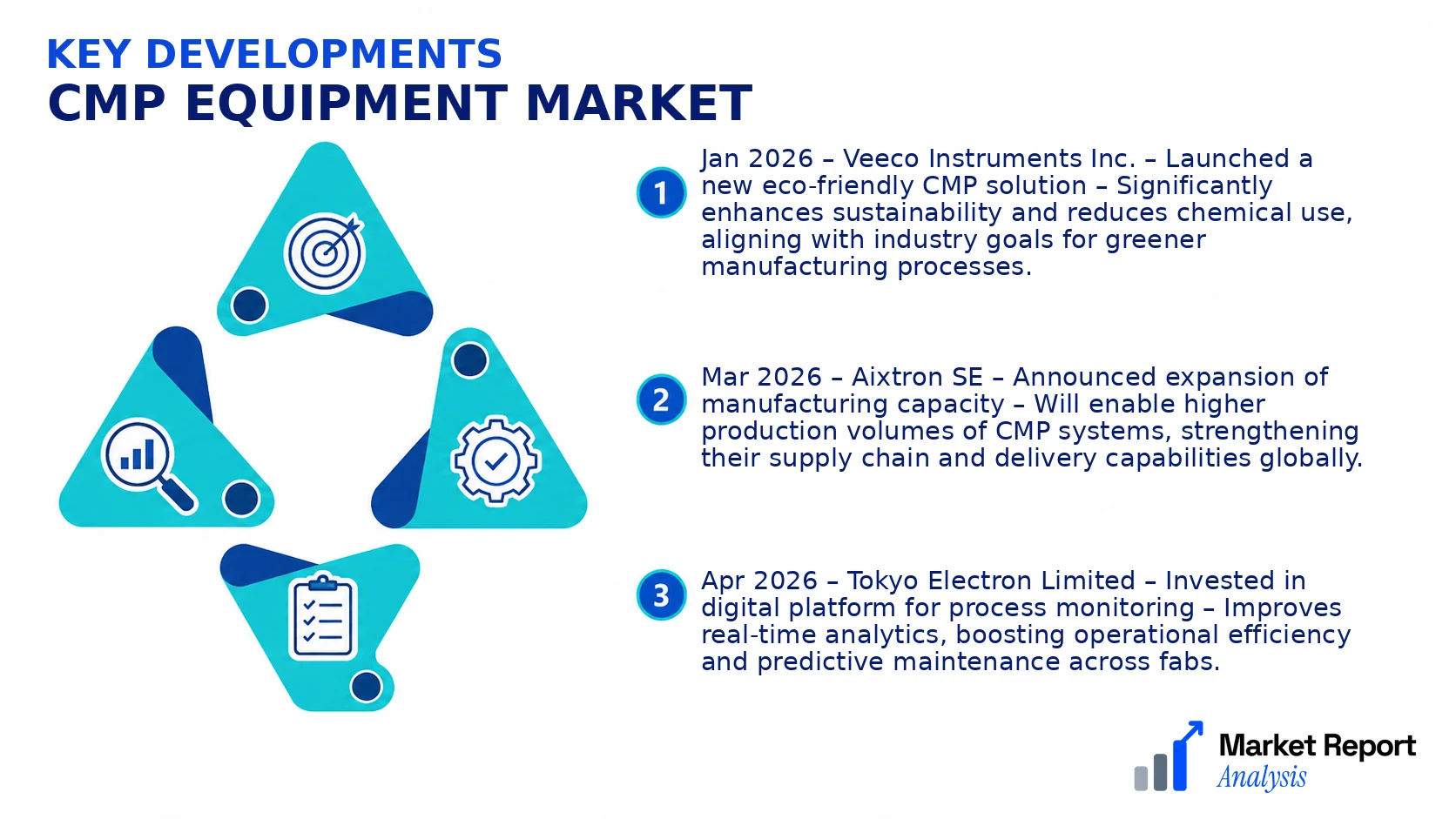
- Jan 2026 – Veeco Instruments Inc. – Launched a new eco-friendly CMP solution – Significantly enhances sustainability and reduces chemical use, aligning with industry goals for greener manufacturing processes.
- Mar 2026 – Aixtron SE – Announced expansion of manufacturing capacity – Will enable higher production volumes of CMP systems, strengthening their supply chain and delivery capabilities globally.
- Apr 2026 – Tokyo Electron Limited – Invested in digital platform for process monitoring – Improves real-time analytics, boosting operational efficiency and predictive maintenance across fabs.
- May 2026 – Lam Research Corporation – Acquired a startup specializing in AI-driven process optimization – Enhances their CMP technology with advanced predictive analytics, improving yield and process stability.
- Jun 2026 – SUSS MicroTec SE – Formed joint venture with a leading materials supplier – Aims to develop next-generation CMP consumables, increasing process reliability and performance.
Frequently Asked Questions
What is the CMP Equipment Market?
The CMP (Chemical Mechanical Planarization) Equipment Market encompasses the global industry involved in manufacturing and supplying specialized tools used for planarizing semiconductor wafers. This market supports semiconductor fabrication processes essential for producing integrated circuits with high precision and surface quality.
What is the current market size of CMP Equipment Market?
As of 2026, the CMP Equipment Market is valued at approximately USD 4.5 Billion and is expected to reach USD 8.2 Billion by 2034, demonstrating steady growth driven by advancements in semiconductor manufacturing and escalating demand for miniaturized electronic devices.
What factors are driving the CMP Equipment Market?
Key drivers include the rapid expansion of the semiconductor industry, increasing demands for high-performance electronic devices, technological innovations in CMP equipment, and the rising adoption of advanced wafer processing techniques to meet shrinking device geometries.
Which region dominates the CMP Equipment Market?
Asia-Pacific holds the largest share in the CMP Equipment Market, predominantly due to prolific semiconductor manufacturing activity in countries like China, South Korea, and Taiwan, along with robust growth in consumer electronics and automotive electronics sectors.
Which segment is expected to grow the fastest?
The equipment segment for advanced CMP tools, particularly those supporting sub-7 nanometer technologies, exhibits the fastest growth, propelled by the need for ultra-smooth surfaces to meet the stringent requirements of cutting-edge semiconductor node manufacturing.
Who are the leading companies operating in the CMP Equipment Market?
Major players include companies such as Applied Materials, Lam Research, and Tokyo Seimitsu, renowned for their innovation, extensive product portfolios, and strategic expansions to meet rising global demand in semiconductor fabrication processes.
Analyst Perspective
The long-term outlook for the CMP Equipment Market remains robust, driven by continual advancements in CMP technology, increasing complexity of semiconductor device architectures, and rising demand for high-performance chips across diverse applications. Commercial opportunities are poised to expand, particularly in developing regions where semiconductor manufacturing capacity is rapidly growing, alongside integration of AI and automation to improve process efficiency. Technological evolution will focus on enhancing process precision, reducing costs, and enabling better control of critical parameters, fostering innovation in equipment design. Investment priorities should emphasize R&D to sustain technological leadership and partnerships to accelerate adoption of next-generation CMP solutions. Competitive intensity is expected to intensify as key players innovate to differentiate product portfolios and expand globally. Regional growth potential is highest in China, Southeast Asia, and North America, where semiconductor fabs are expanding or being established. Strategic positioning involves balancing innovation with cost efficiency, fostering collaboration, and expanding manufacturing footprints to capture emerging opportunities effectively.
