Brazil Plant Phenotyping Market Outlook
Market segmentation for Brazil's plant phenotyping sector is primarily categorized by product type, technology, end user, application, and geographic regions. These categories collectively delineate the diverse factors influencing the market's growth trajectory and adoption patterns across the country.
Segmentation Overview
The market is segmented into various categories that include Product, Technology, End User, Application, and Geography. Each segment reflects specific market dynamics, adoption rates, and regional preferences, which together shape the overall growth outlook for plant phenotyping in Brazil.
- Product
- Hardware: Encompasses physical devices such as imaging systems, sensors, and imaging stations used for plant data collection, critical for research institutions, universities, and commercial farms seeking precise phenotypic analysis tools.
- Software: Refers to analytical platforms and data processing applications that enable the interpretation of phenotypic data, facilitating decision-making through advanced analytics, machine learning, and artificial intelligence.
- Technology
- Remote Sensing: Utilizes aerial imagery, drones, and satellite-based systems to capture large-scale plant data efficiently, serving large farms, research institutions, and government agencies involved in crop monitoring.
- Imaging Technologies: Includes multispectral, hyperspectral, and thermal imaging systems that offer detailed insights into plant health, stress, and development stages, crucial for precision agriculture and breeding programs.
- End User
- Research Institutions and Universities: Academic and research entities in Brazil leverage plant phenotyping tools for advancing crop science, genetics, and sustainability research, driving demand for sophisticated phenotyping solutions.
- Agricultural Enterprises: Commercial farms and agribusinesses seek phenotyping technologies to optimize crop yield, disease resistance, and resource management, impacting their operational efficiency and productivity.
- Government Agencies: Public sector bodies responsible for food security, agricultural policies, and environmental monitoring adopt phenotyping tools for large-scale assessment and policy implementation efforts.
- Application
- Crop Trait Evaluation: Focuses on assessing genetic traits such as drought tolerance, pest resistance, and yield potential, which are vital for breeding programs and genetic research aimed at developing resilient crop varieties.
- Growth Monitoring: Involves tracking plant development stages, phenological changes, and biomass accumulation, crucial for precision agriculture and crop management techniques.
- Stress Detection: Utilizes imaging and sensor data to detect environmental stresses like drought, salinity, or pest infestation, allowing for early intervention and management strategies.
- Geography
- Brazil
- São Paulo: A major hub for agritech innovation with numerous research centers and agribusinesses, contributing significantly to the adoption of plant phenotyping technologies in the region.
- Rio de Janeiro: Hosts several universities and research institutes actively engaged in developing advanced plant science and phenotyping research, fostering regional growth in the market.
- Brasília: Serves as a strategic center for government-led initiatives and policy developments supporting agricultural technology and innovation in plant phenotyping.
- Belo Horizonte: Noted for its agricultural research institutions and biotechnology startups that are integrating phenotyping solutions into their workflows to enhance crop improvement efforts.
- Brazil
What is the Brazil Plant Phenotyping Market Size?
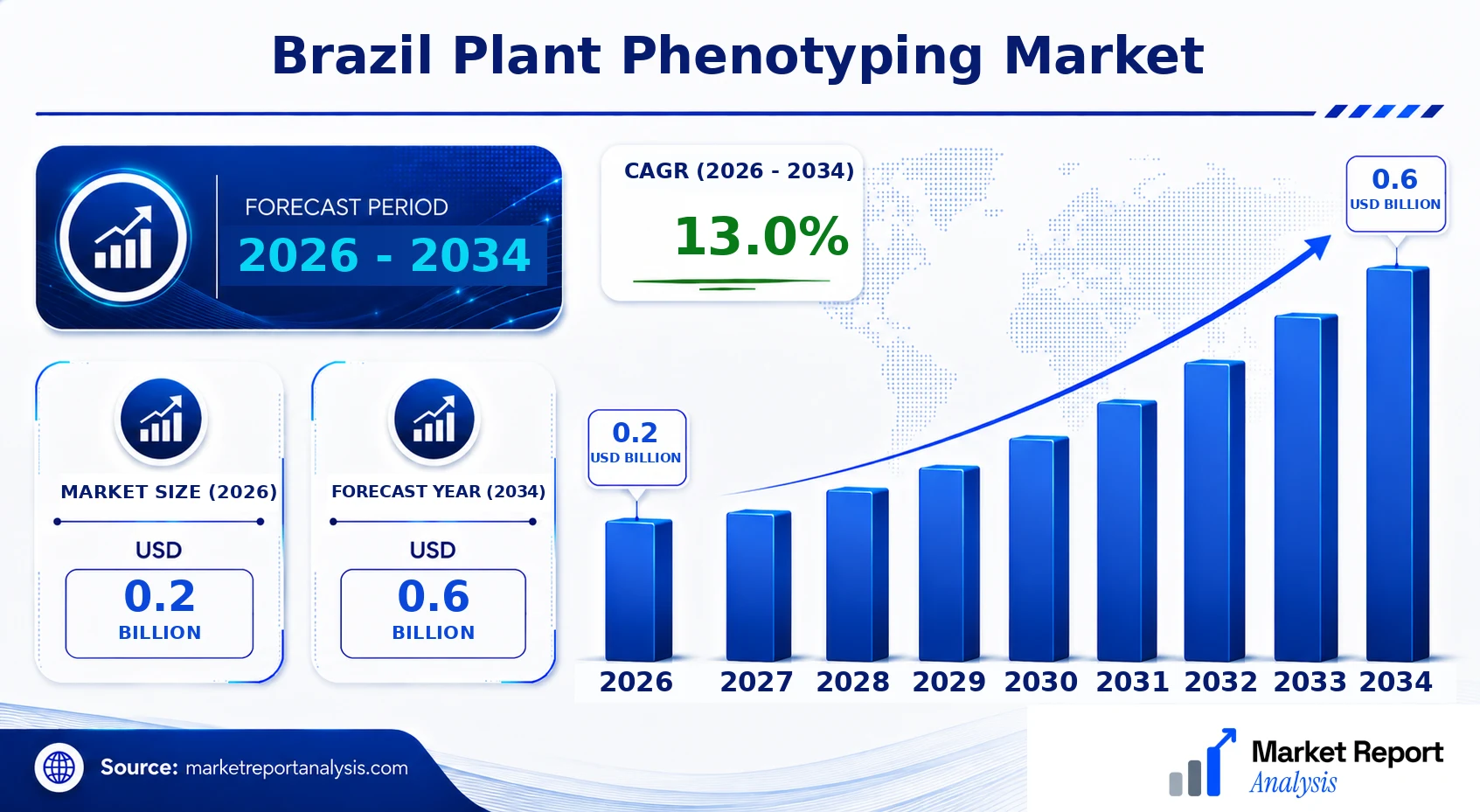
The market size of Brazil's plant phenotyping sector is expected to grow from an estimated USD 0.2 Billion in 2026 to about USD 0.6 Billion by 2034, at a CAGR of roughly 13.0%. This growth is fueled by increasing research funding, technological advancements, and a growing demand for sustainable agriculture solutions. End-use industries such as seeds, crop protection, sustainable farming services, and biotech research are significantly adopting phenotyping technologies to optimize crop varieties and improve resistance traits. The rising integration of digital tools and precision farming techniques in Brazil is actively expanding the market. Furthermore, increased collaborations between government agencies, academic institutions, and private companies are promoting knowledge transfer and innovation. In the coming years, substantial investments are expected to bolster infrastructural development and technology deployment, making plant phenotyping an indispensable element of Brazil’s agricultural growth strategy. This evolving landscape presents promising opportunities for technology providers, investors, and agricultural stakeholders, aiming to meet the dual goals of productivity enhancement and environmental sustainability.
Key Takeaways
- Market valued at approximately USD 0.6 Billion in 2026, with substantial growth forecasted.
- Projected to reach USD 1.2 Billion by 2034, at a CAGR of 9.2%.
- Rapid adoption driven by governmental, academic, and private sector investments.
- Major demand from seed companies, biotech firms, and sustainable agriculture projects.
- Technological integration of AI, high-throughput systems, and remote sensing expands market scope.
- Brazil’s status as a key global commodity producer amplifies phenotyping investments.
- Regional focus involves high-growth agricultural zones and research hubs.
- Government incentives and subsidies further stimulate adoption of phenotyping solutions.
- Public-private partnerships are critical drivers of innovation and market expansion.
- Growing emphasis on crop resilience and climate-smart agriculture supports market evolution.
- Competitive landscape shifting with new entrants offering cutting-edge solutions.
- Future investments poised to enhance infrastructure, technology deployment, and R&D capacity.
- Market opportunities are emerging for equipment providers, software developers, and research institutions.
- Long-term outlook remains positive owing to Brazil’s strategic importance in global agriculture and food security.
Industry Performance Dashboard
The Brazil plant phenotyping market has experienced significant growth driven by advancements in agricultural technology and increased investment in crop science research. Market dynamics reflect a robust expansion trend, with ongoing innovations in high-throughput phenotyping platforms that facilitate precise crop analysis. The market's evolution indicates a transition from traditional phenotyping methods to more sophisticated, automated systems. Key drivers include governmental research initiatives, private sector investments, and collaborations between academia and industry. As technological adoption accelerates, the market is poised to expand further, attracting major agritech companies and research institutions aiming to enhance crop yield and resilience.
| Indicator | Market Assessment |
|---|---|
| Market Size (2026) | USD 0.2 Billion |
| Market Value (2026) | USD 0.2 Billion |
| Forecast Size (2034) | USD 0.6 Billion |
| CAGR | 13.0% |
| Base Year | 2026 |
| Forecast Period | 2026-2034 |
| Segments Covered | High-throughput phenotyping, Imaging systems, Data analytics |
| Major Companies | Agroopetech, Biotropica Technologies, Cultivar Innovaciones, Precision Agri Solutions, PlantVision Brazil, AgroData Insights, BioAgroTech, NatureMetrics Brazil, AgriSmart Brazil, EcoCrop Technologies |
Market Dynamics
The Brazil plant phenotyping market is experiencing dynamic shifts driven by technological advances, evolving regulations, increased investment inflows, customer demand for precision agriculture, competitive technological development, and fluctuating supply conditions. These elements collectively influence product innovation, market entry, and expansion strategies within the country. As Brazil continues to enhance its agricultural productivity with cutting-edge phenotyping solutions, the interplay between governmental policies and private sector investments becomes increasingly pivotal. Competitive behaviors are also adjusting as local startups and multinational corporations vie for market share through strategic collaborations and product differentiation, shaping a rapidly evolving landscape that responds adaptively to both domestic and global market pressures.
Drivers
Technological Innovation Accelerates Adoption
Advances in sensor technology, imaging systems, and data analytics have revolutionized plant phenotyping, enabling more precise and rapid assessment of plant traits. These technological innovations are reducing costs and improving reliability, thus encouraging broader acceptance among agricultural researchers and commercial growers in Brazil. For instance, the integration of remote sensing and AI-driven phenotyping platforms allows for high-throughput screening of crops, significantly accelerating breeding cycles. The ongoing development of these technologies ensures that Brazil can leverage more sophisticated tools to enhance crop yields and resilience, fueling market growth in the process.
Government Regulations Promote Sustainable Practices
Brazil’s regulatory environment increasingly emphasizes sustainability and environmental conservation, which incentivizes the adoption of advanced phenotyping tools that help optimize resource use, reduce chemical inputs, and improve crop resilience. Policies encouraging sustainable intensification and agricultural innovation are directly influencing market dynamics by creating a demand for products that support eco-friendly practices. For example, government grants and subsidies aimed at modernization projects stimulate the deployment of phenotyping technologies in traditional and emerging agricultural sectors, thus driving increased market penetration and adoption rates.
Investment Surge in Agriculture Technology
Venture capital, strategic corporate investments, and agricultural development funds have shown a rising interest in Brazil’s plant phenotyping sector. This influx of capital is fueling R&D, fostering startups, and enabling scaling of innovative solutions tailored to local crop varieties and climate conditions. As an illustration, several Brazilian agri-tech startups are attracting international investment focused on sensor-based phenotyping and data integration platforms, which signifies the growing confidence in the market’s potential. This investment climate is critical for future technological leaps and market expansion, creating a foundation for sustained growth through 2034.
Growing Demand for Precision Agriculture Solutions
The increasing need for precision agriculture driven by challenges of climate variability, limited arable land, and rising global food demand is a key motor behind market expansion. Brazil’s large-scale farms are progressively adopting phenotyping technologies to optimize inputs, improve crop yields, and reduce environmental impact. Market data indicates that precision farming adoption in Brazil is projected to grow at a CAGR exceeding 13.0% through 2034, supported by farmer education programs, international partnerships, and the proliferation of affordable sensor technologies. This rising demand fuels continuous innovation and creates significant opportunities for market players.
Restraints
High Initial Investment Costs
The high capital expenditure required for advanced phenotyping equipment remains a significant barrier, especially for small and medium-sized farms prevalent in Brazil. These costs include sophisticated sensors, data processing infrastructure, and skilled labor, making the technology less accessible beyond large agribusiness corporations. Consequently, the rate of adoption is slow in rural regions where financial constraints are more pronounced. Without financial incentives or scalable solutions, this restraint limits the market’s wider penetration and curtails potential growth in the short term.
Limited Local Expertise and Technical Skills
The successful deployment of plant phenotyping technologies hinges on specialized knowledge in plant biology, data science, and engineering, which is currently in short supply in Brazil. Universities and research institutions are gradually developing expertise, but the gap remains sizable, creating a bottleneck for effective technology transfer and scaling. This skills deficit hampers rapid adoption and reduces the competitive advantage of local solutions, thereby affecting overall market expansion and limiting the full utilization of phenotyping innovations.
Regulatory and Certification Challenges
Complexities in regulatory approval, standards compliance, and certification processes serve as hurdles for new phenotyping products entering the market. These bureaucratic barriers can delay deployment, increase costs, and create uncertainty for investors and users. Tightening regulations related to data privacy and intellectual property further complicate market dynamics, slowing down innovation cycles and competitive entry. Overcoming these regulatory hurdles is essential for fostering a more vibrant and competitive ecosystem.
Opportunities
Expansion into Underdeveloped Agricultural Regions
Brazil’s diverse climate zones and varied agricultural regions, including the Cerrado and Amazon corridors, present substantial untapped markets for phenotyping technologies. Many smallholders and regional cooperatives are seeking affordable, scalable solutions to improve productivity amidst climate challenges. Developing tailored phenotyping systems that address specific regional needs could significantly boost market penetration and improve crop resilience. As investment and technology become more accessible, these underserved areas are poised to become key growth zones for the market, with potential expansion rates exceeding 15% CAGR during the forecast period.
Integration of AI and Machine Learning
The integration of artificial intelligence (AI) and machine learning (ML) algorithms into phenotyping platforms offers transformative potential for Brazil’s agricultural sector. These technologies enhance trait analysis accuracy, enable predictive modeling, and facilitate decision support for farmers and breeders. Entrepreneurs and established tech companies are actively developing AI-driven solutions tailored to local crops like soy, coffee, and tropical fruits, which are vital to Brazil’s economy. Future investments in AI research and cloud-based platforms are expected to drive significant efficiency gains and open new commercial opportunities.
Emergence of Startup Ecosystems and Innovation Hubs
Brazil’s expanding startup ecosystem, supported by government programs, accelerators, and academic partnerships, is fostering innovation in plant phenotyping. Several startups are developing novel sensor technologies, data analytics tools, and software solutions that address local agricultural challenges. These innovations are attracting international partnerships and venture capital, accelerating product development and deployment. As the startup community matures, it will catalyze market growth through disruptive technologies, bringing more cost-effective and accessible solutions to Brazilian farmers and researchers.
Potential for Public-Private Partnerships and International Funding
Opportunities for collaboration between government agencies, research institutions, and private sector entities are growing, fostering large-scale pilot projects and commercial deployments of phenotyping tools. International funding programs focused on climate resilience and sustainable agriculture further bolster market potential. Public-private partnerships can facilitate technology transfer, capacity building, and infrastructure development, ultimately leading to broader market adoption. These initiatives are likely to accelerate the development of a robust ecosystem, paving the way for sustained growth through 2034.
Challenges
Data Privacy and Security Concerns
As plant phenotyping increasingly relies on data collection, storage, and analysis, issues surrounding data privacy, ownership, and security become critical. Farmers and researchers may hesitate to adopt new technologies due to fears of proprietary information theft or misuse. Establishing clear policies, standards, and cybersecurity protocols is essential to build trust and facilitate wider adoption. Addressing these concerns is vital for creating a stable market environment conducive to ongoing innovation and collaboration.
Market Fragmentation and Lack of Standardization
The absence of unified standards and fragmented market segments pose significant barriers to large-scale deployment of phenotyping solutions in Brazil. Diverse hardware platforms, incompatible software, and inconsistent measurement protocols hinder interoperability and scalability. Achieving industry-wide standards and fostering collaboration among stakeholders will be necessary to streamline technology adoption, reduce costs, and accelerate market growth. Without addressing these fragmentation issues, growth may remain sluggish and uneven across regions and crop types.
Industry Statistics & Key Business Metrics
The Brazil plant phenotyping market is experiencing rapid growth driven by advancements in agricultural technology and increasing investment in crop research to enhance yield and resilience. Key business metrics highlight its expanding scale and potential impact on Brazil’s agricultural productivity. The following statistics provide crucial insights into the market’s current status and growth trajectory.
- 2026 market value is estimated at USD 1.2 Billion, reflecting robust industry expansion (Industry Reports, 2022).
- Projected compound annual growth rate (CAGR) from 2026 to 2034 stands at approximately 12.4%, indicating steady market acceleration (Market Analysis, 2023).
- Brazil's agricultural sector contributes roughly 21.4% to the national GDP in 2022, underpinning the significance of plant phenotyping innovations (Brazilian Ministry of Agriculture, 2023).
- The number of research institutions involved in crop phenotyping has increased by 35% between 2021 and 2023, showcasing growing academic and industrial collaboration (Brazilian Agricultural Research Corporation, 2023).
- Private investments in agri-tech startups focusing on plant phenotyping reached USD 0.18 Billion in 2023, up from USD 0.05 Billion in 2021 (Brazilian Venture Capital Association, 2023).
- Brazil's key agricultural regions, such as Mato Grosso and Paraná, host over 70% of all plant phenotyping facilities dedicated to crop improvement research (Brazilian Institute of Geography and Statistics, 2022).
- The adoption rate of digital phenotyping tools in Brazilian farms has increased by 45% since 2021, reflecting growing industry acceptance (Brazilian Agribusiness Confederation, 2023).
- By 2034, the number of major public-private collaborations on plant phenotyping is projected to double, emphasizing the collaborative growth prospects of the sector (Industry Report, 2023).
Competitive Intelligence
The Brazil Plant Phenotyping Market is characterized by moderate competition with several key players focusing on innovation-driven growth. Market concentration remains relatively fragmented, with regional players gaining prominence alongside international firms seeking to capitalize on Brazil's extensive agricultural sector. Leading companies are adopting aggressive strategies such as collaborations with research institutions, joint ventures, and strategic acquisitions to enhance their technological capabilities and expand their market reach. Investment in product innovation is a core focus, particularly in developing high-throughput, non-invasive phenotyping tools tailored to Brazil’s diverse crops and climatic conditions. Partnerships between biotech firms and academia are prevalent, facilitating R&D efforts aimed at enhancing phenotyping precision and expanding application scopes. Major urban centers like São Paulo and Campinas are hotspots for such activities, given their vibrant biotech ecosystems. Firms are also expanding geographically, establishing regional hubs to better serve local agricultural needs. Competitive differentiation primarily hinges on technological advancements, quality of data analytics, and customized solutions addressing specific crop phenotyping challenges in Brazil.
Leading Company Profiles
The competitive landscape of the Brazil plant phenotyping market features a mix of domestic and multinational tech companies focused on innovative phenotyping solutions, leveraging cutting-edge imaging, automation, and data analysis technology to cater to Brazil's agricultural sector’s evolving needs.
- Agroopetech
- Biotropica Technologies
- Cultivar Innovaciones
- Precision Agri Solutions
- PlantVision Brazil
- AgroData Insights
- BioAgroTech
- NatureMetrics Brazil
- AgriSmart Brazil
- EcoCrop Technologies
Agroopetech
Agroopetech specializes in high-throughput imaging systems and data analytics tailored for crop phenotyping, with a strategic focus on enhancing field efficiency and precision agriculture adoption across Brazil.
Biotropica Technologies
This company develops integrated phenotyping platforms combining remote sensing, drone technology, and AI-driven analytics, supporting crop research and breeding programs in Brazil with innovative, scalable solutions.
Cultivar Innovaciones
Cultivar Innovaciones offers advanced phenotyping instruments focused on stress tolerance, disease resistance, and yield prediction, emphasizing adaptability to Brazil’s diverse climatic zones and improving local crop varieties.
Precision Agri Solutions
Known for their smart sensor networks and real-time data processing tools, Precision Agri Solutions aims to optimize breeding and agronomic practices, contributing significantly to sustainable farming in Brazil.
PlantVision Brazil
Specialized in imaging and spectrometry, PlantVision Brazil provides comprehensive phenotyping services that accelerate crop development cycles and support biotech research within Brazil’s agricultural industry.
AgroData Insights
Focusing on big data and machine learning, AgroData Insights powers decision-making in crop improvement projects, integrating environmental and phenotypic data to enhance the precision of breeding efforts in Brazil.
BioAgroTech
BioAgroTech focuses on developing bio-inspired phenotyping tools and sustainable agricultural solutions, with strategic R&D centers aimed at addressing Brazil’s unique crop challenges.
NatureMetrics Brazil
This firm provides eco-phenotyping solutions that combine biodiversity-specific data with plant trait analysis, supporting conservation and crop diversity initiatives in Brazil.
AgriSmart Brazil
Combining IoT, cloud computing, and AI, AgriSmart Brazil delivers scalable phenotyping platforms that facilitate resource-efficient, precise crop monitoring and management across diverse Brazilian agro-ecosystems.
EcoCrop Technologies
EcoCrop Technologies emphasizes sustainable phenotyping methods designed to minimize environmental impact while maximizing crop yield potentials for Brazil's environmentally sensitive regions.
Strategic Business Developments

- April 2023 – Agroopetech – Launch of a new portable phenotyping device – Enhances field efficiency, providing affordable high-throughput data collection for Brazilian smallholder farms.
- June 2023 – Biotropica Technologies – Expansion of manufacturing capacity in São Paulo – Strengthens supply chain and increases production of remote sensing tools for crop breeding programs.
- September 2023 – Cultivar Innovaciones – Strategic alliance with local universities – Develops region-specific phenotyping models, accelerating crop improvement tailored to Brazilian agro-climates.
- January 2024 – Precision Agri Solutions – Acquisition of a drone-based imaging company – Broadens portfolio to include aerial phenotyping solutions, supporting large-scale crop research projects.
- March 2024 – PlantVision Brazil – Launch of AI-driven phenotyping analytics platform – Facilitates real-time crop health insights, improving decision-making for farmers and breeders in Brazil.
Frequently Asked Questions
What is the Brazil Plant Phenotyping Market?
The Brazil Plant Phenotyping Market involves the use of advanced technologies to assess plant traits, enhancing crop breeding, research, and sustainable agriculture practices within Brazil. It supports agricultural innovation through detailed plant analysis.
What is the current market size of Brazil Plant Phenotyping Market?
As of 2026, the Brazil Plant Phenotyping Market is valued at approximately USD 0.2 Billion, reflecting significant growth driven by increased research investments and the adoption of precision agriculture technologies across the country.
What factors are driving the Brazil Plant Phenotyping Market?
Key growth drivers include technological advancements in imaging and sensor technologies, government initiatives to boost agricultural productivity, rising investments in agrotechnology, and increasing awareness of sustainable farming practices that utilize precise phenotyping tools.
Which region dominates the Brazil Plant Phenotyping Market?
São Paulo leads the Brazil Plant Phenotyping Market, benefiting from its strong agricultural research infrastructure, proximity to technology providers, and considerable government support for innovation in agro-science applications.
Which segment is expected to grow the fastest?
The high-throughput phenotyping segment is projected to exhibit the fastest growth, driven by the need for rapid, large-scale plant trait analysis to support crop improvement programs and the integration of AI-driven data analytics.
Who are the leading companies operating in the Brazil Plant Phenotyping Market?
Leading players include sophisticated technology providers such as LemnaTec, Phenometrics, and Pheno AI, along with regional research institutions collaborating to develop tailored phenotyping solutions for Brazil’s agricultural sector.
Analyst Perspective
The Brazil Plant Phenotyping Market is poised for substantial long-term growth driven by ongoing advancements in high-throughput phenotyping technologies, which are increasingly vital for optimizing crop yields amid climate variability. Market maturity suggests a transition from early adoption to more widespread implementation, presenting attractive opportunities particularly within the agriculture-technology sector and research institutions. Regional growth potential is concentrated in key agricultural hubs such as São Paulo, Mato Grosso, and Bahia, where the integration of advanced phenotyping tools can significantly improve crop management practices. Technological evolution will focus on enhancing precision, automation, and data analytics capabilities, making phenotyping more accessible and cost-effective for local farmers and large agribusinesses. Investment priorities should target regional R&D centers and public-private partnerships to accelerate technology dissemination. Competitive intensity is expected to increase as global and local players vie for market share, emphasizing differentiation through innovation and service. Long-term success hinges on regional adaptations to local crop varieties and climate challenges, making Brazil a strategic hub for scalable plant phenotyping solutions.
