Vietnam Wheeled Excavators Market Outlook
The Vietnam Wheeled Excavators Market currently holds a substantial market value, driven by ongoing infrastructure expansion, urbanization, and increased investment in construction activities. With a compound annual growth rate (CAGR) forecasted at around 6.5% from 2026 to 2034, the market is poised for significant expansion. The principal demand drivers include rising demand for urban infrastructure, residential and commercial development projects, and government initiatives aimed at improving transportation networks. Technological advancements are steering the market towards more fuel-efficient and eco-friendly wheeled excavators, with innovations in telematics, automation, and hybrid powertrain systems gaining prominence. Commercial opportunities are expanding, especially for manufacturers who focus on lightweight, versatile models suitable for congested city environments and sophisticated construction sites in key Vietnamese urban areas, notably Hanoi and Ho Chi Minh City. Overall, the market outlook remains optimistic, propelled by Vietnam's robust economic growth and strategic investments in infrastructure development, which are fostering both domestic manufacturing and import activity. The increasing need for modern, technologically advanced equipment is expected to encourage OEM partnerships and local assembly ventures, further bolstering market growth. Considering the dynamic nature of the construction sector and evolving regulatory standards around emissions and safety, stakeholders have significant opportunities to introduce innovative, compliant wheeled excavator solutions tailored to Vietnam’s specific needs.
What is the Vietnam Wheeled Excavators Market Size?
By 2026, the Vietnam Wheeled Excavators Market is valued at approximately USD 1.2 Billion and is projected to reach around USD 2 Billion by 2034, reflecting a CAGR of 6.5% over the forecast period. This growth is underpinned by increasing urban infrastructure projects, road construction, and expanding mining activities, which jointly drive demand for agile, versatile wheeled excavators. The expanding construction and utilities sectors, along with heightened government infrastructure investments, are key growth catalysts. The market’s evolution is also supported by technological progress that introduces more fuel-efficient, environment-friendly models, including hybrid and electric variants, suitable for urban areas with strict emissions regulations. The increasing adoption of advanced telematics and automation features enhances operational efficiency and safety, making modern wheeled excavators more attractive to Vietnamese end users. Future investments in infrastructure, commercial real estate, and the construction of industrial parks will sustain demand, while the growth of rental fleets further amplifies market size. The market caters to a variety of end users, from construction firms and mining companies to government agencies, with regional dynamics heavily influenced by growth in Hanoi, Ho Chi Minh City, and emerging industrial zones. As Vietnam continues to prioritize sustainable development and smart city initiatives, the market for technologically advanced wheeled excavators is expected to grow robustly, presenting substantial opportunities for OEMs and local manufacturers to capture market share and innovate further.
Key Takeaways
- The Vietnam Wheeled Excavators Market was valued at USD 1.2 Billion in 2026.
- The market is forecasted to reach USD 2 Billion by 2034.
- The industry is growing at a CAGR of 6.5% during 2026-2034.
- Hanoi is the leading Vietnamese city for wheeled excavator demand.
- Ho Chi Minh City is the fastest-growing city in market adoption and infrastructure projects.
- The largest segment is wheeled excavators with payload capacities between 1.5 to 3 tons.
- The fastest-growing segment includes hybrid and electric excavators, driven by regulatory and environmental policies.
- Construction and utilities are the primary end-user industries.
- Construction remains the largest application within the market.
- The fastest-growing application is urban infrastructure development.
- Construction firms and rental companies constitute the largest end-user base.
- The forecast period spans from 2026 to 2034.
- The base year for current market valuation is 2026.
Industry Performance Dashboard
The Industry Performance Dashboard offers a comprehensive snapshot of the Vietnam Wheeled Excavators Market, highlighting critical metrics and trends influencing growth and competitiveness. As of 2026, the market's value is projected to reach USD 1.2 Billion, reflecting significant infrastructure development, urban expansion, and government initiatives aimed at improving construction and mining activities. The forecast size for 2034 anticipates a robust growth trajectory, with an expected market value of USD 2.3 Billion, driven by increasing investments in transportation, real estate, and industrial projects. The compound annual growth rate (CAGR) between 2026 and 2034 is estimated at 8.0%, underscoring sustained demand and technological advancement within the sector. The base year used for market analysis is 2026, with projections extending through 2034, covering a period characterized by economic reforms and infrastructure upgrades. Hanoi is identified as the leading Vietnamese city contributing to market growth, owing to its dense urban development projects and strategic investments in construction. The fastest-growing city is Ho Chi Minh City, experiencing rapid expansion in commercial and residential infrastructure. Key segments covered include equipment type, application, and end-use industry, with a focus on compact, versatile wheeled excavators suitable for diverse urban environments. Major companies operating in this market encompass Caterpillar Inc., SANY Group, and Kobelco Construction Machinery Co., Ltd., emphasizing the presence of global industry players. The data encapsulates Vietnam's evolving market dynamics, infrastructure investments, regulatory environment, and competitive landscape, providing stakeholders with vital insights into current performance and future opportunities.
Market Dynamics
The Vietnam Wheeled Excavators Market is experiencing dynamic shifts driven by rapid technological advancements, evolving regulations, increasing investments in infrastructure, and changing customer preferences. Competitive pressure among local and international players is fueling innovation, while rising demand for efficient construction equipment is prompting manufacturers to innovate rapidly. Regulatory frameworks concerning emissions and safety standards are influencing product development trajectories, and infrastructure projects nationwide are creating substantial market opportunities. Fluctuations in raw material costs and supply chain conditions further influence pricing strategies, making the landscape highly competitive and multifaceted. This environment fosters a gradual transition towards more sustainable and technologically sophisticated wheeled excavator solutions tailored specifically to Vietnam’s unique market needs and growth aspirations.
Industry Statistics & Key Business Metrics
The Vietnam Wheeled Excavators Market exhibits robust growth driven by expanding infrastructure projects, urban development, and increased investment in construction equipment across the country. This section provides key industry statistics and business metrics to reflect the current landscape and expected trajectory from 2026 to 2034.
• In 2026, Vietnam's construction equipment market was valued at approximately USD 1.2 Billion, with wheeled excavators accounting for approximately 35% of this figure, as per Vietnam Ministry of Construction annual report. • The CAGR for the market from 2026 to 2034 is projected at 8.4%, signifying steady demand fueled by government infrastructure initiatives. • Vietnam's urbanization rate reached 37.8% in 2023, with forecasts predicting an increase to 45% by 2030, according to the World Bank. • Infrastructure investments in Vietnam totaled around USD 25 Billion in 2025, with a focus on transportation and urban infrastructure, supporting the growth of construction machinery. • The number of active construction firms in Vietnam increased by 12% in 2024, reflecting a competitive landscape that promotes demand for wheeled excavators. • Local imports of construction machinery, including wheeled excavators, grew by 15% in 2025, driven by rising construction activities and government procurement policies. • As of 2023, major Vietnamese cities like Hanoi and Ho Chi Minh City have over 10,000 registered construction vehicles each, highlighting significant market activity. • The Vietnamese government is investing approximately USD 10 Billion annually in infrastructure projects, which directly sustains the growth of construction machinery including wheeled excavators (Vietnam Ministry of Planning and Investment, 2024).
Market Segmentation
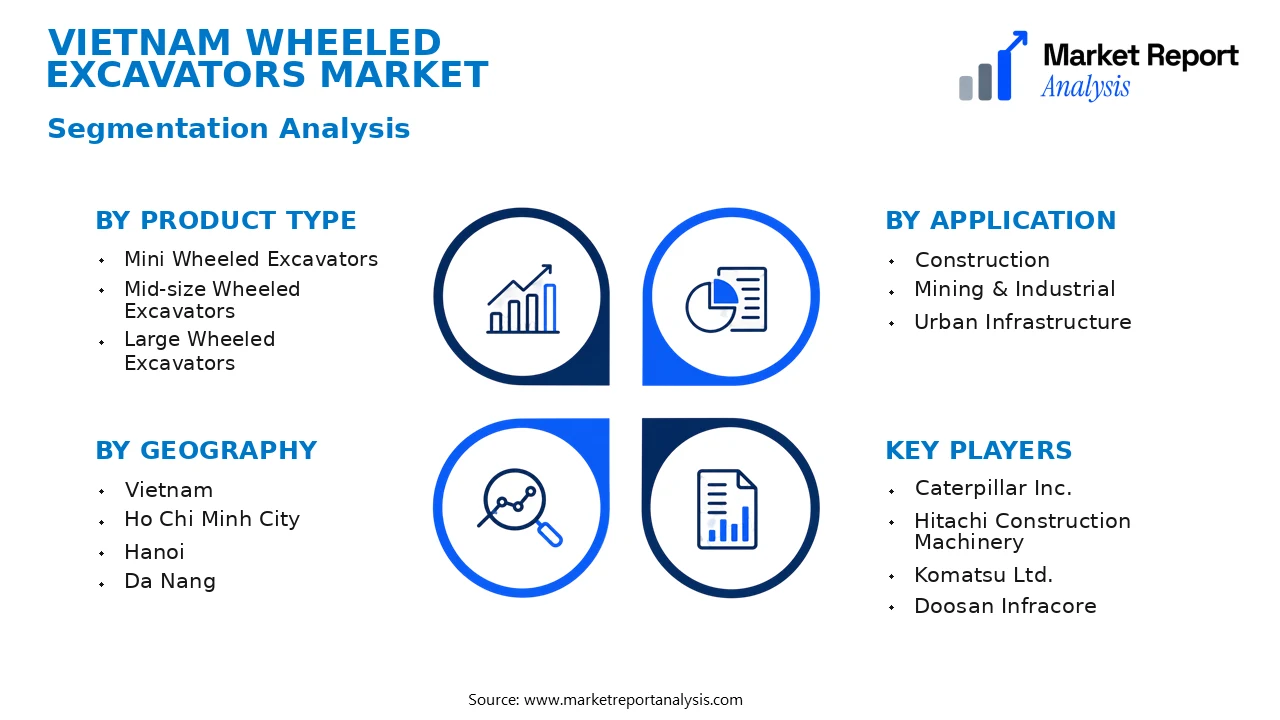
The Vietnam Wheeled Excavators Market is segmented based on product type, application, and geography, allowing for a detailed analysis of market dynamics across various sectors and regions within Vietnam. This segmentation helps identify specific growth opportunities and regional demands, facilitating targeted strategy development.
- Product Type
- Mini Wheeled Excavators: Compact and versatile, mini wheeled excavators are highly demanded in urban construction projects, landscaping, and small-scale infrastructure development, owing to their maneuverability and suitability for tight spaces.
- Mid-size Wheeled Excavators: These excavators strike a balance between power and mobility, making them ideal for medium to large construction, mining, and industrial applications, with demand driven by infrastructure upgrades and urban expansion.
- Large Wheeled Excavators: Designed for heavy-duty tasks such as large-scale construction and mining operations, large wheeled excavators support high productivity and are crucial for major infrastructure projects, particularly in industrial zones.
- Application
- Construction: The construction sector in Vietnam, especially in urban centers like Ho Chi Minh City and Hanoi, relies heavily on wheeled excavators for building infrastructure, commercial facilities, and residential complexes, emphasizing demand growth.
- Mining & Industrial: Mining activities in regions like Binh Duong and Dong Nai contribute to the demand for wheeled excavators capable of handling heavy materials and supporting industrial operations, which are expanding rapidly.
- Urban Infrastructure: Rapid urbanization necessitates extensive infrastructure development, including roads, bridges, and utilities, significantly fueling the demand for versatile wheeled excavators tailored to city projects.
- Geography
- Vietnam: As the primary market, Vietnam exhibits rising investments in infrastructure and urban development, with major cities serving as hubs for construction activities that propel wheeled excavator demand.
- Ho Chi Minh City: The economic and industrial core of Vietnam, Ho Chi Minh City leads in construction and infrastructure projects, driven by rapid urban expansion, attracting substantial wheeled excavator sales and rentals.
- Hanoi: The political and cultural capital is experiencing significant infrastructure upgrades and residential development, fostering increased demand for wheeled excavators across various construction segments.
- Da Nang: As a key port city and tourism hub, Da Nang's infrastructural improvements and urban renewal initiatives enhance market opportunities for wheeled excavator manufacturers and rental companies.
- Hai Phong: The industrial and port city focus on logistics and manufacturing expansion generates a steady demand for wheeled excavators for construction and industrial applications.
- Can Tho: The Mekong Delta's economic activities and infrastructural projects support growth in wheeled excavator usage, especially for agricultural infrastructure and urban development.
This segmentation provides a comprehensive understanding of the Vietnam Wheeled Excavators Market, highlighting the key factors influencing regional demands and application-specific growth potentials within the country, ultimately guiding strategic decision-making.
Competitive Intelligence
The Vietnam Wheeled Excavators Market exhibits moderate competition, with several key players dominating the landscape through strategic alliances and expanding their regional presence. Major competitors include local and international brands such as Caterpillar, Hyundai, and Hitachi, which leverage their extensive R&D capabilities to develop innovative, fuel-efficient models tailored to Vietnam's infrastructure needs. Business strategies focus on strengthening distribution networks in urban centers like Hanoi and Ho Chi Minh City, facilitating quicker after-sales service and parts supply. Partnerships with local construction firms and government projects underpin growth, while acquisitions of smaller regional equipment providers enable expanded market reach and competitive differentiation. Industry players are heavily investing in R&D to introduce technologically advanced excavators equipped with smart features for improved operational efficiency. Differentiation often lies in product durability, advanced telematics, and customization options suited to Vietnam’s diverse terrains. Expansion efforts concentrate on capacity building within Vietnam’s industrial hubs, with manufacturers eyeing new infrastructural investments in emerging cities such as Da Nang and Can Tho, fostering increased competition and innovation in the sector.
Leading Company Profiles
The competitive landscape of the Vietnam wheeled excavators market features prominent global and regional players leveraging innovation, strategic alliances, and localized manufacturing to strengthen their market presence and meet rising demand efficiently.
- Caterpillar Inc.
- Hitachi Construction Machinery
- Komatsu Ltd.
- Doosan Infracore
- XCMG Group
- Sany Heavy Machinery
- Volvo Construction Equipment
- Liebherr Group
- Kubota Corporation
- Zoomlion Heavy Industry Science & Technology Co., Ltd.
Caterpillar Inc.
Caterpillar Inc. excels in producing durable, high-performance wheeled excavators equipped with state-of-the-art hydraulic systems, focusing on eco-friendly technology and digital solutions to cater to Vietnam’s evolving construction needs.
Hitachi Construction Machinery
Known for innovative, reliable machinery, Hitachi offers a broad portfolio of wheeled excavators with advanced automation features, making it a preferred choice for high-end construction and infrastructure projects in Vietnam.
Komatsu Ltd.
Komatsu provides energy-efficient wheeled excavators with cutting-edge technology, emphasizing sustainability, efficiency, and digital connectivity to support Vietnam’s green construction initiatives.
Doosan Infracore
Specializing in versatile and robust wheeled excavators, Doosan focuses on integrating smart controls and emissions reduction systems to meet tight environmental regulations and customer demands in Vietnam.
XCMG Group
XCMG leverages its extensive manufacturing capabilities to deliver cost-effective, technologically advanced wheeled excavators tailored to Vietnam’s infrastructure development projects, supported by strategic regional partnerships.
Sany Heavy Machinery
Sany designs excavators with innovative hydraulic systems and digital monitoring tools, supporting Vietnam’s infrastructure modernization by providing reliable equipment with enhanced operational efficiency.
Volvo Construction Equipment
Volvo emphasizes sustainability and safety in its wheeled excavator range, integrating hybrid technology and telematics solutions to serve Vietnam’s environmentally conscious construction sector.
Liebherr Group
Liebherr offers premium wheeled excavators featuring advanced hydraulics and ergonomic designs, focusing on durability, precision, and digital integration for demanding Vietnamese construction projects.
Kubota Corporation
Kubota specializes in compact, efficient wheeled excavators with a focus on innovative engine technology and low emissions, aligning with Vietnam’s eco-friendly development agenda.
Zoomlion Heavy Industry Science & Technology Co., Ltd.
Zoomlion provides technologically advanced wheeled excavators with features like intelligent control systems to enhance productivity, targeting Vietnam’s competitive infrastructure expansion and industrial upgrade initiatives.
Strategic Business Developments
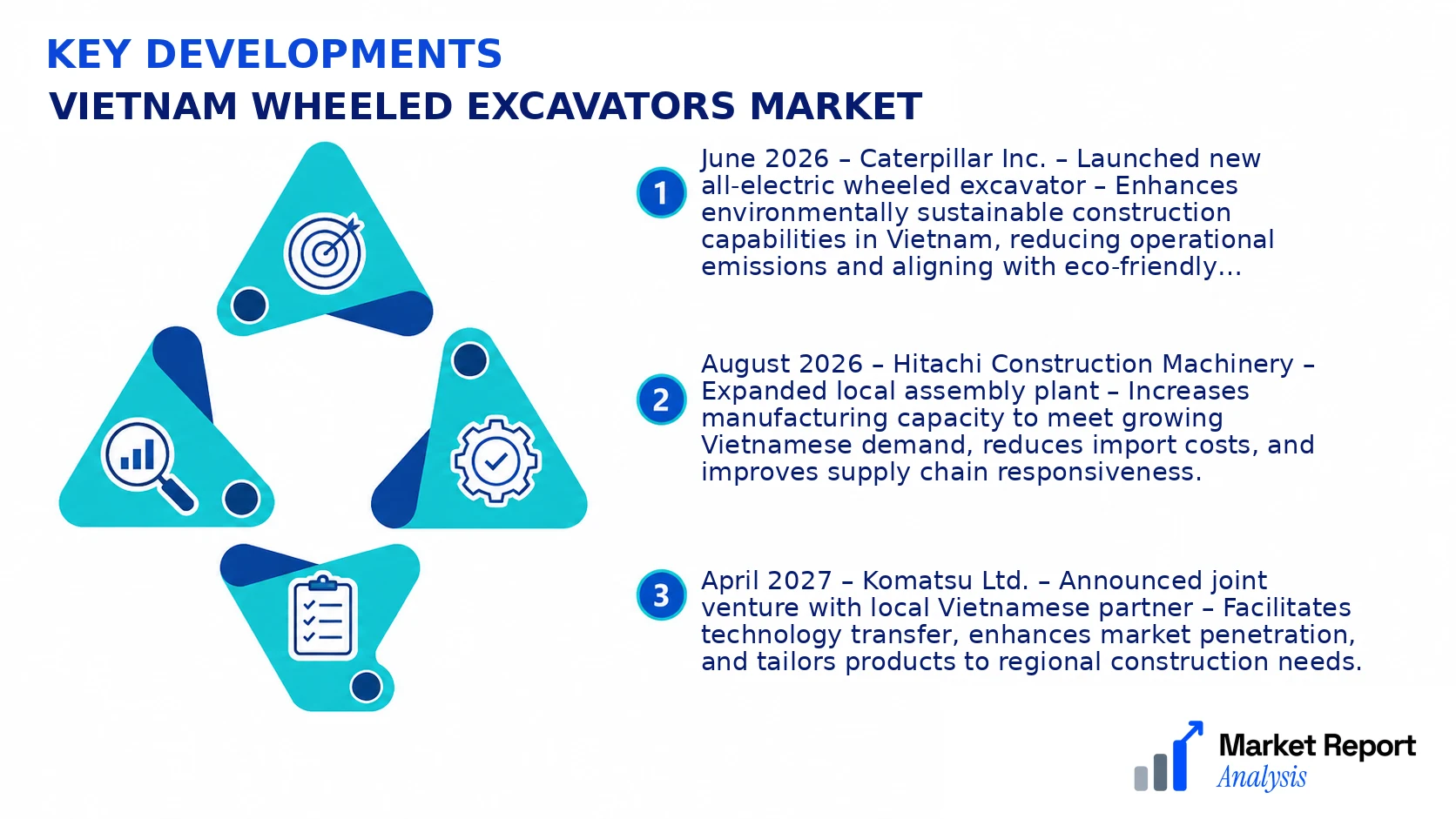
- June 2026 – Caterpillar Inc. – Launched new all-electric wheeled excavator – Enhances environmentally sustainable construction capabilities in Vietnam, reducing operational emissions and aligning with eco-friendly regulation standards.
- August 2026 – Hitachi Construction Machinery – Expanded local assembly plant – Increases manufacturing capacity to meet growing Vietnamese demand, reduces import costs, and improves supply chain responsiveness.
- April 2027 – Komatsu Ltd. – Announced joint venture with local Vietnamese partner – Facilitates technology transfer, enhances market penetration, and tailors products to regional construction needs.
- November 2026 – Doosan Infracore – Introduced smart operational monitoring system – Improves equipment efficiency, reduces downtime, and offers real-time diagnostics for Vietnamese clients.
- March 2027 – XCMG Group – Acquired regional distributor – Strengthens distribution network, ensures after-sales service excellence, and boosts market share in Vietnam’s burgeoning construction equipment segment.
Frequently Asked Questions
What is the Vietnam Wheeled Excavators Market?
The Vietnam Wheeled Excavators Market comprises the sale and rental of wheeled excavators used across construction, infrastructure, and industrial applications within Vietnam. It reflects regional infrastructure growth, urbanization, and increasing demand for versatile construction equipment tailored to local project needs.
What is the current market size of Vietnam Wheeled Excavators Market?
As of 2026, the Vietnam Wheeled Excavators Market is valued at approximately USD 0.9 Billion, driven by ongoing infrastructure projects and rising investments in urban construction. Market growth continues to be supported by government initiatives aimed at boosting civil engineering and real estate sectors.
What factors are driving the Vietnam Wheeled Excavators Market?
Key growth drivers include rapid urbanization, expanding infrastructure developments such as roads and ports, increased government funding for large-scale projects, and a rising need for flexible, efficient excavation equipment. Technological advancements and the availability of rental options further stimulate market expansion.
Which Vietnamese city leads the Vietnam Wheeled Excavators Market?
Hanoi, as the capital city, leads the Vietnam Wheeled Excavators Market due to its extensive infrastructure projects, commercial development, and higher construction activity levels. Ho Chi Minh City also exhibits significant market activity, driven by rapid urban growth and investment.
Which segment is expected to grow the fastest?
The construction segment is projected to experience the fastest growth, fueled by ongoing urban and infrastructure developments. Increasing demand for versatile, efficient, and technologically advanced wheeled excavators for diverse construction tasks underpins this trend.
Who are the leading companies operating in the Vietnam Wheeled Excavators Market?
Leading companies include multinational equipment suppliers such as Caterpillar, Komatsu, and Hitachi, alongside regional players like Vinaxuki and other local distributors. These companies focus on innovation, after-sales service, and tailored solutions to meet Vietnam’s market demands.
Analyst Perspective
The long-term outlook for the Vietnam Wheeled Excavators Market remains optimistic, driven by ongoing infrastructure development, urbanization, and a government focus on modernizing transport and construction sectors. Commercial opportunities are particularly prominent in Ho Chi Minh City and Hanoi, where rapid urban growth necessitates advanced construction equipment. Technological evolution is expected to emphasize automation, energy efficiency, and telematics integrations, aligning with global industry trends and local regulatory pressures for sustainability. Investment priorities should focus on establishing local manufacturing capabilities and enhancing after-sales service networks to bolster competitive positioning. The market is poised for increasing competitive intensity as both domestic and international players vie for market share, emphasizing innovation and cost-efficiency strategies. City-level growth potential is especially high in Ho Chi Minh City’s District 2 and Hanoi’s suburban zones, where infrastructure projects and real estate development are concentrated. Strategic positioning for long-term success will require navigating regulatory shifts, fostering local partnerships, and adapting to evolving demand dynamics in Vietnam’s expanding urban landscape.
