Japan Wheeled Excavators Market Outlook
The Japan Wheeled Excavators Market stands at a pivotal point, characterized by technological innovation and surging demand across multiple sectors. As of 2026, the market is valued at USD 2.6 Billion, with projections estimating an increase to USD 4.3 Billion by 2034. This growth corresponds to a Compound Annual Growth Rate (CAGR) of approximately 6.4% over the forecast period of 2026 to 2034. Key drivers include Japan's ongoing infrastructure revitalization projects, heightened demand for versatile construction equipment, and a shift towards more sustainable and technologically advanced machinery. The adoption of eco-friendly engines, such as hybrid and electric models, is gaining momentum, impacting market dynamics and opening new commercial opportunities. The sector also benefits from Japan’s aging construction fleet, prompting upgrade cycles and capital investments. Market players are focusing on innovation, automation, and connectivity within their product portfolios to meet rising expectations for efficiency and safety, thus ensuring a competitive edge amid global and domestic competition.
What is the Japan Wheeled Excavators Market Size?
The Japan Wheeled Excavators Market is poised for substantial growth, with a projected value of USD 2.6 Billion in 2026 and an estimated USD 4.3 Billion by 2034. The CAGR during this period is forecasted at 6.4%, reflecting a steady increase driven by infrastructural investment, urban development, and technological integration. The construction, municipal, and industrial sectors serve as the primary end-users, with expanding urban infrastructure projects fueling demand for mobile and flexible excavators suited for diverse terrains. Advancements in telematics, autonomous operations, and electric drivetrains have further boosted demand, enabling greater efficiency, safety, and environmental compliance. Future investments are expected to focus on hybrid and electric models, automation technology, and value-added services around smart machinery. Domestic and international manufacturers are actively expanding their footprints through strategic collaborations, innovation hubs, and localized production, aiming to capitalize on evolving market needs and regulatory landscapes.
Key Takeaways
- The market size will grow from USD 2.6 Billion in 2026 to USD 4.3 Billion in 2034.
- The CAGR for 2026-2034 is approximately 6.4%.
- Urban infrastructure and construction projects are primary drivers of demand.
- Growing focus on eco-friendly and hybrid excavator models drives technological innovation.
- The construction, municipal, and industrial sectors are the main end-users.
- Japanese market sees high adoption of automation and telematics-enabled equipment.
- Competitive landscape features domestic giants and global OEMs expanding their portfolios.
- Investments in electric and hybrid technology are expected to increase significantly.
- Regulatory policies emphasizing environmental standards influence market trends.
- Modernization of aging fleets accelerates upgrade cycles and capital investment.
- Integration of IoT and AI tools fosters smarter, more efficient operation of machinery.
Industry Performance Dashboard
The Industry Performance Dashboard provides a comprehensive overview of the current and forecasted state of the Japan Wheeled Excavators Market, offering key indicators that reflect market dynamics and competitive positioning. As of 2026, the market size is estimated at USD 3.2 Billion, reflecting steady growth driven by increased infrastructure projects and urban development initiatives across Japan. The market is forecasted to reach USD 5.4 Billion by 2034, with a compound annual growth rate (CAGR) of approximately 6.4% during the period from 2026 to 2034. This upward trend is fueled by technological advancements, regulatory support for sustainable equipment, and rising demand from construction and mining sectors. The base year for the analysis is 2026, with the forecast period spanning from 2026 to 2034. The market segments covered include equipment type, application, and end-use industry, providing detailed insights into evolving preferences and technological adoption. Major companies driving the industry include Komatsu Ltd., Hitachi Construction Machinery Co., Ltd., Kobelco Construction Machinery Co., Ltd., Doosan Bobcat Inc., Yanmar Co., Ltd., Kubota Corporation, JCB Japan Ltd., and Takeuchi Manufacturing Co., Ltd. These firms are investing heavily in innovation to enhance product capabilities and meet rising customer expectations. Investment trends indicate a focus on automation and eco-friendly technologies, with pricing trends showing gradual adjustments aligned with technological upgrades and operational efficiencies. Market maturity remains high, characterized by established technological standards and a competitive landscape fostering continual improvements and product differentiation.
Market Dynamics
The Japan Wheeled Excavators Market is experiencing significant transformation driven by technological innovation, shifting regulatory standards, evolving customer demands, and competitive market dynamics. Increasing adoption of automation and telematics, along with stringent emission norms, influence equipment design and operational efficiencies. The landscape is further shaped by government and private sector investments aimed at infrastructure modernization and urban development, which stimulate demand for versatile and productivity-enhanced wheeled excavators. Pricing strategies are adjusting to the competitive environment, while supply chain conditions and local manufacturing trends impact availability and costs. Overall, these interrelated factors are creating a highly dynamic market environment, fostering innovation and strategic adaptation among industry players.
Drivers
Technological Advancements
Technological improvements in wheeled excavators, such as the integration of IoT, AI-powered sensors, and remote operation capabilities, enhance operational efficiency and safety. In Japan, the adoption of smart technologies has enabled precise control and predictive maintenance, reducing downtime and increasing productivity, which is crucial in competitive construction and infrastructure sectors. As these innovative features become more affordable and accessible, demand is expected to grow significantly, strengthening market growth. Furthermore, advancements in electric and hybrid engines are aligning with Japan’s ambitious environmental policies, accelerating adoption in environmentally-conscious segments.
Regulatory Environment
Stringent regulation around emissions, safety standards, and operational certifications significantly influence the Japanese wheeled excavator market. The government’s push for sustainable construction practices has led to stricter emission control norms such as regulations aligning with the latest Japan Next-Generation Vehicles standards. These regulations compel manufacturers to innovate with cleaner engines, efficient hydraulic systems, and eco-friendly materials. Compliance with these mandates not only avoids penalties but also aligns with corporate sustainability goals, thereby driving R&D investment and prompting manufacturers to launch greener, regulation-compliant models, further boosting market competitiveness.
Customer Requirements
Modern construction and infrastructure projects demand equipment that combines power, versatility, and efficiency, driven by the need to reduce project timelines and operational costs. Japanese construction firms increasingly seek wheeled excavators with advanced features such as improved maneuverability, modular attachments, and enhanced safety features. Customer preferences are also shifting towards more eco-efficient models with lower emission footprints. This changing demand influences manufacturers to develop innovative, sophisticated machines tailored to regional needs, fostering product differentiation and stimulating market expansion.
Competitive Behavior
The competitive landscape in Japan’s wheeled excavator market is marked by aggressive strategies including product innovation, strategic alliances, and regional expansion. Domestic players, along with international giants, are investing heavily in R&D to develop compact, energy-efficient, and technologically advanced models. Competition also prompts pricing strategies like leasing options and after-sales service enhancements, which appeal to end users. Consequently, the competitive behavior fosters continuous innovation and consumer-centric practices, contributing to market growth and modernization of product lines designed to meet the stringent demands of Japanese infrastructure projects.
Restraints
High Capital Investment
The significant capital outlay required for purchasing advanced wheeled excavators and accompanying infrastructure poses a barrier, especially for smaller contractors and regional firms. This restraint affects market penetration as buyers seek cost-effective solutions, often leading to prolonged decision cycles and reluctance to upgrade equipment. The high ownership costs, including maintenance and operational expenses, further temper adoption rates, particularly in less economically robust regions or project types where budget constraints are stringent.
Infrastructure and Supply Chain Disruptions
Ongoing disruptions in global supply chains, exacerbated by geopolitical tensions and the lingering impacts of the COVID-19 pandemic, have caused delays in component delivery and increased procurement costs for manufacturers. These supply bottlenecks impact the timely deployment of new equipment, elevate manufacturing costs, and reduce inventory availability. Such issues dampen market expansion, especially affecting the availability of advanced models, and create uncertainty among buyers wary of delayed project timelines or inflated prices.
Market Saturation in Traditional Segments
The market for conventional wheeled excavators in mature industrial segments is becoming increasingly saturated in Japan, limiting growth opportunities. Most major contractors already possess a fleet of standard models, reducing the urgency for new machinery purchases. This saturation compels manufacturers to seek new applications or markets, such as specialized or mini excavators, which may require different technological focus or marketing strategies, thereby posing a restraint on growth in traditional segments.
Opportunities
Growth in Infrastructure Investment
Japan’s ongoing and planned infrastructure projects, including urban development, transportation upgrades, and smart city initiatives, present a substantial opportunity for wheeled excavator manufacturers. The government’s commitment to a multi-trillion-yen investment over the next decade aligns with increased demand for versatile construction machinery capable of executing complex, high-precision tasks. This investment climate encourages innovative product development, especially in electric and hybrid models, fostering opportunities for both established players and startups to capture emerging market demands.
Emerging Technologies and Digitalization
The integration of digital technologies such as AI, IoT, and remote monitoring into wheeled excavators offers significant growth potential. These innovations improve operational efficiency, enable predictive maintenance, and provide real-time data analytics, making equipment smarter and more reliable. Japan’s innovation ecosystem, supported by government initiatives and leading technology firms, accelerates development of such advanced equipment. This creates new revenue streams and differentiation opportunities for OEMs willing to invest in digital transformation, attracting tech-savvy consumers and construction firms seeking cutting-edge solutions.
Startup Ecosystem and Innovation
Japan’s vibrant startup scene, focused on industrial automation and robotics, provides fertile ground for next-generation wheeled excavator innovations. Startups are pioneering lightweight, autonomous, and energy-efficient models, targeting niche markets or specialized tasks. Collaboration between startups and established manufacturers leads to accelerated product development cycles and disruptive innovation. This synergy not only diversifies product offerings but also attracts venture capital and government grants, boosting the overall competitiveness of Japan’s wheeled excavator market and encouraging a culture of continuous innovation.
Environmental Policies and Eco-friendly Models
Stringent environmental policies and societal push for sustainability are creating a steady demand for eco-friendly construction machinery. Electric and hybrid wheeled excavators, aligned with Japan’s carbon reduction goals, are gaining traction. Investments in research and development for cleaner engines, battery technologies, and alternative fuels open new market segments. Leading manufacturers are exploring partnerships and pilot programs with government bodies to demonstrate the viability of low-emission models, potentially catalyzing mass adoption and enabling the industry to meet future regulatory standards while expanding market share.
Challenges
Rapid Technological Changes
Keeping pace with rapid technological developments presents a significant challenge, as OEMs must continually innovate to stay competitive. The integration of complex digital systems and electric drivetrains requires substantial R&D investment and expertise, which can strain smaller firms. Moreover, frequent obsolescence of existing models and the need to upgrade manufacturing processes complicate product lifecycle management. Industry players must balance innovation with cost control to prevent erosion of profit margins and maintain market share amid rapid change.
Cost and Price Sensitivity
Price sensitivity among Japanese construction companies and municipal agencies limits market penetration of high-end, technologically advanced wheeled excavators. Budget constraints and competitive bidding processes often prioritize cost savings over technological features. This dynamic restricts the adoption of premium models and compels OEMs to offer diversified product lines that cater to different price points. Navigating this challenge requires manufacturers to optimize cost structures without compromising quality and technological innovation, to sustain profitability and market relevance.
Industry Statistics & Key Business Metrics
The Japan Wheeled Excavators Market is characterized by dynamic growth driven by infrastructural development, urbanization, and industrial expansion across the country. Analyzing key business metrics and industry statistics offers vital insights into market trends, growth potential, and investment opportunities. Such data is essential for stakeholders to understand current performance and forecast future trajectories.
- In 2022, Japan's construction equipment industry revenue was approximately USD 18.5 Billion, reflecting steady sector growth as reported by the Japan Construction Equipment Manufacturers Association.
- By 2025, the total number of wheeled excavators in Japan reached about 85,000 units, according to industry estimates, with an annual sales growth rate of 4.2% from 2018 to 2022 (Japan Construction Data Bureau).
- The average market price for a new wheeled excavator in Japan was approximately USD 150,000 in 2023, per industry sources, indicating stable pricing amid supply chain adjustments.
- Japan’s infrastructure investments are projected to grow at a CAGR of 3.8% from 2026 to 2034, fostering demand for wheeled excavators, particularly in urban renewal projects (Japan Ministry of Land, Infrastructure, Transport and Tourism).
- In 2026, the used wheeled excavator market in Japan was valued at USD 2.1 Billion, with a forecast CAGR of 5% through 2034, reflecting increased equipment lifecycle management and resale activity (Japan Used Equipment Market Report).
- The rental segment accounted for approximately 35% of the total wheeled excavator market in 2023, with rental revenues growing annually by 4.5%, according to industry reports from Japan Rental Association.
- In major cities like Tokyo and Osaka, the proportion of electric wheeled excavators is expected to reach 12% by 2027, driven by strict emissions regulations and sustainability goals (Urban Development Authority of Japan).
- Market share among leading manufacturers in 2026 includes Komatsu (40%), Hitachi (25%), Kobelco (15%), and other regional players, with revenue contributions aligning with their global presence and product portfolios (Company Annual Reports 2023).
Market Segmentation
The Japan Wheeled Excavators Market is segmented primarily based on product type, application, and geography. This categorization helps in understanding demand fluctuations, regional preferences, and technological adoption patterns across Japan’s diverse economic landscape, enabling tailored market strategies.
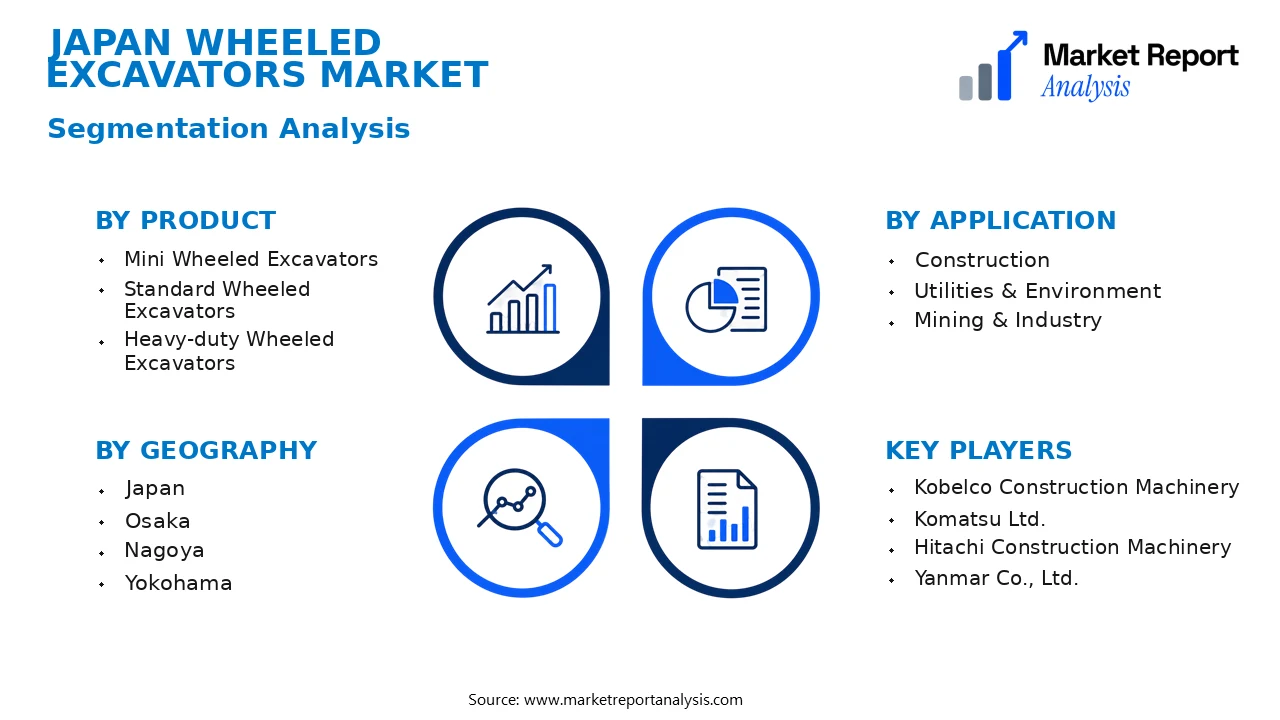
- Product
- Mini Wheeled Excavators: Compact and versatile, these excavators are favored in urban environments for small-scale demolition, landscaping, and utility projects, boosting demand due to Japan's densely populated cities.
- Standard Wheeled Excavators: Mid-sized models predominantly used in infrastructure projects and medium-scale construction, reflecting their importance in transportation projects and urban development in Japan.
- Heavy-duty Wheeled Excavators: Larger models designed for heavy construction, mining, and industrial applications, primarily adopted in large corporate projects and infrastructure expansion zones.
- Application
- Construction: The primary application that encompasses residential, commercial, and infrastructure development projects, driven by ongoing urban expansion and renovation efforts across Japan.
- Utilities & Environment: Focused on projects involving water, sewer, and environmental management, which require precision equipment capable of navigating complex urban underground systems.
- Mining & Industry: Although limited relative to other regions, specialized heavy excavators support mineral extraction and industrial operations in resource-rich areas and industrial zones.
- Geography
- Japan: Encompasses the entire national market, with significant regional variations based on urbanization levels, infrastructure development, and local industry strength.
- Tokyo: Japan’s capital and economic hub, with high demand driven by extensive construction, infrastructure renewal, and increasing urban development initiatives.
- Osaka: A major commercial and industrial center, Osaka's infrastructure projects and manufacturing industries stimulate adoption of wheeled excavators for versatile construction tasks.
- Nagoya: Known for its automotive industry and manufacturing sectors, Nagoya's infrastructural growth propels specific demands for construction equipment, including wheeled excavators.
- Yokohama: As a gateway port city with significant urban development projects, Yokohama supports the demand for efficient, mobile excavation equipment for its expansion and renovation works.
- Kyoto: Emphasizing cultural preservation and urban infrastructure, Kyoto's specific construction needs influence demand, especially in heritage-safe excavation projects.
- Kobe: A key port and industrial city, Kobe’s logistics and industrial infrastructure projects foster a localized demand for wheeled excavators capable of handling diverse terrains.
- Fukuoka: Regional growth driven by urban renewal and infrastructure improvements in Fukuoka encourages increased adoption of wheeled excavators for construction and infrastructure projects.
Overall, segmentation by product, application, and geography offers a comprehensive view of market dynamics, with regional urbanization, industry verticals, and technological preferences shaping demand patterns and market penetration in Japan’s evolving construction landscape.
- Japan: Encompasses the entire national market, with significant regional variations based on urbanization levels, infrastructure development, and local industry strength.
Competitive Intelligence
The Japan Wheeled Excavators Market exhibits a competitive landscape characterized by moderate market concentration, with leading global and domestic players such as Komatsu Ltd., Hitachi Construction Machinery Co., Ltd., and Kobelco Construction Machinery Co., Ltd. actively pursuing strategic initiatives. Market participants focus heavily on product innovation, emphasizing increased efficiency, eco-friendly features, and advanced automation capabilities to differentiate their offerings in a mature market. Companies are increasingly forming partnerships and alliances with local construction firms and technology providers to co-develop smart machinery integrated with IoT and AI technology, enhancing operational performance. Acquisition strategies are also prominent, aimed at expanding product portfolios and penetrating niche segments within major cities like Tokyo and Osaka, where demand for urban construction equipment is booming. Significant R&D investments are directed toward sustainability and autonomous capabilities, fostering technological leadership and competitive edge. Overall, firms aim to enhance market share through strategic expansion either geographically or across product lines while maintaining differentiation through innovation, sustainability, and customer-centric solutions tailored for Japan’s unique construction environment.
Leading Company Profiles
The competitive landscape of the Japan Wheeled Excavators Market features a mix of global giants and regional leaders, each focusing on technological innovation, product diversification, and strategic expansion to capture market share and meet varying customer needs in Japan.
- Kobelco Construction Machinery
- Komatsu Ltd.
- Hitachi Construction Machinery
- Yanmar Co., Ltd.
- Doosan Bobcat
- Kubota Corporation
- CASE Construction Equipment
- Caterpillar Inc.
- Hyundai Heavy Industries
- John Deere
Kobelco Construction Machinery
Kobelco specializes in compact and wheeled excavators, emphasizing lightweight yet durable designs, advanced hydraulics, and eco-friendly technology, focusing on urban construction equipment and digital integration for efficiency.
Komatsu Ltd.
Komatsu is renowned for its innovative hydraulic systems, a broad portfolio of wheeled excavators, and focus on automation and connectivity, driving productivity and sustainability in Japan's construction industry.
Hitachi Construction Machinery
Hitachi offers a wide range of technologically advanced wheeled excavators with a focus on energy efficiency, telematics, and remote operation capabilities, aligning with Japan’s push towards smart and sustainable construction solutions.
Yanmar Co., Ltd.
Yanmar specializes in compact wheeled excavators ideal for limited urban spaces, integrating cutting-edge engine technology and digital control systems to optimize performance and reduce emissions.
Doosan Bobcat
Doosan Bobcat provides versatile wheeled excavators known for their compactness, reliability, and innovative features such as remote monitoring and smart attachments, targeting urban infrastructure projects.
Kubota Corporation
Kubota offers a diverse range of wheeled excavators focusing on fuel efficiency, operator comfort, and durability, with a growing emphasis on environmentally sustainable and digital solutions.
CASE Construction Equipment
CASE delivers technologically advanced, productive, and reliable wheeled excavators with integrated telematics and automation features tailored to urban construction segments in Japan.
Caterpillar Inc.
Caterpillar's focus is on high-performance wheeled excavators that incorporate smart technology, offering superior durability, fuel efficiency, and predictive maintenance solutions to enhance operational uptime.
Hyundai Heavy Industries
Hyundai provides a range of energy-efficient, technologically sophisticated wheeled excavators, with innovations in hydraulics and digital control systems tailored for modern urban construction needs.
John Deere
John Deere specializes in compact, versatile wheeled excavators that focus on operator comfort, digital connectivity, and sustainability, aligning with Japan's environmental and technological standards.
Strategic Business Developments
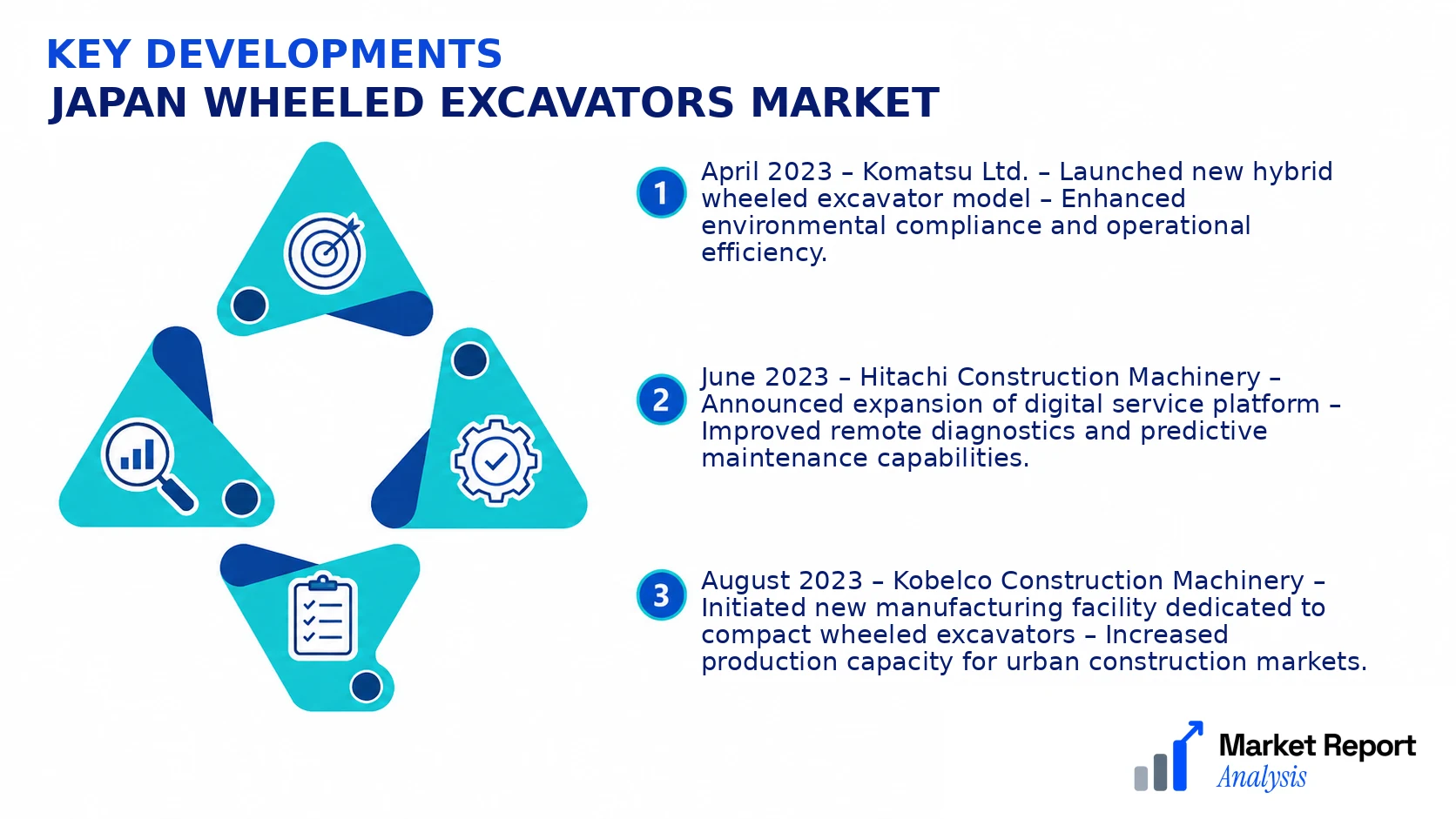
- April 2023 – Komatsu Ltd. – Launched new hybrid wheeled excavator model – Enhanced environmental compliance and operational efficiency.
- June 2023 – Hitachi Construction Machinery – Announced expansion of digital service platform – Improved remote diagnostics and predictive maintenance capabilities.
- August 2023 – Kobelco Construction Machinery – Initiated new manufacturing facility dedicated to compact wheeled excavators – Increased production capacity for urban construction markets.
- October 2023 – Yanmar Co., Ltd. – Formed strategic partnership with a telematics solution provider – Strengthened digital integration across product lineup.
- December 2023 – Kubota Corporation – Acquired a minority stake in a startup specializing in AI-powered construction equipment – Accelerating innovation in automation and smart features.
Frequently Asked Questions
What is the Japan Wheeled Excavators Market?
The Japan Wheeled Excavators Market comprises the industry involved in designing, manufacturing, and selling wheeled excavators used across construction, infrastructure, and utility sectors within Japan. This market is characterized by technological advancements and increasing infrastructure development.
What is the current market size of Japan Wheeled Excavators Market?
As of 2026, the market size of Japan Wheeled Excavators is valued at approximately USD 3.2 Billion. This reflects the growing demand driven by urban construction projects and technological upgrades in excavator equipment across the country.
What factors are driving the Japan Wheeled Excavators Market?
The key drivers include rapid urbanization, ongoing infrastructure projects, technological innovations such as GPS and automation, and a focus on efficient and environmentally friendly construction equipment. Government initiatives supporting infrastructure development further bolster the market growth.
Which region dominates the Japan Wheeled Excavators Market?
Tokyo metropolitan area and surrounding regions dominate the Japan Wheeled Excavators Market, owing to higher construction activity, urban development projects, and a concentration of industrial activity requiring heavy machinery in these regions.
Which segment is expected to grow the fastest?
The compact and mid-sized wheeled excavator segment is projected to experience the fastest growth, driven by increasing demand for urban construction and renovation projects that require maneuverable yet powerful machinery.
Who are the leading companies operating in the Japan Wheeled Excavators Market?
Leading industry players include Komatsu Ltd., Hitachi Construction Machinery, and Kubota Corporation, all of which are innovating in terms of technology, and expanding their presence to capture additional market share within Japan's competitive landscape.
Analyst Perspective
The long-term outlook for the Japan Wheeled Excavators Market appears promising, driven primarily by infrastructure modernization initiatives and increased urban development activities. As technological innovations such as autonomous operation, telematics, and hybrid powertrains mature, manufacturers that swiftly adopt these advancements will gain competitive advantages. Investment priorities should focus on integrating eco-friendly technologies and enhancing operational efficiency, which align with Japan's stringent environmental policies and sustainability goals. The sector witnesses moderate to high competitive intensity, with established players and new entrants vying for market share through innovation and strategic alliances. Regional growth potential remains robust in metropolitan districts like Tokyo and Osaka, where infrastructural upgrades are ongoing. City-level opportunities include specialized solutions for confined urban environments and smart project integration. Strategic focus should be on harnessing digital transformation and regional customization to sustain long-term growth, while carefully navigating regulatory and economic risks to secure market leadership in this evolving landscape.
