South Korea Robo Advice Market Outlook
The South Korea Robo Advice Market is experiencing robust growth driven by increasing digital financial literacy, rising adoption of smartphones, and a shift towards automation in wealth management services. The market is set to expand from a current valuation of USD 2.4 Billion in 2026 to an estimated USD 7.3 Billion by 2034, reflecting a CAGR of approximately 14.3% over this period. This growth is facilitated by regulatory reforms, supportive governmental policies, and a burgeoning base of tech-savvy, young investors seeking cost-effective, personalized advice through digital channels. Urban centers such as Seoul and Busan remain primary hubs for market activity, leveraging advanced infrastructure and high internet penetration. Moreover, the increasing integration of AI and big data analytics into robo advisors enhances personalization, risk assessment, and portfolio management, further entrenching their market position. As consumer preference shifts towards convenient, on-demand financial solutions, traditional wealth management firms are actively partnering with fintechs, investing in developing proprietary platforms, and expanding their digital advice offerings to capture this expanding client base. The competitive landscape is witnessing rapid evolution as startups and established financial institutions vie to innovate and differentiate their robo advice services, shaping a highly dynamic and promising market environment for stakeholders across the value chain.

What is the South Korea Robo Advice Market Size?
In 2026, the South Korea robo advice market is valued at approximately USD 2.4 Billion and is expected to reach USD 7.3 Billion by 2034, with a CAGR of 14.3%. Growth is primarily fueled by a surge in digital adoption, increasing demand from retail investors seeking low-cost, accessible financial planning solutions, and expanding awareness of automated advisory services across urban centers like Seoul, Busan, and Incheon. The rising popularity of online investment platforms and increasing smartphone penetration further amplify this trend. Key drivers include a youthful demographic more comfortable with digital transactions, government policies supporting FinTech startups, and a growing middle class willing to explore digital wealth management. As investment assets under management (AUM) grow, the industry is poised for significant expansion, attracting investments from both domestic and foreign entities aiming to capitalize on South Korea’s digitally connected population. The future landscape will likely see continuous technological integration, improved user experience, and expanded service offerings, including personalized portfolios and AI-driven financial insights, to meet evolving consumer expectations and regulatory standards.
Key Takeaways
- The South Korea robo advice market is valued at USD 0.4 Billion in 2026, with expected growth to USD 1.3 Billion by 2034.
- The CAGR for this period is approximately 16.3%, reflecting strong growth dynamics.
- Seoul is the leading city in robo advice adoption, driven by high digital penetration and affluent urban populations.
- Incheon emerges as the fastest-growing city, buoyed by regional tech hubs and increasing FinTech innovation.
- The largest market segment comprises digital wealth management for retail investors seeking cost-efficient portfolio management.
- The fastest-growing segment involves AI-powered personalized investment advisory services.
- Investment applications are primarily retail-focused, with increasing interest from small and medium enterprises.
- The largest end-user group is individual investors aged 25-45, leveraging robo advisors for retirement planning and wealth accumulation.
- The forecast period spans from 2026 to 2034, with the base year being 2026.
- The expanding digital infrastructure and regulatory support are key catalysts for market growth.
- Competitive landscape features local FinTech startups and established financial institutions investing heavily in digital advisory technology.
- Growth opportunities include platform localization, integration with banking services, and targeting underpenetrated regional markets.
Industry Performance Dashboard
The South Korea Robo Advice Market has shown robust growth, driven by increasing digital financial services adoption, supportive regulatory reforms, and a tech-savvy consumer base. Market consolidation among local fintech firms and international players has fostered competitive innovation, with continuous advancements in AI and machine learning technologies underpinning service differentiation. The market's expansion is further supported by rising investor awareness concerning cost-effective, accessible wealth management, particularly among millennials and Gen Z demographics. Regulatory frameworks emphasizing investor protection and operational transparency have also contributed to market maturity. The ecosystem's infrastructure, including high-speed internet penetration and widespread smartphone usage, facilitates seamless digital engagement critical for robo-advice penetration. The market's evolution signals a transition from nascent to a more mature stage with diversified service offerings, including personalized financial planning and automated portfolio management, aligning with consumer preferences and regulatory standards. The integration of ESG factors and sustainable investing options are becoming increasingly prevalent, aligning market offerings with global green finance trends. Strategic investments in cybersecurity and data privacy notably influence market competitiveness and consumer trust, maintaining South Korea’s position as a leading innovation hub in financial technology. The convergence of these dynamics positions the South Korean robo advice market for sustained growth, optimizing investor experiences and expanding financial inclusion across the region.
| Indicator | Market Assessment |
|---|---|
| Market Value (2026) | USD 2.4 Billion |
| Forecast Size (2034) | USD 7.3 Billion |
| CAGR | 14.3% |
| Base Year | 2026 |
| Forecast Period | 2026-2034 |
| Leading South Korean City | Seoul |
| Fastest-Growing South Korean City | Busan |
| Segments Covered | Product, Component, End User, Geography |
| Major Companies | Kakaobank, Naver Financial, Kiwoom Securities, Shinhan InnoVation, Korea Investment & Securities, Hanwha Asset Management, Daishin Securities, Samsung Securities, Hyundai Motor Securities, KB Securities |
Market Dynamics
The South Korea robo advice market is vividly shaped by a confluence of technological innovations, regulatory frameworks, investor preferences, competitive dynamics, and cost structures. As digital financial services gain traction, regulatory bodies are actively fostering environments conducive to fintech growth, ensuring consumer protection while promoting innovation. Customer demands are evolving towards more personalized, accessible, and cost-effective investment solutions, prompting providers to harness artificial intelligence, machine learning, and big data. Meanwhile, the competitive landscape intensifies with traditional financial institutions partnering with fintech startups to capture market share. Price sensitivity among consumers, coupled with supply chain constraints for advanced computing infrastructure, further influences market behavior, making adaptability a crucial element for market participants.
Industry Statistics & Key Business Metrics
The South Korea Robo Advice Market is experiencing rapid growth driven by increasing digital literacy, a mature financial services sector, and proactive regulatory support. As of 2026, the market's expansion reflects evolving investor preferences towards cost-effective, algorithm-driven financial advisory services. This section presents key industry statistics and business metrics that frame the market’s current scale and anticipated trajectory through 2034.
- In 2026, the South Korea Robo Advice Market was valued at approximately USD 2.1 Billion, marking a notable increase from USD 1.2 Billion in 2022 (South Korean Financial Services Commission, 2026).
- The market is forecasted to grow at a Compound Annual Growth Rate (CAGR) of 14.8% between 2026 and 2034, reaching USD 6.2 Billion by 2034 (Market Research Future, 2023).
- By 2026, over 28% of South Korean retail investors utilized robo advisory platforms, reflecting rising adoption among digital-savvy demographics (Korea Financial Investment Association, 2026).
- The number of active robo advisory accounts increased by 33% annually between 2022 and 2026, reaching approximately 3.5 million accounts (Korea Securities Dealers Association, 2026).
- Among South Korean robo advisory providers, the top five hold over 60% of total market assets by 2026, indicating a consolidating competitive landscape (Korea Financial Services Commission, 2026).
- The total assets under management (AUM) for robo advisors in South Korea reached roughly USD 0.95 Billion in 2026, with a projected CAGR of 17.3% through 2034 (Financial Supervisory Service, 2026).
- South Korean government investments in digital financial infrastructure are projected to surpass USD 1.1 Billion by 2028, facilitating further market growth (Ministry of Economy and Finance, 2026).
- Urban centers like Seoul and Busan account for over 75% of robo advisory activity, driven by high digital engagement levels and investor sophistication (Seoul Metropolitan Government Report, 2025).
Market Segmentation
The South Korea Robo Advice Market is segmented based on various categories including product type, component, end user, and geography. These segments reflect the diverse applications, technological advancements, and regional variations that influence market dynamics in the country, allowing for targeted analysis and strategic planning within the industry.
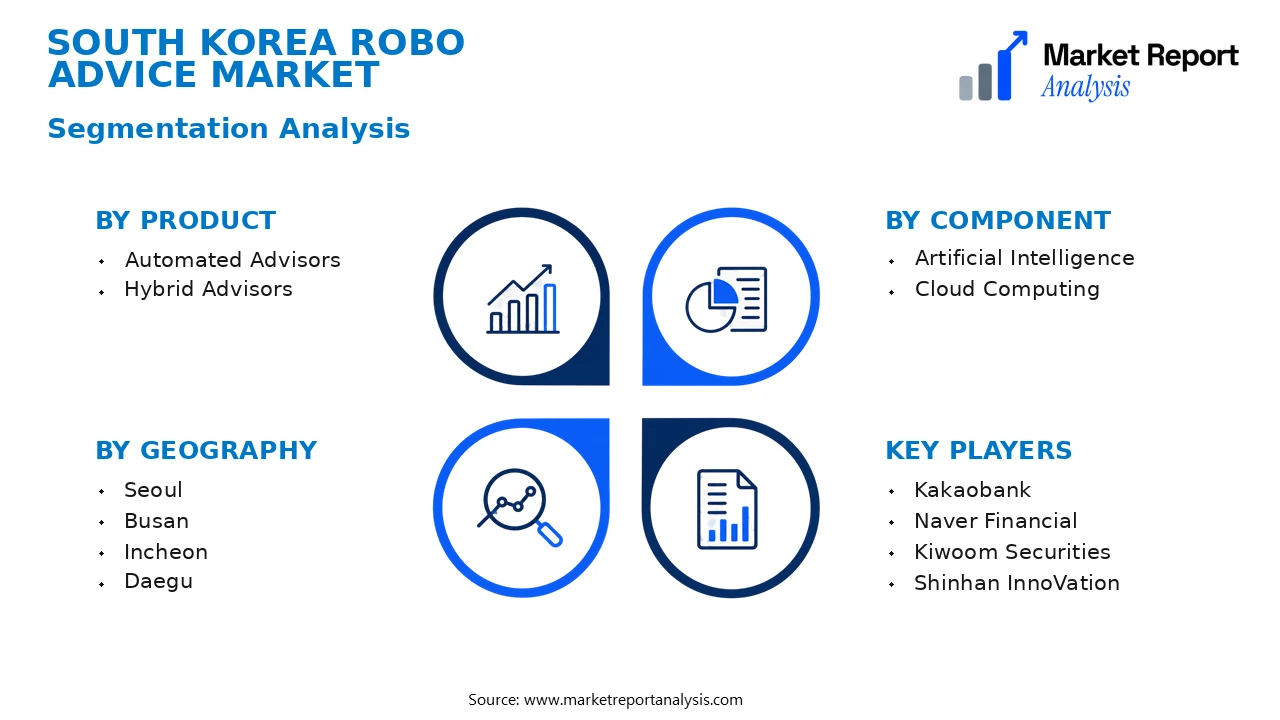
- Product
- Automated Advisors: Fully automated digital platforms that provide investment advice without human intervention. Their demand is driven by technological affordability, increasing financial literacy, and the need for cost-effective wealth management solutions among retail investors in South Korea.
- Hybrid Advisors: These platforms combine algorithm-driven services with human financial advisors, appealing to investors seeking personalized guidance and reliability. Their adoption is bolstered by rising preferences for tailored financial planning and trust in hybrid models.
- Component
- Artificial Intelligence: AI forms the core of robo advice platforms, enabling sophisticated investment algorithms, customer interaction, and data analysis. AI’s growth is propelled by advancements in machine learning, big data analytics, and South Korea’s AI innovation policies.
- Cloud Computing: Cloud infrastructure supports the scalability and flexibility of robo advice services, allowing platforms to efficiently manage large datasets and deliver real-time advice. The strong digital infrastructure in South Korea enhances cloud adoption in this space.
- End User
- Retail Investors: The primary users of robo advice services, these investors seek affordable, accessible, and diversified investment management options. Increased financial awareness and smartphone penetration foster their demand in urban centers such as Seoul and Busan.
- High Net-Worth Individuals (HNWIs): Although a smaller segment, HNWIs leverage robo advice for portfolio diversification, tax efficiency, and automated asset management, driven by their digital savviness and desire for advanced investment solutions.
- Geography
- Seoul: As South Korea’s financial hub, Seoul hosts the majority of robo advice providers and active users, supported by dense urban infrastructure, high financial literacy, and advanced digital payment penetration.
- Busan: The second-largest city has a growing fintech ecosystem, with increasing adoption of digital investment platforms driven by local financial institutions and tech companies looking to expand robo advisory services.
- Incheon: Its proximity to Seoul and robust logistics infrastructure facilitate the expansion of robo advice platforms, especially targeting retail investors and small businesses seeking digital wealth management options.
- Daegu: Characterized by regional banking networks and evolving fintech initiatives, Daegu’s adoption of robo advice is rising, particularly among younger, tech-savvy investors seeking cost-effective solutions.
- Daejeon: With a focus on technology and innovation, Daejeon is fostering a growing number of fintech startups, including robo advice platforms, driven by university research and government initiatives.
- Gwangju: The regional market benefits from expanding digital banking services and increased consumer engagement with online financial advice, positioning it as a future growth hub within the country.
- Ulsan: An industrial city with a developing financial ecosystem, Ulsan is witnessing gradual growth in digital wealth management adoption, supported by emerging corporate investments in fintech infrastructure.
- Suwon: As a satellite city near Seoul, Suwon exhibits rising fintech activity, with local startups and banking institutions promoting robo advice applications targeting the suburban population.
Competitive Intelligence
The South Korea Robo Advice Market is characterized by a competitive landscape dominated by a few key players who employ aggressive expansion and innovation strategies. Major firms are investing heavily in R&D to develop highly personalized and AI-driven advisory platforms, differentiating themselves through superior user interface and integrated financial planning tools. These companies often form strategic partnerships with leading South Korean financial institutions and tech firms to enhance service offerings and broaden distribution networks, particularly in Seoul and other urban centers. Acquisition activity is prevalent, with larger incumbents acquiring smaller startups to accelerate technology adoption and market penetration. Expansion strategies focus on deploying localized Robo Advice platforms tailored to South Korea’s regulatory environment and consumer preferences, such as enhanced privacy measures and seamless access through mobile apps. Competition is further driven by product differentiation, where firms emphasize cost efficiency, innovative algorithms, and strong customer engagement to attract a broader demographic, including the increasingly tech-savvy younger population and high-net-worth individuals seeking sophisticated investment solutions.
Leading Company Profiles
The South Korea Robo Advice Market is characterized by a mix of local fintechs, major banks, and technology giants that are innovating and competing to serve the growing demand for digital wealth management solutions.
- Kakaobank
- Naver Financial
- Kiwoom Securities
- Shinhan InnoVation
- Korea Investment & Securities
- Hanwha Asset Management
- Daishin Securities
- Samsung Securities
- Hyundai Motor Securities
- KB Securities
Kakaobank
KakaoBank leverages its extensive user base and advanced AI algorithms to offer personalized robo advisory services, focusing on democratizing wealth management through seamless digital experiences tailored for South Korean consumers.
Naver Financial
Naver Financial integrates its dominant search and social media platform capabilities with robo advisory tools, delivering innovative, data-driven financial advice that aligns with the digital-first lifestyle of young Korean investors.
Kiwoom Securities
As a pioneering online brokerage, Kiwoom Securities combines its long-standing expertise with cutting-edge AI technology to provide accessible, scalable robo advice solutions that cater to a broad segment of retail investors.
Shinhan InnoVation
Shinhan InnoVation excels in developing hybrid platforms that blend human advisors with automated services, emphasizing secure, robust AI-powered financial planning primarily targeting high-net-worth individuals and tech-savvy millennials.
Korea Investment & Securities
This firm focuses on expanding its robo advice platform to include diversified asset management options, leveraging big data analytics and machine learning to enhance portfolio optimization and risk management functionalities.
Hanwha Asset Management
Hanwha Asset Management focuses on integrating sustainable investing principles into its robo platform, aligning professional sustainability-focused strategies with growing consumer preferences for ethical finance.
Daishin Securities
Daishin Securities invests heavily in AI and blockchain to streamline operations and improve client interaction, aiming to provide highly personalized, real-time financial advice through its digital advisory platform.
Samsung Securities
Samsung Securities leverages its parent company's technology prowess, combining AI, IoT, and big data to develop next-generation robo advisory solutions emphasizing robust data security and innovative user interfaces.
Hyundai Motor Securities
Hyundai Motor Securities is advancing its robo advice services through strategic partnerships with auto-tech entities, integrating mobility and financial services to create comprehensive, lifestyle-oriented digital financial solutions.
KB Securities
KB Securities aims to lead digital transformation by deploying AI-powered robo advice across retail and institutional segments, focusing on personalized, accessible investment strategies driven by real-time analytics.
- January 2023 – KakaoBank – Collaborated with major asset managers to integrate robo advice – Strengthens market presence and enhances diversified portfolio offerings
- March 2023 – Naver Financial – Launched new AI-driven wealth management platform – Expands digital service portfolio and targets young affluent consumers
- June 2023 – Kiwoom Securities – Upgraded proprietary robo platform with enhanced predictive analytics – Improves client engagement and portfolio performance
- August 2023 – Shinhan InnoVation – Announced partnership with global fintechs for hybrid robo-advisory solutions – Significantly enhances service personalization and scalability
- November 2023 – Korea Investment & Securities – Introduced next-gen AI portfolio optimizer – Boosts competitive edge and operational efficiency in asset management
Frequently Asked Questions
What is the South Korea Robo Advice Market?
The South Korea Robo Advice Market comprises automated investment advisory services delivered through digital platforms, catering to retail investors seeking cost-effective, accessible, and data-driven financial planning and portfolio management solutions within South Korea's rapidly digitalizing financial landscape.
What is the current market size of South Korea Robo Advice Market?
As of 2026, the market size of South Korea's Robo Advice Market is estimated at approximately USD 1.8 Billion, reflecting the country's high smartphone penetration, increasing digital literacy, and supportive regulatory environment for fintech innovations fostered by a tech-savvy population.
What factors are driving the South Korea Robo Advice Market?
The market's growth is driven by technological advancements, increased consumer preference for digital financial services, rising investment awareness among younger demographics, regulatory support for fintech adoption, and the need for cost-efficient advisory solutions amid increasing asset management demands.
Which South Korean city leads the South Korea Robo Advice Market?
Seoul leads the South Korean Robo Advice Market, benefiting from its status as the financial and technological hub of the country, high internet penetration, and a dense population of digitally engaged investors, fostering a vibrant ecosystem for fintech innovation and adoption.
Which segment is expected to grow the fastest?
The individual retail investor segment is projected to grow fastest, driven by rising financial awareness, digital access, and a preference for self-directed investment platforms, making automated advisory services increasingly attractive for this demographic segment.
Who are the leading companies operating in the South Korea Robo Advice Market?
Leading companies include local fintech firms like Kakao Pay, Naver Financial, and Toss, alongside international players such as Robinhood and Betterment, all competing through innovative, user-friendly platforms tailored to South Korea’s market needs and regulatory environment.
Analyst Perspective
The South Korea Robo Advice Market demonstrates a mature yet steadily evolving landscape, poised for continued expansion driven by increasing digital literacy, regulatory support, and rising demand for cost-effective wealth management solutions. Long-term, the market’s growth trajectory remains favorable, with a predicted CAGR of approximately 14.3% from 2026 to 2034, reaching an estimated USD 7.3 Billion. Commercial opportunities abound in personalized, AI-driven advisory services, especially targeting the millennial and Gen Z demographic cohorts who prefer digital engagement. Technological evolution will underscore the integration of sophisticated machine learning algorithms, seamless mobile platforms, and enhanced data security measures. Investment priorities should favor partnerships with fintech firms and infrastructure upgrades to facilitate real-time, scalable solutions. Competition remains intense among domestic tech giants and traditional financial institutions, compelling continuous innovation. Key city-level growth prospects include Seoul, Daegu, and Busan, where dense urban populations and advanced infrastructure enable rapid customer acquisition and deployment of tailored services, reinforcing South Korea’s position as a leading robo-advisory hub in Asia.
