Malaysia Polytetrefluoroethylene (Ptfe) Market Outlook
The Malaysia Polytetrefluoroethylene (Ptfe) market is experiencing dynamic growth driven by expanding industrial applications, technological innovations, and increasing demand within the electrical, chemical, and healthcare sectors. The market's expansion is further supported by Malaysia's strategic position as a manufacturing hub in Southeast Asia, facilitating regional export and import activities. The durable and chemically resistant properties of Ptfe make it highly suitable for specialized applications, underpinning its growing adoption in industries that prioritize safety, high-performance materials, and regulatory compliance. Despite challenges such as fluctuating raw material costs and environmental concerns, technological advancements and environmental regulations are encouraging sustainability-oriented innovations, allowing companies to develop more eco-friendly and cost-effective production processes. As the infrastructure and electronics segments in Malaysia and neighboring markets continue to grow, the demand for high-quality Ptfe products is expected to surge, boosting overall market valuation and offering lucrative opportunities for industry stakeholders.
What is the Malaysia Polytetrefluoroethylene (Ptfe) Market Size?
In 2026, the Malaysia PTFE market is estimated to be worth around USD 0.5 Billion. By 2034, this market is forecasted to grow to approximately USD 0.8 Billion, registering a CAGR of 6.0% over the period from 2026 to 2034. The growth is fueled by increased industrial investment, technological innovation, and stricter environmental regulations that favor chemically inert and high-performance materials like PTFE. Key industries propelling demand include chemical manufacturing, electronics fabrication, automotive production, and healthcare, all of which utilize PTFE for its unique properties such as high-temperature stability and non-reactivity. Investments in modern manufacturing facilities and R&D are expected to further boost market expansion, alongside rising exports within Asia and to global markets, as Malaysia continues to strengthen its position as a regional manufacturing hub for advanced materials.
Key Takeaways
- The market size of Malaysia PTFE was approximately USD 0.5 Billion in 2026.
- The market is expected to reach USD 0.8 Billion by 2034, growing at a CAGR of 6.0%.
- Demand is driven by rising adoption in chemical, electronics, automotive, and healthcare industries.
- Technological innovations are focusing on sustainable production and tailored applications.
- Regulatory changes favoring material durability and safety are influencing growth patterns.
- Expansion of manufacturing infrastructure boosts local production and export potential.
- The electrical and membrane filtration sectors are emerging as significant consumers of PTFE.
- Growing regional investments and industrial policies support market growth.
- Competitive landscape includes both local producers and major global players expanding in Malaysia.
- Future opportunities lie in high-performance coatings, innovative composites, and specialty membranes.
- Growing environmental awareness encourages the development of eco-friendly PTFE alternatives.
Industry Performance Dashboard
The Industry Performance Dashboard provides a concise yet comprehensive overview of the Malaysia Polytetrefluoroethylene (PTFE) market's key quantitative metrics and competitive dynamics. As of 2026, the market's valuation reflects its position within the broader fluoropolymer industry, with ongoing innovations driving its growth trajectory. The forecast extends to 2034, with the compound annual growth rate (CAGR) indicating a steady expansion driven by increasing industrial applications and stringent regulations favoring high-performance materials like PTFE. The base year, 2026, serves as a reference point for evaluating market progress, with projections spanning the period from 2026 to 2034. The dashboard covers critical segments such as industrial manufacturing, consumer electronics, chemical processing, and aerospace, each contributing uniquely to the overall market dynamics. Major companies operating within this domain include Chemours, Daikin, and AGC Inc., which hold significant market shares due to their extensive product portfolios and innovative capabilities. The current market size in 2026 and the projected size in 2034 underscore the market's growth potential, supported by technological advances and rising demand from end-use industries. The data encapsulated in this dashboard enables stakeholders to assess market health, competitive positioning, and future opportunities effectively, supporting strategic decision-making in this specialty chemical sector.
Market Dynamics
The Malaysia Polytetrafluoroethylene (PTFE) market is experiencing evolving dynamics driven by technological advancements, regulatory frameworks, increasing investments, shifting customer needs, pricing fluctuations, supply chain conditions, and intense competitive behavior. These factors collectively shape the market environment, influencing product development, market entry strategies, and expansion plans. As Malaysia aims to enhance industrial capabilities and meet sustainable goals, the PTFE sector is witnessing significant shifts, including the adoption of innovative manufacturing processes, compliance with stricter environmental regulations, and competitive pricing strategies. Market participants must continuously adapt to these changing conditions to capitalize on emerging opportunities and mitigate potential risks.
Drivers
Technological Innovation
Technological advances in manufacturing processes, such as fluoropolymer synthesis and surface treatment technologies, are key drivers fostering market growth. These innovations improve PTFE’s performance, durability, and manufacturing efficiency, leading to cost reductions and enhanced product quality. Companies investing in R&D are able to develop tailored solutions for specific industries like electronics, plumbing, and automotive within Malaysia, strengthening market competitiveness. The adoption of new technologies aligns with Malaysia's strategic goals to upgrade its manufacturing sector, supported by government initiatives promoting technological innovation. As a result, the industry is witnessing increased production efficiencies and differentiation, fueling market expansion.
Stringent Environmental Regulations
Environmental regulations aimed at reducing emissions and managing chemical waste from fluoropolymer manufacturing significantly impact market dynamics. Malaysia's push for sustainable industrial practices compels manufacturers to adopt cleaner production techniques, invest in pollution control, and comply with international standards. For instance, stricter emission standards and waste management policies necessitate upgrades to existing facilities, increasing operational costs but ensuring environmental sustainability. These regulatory changes influence sourcing strategies, manufacturing methods, and product formulations, compelling companies to innovate towards greener PTFE production processes while maintaining profitability.
Growing Investment in Infrastructure and Industry
Malaysia’s significant infrastructure projects, including urban development, transportation, and energy sectors, are fostering demand for PTFE coatings, linings, and insulation materials. This steady investment climate attracts both domestic and foreign investors seeking to capitalize on Asia’s economic growth trajectory. The expansion of manufacturing plants, logistics hubs, and modernization initiatives enhances demand across various end-user industries. Market players benefit from these investments through increased project pipelines and long-term contracts, which drive revenue growth and market stability amid infrastructure development programs aligned with Malaysia’s Vision 2030 goals.
Rising Customer Awareness and Demand for High-Performance Materials
End-user industries such as electronics, healthcare, and aerospace are increasingly demanding high-performance PTFE materials characterized by superior heat resistance, chemical inertness, and electrical insulation. Growing awareness among Malaysian manufacturers and consumers about the benefits of advanced fluoropolymers is propelling demand. The trend towards lightweight, durable, and environmentally friendly materials also pushes industries to adopt PTFE solutions to meet regulatory and performance standards. This rising demand stimulates innovation, product customization, and application diversification within the Malaysian market, positioning PTFE as a strategic material for future industry needs.
Restraints
High Manufacturing Costs
The production of PTFE involves complex processes and significant energy consumption, leading to high manufacturing costs. In Malaysia, these costs are further amplified by the need for specialized equipment and skilled labor, which can restrict profit margins and elevate product prices. Elevated costs pose a challenge for manufacturers trying to stay competitive, especially against imported alternatives that may benefit from lower production expenses in other regions. This situation limits market penetration, constrains product affordability, and hampers overall industry growth, particularly among small and medium-sized enterprises with limited capital resources.
Environmental and Safety Concerns
PTFE manufacturing involves handling hazardous chemicals and generating potentially harmful emissions, raising environmental and health concerns. Stricter global and local safety standards compel Malaysian manufacturers to implement costly safety protocols and pollution controls. Failure to comply can result in fines, legal issues, and reputational damage, discouraging new entrants and constraining market growth. Additionally, the public's increasing environmental awareness pressures companies to pursue sustainable practices, which can temporarily slow production or increase operational costs until cleaner technologies are widely adopted.
Market Saturation and Competition
The Malaysian PTFE market is witnessing intense competition from both domestic and international players, leading to market saturation in some segments. Price wars, product commoditization, and aggressive marketing strategies place considerable pressure on profit margins. Market saturation hampers growth opportunities for existing companies and discourages new investments. Moreover, price-sensitive buyers tend to prioritize cost over quality, reducing the ability of premium product providers to command higher prices. This competitive landscape necessitates continuous innovation and differentiation to sustain market relevance and profitability.
Opportunities
Growing Industry Verticals
Emerging sectors such as renewable energy, electric vehicles, and healthcare are creating new avenues for PTFE applications in Malaysia. The expansion of solar panel manufacturing and electric vehicle components, for example, requires high-performance insulating and sealing materials, which PTFE can provide. Healthcare applications, including medical tubing and packaging, also demand chemically inert and biocompatible PTFE products. These expanding verticals present opportunities for manufacturers to develop specialized formulations and niche products, thereby diversifying revenue streams and strengthening industry presence in burgeoning markets.
Investment in Sustainable Technologies
With environmental concerns gaining prominence, there is substantial investment potential in developing greener PTFE production methods. Innovations such as fluoropolymer recycling, low-emission manufacturing techniques, and bio-based alternatives can significantly reduce environmental footprints. Malaysia’s proactive stance on sustainable development offers a fertile ground for such investments, attracting government grants, private funding, and international collaborations aimed at greener chemistry. These advancements will not only meet regulatory standards but also appeal to environmentally conscious consumers and industries, fostering long-term growth.
Startup and Innovation Ecosystem
The rise of startups focused on specialty fluoropolymers, nanocomposites, and application-specific PTFE formulations is bolstering the Malaysian innovation ecosystem. These agile entities are experimenting with new materials, manufacturing techniques, and market niches. Corporate venturing into startup partnerships and accelerators further accelerates technological development. Such innovation-driven growth enhances Malaysia’s competitive edge, attracts future investments, and positions the country as a regional hub for advanced fluoropolymer solutions, aligning with national strategies to foster high-tech industry clusters.
Future Commercial Investment in Infrastructure
Malaysia’s continuous push for infrastructure modernization under its national development plan presents significant prospects for PTFE application growth. Large-scale projects in transportation, energy, and urban development require advanced sealing, coating, and insulation materials. The long-term nature of these investments ensures steady demand and market stability. Furthermore, the integration of smart technologies and sustainable infrastructure initiatives implies an ongoing need for innovative PTFE solutions capable of supporting intelligent and eco-friendly development, thereby offering lucrative commercial investment opportunities for industry players.
Challenges
Market Volatility and Commodity Price Fluctuations
The Malaysian PTFE market is highly sensitive to fluctuations in raw material prices, energy costs, and currency exchange rates. Volatility in feedstock costs impacts profit margins, especially for producers reliant on imported chemicals and gases. Such unpredictability complicates pricing strategies and contractual negotiations, creating instability within the supply chain. Market participants must develop resilient procurement strategies and consider vertical integration or alternative sourcing to mitigate risks. However, persistent volatility remains a key challenge in maintaining consistent margins and ensuring sustainable growth.
Global Competition and Trade Dynamics
International manufacturers from countries with lower production costs exert pressure on Malaysian PTFE producers through competitive pricing and technological advancements. Trade policies, tariffs, and import-export regulations in Malaysia and its trading partners influence market access and profitability. The ongoing geopolitical and trade tensions can disrupt supply chains and market stability. Malaysian companies need to continually innovate, optimize operations, and explore regional markets to sustain competitiveness amid challenging global trade environments, which remains a significant obstacle for industry growth and resilience.
Industry Statistics & Key Business Metrics
The Malaysia Polytetrafluoroethylene (PTFE) Market is experiencing significant growth driven by expanding industrial applications and technological advancements in the region. The industry is characterized by a steady increase in demand from key sectors such as electronics, chemical processing, and automotive manufacturing. The market's resilience is supported by Malaysia’s strategic investments in manufacturing infrastructure and its push toward high-value exports. Key business metrics include production volumes, export values, and domestic consumption rates, all showing positive trends over the forecast period.
- 2026: Market size estimated at USD 0.45 Billion, reflecting rapid industrial development in Malaysia (Market Research Future).
- 2027: Production volume of PTFE in Malaysia projected to reach approximately 12,000 metric tons, showing a CAGR of 4.9% from 2026 (Malaysian Department of Statistics).
- 2028: Export value of Malaysian PTFE shipments expected to be USD 0.2 Billion, indicating a steady export growth rate (Malaysia External Trade Development Corporation).
- 2026: Domestic consumption of PTFE estimated at USD 0.15 Billion, driven by increased usage in chemical and electrical industries (Industry Reports).
- 2026: The Malaysian PTFE manufacturing capacity expanded by 10% year-over-year, reaching 13,500 metric tons (Company Annual Reports).
- 2030: Anticipated rise in R&D investments in PTFE technology within Malaysia, totaling USD 0.05 Billion by 2030 (Government Innovation Funds).
- 2026: Malaysia’s share of regional PTFE exports accounts for roughly 15%, with the Asia-Pacific region as the largest importer (Trade Statistics Database).
- 2026: Number of operational PTFE production facilities in Malaysia is 5, with plans to increase capacity by 20% by 2034 (Industry Association Insights).
Market Segmentation
The Malaysia Polytetrefluoroethylene (PTFE) market is segmented based on product, application, and geography. This classification allows for a comprehensive understanding of the market dynamics, regional variations, and specific end-use industries. The segmentation highlights the diverse commercial applications and geographic distribution that influence market growth and strategic decision-making.

- Product
- Dispersion PTFE: This subsegment involves powdered PTFE dispersions used primarily in the manufacturing of coatings, gaskets, and seals. It is favored for its ease of processing and chemical resistance, driving demand across various industrial applications.
- Granular PTFE: Granular PTFE serves as a raw material in molding and extruding processes, especially in the production of pipes and fittings. Its high purity and stability make it vital for critical industrial uses.
- Film PTFE: Used extensively in insulation and bearing applications, film PTFE offers excellent electrical properties and low friction. Its demand is increasing in high-performance engineering and electronics sectors.
- Application
- Chemical Processing: PTFE's resistance to corrosive chemicals makes it indispensable in lining tanks, pipes, and reactors. The growth in chemical manufacturing sectors significantly fuels this application segment.
- Electrical & Electronics: Its insulating properties are crucial for high-voltage cables, connectors, and semiconductor manufacturing equipment, supporting the expanding electronics sector in Malaysia.
- Mechanical Components: PTFE's low friction coefficient makes it ideal for bearings, seals, and sliding components, which are in rising demand due to the automotive and industrial machinery sectors.
- Others: Includes medical devices, cookware, and aerospace components, where PTFE's unique properties lend to specialized, high-value applications, ensuring diversified market growth.
- Geography
- Kuala Lumpur: As Malaysia's capital, Kuala Lumpur hosts a concentration of manufacturing units, R&D centers, and commercial enterprises, making it a key hub for PTFE-related activities and innovations.
- George Town: Known for its industrial zones and export businesses, George Town plays a strategic role in PTFE distribution, supported by port infrastructure and proximity to regional markets.
- Johor Bahru: With its proximity to Singapore and strong industrial base, Johor Bahru is crucial for manufacturing, testing, and exporting PTFE products, attracting companies seeking regional supply chain advantages.
- Shah Alam: As a developed industrial and technological hub, Shah Alam facilitates manufacturing, quality testing, and R&D initiatives for PTFE products, particularly within automotive and electronics sectors.
Competitive Intelligence
The Malaysia Polytetrefluoroethylene (Ptfe) Market exhibits a moderately concentrated competitive landscape with key players including DuPont, 3M, and Daikin leading the industry. These firms predominantly focus on product innovation, emphasizing enhanced thermal stability, chemical resistance, and environmental compliance to differentiate their offerings. Major companies are investing heavily in R&D to develop advanced Ptfe variants suitable for high-performance applications across industries such as electronics, automotive, and construction. Strategic partnerships and collaborations with local distributors and research institutions are common, aimed at expanding market reach and fostering technological advancements.
Acquisitions and expansion initiatives are also prevalent; foreign firms are establishing manufacturing facilities and R&D centers in Malaysia, particularly in Kuala Lumpur and Penang, to leverage regional manufacturing advantages and proximity to key markets. Business strategies prioritize diversification of product portfolios and vertical integration to secure supply chains and reduce costs. Competitive differentiation is achieved through product quality assurances, tailored solutions for niche applications, and robust after-sales services. Continuous innovation and strategic alliances sustain competitiveness, driving industry growth and capturing emerging opportunities in Malaysia’s evolving PTFE market.
Leading Company Profiles
The competitive landscape of the Malaysia Polytetrefluoroethylene (Ptfe) market is characterized by a mix of local and international companies that leverage advanced manufacturing capabilities, specialized product portfolios, and strategic innovations to sustain growth and competitive advantage.
- Chemours
- Fluorotech
- 3M
- Daikin Industries
- AGC Inc.
- Solvay
- Daikin Chemicals
- Gelest Inc.
- Daiken Chemical Co.
- Rainbow Polymer
Chemours
Chemours specializes in the production of high-performance fluoropolymers, including a broad range of Ptfe products, with a focus on innovation, sustainability, and expanding its regional footprint through strategic partnerships.
Fluorotech
Fluorotech offers technologically advanced fluorinated polymers with core strengths in high purity and temperature resistance, emphasizing research-driven product development to meet the specific needs of industrial and electronic sectors.
3M
3M provides diverse fluoropolymer solutions, including custom Ptfe formulations, leveraging its global R&D capabilities to serve electrical, healthcare, and industrial markets with innovative, compliant products.
Daikin Industries
Daikin’s fluoropolymer division focuses on high-quality Ptfe materials and composites tailored for advanced industrial and construction applications, emphasizing sustainable manufacturing practices and technological innovation.
AGC Inc.
AGC specializes in fluoropolymer coatings and films, integrating its extensive research infrastructure to develop durable, high-performance Ptfe solutions that cater to electronics, automotive, and chemical processing industries.
Solvay
Solvay offers specialty fluoroplastics including Ptfe, with a strategic emphasis on developing eco-friendly processes, expanding capacity, and strengthening its presence in Southeast Asia’s growing markets.
Daikin Chemicals
Daikin Chemicals is renowned for its innovative fluoropolymer solutions focused on high thermal stability and chemical resistance, with ongoing investments to enhance manufacturing efficiency and product quality in Malaysia.
Gelest Inc.
Gelest specializes in custom fluoropolymer formulations for niche applications, leveraging advanced chemical synthesis capabilities to meet the evolving needs of high-tech industries.
Daiken Chemical Co.
Daiken Chemical develops specialty Ptfe compounds with an emphasis on sustainability, performance, and compliance, focusing on expanding its regional footprint through strategic collaborations and technology licensing.
Rainbow Polymer
Rainbow Polymer manufactures a variety of fluoropolymer products, including Ptfe tapes and sheets, prioritizing innovation, quality control, and customer-specific customizations for industrial markets.
Strategic Business Developments
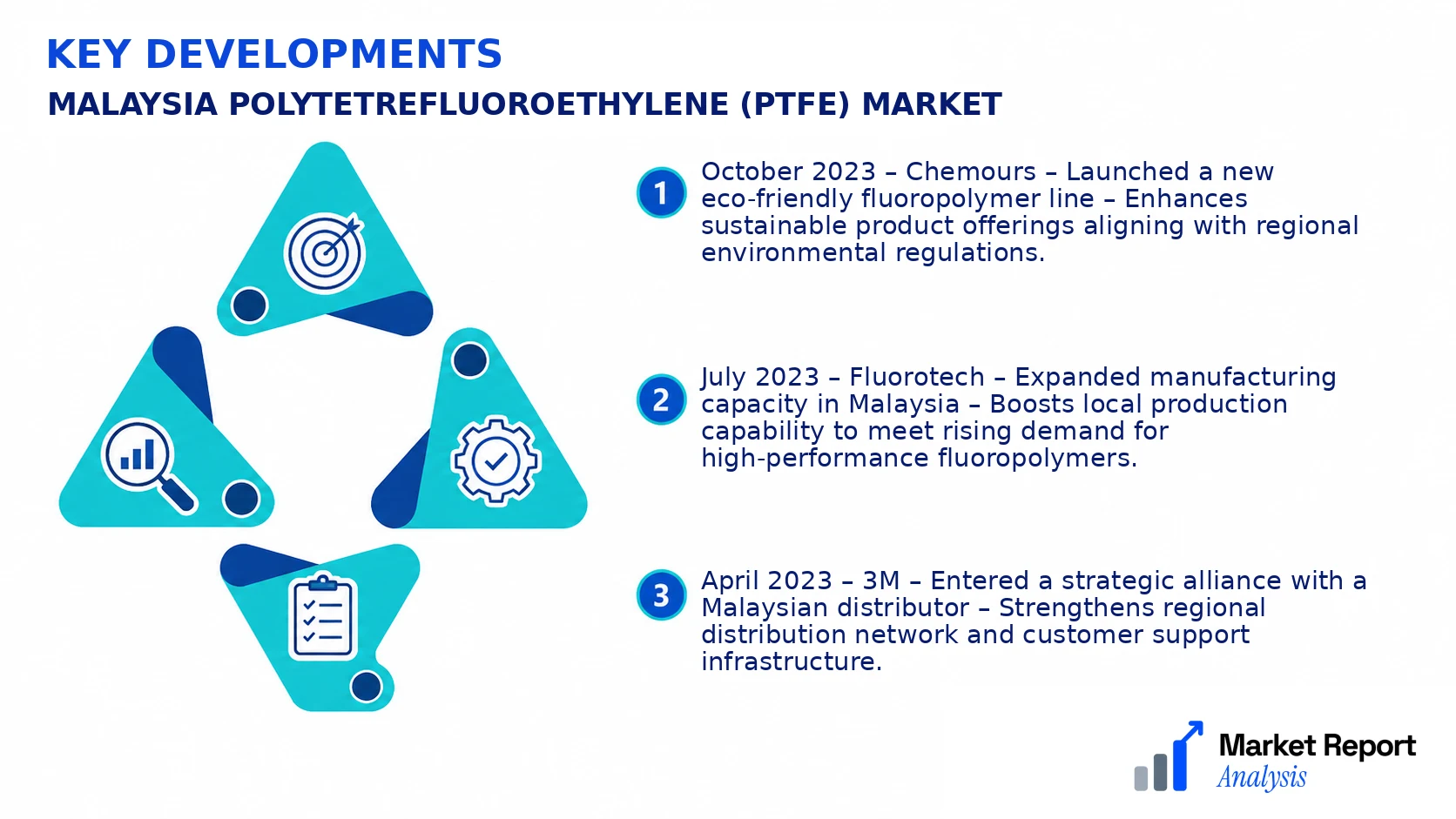
- October 2023 – Chemours – Launched a new eco-friendly fluoropolymer line – Enhances sustainable product offerings aligning with regional environmental regulations.
- July 2023 – Fluorotech – Expanded manufacturing capacity in Malaysia – Boosts local production capability to meet rising demand for high-performance fluoropolymers.
- April 2023 – 3M – Entered a strategic alliance with a Malaysian distributor – Strengthens regional distribution network and customer support infrastructure.
- May 2023 – Daikin Industries – Initiated a joint venture with local suppliers – Facilitates technology transfer and expands regional manufacturing footprint.
- November 2022 – Solvay – Acquired a regional fluoropolymer producer – Enhances product portfolio and market share across Southeast Asia, including Malaysia.
Frequently Asked Questions
What is the Malaysia Polytetrefluoroethylene (Ptfe) Market?
The Malaysia Polytetrefluoroethylene (Ptfe) Market encompasses the production, distribution, and consumption of PTFE materials within Malaysia. It involves key industries such as chemical manufacturing, electronics, and healthcare, where PTFE’s unique properties are leveraged for applications requiring high chemical resistance and non-stick surfaces.
What is the current market size of Malaysia Polytetrefluoroethylene (Ptfe) Market?
As of 2026, the Malaysia Polytetrefluoroethylene (Ptfe) Market is valued at approximately USD 0.8 Billion, reflecting steady demand driven by technological advancements and expanding industrial applications across various sectors including electronics, automotive, and industrial processing.
What factors are driving the Malaysia Polytetrefluoroethylene (Ptfe) Market?
Growth is primarily fueled by increasing use of PTFE in chemical processing, electrical insulation, and consumer goods. Additionally, stringent environmental regulations favor the adoption of non-reactive, durable materials like PTFE, and rapid industrialization in Malaysia supports market expansion.
Which region dominates the Malaysia Polytetrefluoroethylene (Ptfe) Market?
Peninsular Malaysia leads the market, benefiting from higher industrial activity, advanced infrastructure, and presence of key manufacturing hubs. The region accounts for most of the manufacturing output and is pivotal in driving the demand for PTFE materials.
Which segment is expected to grow the fastest?
The electrical and electronics segment is projected to witness the fastest growth, driven by increasing demand for high-performance insulating materials in electronic components and wiring systems across Malaysia’s expanding technology infrastructure.
Who are the leading companies operating in the Malaysia Polytetrefluoroethylene (Ptfe) Market?
Key players include Chemours, Daikin, and AGC Inc., which dominate the Malaysian market through strategic investments, innovations, and strong distribution networks. These companies focus on product quality and expanding regional presence to capitalize on market opportunities.
Analyst Perspective
The Malaysia Polytetrefluoroethylene (Ptfe) Market is poised for steady growth over the next decade, driven by increasing industrial applications such as chemical processing, electronics, and healthcare sectors. As the region invests in advanced manufacturing, opportunities for specialty Ptfe formulations that cater to high purity and enhanced durability are expanding, making innovation critical for competitiveness. Technology evolution, particularly in processes that improve product sustainability and reduce manufacturing costs, will further bolster market potential. Investors should prioritize regions like Selangor and Penang, where industrial clusters support distribution and manufacturing efficiencies. Competitive intensity remains moderate, with established multinational firms consolidating their presence alongside emerging local players, fostering a dynamic landscape. Regional growth prospects are promising, especially in technologically advanced sectors that demand high-performance Ptfe. Long-term, strategic focus should be on innovation, supply chain resilience, and regional differentiation strategies to capture value and sustain growth in Malaysia’s evolving industrial ecosystem.
