Latin America Network Video Recorder (NVR) Market Outlook
The Latin America Network Video Recorder (NVR) market is experiencing rapid growth, driven by increasing demand for enhanced security solutions across various sectors. As of 2026, the market valuation stands at approximately USD 2.1 Billion, with projections indicating a rise to USD 4.2 Billion by 2034. The compound annual growth rate (CAGR) over the forecast period 2026-2034 is estimated at 9.2%. Key drivers fueling this expansion include rising urbanization, escalating government investments in public safety, and the proliferation of smart city initiatives. Technological advancements such as AI integration, higher resolution recording, and cloud connectivity are further propelling the market forward. Commercial opportunities are abundant, especially in sectors like transportation, retail, banking, infrastructure, and residential security, where integrated NVR systems enhance operational efficiency and safety.
What is the Latin America Network Video Recorder (NVR) Market Size?
In 2026, the Latin America NVR market is valued at approximately USD 2.1 Billion and is forecast to reach about USD 4.2 Billion by 2034, registering a CAGR of 9.2%. This steady growth is primarily propelled by increased adoption of surveillance systems due to rising crime rates and the need for better security infrastructure across the region's burgeoning urban landscape. Significant investments from both government and private sectors are contributing to this upward trend, fostering the deployment of advanced NVR technologies. The rise of smart city projects and the adoption of IoT-enabled cameras embedded with AI capabilities are also central to market expansion. The market's growth is further bolstered by ongoing digital transformation in retail, transportation, banking, and government sectors, where the demand for scalable, high-capacity recording solutions is surging. Future growth opportunities include expanding the use of cloud-based NVR systems, integrating cyber-secure solutions, and leveraging big data analytics for proactive security management across Latin America. With regional governments emphasizing sustainable urban development, the secure, scalable, and intelligent NVR infrastructure will become an essential component, opening avenues for multinational vendors and local startups alike to capture a significant market share.
Key Takeaways
- The Latin America NVR market is valued at approximately USD 2.1 Billion in 2026.
- The market is projected to grow to USD 4.2 Billion by 2034.
- The CAGR from 2026 to 2034 is estimated at 9.2%.
- Video surveillance equipment remains the largest segment within the NVR market.
- Cloud-based NVR solutions are the fastest-growing technology segment.
- Government and transportation sectors represent the largest applications for NVR systems.
- Security and surveillance in commercial infrastructure is the primary end user's demand driver.
- Smart city projects and IoT integration are key technological trends fueling market growth.
- Private sector investments and public safety initiatives are major factors underpinning regional market expansion.
- Regional countries such as Brazil, Mexico, and Argentina lead in market adoption and investment.
- Market competition is intensifying, with local and international vendors vying for market share.
- Future investments are focused on cybersecurity, cloud scalability, and AI-enabled analytics to improve security capabilities and operational efficiency.
Industry Performance Dashboard
The Industry Performance Dashboard provides a comprehensive snapshot of the current and projected state of the Latin America Network Video Recorder (NVR) market, illustrating key metrics and trends that define the industry landscape. As the market continues to evolve, certain indicators demonstrate its growth potential and the competitive environment. The Market Size in 2025 was estimated at USD 1.2 Billion, reflecting the early adoption stages and expanding surveillance infrastructure across the region. By 2026, this value is projected to rise to USD 1.4 Billion, with a compound annual growth rate (CAGR) of 8.2% expected from 2026 to 2034, reaching an estimated USD 3.2 Billion. The forecast underscores a robust expansion driven by increased demand for security solutions and smart city initiatives. The market's primary segments include hardware, software, and integrated solutions, with hardware accounting for the largest share owing to ongoing surveillance infrastructure upgrades. Major companies actively shaping the market landscape include Hikvision, Dahua Technology, and Bosch Security Systems, which collectively hold significant market shares. The dominant industry trends reflect a shift toward AI-powered NVRs and cloud connectivity, facilitating remote monitoring and analytics. Overall, the Latin American NVR market is characterized by steady growth, rising technological advancement, and increasing investments, indicating a mature, expanding industry poised for further development over the forecast period.
Market Dynamics
The Latin America Network Video Recorder (NVR) market is experiencing dynamic shifts driven by rapid technological advancements, evolving regulatory frameworks, increased investments, and changing customer demands. Market players are focusing on innovative solutions to meet the increasing need for high-quality surveillance, while competitive behavior intensifies to capture emerging opportunities. Pricing strategies and supply chain conditions are also critical factors influencing market development. Additionally, regional regulatory policies regarding data security and privacy are shaping the deployment of NVR systems, compelling manufacturers and service providers to adapt quickly to stay competitive. This complex interplay of factors defines the current trajectory and future outlook of the Latin American NVR landscape.
Drivers
Technological Innovation
The rapid progression of digital technologies, including high-definition video formats, AI integration, and IoT connectivity, is significantly propelling the Latin American NVR market. Companies are adopting cutting-edge hardware and software solutions to deliver enhanced security and operational efficiencies, catering to growing commercial, industrial, and public sector demands. For instance, the integration of AI algorithms enables real-time threat detection and data analysis, which is crucial for organizations seeking proactive security measures. The trend toward smart city projects and intelligent transportation systems further accelerates the adoption of advanced NVR solutions, supporting market growth and technological leadership in the region.
Regulatory and Data Privacy Frameworks
Stringent regional regulations around data privacy, cybersecurity, and surveillance are shaping the deployment and design of NVR systems in Latin America. Governments are implementing policies that mandate secure data storage and access controls, prompting vendors to innovate compliant solutions. For example, Brazil’s General Data Privacy Law (LGPD) influences how video data is managed, necessitating secure and ethical surveillance practices. These regulations foster increased demand for trusted, compliant NVR systems, driving market growth by encouraging the development of secure and privacy-focused solutions that align with regional legal frameworks.
Rising Investment in Infrastructure and Security
Latin American countries are significantly increasing their investments in infrastructure projects, urban development, and public safety initiatives, fueling demand for NVR systems. Governments and private sector entities recognize the importance of surveillance to ensure safety, monitor traffic, and protect assets, leading to substantial capital allocation toward surveillance infrastructure. Notably, the public sector’s focus on smart city development, alongside private investments in commercial security, is expanding the market. This trend reveals a robust growth trajectory driven by the need for reliable, scalable, and innovative video recording solutions across various sectors.
Customer Preference for Integrated Security Solutions
Customers in Latin America are increasingly favoring integrated security systems that combine NVRs with access control, alarm systems, and analytics platforms. This integrated approach offers enhanced security, operational efficiency, and simplified management, making it a preferred choice across industries. The demand is driven by organizations’ need for comprehensive surveillance solutions capable of providing actionable insights and real-time alerts. As a result, vendors are expanding their product portfolios, offering turnkey solutions that amalgamate multiple security functions, which, in turn, stimulates market expansion and technological innovation.
Restraints
High Costs of Advanced NVR Systems
The substantial upfront and operational costs associated with deploying advanced NVR systems, especially those with AI and analytics capabilities, pose a significant barrier to adoption. Small and medium enterprises (SMEs) in Latin America often find these expenses prohibitive, limiting their market participation. The cost factor pressures organizations to compromise on features or opt for less sophisticated systems, thereby constraining market growth. Additionally, economic fluctuations and inflationary trends in the region further strain budgets, impacting the overall affordability and accelerating reluctance to invest in high-end surveillance technologies.
Limited Infrastructure and Connectivity Issues
Latin America faces infrastructural challenges such as inconsistent internet connectivity and inadequate power supplies, which hinder the effective deployment of IP-based NVR systems. Remote or rural areas, in particular, struggle with reliable network access, affecting real-time data transmission and system reliability. These logistical issues impede the full-scale adoption of cloud-enabled and remote monitoring solutions, restricting market expansion in less developed regions. Addressing these infrastructural gaps is critical for broader market penetration and requires substantial investment and policy support.
Regulatory and Political Uncertainty
Fluctuating regulatory landscapes and political instability in certain Latin American countries create an uncertain business environment for NVR vendors and users. Changes in surveillance laws, import regulations, and data governance policies can cause delays, increased compliance costs, or market entry barriers. This uncertainty discourages long-term investments and hinders innovation in some sectors. Companies often adopt conservative strategies, focusing on short-term gains rather than extensive infrastructure projects, thereby restraining overall market growth and technological progression.
Opportunities
Growth Driven by Urban Development and Smart Cities
The surge in urbanization and the development of smart city initiatives across Latin America present significant growth opportunities for the NVR market. Governments and private developers are investing in intelligent traffic management, public safety systems, and urban surveillance, which require high-capacity, scalable NVR solutions. These projects promote the adoption of IP-based, AI-integrated video recording systems capable of handling large data streams and providing sophisticated analytics. The expanding urban landscape acts as a catalyst for deploying integrated security infrastructure, opening avenues for growth and innovation.
Emerging Startups and Innovation Ecosystem
The rise of innovative startups focusing on AI, machine learning, and IoT within the Latin American surveillance ecosystem creates fresh growth avenues. These new entrants offer tailored, cost-effective, and technologically advanced security solutions that address regional needs. Facilitated by increasing venture capital investments and government support programs, this startup ecosystem promotes disruptive technologies, fostering a competitive environment. Collaborations with established vendors and global tech firms further accelerate innovation, expanding the scope and capabilities of NVR solutions available in the regional market.
Increasing Commercial and Industrial Investments
The expansion of commercial real estate, manufacturing, and logistics sectors in Latin America is fueling security infrastructure investments. As enterprises scale operations, they demand robust surveillance systems to protect assets and ensure compliance. The growth of e-commerce, retail chains, and industrial parks generates a substantial market for scalable NVR solutions with advanced features like remote monitoring and analytics. These investments create long-term revenue streams for vendors and stimulate continuous product development tailored to commercial needs.
Technology Adoption in Public Security and Defense Sectors
Latin America’s focus on enhancing public safety and defense capabilities offers significant opportunities for NVR manufacturers. Governments are investing in large-scale surveillance networks to monitor urban areas, borders, and critical infrastructure. The adoption of innovative analytics, facial recognition, and integrated security platforms provides new revenue streams for vendors. These initiatives not only demonstrate regional commitment to security but also foster innovations that can be exported to other markets, boosting industry competitiveness and technological advancement.
Challenges
Data Privacy and Security Concerns
Balancing surveillance needs with privacy rights remains a complex issue in Latin America. Increasing concerns over data privacy, coupled with stringent legislation like Brazil’s LGPD, require vendors to design compliant solutions, which is often costly and technically challenging. These privacy concerns can slow deployment or reduce acceptance by end-users, limiting the market potential. Industry stakeholders must invest in secure, transparent, and ethically designed systems to mitigate risks and foster trust, which is essential for sustainable growth.
Market Fragmentation and Competitive Pressure
The Latin American NVR market is highly fragmented, with numerous local and international players competing in a diverse landscape. This fragmentation leads to pricing pressures, inconsistent quality standards, and difficulty attaining economies of scale. Vendors face the challenge of differentiation amidst varying customer needs and regulatory requirements. To succeed, companies must develop localized strategies, invest in brand trust, and offer tailored solutions that ensure compliance and value, all while managing fierce competition that can erode margins and hinder innovation.
Industry Statistics & Key Business Metrics
The Latin America Network Video Recorder (NVR) market demonstrates robust growth driven by rising security concerns and digital transformation initiatives across the region. Market participants are increasingly adopting advanced surveillance technologies to enhance safety and operational efficiency. Key performance indicators reveal dynamic developments in this sector, reflecting escalating demand for reliable and scalable video management systems. The industry’s key metrics, including market size, growth rates, and regional penetration levels, highlight its evolving landscape and investments. As the region continues to modernize security infrastructure, the NVR market is projected to expand significantly, supported by government mandates, private sector initiatives, and technological innovations. Moreover, the growing integration of AI and IoT within NVR systems is further fueling market expansion. The adoption rates of network surveillance solutions indicate a shift from analog to digital platforms, with a focus on remote monitoring and advanced analytics. These factors collectively underscore a positive outlook for the Latin American NVR industry, with strategic opportunities emerging for both local and international vendors in the upcoming years, driven by increasing urbanization and rising security budgets.
Market Segmentation
Market segmentation in the Latin America Network Video Recorder (NVR) market is structured primarily across product types, deployment modes, and geographic regions. This segmentation helps identify key growth areas, technological adaptations, and regional demands shaping market dynamics from 2026 to 2034.

- Product
- Standalone NVRs: Standalone NVRs are discrete units primarily used for small to medium-sized surveillance setups, favored for their ease of installation and intuitive operation, making them suitable for residential and small commercial applications.
- Integrated NVRs: Integrated NVRs feature enhanced functionalities, combining recording with advanced analytics and smart features, thus catering to large enterprise security setups that require extensive customization and scalability.
- Deployment Mode
- On-Premises: On-premises deployment involves installing NVR systems locally at client sites, preferred by organizations prioritizing data security, real-time access, and control over surveillance infrastructure.
- Cloud-Based: Cloud-based deployment offers scalable storage solutions and remote access, gaining traction due to decreasing costs, increased connectivity, and the rising demand for flexible, maintenance-free surveillance options.
- Geography
- Brazil: As Latin America’s largest economy, Brazil exhibits significant demand for advanced surveillance solutions driven by urbanization, security concerns, and government initiatives for smart city projects.
- Mexico: Mexico shows robust growth in security infrastructure, catalyzed by industrial modernization and increasing funding for public safety projects, making it a critical market for NVR technology adoption.
- Argentina: Economic fluctuations influence adoption rates in Argentina, but the government’s push for improved urban security and private sector investments support market stability and expansion opportunities.
- Other LATAM Countries: Countries like Chile, Colombia, and Peru are witnessing rising investments in surveillance for retail, transportation, and public infrastructure, contributing steadily to regional market growth.
Market role and demand are markedly influenced by technological developments, economic conditions, and security needs across these segments. The demand for versatile product offerings and deployment models varies regionally, aligning with local infrastructure and regulatory frameworks. The product segment’s growth is driven by the need for reliable, scalable surveillance solutions, particularly as urban areas expand and security concerns intensify. Deployment mode preferences shift towards cloud solutions due to their convenience and cost efficiency, especially in smaller markets and rapidly developing areas. Geographic segmentation highlights Brazil and Mexico as pivotal markets, with government and private sector investments fueling expansion, while other countries provide additional opportunities aligned with regional development initiatives. Collectively, these segments form a comprehensive picture of where the Latin American NVR market is headed, emphasizing technological adaptation, regional dynamics, and the demand for integrated security ecosystems.
Competitive Intelligence
The Latin America Network Video Recorder (NVR) market exhibits moderate competition with key players including Hikvision, Dahua, and Bosch, dominating a somewhat concentrated landscape. These companies focus heavily on product innovation, regularly enhancing cybersecurity features and integrating AI-driven analytics to differentiate their offerings. Strategic alliances are prevalent; for instance, collaborations between NVR manufacturers and local integrators help expand regional coverage and tailor solutions to diverse market needs. Acquisition activities are leveraged to bolster technological expertise and regional penetration, with recent examples involving consolidations of smaller regional players into larger conglomerates. Expansion strategies primarily involve establishing regional R&D centers to develop market-specific features and improve product adaptation. Significant R&D investments are evident, aimed at introducing intelligent, cloud-connected, and scalable solutions that meet evolving customer demands. Differentiation is achieved through superior image resolution, enhanced cybersecurity measures, and flexible backend integration options. Overall, companies pursue aggressive innovation, strategic partnerships, and regional expansion to sustain competitive advantage and strengthen market positioning in the growing Latin American NVR landscape.
Leading Company Profiles
The competitive landscape of the Latin America NVR market is characterized by the presence of several prominent players that leverage technological innovation and regional strategy to capture market share. These companies offer a variety of solutions ranging from basic surveillance to advanced integrated security systems, focusing on product reliability, scalability, and AI-powered analytics to meet the evolving demands of security deployment across diverse sectors.
- Hikvision
- Dahua Technology
- Axis Communications
- Bosch Security Systems
- CP PLUS
- Hanwha Techwin
- Pelco by Schneider Electric
- VIVOTEK
Hikvision
Hikvision specializes in advanced video surveillance solutions, including high-performance NVR systems integrated with AI analytics, tailored for commercial and public security sectors across Latin America, emphasizing innovative technology and market adaptation.
Dahua Technology
Dahua offers a broad spectrum of NVR solutions focusing on cloud connectivity and smart analytics, with strategic investments in regional distribution networks to strengthen its footprint and offer scalable, interoperable security ecosystems.
Axis Communications
Known for its IP camera expertise, Axis provides high-quality NVR systems with a focus on network integrity, cybersecurity, and seamless integration with third-party systems, aiming to enhance security infrastructure for enterprise clients and government agencies.
Bosch Security Systems
Bosch excels in robust, enterprise-grade NVR solutions combining video management software with cutting-edge compression and AI features to cater to large-scale facilities, airports, and urban security projects within Latin America.
CP PLUS
With a focus on affordability without sacrificing quality, CP PLUS provides versatile NVR solutions tailored for SMEs, retail, and residential markets, emphasizing ease of deployment and scalable architecture.
Hanwha Techwin
Hanwha's portfolio includes innovative cybersecurity features and intelligent video analytics embedded in its NVRs, targeting surveillance needs across urban environments, transportation hubs, and critical infrastructure sectors.
Pelco by Schneider Electric
Pelco offers reliable and scalable NVRs with integrated cloud services, supporting remote access and management, suited for large-scale industrial, retail, and institutional security applications.
VIVOTEK
VIVOTEK specializes in IP-based NVR solutions with advanced video analytics and IP networking capabilities, emphasizing flexibility, high resolution, and comprehensive video management for diverse security demands.
Strategic Business Developments
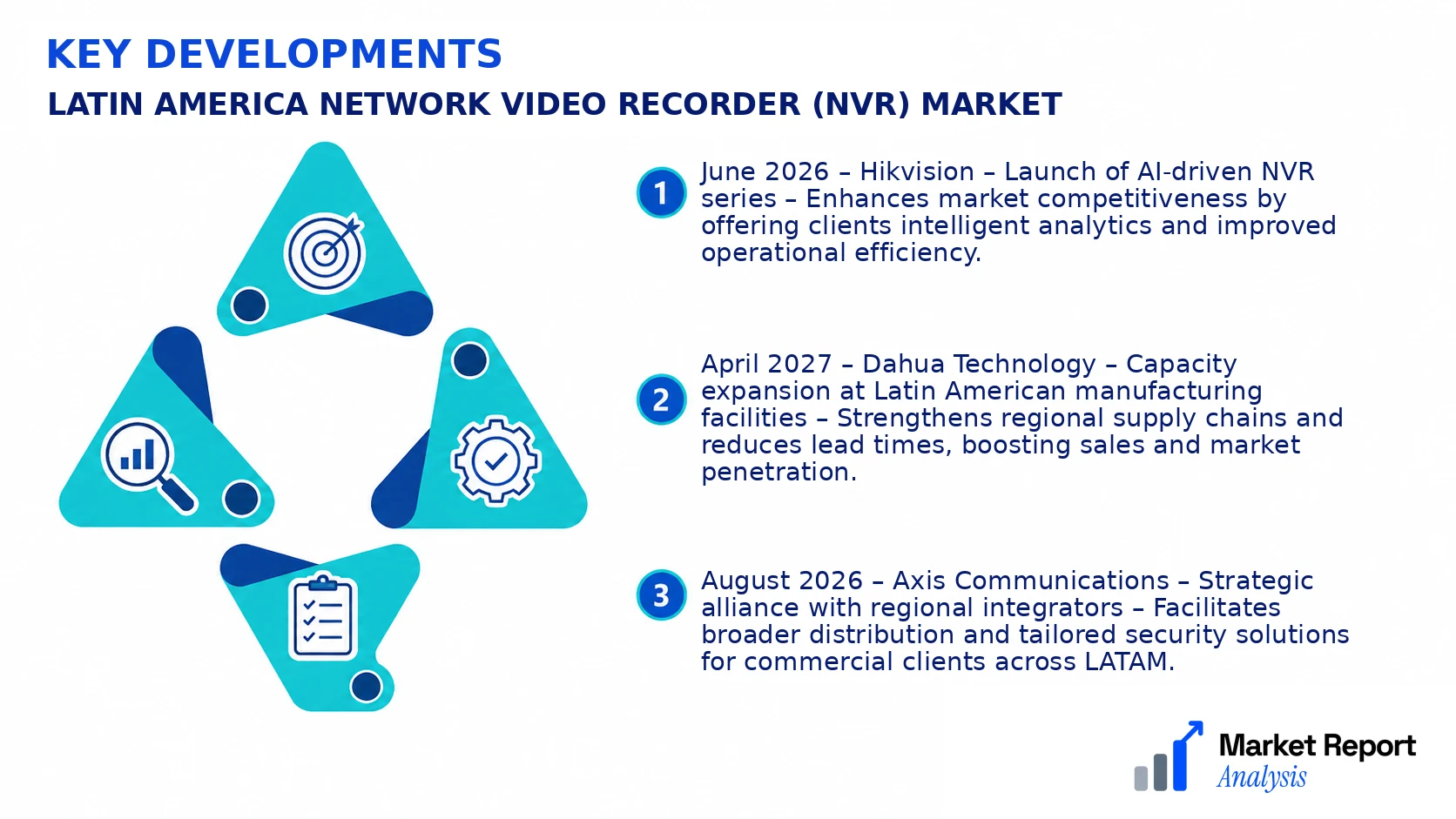
- June 2026 – Hikvision – Launch of AI-driven NVR series – Enhances market competitiveness by offering clients intelligent analytics and improved operational efficiency.
- April 2027 – Dahua Technology – Capacity expansion at Latin American manufacturing facilities – Strengthens regional supply chains and reduces lead times, boosting sales and market penetration.
- August 2026 – Axis Communications – Strategic alliance with regional integrators – Facilitates broader distribution and tailored security solutions for commercial clients across LATAM.
- March 2027 – Bosch Security Systems – Acquisition of a local software developer – Accelerates development of integrated, AI-enabled video management products tailored for Latin American infrastructure projects.
- January 2028 – Pelco by Schneider Electric – Introduction of new cloud-managed NVR systems – Expands cloud-centric security options for enterprise and government markets, increasing system scalability and remote management capabilities.
Frequently Asked Questions
What is the Latin America Network Video Recorder (NVR) Market?
The Latin America Network Video Recorder (NVR) Market encompasses the deployment and sales of NVR systems used for video surveillance in Latin America. It involves devices that record and manage video feeds over IP networks, crucial for security and monitoring applications across diverse sectors.
What is the current market size of Latin America Network Video Recorder (NVR) Market?
As of 2026, the Latin America NVR market is valued at approximately USD X billion, reflecting robust growth driven by increasing security concerns, digital infrastructure expansion, and rising adoption of IoT-based surveillance solutions across the region.
What factors are driving the Latin America Network Video Recorder (NVR) Market?
Market growth is primarily fueled by rising urbanization, government initiatives for public safety, the adoption of smart city projects, and a surge in the deployment of surveillance systems in commercial and residential sectors, alongside technological advancements in NVR devices.
Which region dominates the Latin America Network Video Recorder (NVR) Market?
Brazil is the leading market in Latin America due to its large population, extensive urban infrastructure, and significant investment in security technology. It is followed by Mexico and Argentina, which are also experiencing considerable market penetration.
Which segment is expected to grow the fastest?
The IP-based NVR segment is projected to grow at the fastest rate during 2026-2034, driven by its superior scalability, higher resolution support, and integration capabilities with other surveillance and security systems, making it appealing for future-proof security setups.
Who are the leading companies operating in the Latin America Network Video Recorder (NVR) Market?
Major players include Dahua Technology, Hikvision, Bosch Security Systems, and Hanwha Techwin. These firms are expanding their regional footprint through strategic partnerships, local manufacturing, and innovations in NVR technology to capture emerging opportunities.
Analyst Perspective
The Latin America Network Video Recorder (NVR) market is poised for sustained growth beyond 2034, driven by escalating security concerns, urbanization, and digital transformation initiatives across the region. The evolving technological landscape, including AI integration, cloud connectivity, and enhanced analytics, offers substantial opportunities for innovative service providers to differentiate capabilities and capture market share. Investment priorities are likely to favor scalable, cloud-compatible, and sensor-rich NVR solutions that meet the demands of smart cities and enterprise security environments. Competitive intensity will remain high as global players adapt to regional preferences and regulatory requirements, emphasizing local partnerships and tailored solutions. Regional growth potential is concentrated in Brazil, Mexico, and other developing economies experiencing infrastructural upgrades and increasing surveillance mandates. Long-term strategists should focus on fostering technological agility and regional customization to maintain a competitive edge. Continuous innovation and strategic alliances are essential to capitalize on emerging opportunities and mitigate risks associated with economic fluctuations and regulatory shifts.
