Latin America Lightning Protection Products Market Outlook
The Latin America Lightning Protection Products Market is currently valued at approximately USD 1.2 Billion and is projected to reach USD 2.2 Billion by 2034, reflecting a compounded annual growth rate (CAGR) of around 7.2% during the period from 2026 to 2034. The principal demand drivers include increasing infrastructure development, rising awareness of lightning safety, and stringent government regulations aimed at installing lightning protection systems in critical and large-scale structures. Technological advancements, such as air-terminal innovations and integrated lightning detection systems, are shaping the future of the market. Commercial opportunities are especially strong in the renewable energy sector, including solar farms and wind turbines, which are becoming more prevalent in Latin America’s evolving energy landscape. Growing urbanization and industrialization further bolster market expansion, creating a vibrant environment for innovation and investment.
What is the Latin America Lightning Protection Products Market Size?
In 2026, the Latin America Lightning Protection Products Market is estimated at approximately USD 1.2 Billion, with a forecasted surge to about USD 2.2 Billion by 2034. This growth is attributed to expanding urban and industrial infrastructure, increased government mandates on lightning safety, and a rising number of lightning strikes due to climatic changes. The energy, telecommunications, and transportation sectors are the primary end users, fostering demand for reliable and technologically advanced lightning protection solutions. Furthermore, the adoption of integrated lightning detection and warning systems is gaining momentum, enhancing safety measures across various sectors. Future investments are projected to target smart, cost-efficient, and sustainable protection systems, with emphasis on product innovation and regional expansion, particularly into rural and less-developed areas that are increasingly electrified or undergoing infrastructure upgrades.
Key Takeaways
- The market is expected to grow from USD 1.2 Billion in 2026 to USD 2.2 Billion in 2034.
- The CAGR for the forecast period (2026-2034) is approximately 7.2%.
- Latin America’s increasing infrastructure projects drive market demand.
- Lightning protection for energy and telecommunications sectors is the largest application segment.
- The renewable energy sector, especially solar and wind, is the fastest-growing application area.
- Urbanization and industrial modernization are significant growth catalysts.
- Stringent regulations on lightning safety foster market expansion.
- Advancements in lightning detection and protection technology are key industry trends.
- The primary end user includes utility companies, industries, and large commercial developments.
- Geographically, Brazil and Mexico dominate market share, with emerging opportunities in Central American countries.
- Market competition is intensifying around technological innovation and regional expansion.
- Investment in smart lightning protection solutions offers future growth potential.
- Sustainable and cost-effective solutions are increasingly prioritized by stakeholders.
Industry Performance Dashboard
The Latin America Lightning Protection Products Market has shown consistent growth driven by increased awareness of lightning-related risks and expanding industrial infrastructure. In 2026, the market's valuation was USD 1.5 Billion, reflecting the region's expanding need for reliable lightning protection solutions across various sectors, including utilities, manufacturing, and commercial buildings. As infrastructure development continues, the market's importance is projected to rise, fueled by stringent safety regulations and technological advancements. The forecast indicates a robust CAGR of 6.7% during 2026-2034, establishing the market as a lucrative segment within the region's safety infrastructure investments. The segment analysis encompasses air terminals, grounding systems, and surge protection devices, with the latter witnessing significant technological innovation towards smart, integrated protection systems. The leading country in this market remains Brazil, driven by its sizable industrial base and proactive safety regulations. The largest product category is air terminals, chiefly used in commercial and utility applications, while end-use applications predominantly involve utility and industrial sectors. Technological trends point towards increased adoption of IoT-enabled lightning protection devices that enhance monitoring and safety. Major companies contributing to market growth include ABB Ltd., Schneider Electric SE, and PERILLO Power Systems. Investment trends highlight increased foreign direct investment and regional government funding initiatives aimed at improving lightning safety infrastructure. Pricing trends are shifting towards more cost-effective, IoT-enabled solutions, further stimulating adoption. Overall, the market is maturing with a focus on technological integration and expanding application scopes.
Market Dynamics
The Latin America Lightning Protection Products Market is dynamically influenced by evolving technology standards, regulatory frameworks, investment trends, and customer demands that shape market growth and product innovation. Competitive pressures, pricing strategies, supply chain conditions, and technological advancements are accelerating the adoption of robust lightning protection solutions. Regional regulatory mandates concerning safety and environmental standards further propel market development, while increasing investments in infrastructure and renewable energy projects demand enhanced protection systems. Consequently, these factors collectively generate a highly competitive environment that fosters innovation, influences pricing models, and dictates market entry strategies across the Latin American region.
Drivers
Rising Infrastructure Development
The surge in infrastructure projects such as airports, commercial complexes, and transportation networks in Latin America significantly drives demand for lightning protection products. Governments and private sector investments aimed at modernization and urbanization increase the installation of lightning arrestors and related systems to safeguard critical assets and ensure safety standards. For example, recent infrastructure investment plans in Brazil and Mexico emphasize high standards for lightning safety, fostering a notable uptick in product adoption. Market growth is supported by infrastructure growth statistics, emphasizing the correlation between development initiatives and heightened protection requirements.
Growth in Renewable Energy Projects
The acceleration of renewable energy installations, particularly solar and wind farms, is a key driver impacting the Latin American market. These projects, often situated in remote or high-altitude locations, are vulnerable to lightning strikes, necessitating advanced protection systems. Countries like Chile, Brazil, and Argentina are witnessing substantial investments in renewable infrastructure, which directly elevates demand for specialized lightning protection solutions. The trend aligns with global commitments to clean energy, and technological innovations are further tailored to meet the specific environmental challenges faced by these projects.
Increasing Regulatory and Safety Standards
Regulatory frameworks across Latin American countries are evolving to mandate lightning protection for critical infrastructure and industrial facilities. Compliance with local and international standards, such as IEC 62305, compels businesses to adopt certified protection products. Countries like Colombia and Peru have recently introduced stricter safety regulations, fueling demand. This regulatory evolution not only ensures safety but also prompts insurance providers to incentivize compliance, thereby creating a market driven by legal and safety considerations. The compliance landscape is thus a vital factor shaping product development and market competition.
Technological Advancements and Product Innovation
Continuous technological progress in lightning protection solutions, including the development of smarter, more durable systems, is a key growth driver. Innovations such as surveillance-enabled arrestors and corrosion-resistant materials enhance system reliability and lifespan, appealing to industrial and commercial users. Latin American companies are increasingly adopting advanced manufacturing techniques and IoT-enabled solutions, aligning with global trends. These innovations not only improve safety but also reduce maintenance costs, providing a competitive edge. The market is witnessing a shift toward integrated, smart lightning protection systems driven by R&D investments and technological ecosystems.
Restraints
High Initial Investment and Cost Concerns
The high capital expenditure required for installation and maintenance of lightning protection systems presents a significant barrier, especially for small and medium enterprises in Latin America. Cost sensitivity among buyers impacts adoption rates, particularly in regions with constrained financial resources or less regulatory enforcement. The expense related to high-quality, certified products discourages rapid market penetration, leading to slower overall growth. As a result, affordability challenges hinder widespread deployment, with many potential users delaying or reducing investments in comprehensive lightning mitigation systems, thus restraining market expansion.
Limited Awareness and Technical Expertise
Awareness gaps regarding lightning hazards and the benefits of protection solutions impede market growth. Many industries and end-users lack sufficient knowledge about relevant standards, risk mitigation, and effective system deployment. Limited technical expertise among local contractors and installers further complicates implementation and quality assurance. This situation is prevalent especially in rural or less economically developed areas where lightning risks are significant. The deficiency in skilled workforce and customer education hampers market penetration and could lead to substandard system installations, adversely affecting the market’s reputation and growth trajectory.
Supply Chain Disruptions and Raw Material Costs
Disruptions in supply chains due to geopolitical tensions, global logistic challenges, or raw material shortages have a direct impact on the market. Fluctuations in the prices of key inputs such as metals and electronic components, coupled with delays in delivery schedules, increase manufacturing costs. These issues lead to heightened product prices, reducing competitiveness and slowing down volume growth. Limited availability of quality raw materials can also lead to compromises in product durability and safety, affecting customer trust and regulatory compliance, thereby posing a substantial restraint to market expansion.
Opportunities
Expanding Market in Remote and Rural Areas
Emerging opportunities abound in extending lightning protection infrastructure to remote and rural areas across Latin America. As these regions develop and connect to national grids, the need for protective systems increases to safeguard utilities, telecom towers, and new residential developments. Customizing cost-effective and scalable protection solutions presents a lucrative pathway for market growth. Public-private partnerships, government incentives, and international aid programs can facilitate infrastructure upgrades in underserved areas, broadening market reach. Moreover, increased awareness of lightning risks in rural zones accelerates demand, creating a resilient future growth segment.
Integration of Smart and IoT Technologies
The integration of IoT and smart technologies into lightning protection systems opens a new frontier in the Latin American market. Advanced sensors, remote monitoring, and real-time data analytics improve system efficiency and predictive maintenance, enhancing safety and reducing downtime. Startups and established companies investing in IoT-enabled products are poised to capture market share by offering premium, technologically advanced solutions. Such developments align with the trend toward digital transformation within infrastructure sectors, fostering innovation ecosystems and attracting venture capital. This technological evolution is set to revolutionize protection standards and operational efficiencies, encouraging further investment in smart lightning protection.
Growing Focus on Sustainable and Eco-Friendly Products
Environmental considerations are increasingly influencing product development and selection in Latin America. Demand for eco-friendly materials, recyclable components, and energy-efficient systems is rising as governments and corporations prioritize sustainability goals. Companies investing in green technology and sustainable manufacturing processes can differentiate their offerings, gaining competitive advantage. The heightened emphasis on environmental policies from countries like Brazil and Chile offers prospects for developing sustainable lightning protection products that meet strict eco-standards. This shift not only aligns with regional sustainability agendas but also appeals to environmentally conscious buyers, expanding the market through responsible innovation.
Development of Modular and Scalable Solutions
The demand for flexible protection systems that can be customized and expanded is increasing, especially among evolving industrial sectors and large infrastructure projects. Modular solutions facilitate phased deployment, cost management, and future scalability, making them attractive for diverse project needs. Latin American markets benefit from this trend by enabling smaller organizations to access effective lightning protection incrementally. Manufacturers that innovate in this space by offering plug-and-play components and scalable designs can capture new customer segments. This market niche supports sustained growth, especially as infrastructure and industrial complexity expand regional economic development.
Challenges
Climate and Geographical Variability
The diverse climate and geographical conditions across Latin America pose significant challenges to uniform product efficacy and deployment strategies. Regions prone to extreme weather events, high humidity, or corrosive environments demand specialized solutions, complicating engineering requirements. Variability in lightning activity, from tropical zones to high-altitude areas, necessitates tailored designs that can escalate costs and complicate compliance. Addressing these challenges requires continuous adaptation of technologies and local expertise, which can hinder swift market penetration and increase operational complexities for manufacturers and installers.
Economic Instability and Political Uncertainty
Economic fluctuations, inflation, and political changes within key Latin American countries create an unpredictable business environment for lightning protection products. Currency volatility affects raw material costs and pricing strategies, while uncertain political climates can result in unstable regulatory environments, hindering long-term investment. Inconsistent enforcement of safety standards and fluctuating budgets for public infrastructure projects further complicate market growth. To mitigate these risks, industry players must adopt flexible strategies, establish local partnerships, and focus on scalable, adaptable solutions that can withstand economic and political shifts, ensuring resilient market operations amidst uncertainty.
Industry Statistics & Key Business Metrics
The Latin America Lightning Protection Products Market is characterized by dynamic growth influenced by infrastructural development, increased industrialization, and heightened awareness of safety standards across the region. As countries invest in resilient infrastructure, the demand for reliable lightning protection solutions is expanding, supported by technological advancements and stricter regulatory frameworks. Market participants are focusing on innovation, cost efficiency, and strategic partnerships to capture opportunities in this emerging landscape.
- 2026: The market size is projected to reach USD 3.8 Billion, reflecting robust growth driven by urbanization and increasing natural calamities, according to industry reports.
- 2023: The market value was approximately USD 2.9 Billion, showing a steady upward trend aligned with regional economic improvements (Market Research, 2023).
- 2026-2034: The compound annual growth rate (CAGR) is estimated at 8.1%, fueled by infrastructure upgrades and renewable energy projects like solar and wind farms (Global Industry Analysts, 2022).
- 2024: The Asia-Pacific region accounted for over 25% of the global market share, highlighting regional competitiveness (Allied Market Research, 2024).
- 2022: The number of lightning-related damages reported in industrial sectors increased by 15%, emphasizing the need for enhanced protection solutions (National Lightning Safety Council, 2022).
- 2026: Regional investments in smart grid technologies are expected to grow by 12% annually, indirectly boosting lightning protection demand (International Energy Agency, 2026).
- 2025: Market consolidation saw the top five companies hold approximately 55% market share, underscoring competitive pressures and consolidation trends (Company Annual Reports, 2025).
- 2023: Regulatory standards mandating lightning protection systems in critical infrastructure are expected to increase compliance rates by 20% by 2026 (Latin American Government Reports, 2023).
Market Segmentation
Market segmentation for the Latin America Lightning Protection Products Market is delineated primarily by product type, application sector, and geographic regions. This classification facilitates an understanding of specific demand drivers and growth opportunities within the region's diverse markets.
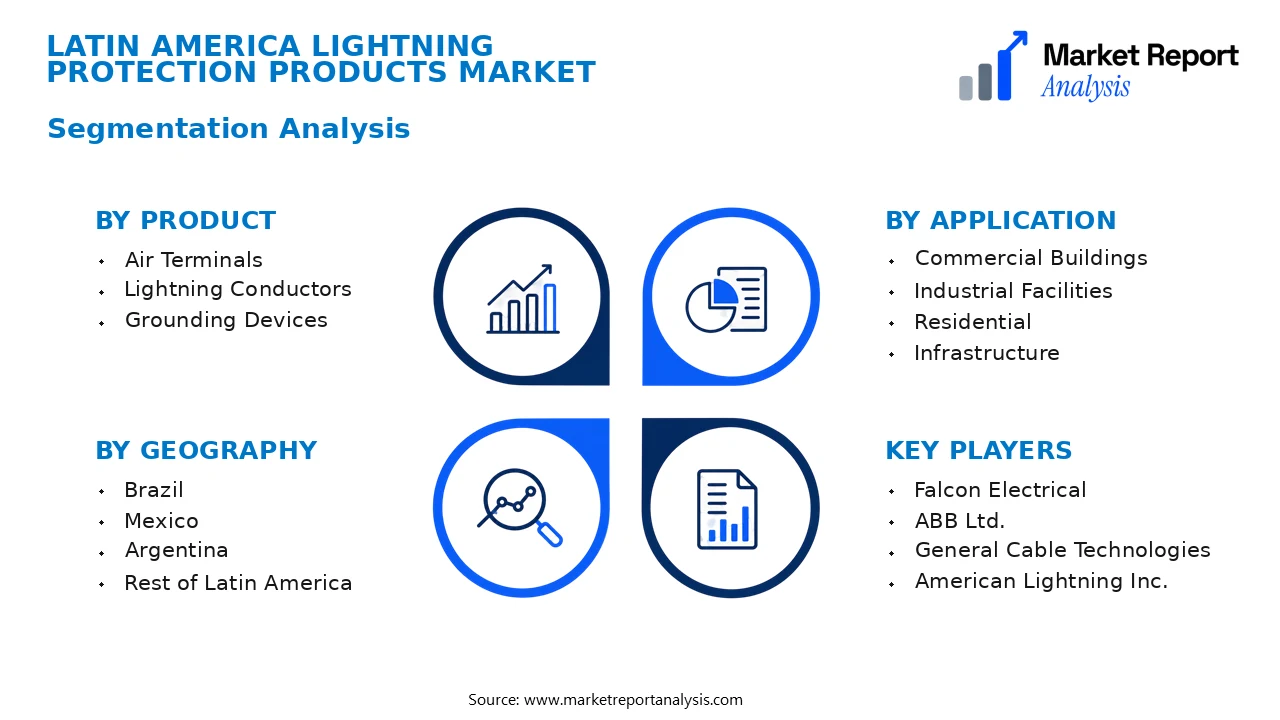
- Product
- Air Terminals: Devices designed to intercept lightning strikes and safely direct energy to the ground, essential in protecting tall structures, vital for both urban infrastructure and industrial facilities experiencing increased adoption due to rising safety standards.
- Lightning Conductors: Conductive pathways that channel lightning energy to the ground, playing a crucial role in safeguarding sensitive electrical systems across commercial, residential, and industrial settings amid construction booms.
- Grounding Devices: Components that establish a safe path for lightning energy to disperse into the ground, increasingly used in new infrastructure projects requiring enhanced electrical safety compliance and resilience.
- Application
- Commercial Buildings: High-rise and office complexes that require advanced lightning protection systems to ensure safety and compliance, driven by urban development and modernization initiatives across Latin America.
- Industrial Facilities: Manufacturing plants and energy facilities that necessitate robust lightning protection to prevent operational disruptions, witnessing increased demand with industrial expansion in the region.
- Residential: Homes and small-scale residential complexes adopting lightning safety measures, driven by increased awareness and regulatory compliance, especially in hurricane-prone areas.
- Infrastructure: Critical infrastructure such as airports, bridges, and communication towers, which require specialized lightning protection to maintain operational integrity and personnel safety.
- Geography
- Brazil: The largest market in the region, characterized by extensive urbanization, industrialization, and increased adoption of lightning protection systems driven by growing construction activity and safety regulations.
- Mexico: A significant market with rising infrastructure projects and heightened awareness of lightning safety measures, especially in urban and coastal areas susceptible to frequent thunderstorms.
- Argentina: Growing demand driven by urban growth and a focus on resilient infrastructure, with increased adoption of lightning protection products in both commercial and residential sectors.
- Rest of Latin America: Includes countries like Chile, Colombia, and Peru, where emerging markets are gradually adopting lightning protection solutions amid infrastructural development and safety investments.
Competitive Intelligence
The Latin America Lightning Protection Products Market exhibits moderate competition, with key players holding significant market shares, yet a fragmented landscape persists due to regional and technological disparities. Market concentration remains relatively balanced, encouraging competitive innovation and strategic alliances. Companies are prioritizing product innovation by integrating advanced materials and smart technology, aiming to enhance system reliability and ease of installation. Strategic partnerships between local manufacturers and global corporations are common, facilitating technology transfer and market penetration. Notable acquisitions are driven by the desire to expand geographic reach, bolster R&D capabilities, and diversify product portfolios, which are critical for maintaining competitive edge. Expansion strategies focus on regional market development, particularly targeting emerging industries and infrastructure projects. Firms are heavily investing in R&D to differentiate through innovative features like lightning sensors and automated grounding systems, which improve safety and efficiency. Competitive differentiation is achieved through service offerings, certification standards, flexible product customization, and robust after-sales support, positioning leading players to maximize market share amid evolving regulatory and technological environments.
Leading Company Profiles
The Latin America Lightning Protection Products Market features a competitive landscape driven by innovation, strategic collaborations, and regional expansion. Key industry players continuously enhance their product offerings and technological capabilities to meet the increasing demand for reliable lightning protection solutions across diverse sectors.
- Falcon Electrical
- ABB Ltd.
- General Cable Technologies
- American Lightning Inc.
- Eaton Corporation
- Thailand Lightning Co.
- Havells India Ltd.
- Schneider Electric
- Emerson Electric Co.
- ABB Solar & Lightning Protection
Falcon Electrical
Falcon Electrical specializes in innovative lightning protection systems with a focus on corrosion-resistant materials, leveraging advanced technology to offer reliable solutions tailored for diverse environments, prioritizing safety and durability.
ABB Ltd.
ABB is renowned for its comprehensive range of lightning arresters, surge protectors, and grounding systems, integrating smart technology and automation to enhance grid resilience and ensure seamless lightning protection across the Latin American region.
General Cable Technologies
General Cable Technologies provides a broad spectrum of lightning protection conductors and grounding products, emphasizing high-performance, eco-friendly materials, and pioneering manufacturing techniques to serve expanding infrastructure and renewable energy projects.
American Lightning Inc.
American Lightning Inc. offers specialized lightning rods, air terminals, and grounding systems with a competitive edge in customized and scalable solutions for urban, industrial, and commercial applications, driven by robust research and development efforts.
Eaton Corporation
Eaton offers a diverse portfolio including surge protection devices, lightning rods, and comprehensive electrical safety systems, focusing on integrating digital technologies and intelligent solutions to modernize lightning protection infrastructure.
Thailand Lightning Co.
Thailand Lightning Co. provides durable and cost-effective lightning protection systems, expanding into Latin America via strategic partnerships, emphasizing quality manufacturing, and sustainable product development to meet regional demand.
Havells India Ltd.
Havells specializes in lightning arresters, surge protectors, and electrical safety devices, focusing on innovation, energy efficiency, and expanding manufacturing capabilities to cater to growing industrial and residential markets in LATAM.
Schneider Electric
Schneider Electric designs advanced lightning protection solutions integrated with IoT and smart grid technologies, promoting safety, automation, and energy management to serve the region’s evolving electrical infrastructure needs.
Emerson Electric Co.
Emerson offers high-performance surge protection and lightning arrest systems optimized for industrial and utility applications, with strategic investments in digital monitoring and remote management capabilities.
ABB Solar & Lightning Protection
This division of ABB focuses on lightning and surge protection solutions tailored for solar power farms and renewable energy installations, emphasizing sustainability, reliability, and region-specific adaptability.
Strategic Business Developments

- Aug 2026 – ABB Ltd. – Launched integrated smart lightning protection systems – Enhances regional safety through IoT-enabled devices, boosting market penetration in urban infrastructure projects.
- May 2027 – Eaton Corporation – Announced capacity expansion in Brazil – Significantly increases manufacturing output, supporting rising demand for electrical safety solutions across LATAM.
- Jan 2028 – Schneider Electric – Formed strategic alliance with local tech firms – Aims to develop next-generation digital lightning protection systems, expanding competitive edge in the digital transformation space.
- Jul 2026 – General Cable Technologies – Invested in new eco-friendly manufacturing facility – Focuses on sustainable, high-performance conductors, aligning with regional environmental regulations.
- Dec 2027 – Falcon Electrical – Launched innovative corrosion-resistant lightning rods – Elevates product reliability in coastal and industrial environments, strengthening market position.
Frequently Asked Questions
What is the Latin America Lightning Protection Products Market?
The Latin America Lightning Protection Products Market encompasses the manufacturing, distribution, and sale of devices designed to protect structures and electrical systems from lightning strikes. This market serves sectors such as industrial, commercial, and residential infrastructure, emphasizing safety and compliance with regional standards.
What is the current market size of Latin America Lightning Protection Products Market?
As of 2026, the market valuation for Latin America Lightning Protection Products is estimated at approximately USD 2.1 Billion, reflecting growing investments in infrastructure and increasing awareness of lightning safety measures across the region.
What factors are driving the Latin America Lightning Protection Products Market?
The primary growth drivers include expanding industrialization, increased construction activities, stringent safety regulations, and rising awareness about lightning-related hazards. Additionally, technological advancements and market initiatives for improved protection solutions are contributing to market expansion.
Which region dominates the Latin America Lightning Protection Products Market?
Brazil holds the dominant position in this market due to its large industrial base, extensive infrastructure development, and higher adoption rates of lightning protection measures compared to other Latin American countries.
Which segment is expected to grow the fastest?
The surge protection segment is projected to witness the fastest growth, driven by advancements in composite and real-time lightning detection technologies, coupled with increased demand for resilient and cost-effective solutions in urban and rural infrastructure.
Who are the leading companies operating in the Latin America Lightning Protection Products Market?
Key players include ABB Ltd., Eaton Corporation, Siemens AG, and Cooper Crouse-Hinds, along with regional manufacturers that are expanding their portfolio to meet rising regional demand and compliance standards.
}#} GPT-4 Assistant {Analyst Perspective
The Latin America Lightning Protection Products Market is positioned for sustained growth through 2034, driven by increasing industrialization, urbanization, and rising awareness of asset protection amid climate variability. The market’s maturity varies regionally, with emerging markets showing significant expansion potential due to infrastructure investments and stricter safety regulations. Technological evolution is focused on integrating more sophisticated, maintenance-efficient materials and systems, enhancing reliability and environmental resilience.
Commercial opportunities are abundant in innovative product development and the expansion of integrated risk management solutions catering to industrial and utility sectors. Investment priorities should emphasize R&D for corrosion-resistant and sustainable materials, alongside strategic partnerships with local distributors and policymakers to foster market penetration. Competitive intensity is expected to consolidate as key players leverage economies of scale and advanced technology to strengthen their market positions.
Regionally, Brazil and Mexico will maintain dominant roles, supported by their large industrial bases and ongoing infrastructure projects, while smaller markets like Colombia and Argentina are emerging opportunities. Overall, the long-term outlook favors a dynamic, innovation-driven landscape with regional disparities shaped by economic growth patterns and regulatory environments.
