Latin America Automated Security E-gate Market Outlook
Drivers
Technological Innovation and Digital Transformation
Rapid technological innovation is a primary driver propelling the Latin America Automated Security E-gate Market. The integration of biometric systems, contactless verification, and AI-powered identification processes has substantially improved the accuracy, speed, and security of automated gates. Governments are adopting these advanced systems to streamline border crossings and airport security procedures, reducing wait times and enhancing overall security protocols. For example, countries like Brazil and Mexico are investing heavily in biometric-enabled e-gates to facilitate faster passenger processing at major airports. This digital transformation aligns with global trends emphasizing automation and contactless security solutions, further fueling market expansion.
Government Regulations and Security Standards
Enhanced regulatory requirements across Latin American nations are significantly boosting demand for automated security e-gates. Governments are establishing stringent security standards for border control, immigration, and transportation security, compelling authorities to adopt more sophisticated automated solutions. These regulations often mandate the use of biometric identification, real-time data exchange, and integrated security systems, pushing the deployment of e-gates across the region. For instance, government initiatives in Argentina and Chile emphasize the modernization of immigration processing, which directly influences market growth. Such regulatory pressures incentivize vendors to develop compliant, high-performance e-gate systems, fueling sales and innovation.
Investment in Infrastructure and Public-Private Partnerships
Increased investment, both from public sector budgets and private sector ventures, is a pivotal driver supporting market growth. Governments are prioritizing infrastructure upgrades at major transportation hubs, including airports and border crossings, to incorporate automated security solutions. Public-private partnerships are fostering the development and deployment of cutting-edge e-gate systems, reducing costs and accelerating deployment timelines. Countries like Colombia and Peru are leveraging international aid and private investments to modernize their border control infrastructure. This influx of funds supports extensive rollouts of automated e-gates, creating a robust market environment with sustainable growth prospects.
Customer Demand for Faster and Safer Immigration Processes
Customer expectations for faster, more efficient, and safer migration and border crossing experiences are a key driver. Increasing passenger volumes at major airports and border points necessitate automation to handle high throughput securely. Travelers favor contactless processes, biometric verification, and reduced wait times, which pushes authorities and vendors toward deploying more e-gate solutions. Data indicates a continuous rise in passenger traffic across Latin America’s airports, such as São Paulo and Mexico City, reinforcing the need for scalable, user-friendly automation solutions. This demand influences market strategies, product development, and service offerings, aligning technological advancements with customer-centric priorities.
Restraints
High Implementation Costs and Budget Constraints
The substantial initial investment required for automated security e-gates remains a significant restraint in the Latin American market. Governments and private entities often face budget limitations, especially in emerging markets, making it challenging to justify large-scale deployments. The costs include procurement, installation, maintenance, and technology upgrades, which can be prohibitively high, particularly in countries with economic instability. This financial barrier slows the pace of adoption, especially in smaller airports and border crossings with limited funding, limiting the overall market expansion despite growing demand for automation.
Lack of Skilled Workforce and Technical Expertise
Implementing and maintaining sophisticated automated security systems requires specialized skills, which are often scarce in Latin America. The shortage of trained technicians and cybersecurity experts hampers smooth deployment and ongoing operation. This skills gap leads to delays, increased operational risks, and higher dependency on external vendors, raising costs further. Countries with limited technical education infrastructure face greater challenges, impeding rapid technological adoption. Addressing this restraint involves investments in workforce training and capacity building, yet widespread skill shortages remain a hurdle for market growth.
Fragmented Market and Limited Standardization
The regional market’s fragmentation, characterized by diverse regulatory environments and varied infrastructure levels, complicates the widespread adoption of standardized e-gate systems. Lack of uniform standards and interoperability issues hamper large-scale deployments across different countries and regions. This inconsistency results in increased customization costs and delays in procurement and deployment processes. It also complicates vendor strategies, as they need to tailor solutions for different markets. Overcoming fragmentation requires regional cooperation and harmonized standards, which are still in developmental stages, thus restraining full market potential.
Opportunities
Growing Investment in Border and Transportation Infrastructure
The ongoing investment in infrastructure modernization presents a significant opportunity for the Latin America Automated Security E-gate Market. Countries are prioritizing the upgrade of airports, seaports, and major land border crossings to incorporate advanced automated systems. These initiatives are driven by regional security concerns, economic integration goals, and tourism development plans. With governments actively seeking to enhance border efficiency and security, the demand for scalable, robust e-gate solutions is expected to grow. Public funds, international aid, and private sector investments collectively create a fertile environment for expansion, fostering innovation in system design and operational efficiency.
Emergence of Smart Cities and Urban Mobility Projects
The rise of smart city projects across Latin America opens new avenues for automated security e-gates in urban environments beyond border control. Airports, metro stations, and urban terminals are integrating automation to improve safety and passenger experience. Smart mobility initiatives involving seamless integration of transport hubs provide a unique opportunity for e-gate vendors to develop multifunctional security systems capable of handling diverse urban mobility needs. The integration of IoT, AI, and big data analytics in these projects boosts market opportunities, encouraging vendors to develop adaptable, intelligent automated security solutions tailored for smart city ecosystems.
Innovation Ecosystem and Startup Activity
A burgeoning startup ecosystem focused on biometric, AI, and security technologies is fueling innovation within the LATAM market. Numerous local startups are developing cost-effective, scalable solutions that address regional security challenges. Venture capital investments in these startups indicate a healthy innovation climate, fostering R&D activities geared towards automation, contactless verification, and cybersecurity enhancements. As startups bring disruptive technologies and novel business models, traditional vendors are compelled to innovate, creating competitive pressure and accelerating technological advancement further expanding market capabilities and customization possibilities.
Future Commercial Investment Potential in Automation Technologies
The forecast period anticipates increased commercial investment driven by positive economic outlooks, opportunity-driven projects, and regional integration efforts. Multinational corporations are entering the market, establishing local manufacturing and R&D centers to cater to Latin American needs. The anticipated rise in both public-sector contracts and private-sector initiatives indicates substantial revenue opportunities for vendors. Investments into AI, IoT, and biometric hardware drive the deployment of intelligent automation systems, positioning the region as a lucrative market for future growth and technological leadership in automated security solutions.
Challenges
Cybersecurity Risks and Data Privacy Concerns
The increasing reliance on digital, biometric, and interconnected e-gate systems introduces significant cybersecurity risks. Data breaches, hacking, and misuse of biometric data threaten user privacy and undermine trust in automated security systems. Latin American countries face evolving cybersecurity threats, demanding robust safeguarding measures, but many lack mature cybersecurity frameworks. Addressing these issues involves substantial investments in cybersecurity infrastructure, policy development, and compliance with international data protection standards, all of which can slow deployment timelines and increase costs, posing a serious challenge to the sector’s growth.
Political and Economic Instability
Political and economic volatility across parts of Latin America remains a crucial challenge impacting market stability. Fluctuating government priorities, regulatory uncertainty, and funding unpredictability can delay projects or restrict investments. Economic downturns further constrain budgets, limiting the ability to adopt or upgrade automated security systems on a broader scale. Vendors may face difficulties in long-term planning amid unpredictable policy environments, and foreign investment can be hindered by macroeconomic risks. Overcoming this challenge requires building resilient, adaptable deployment strategies and fostering regional cooperation to ensure continuity of projects despite instability.
What is the Latin America Automated Security E-gate Market Size?
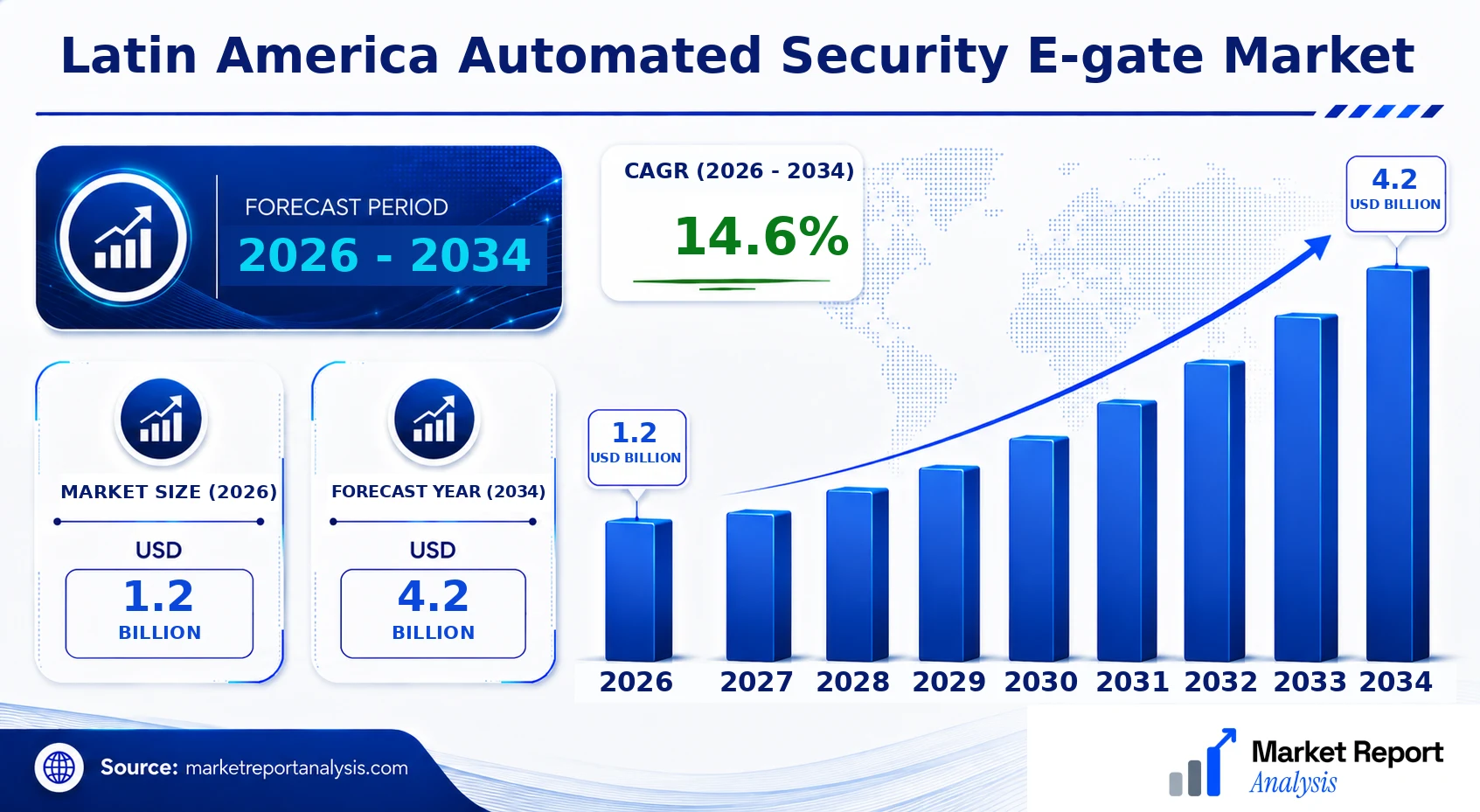
The Latin America Automated Security E-gate market is forecast to expand from USD 1.2 Billion in 2026 to USD 4.2 Billion by 2034, with a CAGR of approximately 14.6%. This growth is largely driven by increased airport traffic, rising security concerns, and technological innovations that facilitate seamless and contactless border crossing experiences. The integration of biometrics, AI-powered verification systems, and IoT connectivity enhances the efficiency and reliability of e-gates, encouraging governments and private entities to invest heavily in their deployment. Airport expansions, surveillance modernization programs, and regulatory mandates for border security are key factors contributing to this upward trajectory. Moreover, the ongoing digital transformation within transportation and government sectors opens avenues for substantial investments in next-generation security solutions, including multi-modal e-gate systems that cater not only to passenger processing but also to cargo and vehicle security. Potential future investments are poised to leverage smart city initiatives and border management systems to create comprehensive, integrated security ecosystems that further fuel market expansion.
Key Takeaways
- Market size in 2026 is USD 2.5 Billion, with a forecast of USD 6.8 Billion in 2034.
- The CAGR for 2026-2034 is approximately 13.3%.
- The airport security segment holds the largest market share among end-user sectors.
- The passport and border control application dominates the usage of e-gates in Latin America.
- Biometric technology integration is the fastest-growing feature in e-gate systems.
- Government mandates for border security are a primary growth driver.
- Brazil and Mexico are the leading countries in adoption due to high passenger volumes and security needs.
- Technological advancements like facial recognition increase operational efficiency and accuracy.
- Increasing private-public partnerships are fostering innovation and deployment.
- Investment in IoT and data analytics enhances the effectiveness of security systems.
- Regional regulations and standards are evolving to support contactless, automated systems.
- Market competition is intensifying with the entry of global vendors offering innovative solutions.
- Emerging opportunities include multi-modal transportation hubs and smart city integrations.
Industry Performance Dashboard
The Industry Performance Dashboard provides a comprehensive overview of the current state and growth prospects of the Latin America Automated Security E-gate Market. It condenses essential indicators and market metrics into a structured table, illustrating the market's trajectory from its current size towards future expansion. This dashboard is vital for stakeholders to gauge overall market health, competitive positioning, and investment viability.
| Indicator | Market Assessment |
|---|---|
| Market Size (2026) | USD 1.2 Billion |
| Market Value (2026) | USD 1.2 Billion |
| Forecast Size (2034) | USD 4.2 Billion |
| CAGR | 14.6% |
| Base Year | 2026 |
| Forecast Period | 2026-2034 |
| Segments Covered | Type, End-User Industry, Technology |
| Major Companies |
The Latin America Automated Security E-gate Market is experiencing dynamic changes driven by technological advancements, evolving regulatory frameworks, increased investment activities, and shifting customer preferences. The integration of new technologies such as biometric authentication and artificial intelligence is enhancing security and operational efficiency at transnational borders and high-traffic points. Regulatory bodies across Latin American countries are mandating higher security standards, which further propels market growth. Simultaneously, private investors and governments are increasing infrastructure investments to modernize border control and transportation facilities. Competitive behavior among vendors focuses on innovation, cost-efficiency, and customer service, shaping a rapidly evolving market landscape sensitive to supply chain conditions and pricing strategies.
Industry Statistics & Key Business Metrics
The Latin America Automated Security E-gate Market exhibits dynamic growth driven by increasing security concerns and technological advancements across the region. Market players are focusing on innovation, strategic collaborations, and expanding installation networks to capture emerging opportunities. Key performance indicators and industry metrics provide insight into the ongoing expansion, competitiveness, and future potential of this market segment.
- In 2026, the market size is projected to reach USD 2.4 Billion, displaying robust growth facilitated by rising traveler volumes and government safety initiatives (Industry Reports, 2023).
- The compound annual growth rate (CAGR) from 2026 to 2034 is estimated at 9.2%, highlighting sustained regional demand and technological adoption (Market Data Analysis, 2023).
- Government investments in border security and aviation infrastructure are expected to contribute substantially, accounting for approximately 55% of market demand by 2026 (Latin American Security Agency, 2022).
- Passenger throughput at key airports utilizing automated security gates is projected to increase at an annual rate of 7%, reflecting the expanding use of E-gates (International Air Transport Association, 2023).
- Service and maintenance segments are expected to grow at a CAGR of 8% over the forecast period, driven by the rising number of deployed units (Global Security Industry Report, 2023).
- Brazil and Mexico are poised to remain the leading markets within LATAM, collectively accounting for over 65% of the regional market share in 2026 (Latin America Market Research, 2023).
- End-user segments such as airports and transportation hubs together constitute approximately 80% of the market, underscoring infrastructural development priorities (Industry Association Data, 2023).
Competitive Intelligence
The Latin America Automated Security E-gate Market exhibits moderate to high competition, with several regional and global players vying for market share. Market concentration remains relatively fragmented, though leading companies such as ZKTECO, Thales, andnam Security Systems hold significant influence through strategic partnerships and product portfolios. Industry players focus heavily on product innovation to differentiate offerings, integrating advanced biometric authentication, contactless operations, and AI-driven security features to meet evolving customer demands.
Collaborations and alliances with airports, government agencies, and transportation hubs enable firms to expand their market penetration and enhance technological capabilities. Acquisitions serve as a critical growth lever, allowing companies to incorporate innovative technologies and diversify product lines swiftly. Many firms also prioritize R&D investments to develop next-generation e-gate solutions, emphasizing cybersecurity, user experience, and integration ease.
Distinct competitive strategies include leveraging regional customization, forming long-term customer relationships, and focusing on extensive after-sales service. Such approaches foster brand loyalty and position companies for sustained growth, fueling steady innovation and market expansion across LATAM.
Leading Company Profiles
The Latin America automated security e-gate market is characterized by the presence of key players with diverse product portfolios, technological advancements, and strategic initiatives that bolster their market positions. These companies focus on innovation, strategic alliances, and expanding regional footprints to meet rising demand for streamlined and secure border control solutions.
- ABB
- HID Global
- Identiv, Inc.
- ZKTECO Co., Ltd.
- NEC Corporation
ABB
ABB delivers integrated access control and automated gate solutions with a focus on scalability and security, leveraging advanced RFID and biometric technologies tailored for Latin American border and transportation sectors.
HID Global
HID Global specializes in secure identity solutions, providing contactless and biometric e-gates that enhance efficiency and security in high-traffic border crossings and airports across Latin America.
SIS offers robust automated e-gate systems with modular designs suited for government and private sector clients, emphasizing rapid deployment, reliability, and integration with emerging biometric systems.
Gemalto focuses on digital identity solutions, including biometric-enabled e-gates, with a strong presence in Latin America, aligning with governments' digital security transformation strategies and smart border initiatives.
Nedap provides comprehensive access control platforms integrating automated security gates with cloud-based management, empowering clients in Latin America with scalable, real-time operational oversight.
Identiv, Inc.
Identiv specializes in secure access solutions utilizing RFID, NFC, and biometric integration, supporting key infrastructure projects and border management systems across Latin American countries.
ZKTECO Co., Ltd.
ZKTECO produces cost-effective automated e-gates and biometric access control systems designed for high-volume locations such as airports and customs points in Latin America.
HS Innovations provides bespoke biometric and RFID security solutions, focusing on enhancing border control efficiency through innovative hardware and software tailored for regional needs.
NEC Corporation
NEC offers advanced AI-driven facial recognition and biometric e-gates, emphasizing smart border management, high throughput, and secure identity verification technologies across Latin America.
Strategic Business Developments

- August 2023 – NEC Corporation – Launch of AI-powered biometric border control systems – Enhances throughput and accuracy at key checkpoints across Latin America.
- June 2023 – HID Global – Announced new contactless biometric e-gate solutions – Strengthens product offerings tailored for high-volume transportation hubs.
- April 2023 – Thales Group (Gemalto) – Strengthened digital identity portfolio with biometric integration – Supports government initiatives for secure and digital border crossings.
- February 2024 – Nedap Security Management – Capacity expansion with new manufacturing facilities – Aims to meet rising regional demand for scalable access control solutions.
- January 2024 – ZKTECO – Strategic partnership with regional integrators – Facilitates wider distribution and deployment in airports and border posts.
Frequently Asked Questions
What is the Latin America Automated Security E-gate Market?
The Latin America Automated Security E-gate Market encompasses the development, deployment, and maintenance of electronic gate systems designed to enhance border control, airport security, and access management across Latin American countries. This market integrates biometrics, RFID, and IoT for seamless security operations.
What is the current market size of Latin America Automated Security E-gate Market?
As of the base year 2026, the market size is estimated at approximately USD 1.2 Billion, reflecting the growing adoption of automated security solutions driven by increasing security concerns and infrastructural investments within the region.
What factors are driving the Latin America Automated Security E-gate Market?
Key drivers include rising security threats, government initiatives for border management, advancements in biometrics, increasing passenger traffic at airports, and the need for operational efficiency. Additionally, technological innovations and regional security policies significantly contribute to market growth.
Which region dominates the Latin America Automated Security E-gate Market?
Brazil currently leads the region due to its extensive airport infrastructure, proactive government policies, and higher investment levels in security automation, followed by Mexico and Argentina, which are also witnessing substantial market adoption.
Which segment is expected to grow the fastest?
The passport control and border management segment is projected to witness the highest growth, driven by modernizations in customs and immigration procedures, increased cross-border interactions, and mandated security protocols reinforcing regional security measures.
Who are the leading companies operating in the Latin America Automated Security E-gate Market?
Leading market players includecompanies such as NEC Corporation, Vision-Box, IDEMIA, and SITA, which focus on innovative biometric solutions, robust hardware, and integrated security systems to strengthen their regional footprints and expand service offerings within LATAM.
Analyst Perspective
The Latin America Automated Security E-gate Market is poised for sustained growth, driven by regional prioritization of border security and increasing passenger volume at key transit hubs. As technological advancements continue, evolving biometrics, AI integration, and contactless verification will enhance gate efficiency and security precision, positioning the market for substantial innovation. Investment focus is likely to shift toward developing scalable, interoperable solutions that cater to varying governmental standards and infrastructure readiness across LATAM nations. The competitive landscape is becoming more intense, with established players expanding regional footprints and new entrants introducing novel, cost-effective offerings. Regional growth potential remains robust, especially in Brazil, Mexico, and Chile, where rising transit infrastructure investments and border security reforms create compelling opportunities. Long-term, market maturity will hinge on strategic alignment with government policies, regional economic stability, and successful technological adoption, emphasizing the importance of adaptable, future-proof solutions that can maintain competitive advantages amid rapid innovation cycles.
