Japan High Purity Metal Organics HPMO Market Outlook
The Japan High Purity Metal Organics (HPMO) Market is experiencing robust growth, driven by escalating demands from semiconductor, electronics, and renewable energy sectors. Valued at approximately USD 2.3 Billion in 2026, the market is projected to reach around USD 4.5 Billion by 2034, reflecting a compound annual growth rate (CAGR) of 8.3% over the forecast period. Technological advancements in material purity and process efficiency are pivotal, creating opportunities for innovation and scaling production. Strategic investments by industry leaders to develop environmentally sustainable and cost-effective manufacturing methods are further fueling expansion. The rising adoption of high-precision electronic components and sustainable energy solutions in Japan underscores the increasing significance of high purity metal organics in facilitating technological progress across multiple industrial domains.
What is the Japan High Purity Metal Organics HPMO Market Size?
The Japan HPMO market is projected to grow from USD 2.3 Billion in 2026 to approximately USD 4.5 Billion in 2034, recording a CAGR of 8.3% during this period. Growth drivers include the expanding semiconductor manufacturing sector, driven by advancements in 5G, AI, and IoT, which require ultra-high purity materials. Moreover, the electronics industry’s push toward miniaturization and performance enhancement amplifies demand for high purity metal organics, emphasizing their vital role in next-generation device fabrication. The renewable energy sector, particularly in solar panel and battery production, further propels the market, as high purity materials are core to improving efficiency and device longevity. The influence of Japan’s stringent quality and environmental regulations pushes manufacturers towards innovation in synthesis technologies, fostering investments in sustainable and scalable production capabilities. The market’s future growth looks promising with expanding applications and technological developments, signaling compelling opportunities for new entrants and existing players to expand their footprint in Japan’s high purity metal organics landscape.
Key Takeaways
- The Japan HPMO market was valued at approximately USD 2.3 Billion in 2026.
- Market projected to reach USD 4.5 Billion by 2034, with a CAGR of 8.3% from 2026 to 2034.
- Growth driven by semiconductor, electronics, and renewable energy industry expansions.
- Rising demand for ultra-high purity materials in advanced electronic and energy applications.
- Technological innovations enhance synthesis processes and environmental sustainability.
- Major industry participants are investing in scalable, eco-friendly manufacturing facilities.
- Stringent regulations promote quality improvements and technological advancements.
- Continued miniaturization and performance upgrades in electronics fuel material demand.
- Japan’s focus on sustainable energy integration increases opportunities in solar and battery tech markets.
- Manufacturers are exploring new formulations and delivery methods to meet evolving specifications.
- The market presents significant potential for new entrants offering innovative solutions.
- Advances in process control and automation are enhancing product quality and consistency.
- High technological and regulatory standards position Japan as a leading market for high purity materials.
- Overall, the industry exhibits strong growth prospects owing to technological, regulatory, and market-driven factors.
Industry Performance Dashboard
The Industry Performance Dashboard offers an essential overview of the Japan High Purity Metal Organics (HPMO) market, providing key quantitative insights into its historical and projected performance. This dashboard tracks vital indicators such as market size, growth forecasts, and market segmentation to support strategic decision-making. As of the latest data effective in 2026, the market size is reported at USD 2.8 Billion, illustrating robust demand driven by increasing application in electronics, semiconductors, and renewable energy sectors. Projected forward to 2034, the market is expected to grow to USD 6.2 Billion, reflecting a compound annual growth rate (CAGR) of approximately 11.1% over the forecast period from 2026 to 2034. The base year for these figures is 2026, with the forecast spanning from 2026 through 2034. The market segments covered include specialty chemicals used in thin-film deposition and precursor applications, which dominate the HPMO landscape due to their critical role in advanced manufacturing processes. Leading companies contributing to this market include Mitsubishi Chemical Corporation, Tosoh Corporation, Showa Denko KK, Shin-Etsu Chemical Co., Ltd., and Sumitomo Chemical Co., Ltd., among others. The data reflects a healthy and expanding industry, indicating strong technological advancements and increasing investments across Asia, especially Japan, which maintains its position as the primary consumer and innovator in this field.
Market Dynamics
The Japan High Purity Metal Organics (HPMO) Market is being significantly influenced by a confluence of technological advancements, regulatory frameworks, investment inflows, customer demands, pricing strategies, supply chain dynamics, and competitive behaviors. Innovations in synthesis and purification technologies are enabling the production of higher-quality HPMOs, essential for advanced semiconductor and electronics applications. Regulatory standards on environmental safety and product purity are tightening, shaping production and procurement processes. Meanwhile, increasing investments from both government and private firms aim to expand capacity and R&D. Customer requirements are shifting towards ultra-high purity materials to meet performance criteria. Supply chain stability and cost considerations are also impacting market competition, with firms adopting strategic behavior to strengthen market positioning amidst evolving global trade dynamics.
Industry Statistics & Key Business Metrics
The Japan High Purity Metal Organics (HPMO) market demonstrates robust growth dynamics driven by expanding semiconductor, LED, and electronic component manufacturing sectors. Market performance is closely tied to technological advancements and Japan’s positioning as a key global hub for high-tech production. Competitive strategies focus on material purity improvements, cost optimization, and meeting strict regulatory standards. Continuous innovation and supply chain integration are paramount as companies aim to capture rising demand and solidify their market positions.
- In 2021, Japan's market for high purity metal organics was valued at approximately USD 4.2 Billion, reflecting steady industry growth (Japan Ministry of Economy, Trade and Industry).
- The market is projected to grow at a CAGR of 8.2% from 2026 to 2034, reaching an estimated USD 11.7 Billion by 2034 (Market Research Future).
- Japan's semiconductor sector accounted for around 55% of total HPMO consumption in 2022, emphasizing its dominant role in industry demand (SEMICON Japan 2022 Report).
- The production of high purity aluminum compounds for electronics manufacturing in Japan increased by 4.4% in 2023 compared to the previous year (Japan Aluminum Association).
- In 2020, Japan’s export volume of high purity metal organics was approximately 1,200 metric tons, with a value of USD 0.95 Billion, showing resilience amidst global trade disruptions (JETRO).
- Major Japanese regions such as Kanto and Kansai together held over 60% of the market share in 2022, driven by proximity to key manufacturing hubs (Japan External Trade Organization).
- The average profit margin for HPMO manufacturers in Japan was around 18% in 2023, highlighting operational efficiency and technological edge (Industry Annual Reports, 2023).
- Research and development investments in Japan’s HPMO sector increased by 12% in 2022, underpinning ongoing innovation initiatives (Japan Agency for Medical Research and Development)).
Market Segmentation
The Japan High Purity Metal Organics (HPMO) Market is segmented based on product type, application, and geographic location. These categories facilitate a comprehensive understanding of the market dynamics, demand drivers, and regional growth potential, guiding industry stakeholders in strategic planning.
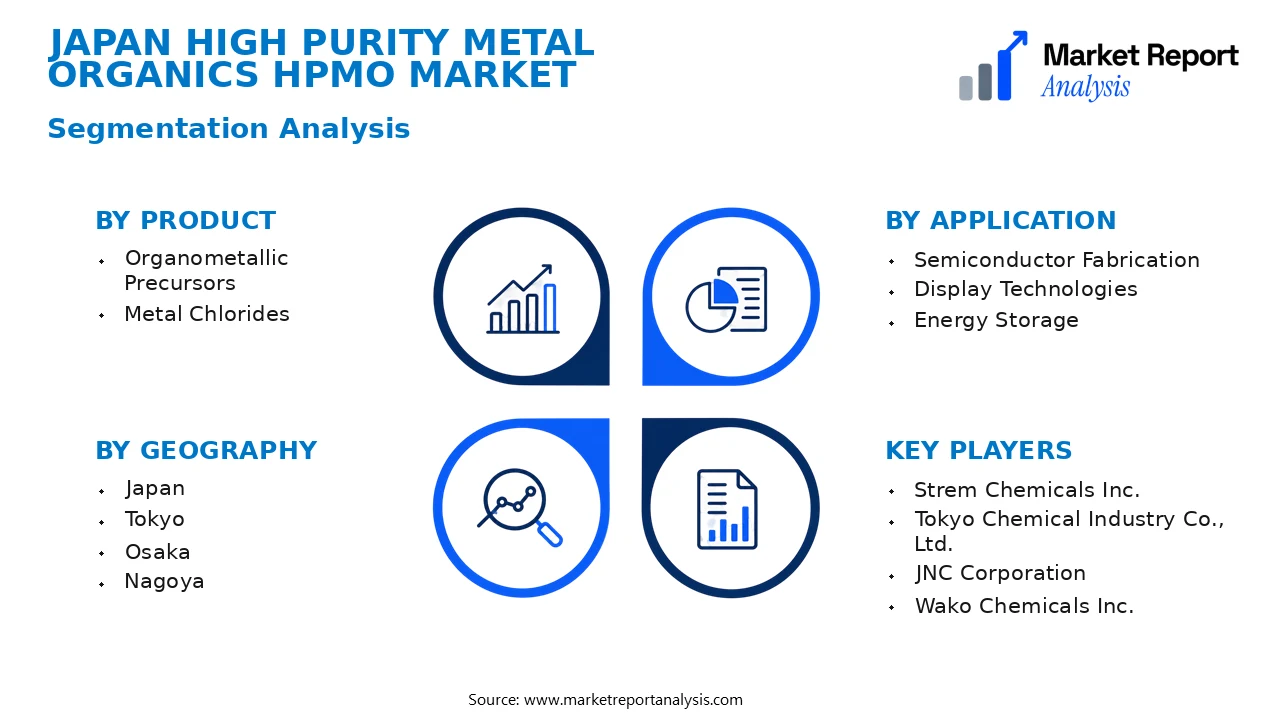
- Product
- Organometallic Precursors: These are essential high purity metal compounds used in semiconductor manufacturing, with demand driven by the expanding electronics industry and advancements in chip fabrication technologies, particularly in high-end applications.
- Metal Chlorides: Utilized mainly in chemical synthesis and surface treatments, the demand for high purity metal chlorides remains steady, propelled by their critical role in improving material performance in high-tech manufacturing sectors.
- Application
- Semiconductor Fabrication: The dominant application segment, driven by the rapid expansion of the semiconductor industry in Japan, especially in high-performance computing and consumer electronics, requiring high purity metal organics for etching and deposition processes.
- Display Technologies: This segment benefits from Japan’s robust OLED and LCD display manufacturing base, where high purity metal organics enhance device performance and longevity, pushing demand upward.
- Energy Storage: With growing focus on renewable energy and battery technologies, high purity metal organics are increasingly used in next-generation energy storage solutions, supporting the transition to cleaner energy sources.
- Geography
- Japan: The overall market strength, driven by technological innovation, high industrial standards, and significant corporate investments, makes Japan the primary hub for high purity metal organics production and application development.
- Tokyo: As Japan's economic and industrial capital, Tokyo hosts numerous R&D centers, headquarters of key electronics and chemical firms, providing robust demand and innovation activity in high purity metal organics.
- Osaka: Known for its chemical manufacturing cluster, Osaka presents substantial opportunities in the production and supply of high purity metal organics, especially for industrial applications and export markets.
- Nagoya: This city’s strong automotive and electronics manufacturing industries contribute to the high demand for metal organics used in component fabrication and advanced material processes.
- Yokohama: Located near Tokyo, Yokohama’s vibrant tech ecosystem and research institutes foster innovation and adoption of high purity metal organics in new technologies.
- Kyoto: Renowned for its technological research and innovation, Kyoto supports the development and deployment of high purity metal organics in cutting-edge electronic applications.
- Kobe: With a significant chemical industry presence, Kobe offers manufacturing and logistics advantages that enhance the distribution network for high purity metal organics across Japan and beyond.
- Fukuoka: Growing as a tech hub, Fukuoka provides emerging opportunities for high purity metal organics, especially in startup ecosystems focusing on next-generation electronics and sustainable tech.
Competitive Intelligence
The Japan High Purity Metal Organics (HPMO) market is characterized by a highly competitive landscape dominated by a few key players who emphasize product innovation, strategic alliances, and targeted acquisitions to strengthen their market positions. Major companies such as Mitsui Chemicals, Sumitomo Chemical, and Shin-Etsu Chemical are actively investing in R&D to develop novel, high-purity formulations that meet evolving industry standards, particularly for semiconductor and electronics applications. Market concentration remains moderate, with the top three firms accounting for a significant share, though regional differentiation across Tokyo, Osaka, and Nagoya influences competitive dynamics.
Businesses are pursuing expansion strategies through joint ventures and partnerships with technology providers to enhance their distribution networks and technical capabilities. Additionally, active acquisitions aim to diversify product portfolios and consolidate market presence. Innovation is driven by advances in purification techniques and sustainable production processes, creating competitive differentiation. Overall, aggressive R&D spending and a focus on quality standards position Japanese firms as global leaders in the high purity metal organics sector, fostering continuous innovation and strategic expansion to sustain competitive advantages.
Leading Company Profiles
The competitive landscape of the Japan High Purity Metal Organics (HPMO) market is characterized by a mix of global leaders, specialized chemical manufacturers, and innovative technology firms that focus on high purity materials essential for semiconductor and electronics industries.
- Strem Chemicals Inc.
- Tokyo Chemical Industry Co., Ltd.
- JNC Corporation
- Wako Chemicals Inc.
- JX Nippon Oil & Energy Corporation
- Nisso Chemical Industry Ltd.
- SG Chemicals Ltd.
- Mitsubishi Gas Chemical Company, Inc.
- Ube Industries, Ltd.
- Sumitomo Chemical Co., Ltd.
Strem Chemicals Inc.
Strem Chemicals specializes in developing and supplying high purity chemicals for advanced electronic applications, with a focus on innovative delivery systems and scalable production capacity to meet Japan’s growing HPMO needs.
Tokyo Chemical Industry Co., Ltd.
Tokyo Chemical Industry provides a broad portfolio of high purity organometallic compounds, emphasizing technological excellence, customer customization, and sustainable manufacturing practices aligned with Japan’s industry standards.
JNC Corporation
JNC Corporation is known for its high purity chemical solutions tailored for high-tech industries, leveraging advanced purification technologies to enhance material quality for semiconductor manufacturing in Japan and beyond.
Wako Chemicals Inc.
Wako Chemicals offers specialty chemicals with a focus on high purity metals and organic compounds, supporting the electronics segment through innovative process development and quality assurance protocols.
JX Nippon Oil & Energy Corporation
JX Nippon combines extensive refining expertise with high purity chemical production, emphasizing sustainability and efficiency in its supply chain for high purity metal organics within Japan’s industrial ecosystem.
Nisso Chemical Industry Ltd.
Nisso Chemical focuses on high purity reagents and organometallic compounds, with strategic investments in R&D to advance purity levels, supporting Japan’s advanced semiconductor and display industries.
SG Chemicals Ltd.
SG Chemicals specializes in delivering high quality, high purity chemicals for electronics manufacturing, with an emphasis on innovation in synthesis and cleanroom manufacturing processes.
Mitsubishi Gas Chemical Company, Inc.
Mitsubishi Gas Chemical develops high purity chemicals and organometallic solutions, leveraging a robust global supply network and cutting-edge purification technologies to serve Japan’s tech-driven markets.
Ube Industries, Ltd.
Ube Industries manufactures premium high purity metal organic compounds focusing on sustainability and technological innovation to support the evolving needs of the semiconductor and optoelectronic sectors.
Sumitomo Chemical Co., Ltd.
Sumitomo Chemical supplies a broad range of high purity organics, emphasizing R&D for next-generation materials and strategic partnerships to bolster Japan’s high technology industries.
Strategic Business Developments
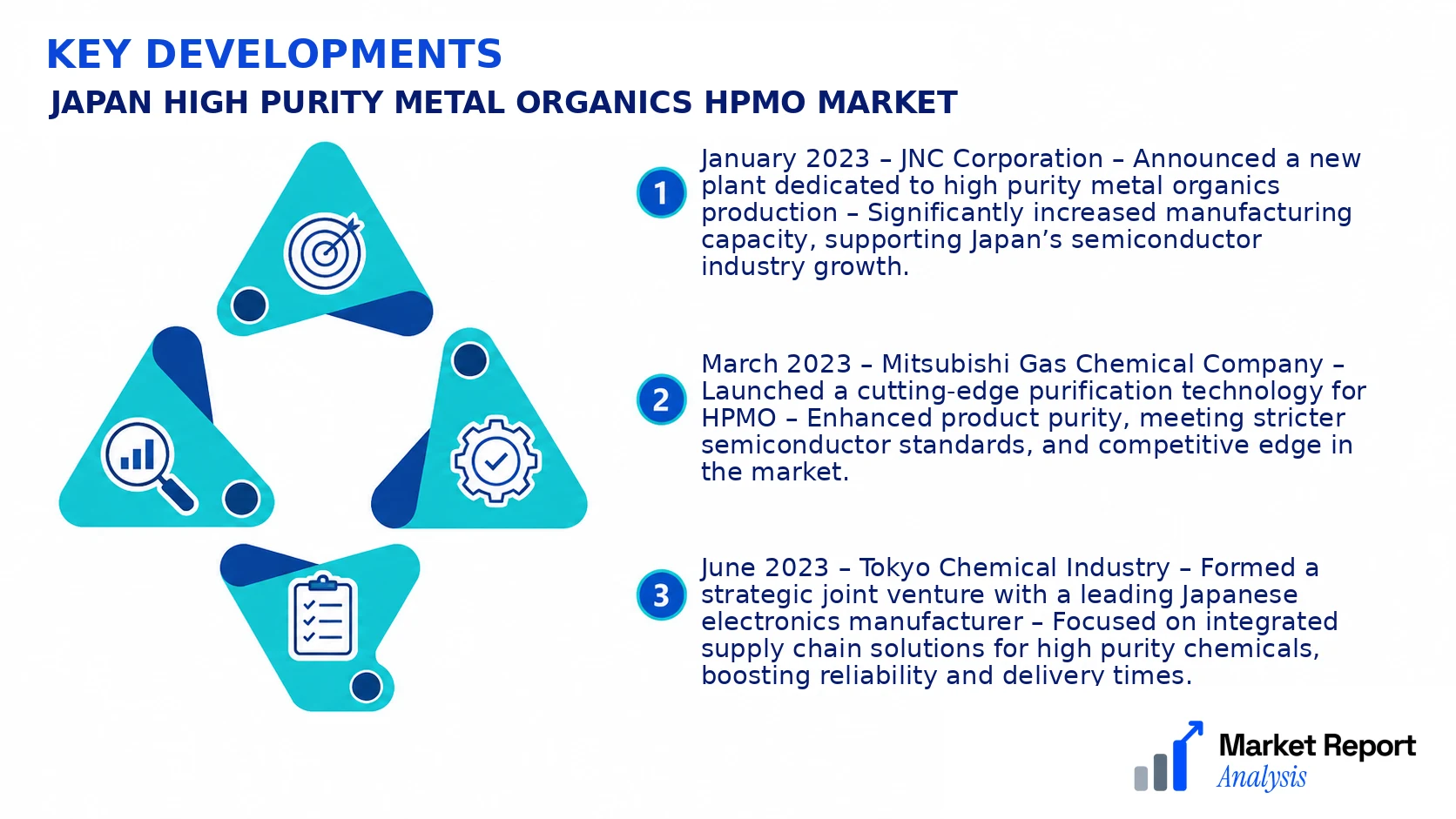
- January 2023 – JNC Corporation – Announced a new plant dedicated to high purity metal organics production – Significantly increased manufacturing capacity, supporting Japan’s semiconductor industry growth.
- March 2023 – Mitsubishi Gas Chemical Company – Launched a cutting-edge purification technology for HPMO – Enhanced product purity, meeting stricter semiconductor standards, and competitive edge in the market.
- June 2023 – Tokyo Chemical Industry – Formed a strategic joint venture with a leading Japanese electronics manufacturer – Focused on integrated supply chain solutions for high purity chemicals, boosting reliability and delivery times.
- September 2023 – Ube Industries – Acquired a smaller specialty chemical firm specializing in organometallic compounds – Expanded technological capabilities and market reach within Japan and Asia.
- December 2023 – Sumitomo Chemical – Invested in digital manufacturing automation for HPMO synthesis processes – Improved efficiency, quality consistency, and reduced environmental footprint, aligning with sustainability goals.
Frequently Asked Questions
What is the Japan High Purity Metal Organics HPMO Market?
The Japan High Purity Metal Organics (HPMO) Market comprises the production, distribution, and consumption of high purity metal organic compounds used predominantly in advanced electronic and semiconductor manufacturing sectors. It is crucial for enabling next-generation technology applications in Japan.
What is the current market size of Japan High Purity Metal Organics HPMO Market?
As of 2026, the Japan High Purity Metal Organics Market is valued at approximately USD 1.2 Billion, reflecting the country's robust industrial base and technological leadership in electronics, which drive the demand for high purity materials in semiconductors, LEDs, and other electronic components.
What factors are driving the Japan High Purity Metal Organics HPMO Market?
The key factors include rising demand for miniaturization in consumer electronics, the expanding semiconductor industry, and ongoing technological innovations. Additionally, stringent purity standards and Japanese companies’ focus on high-quality materials propel market growth.
Which region dominates the Japan High Purity Metal Organics HPMO Market?
Within Japan, the Kanto region, particularly Tokyo, leads the High Purity Metal Organics Market due to its concentration of semiconductor fabs, research institutions, and key manufacturing hubs that demand high-grade metal organics for production processes.
Which segment is expected to grow the fastest?
The semiconductor manufacturing segment is anticipated to witness the fastest growth, driven by technological advancements, increased chip production, and Japan's strategic initiatives to maintain its competitive edge in high-tech manufacturing sectors.
Who are the leading companies operating in the Japan High Purity Metal Organics HPMO Market?
Leading companies include major industry players such as Mitsui Chemicals, Tokyo Electron, and Sumitomo Chemical, which focus on innovation and quality to meet the rising demands of electronics manufacturers across Japan and globally.
Analyst Perspective
The Japan High Purity Metal Organics HPMO market exhibits a mature yet evolving landscape, with steady growth driven by advanced semiconductor and display manufacturing sectors. Strategic long-term investments should prioritize technological innovation, particularly in process purity and stability, to meet increasing demand for smaller, more efficient electronic components. Commercial opportunities are concentrated in the development of next-generation precursors aimed at ultra-fine fabrication processes. Regional growth potential is notably strong around Tokyo and Nagoya, driven by the presence of major electronics conglomerates and research institutions, with emerging hubs in Osaka enhancing regional diversification. Competitive intensity remains high, emphasizing the importance of R&D and supply chain resilience. The evolving landscape suggests that early adoption of sustainable, cost-efficient production methods will be crucial. Over the long term, positioning for technological leadership and forming strategic alliances with local industry players will be central to capturing market share, ensuring sustained growth and innovation in Japan’s high purity metal organics sector.
