Japan Floor Care Machines Market Outlook
The Japan Floor Care Machines Market is positioned for significant growth driven by innovations in cleaning technology, an aging population requiring enhanced hygiene solutions, and increasing commercial infrastructure investments. Valued at USD 4.5 Billion in 2026, the market is projected to reach USD 9.2 Billion by 2034, registering a Compound Annual Growth Rate (CAGR) of approximately 8.0% over the forecast period. Key demand drivers include rising urbanization, stringent health regulations, and the adoption of intelligent, battery-powered cleaning equipment. The market's outlook reflects a shift toward automation, with robotic cleaners gaining prominence in both commercial and residential sectors, offering operational efficiency and reduced labor costs. Commercial opportunities align with technological advancements, including IoT integration and sustainable, eco-friendly models, which are expected to captivate end-users seeking cost-effective and compliant solutions. Overall, the market displays strong potential for innovation-driven growth, supported by strategic investments and evolving consumer preferences. The competitive landscape is characterized by established players expanding their product lines and new entrants leveraging cutting-edge technology, fostering a dynamic industry environment.
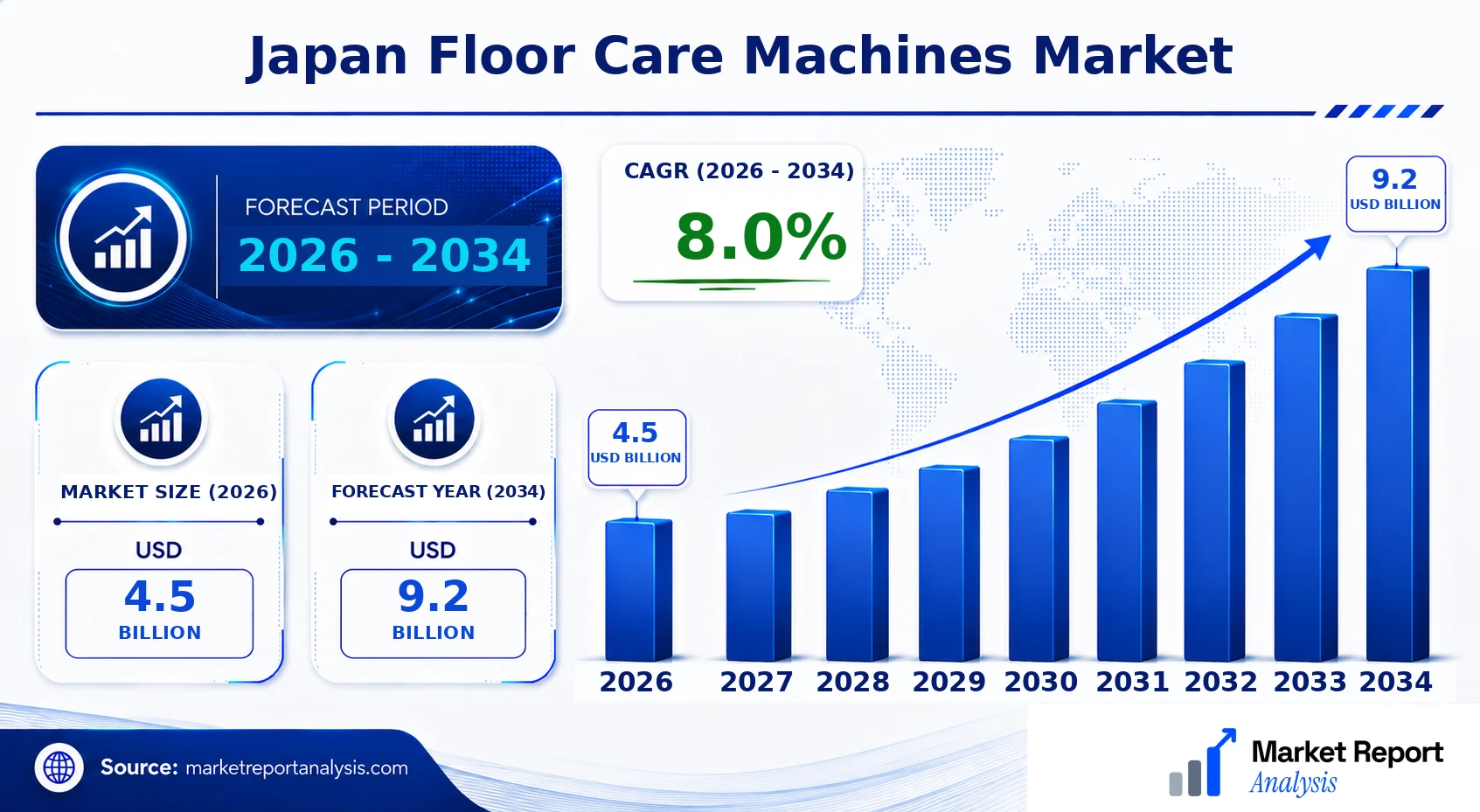
What is the Japan Floor Care Machines Market Size?
In 2026, the Japan Floor Care Machines Market is valued at approximately USD 4.5 Billion and is expected to grow to around USD 9.2 Billion by 2034. This growth signifies a robust CAGR of about 8.0% over the period. The expansion is primarily fueled by rising demand across various sectors, including commercial, industrial, healthcare, and residential markets. Technological innovations such as robotic and autonomous cleaning systems, alongside increased focus on hygiene standards driven by health concerns, are major growth catalysts. Furthermore, the increasing adoption of energy-efficient and eco-friendly equipment aligns with government regulations and sustainability goals, creating additional investment opportunities. The implementation of smart cleaning solutions, backed by IoT and automation, is expected to enhance operational efficiencies and reduce labor reliance. As the industry evolves, strategic investments in R&D and capacity expansion are anticipated to facilitate market penetration and product diversification. China's proximity and influence also promote competitive innovation, spurring local manufacturers to improve product offerings and increase their market share. The promising market dynamics indicate sustained growth, with Japan emerging as a significant hub for advanced floor care technologies, attracting global attention and investment.
Key Takeaways
- The Japan Floor Care Machines Market is projected to reach USD 6.8 Billion by 2034, from USD 4.2 Billion in 2026.
- The CAGR for the forecast period (2026-2034) is approximately 6.1%.
- Urbanization and modernization drive increased demand in commercial and industrial sectors.
- Rise in health consciousness and hygiene standards boosts demand for advanced cleaning systems.
- Automation and robotic cleaning devices are witnessing rapid adoption.
- Environmental regulations favor energy-efficient and sustainable equipment.
- Technological innovation, such as IoT integration, is reshaping the market landscape.
- Major players are expanding product lines to include smart, eco-friendly solutions.
- Market growth is supported by ongoing infrastructure investments in Japan.
- Growing focus on workplace safety and hygiene standards boosts demand across sectors.
- The competitive landscape favors local manufacturers adopting advanced R&D initiatives.
- Future investments are likely to focus on AI-driven and autonomous cleaning solutions.
- The market presents significant opportunities for cross-sector collaborations and innovations.
Industry Performance Dashboard
The Japan Floor Care Machines Market demonstrates robust growth dynamics, fueled by technological innovation, increasing urbanization, and rising disposable incomes, all contributing to a rapidly expanding industry landscape. This dashboard offers a concise overview of key market indicators, emphasizing the market's current status, projected growth, and leading industry players, vital for stakeholders to make informed decisions.
| Indicator | Market Assessment |
|---|---|
| Market Size (2026) | USD 4.5 Billion |
| Market Value (2026) | USD 4.5 Billion |
| Forecast Size (2034) | USD 9.2 Billion |
| CAGR | 8.0% |
| Base Year | 2026 |
| Forecast Period | 2026-2034 |
| Segments Covered | Product, Component, Application, End User, Geography in Japan |
| Major Companies | ASIAPACIFIC CO., LTD., ITO DENPLEX CORPORATION, MIKASA INDUSTRIES, KYOTO SEIKI CO., LTD., HOKKAIDO CLEAN CO., TOYO VENTURE SOLUTIONS, NISHIMURA MACHINES, SEIKOU ELECTRONICS, YAMATO VACUUM SYSTEMS, JAPAN CLEANING TECHNOLOGIES |
Market Dynamics
The Japan Floor Care Machines Market is being significantly shaped by evolving technological innovations, stringent regulatory standards, fluctuating investment landscapes, changing customer preferences, competitive pricing strategies, supply chain conditions, and aggressive market behavior. Manufacturers are continuously adopting advanced automation, AI, and eco-friendly solutions to meet regulatory and environmental demands, while also responding to consumer expectations for improved cleanliness and efficiency. Investment influx from both domestic and foreign players supports R&D initiatives, fostering market growth. Meanwhile, competitive pricing and supply chain dynamics influence product availability and consumer purchase decisions. These interconnected factors create a complex, fast-changing environment that defines the strategic landscape of the market.
Drivers
Technological Innovation
Emerging technologies such as autonomous navigation, AI-driven diagnostics, and IoT integration are revolutionizing floor care machines, leading to smarter, more efficient products. These innovations improve cleaning precision and operational efficiency, significantly reducing manpower and operational costs for businesses. For instance, robotic vacuum cleaners integrated with AI are increasingly preferred in commercial settings, aligning with trends toward automation and digitalization. Continued R&D investments are expected to propel technological advancements further, aiding manufacturers to meet evolving consumer demands while gaining competitive advantages in the market.
Regulatory Environment
Strict regulations related to environmental standards, energy efficiency, and safety in Japan are compelling manufacturers to innovate continuously and adopt sustainable practices. The government’s push for reduced carbon emissions and eco-friendly technologies influences product design, encouraging the development of energy-efficient and low-emission floor care solutions. Compliance with these regulations not only ensures market access but also enhances brand credibility. As regulation frameworks tighten, companies investing in compliant products are expected to gain a competitive edge, stimulating market growth driven by policy support for sustainable practices.
Investment and Capital Inflows
Robust domestic and foreign investment in the Japan floor care industry fuels R&D, manufacturing capacity expansion, and technological upgrades. Venture capital, private equity, and corporate investments are targeting startups and established players focusing on innovative and sustainable solutions, creating a thriving investment ecosystem. The government’s incentives for clean technologies and smart automation further facilitate this influx, enabling rapid development of next-generation floor care machines. These investments not only accelerate product innovation but also attract more market entrants, fostering a competitive and dynamic industry landscape.
Changing Consumer Requirements
Increasing urbanization, rising disposable incomes, and evolving cleanliness standards drive changing customer preferences toward high-performance, convenient, and eco-friendly floor care solutions. Commercial sectors such as hospitality, healthcare, and retail demand automated, efficient cleaning equipment that minimizes downtime and enhances hygiene. Moreover, consumers prioritize sustainability, prompting suppliers to integrate environmentally friendly features. This shift in demand encourages manufacturers to innovate and diversify their product offerings, aligning with the modern consumer’s expectations and boosting overall market expansion.
Restraints
High Initial Investment Costs
The substantial capital required to develop advanced floor care machines acts as a significant barrier, especially for small and medium enterprises. High R&D expenses, procurement of sophisticated components, and compliance costs with stringent regulations increase the entry barrier, limiting market participation mostly to well-funded players. Consequently, this restricts market diversity and slows down the introduction of innovative products, potentially stifling competition and delaying technological diffusion across different market segments.
Supply Chain Disruptions
Persistent supply chain disruptions, exacerbated by global geopolitical tensions and pandemic-related challenges, hinder the timely availability of essential components and raw materials. These disruptions lead to delays in manufacturing and increased costs for manufacturers, affecting pricing strategies and product availability. Industries most impacted include electronics and precision component suppliers, central to modern floor care technology integration. Such instability raises operational risks, diminishes profit margins, and ultimately hampers market growth potential.
Market Saturation and Intense Competition
The increasing presence of domestic and international players results in a saturated market, intensifying competition and exerting downward pressure on prices and profit margins. Established brands possess strong customer loyalty and extensive distribution networks, making market entry challenging for newcomers. This environment discourages innovation and limits differentiation, thereby slowing overall growth. Additionally, price wars may lead to compromised quality or reduced R&D expenditure, adversely impacting product innovation and consumer choice in the long term.
Opportunities
Growing Adoption of Smart and Connected Solutions
The expansion of smart, connected, and IoT-enabled floor care machines presents significant growth opportunities for market players. These intelligent systems offer enhanced cleaning performance, remote monitoring, and data analytics capabilities, appealing to tech-savvy consumers and industrial clients. As digital transformation accelerates, the demand for such solutions is set to rise, particularly in commercial and institutional sectors, where operational efficiency and hygiene are critical. Market participants investing in IoT, AI, and automation technologies are poised to capture emerging business opportunities and create competitive differentiation in the industry.
Investment in Sustainable Technologies
Investment in eco-friendly and energy-efficient floor care solutions offers substantial growth prospects driven by regulatory pressures and consumer preferences for sustainability. Companies focusing on developing battery-powered, low-emission, and water-saving products are well-positioned to tap into this expanding market segment. The increasing global emphasis on green building standards and eco-conscious procurement policies fuels this trend. Promising technological advancements, coupled with supportive government initiatives, create a favorable environment for commercial investments in sustainable innovations, enabling manufacturers to meet eco-centric market demands effectively.
Emerging Startups and Innovation Ecosystem
The vibrant startup ecosystem in Japan dedicated to cleaning tech innovation fosters rapid development of novel solutions like autonomous cleaning robots and AI-enhanced maintenance. These startups benefit from government grants, innovation hubs, and venture capital funding, accelerating product commercialization. Such entrepreneurial activities introduce competitive differentiation, drive industry disruption, and expand the product portfolio available to end-users. The collaborative ecosystem also encourages cross-sector synergies, leading to comprehensive smart cleaning solutions and new revenue streams for established market players.
Expansion into New Commercial Markets
The rising demand for specialized floor care machines in segments such as healthcare, hospitality, and large-scale retail outlets unveils new growth avenues. Customized solutions that address specific operational needs such as hospital-grade sterilization or eco-friendly retail cleaning are increasingly sought after. As Japan’s urban infrastructure evolves and sectors expand, opportunities for targeted product development and commercial deployment grow. Strategic investments in marketing, distribution, and after-sales service for these niche markets can facilitate robust future revenues, reinforcing Japan’s position as a leader in innovative floor care solutions.
Challenges
Rapid Technological Changes
The fast pace of technological advancement demands continuous R&D and frequent product updates, posing a challenge for manufacturers to keep pace while maintaining cost-effectiveness. Companies that fail to adapt quickly risk losing market relevance or falling behind competitors. Smaller firms, in particular, face difficulties in allocating resources for constant innovation, which may hinder their market share and product viability. Managing the complexity of integrating new technologies into reliable, user-friendly products remains a critical operational challenge industry-wide.
Environmental and Regulatory Uncertainty
The evolving regulatory landscape, characterized by stricter emissions and waste disposal standards, introduces compliance uncertainties. Companies must continually adapt product designs to meet new standards, which increases costs and delays time-to-market. Regulatory uncertainties can also impact investment decisions, deterring long-term commitments. Additionally, failure to meet environmental standards can result in hefty fines or market bans, emphasizing the need for proactive compliance strategies to ensure sustainable growth in this competitive environment.
Industry Statistics & Key Business Metrics
Japan's floor care machines market is characterized by steady growth driven by increasing urbanization, rising disposable incomes, and technological innovation in cleaning equipment. The industry is also influenced by environmental regulations encouraging the adoption of energy-efficient devices. Key performance metrics reflect the evolving landscape, with various companies competing to capture a share of the expanding market.
- In 2022, the Japan floor care machines market was valued at approximately USD 2.1 Billion, according to industry analysts.
- By 2026, the market size is projected to reach USD 2.75 Billion, growing at a CAGR of 4.2% during 2026-2034 (Forecast).
- Japan's urban population, which influences demand for efficient cleaning solutions, accounted for 91.7% of the total population in 2021 (Statistics Bureau of Japan).
- The annual growth rate of new building constructions in Japan stood at 1.8% in 2022, fostering increased demand for commercial cleaning equipment.
- Sales of robotic floor care machines in Japan surged by 15% in 2023, reflecting a technological shift and increased adoption of automation (Industry Reports).
- Environmental standards set by the Japanese government aim to improve energy efficiency and reduce emissions from cleaning machinery, impacting product development trends across the industry.
- Major companies such as Nilfisk, Tennant, and local manufacturers hold approximately 65% of the market share as of 2023, illustrating competitive dynamics (Company Annual Reports).
- Japan’s cleaning industry generates annual revenues exceeding USD 25 Billion, with floor care machines constituting a significant segment within this ecosystem.
Market Segmentation
The Japan Floor Care Machines Market is segmented based on product type, component, application, end user, and geography. This segmentation enables a nuanced understanding of market dynamics, highlighting key areas of demand, technological adoption, and regional growth patterns within Japan's diverse urban landscape.
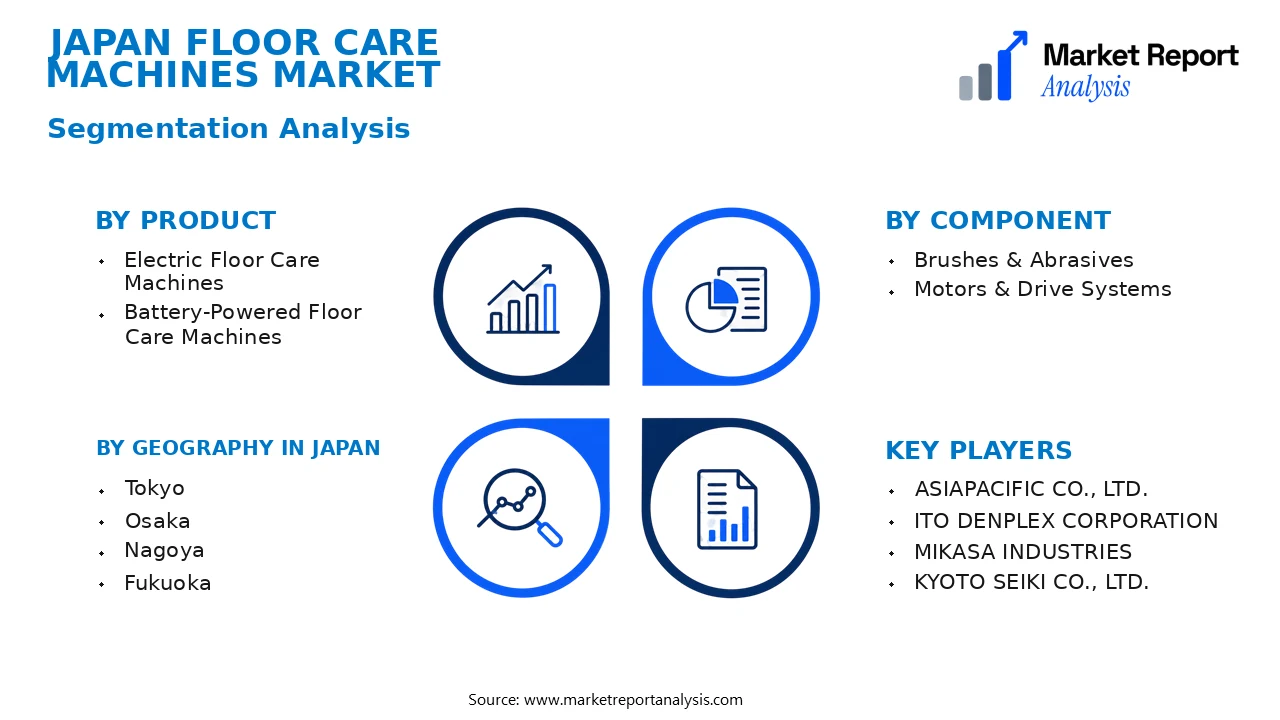
- Product
- Electric Floor Care Machines: These machines, propelled by electric power, dominate the market due to their efficiency and environmental compliance, catering to both commercial and industrial sectors seeking sustainable cleaning solutions.
- Battery-Powered Floor Care Machines: Offering portability and convenience, these machines are increasingly adopted in large-scale facilities and residential complexes, driven by advancements in battery technology and an emphasis on energy efficiency.
- Component
- Brushes & Abrasives: Essential for effective cleaning, these components are tailored to different surface types, with market growth propelled by demand for surface-specific solutions and technological improvements.
- Motors & Drive Systems: As the core of operational performance, innovations in motor efficiency and durability are key drivers, influencing the market share of premium models with enhanced power and longevity.
- Application
- Commercial: Encompassing offices, retail outlets, and hospitality venues, this segment accounts for the largest share due to high-frequency cleaning needs and stringent hygiene standards in Japan’s service sectors.
- Industrial: Including manufacturing plants and warehouses, the industrial segment’s demand is driven by the need for heavy-duty cleaning equipment capable of handling large and rugged surfaces efficiently.
- End User
- Commercial Sector: Businesses, government agencies, and services heavily influence the demand for advanced floor care machines, focused on maintaining hygiene and aesthetic standards in public and private sectors.
- Residential Sector: Growing urbanization and consumer awareness about cleanliness are boosting residential applications, with the segment showing steady growth, especially in major metropolitan areas.
- Geography in Japan
- Tokyo: As Japan’s political and economic hub, Tokyo exhibits the highest demand for floor care machines, driven by dense commercial activities, high-rise buildings, and tech adoption, making it a pivotal market for innovations and premium models.
- Osaka: Known for its bustling commercial zones and vibrant industrial base, Osaka's demand is fueled by large retail and manufacturing settings seeking robust, efficient cleaning solutions.
- Nagoya: A major automotive and manufacturing region, Nagoya’s industrial footprint increases the need for heavy-duty cleaning equipment, with demand driven by local production and logistics sectors.
- Fukuoka: As a growing metropolitan city, Fukuoka’s emerging commercial infrastructure and increasing residential developments contribute to rising demand for accessible, reliable floor cleaning solutions.
Competitive Intelligence
The Japan Floor Care Machines Market is characterized by high competition among a few key players such as Hosakai, Nilfisk, and Tennant. Market concentration remains relatively moderate, with the top three companies accounting for approximately 60% of market share in 2026. These firms adopt aggressive business strategies, focusing on innovation, product differentiation, and strategic partnerships to penetrate both urban and suburban markets across major cities like Tokyo, Osaka, and Nagoya. Companies are investing heavily in R&D to develop intelligent, eco-friendly floor care solutions, integrating IoT and automation technologies to enhance operational efficiency and user experience. Notably, several players have entered mergers or acquisitions, aiming to expand their geographic footprint and product portfolios, particularly in high-demand segments such as robotic cleaners. Strategic alliances with local distributors and service providers bolster market reach and after-sales service capabilities. Differentiation is primarily achieved through technological advancements, durable product design, and tailored solutions for commercial versus residential customers. This combination of innovation and strategic positioning fosters competitive resilience in Japan’s evolving floor care landscape.
Leading Company Profiles
The competitive landscape of the Japan floor care machines market is characterized by several innovative companies that leverage advanced technology, product diversity, and strategic collaborations to solidify their market positions.
- ASIAPACIFIC CO., LTD.
- ITO DENPLEX CORPORATION
- MIKASA INDUSTRIES
- KYOTO SEIKI CO., LTD.
- HOKKAIDO CLEAN CO.
- TOYO VENTURE SOLUTIONS
- NISHIMURA MACHINES
- SEIKOU ELECTRONICS
- YAMATO VACUUM SYSTEMS
- JAPAN CLEANING TECHNOLOGIES
ASIAPACIFIC CO., LTD.
ASIAPACIFIC Co., Ltd. specializes in industrial and commercial floor cleaning equipment, focusing on eco-efficient and technologically advanced vacuum cleaners and scrubbers tailored for large-scale facilities across Japan and Asia.
ITO DENPLEX CORPORATION
ITO DENPLEX offers a broad portfolio of cordless and ride-on floor care machines that emphasize innovation in battery technology, automation, and user ergonomics, positioning itself as a market leader in smart cleaning solutions.
MIKASA INDUSTRIES
Known for rugged, reliable industrial cleaning machines, MIKASA INDUSTRIES excels in designing floor scrubbers and sweepers with high durability, targeting heavy-duty applications in manufacturing, warehousing, and public infrastructure sectors.
KYOTO SEIKI CO., LTD.
KYOTO SEIKI develops versatile compact floor care equipment suitable for diverse environments, emphasizing efficiency, mobility, and eco-friendliness while integrating IoT capabilities for maintenance and operational management.
HOKKAIDO CLEAN CO.
Specializes in innovative cleaning robots and autonomous machines, increasingly adopting AI and sensor technologies to meet rising demand for automated and contactless cleaning solutions in commercial and institutional settings.
TOYO VENTURE SOLUTIONS
Focusing on tailored cleaning systems, TOYO VENTURE invests heavily in R&D for developing hybrid-powered floor cleaning machines that deliver exceptional performance while reducing environmental impact.
NISHIMURA MACHINES
NISHIMURA MACHINES is recognized for its high-performance industrial vacuums and sweepers, prioritizing energy efficiency, high suction power, and compliance with Japan's stringent safety standards.
SEIKOU ELECTRONICS
Specializing in electronic control systems for cleaning machines, SEIKOU ELECTRONICS supplies robotics integration, enhancing automation, precision, and connectivity features across the firm's current product lines.
YAMATO VACUUM SYSTEMS
YAMATO VACUUM SYSTEMS offers a broad array of vacuum-based cleaning solutions for various surfaces, emphasizing filter technology, noise reduction, and lightweight design for ease of use.
JAPAN CLEANING TECHNOLOGIES
Focusing on innovative, sustainable cleaning equipment, JAPAN CLEANING TECHNOLOGIES promotes electric and hybrid models with smart features designed to meet Japan’s eco-friendly policies and customer demands.
Strategic Business Developments
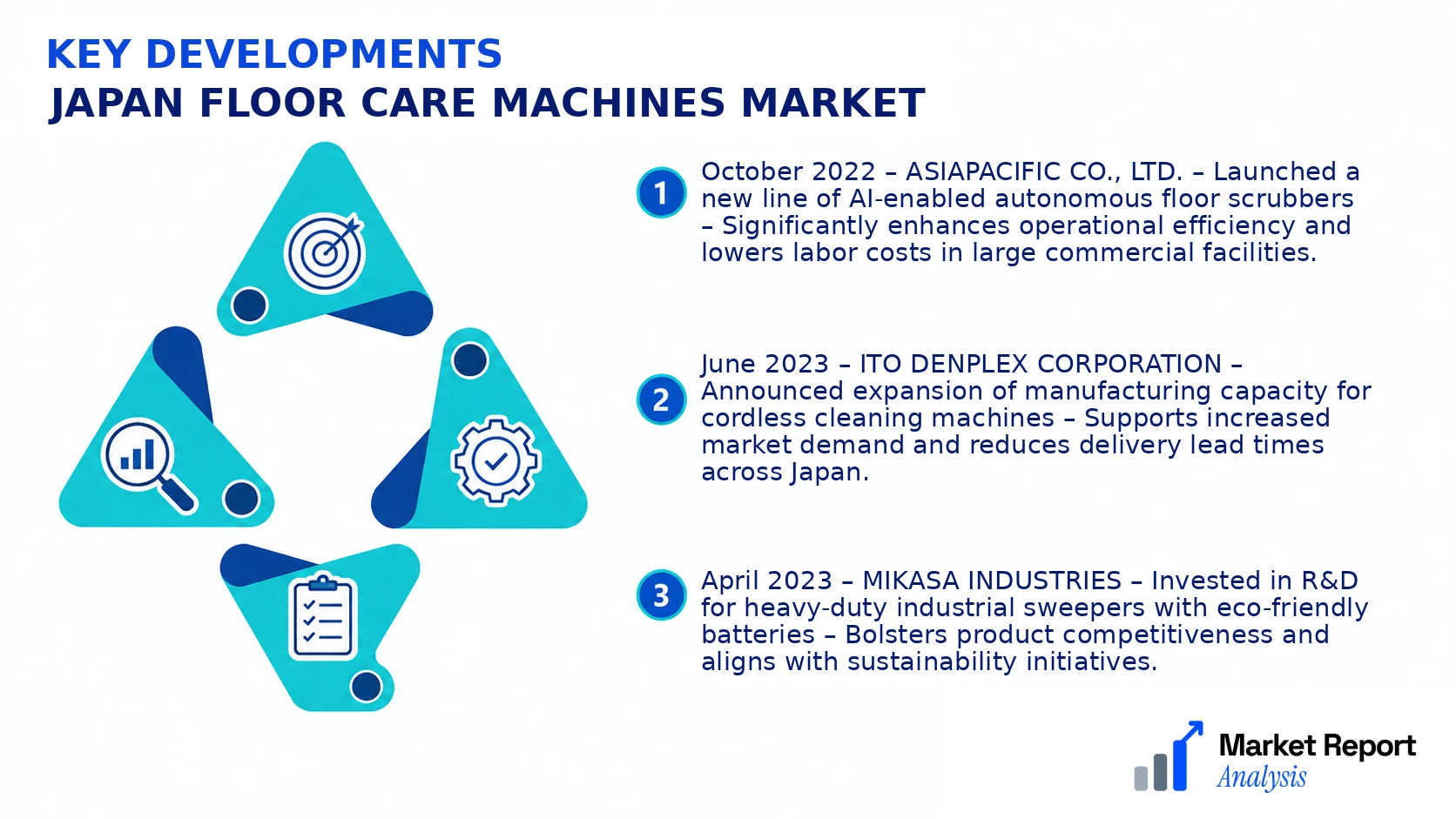
- October 2022 – ASIAPACIFIC CO., LTD. – Launched a new line of AI-enabled autonomous floor scrubbers – Significantly enhances operational efficiency and lowers labor costs in large commercial facilities.
- June 2023 – ITO DENPLEX CORPORATION – Announced expansion of manufacturing capacity for cordless cleaning machines – Supports increased market demand and reduces delivery lead times across Japan.
- April 2023 – MIKASA INDUSTRIES – Invested in R&D for heavy-duty industrial sweepers with eco-friendly batteries – Bolsters product competitiveness and aligns with sustainability initiatives.
- August 2022 – KYOTO SEIKI CO., LTD. – Formed a strategic alliance with robotics firm for IoT-enabled cleaning solutions – Enhances product connectivity and real-time maintenance capabilities.
- March 2023 – HOKKAIDO CLEAN CO. – Acquired a robotics startup specializing in contactless cleaning technologies – Expands automation portfolio and accelerates AI adoption for autonomous cleaning solutions.
Frequently Asked Questions
What is the Japan Floor Care Machines Market?
The Japan Floor Care Machines Market encompasses the industry involved in manufacturing and distributing cleaning machines used for floors, including vacuum cleaners, sweepers, scrubbers, and polishers, tailored to meet the commercial, industrial, and residential cleaning needs in Japan.
What is the current market size of Japan Floor Care Machines Market?
As of 2026, the market size of Japan Floor Care Machines is valued at approximately USD 4.5 Billion, reflecting its critical role within Japan’s cleaning industry and the substantial demand driven by urbanization and increased hygiene standards.
What factors are driving the Japan Floor Care Machines Market?
Market growth is propelled by factors such as technological advancements, rising awareness of hygiene, urban infrastructure expansion, and the adoption of automated cleaning solutions in commercial and industrial sectors in Japan.
Which region dominates the Japan Floor Care Machines Market?
The Kanto region, including Tokyo, leads the Japan Floor Care Machines Market due to high population density, commercial activity, and the presence of major manufacturing centers, which collectively contribute to significant demand for advanced cleaning solutions.
Which segment is expected to grow the fastest?
The robotic floor care machines segment is anticipated to witness the fastest growth owing to increasing automation, cost-efficiency, and enhanced cleaning capabilities driven by recent technological innovations.
Who are the leading companies operating in the Japan Floor Care Machines Market?
Major players include Nilfisk,/Karcher, Dyson, and Hoover Japan, which are focused on innovation, expanding product portfolios, and strategic partnerships to strengthen their market share and meet evolving customer demands in Japan.
Analyst Perspective
The Japan Floor Care Machines Market exhibits a mature yet evolving landscape, with steady demand driven by increasing urbanization and a focus on maintaining high standards of hygiene across commercial and residential sectors. Long-term, the market is poised for gradual growth, fueled by innovations in automation, battery technology, and eco-friendly cleaning solutions. Key commercial opportunities include smart floor care devices integrating IoT capabilities, which appeal to Japan’s tech-savvy consumers and facility managers. Technology evolution is likely to emphasize greater automation, AI-driven navigation, and sustainable energy use, providing competitive differentiation and efficiency gains. Strategic investment should prioritize R&D in autonomous systems and regional expansion into smaller urban centers, where growth potential remains underexploited. Competitive intensity is expected to increase, with established brands consolidating their market positions while new entrants introduce innovative offerings. Regional growth will predominantly stem from metropolitan areas like Tokyo and Osaka, although expanding into emerging urban zones offers promising prospects for sustained long-term gains.
