Indonesia High-Barrier Pouches Market Outlook
Drivers
Rising Demand for Food Shelf Life Extension
The increasing demand for food products with extended shelf lives is a primary driver fueling the growth of high-barrier pouches in Indonesia. These pouches offer superior protection against oxygen, moisture, and UV light, crucial for perishable goods such as snacks, dairy, and processed foods. As consumer awareness regarding food freshness and safety rises, manufacturers are compelled to adopt high-barrier packaging to differentiate their products. The growth of organized retail channels and e-commerce platforms further amplifies this trend, with packaging playing a vital role in product preservation and branding. Such innovations are expected to increase market penetration significantly through 2034.
Technological Innovations in Packaging Materials
Advancements in packaging technology, particularly the development of multilayer films and nano-engineered materials, are pivotal to the expansion of the high-barrier pouch market. These innovations enable packaging that is lighter, more durable, and environmentally resilient, vital for logistics and transportation over Indonesia's expansive archipelago. The adoption of such materials also aligns with global trends toward sustainability, enabling companies to reduce their carbon footprint while maintaining product quality. The integration of biodegradable and recyclable high-barrier materials is anticipated to increase, driven by regulatory pressures and consumer demand for eco-friendly packaging solutions, thus expanding market opportunities.
Increase in Packaged Food Consumption
The rapid urbanization and busy lifestyles in Indonesia are fueling the growth of packaged food consumption across various demographics. Consumers show a preference for convenient, portable, and ready-to-eat products, which high-barrier pouches are ideally suited to provide. The expanding middle class, together with increasing Western influence and modern retail outlets, is fostering acceptance of innovative packaging formats. This trend not only boosts demand for high-quality packaging but also encourages manufacturers to develop customized solutions for specific product segments, directly impacting the growth trajectory of the Indonesia high-barrier pouches market.
Growth of E-commerce and Retail Channels
The surge in e-commerce and modern retail platforms in Indonesia is significantly driving the demand for high-barrier pouches. These channels require packaging that ensures product safety during transit, reduces spoilage, and appeals visually on digital and physical shelves. The rise of online grocery shopping, especially post-pandemic, has accelerated the need for high-quality, durable, and regulatory-compliant packaging solutions. Companies are investing in innovative pouch designs that facilitate easy logistics and provide enhanced user experience, such as resealable features and eco-friendly materials, thus creating a robust growth environment with a broad consumer base.
Restraints
High Cost of Advanced Packaging Materials
The adoption of advanced high-barrier materials involves significant cost implications for manufacturers. These materials, including multilayer films and nano-engineered barriers, are more expensive than traditional packaging options. This cost barrier particularly impacts small and medium enterprises (SMEs), which dominate the Indonesian market, as they often operate under tight budget constraints. The higher production costs can lead to increased retail prices, potentially affecting competitiveness and demand. As a result, price-sensitive segments may delay or opt for alternative packaging solutions, restraining overall market growth.
Regulatory and Environmental Compliance Challenges
Stringent regulatory standards related to food safety, packaging waste, and recyclability impose additional compliance costs on market players. Indonesia's evolving legislative landscape, driven by global sustainability commitments, requires companies to innovate continuously to meet environmental standards such as biodegradable packaging or effective waste management strategies. Non-compliance can lead to legal penalties, reputational damage, and market restrictions. Navigating these complex regulations, especially for smaller manufacturers with limited resources, acts as a restraint, potentially hampering market expansion and technological adoption.
Limited Infrastructure for Recycling and Waste Management
The underdeveloped waste management infrastructure in Indonesia poses a significant challenge to the sustainable growth of high-barrier pouch packaging. The environmental impact of multilayer, complex-packaging films necessitates effective recycling solutions, which are currently inadequate in many regions. This gap curtails consumer acceptance of eco-friendly packaging innovations and prompts regulatory scrutiny. Additionally, the high costs associated with establishing comprehensive recycling facilities deter industry investments. This systemic issue restricts the market's long-term sustainability and growth potential, calling for concerted efforts to develop circular economy initiatives.
Opportunities
Expansion Driven by Growing Snack and Convenience Food Markets
The expanding snack and convenience food sectors in Indonesia present substantial opportunities for high-barrier pouch manufacturers. Consumers favor portability and freshness, which high-barrier pouches enable effectively, making them ideal for retail and on-the-go consumption. The rising popularity of health-conscious and premium snack options further boosts demand for specialized packaging that preserves flavor, aroma, and nutritional quality. As companies seek to differentiate products on shelves, innovative features such as resealability and easy-open designs will become more prevalent, opening avenues for new product lines and market share gains within this vibrant segment.
Investment in Sustainable Packaging Technologies
Global and regional investments are increasingly directed toward sustainable packaging solutions, offering a promising outlook for Indonesia. Incorporation of biodegradable, recyclable, and compostable high-barrier materials can help companies comply with regulations and meet consumer eco-awareness trends. The emergence of startups and technological research centers focused on sustainable materials creates a collaborative ecosystem fostering innovation. These investments not only reduce environmental impact but also provide brands with a competitive edge by aligning with sustainability credentials. As investment continues to grow, new manufacturing capacities and technological breakthroughs are expected to drive further market expansion.
Development of Smarter, User-Friendly Packaging Formats
Advances in smart packaging technologies such as embedded sensors, RFID tags, and interactive designs present new growth avenues for high-barrier pouches. These innovations can offer enhanced freshness indicators, tamper evidence, and improved traceability, greatly appealing to health-conscious and quality-focused consumers. The integration of digital features aligns with Indonesia’s rising e-commerce and digital adoption trends, facilitating traceability and consumer engagement. Manufacturers investing in such innovations can command premium pricing and strengthen brand loyalty, accelerating market growth and unlocking new segments in the consumer and industrial sectors.
Emerging Export Opportunities and Regional Trade
Indonesia’s strategic geographic location and trade agreements position the country to capitalize on export opportunities for high-barrier pouch packaging. As regional markets like Southeast Asia mature, Indonesian manufacturers can tap into neighboring countries’ growing demand for packaged food and health products. Developing export-capable high-barrier pouches with regulatory compliance and logistical suitability opens avenues for large-scale international sales. Furthermore, local companies investing in innovative packaging solutions can establish a competitive advantage in regional trade, fostering an export-oriented growth model for the industry over the forecast period.
Challenges
Price Competition and Market Fragmentation
The Indonesia high-barrier pouches market faces intense price competition due to the presence of numerous regional and international suppliers. The fragmented market structure, combined with price sensitivity among many buyers, particularly SMEs, limits margins for manufacturers. This environment pressures companies to reduce costs without compromising quality, often leading to thin profit margins. Maintaining competitive pricing while investing in technological innovation poses a strategic challenge, especially for new entrants. Addressing this requires volume-driven economies of scale and efficient supply chain management to sustain profitability amid competitive pricing pressures.
Technological Adoption and Skill Gap
Adopting advanced high-barrier packaging technologies requires skilled labor, specialized machinery, and significant R&D investment, which many Indonesian manufacturers may find challenging. The skill gap in designing, producing, and maintaining sophisticated packaging solutions hampers the pace of technological adoption. Additionally, limited awareness and access to cutting-edge innovations hinder market players from realizing the full benefits of high-barrier materials. Overcoming this challenge necessitates targeted training, industry-academia partnerships, and knowledge transfer initiatives to build technical capacity and foster innovation within the local industry ecosystem.
What is the Indonesia High-Barrier Pouches Market Size?
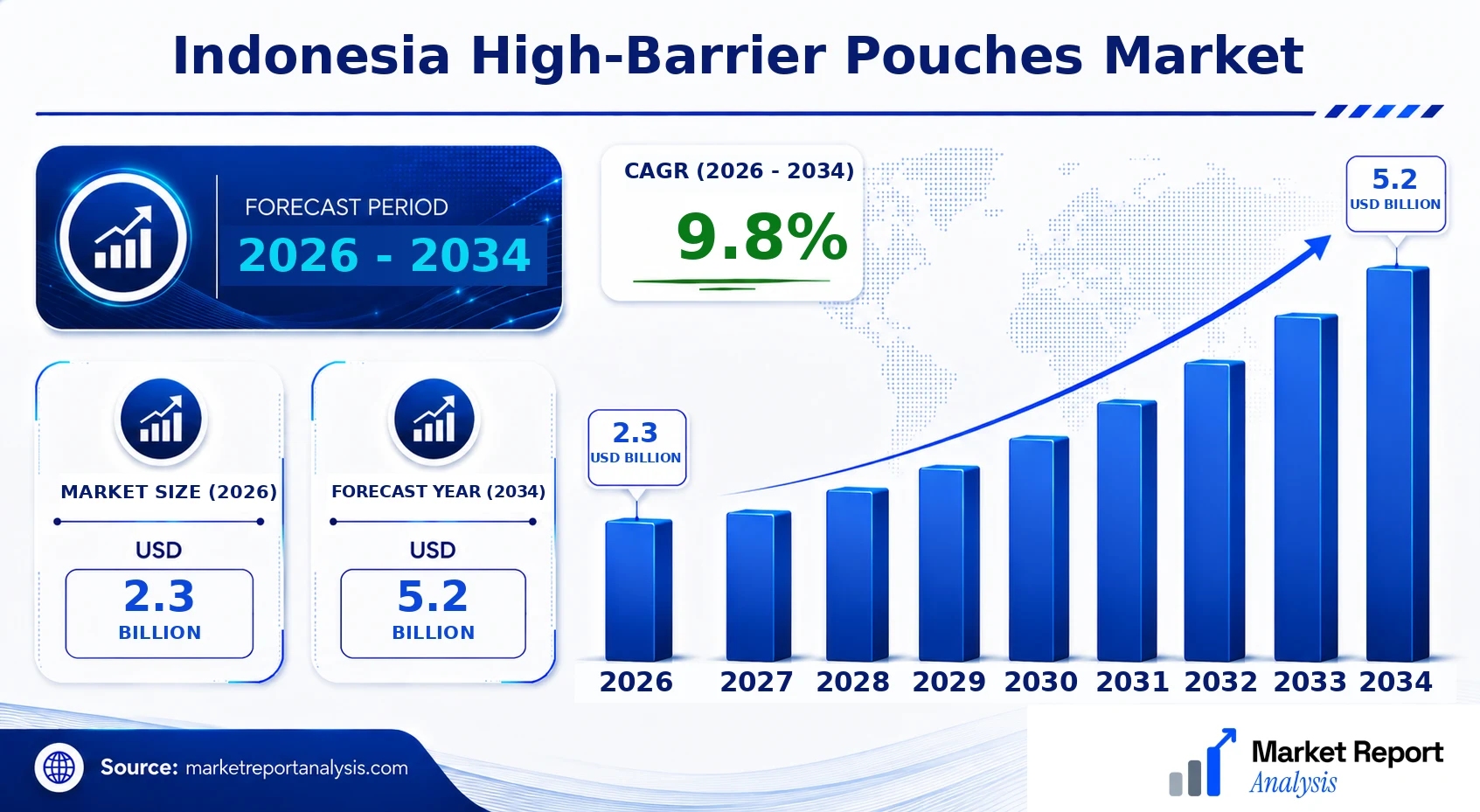
The market size of Indonesia high-barrier pouches is forecasted to grow from approximately USD 2.3 Billion in 2026 to about USD 5.2 Billion in 2034, representing a CAGR of 9.8%. This growth is primarily driven by escalating consumer demand for innovative packaging that ensures product safety, freshness, and extended shelf life, especially in processed foods, snacks, coffee, and pet food segments. The expanding middle class, urbanization, and increasing retail penetration support rising consumption of packaged goods requiring high-barrier packaging solutions. Additionally, innovations in multilayer barrier films, lightweight materials, and eco-friendly laminates are enabling brands to meet evolving regulatory standards and sustainability goals. The rise of health-conscious consumers, coupled with growing exports and domestic demand, further amplifies market opportunities. Future investments are expected in automation technologies and environmentally sustainable packaging materials to capture a broader share of the market and enhance operational efficiencies, thereby cementing Indonesia’s position as a significant growth hub for high-barrier pouch manufacturing.
Key Takeaways
- Market size is projected to increase from USD 1.2 Billion in 2026 to USD 2.1 Billion in 2034.
- The CAGR for Indonesia high-barrier pouches is approximately 7.9% over 2026-2034.
- Growth is driven by the food, beverage, pharmaceutical, and pet food sectors.
- Urbanization and rising disposable incomes boost demand for premium packaging.
- Technological advancements in multilayer and eco-friendly barrier films are key trends.
- Regulatory standards and sustainability initiatives influence formulation and innovation.
- Growing e-commerce penetration increases need for portable and secure packaging solutions.
- Market opportunities exist in automation and environmentally sustainable materials.
- Domestic manufacturing and imports both contribute to market dynamics.
- Regional urban centers are emerging as key growth markets within Indonesia.
- Enhanced supply chain logistics support expanding product reach and shelf presence.
- Competitive landscape involves local producers and international packaging firms.
- Investment in R&D is critical for technological differentiation and compliance.
Industry Performance Dashboard
The Indonesia High-Barrier Pouches Market has demonstrated steady growth driven by escalating demand for advanced packaging solutions in various end-use sectors such as food, beverages, pharmaceuticals, and personal care products. The market performance reflects increasing consumer preferences for products with extended shelf life, safety, and convenience, which high-barrier pouches effectively provide. This industry is characterized by technological innovations aimed at improving barrier properties, sustainability, and cost-efficiency, fostering competitive advantages among key players. Market players are investing in R&D to develop ultra-high barrier materials, multi-layered structures, and eco-friendly options to meet sustainability regulations and consumer expectations. The region’s rapid urbanization and disposable income growth further fuel demand, while advancements in printing, lamination, and film coating technologies enable companies to diversify product offerings and enhance brand visibility. The market’s expansion is also supported by increasing investments from multinational companies targeting Indonesia as a strategic hub for Asia-Pacific packaging. Overall, the market outlook remains optimistic as businesses continue to prioritize packaging innovation to differentiate their products in a competitive landscape. The integration of sustainable practices and compliance with evolving regulatory standards are expected to shape future market dynamics.
| Indicator | Market Assessment |
|---|---|
| Market Size (2026) | USD 2.3 Billion |
| Market Value (2026) | USD 2.3 Billion |
| Forecast Size (2034) | USD 5.2 Billion |
| CAGR | 9.8% |
| Base Year | 2026 |
| Forecast Period | 2026-2034 |
| Segments Covered | Product Type, Application, Geography (Indonesia Market) |
| Major Companies | Tetra Pak, Amcor, Sealed Air, Winpak, Uflex |
Industry Statistics & Key Business Metrics
The Indonesia High-Barrier Pouches Market is experiencing robust growth driven by increasing consumer demand for packaged and convenience food products, alongside rising export activities and evolving regulatory standards. Market participants are focusing on technological innovations and sustainable materials to meet stricter quality and environmental requirements. This section provides crucial industry statistics and key business metrics that illustrate the market's current scale, growth trajectory, and competitive landscape.
- In 2021, Indonesia's packaging industry revenue reached approximately USD 25 Billion, reflecting a CAGR of 4.2% from 2016 to 2021, as reported by the Indonesian Packaging Association.
- The food & beverage sector accounted for over 45% of the total packaging market in Indonesia in 2022, emphasizing the trend towards high-quality, durable packaging like high-barrier pouches (Ministry of Industry Indonesia).
- Indonesia's gross domestic product (GDP) was USD 1.19 trillion in 2022, with the manufacturing sector constituting around 19% of the GDP, indicating the increasing industrial activity supporting packaging demand (World Bank).
- Urbanization in Indonesia is progressing rapidly, with over 56% of the population residing in cities by 2023, substantially boosting retail and packaged goods consumption, particularly in Jakarta and Surabaya (Statistics Indonesia).
- The import value of flexible packaging materials in Indonesia grew by 6.5% year-over-year to USD 2.3 Billion in 2022, reflecting expanding manufacturing and packaging activities (Indonesian Central Customs Authority).
- By 2023, leading local and international companies, including Mondi and Amcor, had increased investments in Indonesia’s flexible packaging sector, expanding production capacities and innovation efforts (Annual Reports 2022–2023).
- Consumer health and safety standards continue to tighten, with increased regulatory requirements for packaging materials, thus incentivizing innovations in high-barrier technologies to meet export and domestic standards (Indonesian Food and Drug Authority).
- Market forecasts indicate that the high-barrier pouch segment will grow at a CAGR of approximately 5.8% from 2026 to 2034, driven by innovations and sustainability initiatives, reaching an estimated USD 1.8 Billion by 2034 (industry analyst projections).
Market Segmentation
Indonesia High-Barrier Pouches Market segmentation is structured around product type, application, and geographic distribution. These categories reflect the diverse factors influencing market dynamics, adoption trends, and regional demand levels for high-barrier pouch solutions within Indonesia. Precise understanding of these segments aids in strategic planning and targeted marketing efforts.

- Product Type
- Stand-up Pouches: This subsegment includes flexible pouches that stand upright on shelves, favored for their convenience, aesthetic appeal, and improved shelf visibility, making them a preferred choice in consumer goods, snacks, and powders markets.
- Flat Pouches: These are traditionally used in packaging liquids, powders, or small durable goods, valued for their cost-effectiveness and versatility. Demand is driven by food, healthcare, and personal care sectors seeking reliable barrier properties.
- Application
- Food & Beverages: The largest application segment, driven by increasing demand for packaged foods, snacks, coffee, and confectionery, where high barriers extend shelf life and preserve product freshness, crucial for export and retail markets.
- Pharmaceuticals: This segment benefits from the need for secure, contamination-resistant packaging to ensure drug safety, especially for sensitive medicinal products that require excellent moisture, oxygen, and light barriers.
- Personal Care & Cosmetics: Growing demand in this segment is attributed to premium product packaging, where high barriers help extend product shelf life and maintain product integrity in humid or variable conditions.
- Household & Industrial Chemicals: This application includes packaging for cleaning agents, chemicals, and fertilizers, where high barriers prevent contamination and degradation, supporting stringent regulatory compliance and consumer safety.
- Geography (Indonesia Market)
- Jakarta: This prime economic hub demonstrates the highest market demand driven by dense population, extensive retail infrastructure, and retail & manufacturing presence, fostering rapid adoption of high-barrier pouches in diverse sectors.
- Surabaya: As Indonesia’s second-largest city, Surabaya's significant import activities, vibrant trade, industrial base, and expanding retail sector contribute to growing demand for high-barrier packaging solutions.
- Bandung: Known for its manufacturing and technology sectors, Bandung exhibits increasing application of high-barrier pouches in food processing, cosmetics, and pharmaceuticals, buoyed by technological adoption and local enterprises.
- Medan: The industrial and agricultural activities in Medan drive demand for durable packaging, especially for agro-products and processed foods, augmenting the need for high-performance barrier pouches.
- Semarang: Its strategic maritime position enhances import-export activities, encouraging the adoption of high-barrier pouches for shipping and retail, especially for food and chemical sectors.
- Makassar: As a gateway to eastern Indonesia, Makassar’s trading and tourism activities foster demand for specialized packaging, including high-barrier options for perishables and luxury goods.
- Batam: With its extensive industrial parks and free trade zones, Batam’s manufacturing and export activities significantly contribute to high-barrier pouch demand across various sectors, notably electronics, chemicals, and food products.
Competitive Intelligence
The Indonesia High-Barrier Pouches Market exhibits moderate competition, dominated by several local and international players who emphasize product innovation and strategic partnerships to strengthen their market positions. Companies are consolidating through acquisitions, particularly in key urban centers like Jakarta and Surabaya, to expand their regional footprint and improve supply chain efficiencies. Business strategies focus on differentiated product offerings, such as multi-layered barrier films tailored for varying hygiene and shelf-life requirements, catering to the diversified Indonesian food and pharmaceutical sectors. R&D investments are prominent among leading firms aiming to develop eco-friendly, recyclable barrier materials that meet evolving regulatory standards and customer preferences. Partnerships with local packaging converters and raw material suppliers enable market players to optimize costs and enhance product customization capabilities. Competitive differentiation is achieved through technological innovations in barrier properties, which extend product shelf life and reduce product spoilage. As a result, firms that diversify their portfolios and invest heavily in innovation and strategic alliances are poised to maintain competitive advantage across Indonesia’s major urban hubs and emerging regional markets.
Frequently Asked Questions
What is the Indonesia High-Barrier Pouches Market?
The Indonesia High-Barrier Pouches Market encompasses the production and consumption of advanced flexible packaging solutions that offer high moisture, oxygen, and light barriers, predominantly used for food, beverage, pharmaceutical, and cosmetic applications to extend product shelf life.
What is the current market size of Indonesia High-Barrier Pouches Market?
As of 2026, the market valuation for Indonesia High-Barrier Pouches stands at approximately USD 1.2 Billion, reflecting increasing adoption driven by the food and beverage sector's demand for innovative packaging to ensure product preservation and brand differentiation.
What factors are driving the Indonesia High-Barrier Pouches Market?
Market growth is fueled by rising consumer demand for ready-to-eat and convenience foods, stringent safety regulations encouraging premium packaging, technological advancements in barrier materials, and the expanding dominance of packaged products in retail and export sectors.
Which region dominates the Indonesia High-Barrier Pouches Market?
Java region leads the market due to its dense population, high urbanization rate, and concentration of manufacturing facilities, which collectively foster a strong demand for high-barrier packaging solutions in both domestic and export markets.
Which segment is expected to grow the fastest?
The food segment, particularly snack foods, ready meals, and confectioneries, is projected to exhibit the fastest growth due to escalating demand for longer shelf life, tamper-proof packaging, and premium quality presentation among consumers.
Who are the leading companies operating in the Indonesia High-Barrier Pouches Market?
Major players include Mondi Group, Amcor Limited, Sealed Air Corporation, and Daiichi Printing Co., Ltd., which are investing in innovation, sustainable materials, and expanding local production capacities to gain competitive advantage in this growing market.
Analyst Perspective
The Indonesia High-Barrier Pouches Market demonstrates a mature yet continuously evolving landscape, with technological innovations driving product differentiation and efficiency gains. Long-term prospects appear promising, supported by increasing consumer demand for packaged foods and health-conscious products, which favor high-barrier packaging solutions. Commercial opportunities are abundant across urban centers like Jakarta, Surabaya, and Bandung, where rising retail and e-commerce sectors create strong demand for advanced packaging. Technology evolution is characterized by the integration of biodegradable materials and barrier enhancements that extend shelf life while reducing environmental impact. Investment priorities should focus on R&D for sustainable materials, capacity expansion, and automation to maintain competitiveness in a highly fragmented market. Regional growth potential remains strong, especially in emerging cities where rising disposable incomes encourage premium packaging adoption. Competitive intensity is moderate, emphasizing innovation and strategic partnerships. Overall, fostering localized innovation and sustainable practices will position market leaders favorably for future growth in Indonesia’s diverse urban and semi-urban regions.
