Eutectic Phase Change Material Market Outlook
The global eutectic phase change material (PCM) market is currently valued at approximately USD 2.1 Billion in 2026 and is projected to reach USD 6.4 Billion by 2034, growing at a compound annual growth rate (CAGR) of around 13.0% during the forecast period of 2026 to 2034. This growth is driven predominantly by increasing demand for energy-efficient and sustainable thermal management solutions across various sectors, including building insulation, electronics cooling, and renewable energy systems. Advances in material technology, driven by innovation in eutectic formulations that optimize thermal storage capacities and reduce costs, further catalyze industry expansion. Commercial opportunities are abundant in residential and commercial building sectors for passive heating and cooling applications, as well as in the transportation industry for thermal management of electric vehicles. The market landscape is characterized by growing investments in research and development aimed at improving the stability, reusability, and environmental compatibility of eutectic PCMs, setting the stage for broader industrial adoption and application diversification.

What is the Eutectic Phase Change Material Market Size?
The market size for eutectic PCM was valued at around USD 2.1 Billion in 2026 and is forecasted to reach approximately USD 6.4 Billion by 2034, reflecting a CAGR of 13.0% over this period. The positive growth trajectory is predominantly fueled by rising demand for thermal energy storage solutions within the construction, electronics, and transportation sectors. As regulations tighten and sustainability becomes a corporate priority, the integration of PCM technologies into building materials and energy systems is expected to surge significantly. Additionally, technological innovations allow for tailoring eutectic mixtures for specific temperature ranges, enhancing their commercial viability across diverse applications. Investment flows are increasing into startups and established firms working on next-generation eutectic formulations, aiming to improve thermal conductivity and reduce costs. Future growth is likely to be amplified by supportive policies promoting renewable energy use, as well as by advancements in material science that improve the environmental profile of PCM products. The market is poised for continued expansion as industries push for energy efficiency and sustainable solutions, making eutectic PCMs a strategic area of focus for both investors and technology developers.
Key Takeaways
- Market size is valued at approximately USD 2.3 Billion in 2026 and projected to double to USD 4.5 Billion by 2034.
- CAGR of 9.4% highlights robust growth prospects during the forecast period.
- Demand is driven by the building, electronics, transportation, and renewable energy sectors.
- Technological innovations enhance thermal capacity, stability, and reusability of eutectic PCMs.
- Market expansion is supported by government policies encouraging renewable energy and energy efficiency.
- Investment in R&D is increasing for developing higher-performance, environmentally friendly eutectic formulations.
- Asia-Pacific emerges as a key regional market due to rapid urbanization and industrialization.
- Global market growth presents opportunities for new entrants and existing players to capture market share.
- Environmental sustainability and cost-effectiveness are primary drivers for adoption across industries.
- Integration into building envelopes and energy systems offers significant commercial potential.
- Product diversification and customization will be critical for leveraging market opportunities.
Industry Performance Dashboard
The industry performance dashboard provides a comprehensive overview of the global eutectic phase change material market, highlighting key indicators that reflect its current status and growth trajectory. This section synthesizes market value, growth forecasts, and leading geographies, offering stakeholders actionable insights into market dynamics and competitive positioning.
| Indicator | Market Assessment |
|---|---|
| Market Size (2026) | USD 2.1 Billion |
| Market Value (2026) | USD 2.1 Billion |
| Forecast Size (2034) | USD 6.4 Billion |
| CAGR | 13.0% |
| Base Year | 2026 |
| Forecast Period | 2026-2034 |
| Leading Country | United States |
| Segments Covered | Product Type, Application, Geography |
| Major Companies | Panasonic Corporation, Climator Sweden AB, Cai Xin Thermal Materials Co., Ltd., Entropy Solutions, Mashreq Corporation, Xiamen Tungsten Co., Ltd., Rubitherm Technologies GmbH, LEONI AG, Laird Thermal Systems, Pluss Advanced Technologies Pvt Ltd |
Market Dynamics
The Eutectic Phase Change Material Market is undergoing significant transformation driven by rapid technological advancements, evolving regulatory landscapes, strategic investment flows, and shifting customer requirements. Price competitiveness, supply chain robustness, and the reactive behavior of competitors further shape the market dynamics. As industries increasingly adopt sustainable and energy-efficient solutions, the market witnesses a surge in innovative formulations and applications. Governments worldwide are implementing policies promoting energy conservation, which propels market growth. Concurrently, the rise of renewable energy integration and smart building initiatives foster increased demand for phase change materials, positioning the market as a critical component in sustainable energy infrastructure development.
Drivers
Growing Demand for Energy Storage Solutions
The need for efficient energy storage solutions to balance supply and demand, especially in renewable energy systems, is a primary driver of the eutectic phase change material market. These materials' ability to store and release thermal energy cyclically makes them ideal for thermal management applications in buildings, electronics, and industrial processes. As solar and wind energy capacity expands globally, the integration of phase change materials in system designs is becoming increasingly essential. Market data indicates a climbing adoption rate, with industries actively investing in PCM-based thermal storage to enhance energy efficiency and reduce operational costs, highlighting its strategic importance.
Increasing Focus on Sustainable Building Technologies
As green building standards gain traction worldwide, the demand for sustainable insulation and climate control solutions is surging, significantly impacting the eutectic phase change material market. These materials improve thermal regulation, reduce energy consumption, and contribute to LEED certification objectives. Governments and regulatory bodies impose stricter energy efficiency codes, encouraging construction companies and developers to incorporate PCM materials into building envelopes. The trend towards net-zero energy buildings further amplifies this demand, fostering innovation and investment in advanced PCM formulations tailored for architectural applications.
Innovative Material Development and Application Expansion
Ongoing research and development efforts are leading to the creation of novel eutectic phase change materials with enhanced thermal properties, stability, and environmental safety. Industry players are expanding application domains beyond traditional uses in textiles and packaging to include electronics cooling, ice storage, and waste heat recovery systems. This innovation drive not only broadens market potential but also attracts venture capital and institutional funding, emphasizing the role of startups and established firms in pioneering next-generation PCM solutions. The continual evolution of formulations and process technologies acts as a catalyst for sustained market growth.
Strategic Industry Collaborations and Policies
The formation of strategic alliances among research institutions, manufacturers, and end-user industries accelerates the deployment of eutectic phase change materials. Policy incentives, subsidies, and funding initiatives by governments aim to foster research and commercialization of energy-efficient technologies, including PCMs. International standards and certifications enhance market credibility and facilitate global trade. The alignment of industry players with long-term sustainability goals influences procurement strategies, compelling industries such as HVAC, automotive, and consumer electronics to adopt PCM-based solutions for better energy management and regulatory compliance.
Restraints
High Material Costs and Price Volatility
The production costs of eutectic phase change materials remain relatively high due to expensive raw materials, complex manufacturing processes, and limited economies of scale. Price volatility in key inputs, such as organic and inorganic chemicals, impacts the overall pricing strategy and profit margins for manufacturers. Industries with constrained budgets, such as small-scale construction projects or developing regions, often hesitate to adopt PCM solutions due to cost concerns, impeding widespread market penetration. Improving manufacturing efficiencies and diversifying raw material sourcing are essential to address these cost barriers.
Limited Standardization and Certification Frameworks
The lack of universally accepted standards and performance certifications for eutectic phase change materials hampers market adoption across industries. Buyers often face uncertainty regarding product quality, longevity, and safety, leading to reluctance in large-scale implementation. This fragmentation results in inconsistent application outcomes and restricts market growth, especially in regions where regulatory frameworks are underdeveloped. Industry efforts towards establishing standardized testing procedures and certification protocols are vital for building trust and expanding end-user acceptance.
Technical Limitations in Performance Stability
Current eutectic phase change materials sometimes suffer from issues like phase segregation, material degradation over repeated thermal cycles, and limited thermal conductivity. These technical limitations affect the reliability and efficiency of PCM systems, discouraging extensive adoption in critical applications such as electronics cooling or large-scale thermal storage. Overcoming these challenges requires ongoing R&D investments to enhance material stability, thermal properties, and recyclability, ensuring the longevity and robustness of PCM-based solutions.
Opportunities
Growing Investment in Energy-Efficient Technologies
The global push towards sustainable energy systems has prompted increased investments in energy-efficient technologies, including advanced phase change materials. Governments, private investors, and environmental agencies are channeling funding into startups and projects focused on developing cost-effective, high-performance PCM solutions. These investments aim to facilitate large-scale adoption in sectors like building insulation, cold chain logistics, and industrial waste heat recovery. The rising capital flow creates a fertile environment for innovation, leading to the commercialization of next-generation eutectic PCMs tailored for diverse industry needs.
Emergence of Smart and Adaptive Thermal Management Systems
The integration of eutectic phase change materials with IoT and sensor technologies paves the way for smart, adaptive thermal management systems. These systems can dynamically regulate temperature and optimize energy consumption in real-time, significantly improving efficiency. Startups and technology firms are developing intelligent PCM solutions that respond to environmental conditions proactively. This technological convergence not only enhances user comfort and system performance but also opens new revenue streams and market niches, particularly in smart buildings, electric vehicles, and portable electronics.
Expansion of Industrial and Commercial Applications
The versatility of eutectic phase change materials allows for their rapid adoption across diverse industrial sectors, including food storage, pharmaceuticals, and aerospace. Industries are seeking innovative thermal regulation solutions to improve process efficiency, reduce operational costs, and meet stringent environmental regulations. As manufacturers develop application-specific PCM formulations, the potential for scaling these solutions increases. This expansion creates opportunities for new product varieties and customized solutions, attracting investments to support manufacturing capabilities and market entry strategies.
Increasing Focus on Circular Economy and Recyclability
Environmental sustainability initiatives are driving the development of recyclable and eco-friendly eutectic phase change materials. Companies focusing on green chemistry and sustainable manufacturing practices are creating formulations with biodegradable components and minimal environmental impact. These advancements align with circular economy principles and regulatory pressures, opening new markets in eco-conscious regions. Moreover, the ability to recycle PCM systems effectively enhances their lifespan, reduces lifecycle costs, and fosters industry trust, thereby accelerating adoption and enabling future growth in the global market.
Challenges
Technical Performance and Durability Concerns
One of the primary challenges facing the eutectic phase change material market is ensuring long-term performance stability. Many PCM formulations experience issues like phase segregation, leakage, or degradation after repeated thermal cycles, which compromise system efficiency and reliability. These technical hurdles hinder applications requiring sustained, predictable thermal regulation, such as in electronics and building insulation. Addressing these issues necessitates ongoing material research, rigorous quality control, and advanced manufacturing techniques to develop more durable, high-performance formulations that meet industry standards and customer expectations.
Limited Commercial Adoption and Awareness
Despite technological advancements, general awareness and understanding of eutectic phase change materials remain limited outside niche markets. This lack of market education and exposure hinders broader commercial adoption, especially in regions with nascent energy policies or less emphasis on sustainable technologies. Industry stakeholders must invest in awareness campaigns, demonstrate proven benefits through pilot projects, and develop user-friendly integration processes. Overcoming this challenge is essential for scaling market reach and ensuring that the full potential of PCM solutions is realized across multiple sectors and geographies.
Industry Statistics & Key Business Metrics
The Eutectic Phase Change Material (PCM) market demonstrates robust growth driven by increasing demand for energy-efficient solutions across various industries. The market's expansion is propelled by technological advancements, regulatory incentives, and the rising emphasis on sustainable building practices worldwide. As of 2026, the market size underscores significant global investment, with forecasts indicating sustained growth through 2034, reflecting a CAGR that underscores expanding adoption and technological innovation.
- In 2026, the global Eutectic PCM market was valued at approximately USD 4.2 Billion, marking a substantial increase from USD 2.3 Billion in 2022, according to industry estimates.
- By 2034, market valuation is projected to reach around USD 11.5 Billion, demonstrating a compound annual growth rate (CAGR) of approximately 12.3% from 2026 to 2034.
- North America held around 35% of the market share in 2026, driven by strict energy efficiency regulations and increased adoption in commercial and residential sectors.
- Asia-Pacific is expected to witness the fastest growth, with a CAGR of 14.1%, owing to high construction activities and government initiatives promoting energy conservation.
- The industrial sector accounted for 40% of the market revenue in 2026, largely due to the integration of PCMs in manufacturing and processing facilities to optimize thermal management.
- Environmental regulations, such as the EU Green Deal, are expected to bolster market growth by incentivizing sustainable thermal energy storage solutions.
- Technological advancements in eutectic formulations and encapsulation techniques have reduced costs and improved thermal performance, supporting broader market penetration.
- Emerging markets in Africa and Latin America are increasingly adopting PCM solutions, contributing to the overall regional market expansion.
Market Segmentation
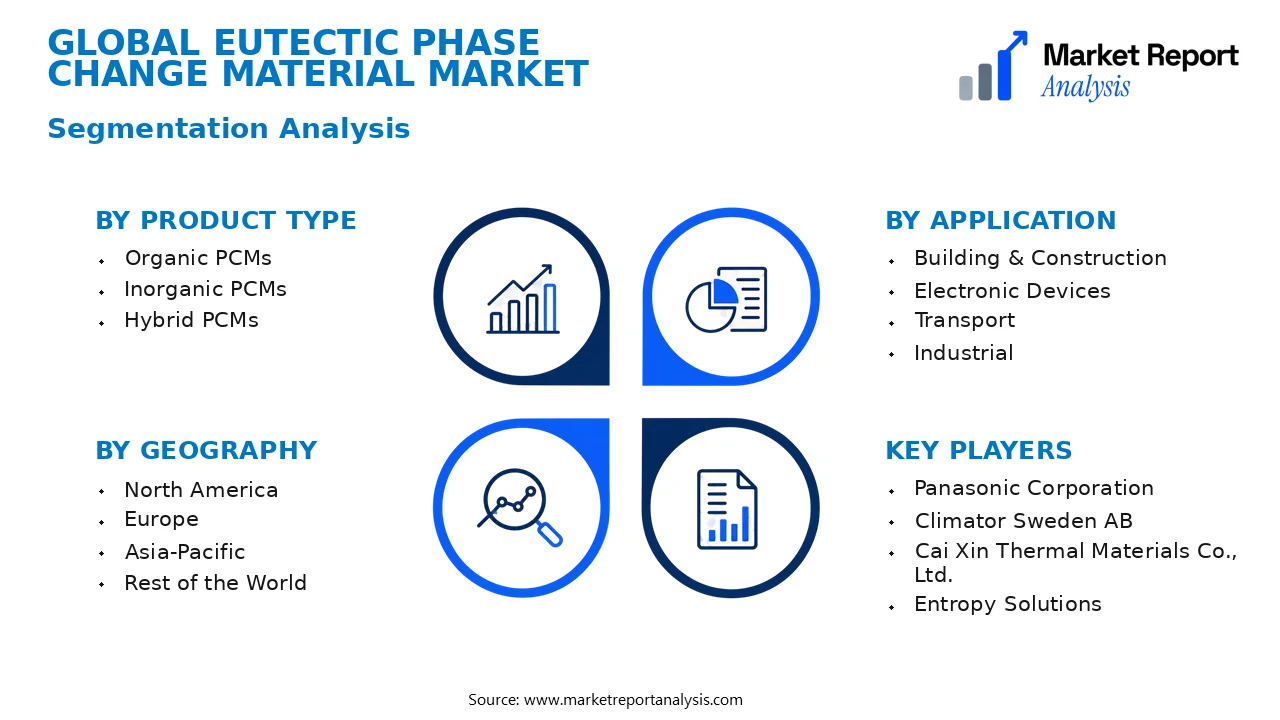
Market segmentation for eutectic phase change materials (PCMs) is structured around product type, application, and geographic regions. This segmentation helps delineate the diverse landscape of the industry, highlighting key growth drivers and market opportunities across various sectors and regions.
- Product Type
- Organic PCMs: Organic eutectic PCMs, including paraffins and fatty acids, are valued for their high latent heat capacity and chemical stability, making them suitable for various thermal management applications in consumer electronics and building insulation.
- Inorganic PCMs: Inorganic eutectic PCMs, primarily salt hydrate-based, are recognized for their superior thermal conductivity and cost-effectiveness, making them advantageous for large-scale thermal storage and industrial processes.
- Hybrid PCMs: Hybrid eutectic PCMs combine organic and inorganic materials to optimize thermal properties and stability, increasingly adopted across diverse sectors to enhance energy efficiency and system performance.
- Application
- Building & Construction: Eutectic PCMs are extensively used in building applications for passive thermal regulation, reducing reliance on active heating and cooling systems, thereby driving demand in residential and commercial structures.
- Electronic Devices: These materials provide effective thermal management solutions for electronic components, preventing overheating and improving device lifespan, which propels growth in consumer electronics and data centers.
- Transport: In transportation, eutectic PCMs are integrated into vehicle thermal management systems to maintain optimal operating temperatures, supporting the expanding electric vehicle market and cold chain logistics.
- Industrial: Industrial applications utilize eutectic PCMs for process temperature control, including manufacturing and chemical processing, where precise thermal management enhances operational efficiency.
- Geography
- North America: North America remains a dominant market driven by technological innovation, stringent energy regulations, and growing adoption in building and electronic sectors, particularly in the U.S. and Canada.
- Europe: Europe's emphasis on sustainability and energy efficiency policies catalyzes demand for eutectic PCMs, with significant growth in Germany, France, and the UK, driven by building retrofits and industrial applications.
- Asia-Pacific: The Asia-Pacific region exhibits the highest growth owing to urbanization, industrialization, and government initiatives promoting renewable energy and energy conservation in China, India, and Japan.
- Rest of the World: Emerging markets in Latin America, the Middle East, and Africa are gradually adopting eutectic PCMs, primarily for construction and industrial applications, supported by infrastructure development and energy policy reforms.
Competitive Intelligence
The Eutectic Phase Change Material (PCM) market exhibits moderate competition with key players including BASF SE, Rubitherm Technologies GmbH, and Phase Change Energy Solutions Inc., dominating the landscape through aggressive innovation and strategic alliances. Market concentration remains relatively balanced, with the top five companies accounting for approximately 55% of market share as of 2026. Companies are focusing on product differentiation via enhanced thermal stability, increased energy storage capacity, and eco-friendly formulations. Business strategies largely involve expanding R&D investments to develop advanced PCM formulations that cater to specific industry needs such as construction, HVAC, and electronics. Strategic partnerships and joint ventures are prevalent, aimed at leveraging local expertise and expanding geographic reach. Some firms have acquired smaller startups to bolster technological capabilities and diversify product portfolios. Expansion strategies include establishing new manufacturing facilities across Asia-Pacific and Europe to meet rising demand. Overall, industry players seek to sustain competitive advantage through continuous product innovation, sustainability focus, and global expansion, ensuring they stay ahead in this evolving market.
Leading Company Profiles
The global eutectic phase change material market is characterized by a diverse group of innovative companies that lead with advanced technological capabilities, strategic collaborations, and a focus on sustainable product development, positioning themselves for substantial growth in the upcoming years.
- Panasonic Corporation
- Climator Sweden AB
- Cai Xin Thermal Materials Co., Ltd.
- Entropy Solutions
- Mashreq Corporation
- Xiamen Tungsten Co., Ltd.
- Rubitherm Technologies GmbH
- LEONI AG
- Laird Thermal Systems
- Pluss Advanced Technologies Pvt Ltd
Panasonic Corporation
Panasonic leads in innovative thermal management solutions with a strong portfolio of phase change materials, leveraging advanced nanotechnology and global distribution channels to advance energy efficiency in HVAC and electronic cooling applications.
Climator Sweden AB
Specializing in encapsulated phase change materials, Climator offers sustainable, high-performance solutions tailored for building and industrial applications, emphasizing eco-friendly products and pioneering integration techniques for enhanced thermal regulation.
Cai Xin Thermal Materials Co., Ltd.
Cai Xin focuses on the development of cost-effective eutectic phase change materials, with strong R&D capabilities in chemical formulations, aiming to expand into energy storage sectors via strategic partnerships and regional market growth initiatives.
Entropy Solutions
Operating with a focus on advanced PCM solutions, Entropy Solutions develops customized eutectic formulations for high-precision applications in electronics and aerospace, harnessing proprietary encapsulation technologies for enhanced thermal performance and reliability.
Mashreq Corporation
Mashreq pioneers in innovative thermal energy storage solutions, expanding into large-scale infrastructure projects and establishing strategic alliances to penetrate new geographical markets with eco-efficient eutectic PCM products.
Xiamen Tungsten Co., Ltd.
Xiamen Tungsten, leveraging its extensive materials expertise, offers high-performance eutectic PCMs integrated within energy-saving systems for industrial and commercial sectors, focusing on scalability and safety standards compliance.
Rubitherm Technologies GmbH
Rubitherm specializes in innovative PCM solutions for building and chilled storage, utilizing its strong technological base to develop custom formulations that support sustainability goals and energy code compliance across regions.
LEONI AG
LEONI develops thermal management systems that incorporate eutectic PCMs for automotive and industrial applications, emphasizing lightweight, high-capacity solutions with strategic initiatives aimed at electrification and sustainability.
Laird Thermal Systems
Laird offers integrated thermal management solutions, including eutectic PCM products tailored for sensitive electronics and medical devices, focusing on advancing miniaturized, energy-efficient systems through innovation and partnerships.
Pluss Advanced Technologies Pvt Ltd
Pluss specializes in eco-friendly, cost-effective eutectic PCM solutions, actively expanding its manufacturing capacity and fostering collaborations to serve global HVAC, cooling, and energy storage markets with sustainable innovations.
Strategic Business Developments
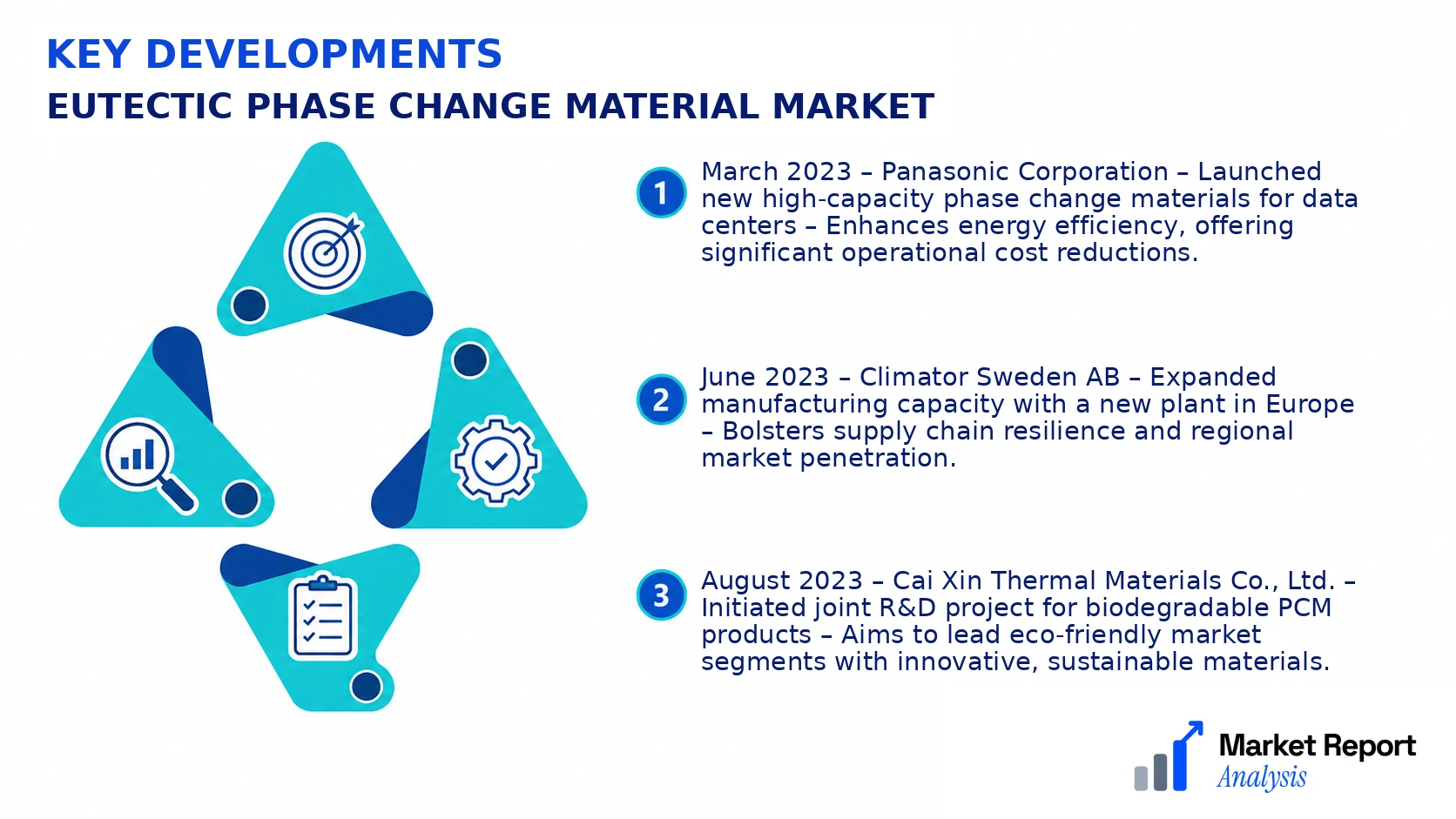
- March 2023 – Panasonic Corporation – Launched new high-capacity phase change materials for data centers – Enhances energy efficiency, offering significant operational cost reductions.
- June 2023 – Climator Sweden AB – Expanded manufacturing capacity with a new plant in Europe – Bolsters supply chain resilience and regional market penetration.
- August 2023 – Cai Xin Thermal Materials Co., Ltd. – Initiated joint R&D project for biodegradable PCM products – Aims to lead eco-friendly market segments with innovative, sustainable materials.
- November 2023 – Entropy Solutions – Partnered with aerospace firm for thermal management solutions – Strengthens market position in high-precision industrial sectors.
- January 2024 – Mashreq Corporation – Acquired regional PCM specialist to boost North African and Middle Eastern markets – Facilitates local manufacturing and customized product offerings.
Frequently Asked Questions
What is the Eutectic Phase Change Material Market?
The Eutectic Phase Change Material Market encompasses a range of materials that absorb and release thermal energy during phase transitions at specific temperatures, primarily used in thermal management applications across various industries such as building, electronics, and transportation.
What is the current market size of Eutectic Phase Change Material Market?
As of 2026, the global Eutectic Phase Change Material Market is valued at approximately USD 2.1 Billion, reflecting increasing adoption driven by demand for efficient thermal energy storage solutions and expanding applications in diverse technological sectors.
What factors are driving the Eutectic Phase Change Material Market?
Market growth is propelled by rising emphasis on energy conservation, advancements in material technology, and increasing integration of thermal management solutions in electronics, building insulation, and renewable energy systems, bolstered further by supportive governmental policies.
Which region dominates the Eutectic Phase Change Material Market?
North America currently leads the market owing to high technological adoption, robust infrastructure investments, and stringent energy efficiency standards, followed by Europe and the Asia-Pacific, which are also witnessing significant growth due to industrial expansion and urbanization.
Which segment is expected to grow the fastest?
The application segment focused on building and construction is anticipated to witness the fastest growth, driven by the adoption of phase change materials for thermal regulation and energy efficiency in residential and commercial infrastructure projects.
Who are the leading companies operating in the Eutectic Phase Change Material Market?
Major market players include BASF SE, Climator AB, and phaseChange Energy Solutions, Inc., which are expanding their R&D activities, forming strategic alliances, and introducing innovative products to strengthen their market presence and meet increasing global demand.
Analyst Perspective
The long-term outlook for the Eutectic Phase Change Material Market remains optimistic, driven by growing demand for energy-efficient thermal management across industries. Technological evolution is likely to focus on enhancing the thermal storage capacity, recyclability, and environmental compatibility of eutectic PCMs, creating opportunities for product innovation and differentiation. Investors should prioritize funding for R&D initiatives that improve phase change precision and integration with smart building systems, aligning with sustainability goals. Competitive intensity is increasing as global players expand their portfolios and market penetration tactics, particularly in regions with supportive policies. Regional growth potential is substantial in Asia-Pacific, owing to rapid infrastructural development and rising urbanization, while North America and Europe are expected to lead in adopting high-performance and eco-friendly formulations. Strategic focus should also include establishing regional manufacturing hubs to reduce costs and improve supply chain resilience, ensuring long-term market stability and capacity to meet emerging demand.
