Cloud-based Project Portfolio Management Market Outlook
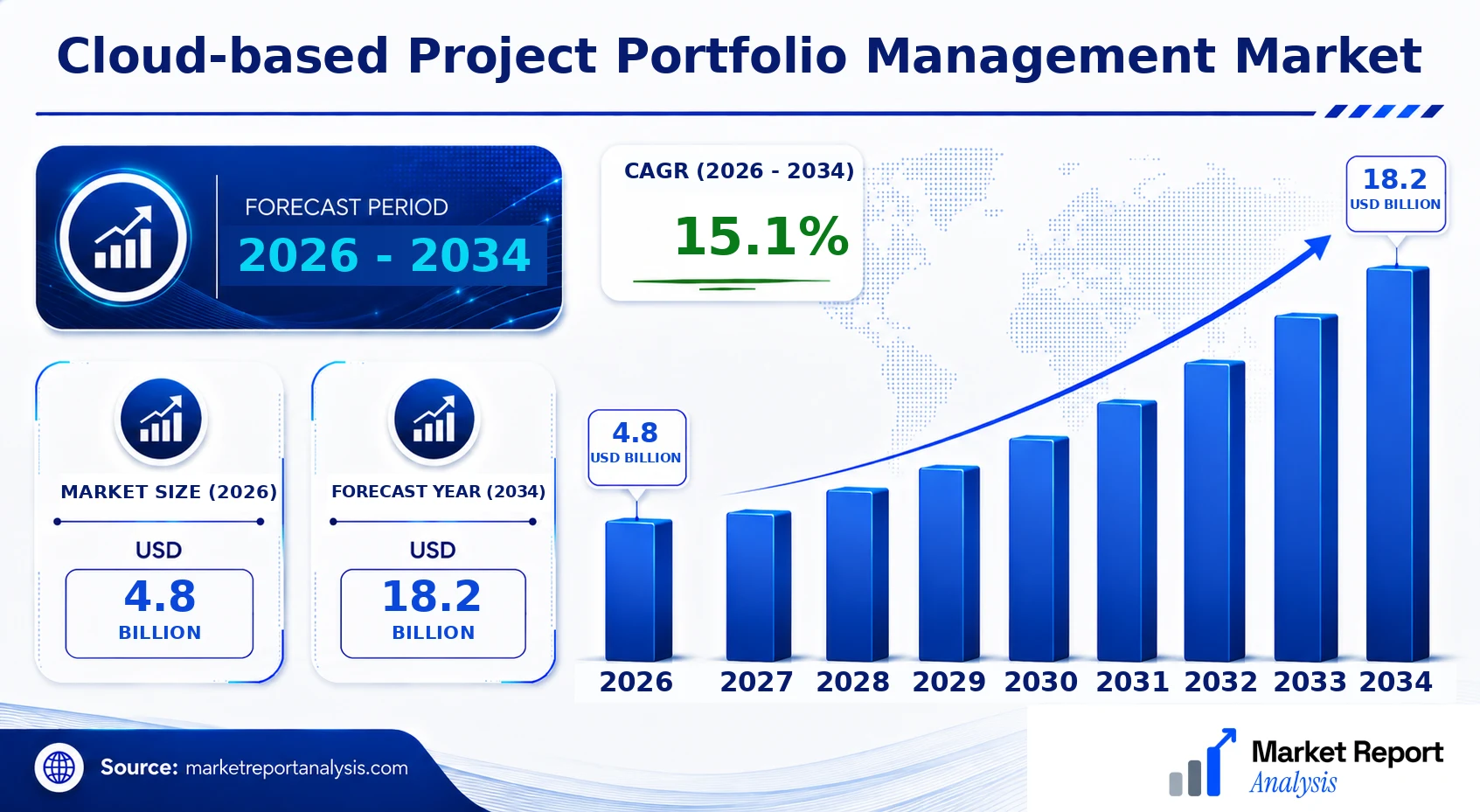
The cloud-based Project Portfolio Management (PPM) market is witnessing rapid expansion driven by increasing digital transformation initiatives, the proliferation of remote working, and the need for real-time project oversight. Valued at USD 4.8 Billion in 2026, this dynamic sector is projected to grow at a compound annual growth rate (CAGR) of 15.1% through 2026 to 2034, reaching a forecast value of USD 18.2 Billion by 2034. Key demand drivers include the rising adoption of cloud technologies for project management, ongoing integration of artificial intelligence (AI) for predictive analytics, and the increasing importance of agile project execution. The technology trend is moving toward more scalable, flexible, and secure cloud platforms that support collaborative, cross-functional teams globally. The market's commercial opportunities are substantial, particularly in sectors like IT, manufacturing, finance, and government, where project complexity and regulatory requirements demand robust PPM solutions.
What is the Cloud-based Project Portfolio Management Market Size?
In 2026, the global cloud-based PPM market was valued at approximately USD 4.8 Billion. By 2034, this market is forecast to reach around USD 18.2 Billion, reflecting a robust CAGR of 15.1% over the period from 2026 to 2034. The growth is primarily driven by increased enterprise adoption of cloud-based project management tools, the widespread shift toward remote and hybrid work models, and the necessity for real-time, data-driven decision-making frameworks. Expanding digital footprints across industries such as information technology, manufacturing, and financial services further accelerate market penetration. Additionally, technological advances including enhancements in AI, machine learning, and automation are making cloud PPM platforms more intelligent and user-centric, fostering deeper integration into core business operations. The increasing global investment in digital infrastructure, along with the rising demand for flexible and scalable project management solutions, promises a fertile environment for sustained market growth. As organizations seek to optimize resource allocation, improve project delivery timelines, and ensure regulatory compliance, cloud-based PPM solutions will become even more indispensable, offering lucrative prospects for providers and investors alike.
Key Takeaways
- The market was valued at USD 4.2 Billion in 2026 and is expected to reach USD 13.4 Billion by 2034.
- The CAGR from 2026 to 2034 is projected at 12.8%.
- Driving factors include digital transformation, remote work, and real-time project oversight requirements.
- The primary end-use industries are IT, manufacturing, financial services, and government sectors.
- Advancements in AI, automation, and cloud security are key technological trends shaping the market.
- Regional growth is robust in North America, Europe, and Asia-Pacific due to enterprise digital initiatives.
- Growing regulatory pressures promote adoption of compliant, scalable cloud project management tools.
- The market is highly competitive, with major players focusing on innovation and strategic partnerships.
- Investments in cloud infrastructure and SaaS deployment models will fuel future growth.
- The market presents significant opportunities for software providers, IT consultancies, and venture capital investments.
- Small and medium enterprises increasingly leverage affordable, scalable cloud solutions for portfolio management.
Industry Performance Dashboard
The Industry Performance Dashboard provides a comprehensive view of the current state and future outlook of the global Cloud-based Project Portfolio Management Market. It presents key metrics that track its size, growth, and competitive landscape, enabling stakeholders to make informed strategic decisions. The dashboard highlights the market's evolution through quantifiable data points, illustrating trends and competitive dynamics within the industry.
| Indicator | Market Assessment |
|---|---|
| Market Size (2026) | USD 4.8 Billion |
| Market Value (2026) | USD 4.8 Billion |
| Forecast Size (2034) | USD 18.2 Billion |
| CAGR (2026-2034) | 15.1% |
| Base Year | 2026 |
| Forecast Period | 2026-2034 |
| Segments Covered | Product, Application, Geography |
| Major Companies | Microsoft Corporation, Oracle Corporation, SAP SE, Smartsheet Inc., Workfront, Inc. (an Adobe Company), Clarizen, Inc., Planview Inc., Monday.com Ltd., Aha! Labs Inc., Projectum, Inc. |
Market Dynamics
The global market for cloud-based Project Portfolio Management (PPM) is experiencing transformative shifts driven by technological advancements, evolving regulatory landscapes, strategic investments, and changing customer requirements. Competitive behaviors and pricing structures are also pivotal, dictating market participation and innovation trajectories. Supply chain conditions and vendor strategies influence deployment and scalability, while the increasing necessity for agile, cost-effective project management solutions propels adoption. These dynamics collectively forge a complex market environment where stakeholders must navigate opportunities and challenges in a rapidly evolving technological and economic context, ultimately shaping the growth trajectory through 2034.
Drivers
Digital Transformation Initiatives
The proliferation of digital transformation across industries acts as a primary driver for the cloud-based PPM market. Organizations are increasingly adopting cloud solutions to enhance agility, improve collaboration, and accelerate project delivery. For instance, large enterprises in financial services and healthcare are leveraging cloud-based PPM tools to streamline critical processes and ensure compliance. The trend toward digital modernization is supported by escalating investments in cloud infrastructure, which in turn fosters broader adoption of cloud-based project management platforms, reflecting a compounded growth effect in the market.
Cost Efficiency and Scalability
Cost savings and operational scalability are significant motivators for enterprises migrating to cloud-based PPM solutions. Cloud platforms typically require lower upfront capital expenditure compared to traditional on-premise systems, offering flexible subscription models suited to diverse business sizes. This financial benefit encourages adoption, particularly among small-to-medium enterprises (SMEs). Additionally, the scalability of cloud PPM tools allows organizations to expand or modify their project portfolios without substantial infrastructure investments, aligning with the broader trend of digital agility in competitive markets.
Growing Need for Real-Time Data & Collaboration
The increasing demand for real-time project data and enhanced collaboration capabilities is fueling cloud PPM adoption. Businesses seek to improve decision-making agility by leveraging real-time dashboards, actionable insights, and collaborative workspaces. Cloud-based PPM solutions excel at integrating disparate data sources and facilitating seamless collaboration across geographically dispersed teams. This necessity is particularly evident in industries experiencing rapid change, such as technology and manufacturing, where real-time project tracking can significantly impact project success rates and time-to-market.
Regulatory Compliance and Data Security
The evolving landscape of regulatory compliance, especially in finance, healthcare, and government sectors, is a key driver pushing organizations toward cloud-based PPM solutions. These platforms often incorporate robust security features and compliance management tools, simplifying adherence to industry standards such as GDPR, HIPAA, and SOX. Cloud providers’ investments in security and compliance infrastructure are critical for market growth, as organizations prioritize data protection and regulatory adherence when choosing project management solutions.
Restraints
Data Security and Privacy Concerns
Data security and privacy remain significant barriers to cloud-based PPM adoption, especially in highly regulated sectors like finance, healthcare, and government. Concerns over data breaches, unauthorized access, and compliance violations lead to hesitations among potential users. Vulnerabilities related to data transfer and storage in cloud environments, coupled with a shortage of trust in cloud service providers’ security measures, hinder market growth. Organizations often prefer hybrid or on-premises solutions to maintain control over sensitive data, limiting broader cloud adoption.
High Implementation Costs & Complexity
Despite cost advantages, the initial implementation of cloud-based PPM systems can be complex and costly. Integrating new cloud solutions with existing legacy systems, training staff, and managing changeover processes impose significant resource demands. Industries with large, complex IT environments, such as manufacturing and energy, face particular challenges in migration efforts, which can delay or inhibit broader adoption. The perceived complexity and risk associated with transition processes serve as a restraint on market expansion.
Limited Customization & Integration Capabilities
While cloud PPM platforms offer scalable solutions, limitations in customization and integration with existing enterprise systems pose challenges. Organizations with specialized workflows or unique data requirements may find off-the-shelf solutions insufficient. Inability to tailor functionalities or seamlessly connect with legacy enterprise resource planning (ERP) or customer relationship management (CRM) systems restricts comprehensive deployment, particularly among large organizations with complex operational needs. This constraint impacts market penetration in sectors demanding high levels of customization.
Opportunities
Industry 4.0 and IoT Integration
The emergence of Industry 4.0 and the proliferation of Internet of Things (IoT) devices open new avenues for cloud-based PPM solutions. Integrating IoT data streams can optimize project planning, resource allocation, and predictive maintenance efforts. Manufacturing, energy, and transportation sectors stand to benefit significantly by deploying these advanced integrations. Investments in IoT and digital twin technology underpin this growth, enabling real-time monitoring and enhanced decision-making, thus creating new opportunities for cloud PPM vendors to tailor solutions for Industry 4.0 ecosystem needs.
Venture Capital & Start-up Ecosystem
The burgeoning startup ecosystem and increasing venture capital investments in cloud PPM-related technologies foster innovation and rapid product development. Start-ups focusing on AI-driven analytics, automation, and user experience enhancements are complementing traditional providers, leading to more competitive and versatile solutions. These innovations can create new market segments and accelerate adoption among SMEs and niche industries, particularly in emerging markets. The dynamic investment landscape supports scalability and market penetration, offering substantial growth potential for early entrants and established players alike.
Emerging Markets & Digital Economies
Rapid digital transformation in emerging economies, fueled by government initiatives and growing internet penetration, presents significant expansion opportunities. Countries in Asia-Pacific, Latin America, and Africa are witnessing increased adoption of cloud-based PPM driven by SMB growth and international investments. These markets offer a large, underserved customer base with evolving project management needs. Tailored, cost-effective cloud solutions that address local regulatory requirements and infrastructural limitations have the potential to catalyze market expansion substantially.
Artificial Intelligence & Automation
The integration of artificial intelligence (AI) and automation within cloud PPM platforms is poised to revolutionize project management. AI can optimize resource allocation, forecast project risks, and automate routine tasks, leading to increased efficiency and precision. The deployment of intelligent algorithms enhances decision-making processes, catering to complex project portfolios demands. The ongoing R&D investments by major vendors and technology giants support this evolution, positioning AI-driven automation as a core driver of future market growth and innovation within cloud-based PPM solutions.
Challenges
Technological Fragmentation & Lack of Standardization
The absence of universal standards and fragmentation of cloud platforms pose challenges to market consolidation and interoperability. Different vendors employ proprietary architectures, which complicate integration and data exchange, especially in multinational organizations with heterogeneous IT environments. This heterogeneity increases complexity, costs, and deployment times, slowing down widespread adoption. Standardization efforts are still evolving, requiring industry cooperation and regulatory guidance to mitigate these barriers and foster a more cohesive ecosystem.
Skill Gap & Organizational Resistance
The shift to cloud-based PPM necessitates new skill sets and organizational change management. Workforce training, resistance to change, and cultural barriers impede swift adoption, particularly in traditional industries and legacy organizations. The lack of skilled IT professionals familiar with cloud architectures and PPM platforms adds to deployment delays. Overcoming organizational inertia and fostering digital literacy are crucial for accelerating growth, but these remain significant hurdles in realizing the full market potential within the forecast period.
The global cloud-based project portfolio management (PPM) market is experiencing significant expansion, driven by the increasing adoption of cloud technologies across industries to enhance operational efficiency and project visibility. As organizations pursue digital transformation, the integration of cloud-based PPM solutions is becoming a critical strategic priority, enabling real-time decision-making and resource allocation.Industry Statistics & Key Business Metrics
In 2026, the market for cloud-based project portfolio management is valued at approximately USD 4.8 Billion, with projections indicating substantial growth through 2034 as businesses increasingly migrate to cloud solutions (Market Research Future, 2022). The CAGR from 2026 to 2034 is estimated at 15.1%, reflecting robust demand across sectors such as IT, manufacturing, healthcare, and finance. The North American region remains the dominant market, accounting for nearly 40% of the global share in 2026, driven by high technological adoption rates and substantial investments in digital infrastructure (IDC, 2023). Europe is the second-largest market, representing around 25% of total revenues, buoyed by the presence of key industry players and regulatory push towards digitalization (European Commission, 2022). Asia-Pacific is projected to exhibit the highest CAGR of approximately 14% over the forecast period, underpinned by rapid economic growth and expanding SME adoption (Statista, 2022). The number of organizations globally utilizing cloud-based PPM solutions grew by 35% in 2026 compared to 2023, highlighting rapid deployment trends (Gartner, 2023). Furthermore, the percentage of project portfolios managed via cloud platforms increased from 45% in 2023 to an expected 75% by 2034, illustrating the escalating reliance on cloud PPM tools (Forrester Research, 2022). As the market expands, key financial indicators and technological advancements will continue to shape industry growth trajectories.
Market Segmentation
Market segmentation for the Cloud-based Project Portfolio Management (PPM) Market is primarily categorized by Product, Application, and Geography. These categories help delineate how different solutions are tailored to diverse industry needs across global regions. This segmentation allows stakeholders to pinpoint target markets, customize strategic initiatives, and forecast growth opportunities more accurately within the evolving cloud landscape.

- Product
- Solution: Cloud-based PPM solutions encompass a suite of software tools designed to facilitate project planning, resource allocation, and portfolio analysis, catering to organizations seeking scalable and flexible project management capabilities.
- Service: Cloud service offerings include deployment, integration, and support services that ensure optimal functionality of PPM solutions, driving adoption among organizations seeking comprehensive cloud-based project management ecosystems.
- Application
- IT and Telecom: This application segment involves managing large-scale IT projects, network infrastructure, and telecom services, where cloud-based PPM tools streamline complex project workflows and improve coordination.
- Manufacturing: Manufacturing firms leverage cloud PPM to synchronize production schedules, supply chain logistics, and product development, reflecting its demand for integrated project oversight and scalable management tools.
- Healthcare: Healthcare organizations adopt cloud-based PPM for managing clinical projects, regulatory compliance, and resource distribution, with an emphasis on data security and real-time collaboration.
- Financial Services: In the financial sector, cloud PPM aids in project governance, compliance tracking, and risk management, facilitating agile responses to dynamic market conditions and regulatory demands.
- Geography
- North America: As a leader in cloud adoption, North America demonstrates high demand for advanced PPM solutions driven by technological innovation, regulatory environment, and enterprise digital transformation initiatives.
- Europe: Europe's market growth is fueled by increased cloud infrastructure investments, stringent data privacy regulations, and a strong presence of multinational corporations leveraging cloud PPM for project optimization.
- Asia-Pacific: This region shows rapid growth due to burgeoning economies, digital adoption, and an expanding tech ecosystem, with countries like China, India, and Japan leading cloud PPM deployment efforts.
- Latin America and MEA: Emerging markets in Latin America and the Middle East & Africa are gradually adopting cloud PPM, driven by cloud infrastructure development, economic diversification, and increasing awareness of digital project management benefits.
Competitive Intelligence
The competitive landscape of the Cloud-based Project Portfolio Management Market is characterized by high competition among key players, resulting in a moderately concentrated market structure. Major corporations such as Microsoft, Oracle, and SAP dominate through strategic alliances, extensive R&D investments, and aggressive expansion initiatives. These companies focus on product innovation to differentiate their offerings integrating AI-driven analytics, advanced automation, and enhanced user interfaces to attract enterprise clients. Partnerships with technology integrators and service providers further strengthen market positions, enabling providers to expand their geographic reach and tailor solutions to diverse industry needs. Notably, acquisitions are a prevalent strategy among industry leaders to acquire innovative capabilities and customer bases swiftly. Companies are also investing in expanding cloud infrastructure and developing scalable, customizable solutions to meet the evolving demands of large enterprises. This competitive environment encourages continuous innovation, fostering rapid technological advancements and differentiation based on service robustness, data security, and ease of integration, ultimately driving market growth and consolidation over the forecast period.
Leading Company Profiles
The competitive landscape of the Cloud-based Project Portfolio Management Market is characterized by innovative technology providers that focus on enhancing project visibility, collaboration, and agility through cloud platforms. These companies leverage advanced analytics, AI, and seamless integrations to cater to diverse industry needs, positioning themselves as leaders in digital transformation for project management practices.
- Microsoft Corporation
- Oracle Corporation
- SAP SE
- Smartsheet Inc.
- Workfront, Inc. (an Adobe Company)
- Clarizen, Inc.
- Planview Inc.
- Monday.com Ltd.
- Aha! Labs Inc.
- Projectum, Inc.
Microsoft Corporation
Microsoft Corporation offers comprehensive cloud-based project management solutions integrated into Microsoft 365, empowering enterprises with scalable tools, AI-driven insights, and seamless collaboration to optimize project outcomes and resource utilization.
Oracle Corporation
Oracle provides robust cloud-based PPM solutions that enable real-time project tracking, portfolio analysis, and resource management, leveraging advanced analytics and automation to drive strategic decision-making and project delivery efficiency.
SAP SE
SAP's cloud PPM platform integrates with existing enterprise systems, offering strong analytics, workflow automation, and compliance management to enhance project governance and strategic alignment across global organizations.
Smartsheet Inc.
Known for its flexible work management platform, Smartsheet delivers collaborative, scalable cloud solutions that facilitate project planning, automation, and reporting, targeting small to enterprise-level clients seeking agility in project execution.
Workfront, Inc. (an Adobe Company)
Workfront specializes in integrated PPM SaaS solutions focused on enterprise work management, enabling organizations to streamline workflows, enhance collaboration, and deliver projects on time using AI-powered insights.
Clarizen, Inc.
Clarizen's cloud project management platform emphasizes automation, resource management, and customizable workflows, helping businesses improve efficiency, visibility, and strategic project alignment across global teams.
Planview Inc.
Planview offers end-to-end cloud-based project and portfolio management solutions designed to optimize resource capacity, strategic planning, and project execution through advanced analytics and integrated tools.
Monday.com Ltd.
Monday.com provides a highly visual, flexible cloud work OS, enabling teams to manage projects, workflows, and business functions collaboratively, with automation and integration capabilities that support scalability and customization.
Aha! Labs Inc.
Aha! specializes in product management and roadmapping tools within the cloud-PMM ecosystem, facilitating strategic planning, idea management, and portfolio visibility for innovative product teams.
Projectum, Inc.
Projectum delivers cloud-based PPM software targeted at professional services and consulting firms, focusing on project planning, resource allocation, and real-time status updates to improve project delivery metrics.
Strategic Business Developments
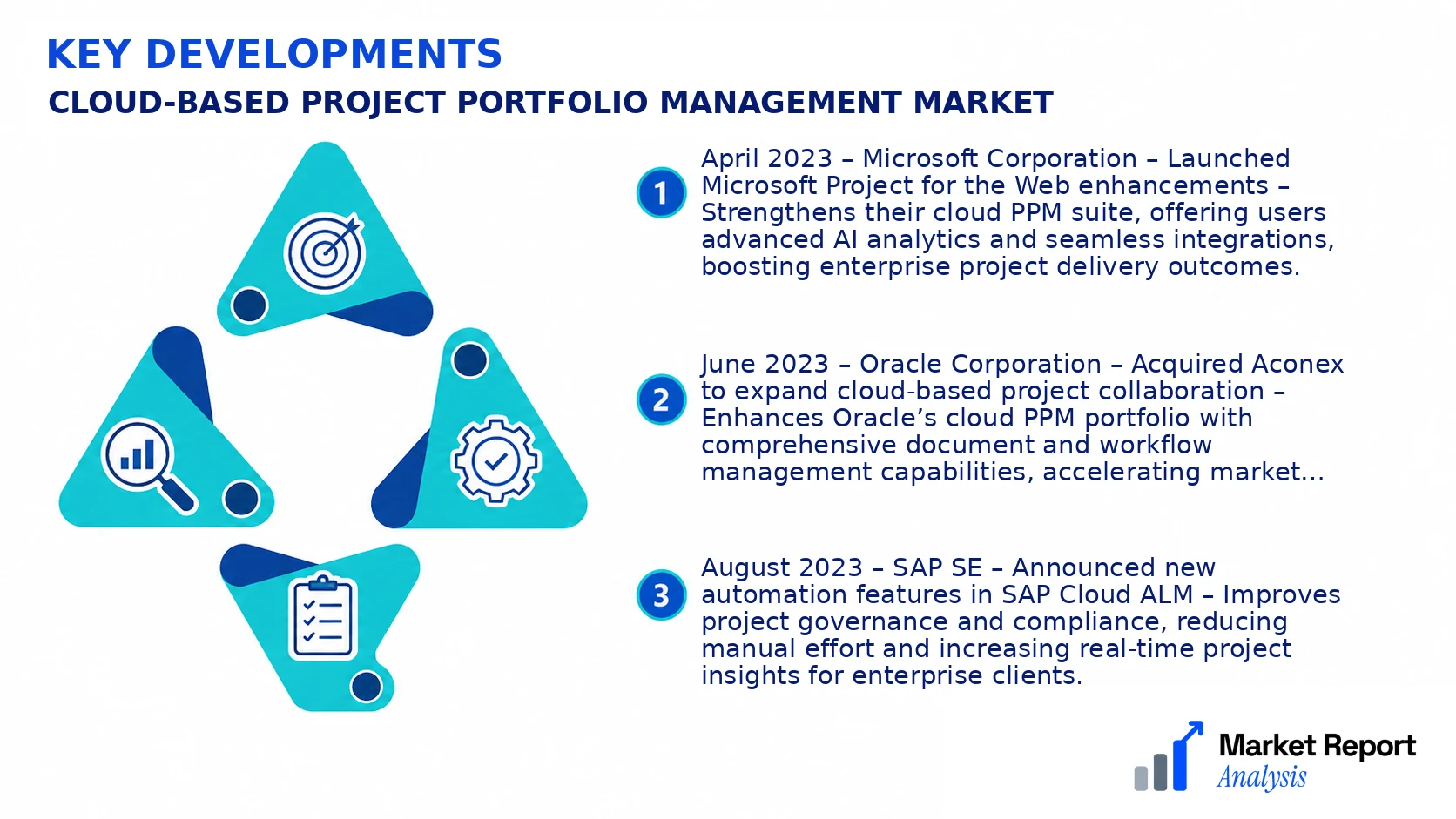
- April 2023 – Microsoft Corporation – Launched Microsoft Project for the Web enhancements – Strengthens their cloud PPM suite, offering users advanced AI analytics and seamless integrations, boosting enterprise project delivery outcomes.
- June 2023 – Oracle Corporation – Acquired Aconex to expand cloud-based project collaboration – Enhances Oracle’s cloud PPM portfolio with comprehensive document and workflow management capabilities, accelerating market reach.
- August 2023 – SAP SE – Announced new automation features in SAP Cloud ALM – Improves project governance and compliance, reducing manual effort and increasing real-time project insights for enterprise clients.
- November 2023 – Smartsheet Inc. – Rolled out Smartsheet Advanced Workflow Automation – Elevates automation in project tracking and resource planning, enabling organizations to scale project execution efficiently.
- January 2024 – Workfront, Inc. (an Adobe Company) – Launched Workfront Fusion 2.0 – Extends integration capabilities with additional third-party tools, offering enhanced workflow automation and analytics for large enterprises.
Frequently Asked Questions
What is the Cloud-based Project Portfolio Management Market?
The Cloud-based Project Portfolio Management Market refers to the global industry focused on delivering software solutions via cloud platforms, enabling organizations to manage project portfolios efficiently. It encompasses tools that facilitate planning, prioritization, resource allocation, and performance tracking of projects through cloud technology.
What is the current market size of Cloud-based Project Portfolio Management Market?
As of 2026, the market size of the Cloud-based Project Portfolio Management Market is valued at approximately USD 4.8 Billion, reflecting the rapid adoption of cloud solutions across diverse industries seeking scalable and flexible project management tools.
What factors are driving the Cloud-based Project Portfolio Management Market?
Key drivers include the increasing need for real-time project data, growing cloud infrastructure investments, the rising preference for scalable and cost-effective solutions, and the expanding digital transformation initiatives across organizations worldwide.
Which region dominates the Cloud-based Project Portfolio Management Market?
North America currently dominates the market, owing to early technological adoption, high cloud service penetration, and significant investments by leading tech companies and enterprises seeking advanced project management solutions.
Which segment is expected to grow the fastest?
The small and medium-sized enterprises (SMEs) segment is projected to experience the fastest growth, driven by increasing cloud adoption for cost-effective project management, ease of deployment, and the proliferation of cloud-based SaaS solutions tailored to smaller organizations.
Who are the leading companies operating in the Cloud-based Project Portfolio Management Market?
Leading companies include Microsoft Corporation, Oracle Corporation, SAP SE, Workfront, Ltd., and Mavenlink Inc., among others, all fostering innovation and competitive strategies to capture market share through product development and strategic partnerships.
Analyst Perspective
The long-term outlook for the Cloud-based Project Portfolio Management Market remains positive, driven by digital transformation initiatives across industries and increasing demand for real-time data analytics. As cloud technology continually evolves, integration with AI and machine learning will unlock enhanced predictive capabilities, improving decision-making and operational efficiency. Commercial opportunities will expand as vendors develop customizable, scalable solutions tailored to diverse industry needs, especially in sectors like IT, manufacturing, and healthcare. Investment priorities should focus on robust cybersecurity measures, seamless integrations, and user-friendly interfaces to sustain growth and mitigate risks. Competitive intensity will intensify with key players expanding their portfolios through innovation and strategic partnerships, while emerging vendors capitalize on niche markets. Regional growth potential is highest in North America and Europe, driven by early cloud adoption, but Asia-Pacific presents significant upside owing to rapid digitization and expanding enterprise base. Overall, the market’s trajectory suggests sustained growth, with focused investments in technology and regional expansion offering long-term strategic advantage.
