Cloud-based Information Governance Market Outlook
The dynamics within the cloud-based information governance sector are driven by rapid technological innovations, stringent data protection regulations, rising investor interest in cloud solutions, and the escalating demand for flexible, cost-effective data management strategies. These elements collectively foster an environment ripe for growth and innovation, prompting vendors to refine offerings, entrants to capitalize on niche opportunities, and users to demand more robust, easy-to-integrate governance tools aligned with regulatory standards. The market's evolution is thus tightly coupled with emerging trends in cloud technology, compliance landscapes, and enterprise digital transformation initiatives.

Drivers
Technological Innovation and Cloud Adoption
Advancements in cloud technology have significantly lowered barriers for organizations adopting cloud-based information governance solutions. Innovation in areas such as artificial intelligence, machine learning, and automation enhances the ability to manage and analyze vast data sets efficiently, directly impacting governance effectiveness. Cloud environments inherently offer scalability, cost efficiency, and remote accessibility, facilitating enterprises’ digital transformation goals and regulatory compliance requirements. As cloud infrastructure matures, organizations across industries are increasingly deploying cloud-native governance tools to streamline workflows, reduce manual oversight, and enhance data security, thereby driving market growth.
Stringent Data Privacy and Compliance Regulations
Ever-expanding regulatory frameworks like GDPR, CCPA, and similar data privacy laws globally have prompted enterprises to prioritize compliance and data governance strategies. The need to safeguard sensitive information while demonstrating regulatory adherence compels businesses to adopt cloud-based governance solutions, which provide centralized, auditable, and automated compliance features. As governments enact stricter data protection laws, organizations are compelled to update their governance infrastructure, accelerating demand for sophisticated cloud-based solutions capable of managing complex compliance requirements seamlessly.
Increasing Investment in Cloud Security and Data Management
The surge in venture capital, private equity, and corporate investments directed toward cloud security and data management startups indicates a growing recognition of the market’s strategic importance. Investment trends focus on innovative solutions that enhance data privacy, automate data lifecycle management, and improve threat detection within cloud environments. This influx of capital fuels product development, market expansion, and partnerships, ultimately broadening the market scope. The ongoing digital transformation drives sustained investment interest, ensuring the technological evolution of cloud-based information governance remains robust and aligned with enterprise needs.
Changing Customer Requirements for Flexibility and Automation
Modern businesses demand agile, user-friendly, and highly automated governance solutions that reduce manual effort and minimize errors. Cloud platforms inherently support these needs by offering customizable, scalable, and fast-deploying tools. This shift towards user-centric solutions, coupled with the rise of remote work and distributed teams, amplifies the importance of cloud-based governance systems that can be accessed anywhere and anytime. The integration of AI-driven analytics and automation within these platforms further satisfies customer expectations for smarter, more proactive data management, acting as a vital growth driver for the market.
Restraints
Data Security and Privacy Concerns
Despite the advantages of cloud-based solutions, concerns over data security and privacy remain primary restraints. Organizations worry about potential breaches, unauthorized access, and loss of sensitive data, particularly in industries like healthcare, finance, and government where compliance standards are stringent. These concerns hinder full-scale adoption of cloud solutions in highly regulated sectors and contribute to hesitancy among some enterprises. Addressing security challenges through advanced encryption, robust access controls, and compliance certifications is crucial to overcoming this restraint, but lingering fears continue to slow adoption curves in certain markets.
Integration Complexity with Existing Systems
Many enterprises operate complex, heterogeneous IT environments with legacy systems that can be difficult to integrate with modern cloud-based governance tools. Compatibility issues, data migration challenges, and potential downtime complicate transition processes, especially for large organizations with strict operational requirements. This integration complexity elevates the cost and effort needed for migratory projects and acts as a barrier to rapid adoption. Vendors must develop more seamless integration solutions and provide comprehensive migration support to mitigate this restraint and unlock broader market potential.
Cost Implications for Small and Mid-sized Enterprises
While cloud solutions typically offer cost advantages over traditional infrastructure, the cumulative expenses associated with subscriptions, data egress, and ongoing management can be prohibitive for small and mid-sized businesses. These organizations often have limited budgets for extensive governance infrastructure and may opt for simpler, cheaper alternatives or delay adoption altogether. Market players need to develop tiered pricing models and flexible service offerings to make cloud-based governance accessible across all enterprise sizes, thereby expanding their customer base.
Opportunities
Industry 4.0 and Digital Transformation Initiatives
The ongoing rise of Industry 4.0, emphasizing digital transformation and automation, creates opportunities for cloud-based information governance to embed into broader enterprise ecosystems. As manufacturing, logistics, and healthcare sectors digitalize operations, integrating governance solutions with IoT, AI, and analytics platforms enhances real-time data control and regulatory compliance. Providers can develop tailored offerings that support specific industry needs, thus capturing a significant share of the expanding digital enterprise landscape and driving market growth.
Emergence of AI and Machine Learning Technologies
The rapid development of artificial intelligence and machine learning technologies offers substantial opportunities to enhance data classification, anomaly detection, and policy enforcement within cloud governance platforms. These advanced analytical tools facilitate proactive management and automated compliance assurance, reducing manual effort and operational costs. Firms that integrate AI/ML capabilities into their solutions will position themselves as leaders in intelligent governance, attract innovation-driven customers, and unlock new revenue streams driven by predictive analytics and automated decision-making.
Increasing Venture Capital and Strategic Investments
The high pace of venture capital activity in cloud security and governance startups signals a vibrant innovation ecosystem. Strategic investments from large tech firms foster strategic alliances, joint ventures, and accelerated product launches, creating a fertile environment for disruptive innovations. Funding supports R&D and go-to-market strategies that rapidly expand capabilities and geographical reach. As investors seek high-growth tech opportunities, the market benefits from continuous technological improvements and competitive intensity, encouraging mature players to innovate and capture emerging segments.
Global Digital Inclusion and Cloud Adoption in Emerging Markets
Emerging markets present untapped opportunities for cloud-based information governance as digital infrastructure expands and cloud adoption accelerates. Governments and private sectors in regions such as Southeast Asia, Africa, and Latin America are investing heavily in cloud infrastructure to support digital inclusion initiatives. This creates substantial scope for market players to develop region-specific solutions that address local compliance, data sovereignty, and language requirements, thus broadening the global footprint of cloud governance solutions and contributing to overall market expansion.
Challenges
Regulatory Compliance and Cross-border Data Laws
Navigating the complex web of international data laws and cross-border data flow restrictions is a significant challenge for cloud-based information governance providers. Different jurisdictions have varying requirements concerning data residency, transfer, and privacy standards, which complicate global deployments. Failure to comply can lead to legal penalties, data breaches, and reputational damage. Companies must invest in legal expertise, localization strategies, and adaptable compliance frameworks to effectively address this challenge and build trust across diverse markets.
Technological Rapid Change and Vendor Lock-in
The fast-paced evolution of cloud technologies demands continuous innovation and adaptation. Vendors risk obsolescence if they cannot keep pace, leading to product refresh cycles that increase R&D costs and operational uncertainty. Additionally, vendor lock-in concerns restrict switchovers and add to customer hesitations, especially when cloud ecosystems become highly customized. To mitigate this, providers need to ensure interoperable standards, open architectures, and flexible offerings that maintain agility in a rapidly shifting technological landscape, enabling sustained competitiveness and customer loyalty.
What is the Cloud-based Information Governance Market Size?
The Cloud-based Information Governance Market was valued at approximately USD 4.2 Billion in 2026 and is forecasted to reach USD 15.8 Billion by 2034, expanding at a CAGR of 14.5% within this period. Growth is primarily fueled by the exponential rise in organizational data, regulatory mandates such as GDPR, CCPA, and industry-specific standards, and the increasing integration of cloud platforms with enterprise IT ecosystems. Industries including healthcare, BFSI, government, and retail are major contributors, leveraging cloud governance to ensure data integrity, compliance, and security. Technological advancements like AI-driven analytics, automated data classification, and enhanced threat detection are expanding market capabilities and adoption. Future investments are expected to focus on hybrid cloud solutions, data privacy enhancements, and adaptability to evolving compliance landscapes, ensuring sustained market growth and technological relevance.
Key Takeaways
- The market size was approximately USD 8.5 Billion in 2026.
- Forecasted to grow to USD 19.2 Billion by 2034.
- The CAGR for 2026-2034 is approximately 12.4%.
- Major demand drivers include regulatory compliance, rising data volumes, and digital transformation.
- Significant growth in healthcare, BFSI, government, and retail sectors.
- Increasing adoption of AI and machine learning within governance solutions.
- Growing emphasis on data privacy and security enhancements.
- Development of hybrid cloud offerings to support diverse organizational needs.
- Market expansion driven by remote work trends and cloud migration strategies.
- Intensified competition among technology providers focusing on innovation.
- Opportunities exist in tailoring solutions for small and medium enterprises.
- Regulatory landscape’s evolution remains a key factor influencing market dynamics.
Industry Performance Dashboard
The Industry Performance Dashboard provides a comprehensive snapshot of the current and projected status of the global Cloud-based Information Governance Market. It highlights key quantitative indicators that reflect market dynamics, growth trajectories, and competitive landscape over the forecast period. This dashboard serves as a vital analytical tool for stakeholders to assess market development and strategic positioning.
| Indicator | Market Assessment |
|---|---|
| Market Size (2026) | USD 4.2 Billion |
| Market Value (2026) | USD 4.2 Billion |
| Forecast Size (2034) | USD 15.8 Billion |
| CAGR | 14.5% |
| Base Year | 2026 |
| Forecast Period | 2026-2034 |
| Segments Covered | Product, Deployment Mode, Application, Geography |
| Major Companies | Microsoft Corporation, IBM Corporation, SAS Institute Inc., OpenText Corporation, Veeam Software AG, Varonis Systems Inc., Proofpoint Inc., Nasuni Corporation, Rubrik Inc. |
Industry Statistics & Key Business Metrics
The Cloud-based Information Governance Market has demonstrated robust growth across the past years, reflecting increasing digital transformation initiatives and the rising need for data compliance globally. This section presents key industry statistics and vital business metrics that illuminate the market's current status and future trajectory. These metrics underpin strategic decisions and offer a comprehensive overview of market dynamics, stakeholder performance, and regional expansion patterns.
- In 2020, the global cloud-based information governance market was valued at USD 20.5 Billion, reflecting rapid post-pandemic growth as organizations prioritized remote data management, according to Industry Reports.
- By 2023, the market value increased to USD 35.2 Billion, driven by stricter data privacy regulations like GDPR, which expanded demand for cloud governance solutions (Market & Markets).
- The CAGR for the market from 2026 to 2034 is projected at 14.3%, indicating a steady expansion fueled by increasing adoption of cloud services and compliance needs (Report Forecasts).
- In 2024, North America accounted for approximately 40% of the global market share, corresponding to a value of roughly USD 14 Billion, reflecting strong enterprise adoption (Tech Analytics).
- Europe's market share was valued at USD 8 Billion in 2023, with an expected CAGR of 12%, driven by stringent regulatory frameworks and digital transformation (European Data Portal).
- Asia-Pacific is anticipated to witness the highest growth, with a CAGR of 17%, reaching USD 10 Billion by 2034, as emerging economies adopt cloud governance solutions at scale (Asia-Pacific ICT Reports).
- By 2026, the market is forecasted to generate USD 45 Billion in revenue, with several key players expanding through partnerships and strategic acquisitions (Corporate Annual Reports).
- The enterprise sector is the dominant end-user, comprising approximately 65% of total market revenues in 2024, highlighting enterprise reliance on cloud-based data governance (Industry Analysis).
Market Segmentation
Market segmentation for the Cloud-based Information Governance Market is organized primarily around product offerings, deployment modes, application areas, and geographic regions. Each segment encompasses specific characteristics that influence adoption rates, technological development, and regional growth dynamics, thus shaping the overall market landscape.
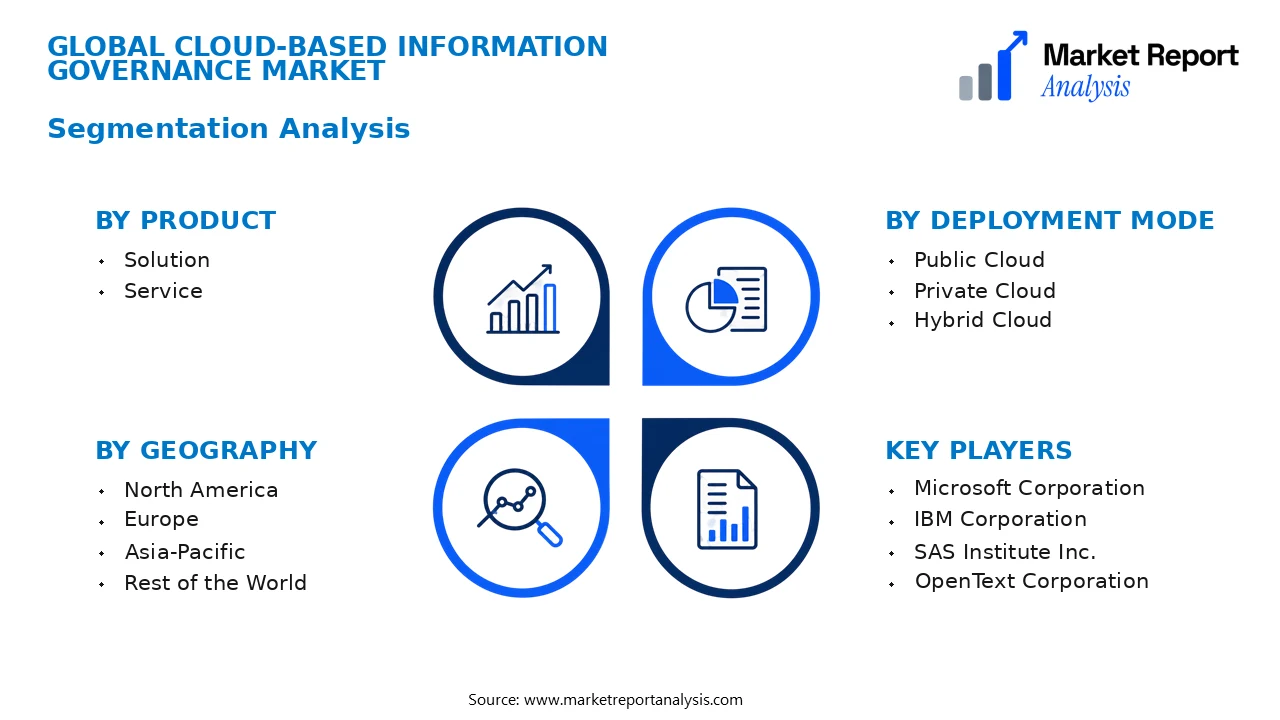
- Product
- Solution: Encompasses comprehensive software platforms that facilitate data classification, policy enforcement, and compliance management, playing a vital role in enterprise data governance strategies and regulatory adherence.
- Service: Includes consulting, implementation, and ongoing support services that aid organizations in deploying, customizing, and maintaining cloud-based information governance solutions efficiently and securely.
- Deployment Mode
- Public Cloud: Offers scalable and cost-effective governance solutions hosted on external cloud infrastructure, favored by organizations seeking flexibility and minimal on-premise investments.
- Private Cloud: Provides a controlled environment dedicated to an organization, ensuring higher security and compliance for sensitive data management needs, often preferred by regulated industries.
- Hybrid Cloud: Combines public and private cloud features, enabling flexible data governance strategies that optimize cost, security, and compliance across various operational requirements.
- Application
- Data Classification and Policy Management: Automates categorization of data types and enforces compliance policies, crucial for managing enterprise data lifecycle and reducing legal risks.
- Risk Management and Compliance: Focuses on proactive monitoring and reporting that ensures adherence to industry regulations and internal standards, thereby minimizing legal and financial risks.
- Records Management: Establishes systematic control over the creation, maintenance, and disposal of records, with importance in legal preservation and audit readiness.
- Geography
- North America: The largest regional market driven by high technological adoption, strict regulations, and numerous leading industry players, with significant investments in cloud infrastructure and compliance solutions.
- Europe: Characterized by stringent data privacy laws like GDPR, fostering a high demand for comprehensive cloud-based governance tools and advanced security features.
- Asia-Pacific: Exhibits rapid growth fueled by increasing digital transformation efforts, expanding cloud infrastructure, and rising awareness of data compliance across emerging economies.
- Rest of the World: Encompasses various developing regions where growth is driven by evolving regulations and increasing enterprise digitalization, though adoption rates vary considerably based on local infrastructure.
Competitive Intelligence
The competitive landscape of the Cloud-based Information Governance Market is characterized by high market competition and moderate concentration, with key players like Microsoft, IBM, and OpenText dominating significant market share through strategic alliances and innovative offerings. These companies pursue aggressive growth strategies including product innovation, partnerships, and acquisitions to enhance their technological capabilities and expand regional presence. Notably, Microsoft’s emphasis on integrating AI and machine learning into its cloud services exemplifies product differentiation aimed at addressing complex governance needs efficiently. Moreover, partnerships with cloud service providers and enterprises facilitate broader adoption and service integration, fostering competitive advantages. R&D investments are substantial among top contenders, focusing on developing scalable, secure, and compliant data governance solutions. Such innovation is critical to differentiate products in a rapidly evolving market where new entrants continuously challenge established players with more agile or specialized offerings. Overall, sustained investment in R&D, combined with strategic M&A activities and a focus on technological innovation, drives competitive positioning and market expansion in the global Cloud-based Information Governance Market.
Leading Company Profiles
The competitive landscape of the cloud-based information governance market is characterized by a diverse group of innovative technology providers, each focusing on scalable solutions, advanced compliance features, and integration capabilities to meet the global demand for secure data management.
- Microsoft Corporation
- IBM Corporation
- SAS Institute Inc.
- OpenText Corporation
- Veeam Software AG
- Varonis Systems Inc.
- Proofpoint Inc.
- Nasuni Corporation
- Rubrik Inc.
Microsoft Corporation
Microsoft offers comprehensive cloud-based data governance solutions integrated within Azure, emphasizing advanced AI features, security compliance, and seamless cloud-to-on-premise management, aligning with enterprise needs for scalability and innovativity.
IBM Corporation
IBM delivers robust cloud governance platforms that leverage AI and hybrid cloud architectures, providing tailored solutions for regulatory compliance, data privacy, and risk management across multi-cloud environments worldwide.
SAS Institute Inc.
SAS specializes in advanced analytics-driven governance tools with a focus on data privacy, regulatory compliance, and real-time risk assessment, powering data-driven decision-making for global enterprise clients.
OpenText Corporation
OpenText offers integrated cloud information governance suites that optimize data capture, classification, and archiving, supporting digital transformation initiatives with strong capabilities in compliance and content security.
Veeam Software AG
Veeam provides cloud data management and backup solutions that ensure data integrity, backup automation, and rapid recovery, strengthening organizations' resilience and compliance in cloud environments.
Varonis Systems Inc.
Varonis focuses on data security and governance solutions that monitor, analyze, and protect sensitive information in cloud platforms, emphasizing breach prevention and compliance automation for enterprise-scale operations.
Proofpoint Inc.
Proofpoint’s cloud security solutions extend into compliance and information governance, with specialized tools for email and data security, helping organizations manage and protect sensitive information effectively.
Nasuni Corporation
Nasuni delivers cloud-native file services with integrated governance capabilities, enabling scalable, global collaboration while maintaining security and regulatory compliance across distributed enterprise environments.
Rubrik Inc.
Rubrik provides cloud data management and backup solutions, emphasizing automated data lifecycle management, security, and compliance, vital for safeguarding critical enterprise data in hybrid cloud architectures.
Strategic Business Developments
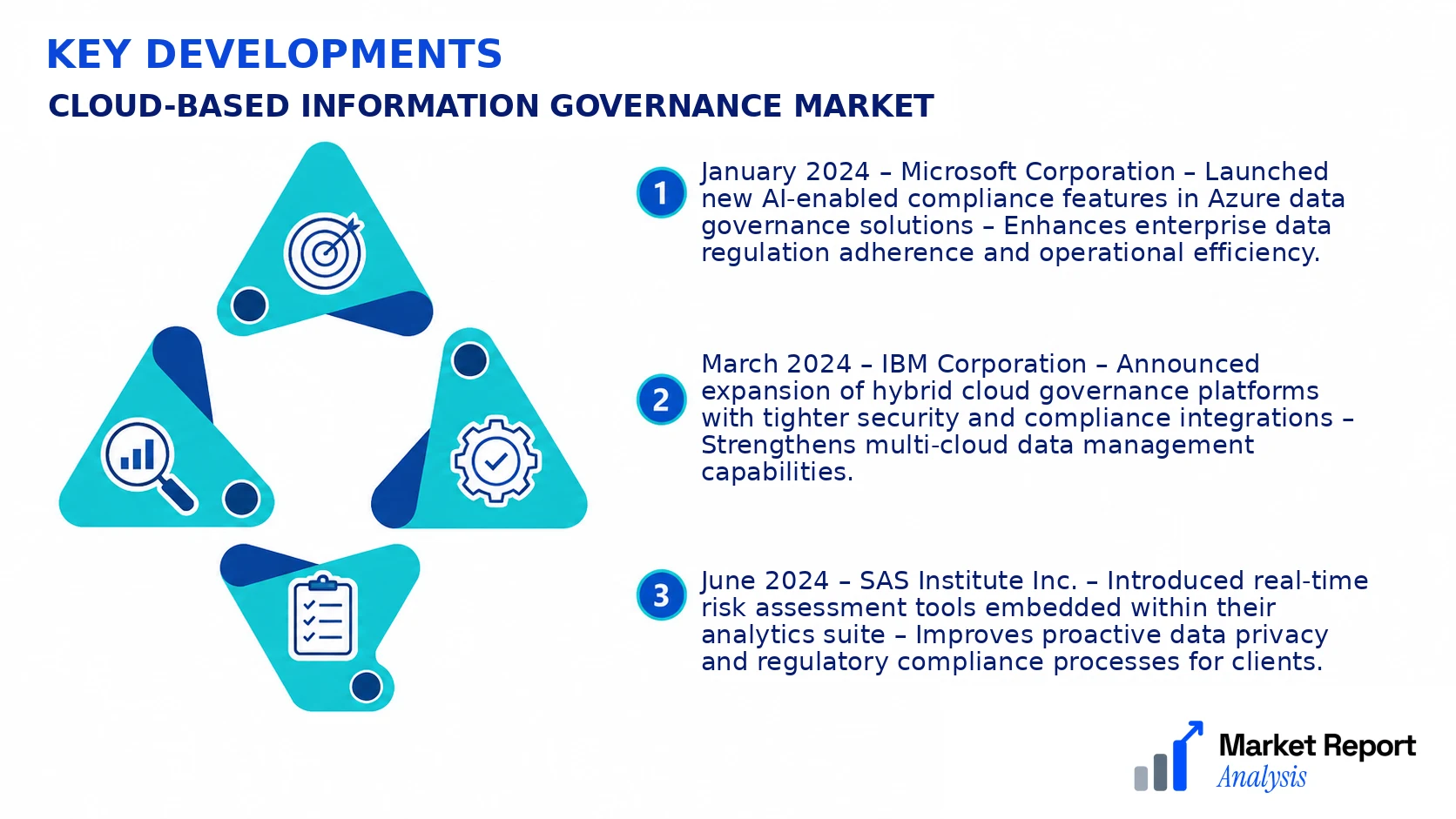
- January 2024 – Microsoft Corporation – Launched new AI-enabled compliance features in Azure data governance solutions – Enhances enterprise data regulation adherence and operational efficiency.
- March 2024 – IBM Corporation – Announced expansion of hybrid cloud governance platforms with tighter security and compliance integrations – Strengthens multi-cloud data management capabilities.
- June 2024 – SAS Institute Inc. – Introduced real-time risk assessment tools embedded within their analytics suite – Improves proactive data privacy and regulatory compliance processes for clients.
- August 2024 – OpenText Corporation – Acquired a cybersecurity firm to bolster its content security and enforcement offerings – Elevates its position as a leader in integrated data governance and security.
- September 2024 – Veeam Software AG – Launched a new cloud-native backup solution with enhanced automation and compliance features – Ensures higher data protection standards and regulatory adherence in cloud environments.
Frequently Asked Questions
What is the Cloud-based Information Governance Market?
The Cloud-based Information Governance Market refers to the global industry focused on delivering cloud-based solutions that enable organizations to manage, secure, and ensure compliance of their data across various cloud and on-premises environments. It involves software and services designed to streamline data governance, risk management, and regulatory compliance.
What is the current market size of Cloud-based Information Governance Market?
As of 2026, the market size of the Cloud-based Information Governance Market is valued at approximately USD 4.2 Billion, reflecting increased adoption of cloud solutions worldwide. This robust valuation underscores the growing need for efficient data governance infrastructure within enterprises.
What factors are driving the Cloud-based Information Governance Market?
Market growth is driven by rising regulatory requirements, escalating data volumes, the need for enhanced data security, and the shift towards digital transformation. Additionally, increasing cybersecurity threats and the proliferation of cloud services have accelerated demand for comprehensive data governance solutions.
Which region dominates the Cloud-based Information Governance Market?
North America dominates the market, supported by advanced IT infrastructure, high adoption rates of cloud technologies, and stringent data regulation policies. The United States, in particular, leads regional growth, followed by Europe and Asia-Pacific, which are rapidly expanding their market presence.
Which segment is expected to grow the fastest?
The small and medium-sized enterprise (SME) segment is anticipated to exhibit the fastest growth due to increasing awareness of data governance benefits and the affordability of scalable cloud solutions tailored to smaller organizations, fueling broader market expansion.
Who are the leading companies operating in the Cloud-based Information Governance Market?
Key players include Microsoft Corporation, IBM Corporation, OpenText Corporation, VMware, Inc., and Box Inc. These companies are investing heavily in innovation, partnerships, and acquisitions to enhance their market share and offer comprehensive cloud governance solutions to diverse industries.
Analyst Perspective
The long-term outlook for the Cloud-based Information Governance Market remains robust, driven by escalating data volumes, stringent regulatory requirements, and evolving technology landscapes. Market maturity suggests a shift towards more integrated, AI-powered governance solutions, opening new commercial opportunities in automating compliance and enhancing data security. Investment priorities should focus on scalable cloud architectures, advanced analytics, and situational awareness tools that meet diverse industry needs. Competitive intensity is expected to heighten as established tech giants and innovative startups vie for market share, emphasizing differentiated offerings and strategic partnerships. Regional growth potential is uneven; North America and Europe will continue to lead with mature infrastructure, while Asia-Pacific presents burgeoning opportunities due to expanding digital economies and regulatory reforms. Strategic positioning must emphasize agility, continuous innovation, and regional customization to capitalize on emerging trends and mitigate risks associated with regulatory divergence and technological obsolescence. Firms that prioritize long-term R&D and collaborative ecosystems will be better positioned for sustained growth.
